
Marketing and Sales Funnel for Banks That Converts
Brian's Banking Blog
Your pipeline review probably looks familiar. Marketing reports a healthy flow of campaign responses. Relationship managers say they're busy. The CRM shows names, activities, and meetings in motion. Yet funded relationships don't rise at the same pace. Deposit growth lags. Commercial loan wins come in sporadically. Fee opportunities stall in committee or disappear after an encouraging first call.
That usually isn't a lead generation problem alone. It's a funnel problem.
In banking, the marketing and sales funnel isn't a marketing diagram for junior staff. It's an operating system for revenue. It tells you where attention turns into inquiry, where inquiry turns into qualified opportunity, and where opportunity dies before account opening, credit approval, treasury setup, or onboarding. When executives can't see those transitions clearly, teams manage activity instead of outcomes.
Banks that treat the funnel as a measurable system make better decisions. They know whether to invest in awareness, tighten qualification, speed handoffs, or sharpen follow-up. They also know which data sources should inform each step, from website behavior and CRM events to HMDA patterns, deposit trends, and prospect intelligence.
Why Your Bank Funnel Feels Full but Closes Little
Monday's pipeline meeting starts with good news. A commercial lender met a growing business owner at a local event. The company looked promising. Payroll was healthy, expansion was visible, operating accounts were spread across institutions, and a credit need was easy to spot. The owner agreed to a follow-up. An email went out the next morning. By the end of the week, no second meeting was on the calendar. By month-end, the deal sat in the CRM as stalled.
Banks see this pattern every quarter.
The first diagnosis is often "we need more leads." In many cases, the problem sits lower in the funnel. Every funnel narrows. In banking, it narrows harder because each step asks the prospect for more commitment, more documentation, and more internal coordination. Generic B2B benchmarks often cite sales funnel conversion in the low single digits and landing page conversion in the low-to-mid single digits. Financial services funnels commonly face similar compression, often around 2% to 5%, because trust, timing, and approval friction reduce pull-through long before account opening or funding.
A full pipeline can still be weak. It works like a loan pipeline with too many applications that never make it through underwriting. Volume at entry does not guarantee production at exit.
Activity can mask leakage
Executives usually see three signals that create false confidence:
- Lead volume looks healthy. Website forms, branch conversations, event contacts, and referrals keep feeding the CRM.
- RM activity looks high. Calls are logged, emails are sent, and follow-ups appear to be in motion.
- Revenue lag arrives late. The shortfall shows up only after accounts fail to open, credits do not fund, or treasury services never attach.
That delay matters. A bank can spend an entire quarter celebrating top-of-funnel activity while losses happen in handoffs between marketing, business development, credit, treasury, and onboarding.
The problem is rarely one person. It is usually a workflow issue.
A commercial prospect may involve an owner, controller, operations lead, attorney, and outside CPA. One RM logs the meeting. A treasury officer joins later. Credit asks for updated financials. Documentation slows. Nobody owns the next step with the same urgency. The opportunity does not die in one dramatic moment. It loses speed at each transfer.
Practical rule: If your bank cannot identify the exact stage where qualified prospects stop advancing, your funnel is not under management.
The question executives should ask
A better question is not how many names entered the pipeline. It is where viable relationships lose momentum, and which bank data source should have exposed that slowdown sooner.
That framing changes the work. Instead of asking marketing for more campaign volume, leaders can ask sharper operating questions. Are event leads converting to booked meetings? Are booked meetings producing completed discovery? Are treasury conversations attaching before credit approval, or after? Are strong prospects disappearing because response times are slow, because qualification is weak, or because RMs are spending time on businesses that look attractive socially but not financially?
Those answers live in bank workflows and data, not in a generic funnel dashboard. CRM timestamps show follow-up speed. Core and treasury systems show product adoption after close. Pipeline stages reveal where deals age out. Market intelligence tools such as Visbanking help teams test whether a prospect that looks active in the field also shows the deposit trends, branch footprint, or lending profile that justify RM time.
Banks that close more business do not confuse motion with progress. They measure movement between stages, tie each stage to an owner, and treat stalled deals as operating signals instead of anecdotes.
What the Marketing and Sales Funnel Means for Banks
A commercial banker leaves a prospect meeting convinced the relationship is real. The company fits the market, likes the treasury pitch, and asks for next steps. Ninety days later, nothing is funded. Marketing counts the account as sourced. Sales counts it as stalled. Finance sees no revenue. The funnel exists to explain that gap.
In banking, a marketing and sales funnel is not a generic diagram borrowed from software companies. It is a staged operating model for how a business moves from market visibility to an onboarded, funded relationship. The point is not to force every buyer into a straight line. The point is to define what must happen before a prospect earns more RM time, pricing attention, credit review, and onboarding capacity.
The model is old. The bank application is practical.
The classic funnel idea came from early staged buyer models such as AIDA: attention, interest, desire, action. The labels matter less than the discipline behind them. Leaders needed a way to see where interest narrowed, where buyers hesitated, and where resources were being wasted.
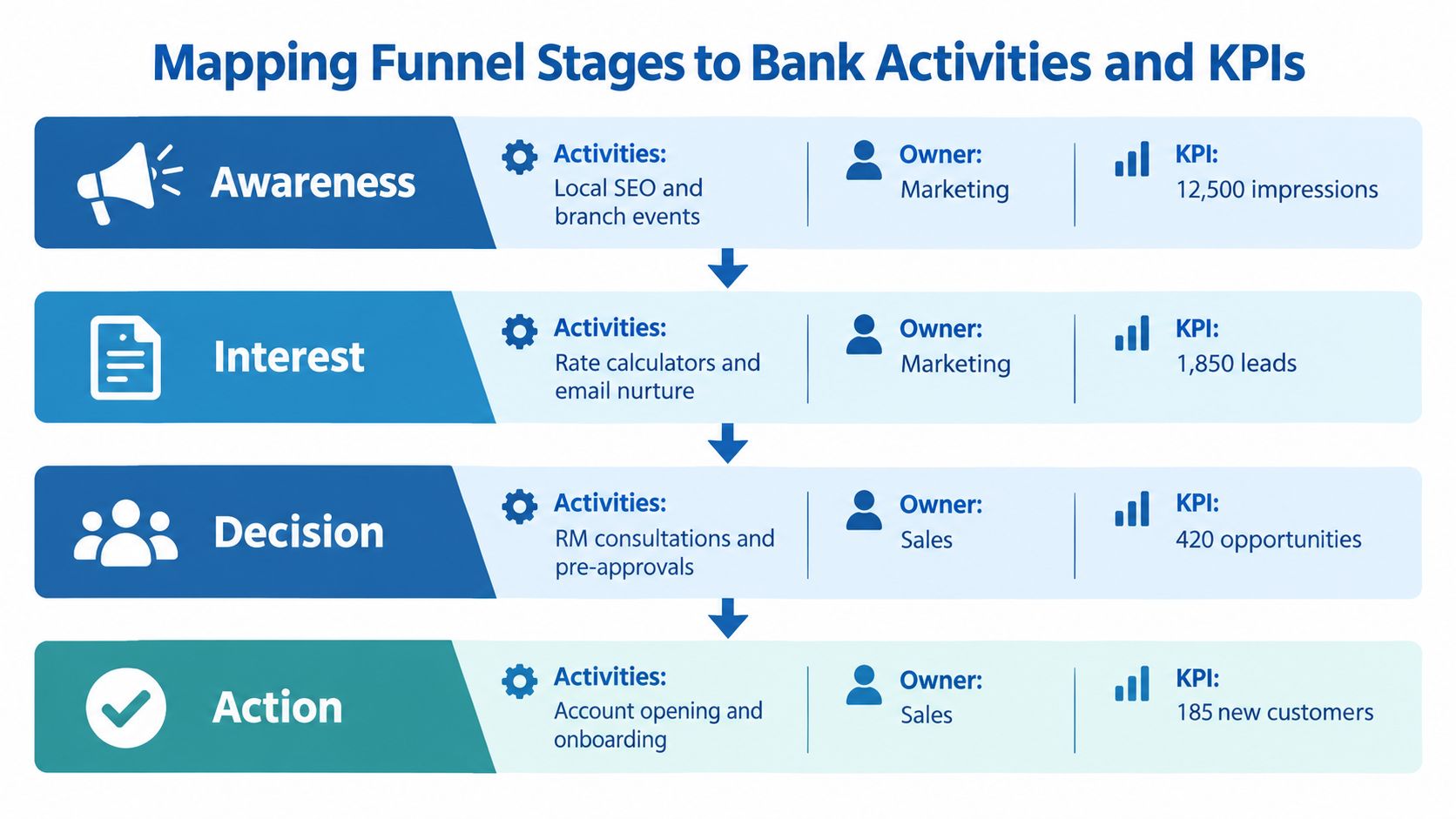
Banks still need that discipline, but the stages map to bank work rather than generic demand generation. Awareness may start with local search, branch visibility, community events, referral activity, or a treasury webinar. Interest shows up when a prospect visits product pages, responds to outreach, submits a form, or agrees to a first meeting. Sales engagement begins when an RM, lender, or treasury officer confirms fit and starts discovery. Conversion is not a signed proposal alone. In a bank, conversion usually means approved, funded, onboarded, and ready for product expansion.
That difference matters. A software company can call a contract closed. A bank still has account opening, documentation, credit conditions, implementation, and early relationship activation ahead.
The funnel works like credit screening
Bank executives already manage one process this way. Credit starts wide, narrows through policy screens, and advances only when each checkpoint is met. Funnel management applies the same discipline to revenue creation before the credit file is complete.
At the top, the bank asks, "Who in this market should know us?" In the middle, the question changes to, "Which businesses show enough fit to justify banker time?" Near the bottom, the question becomes more expensive and more specific. "Which opportunities should receive pricing exceptions, underwriting attention, treasury design work, and onboarding priority?"
That is why stage definitions matter. A prospect who downloaded a rate sheet is not the same as one who shared deposit balances, entity structure, and treasury pain points. Both may look active in a dashboard. Only one is ready for a serious sales workflow.
Why banks need stage discipline even when buyers move out of order
Commercial and retail buyers rarely progress neatly. A business owner may research treasury services for weeks without talking to anyone. A consumer may visit a branch first, then apply online later. A middle market company may go quiet until its current bank changes terms, closes a branch, or misses a service issue. The journey bends.
The funnel still helps because it gives the bank shared decision rules. A useful overview of that broader planning model appears in this discussion of a full funnel strategy from Wojo Media. For banks, the practical question is simpler: what evidence moves a prospect from one level of attention to the next?
Without that clarity, handoffs become subjective. Marketing reports lead volume. RMs question quality. Treasury enters too late. Credit gets pulled into weak opportunities. Executive reviews turn into opinions instead of operating analysis.
A bank specific definition executives can use
Use three plain definitions.
- Marketing funnel: The activities that create awareness and signal early interest before a banker owns the relationship.
- Sales funnel: The activities that qualify, advance, structure, approve, and close the opportunity.
- Bank funnel: The full path from first market signal to funded account, active product use, and relationship expansion.
For banks building more digital acquisition capacity, that model becomes more useful when campaign activity connects to banker workflows and account outcomes, not just clicks and impressions. Teams doing that work often use banking-specific guidance such as this overview of digital marketing for banks.
The funnel is a management system for deciding where banker time goes, where prospects stall, and which relationships are worth pursuing before costs rise.
Mapping Funnel Stages to Bank Activities and KPIs
A bank funnel becomes useful when each stage has an owner, a decision standard, and a measurable output. Without that, teams inherit leads informally, qualification changes by person, and executive reviews turn into anecdote.
Start with ownership, not software
In most banks, the early funnel belongs to marketing and market development. The middle belongs jointly to marketing and frontline sales. The lower funnel belongs to RMs, lenders, branch leaders, treasury officers, and onboarding teams.
What matters is consistency. If one commercial team treats a downloaded treasury guide as a lead and another treats it as noise, conversion reporting won't hold.
Bank Funnel Stages Mapped to Activities and KPIs
| Funnel Stage | Bank Activities and Owner | Primary KPIs |
|---|---|---|
| Awareness | Local SEO, branch events, referral programs, market education. Owner: Marketing | Reach, website visits, branded search, event engagement |
| Interest | Rate calculators, newsletters, product pages, gated content, inbound forms. Owner: Marketing | Lead volume, form completions, content engagement |
| Consideration | Discovery calls, product education, fit assessment, initial needs analysis. Owner: Marketing and Sales | Qualified meetings, lead acceptance, response time |
| Intent | RM consultation, document collection, pre-application review, treasury scoping. Owner: Sales | MQL-to-SQL conversion, appointment progression |
| Evaluation | Credit discussion, pricing, proposal review, competitor comparison, stakeholder alignment. Owner: Sales and Credit | SQL-to-opportunity conversion, proposal acceptance |
| Conversion | Account opening, loan application completion, approval, funding, service setup. Owner: Sales and Operations | Win rate, funded accounts, booked balances |
| Onboarding and Expansion | Treasury implementation, onboarding, cross-sell review, retention planning. Owner: Operations and Relationship Team | Product penetration, early attrition, expansion opportunities |
Where banks usually lose control
The largest drop often happens before a prospect becomes sales-ready. Financial services funnels often show end-to-end lead-to-customer conversion around 2% to 5%, while the MQL-to-SQL handoff can fall to 15% to 21%, according to this financial services funnel analysis. That's why banks with healthy inquiry volume can still feel starved for closable business.
A separate benchmark source for financial services reports a 29% lead-to-MQL rate, 38% MQL-to-SQL, 49% SQL-to-opportunity, and 53% SQL-to-close, in these funnel stage statistics. Read those figures directionally. They suggest that early-stage qualification is often weaker than late-stage closing discipline.
What good looks like by stage
A strong bank funnel usually shows a few visible traits:
- Clear acceptance rules: Sales can reject a lead, but only for explicit reasons such as geography, size, product fit, or timing.
- Documented handoffs: Marketing knows when a prospect moved from inquiry to active banker ownership.
- Stage-specific evidence: A prospect isn't "qualified" because someone had a pleasant call. Qualification requires signals tied to need, authority, timing, and fit.
- Operational completion: A close isn't just verbal commitment. In banking, the true conversion point may be funding, account activation, treasury implementation, or first recurring transaction.
A pipeline stage should reflect a real bank event, not optimism.
Executive takeaway
If your funnel report skips from "lead" to "opportunity," you're blind in the middle. That's where most banks lose time, margin, and credibility. The fix isn't more dashboard color. It's sharper stage design tied to actual bank workflows.
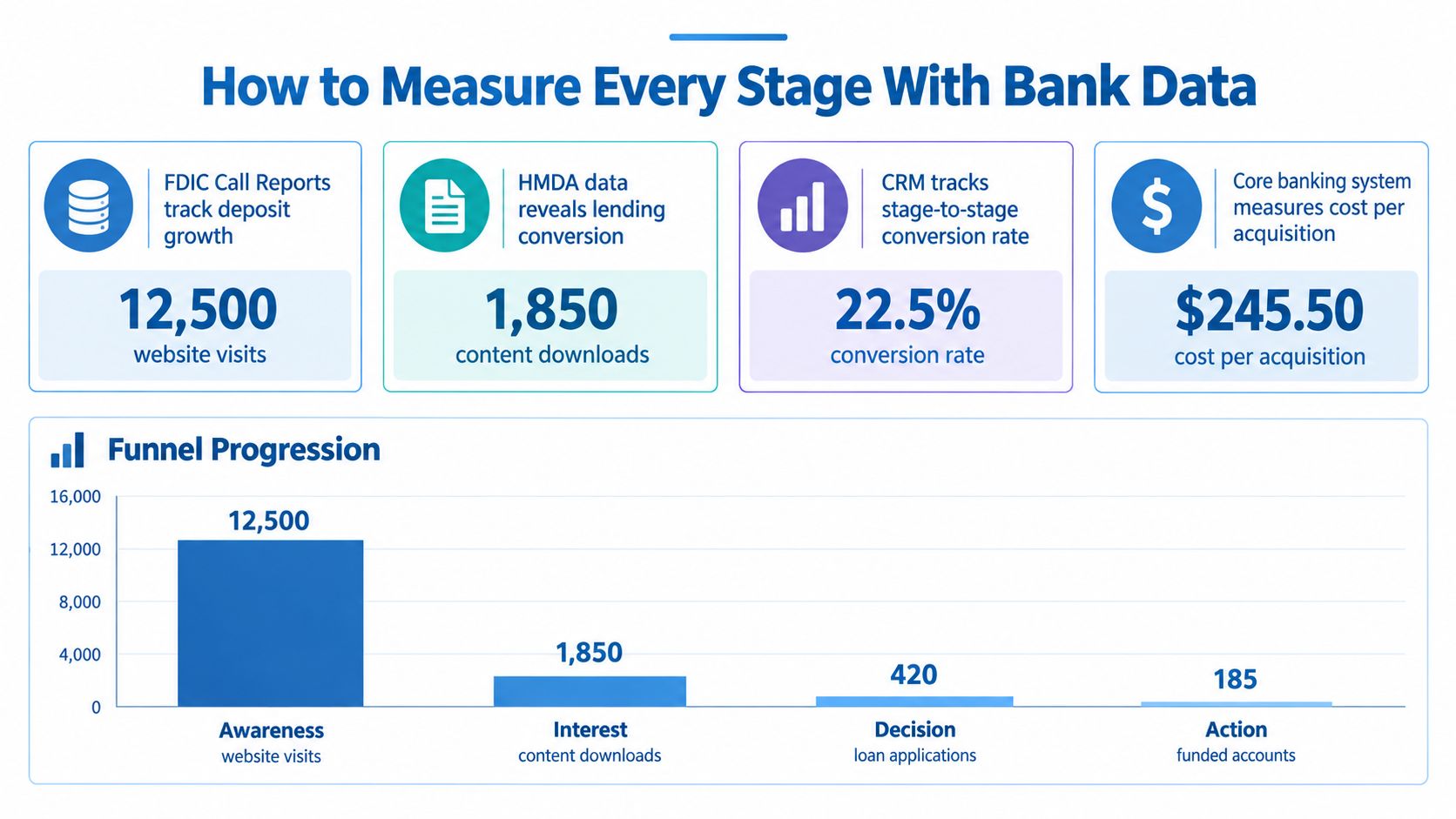
How to Measure Every Stage With Bank Data
Bank leaders already own more funnel data than most industries. The challenge isn't access. It's connecting the data to decisions before a prospect cools off.
Build the measurement spine
A practical bank measurement stack usually pulls from four places.
- Front-end demand signals: Website visits, form submissions, rate tool engagement, search traffic, event registrations.
- CRM workflow data: Lead source, stage progression, response timestamps, banker ownership, meeting outcomes.
- Banking and regulatory data: FDIC call reports, HMDA trends, UCC filing activity, and local market signals that sharpen targeting.
- Core and onboarding events: Account opened, loan booked, service implemented, relationship expanded.
Analytics becomes operational rather than descriptive. A bank can combine behavioral signals with institution and market context, then review funnel movement through a dedicated banking analytics layer such as analytics for banking.
Use benchmarks carefully
Benchmarks are useful only if they guide diagnosis. They shouldn't dictate strategy.
Recent benchmark coverage notes that visitor-to-lead conversion may sit around 1% to 3%, while MQL-to-SQL conversion can be around 13% to 21%, in these B2B sales performance benchmarks. Another benchmark compilation reports visitor-to-lead conversion as low as 0.7% for enterprise and 1.4% for SMB and mid-market, with overall lead-to-customer conversion around 2.7%, while other benchmark sets place healthy inbound lead-to-close rates at 1% to 3% and outbound at 0.5% to 1.5%, as outlined in this pipeline benchmark review.
Those ranges tell you something important. Average funnel math is noisy. Segment, channel, and offer structure matter.
A weekly executive review
A useful funnel review asks five questions:
- Where is volume entering? Separate referrals, digital inbound, branch-originated leads, and outbound prospecting.
- Where is leakage highest? Focus on the first major drop, not the most emotionally frustrating one.
- Is the issue quantity or quality? More names won't help if qualification is weak.
- How quickly does ownership occur? Delayed handoff often destroys signal value.
- What changed by segment? Commercial, SBA, mortgage, treasury, and wealth should not be merged into one average.
Banks should diagnose funnels the way they review credit quality. By segment, by exception, and with attention to early warning signals.
One more complication matters now. Buyers increasingly do their research in AI-assisted environments and off-channel conversations before they speak to a banker. That means the middle of the funnel is less visible than it used to be. Banks won't solve that by abandoning the funnel. They'll solve it by tightening signal capture, tracking qualification rigorously, and reviewing stage movement with more discipline than generic B2B teams.
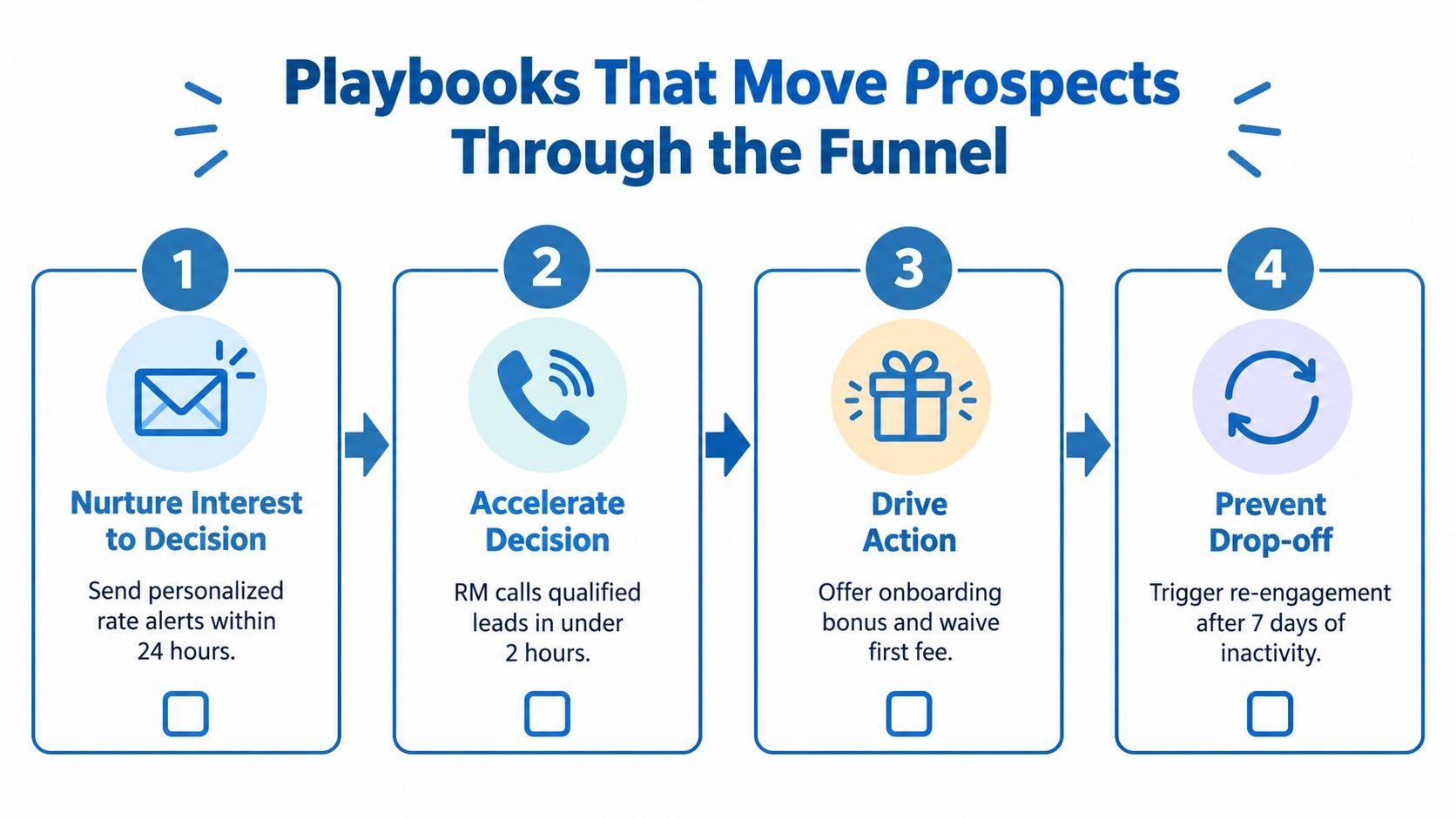
Playbooks That Move Prospects Through the Funnel
A bank can generate plenty of lead volume and still miss the quarter because stage movement is weak. The practical fix is a set of operating playbooks tied to owners, timing, and measurable next steps.
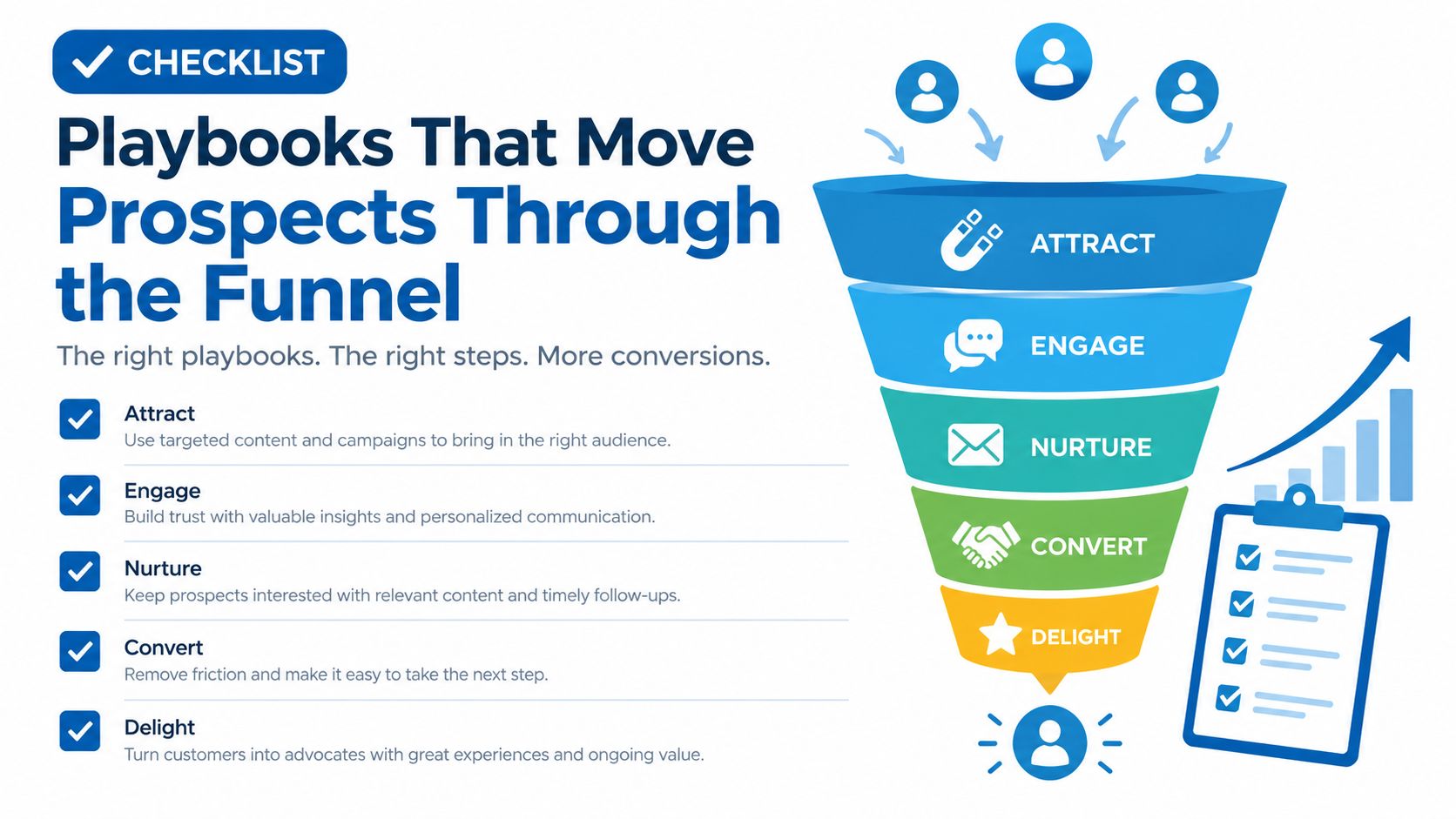
Start with speed to first contact
A prospect who fills out a treasury form or requests a lending call is sending a short-lived signal. Banks often treat that signal like a general inbox item. It should be handled more like a credit exception. Assigned fast, tracked closely, and reviewed if it sits.
Research summaries collected in these sales funnel timing statistics report that leads contacted within 5 minutes can convert 8 times more often than leads contacted later, and that response delays sharply reduce contact odds. For a bank executive, the takeaway is straightforward. If digital inquiries, branch referrals, and campaign responses are not routed to a named owner within minutes, the funnel is losing value before any banker starts a conversation.
A useful operating rule is simple: every qualified inbound lead gets an owner, a response window, and a logged outcome.
Three bank-ready plays
1. Set a response SLA by lead type.
Not every inquiry deserves identical treatment, but every inquiry needs a rule. A treasury management request from a business with meaningful balances should route differently from a student checking inquiry. Mortgage, SBA, commercial deposit, and wealth leads each need their own service level agreement, owner logic, and escalation path. This funnel conversion guidance is directionally useful on timing and scoring. In a bank, that scoring should come from fit data such as company size, branch footprint, existing relationship status, deposit mix, and product need.
2. Build middle-funnel nurture around banker workflows.
Many banks over-focus on the last stage because closings are visible and nurture activity is not. That is a mistake. The middle of the funnel works like a loan pipeline between application and approval. If no one advances the file, it stalls.
For banks, nurture should be structured and product-specific. A commercial prospect might receive an industry cash-flow checklist, a treasury onboarding timeline, a rate environment update, or a follow-up from the RM after a webinar or branch introduction. Analysts at HubSpot's lead nurturing benchmark summary report stronger sales-readiness and lower cost when firms nurture consistently. The bank version of that principle is disciplined touch patterns by segment, with each touch tied to a likely next conversation.
3. Make handoffs visible and auditable.
Marketing to RM. Branch to commercial banker. Treasury officer to lender. These are the points where banks lose momentum.
Each accepted lead should carry four fields at minimum: reason code, owner, next step, and target date. Each rejected lead should carry a disposition code the leadership team can use, such as wrong segment, duplicate relationship, weak credit profile, no current need, or unreachable contact. Visbanking intelligence can support this process by helping teams validate institution details, market context, and contact relevance before an RM spends time on the wrong account.
What executives should inspect each week
A playbook matters only if managers can see whether it is being followed.
- For MQL to SQL: verify market fit, product fit, contact validity, and a clear trigger for outreach.
- For SQL to opportunity: verify identified need, involved stakeholders, expected timing, and a scheduled next event such as discovery, application, or proposal review.
- For opportunity to close: verify pricing path, operational fit, document status, and onboarding readiness.
- For stalled records: verify age in stage, last touch date, and whether the next step belongs to marketing, an RM, treasury, credit, or operations.
This review should feel less like a generic sales meeting and more like a portfolio review. Which stage is aging. Which banker is converting. Which source is producing qualified meetings. Which segment needs a different follow-up sequence.
Banks that outsource parts of demand generation or appointment setting often want pay tied to outcomes, not activity counts. In that context, this overview of Capstacker performance based deals is useful because it shows how performance-linked structures can improve accountability.
Fast response protects intent. Structured nurture keeps consideration alive. Clean handoffs let management fix leaks while the prospect still remembers your bank.
How Visbanking Accelerates Conversion and Risk Aware Prospecting
A bank funnel improves when teams can see the institution, the market, and the contact in one workflow. That is where a unified banking data layer changes execution.
McKinsey highlights concrete analytics use cases in corporate and commercial banking such as wallet sizing, next-product-to-buy prediction, probability-to-churn, reference pricing, pricing leakage, target setting, RM effectiveness, and churn management in its corporate and commercial banking analytics framework. Those use cases map directly to funnel decisions. Who should an RM call first? Which account base deserves retention attention? Which prospect likely needs treasury, lending, and deposits together rather than a single product pitch?
What this looks like in practice
A banker covering middle-market companies doesn't just need more names. The banker needs ranked opportunities, relationship context, institution signals, and timing. A platform such as Visbanking's banking sales intelligence platform combines multi-sourced banking, regulatory, market, and people data into workflow-ready views that support that work.
That matters because the funnel in banking isn't only about conversion. It's also about risk-aware conversion.
Where the data changes decisions
Visbanking's operating model, based on the publisher information provided here, connects several modules to funnel execution:
- Bank Performance: Peer benchmarking and historical trend analysis across 4,600+ institutions.
- Prospect: Relationship, product, and decision-maker visibility to support business development.
- Talent: Access to a 2.6M+ professional graph for outreach and hiring workflows.
- Bank Intelligence: Predictive risk and performance alerts delivered through email, Slack, and CRM.
The value isn't the dashboard alone. It's the connection between data and action. A commercial team can prioritize prospects based on market movement, observed banking relationships, and likely product fit. A sales leader can compare conversion discipline across teams. A risk-aware growth team can spot churn indicators before balances leave.
Banks building inside sales or SDR coverage for the top and middle of the funnel may also compare internal hiring with external recruiting options. For that decision, this guide on the Best place to hire SDRs can be a practical reference point.
The best funnel data doesn't just explain last quarter. It changes who your team calls today.
Turn Your Funnel Into Funded Relationships
A bank's marketing and sales funnel shouldn't end as a reporting artifact. It should work as a management system for growth, capacity, and risk.
The core discipline is straightforward. Define stages around real bank events. Assign ownership at each handoff. Measure leakage with actual bank data. Then tighten the response, nurturing, and qualification plays that move prospects forward. Small improvements in those areas compound because banking cycles are long, trust-heavy, and expensive to mismanage.
For the next 30 days, most executive teams would benefit from a short checklist:
- Audit stage definitions: Make sure each stage reflects a real workflow event.
- Review handoff speed: Identify where intent decays before a banker engages.
- Segment the funnel: Separate commercial, retail, mortgage, treasury, and wealth.
- Inspect middle-funnel loss: That's usually where optimism hides under activity.
- Tie metrics to action: Every dashboard number should imply a managerial move.
The banks that convert better aren't always the banks with the largest lead flow. They're the ones that know which prospect matters now, who owns the next action, and what signal justifies intervention.
If your funnel feels busy but underproductive, the answer probably isn't more motion. It's better instrumentation and sharper decisions.
Visbanking gives banks and credit unions a way to benchmark performance, surface prospect and market intelligence, and act on funnel signals with more precision. If you want to compare your pipeline discipline against peers and identify where qualified opportunities are leaking, visit Visbanking to explore the data behind stronger banking growth decisions.
Latest Articles
Brian's Banking Blog
How to Manage Vendor Relationships in Banking
Brian's Banking Blog
ISO 20022 Migration Strategy for Bank Leaders
Brian's Banking Blog
Lead Tracking Software for Banks: An Executive Guide
Brian's Banking Blog
What Are Key Metrics for Banks? a Decision Guide
Brian's Banking Blog
Customer Feedback Surveys: A Playbook for Banks
Brian's Banking Blog