
Bank Business Development Playbook That Drives Growth
Brian's Banking Blog
From 2020 to 2025, funds intermediated by the global financial system expanded by $131 trillion, reaching $468 trillion in 2025. Deposits, loans, and assets under management also grew by 6.5% in 2025, following a 6.2% annual rate during 2020 through 2024, according to McKinsey's Global Banking Annual Review. That scale changes the executive question. Bank business development isn't mainly a contest to generate more leads. It's a discipline for identifying the right account, product, decision-maker, and moment, then orchestrating the workflow that turns that combination into a profitable relationship.
Why Bank Business Development Now Demands Precision
Bank executives face a large market, but market size alone doesn't create growth. Deposits compete across banks, fintech platforms, embedded-finance providers, and alternative channels. At the same time, leadership teams are managing tighter cost control and slower growth. Broad outreach consumes relationship-manager capacity without proving that the target has a current need, the right decision-maker is accessible, or the bank can serve the opportunity efficiently.
Modern bank business development should connect five activities:
- Market selection: Identify geographies, industries, and customer cohorts where the bank has a credible right to win.
- Prospect qualification: Match businesses to signals such as funding needs, deposit potential, ownership changes, expansion, and treasury complexity.
- Relationship orchestration: Coordinate lenders, treasury specialists, branch leaders, credit teams, and executives around one account plan.
- Product timing: Introduce lending, deposits, payments, wealth, and advisory services when the customer's operating reality supports the conversation.
- Performance measurement: Track movement from target account to meeting, diagnosis, proposal, approval, onboarding, and relationship expansion.
The historical evolution of U.S. banking helps explain why this work became more complex. The U.S. Senate's banking milestones identify the National Bank Act in 1864, the Federal Reserve Act in 1913, the Banking Act of 1935, the Riegle-Neal Interstate Banking and Branching Efficiency Act of 1994, and the Gramm-Leach-Bliley Act of 1999 as important points in the development of modern banking. Interstate expansion and broader financial holding-company capabilities moved banks from primarily local institutions toward multi-market providers competing on scale, product breadth, and relationship depth.
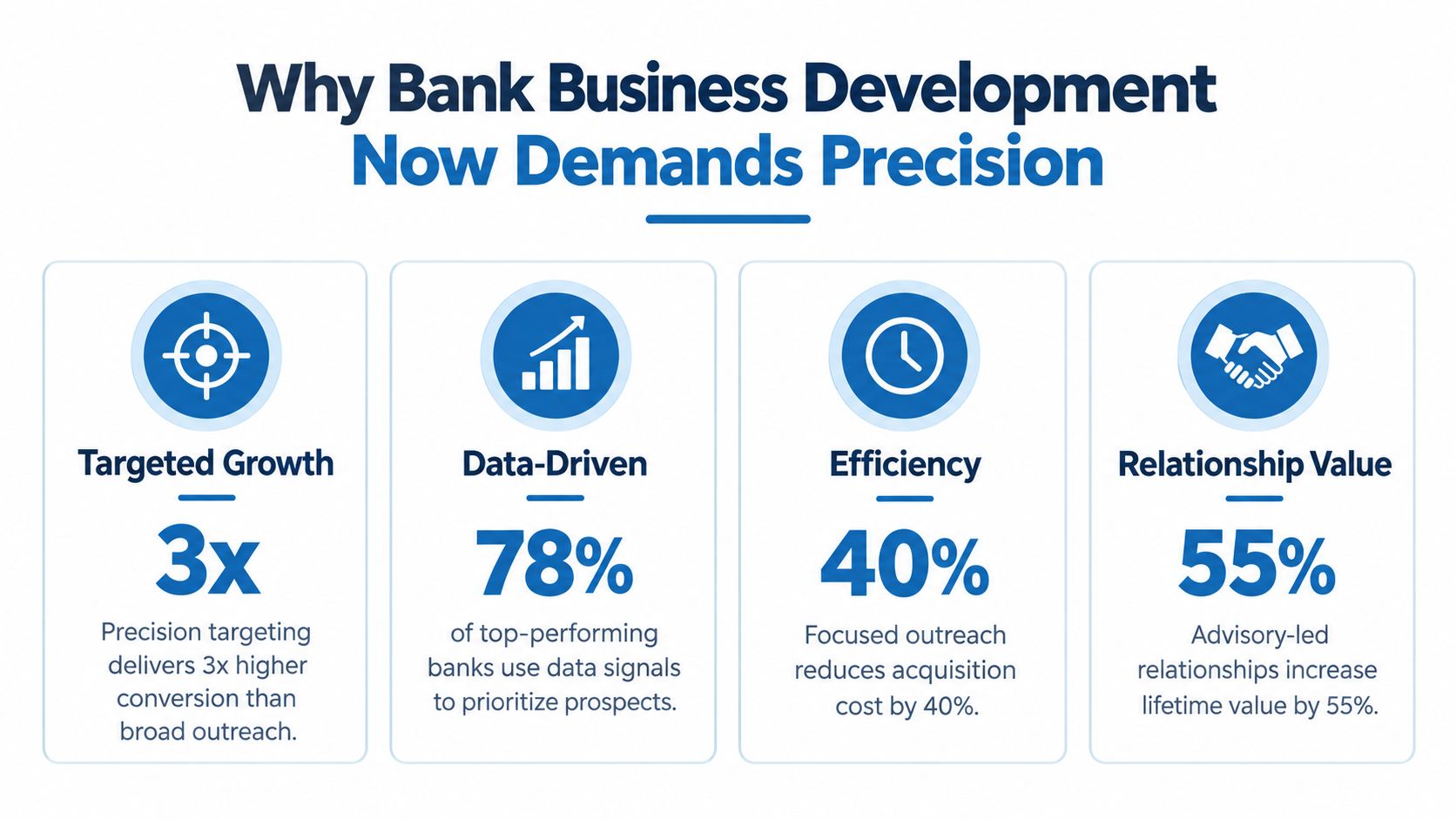
The operating model has changed
The winning operating model is no longer “assign a territory and ask for referrals.” It combines financial and regulatory data with market intelligence, professional information, CRM activity, and product performance. A relationship manager should see not just that a company exists, but why the account matters now, what the bank can credibly offer, and which stakeholder can authorize the next step.
Industry outlooks increasingly point toward digitized origination, transaction-based affordability, next-generation risk scoring, AI-supported relationship management, self-service onboarding, API connectivity, and role-based treasury access as growth levers, as discussed in KPMG's banking trends coverage. The practical implication is clear: intelligence must arrive inside the workflow. A dashboard that requires manual interpretation after the opportunity has cooled won't solve the business-development problem.
Executive takeaway: Replace lead-volume targets with prioritized opportunity queues. Measure whether teams pursue the right relationships, not merely whether they contact more names.
This playbook treats bank business development as a repeatable system. It links board objectives to segment economics, market signals to account selection, advisory conversations to implementation, and pipeline data to action. The result should be a CRM-ready operating rhythm that tells leaders where to deploy coverage and tells bankers what to do next.
Setting Objectives KPIs and Segmentation That Actually Guide Growth
Growth objectives fail when they remain broad statements such as “increase commercial deposits” or “expand small-business lending.” The board may approve that ambition, but relationship teams need a defined market, offer, owner, and stage-level measurement system.
Start with the economic outcome. Decide whether the priority is loan growth, core deposits, fee income, geographic coverage, portfolio diversification, or relationship profitability. Then define the customer behavior that supports it. A deposit objective may require operating-account acquisition among cash-generative businesses. A lending objective may require deeper referral coverage, faster packaging, or a sharper focus on a particular industry.
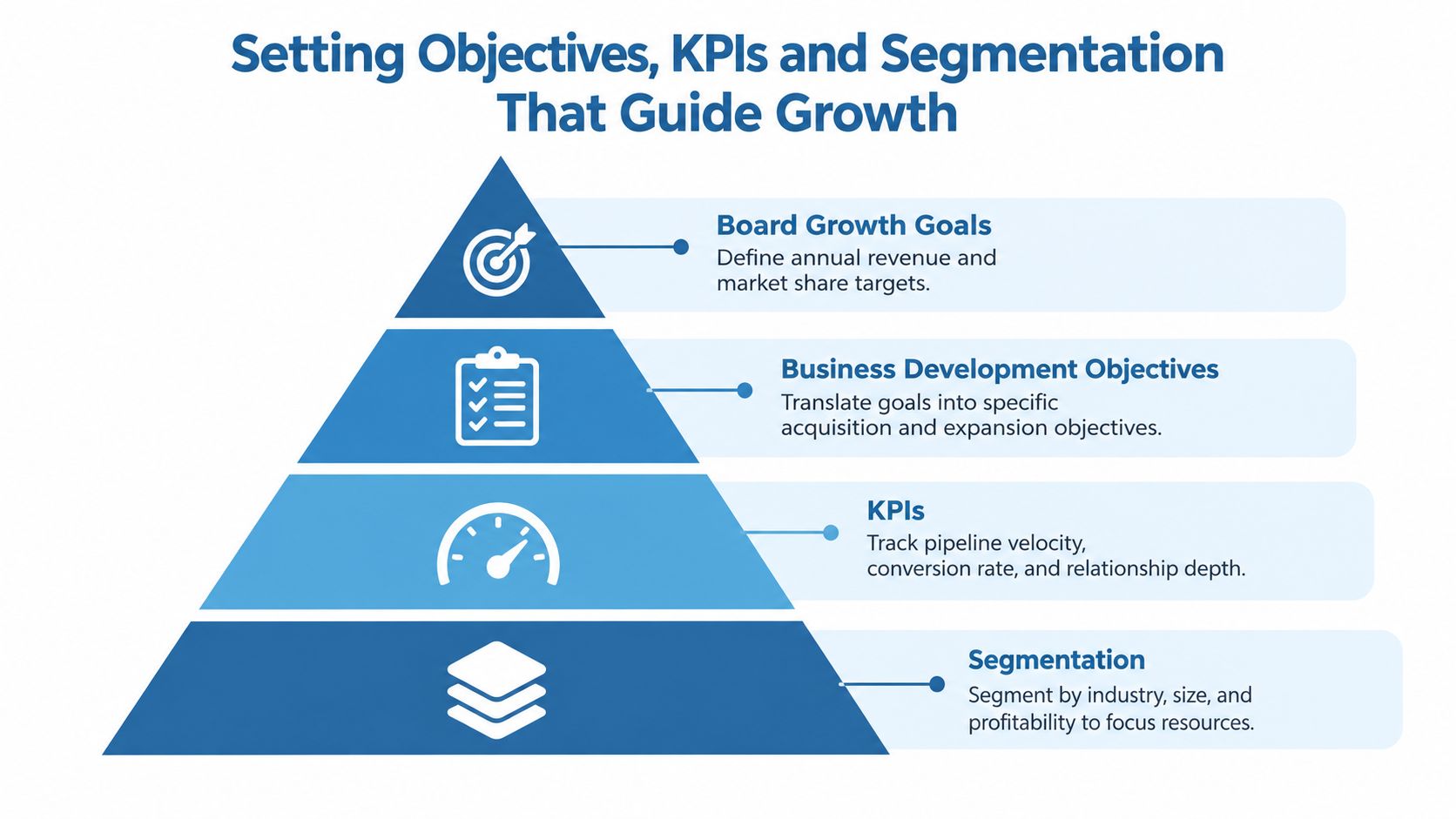
Convert goals into operating measures
A useful scorecard separates leading indicators from financial outcomes. Revenue and balances matter, but they arrive after multiple decisions have already been made. Management should also inspect:
- Coverage quality: Which priority accounts have an assigned owner, a verified decision-maker, and a current reason to engage?
- Pipeline progression: How many targets advance from research to contact, discovery, proposal, approval, onboarding, and expansion?
- Conversion integrity: Where do opportunities stall, and does the cause sit with fit, pricing, credit, documentation, or implementation?
- Relationship depth: Which accounts use one product, and which have a broader operating relationship involving deposits, payments, lending, or treasury?
- Capacity economics: How much banker time does each segment consume relative to its expected balance, fee, risk, and retention value?
Use a shared definition for every stage. Marketing, sales, credit, operations, and finance should agree on what qualifies as an active opportunity and what evidence moves it forward. Otherwise, one team reports a healthy pipeline while another sees incomplete applications and weak implementation readiness.
Segmentation should reflect economics and execution, not just industry codes. Combine industry, business size, geography, ownership, product usage, funding need, deposit behavior, and profitability. A segment is useful only when the bank can identify it, reach it, serve it, and measure its progression.
For a more detailed treatment of how customer attributes and behavior support practical prioritization, use bank customer segmentation as part of the planning process.
Set targets with evidence
Peer benchmarks help directors challenge unsupported assumptions. The Asian Development Bank's evaluation of SME support reports a 55% success rate for access-to-finance operations, finance-sector operations improving from 50% to 67% over time, and SME operations validating at 64% overall. It also reports 78% for business-environment work and 60% for women-in-business operations. These figures aren't sales quotas, but they show why leaders should distinguish segments and intervention types rather than applying one conversion expectation to every market.
Build a one-page KPI sheet with the objective, target segment, product hypothesis, accountable executive, stage definitions, review cadence, and exception triggers. If the sheet can't tell a manager which accounts deserve attention this week, it isn't a management tool.
Finding and Prioritizing Prospects With Market and Branch Signals
The best prospect list starts with market evidence, not a purchased database. Bank leaders should map where deposits are growing, where competitors are gaining share, which industries are expanding, and where the institution already has credibility. That map creates a practical starting point for coverage decisions.
The FDIC's 2026 Summary of Deposits survey covers branch-office deposits as of June 30, 2026. It applies to FDIC-insured institutions, including insured U.S. branches of foreign banks, while institutions with only a main office are exempt from filing and still appear in results through June Call Report totals. For executives, the value is strategic. Branch-level deposit data provides a market-share map for deciding where to add relationship coverage, expand treasury services, or defend core funding.
Consider a bank with three branches holding $525.9 million, $84.9 million, and $23.6 million in booked deposits, as described in the FDIC data context. The disparity doesn't automatically identify the best growth location. It does flag a question. The largest branch may support deeper commercial cross-sell, while the smallest may need a sharper local acquisition strategy, better pricing, or a different coverage model.
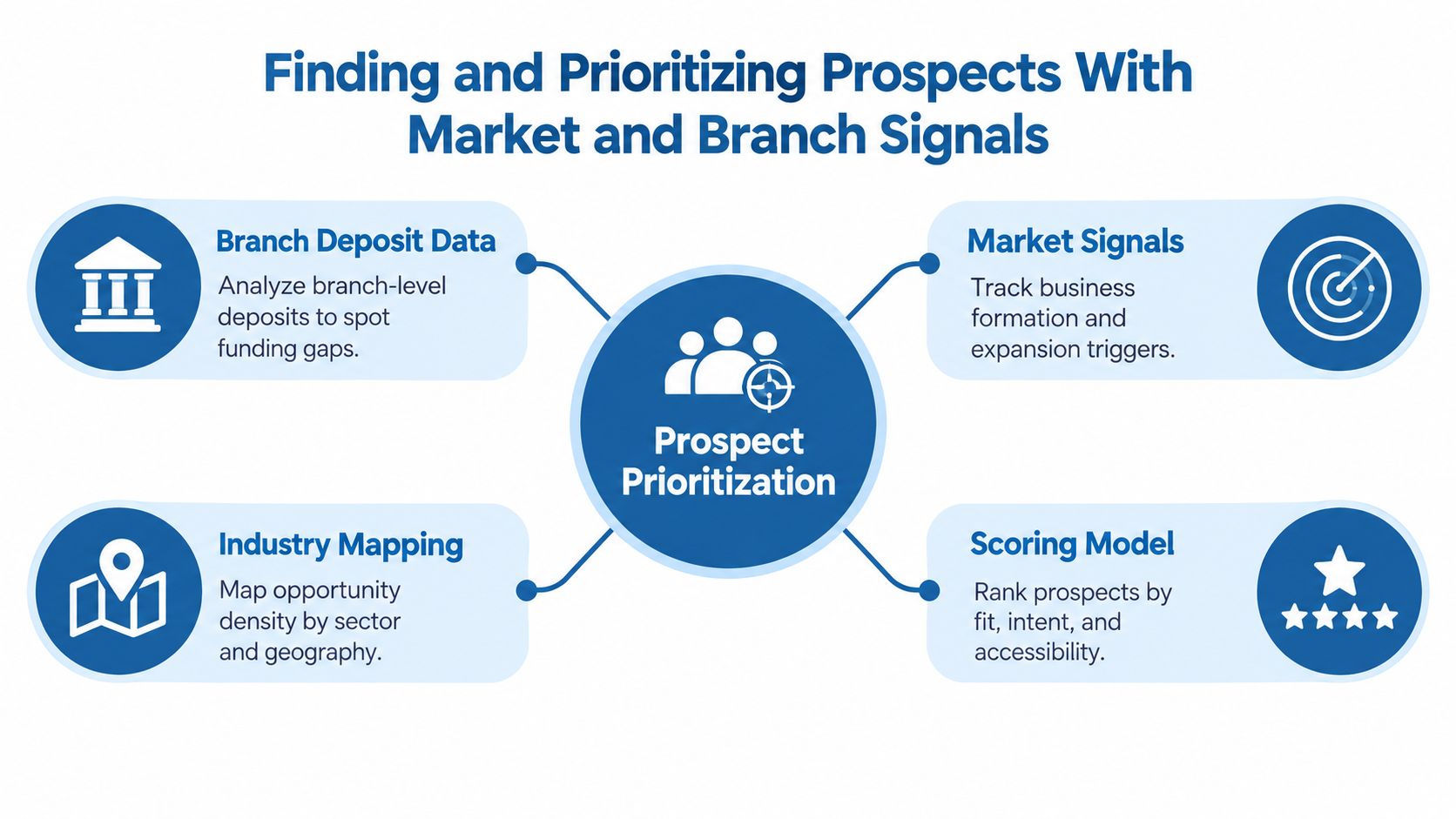
Build a priority score that bankers can use
A useful account score should combine three dimensions:
- Relationship potential: Estimate the opportunity across operating deposits, credit, payments, treasury, and other relevant services.
- Need and timing: Look for expansion, refinancing, liquidity pressure, ownership transition, facility investment, or changes in transaction activity.
- Access and execution fit: Confirm whether the bank can reach the decision-maker and deliver the required product without creating avoidable friction.
Don't hide the score inside an opaque model. Show the signals behind it. A commercial banker should understand why an account moved into the priority queue and what evidence would remove it.
The FDIC's Q1 2026 Quarterly Banking Profile coverage reports 3,763 FDIC-insured commercial banks and $24.962 trillion in insured deposits across 4,287 FDIC-insured institutions. It also notes that $1.7 trillion in foreign-office deposits aren't FDIC insured. That market scale makes institution-level averages insufficient. A regional bank with $10 billion in deposits that shifts 1.0% of balances from non-operating to operating accounts would move $100 million into more stable funding. The example shows why deposit composition, not just total deposits, belongs in prospect and portfolio prioritization.
Relationship teams can use BDRs when additional prospecting capacity is needed, but external coverage should follow the bank's scoring logic. More callers won't fix weak prioritization. The bank must give them clear account criteria, trigger definitions, decision-maker context, and a route for escalating qualified opportunities.
Use business banking prospect identification to support a workflow that combines branch performance, market overlays, peer gaps, and account-level intelligence. The output should be a ranked queue with CRM-ready alerts, not another static spreadsheet.
Outreach and Relationship Playbooks That Convert Faster
A product pitch begins with what the bank wants to sell. An advisory conversation begins with how the business operates. That distinction determines whether the prospect sees the banker as another vendor or as a useful financial partner.
World Bank Group evaluations provide a strong basis for the relationship-led model. Its SME technical-assistance evaluation found successful development outcomes in 84% of cases for SME technical assistance and business-development services. Projects with advisory services attached to investment commitments succeeded 76% of the time, compared with 55% without those services. For bank business development, the lesson is practical. Sequence diagnosis, solution design, and implementation support instead of treating approval or account opening as the finish line.

Use a defined relationship sequence
A commercial outreach sequence can follow this pattern:
- Prepare: Review the account's industry, ownership, operating footprint, existing bank relationships where available, likely product needs, and relevant market trigger.
- Open with relevance: Lead with an observation about the business or sector, not a generic capabilities statement.
- Diagnose: Ask how the company collects cash, pays suppliers, funds growth, manages liquidity, and makes financial decisions.
- Map stakeholders: Identify the owner, chief financial officer, controller, treasury contact, operations leader, and external advisers who influence the decision.
- Design the solution: Coordinate lending, deposits, payments, and treasury around the diagnosed problem.
- Remove implementation friction: Agree on documentation, integration, onboarding ownership, training, and timing before the proposal reaches final approval.
- Create the next milestone: Put a specific action, owner, and date into the CRM.
A bank pursuing a growing manufacturer, for example, shouldn't begin by pushing a term loan. The first discussion may reveal that collections are fragmented, payments require manual approval, and a planned facility investment will create a financing need later. Treasury and lending teams can then build a coordinated plan, while operations validates connectivity and onboarding requirements before the customer commits.
Make handoffs part of selling
Weak implementation and connectivity issues were identified by bankers as the two most frequent challenges in a 2024 relationship-management survey, according to the ADB evaluation source cited above. Treat those risks as part of business development, not back-office cleanup. Assign an implementation owner during discovery, document required integrations, and give the relationship manager visibility into every unresolved dependency.
Bankers who want a broader framework for structuring acquisition activity can consult the 100Signals lead generation guide, then adapt the principles to regulated financial-services workflows. The bank's standard should remain higher than contact volume. A qualified opportunity has a business reason, a decision path, a product hypothesis, and a credible implementation route.
Cross Sell and Product Strategy Anchored in Real Demand
Cross-sell works when the product follows the customer's operating need. It fails when bankers attach a generic bundle to every conversation.
Small-business lending illustrates why product design and sales motion must align. SBA lender resources state that the 7(a) program allows loans up to $5 million, with maturities of 10 years or less in the standard case. Financing or refinancing real estate, or equipment with a useful life exceeding 10 years, can extend to 25 years for real estate, as described in the SBA lender technical updates. Those structures create different customer profiles, underwriting requirements, duration considerations, and relationship opportunities.
A bank targeting a $2.5 million owner-occupied real-estate deal should use a different sales motion from one pursuing a $150,000 working-capital line. The first may require an owner, operating executive, commercial real-estate adviser, lender, and credit team. The second may be more responsive to a faster digital application, transaction-data assessment, and a focused working-capital conversation.
| Opportunity Type | Typical Size and Term | Recommended Sales Motion |
|---|---|---|
| Owner-occupied real estate | $2.5 million example, with real-estate financing potentially extending to 25 years under SBA 7(a) rules | Executive relationship coverage, property and cash-flow diagnosis, coordinated lending and treasury plan |
| Working-capital line | $150,000 example, generally suited to a shorter operating cycle | Fast qualification, transaction and affordability review, streamlined underwriting, payments cross-sell |
| SBA franchise opportunity | Program ceiling of $5 million, with standard maturities of 10 years or less unless qualifying real estate or equipment rules apply | Segment-specific packaging, referral partnerships, lender expertise, and follow-on deposit and treasury planning |
Use production data to challenge product assumptions
SBA's fiscal year 2025 lender reporting shows that 7(a) lenders approved more than 78,000 loans totaling $37.2 billion, with an average loan size of $447,571. Those benchmarks give executives a way to test the shape of their own franchise.
A bank that originated 120 SBA loans averaging $310,000 may be deliberately serving smaller credits, or it may be missing larger opportunities because referrals, packaging, or underwriting capacity are weak. The number doesn't answer the question by itself. It tells management where to investigate.
Cross-sell triggers should come from actual relationship behavior. Rising receivables may support a working-capital discussion. Growing payroll activity may signal treasury demand. A new facility, ownership change, or recurring payment complexity may justify a lending and payments conversation. Product teams should review these signals alongside portfolio performance, concentration, pricing, and onboarding effort before expanding an offer.
Measuring Iterating and Scaling With Intelligence Workflows
A bank business development program becomes durable when measurement changes behavior. Leaders should review not only booked balances and closed loans, but also the leading signals that determine whether future production is forming.
Track the pipeline by segment, product, decision-maker, stage, owner, and aging. Compare target-account coverage with meetings, qualified opportunities, proposals, approvals, funded relationships, activated services, and early relationship depth. A stalled stage needs an owner and an explanation. If a segment produces meetings but few complete applications, the problem may sit in qualification or documentation. If approvals don't become active relationships, implementation is the constraint.
Deposit intelligence deserves equal attention. Branch, call report, and market data can reveal where share is improving, where operating balances are weakening, and where a peer is gaining ground. Directors should ask which alerts trigger action, how quickly teams respond, and whether the bank records the outcome in the CRM.
A practical workflow has four parts:
- Unified data: Bring financial, regulatory, market, product, and people information into a consistent account and institution view.
- Explainable signals: Show the evidence behind a prospect score, deposit warning, product recommendation, or peer exception.
- Automated routing: Send relevant alerts through email, Slack, and CRM workflows to the person who can act.
- Closed-loop learning: Record whether the signal produced contact, a meeting, an opportunity, a win, a loss, or a false positive.
Leaders building this operating rhythm can use performance measurement systems for banks to structure peer benchmarking, trend analysis, and stage-level review. Visbanking's Bank Intelligence and Action System unifies multi-source financial, regulatory, market, and people data, with modules for bank performance, prospect intelligence, talent, and predictive alerts. Its Bank Performance application supports benchmarking across 4,600+ institutions, while the broader system is designed to move insights into email, Slack, and CRM workflows.
The operating principle is simple: don't ask relationship teams to interpret disconnected dashboards and then manually recreate the answer in spreadsheets. Give them ranked opportunities, visible evidence, clear next actions, and a way to report what happened. That turns bank business development from a periodic campaign into a measurable management system.
Visbanking helps banks connect peer benchmarks, branch and market signals, prospect intelligence, and workflow alerts so executives can act on growth opportunities with greater precision. Visit Visbanking to benchmark your institution and explore the Bank Intelligence and Action System.
Latest Articles
Brian's Banking Blog
How to Manage Vendor Relationships in Banking
Brian's Banking Blog
ISO 20022 Migration Strategy for Bank Leaders
Brian's Banking Blog
Lead Tracking Software for Banks: An Executive Guide
Brian's Banking Blog
What Are Key Metrics for Banks? a Decision Guide
Brian's Banking Blog
Customer Feedback Surveys: A Playbook for Banks
Brian's Banking Blog