
Lead Tracking Software for Banks: An Executive Guide
Brian's Banking Blog
Only 37% of 2,241 U.S. companies responded to a test lead within one hour, while 23% never responded. Among companies that did respond within 30 days, the average first-response time was 42 hours, according to a Harvard Business Review audit summarized by Machina. For banks, that isn't a minor service defect. A delayed response can mean a relationship manager loses the opportunity before the institution has even established ownership.
Lead tracking software should therefore be treated as a revenue-control system, not an upgraded contact list. It must show which prospects entered the funnel, who owns them, how quickly the bank acted, whether the prospect is commercially relevant, and what happens next. The strongest systems also connect those records to institutional, regulatory, and market data, so bankers prioritize accounts based on opportunity rather than activity volume.
Why Lead Tracking Software Is a Banking Priority
Digital inquiries have changed how banks manage potential business. A prospect may submit a website request, answer a campaign, register for an event, or appear through a market signal. Each source requires a clear owner and a defensible follow-up path. Without that record, leadership cannot tell whether an opportunity failed because the prospect lacked fit, the inquiry remained unassigned, or a relationship manager missed the next action.
Banking teams face a sharper operational consequence than many sales organizations. Relationship managers often handle fewer prospects with greater potential across lending, treasury, payments, and institutional services. A slow or poorly documented process can therefore waste high-value opportunities while leaving managers unable to distinguish weak demand from weak execution.
Executive implication: A pipeline without timestamps, ownership, and next-action discipline is an opinion about revenue, not a reliable view of revenue.
Leadership should evaluate lead tracking software against four questions:
- Can the bank identify every inbound source? Website forms, referrals, campaigns, market research, and relationship activity should create traceable records. A lead generation approach for banks should connect those signals to defined commercial objectives, rather than just increase the queue.
- Can managers see stalled ownership? The system should expose records that remain unassigned, untouched, or overdue, with escalation rules that match the bank's operating model.
- Can the bank distinguish fit from volume? Institutional and regulatory data, including UBPR and HMDA where appropriate, can help teams assess market relevance, lending conditions, and account potential before assigning scarce banker time.
- Can compliance reconstruct the decision? AI-assisted scores should preserve the inputs, recommendation, human override, and handoff history. Explainability and auditability matter as much as predictive usefulness when a bank prioritizes prospects.
These questions shift evaluation from contact storage to controlled revenue operations. The bank needs evidence that each signal received an appropriate owner, priority, action, and review path. Volume alone cannot provide that control.
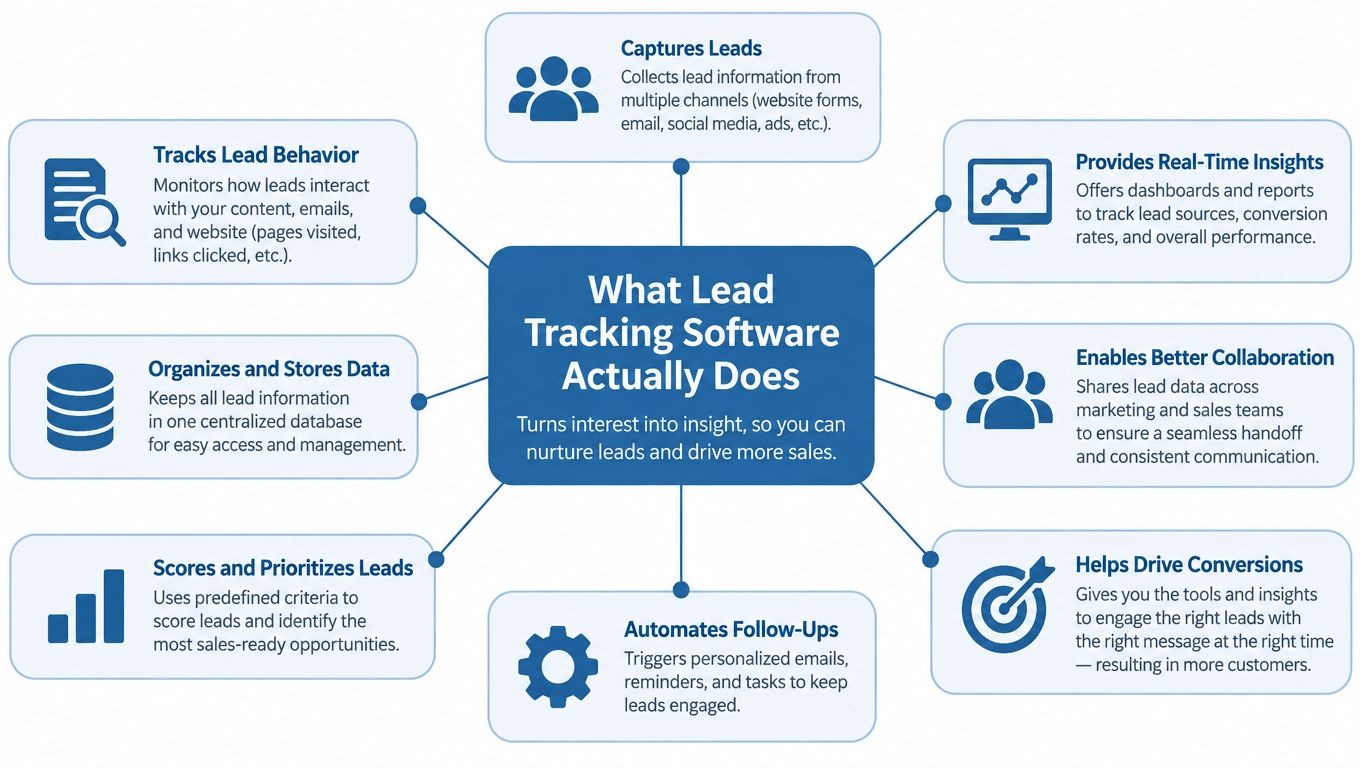
What Lead Tracking Software Actually Does
Think of lead tracking software as the trading desk of a bank's sales function. A trading system timestamps orders, records ownership, monitors status, and flags exceptions. A banking sales system should do the same for inquiries and prospects. It creates the event history that lets executives understand not only what entered the funnel, but how the bank handled it.
The minimum record should include:
- Lead origin, such as a website inquiry, referral, campaign, event, or external data signal.
- Assignment time, showing when a specific person or team accepted responsibility.
- First-touch time, separating ownership from actual outreach.
- Contact attempts, including calls, emails, meetings, and meaningful responses.
- Qualification status, with a clear reason for advancing, nurturing, suppressing, or closing the record.
- Next action, including an owner and an expected date.
Those fields turn vague pipeline commentary into process evidence. A manager can identify whether opportunities are disappearing because targeting is weak, routing is slow, ownership is unclear, contact attempts are inadequate, or bankers are recording activity without progressing the relationship.
The record matters more than the screen
A polished interface won't compensate for incomplete event data. Bank executives should ask vendors to demonstrate how the system handles duplicate prospects, reassignment, suppression, inactivity, and changes to qualification status. If the platform overwrites history instead of preserving it, leadership loses the ability to audit the funnel.
The response clock deserves particular attention. A foundational 2007 Lead Response Management study associated with MIT researchers analyzed more than 15,000 leads and over 100,000 dialing attempts across six companies. It found that the odds of successfully contacting a lead were approximately 100 times higher when a salesperson responded within five minutes rather than waiting 30 minutes (study summary). The study measured contact outcomes, not closed revenue, but it provides a strong rationale for timestamping, alerts, queue prioritization, and CRM synchronization.
The practical test is simple. Select a sample of recent inquiries and ask the system to show the source, assignment event, first touch, every attempt, qualification decision, and next action. If the answer requires manual spreadsheet reconstruction, the bank doesn't have operational control.
Core and Advanced Features Banks Should Demand
Banks shouldn't buy lead tracking software because it has the longest feature list. They should buy it because the system captures the right evidence, routes work reliably, and helps relationship managers act on commercially relevant signals without weakening governance.
Core capabilities
Lead capture and normalization should collect inquiries from digital forms, campaigns, referrals, and approved external sources. The system needs duplicate detection and consistent institution, contact, product, and source fields. Otherwise, the same prospect can appear as multiple opportunities and distort both workload and reporting.
Workflow automation should assign ownership, create tasks, apply service-level rules, and escalate inactivity. Automation earns its place when it initiates an accountable action, not when it generates another notification that nobody owns.
Scoring and enrichment should combine stated interest with verified context. In banking, that may include institution profile, product fit, relationship status, market activity, and relevant performance signals. A score without visible evidence is difficult for a banker to trust and difficult for compliance to review.
Audit trails and permissions are mandatory. The platform should preserve changes to ownership, qualification, score, suppression, and next action. Role-based access should limit sensitive data while allowing managers and control functions to inspect the decision history.
Advanced capabilities
The differentiating layer connects CRM activity to regulatory and institutional intelligence. HMDA can provide mortgage-market context. FFIEC and UBPR data can support peer comparisons. Relationship mapping can show where an institution already banks and which decision-makers require attention. These inputs help a manager decide whether a lead represents a credible account opportunity or merely an available contact record.
| Capability | Generic CRM | Bank-Intelligent Platform |
|---|---|---|
| Lead capture | Stores forms, contacts, and campaign responses | Connects capture to institution, market, and relationship context |
| Scoring | Often based on activity or firmographic fields | Shows the data inputs, refresh timing, and reason for prioritization |
| Routing | Assigns by territory, queue, or round robin | Routes by ownership, product fit, relationship status, and account potential |
| Reporting | Counts activities, stages, and pipeline value | Separates response latency, quality, qualification, progression, and conversion |
| Governance | May retain notes and basic field history | Preserves provenance, model versions, overrides, permissions, and suppression rules |
| Alerts | Email or in-app reminders | Action-based alerts through CRM, email, or collaboration tools |
A bank should prefer a less aggressive but explainable score over a black-box recommendation that sales leadership can't challenge. More sophistication isn't automatically better. The correct trade-off is measurable commercial usefulness with a record that a banker, auditor, and compliance officer can understand.
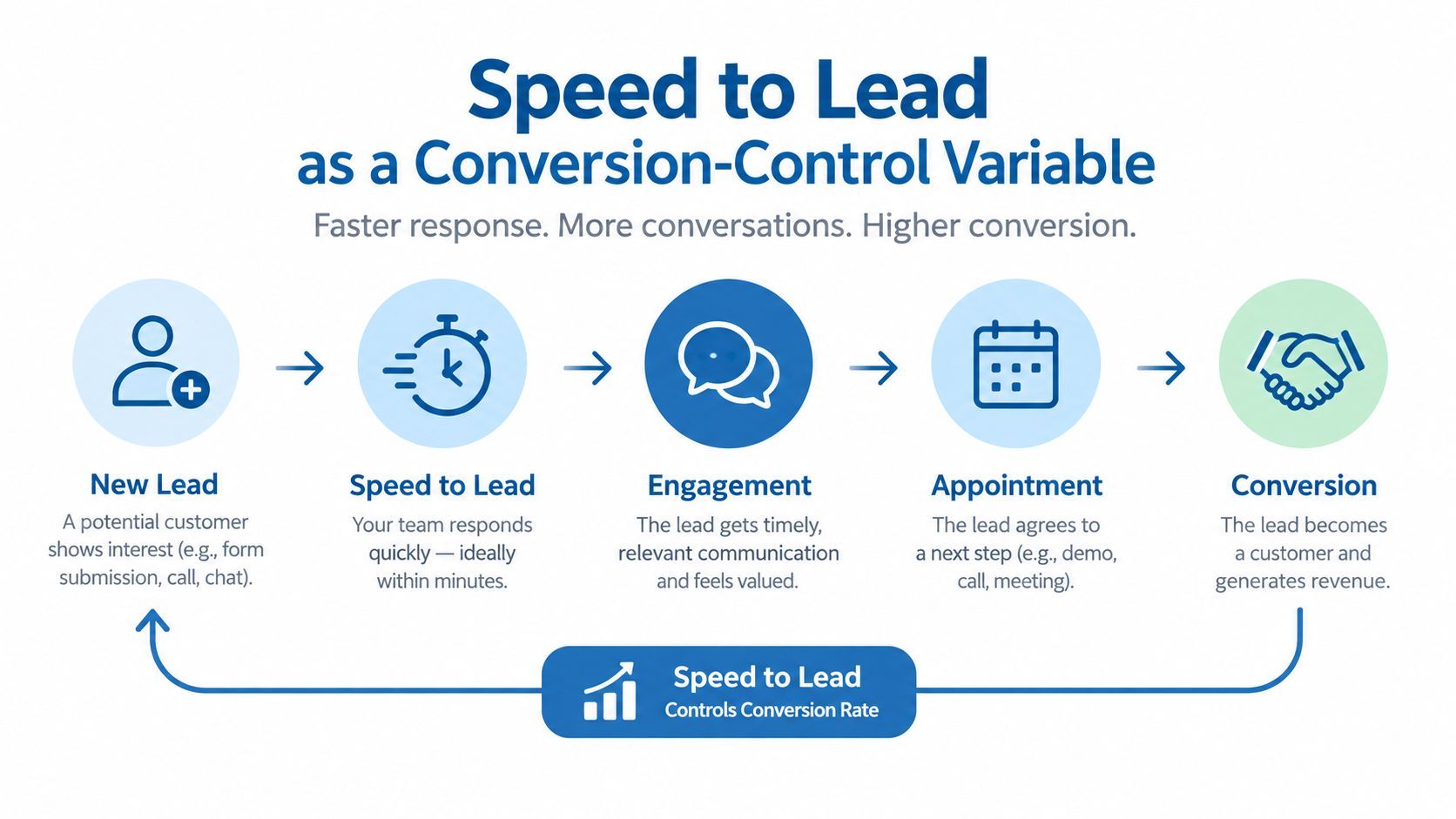
Speed to Lead as a Conversion-Control Variable
Response latency is not just a productivity metric. It is a conversion-control variable because the time between inquiry and first contact affects the likelihood that a prospect becomes qualified.
A Harvard Business Review study of 2,241 companies found that organizations attempting contact within one hour of an online inquiry were nearly seven times more likely to qualify the lead than organizations waiting another hour. Leads left for 24 hours or more were about 60 times less likely to qualify (response-time analysis). These findings describe contact and qualification outcomes, not closed revenue, so executives shouldn't treat them as a universal revenue guarantee. They do establish a clear operating principle: the bank should measure and control elapsed time.
Build an event-driven response process
The workflow should begin when the inquiry arrives:
- Capture the inquiry timestamp and preserve the original source.
- Assign an owner immediately, using explicit routing rules.
- Calculate elapsed time continuously, including business-hour status where appropriate.
- Trigger reassignment after five minutes if no owner has accepted responsibility.
- Notify a manager after fifteen minutes if the lead remains untouched.
- Record the first touch and subsequent attempts separately.
- Measure qualification and meeting creation, not just response activity.
These thresholds are operating examples, not conversion guarantees. A bank may adjust them by product, channel, coverage model, and business-hour policy, but it shouldn't leave the rule undefined.
The dashboard should show whether a weak result comes from poor demand or poor execution. If high-fit prospects receive timely contact but rarely qualify, targeting or offer design may be wrong. If qualification improves when response is fast but the average lead waits through a routing bottleneck, the priority is operational redesign. A bank's sales conversion rate becomes more useful when leadership can see which part of the process controls it.
Prioritizing Lead Quality Over Lead Volume
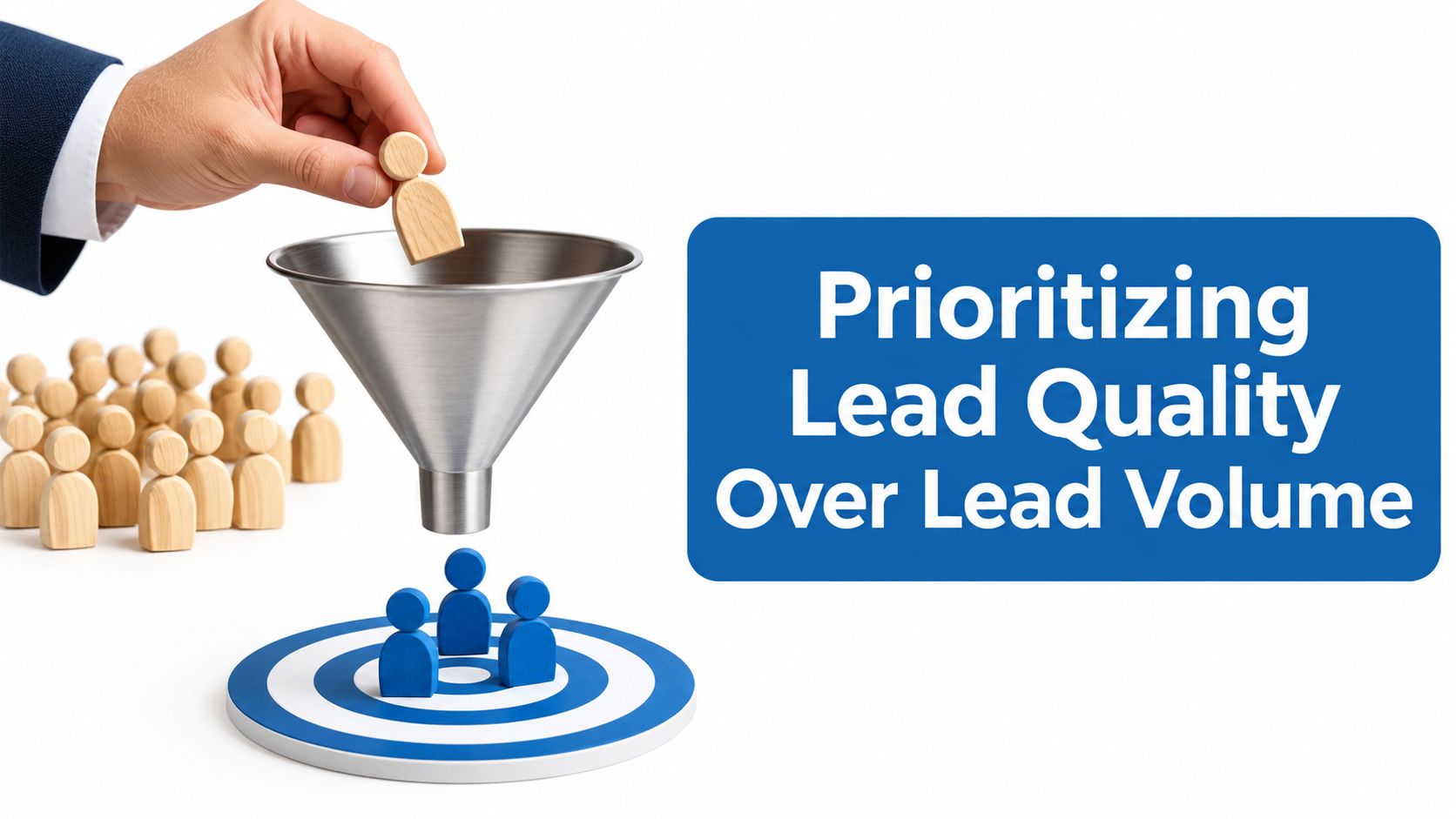
More leads can make a bank's sales performance worse. Stale records, duplicates, unowned prospects, and contacts with no realistic product fit consume relationship-manager capacity while making the pipeline appear active. The correct executive question isn't “How many leads did marketing deliver?” It is “Which accounts deserve banker time, and what evidence supports that decision?”
A banking-specific quality framework should combine five dimensions:
- Account potential: Size, products, strategic relevance, and relationship expansion potential.
- Current provider: Where the institution or prospect currently banks, including any known relationship gap.
- Lending or treasury triggers: Market activity, balance-sheet pressure, funding needs, payment requirements, or other relevant signals.
- Ownership status: Existing relationship manager, coverage team, open opportunity, or no assigned owner.
- Next-best action: A specific outreach objective, not a generic instruction to “follow up.”
Use peer data to sharpen the signal
The FFIEC's Uniform Bank Performance Report combines an institution's own data, comparable peer-group data, and percentile rankings. Its peer-group averages are trimmed by removing observations above the 95th percentile and below the 5th percentile, and the report gives an example trimmed peer-group Return on Assets of 1.16% (FFIEC UBPR documentation).
That matters because a prospect should be assessed against an appropriate comparison set, not an undifferentiated market average. Suppose a target institution's profitability is below the relevant peer reference. The relationship manager can frame outreach around performance improvement, efficiency, funding, or product gaps. The data doesn't replace judgment. It gives the conversation a defensible starting point.
Connect external signals to frontline action
The valuable output isn't another benchmark report. It is a prioritized account list with current context, relationship ownership, and a recommended action. A platform such as Visbanking can connect market activity, institution profiles, performance history, and relationship ownership so executives can decide which accounts merit attention first.
The measurement standard should also change. A scoring model that increases logged activities but doesn't improve qualified opportunities, meetings, progression, or conversion is creating administrative motion. Lead quality must be validated against frontline outcomes, not accepted because the score looks impressive.
Explainability and Auditability in AI-Assisted Scoring
The central governance question is straightforward: Can a relationship manager explain why this prospect was prioritized? The answer should identify the supporting data, its refresh time, the model or rule version, the banker who reviewed the recommendation, and any override that changed the outcome.
That discipline matters because banks combine sensitive information with regulated sales and lending processes. Predictive scoring can help a team focus, but an unexplained recommendation can create operational, compliance, and reputational exposure. A transparent model with slightly less aggressive prioritization is often more valuable than a black box that nobody can challenge.
Establish an evidence chain
A bank's AI-assisted lead workflow should preserve:
- Source-level provenance: The system records where each input originated.
- Data freshness: Scores display when supporting information was collected or refreshed.
- Model history: The bank retains the model or rule version used for each recommendation.
- Role-based access: Users see only the information appropriate to their responsibilities.
- Immutable activity history: Ownership, contact, qualification, and suppression changes remain visible.
- Override reasons: Bankers explain why they accepted, rejected, or changed a recommendation.
- Suppression rules: The workflow prevents outreach where policy, consent, relationship status, or other controls require it.
- Outcome testing: The bank periodically tests whether scores improve qualified opportunities without producing unacceptable bias or false positives.
A useful dashboard should connect the recommendation to action and outcome. It should show score timestamp, first response, qualification, meeting creation, opportunity progression, and conversion by relevant segment. That allows leaders to distinguish a data-quality issue from a routing failure and a model problem from weak execution.
A McKinsey survey found that 53% of banking respondents identified a shortage of high-quality leads as their largest prospecting barrier, while excessive administrative work and difficult meeting preparation also ranked among leading challenges (survey context). The answer isn't to automate every decision. It is to reduce low-value research while giving bankers evidence they can inspect.
For teams adding professional-network signals, guidance on señales de LinkedIn para ventas can help structure those inputs without treating engagement as proof of commercial intent. The bank still needs consent controls, provenance, and human review.
A practical explainable AI approach in banking should leave a clear answer to four questions: what the system saw, what it inferred, what the banker did, and what happened afterward.
KPIs and Dashboards That Measure Success
A bank's dashboard should measure speed, quality, progression, and outcomes. Counting calls or logged emails alone rewards activity, even when the activity doesn't move an opportunity forward.
The minimum executive scorecard should include:
- Response latency: Median and percentile first-response times by representative, territory, source, and business-hour status.
- Ownership performance: Time to assignment, reassignment frequency, and unworked-lead volume.
- Qualification: Qualification rate by source, segment, product interest, score band, and relationship status.
- Meeting creation: Meetings created after first touch, including relevant segment and product context.
- Opportunity progression: Movement from qualified lead to active opportunity and subsequent stages.
- Conversion: Conversion by source, owner, territory, and institutional quality segment.
- Data health: Duplicate rate, stale-record volume, missing ownership, and incomplete next actions.
Read the dashboard diagnostically
Consider two hypothetical territories. Territory A responds quickly, but high-fit institutional prospects rarely qualify. Territory B receives similar prospects, but routing creates a 45-minute bottleneck before assignment. The first problem points toward targeting, product fit, or scoring. The second points toward ownership rules and workflow design. The same low conversion figure can therefore require completely different management action.
A dashboard should also separate business-hour and non-business-hour response. A bank that reports only an overall average can hide a service failure in a specific channel or coverage period. Percentiles reveal whether a small group of extreme delays is distorting the team's experience.
Add market context
The 2024 HMDA dataset contains loan-level information from approximately 4,898 mortgage-reporting institutions, creating a foundation for segmenting opportunities by loan activity and comparing a bank's mortgage pipeline with broader market demand (Consumer Financial Protection Bureau announcement). A sales dashboard can use that context to distinguish a mortgage prospect with relevant market activity from one that merely matches a contact profile.
The same principle applies to external research tools used for hedge funds and analysts. Data is useful only when the bank connects it to a defined decision, a responsible owner, and a measurable result.
Rollout Checklist and Evaluation Criteria for Bank Sales Teams
A bank shouldn't begin with a large technology deployment. It should begin with a controlled operating model and a small set of measurable failure points.
Phase one establishes data discipline
Define the lead object, required fields, ownership rules, source taxonomy, qualification reasons, suppression logic, and next-action standards. Establish which data can enter the workflow, who may view it, and how long the bank retains the activity history. Don't automate a process that leadership hasn't agreed to run.
Phase two makes response accountable
Configure immediate assignment, escalation thresholds, duplicate handling, and CRM synchronization. Alerts should reach the channel where the owner works, whether that's the CRM, email, or an approved collaboration tool. Managers need an exception queue for unassigned, untouched, overdue, and repeatedly reassigned records.
Phase three tests quality and governance
Run the scoring model in a controlled setting before allowing it to drive priority. Require source provenance, score timestamps, model-version records, override reasons, and periodic outcome testing. Compare the model's recommendations with qualified opportunities, meetings, progression, and conversion. If it increases activity without improving commercial outcomes, change the model or stop using it.
Vendor evaluation should focus on evidence rather than demonstrations:
- Data integration: Can the platform connect CRM records to approved regulatory, market, institution, and relationship data?
- Peer segmentation: Can the bank compare prospects with relevant cohorts rather than a market-wide average?
- Explainability: Can a banker inspect the inputs and reason behind a recommendation?
- Auditability: Does the system preserve changes, approvals, overrides, and timestamps?
- Workflow execution: Can it assign, escalate, suppress, and synchronize without manual reconciliation?
- Measurement: Can leaders isolate response delays from weak lead quality?
- Adoption: Can relationship managers use the workflow without creating a second administrative system?
The FFIEC provides peer-group reports for banks with assets between $300 million and $1 billion, demonstrating why benchmark analysis should be organized around institution size rather than applied as one market-wide average (FFIEC peer-group report). A $450 million community bank shouldn't be scored against a multibillion-dollar institution with a different balance sheet, product mix, and operating model.
Visbanking connects bank intelligence, institutional performance, market activity, relationship context, and prospect workflows so sales leaders can benchmark accounts and route better-qualified opportunities into CRM processes. Visit Visbanking to explore the data and determine where response speed, lead quality, and account prioritization are limiting your bank's growth.
Latest Articles

Brian's Banking Blog
ISO 20022 Migration Strategy for Bank Leaders
Brian's Banking Blog
What Are Key Metrics for Banks? a Decision Guide
Brian's Banking Blog
Customer Feedback Surveys: A Playbook for Banks
Brian's Banking Blog
How to Create a Dashboard That Banks Actually Use

Brian's Banking Blog
What Is Consultative Selling Approach and Why Banks Need It
Brian's Banking Blog