
A Data-Driven Approach to Digital Marketing for Banks
Brian's Banking Blog
Digital marketing for banks is not about online advertising. It is the strategic use of digital channels to acquire new customers, grow deposits, and originate loans—profitably and in full compliance.
This requires a fundamental shift from broad-stroke advertising to a data-first framework where every dollar is measured against tangible results, such as a lower Customer Acquisition Cost (CAC) or a higher Customer Lifetime Value (LTV). For bank leadership, this is not a marketing initiative; it is the primary engine for measurable growth.
The New Competitive Arena in Banking
The competitive landscape has fundamentally changed. For bank executives and directors, digital marketing is no longer a matter of keeping up with trends; it is a matter of survival and market dominance. Your customers conduct their financial lives online, and a precise digital strategy is the only path to sustainable growth. Inaction is a direct concession of market share to more agile competitors.
This reality demands a new mindset. Digital marketing should be viewed not as a line-item expense, but as a direct investment in the bank's core revenue streams. The winners in this new era are not determined by the number of brick-and-mortar branches, but by their ability to reach the right customer, at the right time, with a compelling offer.
The Tangible Cost of Digital Inaction
Consider a $2 billion community bank experiencing an 8% year-over-year decline in new checking account openings. Simultaneously, a peer institution in an adjacent county is growing its deposit base by 12%.
The differentiator is not their product suite; it is their go-to-market strategy. The competitor has secured top local search engine rankings, making them the first result when a business owner searches for "commercial loans." They execute targeted social media campaigns reaching young families exhibiting behaviors consistent with first-time homebuyers.
This is not a hypothetical scenario; it is the predictable outcome of disciplined digital execution. The cost of inaction is a measurable erosion of your customer base and a direct transfer of revenue to competitors. Every day you delay implementing a robust digital plan, you are funding their growth.
The critical question for bank leadership is no longer if you should invest in digital marketing, but how to deploy capital with enough precision to guarantee a clear return. The answer lies in actionable data intelligence.
Platforms like Visbanking provide the competitive intelligence necessary to formulate a winning strategy. Instead of relying on assumptions, you can analyze a competitor’s loan origination patterns or identify underserved census tracts within your own footprint. This data-driven approach removes guesswork, allowing you to allocate resources for maximum impact and hold your teams accountable for measurable results.
For a deeper examination of this framework, review our guide on building a successful bank digital strategy.
The institutions that will thrive are those that benchmark their performance, monitor competitor activity, and execute bold strategies based on hard data. We will now outline how to construct that framework.
Building Your Data-Driven Marketing Framework
Allocating marketing funds across various channels without a clear performance metric is not a strategy; it is a gamble. For banks and credit unions, effective digital marketing is defined by precision, not activity. It is imperative to move beyond generic campaigns and implement a system where every marketing dollar is tied to measurable business outcomes.
The core of this approach is a shift from intuition-based decisions to data-driven execution. This begins with establishing clear, measurable goals that directly impact the balance sheet. An objective like "increase our online presence" is insufficient. A powerful goal is: "Reduce the cost per acquisition (CPA) for new checking accounts by 15% within six months." That is a goal that resonates with the board.
Pinpointing Your Highest-Value Opportunities
Imagine a $5 billion community bank. Spreading its marketing budget evenly across its entire footprint is an inefficient allocation of capital. A data-driven framework enables surgical precision. By analyzing market data, the bank can uncover specific, high-value customer segments that are currently being overlooked.
This is where data intelligence platforms provide a decisive advantage. Using a tool like Visbanking, the executive team can analyze demographic, competitive, and loan origination data to pinpoint specific geographic areas with a high concentration of young families likely to require mortgages. This analysis might reveal two zip codes where competitors have a weak digital footprint but residential growth is accelerating. You can see how this works in our deep dive on bank customer segmentation.
This level of granular insight transforms the entire marketing operation. The budget is no longer spread thin but concentrated on high-ROI channels—such as localized SEO and hyper-targeted digital ads—aimed squarely at those two high-potential zip codes.
This diagram illustrates how a focused digital marketing effort directly supports the bank's core growth pillars.
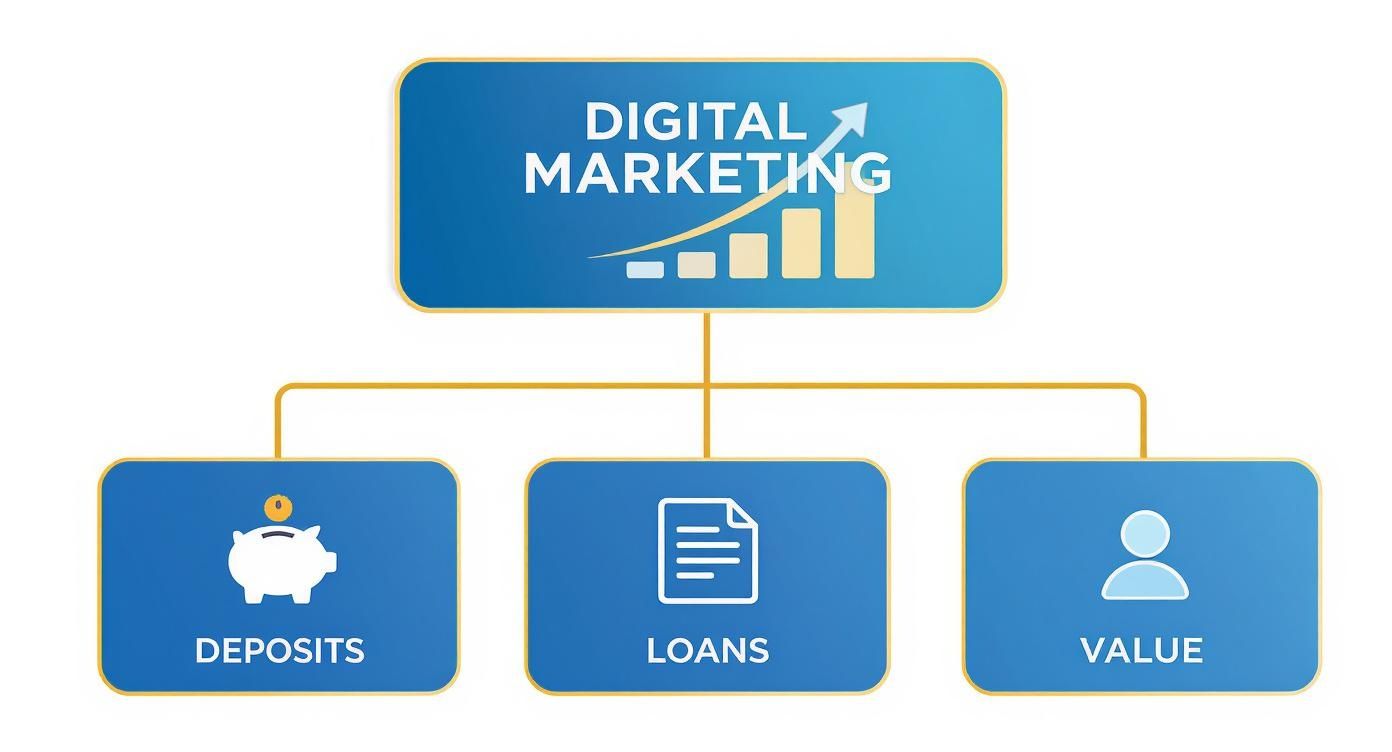
The message is clear: digital marketing is not a siloed function. It is a primary engine for driving the financial metrics that matter most to leadership.
From Data to Actionable Strategy
Once high-value segments are identified, the next step is to allocate resources for maximum impact. This framework ensures your team focuses on channels that deliver results for specific products.
For Mortgage Origination: A data-backed approach prioritizes investment in hyper-local SEO for terms like "home loans in [target city]" and paid search campaigns targeting in-market homebuyers. This is far more effective than generic brand awareness advertising.
For Small Business Deposits: The focus shifts to content marketing that addresses the real-world challenges of local entrepreneurs and targeted LinkedIn advertising to position the bank as a strategic partner, not merely a service provider.
A data-driven framework eliminates ambiguity from marketing. It compels your team to justify every campaign with quantitative results and connects their daily activities directly to the bank's strategic objectives: growing deposits, originating loans, and increasing profitability.
Ultimately, this framework creates accountability and provides executives with the necessary oversight. It empowers you to ask critical questions, such as, "What was our return on ad spend for the last mortgage campaign?" or "How did our local SEO investment impact commercial loan applications?" With the right data, your team can finally provide concrete answers.
Scalable growth is achieved not through more marketing, but through smarter marketing. To begin, benchmark your institution’s performance against its peers and explore the market data available to you.
Mastering Channels for Customer Acquisition
A solid framework is your blueprint, but disciplined execution through the right digital channels is where strategy becomes revenue. For bank executives, the goal is not a ubiquitous presence. It is making calculated investments in the channels that attract your most valuable customers, whether that is a local business seeking a commercial loan or a high-net-worth family requiring wealth management services.
Success is not simply having an online presence; it is achieving digital dominance in your priority markets. You must win the critical moments when a potential customer searches for a financial product you offer. To effectively grow your customer base, a practical understanding of proven customer acquisition strategies is essential.
Search Engine Optimization: The Foundation for Local Dominance
When a business owner in Dallas requires financing, their first action is typically a Google search for "small business loan in Dallas." Search Engine Optimization (SEO) is the discipline of ensuring your institution appears at the top of those results.
For a bank, SEO is not an abstract marketing task; it is the digital equivalent of securing the premier location in a high-traffic commercial district.
By optimizing your website and local business listings, you capture individuals actively seeking your services. This is not speculative advertising; it is a direct response to declared intent. A strong SEO strategy generates a consistent, organic flow of qualified traffic to your website and branches at a fraction of the cost of paid advertising.
Paid Search: Precision Targeting for Immediate Impact
While SEO builds long-term authority, Paid Search (PPC) delivers immediate, high-intent leads for your most competitive products, such as mortgages and wealth management. With PPC, you purchase top placement in search results for specific, high-value keywords, generating leads from day one.
This channel provides exceptional control, allowing you to target specific zip codes, demographics, and even income brackets.
The competition for these clicks is intense because the return on investment is significant. Ad spend in the banking sector is projected to increase by 20%, with financial service keywords often costing $4.00 or more per click. With conversion rates averaging 5.1%, the financial model is sound, particularly for high-value services. As highlighted in recent industry analysis, this spending demonstrates the value financial institutions place on these digital customers. You can review more of these financial services marketing statistics on Invoca.com.
Consider a financial model for a wealth management campaign:
- Cost Per Click (CPC): $4.00
- Conversion Rate (Lead): 5%
- Cost Per Lead (CPL): $80.00 ($4.00 / 0.05)
- Lead-to-Client Rate: 10%
- Customer Acquisition Cost (CAC): $800.00 ($80.00 / 0.10)
If a new wealth management client generates $5,000 in first-year revenue, an $800.00 acquisition cost represents an excellent return. This is the level of financial modeling your marketing team must master.
Data intelligence transforms paid search from an expense into a calculated investment. It allows you to model ROI with precision and confidently allocate budget to campaigns proven to drive bottom-line growth.
Content Marketing: Building Authority and Trust
High-value customers do not select a bank based on a flashy advertisement; they choose a partner they trust. Content marketing is the mechanism for building that trust long before they require a product. It involves creating and distributing genuinely useful articles, guides, and analyses that position your bank as an authority.
For example, a bank seeking to grow its commercial lending portfolio could publish a guide titled, "The Business Owner's Playbook for Securing an SBA Loan in [Your State]." This content solves a real problem, attracts business owners via search engines, and immediately establishes your bankers as credible experts.
Content is a long-term strategy that nurtures relationships and generates highly qualified inbound leads. It transforms your website from a digital brochure into an indispensable resource, ensuring that when prospects are ready to make a decision, your institution is their first call.
Using AI and Data for Precision Marketing
Broadcasting generic marketing offers is an inefficient relic of a past era. The future of profitable growth in banking lies in shifting from mass-market communication to precision engagement, powered by artificial intelligence and your existing data assets.
This is not about adopting technology for its own sake. It is about leveraging your customer data to anticipate needs, identify risks, and deliver the right offer to the right person at the right time.
For banking leaders, the directive is clear. AI is no longer optional. Over half of consumers already use GenAI tools, and a majority indicate they would switch banks if their current institution falls behind technologically. When banks execute personalization effectively, customers become advocates, generating 1.7 times faster revenue growth. You can dive deeper into the impact of AI on global banking with this report from McKinsey & Company.

With this approach, your digital marketing function transforms from a cost center into a strategic revenue engine. Every decision is guided by predictive analytics, not retrospective data.
From Reactive to Predictive Offers
Consider the strategic advantage of predicting which customers will require a loan before they begin their search. This is the power of AI in action. By analyzing transactional data, AI models can identify subtle patterns that signal an impending major life event.
Take a long-term customer. AI can detect minor behavioral shifts that a human analyst would miss:
- A sudden increase in spending at home improvement retailers.
- A series of large deposits consistent with accumulating a down payment.
- A new, recurring payment to a local childcare provider.
These are not random transactions; they are clear indicators. This customer is an ideal candidate for a Home Equity Line of Credit (HELOC) or a new mortgage. Instead of waiting for a competitor to acquire them, your system flags the opportunity. You can then proactively deliver a timely, personalized, pre-qualified offer that provides genuine value.
This is no longer marketing in the traditional sense. It is the delivery of a timely financial solution. You stop selling products and start solving problems your customers are just beginning to identify.
This level of precision provides a significant competitive advantage, building loyalty and increasing share of wallet in a way that generic campaigns cannot.
A Case Study in Data-Driven Growth
Consider a real-world example. A regional bank with $7.5 billion in assets faced stagnant growth. Their cross-sell ratio had flatlined at a meager 1.4 products per household. Their marketing strategy consisted of quarterly campaigns promoting the same auto loan special to their entire customer base.
The bank implemented an AI-driven marketing engine to analyze its internal data for untapped opportunities. The system quickly identified a cohort of 3,500 customers exhibiting two key behaviors: their payroll deposits had recently increased by over 15%, and they were regularly transferring funds to external brokerage accounts. This group was identified as having high potential for wealth management services.
The bank launched a surgical digital campaign targeted exclusively at this segment. The messaging focused not on low rates, but on investment diversification and retirement planning. The results were compelling:
- The campaign achieved a 22% engagement rate, a dramatic improvement over their historical 2% average.
- Within six months, they acquired 210 new wealth management clients from this single cohort.
- The bank's overall cross-sell ratio increased by 25% in the first year alone.
This success was not accidental. It was the direct result of using data to understand customer behavior and acting on those insights with precision.
Fueling Your AI with Market Intelligence
Internal data is a valuable asset, but it represents only part of the picture. To optimize your strategy, you must combine internal insights with a comprehensive view of the market. This is where a platform like Visbanking becomes indispensable.
Your AI model can identify who in your customer base may need a mortgage. Visbanking’s data can tell you where the greatest opportunities exist in your market. By analyzing competitor loan data and local market trends, you can direct your AI-powered campaigns toward specific neighborhoods where competitors are underperforming or where demand is projected to increase.
Fusing internal data with external market intelligence ensures that every dollar of your marketing budget is deployed for maximum return. The next step is to put this into practice. Benchmark your current performance, analyze the market data, and begin building a more intelligent, profitable marketing operation.
Turning Your Mobile App Into a Profit Center
For a significant and growing segment of your customer base, your mobile app is the bank. It is no longer merely a portal for checking balances; it is the primary touchpoint for their financial lives. Treating your app as a simple transactional tool is a strategic error that transforms a potential profit driver into a cost center.
A seamless, intuitive mobile experience is directly correlated with customer retention and lifetime value. This is particularly true for younger, high-growth demographics who demand a superior digital experience as a baseline requirement. Investing in your mobile channel is not an IT expense; it is a direct investment in the profitability of your most valuable customer relationships.

The shift to mobile-first banking is accelerating. By mid-2025, consumer banking apps surpassed 2 billion global downloads, a 5.1% increase in just one year. This sustained growth underscores the centrality of the mobile app. For further details, you can explore the full analysis of consumer banking app trends from SensorTower.com.
From Service Channel to Sales Engine
Leading banks and credit unions are already making this transition, transforming their apps from passive service tools into active sales engines. This is accomplished by integrating personalized offers and relevant content directly into the user experience, creating natural cross-selling opportunities.
Consider a customer who frequently transfers large sums to an external brokerage account. Instead of allowing this activity to go unnoticed, your app could trigger a notification offering a consultation with your wealth management team. A routine transaction becomes a revenue-generating conversation.
A Practical Example of In-App ROI
Consider a mid-sized bank that analyzed its app data and identified a segment of 10,000 users who consistently carried high credit card balances but had no other loans with the institution. They launched a targeted in-app campaign offering a personalized debt consolidation loan with a pre-approved rate.
The results were immediate and significant:
- Engagement: The in-app notification achieved a 15% click-through rate, far exceeding the typical 1-2% rate for email campaigns.
- Conversion: Of those who clicked, 8% completed the streamlined in-app application.
- New Revenue: This single, low-cost campaign generated 120 new loans. With an average balance of $15,000, that represents $1,800,000 in new loan originations.
This demonstrates a critical point: your app provides an unparalleled view into customer behavior. Every transaction and login is a data point that can be used to anticipate needs and deliver value.
A well-executed mobile strategy does more than reduce branch traffic; it creates a powerful, persistent channel for personalized marketing that strengthens relationships and drives measurable growth.
To succeed, you must understand the competitive landscape. An app that merely functions is no longer sufficient. You must know how your mobile offering compares to your peers. Benchmarking your app's features and adoption rates against the competition allows you to identify gaps and invest where you can gain the greatest advantage. This data-driven context is essential for turning your mobile app into a genuine profit center. A logical first step is to explore peer data to see exactly where you stand.
Integrating Compliance and Measuring What Matters
In banking, innovative marketing and rigorous compliance are inextricably linked. Navigating the complex regulatory environment—from UDAAP to the TCPA—is non-negotiable in the digital domain.
The challenge is to build a marketing engine that is both agile and fully compliant. For additional information, you can find valuable resources on maintaining regulatory compliance for banks.
Beyond regulatory adherence, effective marketing demands a relentless focus on measurement. It is time to move beyond vanity metrics like clicks and impressions and concentrate on the key performance indicators that impact the balance sheet and are relevant to the board.
Focusing on Board-Level Metrics
When presenting to the board, the discussion must center on business results. Your marketing dashboard should be built around three core metrics that directly link expenditures to growth.
- Customer Acquisition Cost (CAC): The total cost to acquire a new customer. If a $10,000 search campaign generates 20 new checking accounts, the CAC is $500.00 per account.
- Lifetime Value (LTV): The total net profit a customer is expected to generate over their entire relationship with the bank. A high LTV justifies a higher CAC for the right customer segment.
- Return on Marketing Investment (ROMI): The ultimate measure of profitability. A ROMI of 5:1 indicates that for every $1 invested in marketing, the bank generated $5 in revenue.
These metrics transform the marketing discussion from an analysis of expenses to an evaluation of investments. While pursuing these goals, it is prudent to have an effective crisis PR strategy prepared to protect the bank's reputation.
The Power of Peer Benchmarking
Knowing your CAC is a necessary first step, but its strategic value is limited without context. Is a $500.00 CAC for a checking account good? The answer depends entirely on competitive performance.
A standalone number is a data point; a benchmarked number is a strategic insight. It tells you whether you are winning or losing against your direct competitors.
This is precisely where data platforms like Visbanking provide critical value. They supply the missing context.
By benchmarking your CAC, LTV, and ROMI against a curated peer group, you can identify performance gaps, validate your strategy, and report to the board with confidence. This data-first approach shifts the basis of decisions from intuition to objective fact.
The objective is to build a marketing plan that drives measurable growth. Begin by exploring the available data to understand how your institution truly compares to the competition.
Burning Questions from the Boardroom
Bank executives and directors require direct, substantive answers regarding digital marketing. Here are the most common high-level questions, addressed with a focus on strategy and measurable results.
How Can a Community Bank Actually Compete Online?
You win not by outspending national banks, but by out-targeting them. The strategy is to dominate a specific niche rather than attempting to be everything to everyone.
This requires a surgical approach. Dominate local search results in your key counties through hyper-local SEO. Create content that directly addresses the financing needs of local businesses, establishing your institution as the definitive authority. Use data to identify underserved market segments—such as agricultural loans or specific small business lines of credit—and concentrate your budget there with precision. This is how you outmaneuver national competitors who rely on scale, not local intelligence.
What’s the Right First Move to Fix Our Digital Marketing?
Before allocating any further budget, a comprehensive data audit and competitive analysis are essential. You must benchmark your current performance.
Analyze your website traffic, lead sources, and conversion rates. Then, compare these metrics against your direct competitors using a platform like Visbanking. This data-first approach immediately highlights your greatest weaknesses and most promising opportunities. It ensures your next action is strategic, not speculative, and provides a solid business case for any proposed investment.
How Do We Prove ROI When a Customer Walks into a Branch?
Attributing in-branch business to a digital interaction is the core challenge of ROI measurement, and it is entirely achievable through methodical tracking.
Begin with simple tactics. Implement unique, trackable phone numbers in your digital ads to identify which campaigns are generating calls. Add a "How did you hear about us?" field to in-branch client intake forms for direct attribution.
For a more sophisticated approach, leverage your CRM data to connect digital touchpoints over time. Track how an online mortgage guide download converts into a closed loan three months later. The goal is to build a system that links every digital interaction to a revenue-generating outcome, providing a clear picture of your Return on Marketing Investment (ROMI).
Stop operating on guesswork and start executing with precision. Visbanking provides the intelligence to benchmark your performance, uncover hidden market opportunities, and make decisions with confidence. See how data can fuel your next stage of growth.
Related Articles

Visbanking Blog
BIAS: Your Competitive Edge in Banking Data Driven Strategy

Visbanking Blog
Banks are struggling to keep up with technology trends.

Visbanking Blog
Major Banks Focus on Digital Wallet to Counter Tech’s Advance Into Consumer Banking

Visbanking Blog
Bank Branch Networks: Are Physical Locations Still Relevant?

Visbanking Blog
Banking Data Analytics: Turning Information Into Profit

Visbanking Blog