
ISO 20022 Migration Strategy for Bank Leaders
Brian's Banking Blog
The popular advice is to treat ISO 20022 migration as an XML implementation with a deadline. That framing is incomplete, and it creates the wrong executive dashboard. A bank can pass message certification while still carrying incomplete party data, high repair volumes, screening noise, and reconciliation breaks.
The strategic question is not whether an MX message can travel through the payment gateway. It's whether the bank can preserve, interpret, and monetize the richer information across the full payment chain. The institutions that answer that question well will turn a compliance program into better controls, lower operational friction, and stronger corporate banking relationships.
Redefining Payment Data Beyond Simple Format Replacement
ISO 20022 changes the payment data model, not merely the message wrapper. Legacy MT traffic relies heavily on fixed or semi-structured fields. ISO 20022 organizes information into structured business components defined through a common repository and implementation guidelines, giving banks more precise representations of parties, accounts, addresses, purpose, agents, and remittance details. Swift's migration guidance describes the operational implications across validation, translation, sanctions screening, fraud analytics, reconciliation, and downstream data stores.
That distinction changes the executive mandate. A gateway project can validate whether an XML document conforms to a schema. It can't determine whether the debtor's address is complete, whether an identifier remains semantically consistent after translation, or whether a remittance reference can support automated reconciliation. Schema compliance is a technical gate. Data usability is a business outcome.
The enterprise impact
A bank's operating model must preserve meaning from origination through settlement and posting. That requires a canonical data model, explicit mappings from every relevant legacy field to an ISO element, and documented treatment for information that cannot be carried forward. Translation paths deserve particular scrutiny because they can discard structured information while leaving the message technically acceptable.
The control environment should test negative cases rather than only successful examples:
- Incomplete addresses: Truncated street information or missing locality data can undermine screening and routing.
- Character handling: Unsupported characters can trigger transformation errors or alter names during conversion.
- Intermediary information: Missing agent data can create downstream repair activity.
- Identifier duplication: Reused or inconsistent identifiers can weaken traceability.
- Debtor inconsistencies: Conflicting party information can increase investigation effort and compliance alerts.
Executive principle: Treat field-level completeness and semantic fidelity as migration acceptance criteria, not as optional data-governance enhancements.
The business case follows from that discipline. Structured data can improve straight-through processing and reduce ambiguous name and address matching, but only when originating systems populate fields accurately and every downstream system preserves them. A bank that measures only accepted XML messages may declare success while increasing message size, transformation complexity, and manual exception work.
The right scorecard combines field completeness, repair rates, rejection codes, sanctions-screening false positives, reconciliation breaks, and investigation effort. That scorecard moves the conversation from “Did we migrate?” to “Did the payment operation become more reliable and more intelligent?”
Navigating the Regulatory Deadlines and Infrastructure Shifts
Regulatory deadlines mattered, but infrastructure sequencing determined whether banks converted compliance work into better payment performance. Swift's CBPR+ transition began in November 2022 and ended on November 22, 2025, when the MT and ISO coexistence period for in-scope cross-border payment instructions ended. During coexistence, banks could run both formats. After that point, relevant cross-border flows required ISO message support. Swift's financial-institution guidance is clear about where management attention belongs: validating, enriching, monitoring, and reconciling structured payment data.
The domestic timetable developed on a different path. CHIPS was scheduled for April 8, 2024, and the Fedwire Funds Service for March 10, 2025, according to BNY Mellon's ISO 20022 FAQ. The Federal Reserve later announced that Fedwire completed its migration in July 2025. Fedwire settles more than $4.7 trillion in wire transfers daily, so throughput, recovery, and observability belong in board-level risk discussions, not only in engineering runbooks. The Federal Reserve's migration announcement shows why message migration changes operational resilience requirements as much as message syntax.
Why one enterprise status is insufficient
A single enterprise status can hide the actual points of failure. Swift reported approximately 1.4 million CBPR+ payments exchanged daily in December 2024, across 150 sending and 220 receiving countries, with overall adoption at 32.9% in the final quarter of 2024. It also reported that 31% of payment market infrastructures on its network had completed migration by the end of 2024, with 22 more planning to go live during 2025. Those figures show a mixed environment in which banks must handle ISO-native flows, residual translation dependencies, and uneven counterparty readiness at the same time.
That is why directors should ask for a rail-by-rail control view, not a program summary. The minimum view should cover:
- Transmission: Acceptance, timeout, rejection, and queue behavior by rail and message type.
- Processing: XML parsing cost, synchronous screening latency, enrichment performance, and replay behavior.
- Operations: Manual repairs, duplicate detection, reconciliation completion, and investigation volumes.
- Dependencies: Core systems, translation services, screening platforms, correspondent banks, and downstream reporting.
This level of detail changes the management question. A bank can report stable transmission while one correspondent corridor still generates persistent repair work, delayed investigations, or data loss in downstream reporting. Testing should therefore use production-shaped payloads, including large remittance blocks, multiple agents, structured addresses, and high-frequency corporate payment batches.
Executives should also connect payment migration to adjacent structured-data obligations. An explanation of Peppol and Factur-X explained helps frame the broader issue: commercial value comes from preserving meaning across invoices, payments, and reconciliation processes, not from converting file formats alone. The same logic applies to domestic rails, where Nacha developments and payment infrastructure continue to shape operating requirements. Assign one control owner per rail and review that view quarterly alongside the infrastructure roadmap.
Transforming Operational Workflows With Richer Payment Data
The clearest operational opportunity sits in remittance information. ISO 20022 can carry unstructured free text or structured information such as invoice references, creditor references, dates, and related reconciliation fields. That difference changes the economics of receivables because a structured reference can allow a system to match incoming funds to an invoice without asking an employee to interpret a narrative. Huntington's ISO 20022 developer documentation describes the remittance capabilities that make this possible.
Consider a commercial banking operation that processes 20,000 commercial receipts monthly, with manual investigation taking 4 minutes per exception. If exceptions fall from 10% to 6%, the operation eliminates 320 staff-hours per month, based on the example documented in the Huntington reference. The point isn't that every bank will achieve those rates. The point is that leaders can translate data quality into a measurable operating model, then test whether structured remittance is producing the expected result.
Measure usable data, not message volume
A payment operation should add two measures to its migration dashboard:
- Usable structured remittance coverage: The share of transactions containing remittance fields that the bank can interpret and pass to the relevant receivables workflow.
- Automated matching success: The share of eligible receipts matched without manual review, measured by client, payment rail, corridor, and message type.
Those measures distinguish availability from usefulness. A field may be present but malformed. It may be valid in the message but dropped by a translation layer. It may reach the core and never appear in the client's reconciliation system. Each failure requires a different remediation owner.
The commercial value of ISO 20022 appears at the point where structured data removes a human decision from a repeatable workflow.
Corporate clients will also judge the bank by the quality of information returned through statements, confirmations, and investigation channels. A bank that sends richer outbound messages but returns thin or inconsistent reporting leaves the reconciliation benefit unrealized. Leaders should therefore connect payment processing metrics with receivables onboarding, account-information products, and client-service tickets.
Build the business case around exceptions
Exception volume is more useful than transaction count for prioritization. A corridor with modest payment volume but recurring investigation work may deserve earlier remediation than a high-volume corridor that already achieves reliable automated handling. The analysis should isolate whether failures originate in client-entered data, bank enrichment, correspondent transformation, screening thresholds, or reconciliation rules.
This perspective also connects to faster payment operations. Executives evaluating real-time payments and their operating implications should apply the same discipline. Speed increases the cost of poor data because there's less time for manual intervention before a customer expects confirmation, posting, or settlement visibility.
The result is a more credible investment case. Instead of funding ISO 20022 because XML is mandatory, the bank funds specific improvements in matching, repair reduction, investigation handling, and client reporting. Those outcomes can be assigned to products and relationships, giving finance and business leaders a common language for return.
Addressing the Hidden Data Quality and Technical Bottlenecks
The principal migration risk is the gap between technical compliance and usable data. Swift has identified limited and selective data provisioning as a major bottleneck to automation and efficiency, while legacy systems may be unable to parse, store, or preserve hierarchical XML. A receiving bank can accept an MX message and still inherit missing fields, malformed content, or information that was flattened during translation. Swift's analysis of the move to ISO 20022 places data provisioning at the center of the challenge.
Responsibility is distributed across the ecosystem. Corporate customers control much of the originating information. Correspondent banks may transform or selectively transmit it. The receiving institution controls validation, enrichment, screening, storage, and workflow integration. A governance model that assigns the entire problem to the message gateway will miss the points where meaning disappears.
Test failure modes deliberately
A credible test program should measure more than whether a document passes schema validation. It should confirm that the bank retains the intended business meaning after every transformation.
- Address degradation: Compare structured address components before and after translation, including truncated values and missing locality information.
- Character conversion: Test unsupported characters and verify that party names remain intact for screening and posting.
- Intermediary gaps: Confirm routing and investigation behavior when intermediary details are absent.
- Duplicate identifiers: Test repeated references, duplicate payment identifiers, and inconsistent EndToEndID values.
- Debtor conflicts: Verify how screening and reconciliation behave when debtor data differs across systems.
A useful control dashboard should show field-level completeness, repair percentage, rejection codes, sanctions-screening false positives, reconciliation breaks, and investigation time. These indicators reveal whether richer data is lowering friction or merely shifting work into new queues.
Banks undertaking broader system remediation can also review UK data migration services for practical context on preserving data meaning during complex transformations. The relevant lesson is not the geography. It's the need to define lineage, ownership, validation rules, and reconciliation before moving information into a new model.
Make lineage an operating control
Each payment should carry a traceable identity across ingestion, validation, enrichment, screening, routing, settlement acknowledgement, and posting. UETR, payment reference numbers, and EndToEndID can support that continuity when the bank preserves and uses them. If an investigation starts in customer service and ends in a correspondent response, the bank should be able to connect the events without reconstructing the payment from fragments.
That requirement makes core integration central to the program. Leaders should review core banking system integration requirements alongside payment-engine and screening changes, because a strong message layer cannot compensate for a core that truncates, ignores, or misclassifies structured fields.
The practical test is simple. Ask whether the bank can explain why a payment required repair, which field caused the failure, who supplied the original value, where it changed, and whether the same pattern affects other clients or corridors. If the answer requires manual investigation across disconnected logs, the institution has a message project, not yet a data-intelligence capability.
Aligning Organizational Readiness and Customer Education
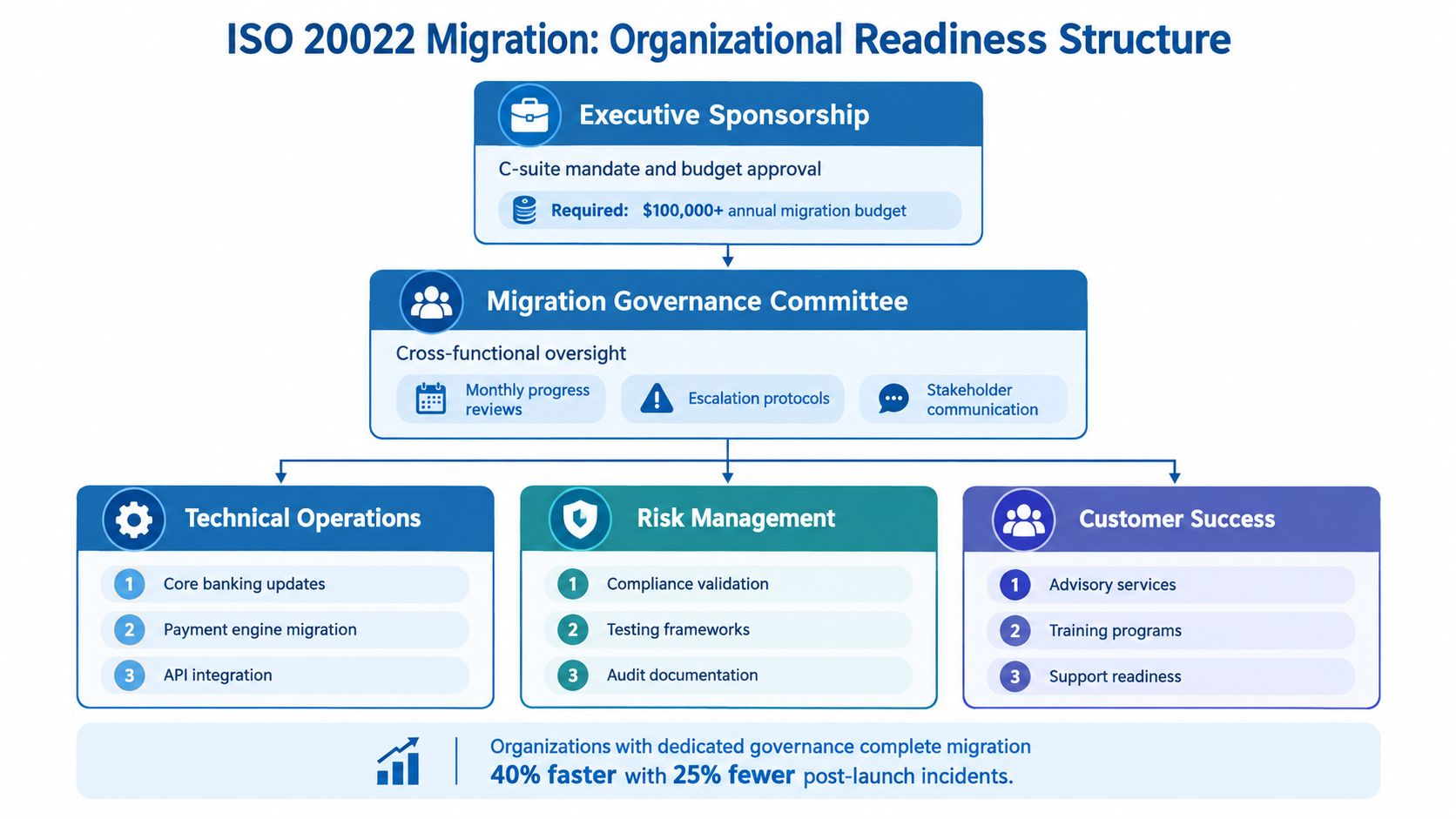
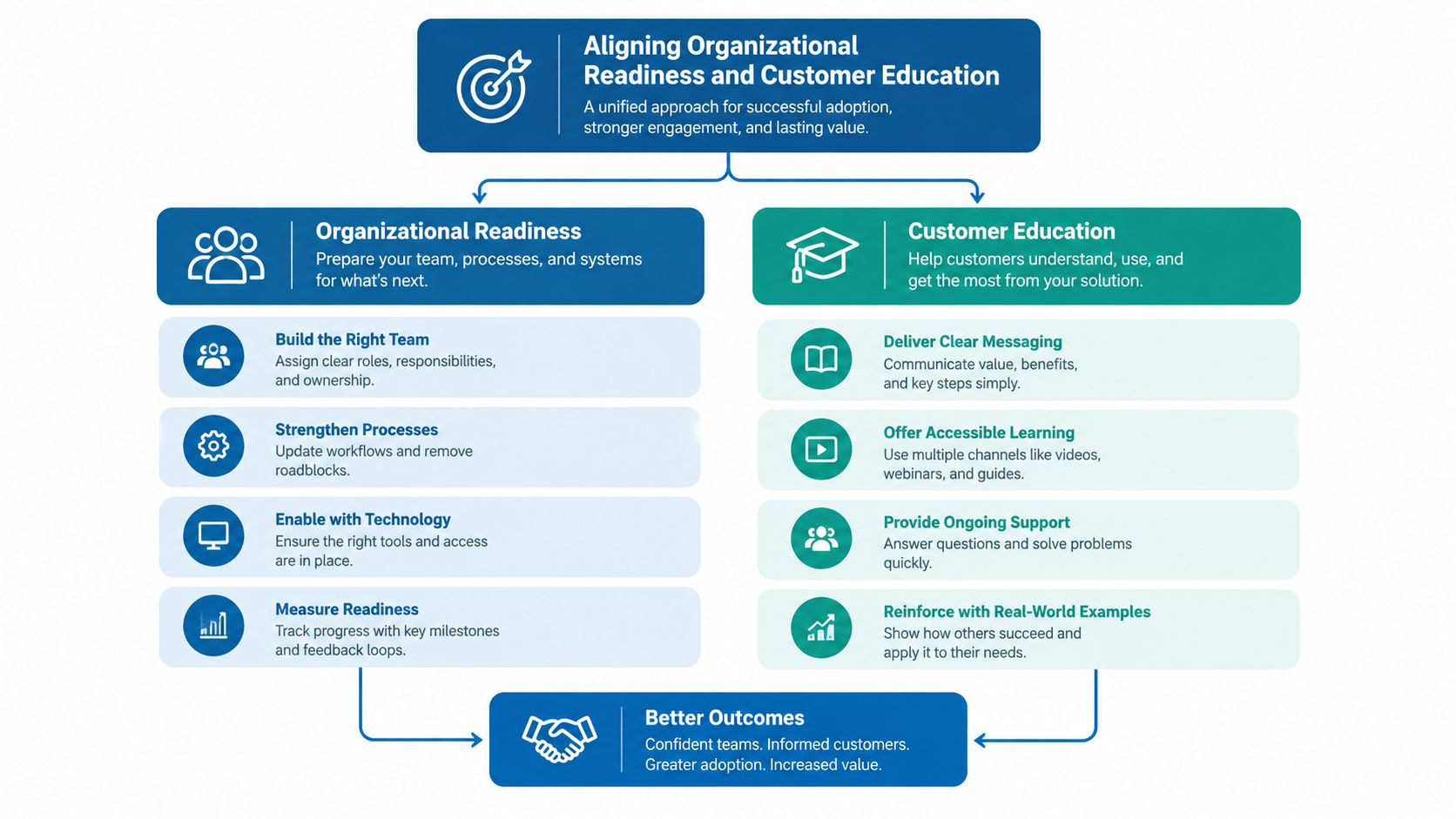
Technology teams can make the rails compatible. They can't force customers to populate reliable party, purpose, address, and remittance data, nor can they decide which commercial segments deserve the earliest investment. ISO 20022 migration therefore requires a relationship and operating-model response, with ownership shared across payment operations, compliance, technology, product, sales, and client implementation.
The governance committee should begin with exposure rather than system inventory. Rank corridors, products, and customer segments by exception volume, compliance risk, correspondent dependency, and revenue opportunity. That ranking gives executives a defensible basis for sequencing remediation when every legacy interface can't receive attention at once.
Give each group a practical mandate
Operations should own repair queues, acceptance latency, reconciliation breaks, and escalation paths. Its job is to show where customer and counterparty data creates work.
Compliance and risk should track screening outcomes, false positives, address quality, identifier continuity, and audit evidence. Richer fields matter only if investigators can use them without creating disproportionate alert noise.
Technology and vendors should document mappings, transformation rules, schema versions, recovery behavior, and data lineage. Vendor certification is necessary, but it doesn't prove that the bank's own workflows preserve meaning.
Relationship managers and client teams should translate requirements into customer actions. Commercial clients need clear specifications for beneficiary data, structured remittance, invoice references, and testing responsibilities, not a generic notice that “the bank has migrated.”
Turn education into onboarding
Customer education should connect data requirements to outcomes the client already values. A treasury team is more likely to prioritize structured invoice references when the bank explains how those fields can reduce reconciliation work. A corporate payer is more likely to remediate beneficiary records when the bank shows how incomplete party information can cause repairs, investigation delays, or future rejection exposure.
Use client-level diagnostics to identify the highest-value intervention. One customer may need ERP mapping support. Another may need supplier master-data cleanup. A third may have clean source data but lose it through a bank connectivity channel. Treating all customers alike wastes implementation effort and obscures accountability.
The bank should also make customer readiness visible in relationship reviews. Report data completeness, exception patterns, repair causes, and matching performance by client, while protecting sensitive information through appropriate controls. That turns a technical requirement into a service conversation and gives sales teams evidence for targeted advisory work.
Governance succeeds when leaders can answer three questions without debate: who owns the field, where is it validated, and which business outcome proves improvement? Without those answers, the bank may complete the migration while leaving the data supply chain unmanaged.
Unlocking Commercial Advantages for Relationship Managers
Relationship managers should stop presenting ISO 20022 as a bank-imposed technical requirement. Commercial customers care about fewer reconciliation exceptions, clearer payment status, faster investigations, and more dependable receivables data. The bank that can demonstrate those outcomes has a stronger proposition than the bank that merely confirms format support.
Structured remittance creates a concrete conversation. A corporate client can provide invoice references and creditor data in a form that the receiving organization's systems can use. The bank can then measure the share of receipts matched automatically, the exceptions requiring human review, and the investigation effort associated with incomplete information. That evidence gives the relationship manager a fact base for service design rather than a generic modernization message.
Sell evidence, not capability
A useful client review compares operating signals across similar relationships, corridors, or payment products. The analysis should ask:
- Which clients generate the highest repair volumes?
- Which corridors produce the most reconciliation breaks?
- Where do incomplete remittance fields correlate with manual handling?
- Which customers provide structured data but lose it through a channel or translation path?
- Which products offer the clearest opportunity to improve service and retention?
The bank can use those findings to shape targeted interventions. A large commercial client may need payment-file mapping and supplier-data remediation. A smaller business may benefit from standardized onboarding guidance and validation at initiation. A correspondent relationship may require technical escalation because the problem appears after the bank transmits the message.
A relationship manager earns credibility by showing the customer where data quality is suppressing productivity, then offering a practical route to improvement.
Convert compliance into differentiation
The advantage won't come from claiming that ISO 20022 is richer. Every serious institution can make that claim. Differentiation comes from proving that the bank preserves and applies the richness.
That proof can include client dashboards, exception reviews, payment-traceability support, and structured reporting that connects transaction data to receivables workflows. It can also inform product pricing and investment decisions. If a corridor generates persistent manual work but represents strategic client revenue, management can justify targeted remediation. If a product has low data quality and weak commercial relevance, the bank can avoid indiscriminate spending.
The same intelligence supports prospecting. Relationship teams can identify organizations with complex payment flows, high reconciliation demands, or supplier-data challenges, then lead with an operating hypothesis rather than a product catalog. The conversation becomes, “We can help you identify where payment data creates manual work,” instead of, “We support the new message format.”
That shift matters for smaller institutions as well as global banks. Benefits won't arrive evenly, because they depend on core systems, screening tools, case management, customer channels, and correspondent relationships. A regional bank can still compete if it focuses on priority segments and demonstrates measurable service outcomes instead of trying to replicate every large-bank investment.
Executing a Data-Driven Migration and Risk Playbook
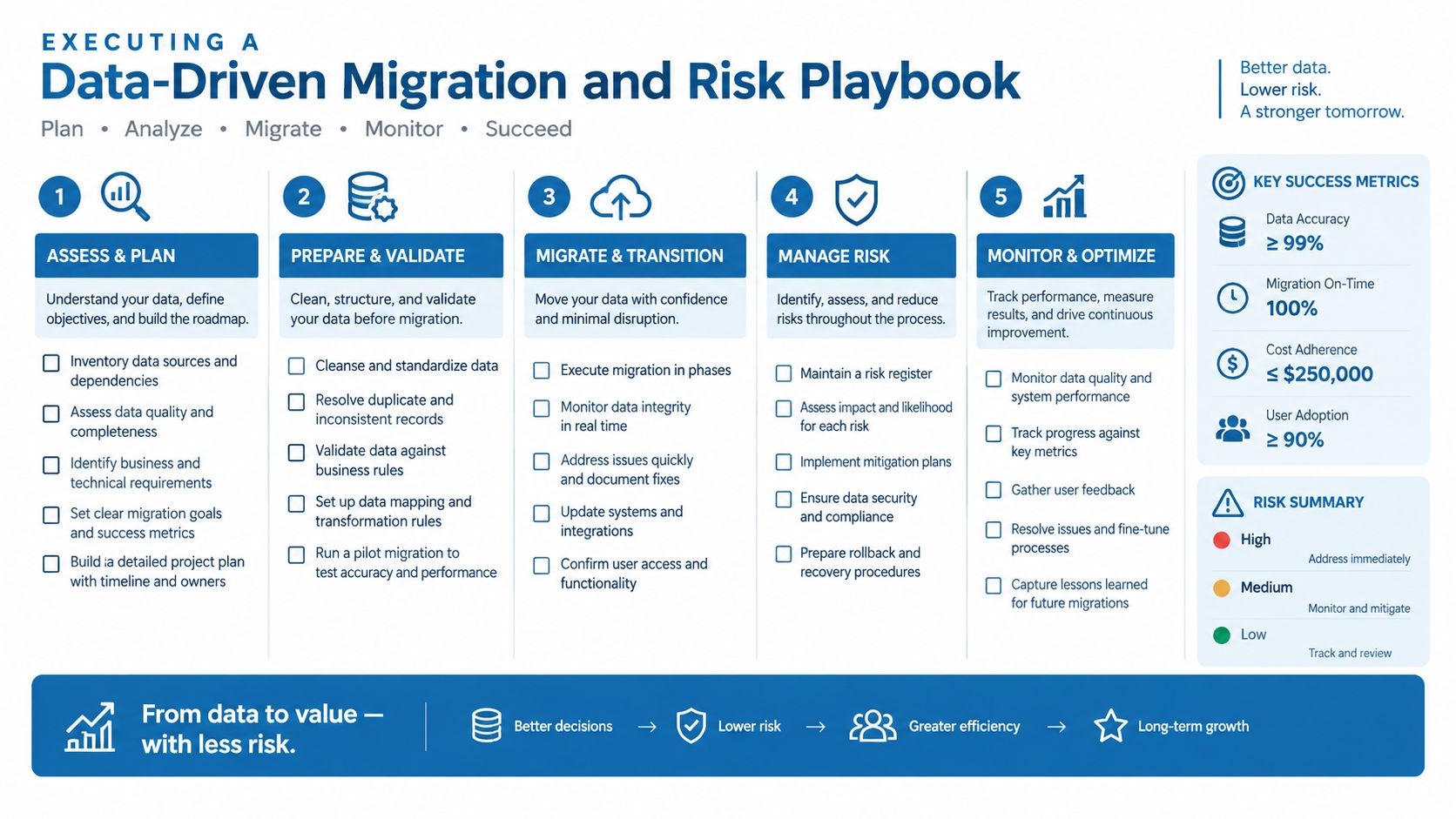
ISO 20022 execution breaks down when leadership treats migration as a release milestone instead of a data-control discipline. The stronger approach is to run it as an operating system for payment quality: define baseline measures, assign owners, set alert thresholds, establish remediation paths, and review post-release outcomes. The point is broader than message conversion. Management needs evidence that field-level completeness improves processing performance, exception handling, and decision quality across rails and counterparties.
Start with an executive scorecard that exposes where richer data is creating value and where weak data is still generating cost. Track acceptance latency, segmented by rail, message type, and processing path. Measure repair percentage and classify the root cause of each manual intervention. Monitor rejection codes, especially where failures stem from missing or malformed business data. Add duplicate detection, screening outcomes, reconciliation completion, and identifier continuity so leaders can see whether UETR, payment reference numbers, and EndToEndID remain usable from intake through posting.
Those measures matter because production conditions punish averages. Capacity tests should reflect peak payloads, large remittance blocks, multiple agents, and corporate batch behavior, not just standard flows. As noted earlier, live network adoption already shows that banks are operating at meaningful scale. That makes observability and production-shaped testing management issues, not only engineering tasks.
The next step is to connect each metric to a specific action. Build a canonical event trail for every payment and correlate ingestion, validation, enrichment, screening, routing, settlement acknowledgement, and posting through a consistent identifier. Then segment outcomes by institution, product, corridor, business unit, vendor, and client.
That segmentation turns a generic migration dashboard into a management tool. It helps the bank separate a core-platform defect from a vendor mapping issue or a counterparty-specific pattern. It also sharpens investment decisions. Persistent repairs in one corridor may justify correspondent remediation. A broader drop in automated matching may point to customer onboarding design or supplier master-data governance. Higher screening false positives can indicate a need for data normalization or rule recalibration.
Contingency translation paths need the same discipline. They preserve continuity during an outage, but they can also strip structured information and create differences between the bank's internal record and the settlement message. Each fallback should therefore include explicit controls for data loss and a reconciliation check once recovery is complete.
A practical model is a staged migration framework such as A data-driven migration and risk playbook outlining five stages for a successful business data migration project. Success means the bank can make faster, better decisions on payment operations, risk, client service, and investment because the underlying data is dependable.
Visbanking brings together financial, regulatory, market, and relationship data to help banks benchmark performance, identify operating signals, and act on payment and customer intelligence. Visit Visbanking to explore decision-ready analytics for turning ISO 20022 data quality into measurable operational and commercial action.
Latest Articles
Brian's Banking Blog
Lead Tracking Software for Banks: An Executive Guide

Brian's Banking Blog
What Are Key Metrics for Banks? a Decision Guide
Brian's Banking Blog
Customer Feedback Surveys: A Playbook for Banks

Brian's Banking Blog
How to Create a Dashboard That Banks Actually Use

Brian's Banking Blog
What Is Consultative Selling Approach and Why Banks Need It
Brian's Banking Blog