
How to Manage Vendor Relationships in Banking
Brian's Banking Blog
A 2025 survey found that 73% of financial institutions have two or fewer full-time employees managing vendor risk while more than half oversee 300 or more vendors. The constraint isn't a missing procurement checklist. It's an allocation problem. A bank can't give every relationship the same executive attention, review cadence, and evidence burden, so it needs an objective method for deciding where scarce capacity goes first. (2025 financial-institution vendor-risk survey)
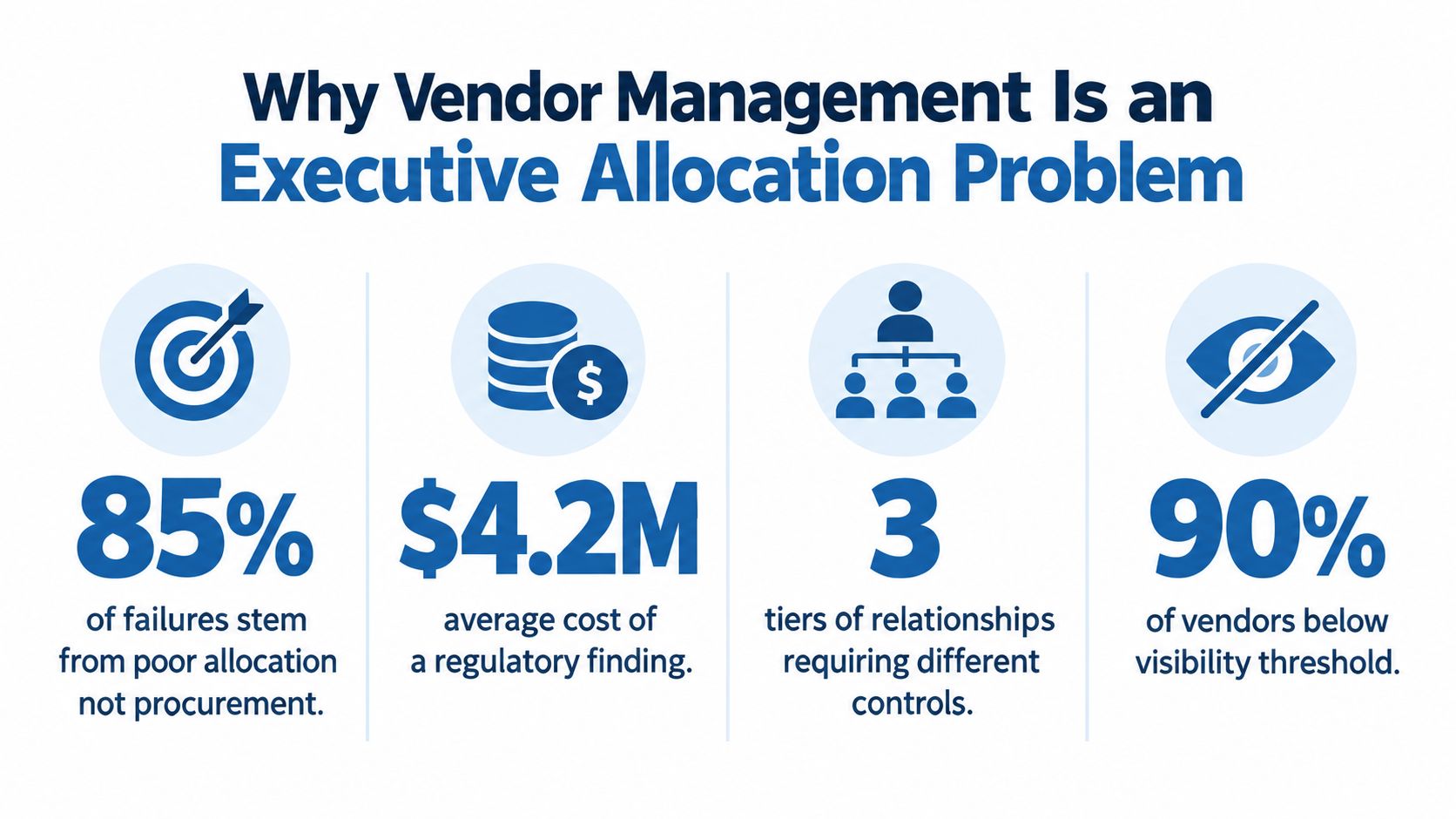
Why Vendor Management Is an Executive Allocation Problem
A vendor portfolio is a set of exposures competing for limited management time. The relationship supporting payments, customer data, or fraud decisions deserves a different operating model from the supplier providing office materials. Treating both relationships as equal creates the illusion of control while directing attention away from the vendors that can interrupt a critical activity.
The same survey found that 64% of institutions assign risk ratings at the product or service level rather than the vendor level. That is the correct instinct. One provider may supply a mission-critical analytics platform and a low-risk administrative tool. A single vendor rating would hide the difference between those services and produce the wrong escalation path.
Allocate attention by exposure
Start with six signals:
- Business criticality: Identify the products, customer journeys, and regulatory obligations that depend on the service.
- Substitutability: Record whether another provider, an internal process, or a manual workaround can take over.
- Concentration exposure: Map shared providers, cloud environments, subcontractors, and dependencies across business units.
- Data access: Distinguish public or low-sensitivity information from customer, payment, identity, and confidential bank data.
- Incident history: Track security events, outages, control findings, missed remediation dates, and recurring service failures.
- Service outcomes: Measure whether the vendor delivers the uptime, turnaround time, data quality, adoption, revenue, or cost benefit the business expected.
That model gives relationship managers a defensible reason to increase contact with one vendor and standardize monitoring for another. It also gives directors a clearer answer when management asks for more headcount: the request connects staffing to exposure, not to vendor count alone.
Board-level rule: Relationship-management capacity should follow the combination of impact, dependency, uncertainty, and evidence quality.
U.S. banking regulators organize third-party risk management around planning, due diligence and selection, contract negotiation, ongoing monitoring, and termination, with controls scaled to the risk and structure of the relationship. That lifecycle should become the spine of the bank's vendor program, not a compliance appendix. Executives looking for a practical operating reference can also consult this 2026 guide for GCC ITSM teams, particularly when translating governance requirements into repeatable service-management work.
Tiering Your Vendor Portfolio by Real Risk Signals
The FDIC identifies four core elements of third-party risk management: risk assessment, due diligence in selecting a third party, contract structuring and review, and oversight. It also states that board approval should precede material third-party arrangements. (FDIC third-party risk framework)
A board-approved tiering policy should turn those principles into a decision rule. Don't let an annual risk rating determine the tier by itself. A vendor supporting payment operations, handling sensitive customer information, or creating material concentration exposure may require executive treatment even when its recent performance looks stable.
For example, a bank could define materiality as any contract above $500,000 per year or any provider supporting payment operations. Under that policy, a proposed $750,000 payments contract would go to the board with documented alternatives, financial-health analysis, concentration exposure, exit costs, and measurable service levels. The dollar threshold is an example of a governance rule the board can adopt, not a universal regulatory threshold.
Use the service as the unit of decision
The service record should contain the business owner, risk owner, technology owner, executive sponsor, renewal date, systems supported, data categories, subcontractors, incident history, contingency options, and contract gaps. Assigning the risk only to the legal vendor entity would miss the fact that the same provider can support both critical and routine activities.
| Tier | Trigger Criteria | Owners | Review Cadence |
|---|---|---|---|
| Tier 1 | Critical activity, low substitutability, sensitive data, material concentration, serious incidents, or material contract value | Business executive, CRO or chief risk delegate, technology, legal, procurement | Monthly operational review, quarterly executive review, and trigger-based reassessment |
| Tier 2 | Important service with available alternatives, moderate data access, or meaningful operational dependency | Business owner, risk, technology, procurement | Quarterly review and reassessment after material change |
| Tier 3 | Low criticality, limited data access, easy substitution, and no material concentration | Business owner and procurement | Standardized monitoring with renewal attestation |
Make the tier movable
A tier isn't a permanent label. Move a relationship upward after a material incident, ownership change, new data use, subcontractor change, AI deployment, worsening financial indicators, or a measurable decline in service outcomes. Move it downward only after documented evidence shows that criticality, dependency, and exposure have declined.
This approach gives directors a one-page portfolio view. It also prevents a thin team from spending equal time on every vendor while the bank's most consequential dependencies receive superficial oversight.
Running Due Diligence That Scales With the Tier
U.S. banking regulators state that controls should be scaled to the relationship's risk and structure, and that outsourcing doesn't transfer responsibility for managing the risk away from the bank. Deloitte's 2023 survey found that 63% of organizations were prioritizing a refreshed third-party risk management methodology, while 48% said executive leadership's role needed strengthening. (Federal Reserve third-party risk guidance)
The practical answer is proportional evidence. A Tier 1 provider needs a documented investigation that can withstand board and examiner review. A Tier 3 supplier shouldn't consume the same amount of specialist time.

Match evidence to exposure
For a critical cloud core provider, request and validate evidence covering:
- Financial capacity: Audited financial information, ownership, liquidity indicators, insurance, and material litigation.
- Operational resilience: Business-continuity plans, recovery testing, service architecture, recovery objectives, and dependency mapping.
- Cybersecurity: Independent assessments, penetration-test summaries, access controls, encryption practices, vulnerability management, and incident history.
- Legal and regulatory compliance: Applicable obligations, licenses, enforcement history, privacy commitments, and examination cooperation.
- Subcontractors: Critical fourth parties, locations, service roles, change-notification rights, and oversight practices.
- References and performance: Comparable customers, service history, incident resolution, and evidence supporting vendor-provided claims.
For a Tier 3 office-supply vendor, a short questionnaire, sanctions screening, basic contract terms, and a limited security or data-access attestation may be sufficient. The bank should still record the decision and its rationale. “Low risk” is a conclusion that needs an owner, not an excuse to create no evidence.
Use independent validation where the consequence warrants it. Vendor-produced scorecards can support a review, but logs, audit reports, attestations, incident records, and bank-observed outcomes should establish whether the claim is reliable. A structured vendor risk management process can connect the evidence to the service, owner, tier, and next decision.
For specialized diligence, a resource on value recovery vendor evaluation can help procurement teams structure questions around provider capability and commercial value. Governance ownership should be explicit: the business owns the outcome, risk challenges the exposure, technology validates architecture, legal controls the contract, and the executive committee resolves unresolved Tier 1 issues.
Negotiating Contracts That Survive a Regulator's Reading
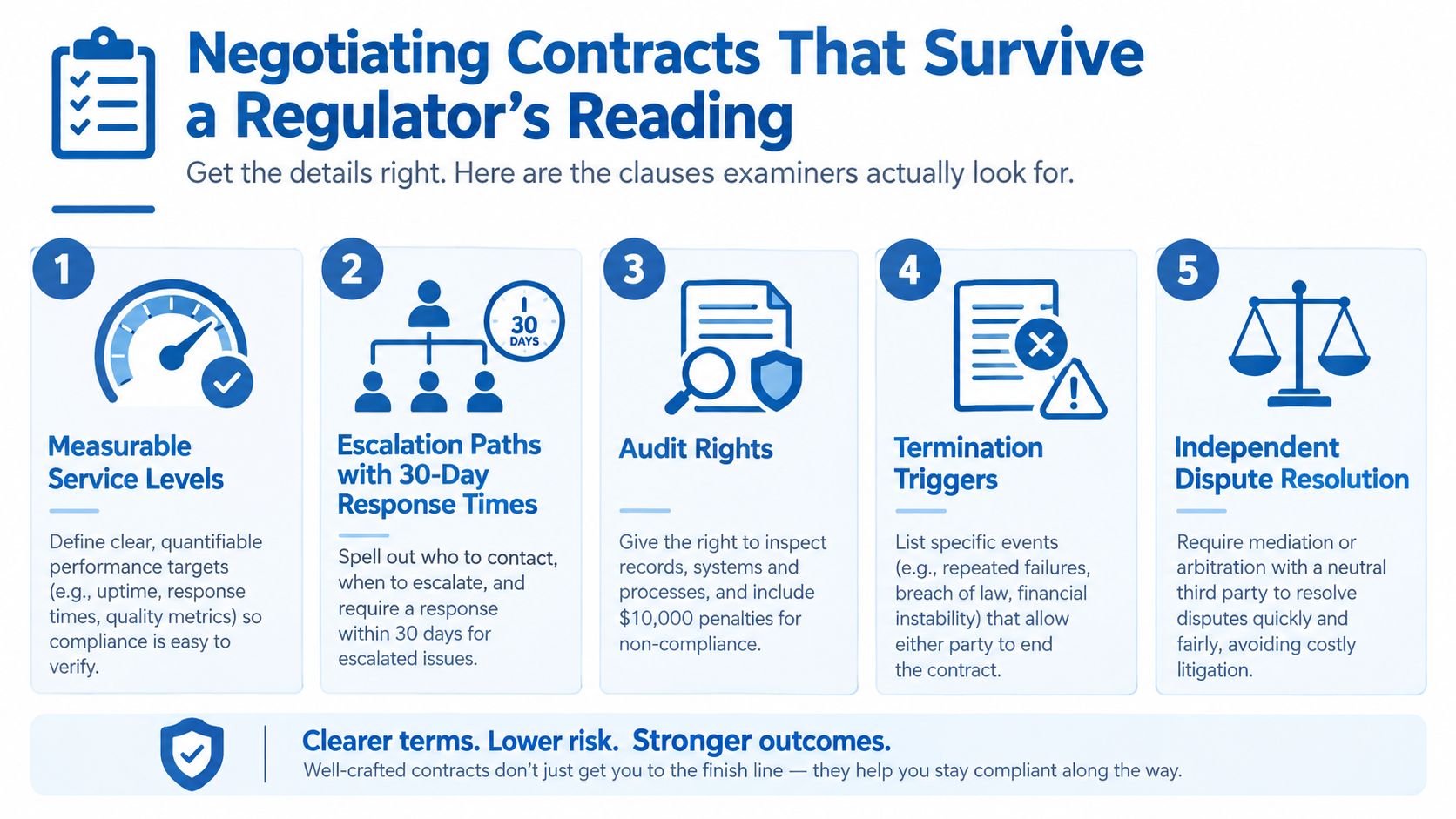
A contract isn't the relationship. It's the durable record showing what the bank required, what the vendor accepted, and how the bank can act when performance or controls fail. A friendly account team can't substitute for precise rights.
The agreement should include measurable service levels, incident-notification deadlines, audit and information-access rights, business-continuity obligations, data ownership, change-control procedures, and termination or transition assistance. It should also identify escalation contacts, remediation expectations, subcontractor oversight, record-retention duties, and the bank's ability to recover relevant information.
Test the contract against a real failure
Consider a hypothetical bank paying $1.2 million annually for a critical fraud-monitoring platform. The bank shouldn't accept terms that limit audit evidence to a short vendor-authored summary or permit the provider to delete logs immediately after termination. Those clauses would impair the bank's ability to investigate incidents, answer supervisory questions, validate model performance, and transition to another provider.
The bank should require access to records needed by management and supervisors, defined response deadlines, preservation of relevant logs, and a documented transition process. It should also require advance notice of material changes to the product, ownership, data use, hosting arrangement, and subcontractors.
Use a pre-renewal clause register
Before renewal, assign a status to each requirement:
- Regulatory access: Can the bank and its supervisors examine the outsourced activity?
- Audit and information rights: Can the bank obtain records, control evidence, logs, and remediation details?
- Record retention: Does the agreement preserve relevant documentation for the required period?
- Information security: Are control obligations, access restrictions, breach duties, and testing rights explicit?
- Incident notification: Does the vendor have to notify the bank within the contractually specified period?
- Subcontractor oversight: Can the bank identify critical subcontractors and challenge material changes?
- Business continuity: Are recovery objectives, testing, dependencies, and alternate operating plans defined?
- Data return: Can the bank retrieve usable data in an agreed format?
- Termination assistance: Must the vendor support migration, knowledge transfer, and controlled shutdown?
The joint interagency guidance issued on June 6, 2023 establishes a five-stage lifecycle and says relevant contracts should preserve regulators' ability to examine outsourced activity, with appropriate retention of and access to documentation and other materials. (Interagency guidance on third-party relationships) A structured contract register can flag missing clauses across hundreds of agreements and rank remediation by service criticality. The bank's third-party risk guidance for U.S. regulators provides additional context for converting those expectations into operating controls.
A background-check resource such as background checks for nonprofits may be useful when a vendor's personnel access facilities or sensitive processes, but the bank should still tie personnel screening requirements to the actual service and access risk.
Monitoring Performance With a Scorecard That Drives Action
Annual reviews and relationship sentiment are not monitoring. A critical vendor can be pleasant, responsive, and commercially important while still missing recovery obligations, weakening controls, or failing to deliver the business outcome that justified the contract.
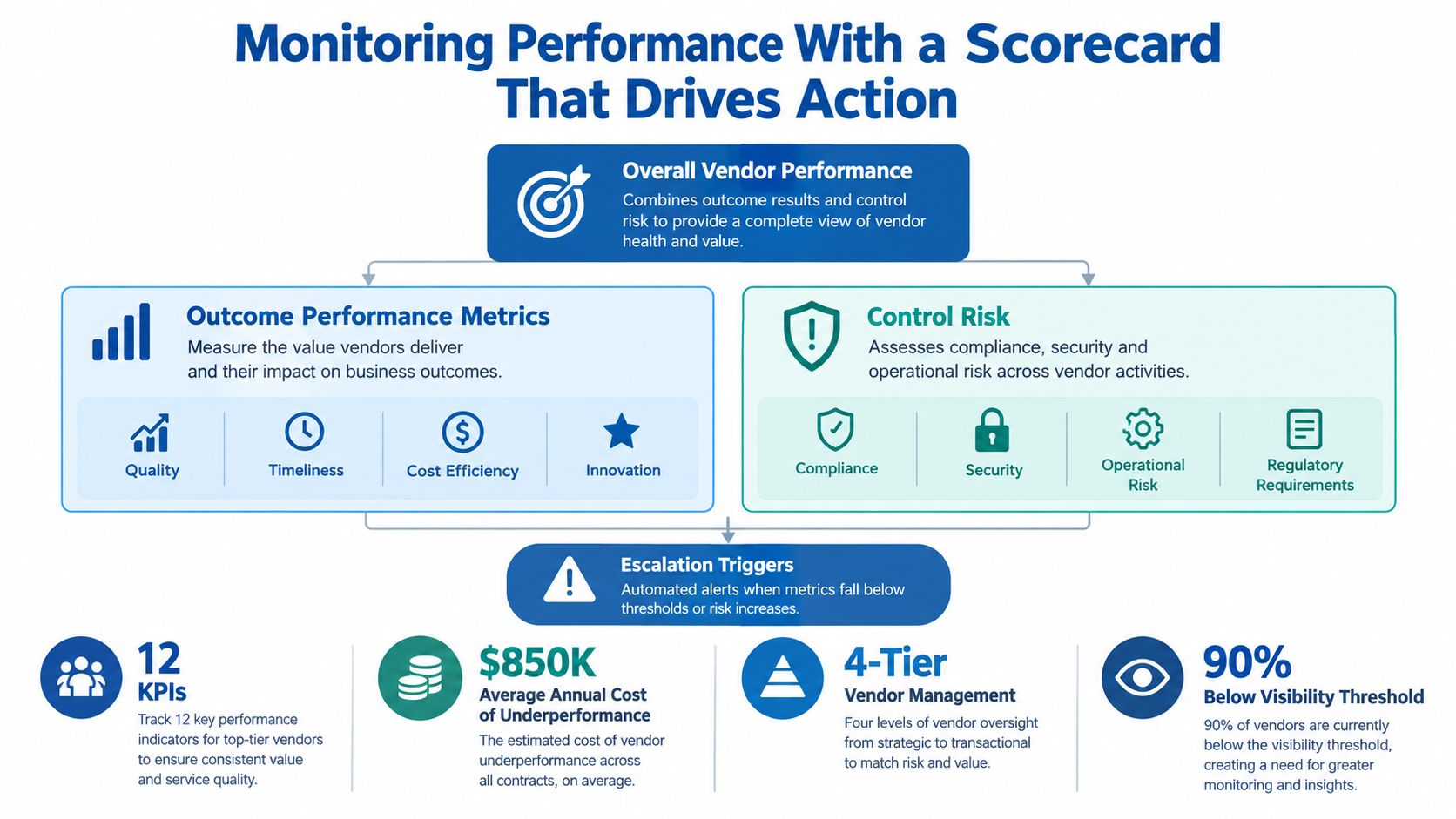
Separate outcome performance from control risk. This prevents a strong uptime result from masking a serious cybersecurity issue, and it stops a clean audit report from concealing a service that no longer supports the bank's strategy.
Score outcomes and controls separately
Outcome measures can include:
- Availability and speed: Uptime, response time, turnaround time, and queue performance.
- Data quality: Error rates, rejected records, reconciliation breaks, and correction time.
- Business adoption: Usage by intended teams and completion of agreed implementation milestones.
- Economic value: Realized revenue or cost benefit compared with the approved business case.
Control measures should cover cybersecurity, resilience, regulatory compliance, model performance, financial health, concentration, and subcontractor dependency. Every score needs an evidence reference, such as a system log, attestation, audit report, incident record, or named remediation owner.
For a critical service, the scorecard can require 99.9% monthly availability, zero unresolved high-severity findings beyond a defined remediation window, tested recovery objectives, and notification of material incidents within the period specified in the contract. These are management thresholds to approve and negotiate, not universal regulatory requirements.
Escalation rule: A threshold without an owner and a consequence is only a dashboard decoration.
Deloitte reported that 87% of surveyed businesses had experienced a third-party disruption, including 28% reporting a major disruption and 11% a complete third-party failure. (Federal Reserve model-risk guidance and cited disruption data) That exposure makes independent validation essential. Don't accept vendor-produced metrics without checking them against bank logs, customer impact, incident records, and operational reconciliations.
When a vendor supplies analytics or a decision-support model, validate accuracy, fitness for purpose, and reliability before deployment and during ongoing use. The Federal Reserve's model-risk guidance specifically calls for validation of vendor products and continued monitoring of those characteristics. A missed model deterioration can affect decisions even when the vendor's infrastructure remains available.
Managing Nth-Party Risk and Concentration in Real Time
A bank's exposure rarely ends with the contracted provider. The service may depend on a cloud platform, a data processor, a specialized software component, a call-center operator, or another shared infrastructure provider. When several bank functions rely on the same underlying dependency, a single outage can become a portfolio event.
The 2025 ICBA third-party risk management survey reported that nearly half of financial institutions experienced a third-party cyber event during the prior year, while respondents ranked AI as the second-largest third-party risk heading into 2025. (2025 ICBA third-party risk management survey) Those signals should change the questions relationship managers ask during quarterly business reviews.
Run a harder QBR conversation
Ask the vendor to answer four questions with evidence:
- Which subcontractors support this service, and what changes require advance notice?
- Where are critical data, processing functions, and recovery capabilities located?
- Which other bank functions, products, or providers depend on the same environment?
- How quickly can you provide incident evidence, customer communications, and an alternate operating plan?
The tone matters. A relationship manager should explain that the bank isn't questioning the vendor's integrity. It is mapping dependencies so both parties can respond faster when conditions change. Trust improves when the request is specific, consistent, and tied to the service's criticality rather than delivered as a vague demand for “more transparency.”
Turn events into review triggers
Don't wait for the next annual assessment when the exposure changes. Launch a targeted review when the vendor adds an AI model, changes a critical subcontractor, suffers an incident, changes ownership, alters data use, or becomes a concentration point across multiple bank services.
The review should update the inventory, test contract rights, validate the affected controls, assess customer and regulatory impact, and decide whether the service tier or contingency plan must change. A bank can use vendor cyber risk analysis to frame these discussions around observable exposure and pricing decisions rather than generic concern.
The executive question is simple: if this provider failed, which bank functions would fail together? Until the inventory answers that question, the bank doesn't have a concentration view. It has a list of vendors.
Designing Renewal and Exit Strategies You Actually Test
Termination isn't a paperwork event. It's a continuity test that exposes whether the bank understands its data, dependencies, operating procedures, and negotiating position.
Start exit planning 12 months before renewal. That gives the bank time to test portability, challenge transition assumptions, secure alternatives, and decide whether the provider still earns a renewal. Waiting until the notice period begins turns the vendor into the party controlling the timetable.
Make exit a deliverable
A tested plan should define:
- Data portability: The format, fields, documentation, encryption, transfer method, and validation process for returned data.
- Parallel operation: The period during which the bank runs the current and replacement services together.
- Manual workaround: The controlled process employees use if the replacement isn't ready.
- Subcontractor coordination: The notifications and technical steps required across the dependency chain.
- Customer communications: Approved templates, ownership, escalation routes, and timing for affected customers.
- Transition assistance: Knowledge transfer, access support, configuration documentation, and the agreed assistance period.
A bank that can't answer “How fast can we leave?” is paying a resilience premium every time it renews. The answer should come from a rehearsal, not a vendor promise. Test whether the bank can retrieve usable records, operate manually, communicate internally, and transfer responsibility without losing audit evidence.
Put the lifecycle into one operating model
The six-part method is straightforward:
- Plan: Define the objective, criticality, data access, alternatives, and exit requirements.
- Select: Complete documented due diligence proportionate to the service.
- Contract: Secure measurable service levels, access rights, continuity duties, and transition support.
- Assign: Name business, risk, technology, legal, procurement, and executive owners.
- Monitor: Review performance, controls, incidents, financial indicators, concentration, and changes.
- Exit: Test termination, migration, manual workarounds, and evidence preservation.
Tier 1 renewals should reach the board with full alternatives, financial-health analysis, concentration exposure, performance evidence, and exit costs. Tier 3 renewals can use an attestation refresh and standardized approval when the service remains low risk and readily replaceable.
The inventory should connect each provider to products, business units, systems, customer data, regulatory obligations, owners, contracts, incidents, and renewal dates. That unified view reflects the data-intelligence principle behind Visbanking's BIAS, which brings multi-source financial, regulatory, market, and people data into explainable, decision-ready views. Directors can then see where an ordinary supplier supports a critical process and where evidence is missing before a control gap becomes an examination finding.
The board doesn't need another vendor spreadsheet. It needs a portfolio view that shows where attention goes, why the priority changed, what evidence supports the decision, and how the bank exits if the relationship fails.
Visbanking helps banks and credit unions connect vendor relationships with financial, regulatory, market, and operational intelligence for clearer risk prioritization and peer benchmarking. Visit Visbanking to benchmark your vendor portfolio, identify concentration and financial-health signals, and turn scattered evidence into decisions your management team and board can act on.
Latest Articles

Brian's Banking Blog
ISO 20022 Migration Strategy for Bank Leaders
Brian's Banking Blog
Lead Tracking Software for Banks: An Executive Guide
Brian's Banking Blog
What Are Key Metrics for Banks? a Decision Guide
Brian's Banking Blog
Customer Feedback Surveys: A Playbook for Banks

Brian's Banking Blog
How to Create a Dashboard That Banks Actually Use

Brian's Banking Blog