
Analytics for Banking That Drive Data Intelligence
Brian's Banking Blog
Analytics for banking is often perceived as a mass of spreadsheets and raw numbers. Applied correctly, analytics transforms data into strategic insights. Descriptive, predictive, and prescriptive analytics form the three pillars leading banks rely on to optimize operations and manage risk with precision.
Understanding The Key Concepts

A data pipeline operates like an orchestra: each section plays a critical role, yet all work in concert to deliver harmony.
- Data Collection ingests transaction logs and market feeds into a unified framework.
- Data Cleansing eliminates errors and duplicates to ensure data integrity.
- Data Modeling applies statistical models and machine learning to forecast outcomes.
- Data Visualization converts analytics into dashboards and reports for rapid decision-making.
Visbanking logs every data handoff, providing built-in governance that streamlines audits and compliance checks.
Descriptive analytics condenses millions of transactions into concise dashboards. Predictive analytics forecasts credit risk and customer churn with probability scores. Prescriptive analytics recommends immediate actions: adjust credit limits, launch targeted loan products, or cross-sell premium services based on real-time data.
Data Pipeline Orchestra
Bank executives view the pipeline as a cohesive ensemble that delivers transparency and control.
Types of Banking Analytics
| Analytics Type | Primary Use Case | Example Outcome |
|---|---|---|
| Descriptive | Transaction dashboards | 500% faster reporting |
| Predictive | Credit risk forecasting | 20% reduction in non-performing loans |
| Prescriptive | Real-time action recommendations | 15% lift in revenue per customer |
Key Insight: Analytics for banking bridges the gap between raw data and decisive actions.
Concrete Example
A regional bank deploys descriptive analytics to summarize 2,000,000 daily transactions by 6:00 AM. With that early visibility, the risk team flags anomalies hours sooner.
- Fraud investigation time fell by 30%
- Liquidity forecasting accuracy improved by 18%
Recent research pegs the global banking analytics market at USD 27.128 billion, with projections up to USD 43.3 billion. Explore global banking analytics market projections
Visbanking Unified Platform
Visbanking integrates every analytics stage—from ingestion through visualization—into a unified workflow:
- Consolidated data ingestion across FDIC, FFIEC, NCUA and market feeds
- MLOps pipelines that refresh models in real time
- Pre-built dashboards benchmarking 4,600+ institutions
Clients report loan processing times reduced by 40% and delinquency rates down 25% within six months. Check out our guide on what is business intelligence analytics to deepen your understanding
Benefits Of Analytics For Banking
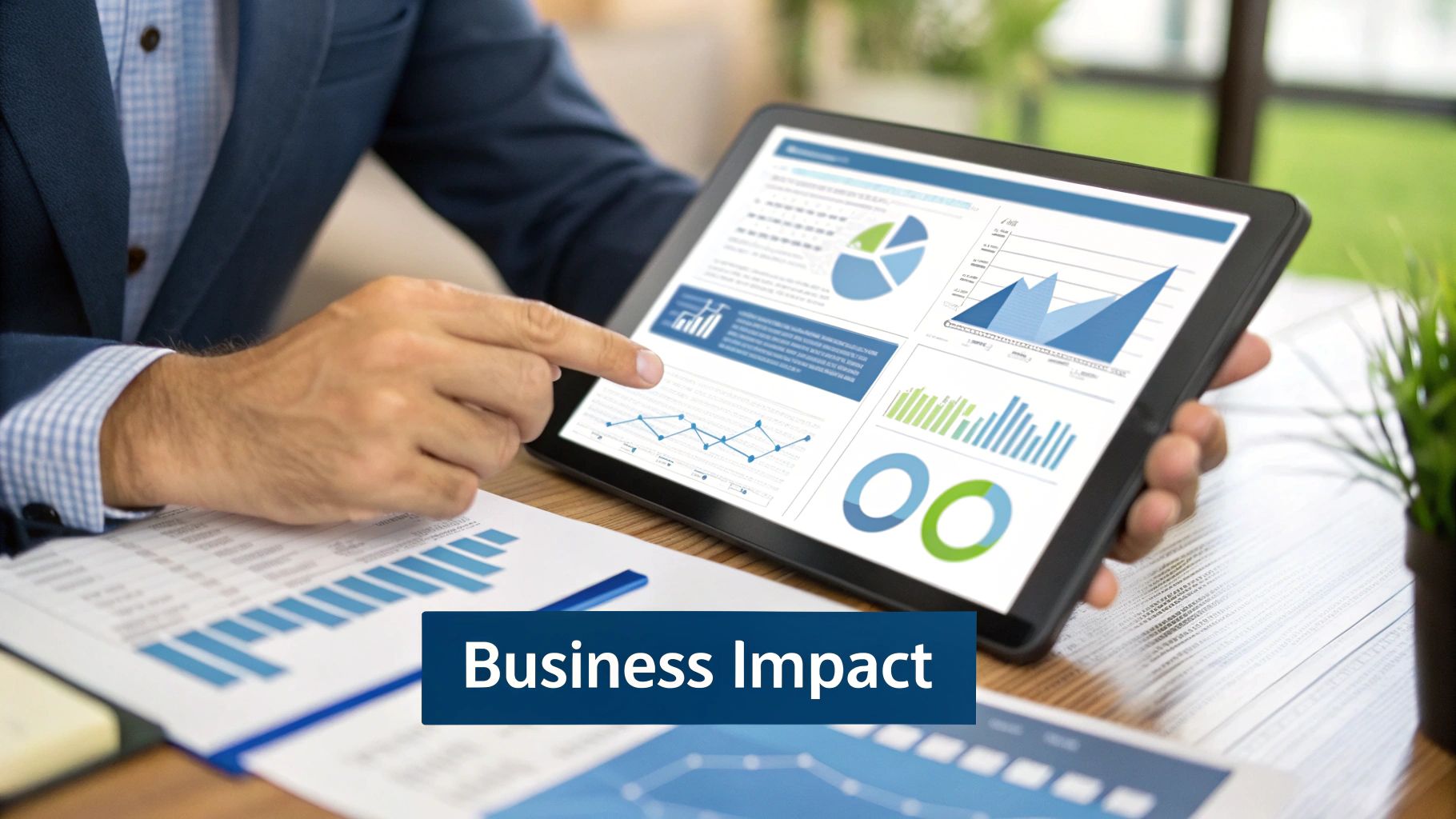
Analytics for banking drives faster decisions, stronger risk controls and revenue growth.
Speeding Loan Underwriting
Manual underwriting often spans 5 days; analytics cuts that to 3 days, a 40% reduction.
- Cost per loan drops from $150 to $90
- Underwriting output increases 60% with the same headcount
- False positives decline, driving higher approval rates
Credit teams process applications faster, reducing overhead and freeing capital for growth.
Boosting Revenue With Personalization
Segmenting customers through analytics transforms generic offers into high-conversion campaigns. One bank achieved a 15% increase in cross-sell revenue:
- Added $2.4 million in six months
- Response rates rose from 1.2% to 3.5%
Real-time dashboards track customer lifetime value and next-best actions, enabling weekly campaign adjustments.
Insight: Banks using personalized analytics report an average 20% higher ROI on marketing spend.
Projected Analytics Market Growth
Market projections illustrate why analytics for banking is a strategic priority. Read the full research about market growth
| Year | Market Size (USD Billion) |
|---|---|
| 2023 | 11.55 |
| 2025 | 13.88 |
| 2030 | 87.40 |
Enhancing Fraud Detection
Predictive alerts from Visbanking analyze transactions in under 2 seconds, flagging anomalies instantly.
- Fraud losses fall 30%, saving $4.2 million annually
- Detection accuracy reaches 92%, reducing false alarms
“With analytics for banking, we thwarted a $5 million heist in its tracks,” reports a Visbanking client.
Optimizing Operational Efficiency
Automating KYC reviews cuts analyst hours by 20%, saving $3 million per year.
- Document checks shrink from 24 hours to 6 hours
- Data-entry errors drop 45%
- Staff refocus from manual tasks to strategic initiatives
Strengthening Compliance Oversight
Automated call report generation halves prep time, while scenario tests spin up liquidity models in minutes.
- Every event is logged and traceable
- Real-time dashboards keep compliance teams aligned
Visbanking eliminates fines and accelerates audit readiness.
Turning Data Into Action
Visbanking’s dashboards and alerts convert metrics into executable steps. Executives monitor credit queues, cost-per-loan and revenue segments in real time.
- Drill down into loss rates and segment returns
- Receive instant notifications via email or Slack
Explore AI-powered business intelligence to see how early adopters cut decision times in half and improve net interest margins by 10 basis points.
Ready to see analytics sharpen every move? Visit visbanking.com to compare your metrics or request a free benchmark report and roadmap today.
Use Cases For Banking Analytics
Analytics for banking tackles critical challenges, guiding executives to precise solutions.
Fraud Detection Impact
A mid-sized bank processed 10,000,000 transactions daily through Visbanking’s fraud module, flagging suspicious activity in under two seconds. Fraud investigations decreased by 30%, and recovery rates improved by 18%.
- Real-Time Alerts automate flags for faster response
- Behavioral Profiling detects unusual patterns in payments and logins
- Continuous Learning refines models after each confirmed event
Credit Risk Optimization
In retail lending, one bank increased monthly applications from 1,000 to 1,400 by adopting real-time credit scoring—generating an extra $2.4 million in interest income annually.
- Define risk tiers and thresholds using historical loan data.
- Integrate third-party credit bureau feeds into models.
- Monitor scorecard drift and refresh quarterly for precision.
Key Insight: Predictive scoring eliminates backlogs and allows analysts to focus on exceptions.
Churn And Liquidity Management
A commercial financer used prescriptive analytics to forecast defaults with 30% higher accuracy, personalized outreach to at-risk clients, and set liquidity buffers. Outcomes:
- Churn dropped 15%
- Cash reserves increased 22%
Comparative ROI Metrics
| Use Case | Key Metric | Outcome |
|---|---|---|
| Fraud Detection | Loss Reduction | 25% drop |
| Credit Approval | Cycle Time | 40% faster |
| Default Prediction | Accuracy Gain | 30% improvement |
| Customer Retention | Churn Reduction | 15% improvement |
| Liquidity Management | Cash Reserves | 22% increase |
Institutions adopting analytics saw corporate and commercial revenues rise by over 20% in three years thanks to real-time detection, smarter credit assessments and targeted marketing. Learn more about these findings
Check our guide on predictive analytics in banking to see how Visbanking accelerates deployment. Benchmark against 4,600+ peers and request a custom demo today.
Insight: Operational analytics drives 20 basis-point gains in net interest margins.
Ready to translate data into decisive action? Explore Visbanking’s analytics capabilities and grab a free benchmark report. Schedule a strategy session to align analytics projects with your institution’s growth and compliance goals. Contact our team or visit Visbanking to start your analytics transformation roadmap.
Unlock actionable insights that drive profitability today.
Implementing Analytics in Banking
Implementing analytics for banking requires a clear roadmap—think of it as plotting a voyage with defined milestones.
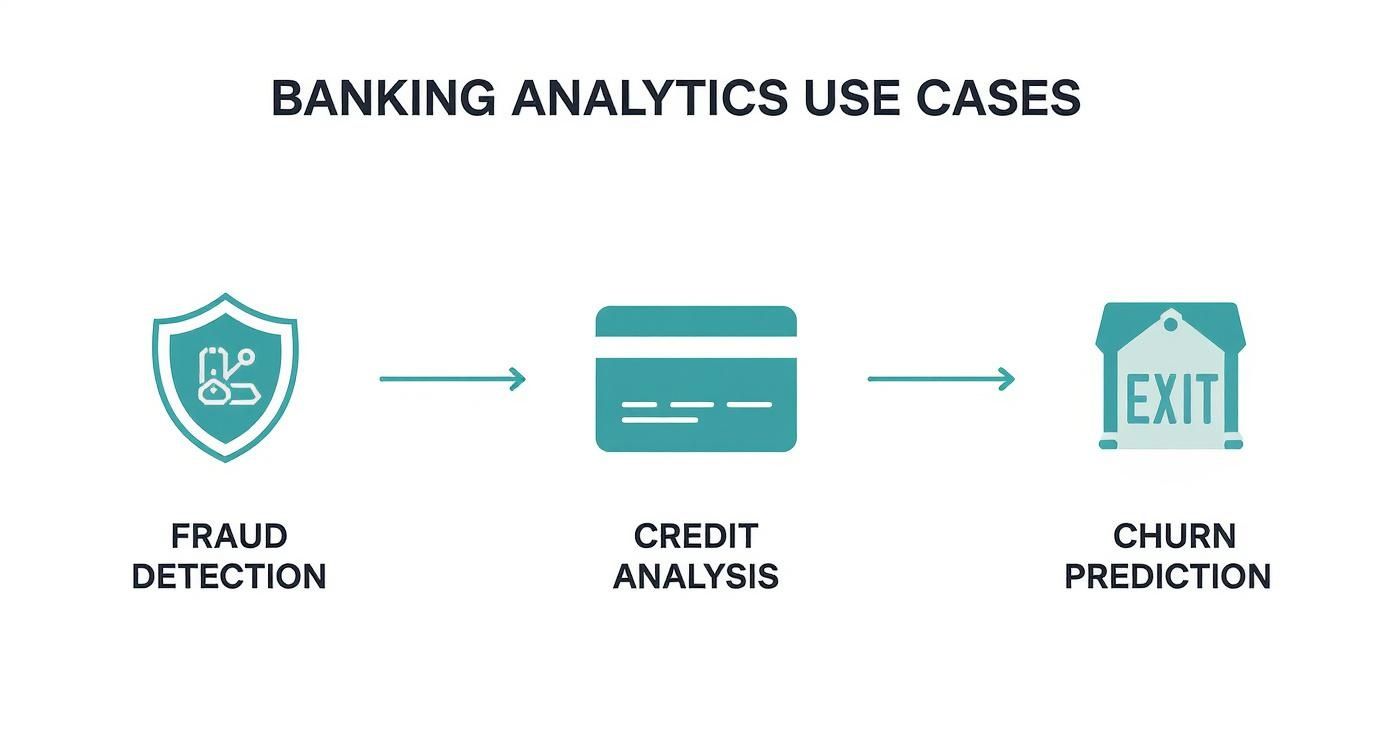
A large regional bank focused on three priorities: reducing fraud losses, improving credit risk metrics and preventing customer churn. These targets aligned analytics initiatives with strategic goals.
Analytics must integrate into broader essential digital transformation strategies.
Defining Objectives And Data Audit
Translate strategic goals into analytics targets: reduce fraud by 20%, accelerate credit decisions by 30% within 12 months. Clear objectives unify teams.
Conduct a comprehensive audit of existing data—transaction logs, customer records, regulatory reports—to identify gaps and quality issues.
Key Data Audit Actions:
- Catalog Data Sources and formats across systems
- Identify Quality Issues, such as duplicates or incomplete records
- Prioritize Cleanup based on business impact
Visbanking’s discovery tools profile data and flag anomalies automatically, cutting audit time by 50%.
Selecting Technology And Tools
Evaluate platforms against criteria like:
- Multi-source integration (regulatory filings, transactions, market feeds)
- Built-in MLOps and feature store support
- User-friendly visualization and alert workflows
- Real-time monitoring and alerts
Visbanking’s unified Bank Intelligence and Action System streamlines data ingestion and modeling with secure APIs and audit-ready pipelines.
Phased Roadmap Stages
- Define Objectives with Metrics (e.g., 20% fraud loss reduction)
- Audit and Cleanse Data Assets
- Select Technology Stack and Vendors
- Plan Pilot Execution (3–6-month proof of concept)
Each stage delivers measurable milestones, building a robust analytics foundation.
Governance And Pilot Planning
Solid governance ensures data accuracy and compliance.
Key Governance Components:
- Roles and Responsibilities: designate data stewards and analytics champions
- Data Quality Checks: automate validation rules and anomaly alerts
- Policy Enforcement: implement access controls, audit logs and documentation
“Visbanking’s governance controls reduced data errors by 35%, accelerating pilot approvals.”
Scaling Pilots Into Enterprise Programs
Rolling out analytics across the enterprise takes 12–18 months.
Key Scaling Tasks:
- Define enterprise milestones each quarter
- Allocate resources among IT, analytics and business teams
- Integrate feedback loops to refine models
One bank saw loan approvals rise by 12% and net interest margin expand by 0.10% within eight months of full deployment.
“Our enterprise rollout delivered a 12% increase in approvals and 0.10% NIM expansion within eight months”
Visbanking supports scale with modular apps and automated MLOps, allowing expansion without rebuilding.
Change-Management Tactics:
- Secure Executive Sponsorship
- Conduct Hands-On Training
- Communicate Wins and Lessons Weekly
Capture initial analytics wins in 3 months and broaden impact by month 12. Benchmark performance against 4,600+ peers with Visbanking.
Ready to benchmark your bank’s analytics journey or explore next steps? Learn more in our guide on data integration best practices.
Best Practices You Need To Know

Effective analytics for banking hinges on people, processes and technology. Executive sponsorship is critical—C-suite champions secure budgets, remove roadblocks and ensure accountability.
Cultivate Data-Driven Culture
- Assign Ownership: Executive sponsors drive initiatives.
- Promote Training: Workshops align directors and managers on analytics.
- Celebrate Wins: Publicize achievements, such as a 15% drop in loan processing time in three months.
- Embed Analytics Goals: Tie metrics to performance reviews.
Enforce Data Quality Standards
Reliable insights start with clean data.
- Profile data sources to detect duplicates and gaps.
- Define validation rules to catch outliers.
- Automate cleansing pipelines with MLOps.
- Monitor quality metrics, targeting error rates under 0.1% and latency under 5 minutes.
A regional lender saw errors fall by 35% after enforcing validation checks on FDIC and FFIEC feeds.
“Strong data quality is the bedrock of reliable insights,” notes a Visbanking data engineer.
Align Analytics KPIs With Strategy
| KPI | Target Improvement | Impact |
|---|---|---|
| Cost Per Loan | 25% decrease | Saves $60 per loan |
| Loan Approval Cycle Time | 30% faster | Cuts approval from 6 days to 4 |
| Non-Performing Loans Ratio | 15% drop | Frees $1.2 million in reserves |
Iterative testing (A/B tests, validation loops) sharpens performance over time.
Foster Cross-Department Collaboration
- Biweekly reviews unpack dashboard takeaways.
- Rotate analytics liaisons through business units.
- Use shared workspaces in Visbanking for real-time updates.
Continuous Performance Monitoring
Real-time dashboards catch drift before it disrupts decisions.
- Set precision thresholds at 90% and recall at 85%.
- Trigger alerts via email or Slack when metrics slip.
- Schedule quarterly retraining to capture new behaviors.
Optimize Budget And Costs
- Review vendor invoices to eliminate underused services.
- Adopt usage-based pricing for variable data volumes.
- Reinvest savings into high-impact pilots.
Optimize Vendor Selection
- Score vendors on integration, MLOps and audit trails.
- Negotiate discounts beyond 500 million records per month.
- Conduct a 60-day pilot before committing.
Build A High-Caliber Analytics Team
- Hire data engineers, scientists and analysts with banking experience.
- Rotate staff through real-world projects.
- Leverage Visbanking’s partner network for specialist gaps.
Key Insight: A balanced team can slash time-to-value by 40%.
Visit Visbanking to compare peer benchmarks and request a custom analytics maturity report.
Overcoming Common Misconceptions
Leaders delay analytics, fearing high costs, complexity and compliance barriers. In reality, modular tools deliver measurable ROI quickly.
At a regional credit union, Visbanking’s modular pricing cut total cost of ownership by 30%—saving $450,000 in year one. Those funds funded additional pilots.
- Cost of ownership declines as use cases expand.
- Teams introduce complexity in phases.
- Pay-as-you-go models align with budgets.
Modular analytics allows pilots in liquidity forecasting or fraud detection. Visbanking’s workflow-ready apps let business users set up dashboards in days, not months.
Built-in audit pipelines and role-based access controls ensure compliance with FFIEC and GDPR from day one.
Addressing Compliance Challenges
Security is integrated at every step. Visbanking logs each pipeline action for regulators.
- AES-256 encryption secures data in transit and at rest
- Role-based access with multi-factor authentication
- Automated logging time-stamps every event
Community banks reduce operational costs by 18% in nine months using peer benchmarking and alerts, channeling savings into digital initiatives.
Key Insight: Dispelling myths around banking analytics empowers strategic focus.
Gaining Executive Confidence
A national credit union used Visbanking to cut delinquency rates by 22% in six months, then reinvested savings into CX enhancements that boosted cross-sell revenue by 14%.
- Define clear success metrics to prevent scope creep
- Compare results against peer benchmarks
- Adjust priorities using modular apps
Visit Visbanking to benchmark your institution, compare metrics across 4,600+ peers and explore secure analytics roadmaps. Schedule a strategy session to accelerate analytics adoption, benchmark against peers, and unlock immediate value through Visbanking’s secure, modular analytics platform built for global banking executives.
Contact us to start your analytics journey.
Frequently Asked Questions
ROI in analytics for banking maps directly to strategic goals. Teams track net interest margin and cost per loan before and after rollout. For example, one regional bank cut underwriting cycle time by 40%, saving approximately $60 per loan. Revenue increases—such as a 15% cross-sell lift—demonstrate analytics’ dollar impact.
Siloed data misses half the story. Blend internal records with external feeds for a comprehensive view. Combine FDIC call reports with transaction logs, credit bureau scores and market data to spot anomalies before they become losses.
- FDIC Call Reports benchmark performance across 4,600+ peers
- Transaction Logs expose real-time behavior trends
- Credit Bureau Feeds deliver early warning credit scores
- Market Data from BLS/BEA adds economic context
Steps To Scale From Pilot To Enterprise
Transition from pilot to enterprise over 12–18 months. Start with a 3–6-month pilot focused on key KPIs. After proving value, roll out additional modules in phases.
Visbanking’s modular apps integrate via secure APIs and real-time pipelines—no core overhaul required. Audit trails cut validation cycles by 50%, and batch uploads handle large historical data sets efficiently.
Tip: Define success metrics up front to reduce approval times by 25%.
Visbanking normalizes legacy systems—from COBOL ledgers to modern CRMs—in days, not months. Ready to benchmark your analytics performance or explore our data intelligence tools? Visit Visbanking today.
Related Articles

Visbanking Blog
BIAS: A New Dawn in Banking Decision-Making

Visbanking Blog
Banking Data Analytics: Turning Information Into Profit

Visbanking Blog
Visbanking: Leading Financial Intelligence for Banks

Visbanking Blog
How Bank Efficiency Ratios Reveal Hidden Operational Costs

Visbanking Blog
Revolutionize Your Banking Operations with Data-Driven Insights from BIAS

Visbanking Blog