
Bank Customer Segmentation Strategies for Better Personalization
Brian's Banking Blog
Bank customer segmentation is the art and science of organizing your customer base into smaller, distinct groups based on shared traits and behaviors. It’s the difference between shouting into a crowded room and having a meaningful, one-on-one conversation.
Ultimately, it’s about offering the right product to the right person at the right time.
What Is Bank Customer Segmentation, Really?

Let's be frank—most banks have customers, but very few truly understand them. Simply having a long list of account holders just doesn't cut it anymore if you want to compete and grow. At its core, bank customer segmentation is about bringing much-needed order and clarity to a diverse, complex customer base.
Think of it this way: a library without a system is just a chaotic pile of books. But once a skilled librarian organizes everything by genre, author, and topic, it becomes an incredible resource where anyone can find exactly what they're looking for. Segmentation does the same for your customers, stopping you from offering mortgages to college students or high-risk investments to retirees.
This isn't some "nice-to-have" marketing buzzword anymore; it's a critical tool for survival. With nimble fintechs breathing down your neck and customer expectations at an all-time high, the one-size-fits-all approach is a guaranteed recipe for failure. Customers are more than willing to jump ship, with one study finding 75% would switch to a provider that better meets their needs.
Moving Beyond Traditional Labels
For decades, banks got by with broad, simple buckets: retail, corporate, and high-net-worth individuals. In today's world, that’s like trying to navigate a sprawling metropolis with a map from the 1800s. The customer landscape is far more intricate and dynamic.
By treating every customer the same, you're not just missing growth opportunities; you're actively pushing away valuable clients who feel misunderstood and underserved. Effective segmentation is the very foundation of genuine customer-centricity.
The focus now is shifting toward identifying unique sub-segments that old-school models completely miss. As we look toward 2025, banks across the globe are zooming in on these micro-communities. These emerging groups include:
- Gig Economy Workers: Freelancers and contractors with fluctuating, unpredictable income streams who need flexible financial products.
- Global Immigrants: Newcomers who require specific services like international money transfers and tools to build credit from scratch.
- Tech-Savvy Seniors: An older demographic that’s increasingly comfortable with digital banking but has unique security and usability concerns.
- Generation Alpha: The next wave of customers, set to number over 2 billion by 2025, who will bring entirely new expectations for digital interaction. You can discover more insights on banking trends for 2025 and beyond.
The Core Pillars of Modern Segmentation
A successful segmentation strategy isn't just about slicing and dicing your customer list. It's about building a robust framework that fuels smarter business decisions across the entire organization.
Below is a quick-glance summary of the fundamental pillars that hold up a modern, effective segmentation strategy.
Core Pillars of Modern Bank Customer Segmentation
| Pillar | Description | Primary Goal |
|---|---|---|
| Data-Driven Insights | Using transactional, behavioral, and demographic data to find meaningful patterns. | To understand why customers act the way they do, not just who they are. |
| Personalized Experiences | Customizing products, communications, and service channels for each segment. | To make every customer feel seen, understood, and valued, which builds fierce loyalty. |
| Strategic Action | Using segment insights to guide product development, marketing campaigns, and risk management. | To align the bank's operations with what customers actually need, driving both profit and retention. |
By embracing this mindset, banks can finally shift from a product-centric model to a truly customer-first strategy. This foundational change is absolutely essential for building lasting relationships and securing a competitive edge in an increasingly demanding financial world.
Choosing the Right Segmentation Models
Think of picking a customer segmentation model like a chef choosing their knives. You wouldn't use a bread knife to filet a fish, would you? Different jobs demand different tools. While you can get by with one or two, the real magic happens when you combine several models to build a rich, actionable picture of your customer base. Each model adds another essential layer, turning a flat profile into a 3D portrait.
The Foundational Layers: Who Are They?
The traditional models are your starting point. They give you a basic, but necessary, understanding of who your customers are. Don’t skip these.
Demographic Segmentation: This is the most straightforward approach. You're slicing up your customer base by objective traits like age, income, occupation, and family size. It helps answer fundamental questions: "Are we connecting with young professionals or are we the go-to bank for soon-to-be retirees?"
Geographic Segmentation: This one is all about location, location, location. It groups customers by where they live, from broad regions down to specific neighborhoods. This is gold for localized marketing. Think promoting agricultural loans in rural areas or highlighting new branch services in a growing suburb.
These models give you a great high-level view, but they only scratch the surface. They tell you what a customer is, but they don't give you a single clue as to why they bank the way they do. To get to the "why," you have to dig deeper.
Moving From "Who" to "Why"
To really get inside your customers' heads, you have to look at their mindsets and actions. This is where psychographic and behavioral models come in, and they're what separate generic outreach from genuinely personal connection.
Psychographic segmentation is about grouping people by their lifestyle, values, and attitudes. It’s about connecting with what they care about. For instance, if you identify a segment of environmentally conscious customers, they'll be far more interested in green investment funds or paperless banking than a generic savings account promotion.
This is where you start seeing a real impact on your bottom line.
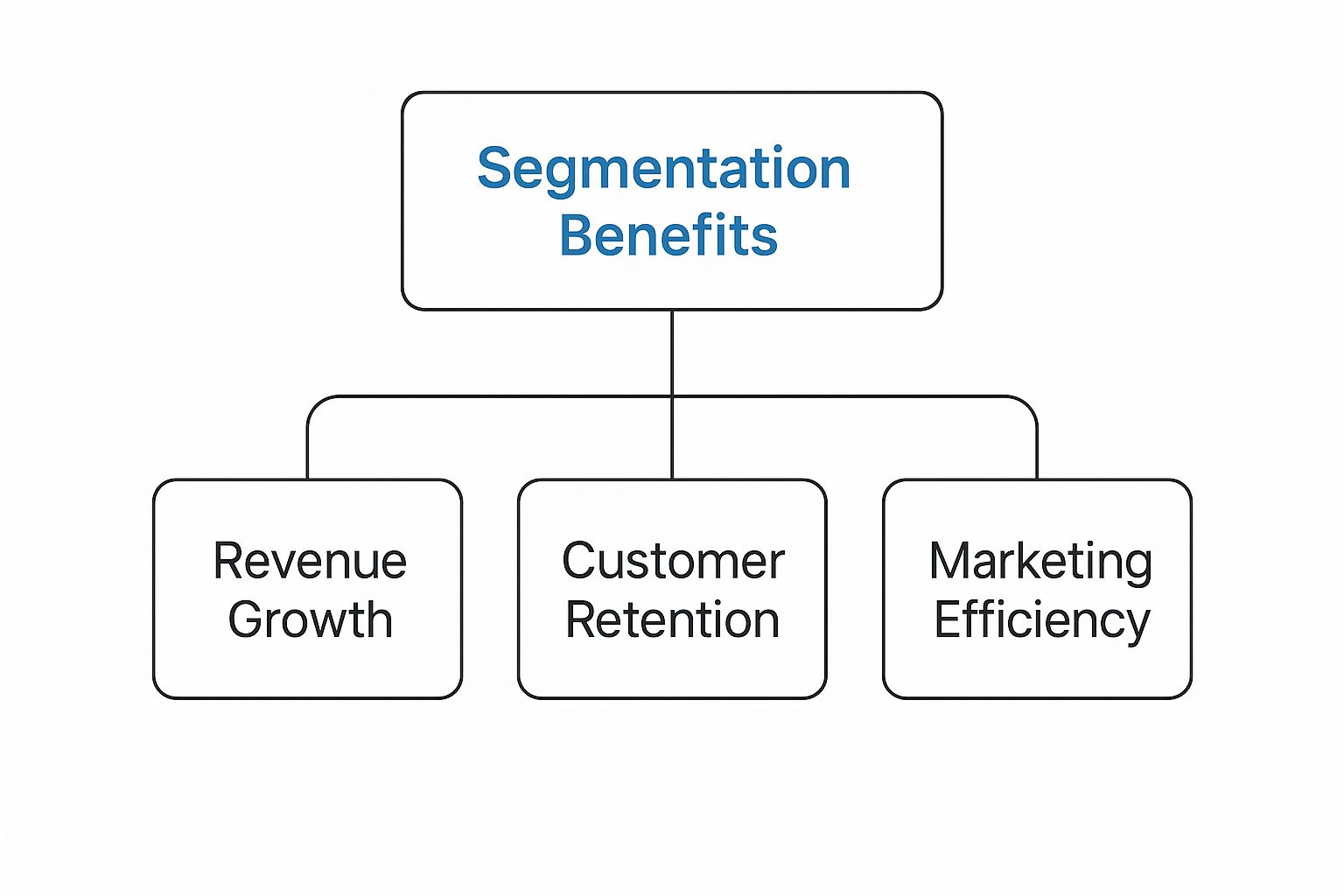
As you can see, understanding your customer on a deeper level isn't just a feel-good exercise. It's the root system that feeds revenue growth, customer retention, and marketing efficiency.
Behavioral Segmentation: The Real Game-Changer
Now we get to the most powerful tool in the shed: behavioral segmentation. This model is all about action. It groups customers based on their direct interactions with your bank—what they actually do.
Behavioral data doesn't guess. It tells you exactly what customers are doing. It’s the difference between knowing a customer is 35 and knowing they just started researching mortgage rates on your website last night.
This approach mines that goldmine of internal data you're already sitting on to reveal intent and need. Today’s most effective banks are dissecting their customer base using multiple criteria, analyzing everything from transaction history and product usage to channel preferences. You can learn more about the layers of bank customer segmentation to see how they all fit together.
This level of detail allows for incredibly timely and specific actions. Imagine identifying a segment of "High-Value Savers with Decreasing Activity." This group might be loyal customers who have suddenly stopped making regular deposits. With that insight, you can proactively reach out with a targeted retention offer or a consultation with a financial advisor, stopping churn before it even starts.
To help clarify how these models fit together, here's a quick comparison.
Comparison of Customer Segmentation Models
This table breaks down the core models, showing what they focus on and where they shine.
| Segmentation Model | Primary Focus | Example Data Points | Best Used For |
|---|---|---|---|
| Demographic | Who the customer is | Age, income, gender, family size, occupation | Broad targeting, product-fit analysis, compliance reporting. |
| Geographic | Where the customer is | Country, state, city, zip code, branch proximity | Localized marketing campaigns, branch location planning, regional offers. |
| Psychographic | Why they make choices | Lifestyle, values, personality, interests, attitudes | Brand messaging, content marketing, developing value-based products. |
| Behavioral | What the customer does | Transaction history, product usage, channel preference, loan inquiries | Predictive analytics, churn prevention, hyper-personalized offers, cross-selling. |
By layering behavioral insights on top of demographic and psychographic data, you create that 360-degree view. You move from a flat sketch of your customer to a rich, multi-dimensional portrait. This isn't just nice to have; it's the key to delivering the hyper-personalized experiences that modern customers now expect from their financial partners.
Putting Your Customer Data to Work

Smart bank customer segmentation isn't magic. It's built by tapping into the high-quality, relevant data you already have. The good news? Most banks are sitting on a goldmine of information. The real challenge is knowing where to dig and how to turn raw numbers into meaningful customer conversations.
Think of it like being a detective. You’re gathering clues—transaction histories, app clicks, call center notes—to piece together a complete picture of your customer. The goal is to move beyond seeing data points and start having a genuine dialogue, where every interaction is informed by a real understanding of who they are and what they need.
Unlocking Your Internal Data Goldmine
Before you even think about looking elsewhere, your most powerful data is already inside your bank's walls. This is your first-party data, and it's the most valuable kind because it's a direct record of your customers' relationship with you. It’s accurate, exclusive, and shows what people actually do, not just what they say they’ll do.
Your most valuable internal sources include:
- Transactional Records: This is the bedrock of behavioral segmentation. It doesn’t just show what customers buy, but also how often, from where, and how much they spend. A sudden spike in spending at a home improvement store? That could be a customer gearing up for a renovation who might be open to hearing about a home equity line of credit.
- Digital Channel Interactions: Every click on your website, every feature used in your mobile app, and every saved mortgage calculation tells a story. Following these digital breadcrumbs reveals what products customers are actively researching, helping you anticipate their next big financial move.
- Customer Service Logs: Call transcripts, chatbot conversations, and support emails are overflowing with raw, unfiltered insights. These notes capture your customers’ biggest headaches and questions in their own words, pointing you directly to service gaps or opportunities for new products.
This internal data gives you the first, most reliable layer for building strong customer segments. It's your best indicator of what your customers need right now.
From Data Points to Real Dialogue
Turning all this raw information into something you can actually use is where the real work begins. You have to start listening to the stories your data is telling.
A single transaction pattern might not look like much on its own. But when you combine it with other data, that pattern could reveal a gig economy worker with an unpredictable income, a student saving up for a semester abroad, or a growing family getting ready for a major purchase.
You have to shift your perspective. Instead of seeing a list of transactions, you start to see a financial journey. A customer who regularly sends money overseas isn't just a number; they could be part of a "Global Citizen" segment with specific needs for multi-currency accounts or low-fee remittance services.
By picking up on these signals, you can start a conversation that feels genuinely helpful and timely, not like a random sales pitch. This is the heart of a successful bank customer segmentation strategy.
Adding Richness with External Sources
While your internal data is the foundation, external data adds critical context. It helps you build out that 360-degree view of the customer by filling in the gaps your own records can't.
Some of the most useful external sources include:
- Public Records: Information like property ownership or new business registrations can help you spot customers who might need wealth management advice or commercial banking services.
- Third-Party Data Providers: Reputable vendors can provide aggregated, anonymous data on lifestyle interests, major life events like moving to a new home, or general purchasing habits.
- Market Research: Broader market surveys and trend reports help you understand the prevailing attitudes within key demographic groups.
Combining these sources turns a simple customer profile into a rich, multi-dimensional portrait. Of course, diving into massive datasets can feel overwhelming. For anyone looking to get a handle on the bigger picture, understanding how big data in banking can be a game-changer is a great place to start.
Ultimately, the skillful blend of internal and external data is what allows banks to stop just selling products and start solving real problems for well-defined groups of people.
How Segmentation Drives Real-World Banking Success
Theory is one thing, but seeing bank customer segmentation in action is where the magic really happens. This is the point where all that data and analysis turn into real-world results that you can see on the bottom line. Smart segmentation isn’t just some academic exercise; it’s a playbook for winning.
Let's look at a few stories of how banks are using this to hit specific, profitable goals. Each one shows a straight line from spotting a customer group to making a move that pays off.
Personalized Marketing That Actually Converts
Picture a regional bank wanting to grow its credit card business. The old way? Blast a generic "0% Intro APR" offer to everyone and hope for the best.
The new way? Use data to find a very specific group: "Recent Graduates and Young Professionals."
What do we know about them?
- Age: They're in the 22-28 range.
- Behavior: They’ve got their first "real" job with steady direct deposits, but their credit history is a blank slate.
- Goal: They need to build credit to hit life's next milestones, like getting an apartment or a car.
Knowing this, the bank creates a campaign that speaks their language. It's not about low rates; it's about giving them a leg up. The offer is a starter credit card with a sensible limit, resources on building a good score, and a dead-simple mobile app. The result? Way higher sign-ups and a new generation of customers who feel understood.
It's a simple shift. Stop selling a product (the credit card) and start solving a problem (building credit). That's when your marketing stops being an ad and starts being a service.
Developing Products That Solve Real Problems
A big national bank dug into its data and found a growing, but overlooked, group: "Gig Economy Workers." Think freelancers, consultants, and contractors. Their income is all over the place, and traditional bank accounts just don't cut it.
Their pain points were loud and clear:
- Income Instability: Wildly fluctuating monthly income makes budgeting a nightmare.
- Tax Headaches: They need to squirrel away money for quarterly taxes, and a standard savings account isn't built for that.
- Loan Hurdles: Good luck getting a mortgage when your income isn't a neat, tidy W-2.
Instead of shrugging, the bank built a new digital account just for them. It had an automatic "tax savings" feature that skimmed a percentage off every incoming payment. It also had a "cash flow projection" tool to help them see what's coming. This wasn't a gimmick; it was a genuine solution for a valuable, growing slice of the economy.
Optimizing Service and Retaining High-Value Clients
Segmentation isn't just about getting new customers; it's about keeping the great ones you already have. Think about a bank identifying a "High-Value, At-Risk" segment. These are clients with big deposits and investments, but suddenly, their activity drops off.
That change in behavior is a red flag that triggers a white-glove response.
- Their calls get routed straight to a senior relationship manager, skipping the hold music.
- Their advisor gets an alert to send a personal email, checking in to see if their goals have changed.
- Their profile is flagged for a review to make sure their accounts still make sense for them.
This kind of proactive, personal service makes your best customers feel seen and valued. It crushes churn. And even in our digital-first world, that human touch is gold. A 2025 global study revealed that when online support fails, most people still head to a branch—that includes 66% of Baby Boomers and even 63% of Gen Z. You can see all the findings on generational banking preferences for yourself.
These examples aren't just hypotheticals; they're proof that truly knowing your customer is the most powerful asset you have. It’s what fuels smarter marketing, better products, and service that keeps people coming back.
Your Blueprint for a Winning Segmentation Strategy

This is where the rubber meets the road. It’s one thing to talk about bank customer segmentation, but actually making it happen is where most plans fizzle out. What you need is a practical, no-nonsense roadmap to turn your data from a static resource into a real engine for growth.
Think of it less as a huge, one-and-done project and more like building a new muscle. It's about creating a culture that’s always learning and refining how it sees the customer. Let's walk through the steps to build a segmentation machine that actually works.
Set Clear and Measurable Objectives
Before you even touch a spreadsheet, you have to define what winning looks like. A fuzzy goal like “improve customer experience” is a non-starter. You need specific, measurable targets that act as your North Star.
Get specific by asking the right questions:
- Are we trying to stop churn within a certain age group?
- Do we want to see more mortgage applications from first-time buyers?
- Is the goal to boost deposits from our high-value small business clients?
A clear target—like "increase cross-selling of investment products to our 'Affluent Achievers' segment by 15% in six months"—gives your team a finish line. It ensures your segmentation work is tied to real business outcomes, not just an interesting academic exercise.
Start Small with a Pilot Project
Don't try to boil the ocean. A common mistake is attempting to segment your entire customer base right out of the gate, which almost always leads to analysis paralysis and wasted effort. The smarter move? Start with a focused pilot project.
The point of a pilot isn't to be perfect; it's to learn. Pick one high-impact area, move fast, measure everything, and see what works before you go all-in.
You could, for example, zoom in on a single, clear segment like "tech-savvy millennials." Launch a targeted campaign for a new digital-only savings account just for them. Then, obsess over the results—engagement, conversion rates, customer feedback. This small-scale test will teach you invaluable lessons you can use as you scale up.
Choose the Right Technology Stack
Your tech should serve your strategy, not the other way around. You don't need a multi-million dollar platform from day one. A great first step is to see what you can accomplish with the tools you already have, like your CRM or core banking system.
As you get more sophisticated, you’ll need technology that can pull together all your different data sources into one clean picture. This is where modern analytics platforms really shine, letting you layer behavioral, transactional, and demographic data. The end goal is a system that delivers actionable insights without needing a team of data scientists for every single question.
Uphold Data Privacy and Compliance
In banking, trust is everything. As you collect and analyze customer data, protecting their privacy and sticking to every regulation is non-negotiable. This isn’t just about dodging fines; it’s about keeping your customers' confidence.
Be transparent about how you use data and make sure your practices are airtight when it comes to rules like GDPR and CCPA. Strong security and ethical data handling are the foundation. For anyone looking to solidify their processes, diving into data governance in banking is a crucial step toward building a program that’s both secure and compliant.
Measure, Refine, and Scale
Your first attempt at segmentation won't be your last. Customer needs change, markets shift, and your segments need to evolve right along with them. Keep a close eye on how each segment performs against the goals you set.
Are your marketing messages actually connecting? Are your products hitting the mark? Use the data to get honest answers, and then refine your approach. Once your pilot projects start showing a proven, repeatable model for success, you can confidently scale it across the rest of the bank. This cycle of testing, learning, and expanding is what builds a truly powerful bank customer segmentation strategy.
The Future of Hyper-Personalized Banking
Bank customer segmentation as we know it is on its last legs. The old way of using static lists and broad categories is being replaced by something far more powerful: living, breathing customer profiles that update in real time. We're moving away from fixed segments and into the world of dynamic, one-to-one customer journeys, all powered by AI and machine learning.
This isn't just a minor tweak. It’s the difference between looking in the rearview mirror and having a crystal ball. Instead of reacting to what a customer has already done, smart banks are using technology to anticipate what they’ll need next.
From Static Segments to Living Profiles
Think of it like this: traditional segmentation is a printed photograph—a single moment, frozen in time. An AI-driven profile is a live video feed.
A static label might call someone a "High-Income Saver," but that's useless the second they decide to start a business, have a baby, or even just plan for a big vacation. Those old labels just can't keep up.
AI and machine learning, on the other hand, constantly sip from a stream of data—transactions, app activity, market shifts—to keep that customer profile fresh. This creates what we call dynamic segments, or even "segments of one," where the entire banking experience is shaped around an individual's immediate life context.
This is about so much more than better marketing. It's about shifting banking from a string of cold transactions to a continuous, supportive partnership that adapts to life as it happens.
This proactive approach unlocks a whole new level of service. For instance, the system might notice consistent payments to a wedding planner. Instead of waiting for the customer to ask, it could proactively offer a targeted savings plan for a home down payment or a special financing deal on a honeymoon. That's a real partnership.
Predictive Power in Action
The real magic of hyper-personalization is its ability to predict what's coming. By spotting subtle patterns a human analyst would almost certainly miss, AI can forecast future needs with startling accuracy. This lets you be there with the right offer before the customer even knows they need it.
Just think about these scenarios:
- Anticipating a Car Loan: An AI model sees a customer browsing car websites, upping their savings contributions, and checking their credit score in your app. That's not a coincidence. The system pieces it together, recognizes an upcoming car purchase, and sends a pre-approved, competitive loan offer right to their phone.
- Supporting a Growing Business: A small business account starts showing a steady climb in monthly revenue and bigger payroll deposits. The system flags this growth, triggering a timely offer for a business loan or line of credit to help them scale. You've just become an indispensable partner in their success.
This kind of foresight is what separates the leaders from the laggards. AI models can analyze thousands of data points to build these predictions—a task that's simply impossible to do manually. If you want to dive deeper into the mechanics, you can learn more about revolutionizing banking with intelligence and action and see exactly how these systems operate.
Ultimately, this predictive, proactive engagement is how you build loyalty that can't be broken and create a massive competitive advantage.
Answering Your Top Questions
Getting into the weeds of bank customer segmentation always sparks a few key questions. Let's tackle some of the most common ones so you can move forward with a clear game plan.
How Often Should We Be Updating Our Customer Segments?
If you're not looking at your segments at least quarterly or semi-annually, you're falling behind. Customer behavior and market tides shift fast, and static segments are a recipe for irrelevance.
But here's the real goal: get to a point of dynamic, real-time segmentation. Imagine your analytics automatically updating customer profiles based on their latest transactions and digital clicks. That’s how you make sure every offer is perfectly timed and based on what’s happening right now.
The biggest hurdle we see? Data that doesn’t talk to each other. Critical insights get stuck in silos—your core system, the CRM, the loan platform—making it nearly impossible to see the full picture of a single customer.
Fixing this isn't easy, but it's step one. You absolutely need a solid data strategy and the right tech to stitch it all together into one clean source of truth.
Can a Small Bank or Credit Union Really Do This?
You bet. Segmentation isn't just a game for the big, multinational banks. In fact, being smaller is your secret weapon. You already have the data to group your customers by their life stage, what products they use, or what they've shown they need.
This is your chance to deliver that high-touch, community-focused service that the giants can't replicate. For a smaller institution, this deep, personal understanding isn't just a nice-to-have; it's your most powerful competitive advantage. It’s how you build rock-solid loyalty.
Ready to stop guessing and start knowing your customers? Visbanking provides the Bank Intelligence and Action System (BIAS) that helps you find your next best customer and benchmark your performance against peers. Gain the actionable intelligence you need to execute a winning segmentation strategy. Find out how Visbanking can help.
Latest Articles
Brian's Banking Blog
Automated Alerts and Notifications for Banks
Brian's Banking Blog
Customer Feedback Loop for Banks: A Practical Playbook
Brian's Banking Blog
Commercial Lending Trends: What Bank Executives Must Know
Brian's Banking Blog
Bank Marketing Dataset Analysis Strategy
Brian's Banking Blog
ESG Peer Benchmarking for Bank Leaders
Brian's Banking Blog