
Talent Intelligence Software for Banks: A 2026 Guide
Brian's Banking Blog
Most regional banks manage labor risk with worse data than they use to manage loan-portfolio risk. That imbalance is becoming expensive: Wolters Kluwer reports a projected 350,000-worker U.S. banking digital-skills gap, while more than one-third of financial-services firms rank talent scarcity above data infrastructure and legacy technology as their primary barrier to scaling AI (Wolters Kluwer).
Bank executives already use external intelligence to assess credit markets, deposits, competitors, and expansion opportunities. Talent intelligence software applies the same operating discipline to people. It combines internal workforce records with labor-market signals so leaders can decide where to hire, whom to develop, whether a market can support expansion, and how much succession risk sits inside a critical role.
That makes this an executive data problem, not another HR dashboard project. The banks that treat talent as a measurable operating input will make faster decisions on relationship-manager hiring, commercial growth, branch leadership, and technology execution. The banks that rely on stale titles, disconnected spreadsheets, and intuition will discover their talent constraints only after growth has already slowed.
Why Banks Now Treat Talent as an Operating Decision
Talent decisions now belong beside credit, deposit, and capital decisions on the executive desk. A retiring relationship manager can weaken a commercial portfolio, deposit-pricing pressure can force a bank to hire advisors before revenue appears, and an acquisition can expose leadership gaps that were invisible during due diligence.
Each problem has an operating metric attached to it. A vacant revenue-producing role can create cost-to-income drag. A newly hired relationship manager can take time to reach productive revenue. An uncovered affluent market can leave high-net-worth households without a banker who understands their needs. These aren't abstract HR concerns. They affect loan growth, deposits, margin management, and client retention.
The labor risk executives still undermeasure
Banks usually know the size and performance of their loan books in detail. They can compare efficiency ratios, delinquency trends, funding costs, and peer performance. They often can't answer equally basic questions about their own talent market:
- Which competitors are hiring commercial lenders in the markets we want to enter?
- Do we have enough internal bench strength for a new lending office?
- Which branch presidents could step into a larger market?
- What skills are missing from the team supporting a technology program?
- Are we recruiting externally for capabilities already present elsewhere in the organization?
A talent intelligence platform creates that missing labor-market layer. It combines internal workforce data with external profiles, job postings, compensation signals, and skills relationships, then turns the combined view into decisions a business leader can use.
Executive rule: If a staffing decision can delay revenue, weaken client coverage, or increase execution risk, it belongs in the operating plan.
The market is moving in that direction. One estimate values the talent intelligence platform market at USD 5.73 billion in 2025, projecting USD 6.85 billion in 2026 and USD 15.46 billion by 2031, with a projected 17.68% CAGR from 2026 to 2031 (Mordor Intelligence). North America is identified as the largest market, while Asia-Pacific is projected to grow fastest, evidence that adoption is developing in both established enterprise markets and growth economies.
The immediate banking applications are practical. Leaders can use strategic workforce planning to evaluate relationship-manager capacity before entering a market, identify staffing requirements for commercial expansion, and test succession coverage for roles such as a branch president, chief information officer, or chief executive officer.
What Talent Intelligence Software Actually Does
Think of talent intelligence software as the analytical layer above the systems a bank already owns. The ATS records applicants and hiring stages. The HRIS stores employee records, roles, tenure, and compensation information. The CRM stores client relationships, opportunities, and activity. Talent intelligence software connects these systems with external labor-market data and translates the combined signals into workforce decisions.
It isn't a replacement for Workday or another HRIS. It isn't merely a sourcing tool, and it isn't a recruiting agency. Its value comes from placing internal and external data in the same decision context.
Where it sits in the banking technology map
A chief financial officer should be able to understand the platform through four questions:
- What data enters the system? Internal employee records, ATS history, learning data, skills inventories, public professional profiles, job postings, labor-market indicators, and compensation benchmarks.
- How does it interpret the data? It normalizes job titles, maps related skills, identifies patterns across profiles, and compares internal capability with external supply.
- What decisions does it support? Hiring, internal mobility, workforce planning, succession, market entry, and reskilling.
- Where does action happen? Recommendations should flow back into the systems and workflows used by recruiters, HR leaders, and line executives.
The distinction from traditional keyword search matters. Industry coverage describes platforms indexing 1B+ talent profiles and combining candidate, employee, patent, and publication signals to infer skills and identify adjacent talent (Guideflow). For a bank, that can reveal a credit analyst with relevant data skills or a commercial lender with experience adjacent to a target market, even when the person's current title doesn't match the open role.
| System | Primary Owner | Core Data | What It Answers | Limitation vs. Talent Intelligence |
|---|---|---|---|---|
| ATS | Talent acquisition | Applicants, stages, interview records | Where is each candidate in the hiring process? | Usually sees candidates already in the pipeline |
| HRIS | Human resources | Employee records, roles, tenure, compensation | Who works here, and what is their current status? | Often lacks external market context |
| CRM | Lines of business | Clients, prospects, opportunities, activity | Which relationships and opportunities need attention? | Doesn't map workforce supply or skills |
| Talent intelligence software | Executive, HR, and business leadership | Internal talent, external profiles, labor signals, skills relationships | Where should we hire, develop, redeploy, or expand? | Depends on clean integrations and governed data |
Banks evaluating the surrounding HR stack may also benefit from this overview of talent performance HR solutions, particularly when clarifying how performance, development, and workforce intelligence should work together.
A repeatable definition is simple: talent intelligence software aggregates workforce and labor-market data, analyzes fit and supply, and surfaces recommendations for hiring, mobility, and planning. That is the explanation a CFO can use without turning the conversation into an HR systems lecture.
The Core Capabilities and Data Behind the Platform
Executives shouldn't buy a feature list. They should buy a reliable decision capability, then fund the data integration needed to make it useful. The architecture typically rests on five pillars, each tied to a specific banking decision.
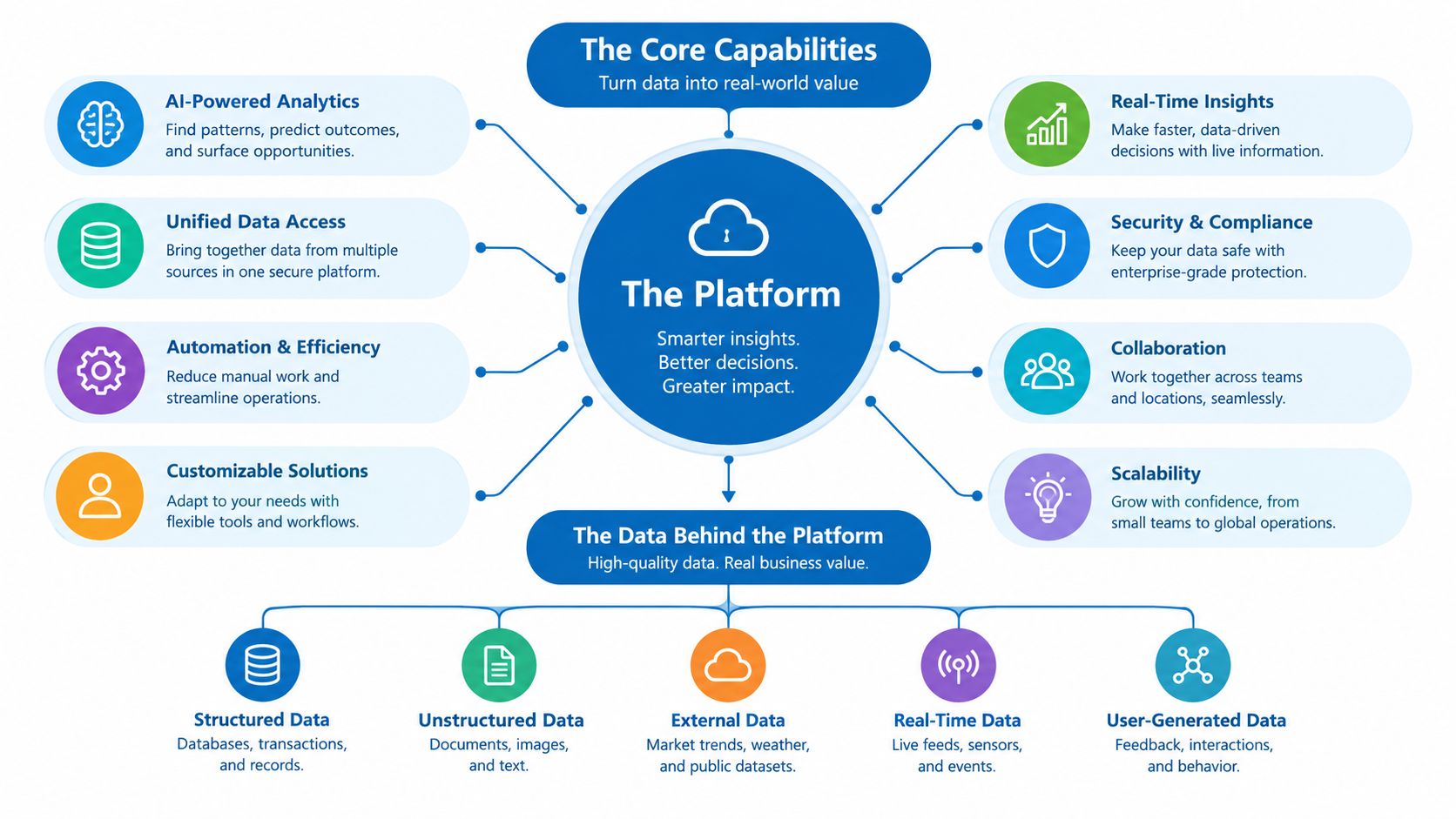
Labor-market intelligence
This pillar tracks external supply, competitor hiring activity, demand signals, and compensation benchmarks. Its data can include public labor-market data, scraped job postings, professional profiles, and salary indicators. A regional bank considering a commercial-lending office can compare the availability of experienced lenders with competing institutions' hiring activity before approving the location.
The broader market is already moving toward cloud-based, software-led delivery. One estimate places software at 64.2% of talent intelligence revenue and cloud deployment at 72.5% market adoption (Dataintelo). Those figures support a practical conclusion: banks should expect the intelligence layer to connect to existing systems rather than operate as a disconnected desktop database.
Skills and role taxonomy
A bank needs a shared language for relationship managers, underwriters, BSA officers, wealth advisors, tellers, and technology specialists. The taxonomy links titles to actual capabilities, certifications, experience, products, markets, and adjacent skills. Without that common language, one business unit's “senior lender” may be another unit's “portfolio manager,” making internal comparisons unreliable.
Internal talent graph
The internal graph maps employees to skills, roles, tenure, performance signals, mobility history, and succession readiness. HRIS records, payroll, LMS activity, performance systems, and ATS history contribute to the picture. A bank can then identify employees who could move into a commercial role, while applying access controls and risk overlays to prevent inappropriate use of sensitive information.
Workforce planning analytics
This capability connects demand forecasts to branch, market, and line-of-business plans. Deposit growth, loan pipelines, planned offices, retirement exposure, and productivity assumptions can inform the workforce model. The output isn't merely a headcount request. It can show whether the bank should hire, redeploy, reskill, centralize, or delay an initiative.
Decision workflows
The final pillar turns analysis into action. Executives can compare scenarios for hiring externally, moving internal talent, adjusting compensation, or changing a market plan. Recruiters need role-fit recommendations and feeder pools. Business leaders need staffing scenarios. Directors need a defensible view of succession and execution risk.
A recruitment CRM serves a different purpose, primarily organizing candidate relationships and engagement activity. This explanation of what a recruitment CRM does helps clarify the boundary: the CRM manages recruiting relationships, while talent intelligence provides the broader analytical context for deciding where those relationships matter.
The integration work is the core investment. Payroll, HRIS, ATS, LMS, public labor data, and job-posting feeds must be normalized, refreshed, and governed before executives trust the output.
Banking Scenarios Where It Changes the Outcome
Talent intelligence earns executive attention when it changes a staffing decision tied to revenue, deposits, or execution. Banks should use it as a labor-market data layer, applying external workforce intelligence with the same discipline they bring to credit and deposit analysis.
Hiring commercial relationship managers
A regional bank needs eight commercial relationship managers across two quarters. A routine search repeats the same job boards, titles, and candidate lists. It also misses adjacent talent and fails to show which competitors are building feeder pools in the target markets.
Talent intelligence software maps relevant skills, previous employers, local supply, and hiring activity. That evidence helps the hiring manager separate a genuinely thin market from a poorly designed search. The bank could broaden the role to include adjacent portfolio experience, adjust the target geography, or use retention-focused compensation instead of reopening the same requisition.
The consequence of a misread reaches beyond recruiting expense. An open relationship-manager territory can delay loan production, weaken deposit coverage, and increase client attrition. The platform does not remove those risks. It gives executives earlier warning and more viable choices.
Staffing a middle-market expansion
Suppose a bank plans to expand middle-market lending and needs 25 analysts with data fluency, but local recruiting can produce only 10. Leadership must choose among national recruiting, internal reskilling, and delaying the program.
A labor-market data layer lets executives test those options before committing branch, office, or technology capital. It can compare local and national supply, identify employees with adjacent skills, and show whether relocation and retention funding is more realistic than a local-only search. Staffing therefore becomes part of the expansion case, rather than a problem discovered after approval.
That distinction matters. Executives can see whether the proposed market plan has the talent capacity to operate.
Protecting a retiring branch president's book
A branch president is retiring with a $400 million book. The exposure involves relationship continuity, local confidence, and the leadership gap competitors may exploit.
An internal talent graph can identify successors with relevant networks, market experience, and leadership readiness. If the bench is thin, it can flag external candidates and show which skills or relationships the bank must acquire. Directors can then connect succession exposure to deposits, client trust, and operating performance.
Retention deserves the same scrutiny as hiring. A practical workplace wellness guide for HR leaders can help teams assess workload, manager quality, and employee experience alongside compensation when key staff face departure risk.
Banks should document these choices through consistent talent management best practices. The goal is not automated judgment. It is stronger evidence before lost deposits, slower loan growth, or damaged client trust reveal the cost of a weak talent decision.
Selection Criteria for a Bank Vendor
Treat vendor selection like a credit committee. Score the provider, challenge the assumptions, document the data, and reject any capability that can't survive operational scrutiny.
The first question is whether the vendor understands banking roles. A platform that performs well for generic technology hiring may still miss the distinctions among a commercial lender, consumer underwriter, BSA officer, wealth advisor, and chief credit officer. Role coverage must reflect the jobs the bank hires.
What belongs in the scorecard
Financial-services data depth matters because external labor signals are only useful when they cover the markets and roles under consideration. Ask how the provider sources, licenses, refreshes, and validates those signals.
Explainability is essential. If the system recommends a successor or candidate, executives should see the relevant skills, experience, market evidence, and assumptions behind the recommendation. A black-box score isn't a governance framework.
Integration depth separates a platform from a dashboard. The system should connect to the HRIS, ATS, performance systems, and learning environment without creating a parallel record that employees must maintain manually.
Security and auditability deserve the same attention as model performance. Ask about SOC 2, access controls, model governance, data lineage, retention, and the ability to reproduce a recommendation later.
| Criterion | What to Score | Deal-Breaker Question |
|---|---|---|
| Banking role coverage | Fit across lending, branch, compliance, risk, wealth, and technology roles | Can the platform distinguish our critical banking roles without manual workarounds? |
| Labor-market depth | Coverage of target markets, skills, competitors, and compensation signals | What evidence proves the data is relevant to our markets? |
| Refresh cadence | Frequency and reliability of updates | How quickly does the system reflect labor-market changes? |
| Explainability | Reasons, evidence, and confidence behind recommendations | Can we defend a recommendation to internal audit or a regulator? |
| Integration | HRIS, ATS, LMS, performance, and identity connections | Which records become stale or duplicated after implementation? |
| Security and governance | Access controls, audit logs, model oversight, and data handling | Can we restrict sensitive succession and employee-risk data by role? |
| Implementation burden | Data mapping, ownership, support, and time to usable output | Who owns the integration after the contract is signed? |
One market listing reports an average G2 rating of 4.63 out of 5 across talent intelligence products and describes capabilities such as real-time supply-and-demand data, workforce snapshots, and labor-market benchmarking (LinkedIn). Ratings can help narrow a shortlist, but they shouldn't substitute for a bank-specific proof of value.
Run the pilot on a real banking decision. Use an active relationship-manager search, a succession role, or an expansion market. If the vendor can't explain its answer, connect the recommendation to a workflow, and show data lineage, don't sign.
The Hard Part Banks Overlook, Data and Integration Risk
Most failed deployments don't fail because the algorithm lacks ambition. They fail because the data foundation is inconsistent, stale, or inaccessible.
Bank HRIS environments often contain outdated titles, duplicate employee records, inconsistent job architectures, and incomplete skills profiles. A commercial lender may appear under one title in the HRIS, another in the ATS, and a third in the performance system. If the platform treats those records as separate people or incompatible roles, its apparent precision becomes misleading.
Data quality determines decision quality
The platform needs a controlled process for cleaning, mapping, and refreshing data. That includes:
- Title normalization: Map local titles to a governed role taxonomy.
- Record matching: Resolve duplicate and orphaned employee records.
- Skills validation: Distinguish claimed skills from evidence in work history, training, and role performance.
- Source governance: Document how external profiles, public job postings, and compensation signals are collected and licensed.
- Refresh ownership: Assign responsibility for correcting data when a role, employee, or market signal changes.
External data creates its own questions. A bank must understand the source, permitted use, licensing terms, and limits on using competitor hiring signals. Legal, compliance, information security, and HR should review those controls before business users depend on the output.
Integration creates quiet failure
Legacy core systems and older HR applications create mapping and latency problems. A succession dashboard can lose credibility if a promotion, departure, or reporting-line change appears late. Managers then return to spreadsheets, not because the analytical method failed, but because the underlying record stopped reflecting reality.
Access design matters just as much. A branch manager shouldn't automatically see sensitive succession assessments across the bank. Managers also shouldn't be able to manipulate skills or performance records to improve a preferred candidate's ranking. Audit logs, role-based access, approval workflows, and documented data lineage are basic operating controls.
The expensive mistake: Buying an AI feature set before funding data governance produces an expensive ornament, not an intelligence layer.
Agentic AI and predictive features are moving into production, but independent guidance continues to identify bias, accuracy, and integration integrity as material risks (The Hackett Group). The differentiator isn't more AI. It is better governance, a credible refresh cadence, and explanations executives can audit.
Measuring ROI Like a Bank Measures Credit
Talent intelligence should face the same approval standard as a commercial pipeline, deposit initiative, or technology program. A bank CFO should fund it only when the platform connects labor-market evidence to operating outcomes, not because its dashboard looks advanced.
Start with measures finance already understands, using a structured performance measurement systems approach. Track cost per acquisition hire, time to productive revenue for relationship managers, vacancy exposure in revenue-generating roles, attrition avoided in key accounts, and succession coverage for branch and commercial leadership. Connect each measure to branch P&L, efficiency-ratio pressure, and sensitivity in loan or deposit growth.
Translate people metrics into operating outcomes
Build the baseline around four questions:
- How long does a revenue-producing role remain vacant?
- How long does the new hire take to contribute productively?
- Which client relationships or markets lack adequate coverage?
- How much critical-role exposure exists without a ready internal successor?
These inputs matter more than activity counts such as applications reviewed or interviews scheduled. Talent analytics links HR processes and program investments with business performance across acquisition, development, attrition, and retention, as Gartner notes.
The table below is a measurement template, not a promise of results. Finance should populate the baseline from the bank's records and define the expected annual impact before approving the purchase.
| Metric | Baseline | Year 1 With Talent Intelligence | Annual Impact |
|---|---|---|---|
| Platform and implementation cost | $250,000 platform plus $90,000 implementation | $340,000 total investment | Use as the approved cost baseline |
| Relationship-manager vacancy | Bank-specific vacancy duration and revenue exposure | Compare against the prior baseline | Recovered productivity and coverage |
| Time to productive revenue | Bank-specific ramp period | Track by market and role | Earlier contribution to loan and deposit plans |
| Critical-role succession | Current ready-now and ready-soon coverage | Reassess after internal matching and development | Reduced execution and replacement risk |
| External hiring efficiency | Current sourcing, interview, and offer funnel | Compare by role and market | Lower search waste and better role-fit decisions |
| Pay and market alignment | Existing compensation position | Compare against external benchmarks | Fewer avoidable declines and retention interventions |
A 12-to-18-month return can support a bank's business case only when management defines recovered productivity, avoided vacancy cost, and reduced succession exposure in advance. Finance should test those assumptions against role mix, data quality, adoption, and execution rather than accept a vendor promise.
For banks that want to benchmark these measures against peers, Visbanking's Bank Intelligence and Action System unifies multi-sourced financial, regulatory, market, and people data. Its Talent module provides access to a 2.6M+ professional graph with matching and AI outreach capabilities for banking and finance roles. Used in this framework, those capabilities can help connect external talent supply, hiring-funnel performance, and workforce risk to broader peer and market analysis.
Benchmark hiring-funnel performance and bench depth against relevant peers before signing the next contract. A bank that cannot quantify its current talent supply, vacancy exposure, and succession coverage does not yet have a credible workforce investment case.
Use Visbanking to connect bank intelligence with practical talent decisions, from professional matching and AI outreach to broader market and institutional analysis. Explore the data, benchmark your workforce position, and identify staffing risks that could affect the next growth or succession decision.
Latest Articles
Brian's Banking Blog
Automated Alerts and Notifications for Banks
Brian's Banking Blog
Customer Feedback Loop for Banks: A Practical Playbook
Brian's Banking Blog
Commercial Lending Trends: What Bank Executives Must Know
Brian's Banking Blog
Bank Marketing Dataset Analysis Strategy
Brian's Banking Blog
ESG Peer Benchmarking for Bank Leaders
Brian's Banking Blog