
Customer Feedback Loop for Banks: A Practical Playbook
Brian's Banking Blog
More feedback isn't better feedback. More accountable action is. Banks can collect surveys after every interaction and still miss the complaints that matter, leave relationship managers without ownership, and give directors a polished satisfaction score that says little about retention, operational risk, or growth.
A customer feedback loop should function as an operating model. It must detect the signal, assign responsibility, resolve the issue, communicate with the customer, and measure whether behavior changed. Survey design matters, but it comes after governance, workflow, and decision-ready data.
Why Most Customer Feedback Loops Fail in Banking
The structural failure is simple: banks treat feedback intake as completion. A survey enters a repository, a score appears on a dashboard, and the organization calls the process customer-centric. The customer, meanwhile, may still be waiting for an explanation, a correction, or a named person who owns the problem.
Independent Ipsos research covering more than 10,000 critical incidents across seven U.S. industries found that organizations were unaware of the complaint or negative incident in more than one-third of cases, while roughly half of customers who experienced a negative incident were dissatisfied with the resolution. The evidence is a warning for bank executives: the largest gap may sit between detection and remediation, not between the bank and another survey instrument. Ipsos research on smarter closed-loop feedback

Collection volume is a poor executive metric
A bank can increase response volume while reducing management clarity. If feedback isn't linked to the account, segment, journey stage, product, service owner, and operational outcome, executives can't tell whether a complaint is isolated, recurring, high-risk, or commercially significant.
That makes ownership the first design question. Who receives a complaint from a commercial relationship? Who decides whether it belongs with the branch, contact center, fraud team, product group, or relationship manager? What deadline applies, and where is the evidence that the bank closed the matter?
A practical customer feedback loop should distinguish between a low-severity suggestion and a serious access failure, fee dispute, fraud concern, or breakdown affecting a strategically important business account. The bank doesn't need to resolve everything immediately, but it must classify, prioritize, assign, and communicate consistently.
Practical rule: Never approve a feedback dashboard that can't show the named owner, due date, resolution state, and subsequent customer outcome for a material issue.
Survey programs still have a place. Banks can use Voicedial.ai feedback collection methods to broaden how they capture voice-of-customer signals, but collection should feed an operating workflow rather than create another disconnected data stream.
The same principle applies to customer experience strategy. Banks should connect feedback to their broader customer experience in the banking industry work, including service recovery, journey redesign, and relationship management. The loop closes only when a customer signal changes an accountable action and the bank can test whether the action worked.
Setting Objectives and KPIs That Bank Directors Can Defend
Directors shouldn't accept “improve customer satisfaction” as an objective. It isn't measurable enough to govern, and it gives management no clear basis for deciding whether the institution has improved service or merely changed survey composition.
Start with an operational statement: reduce repeat contact for defined complaint categories, shorten time-to-owner for priority accounts, increase first-contact resolution, or identify recurring digital failures before they affect retention. Then attach each objective to a segment, owner, service-level expectation, and outcome measure.
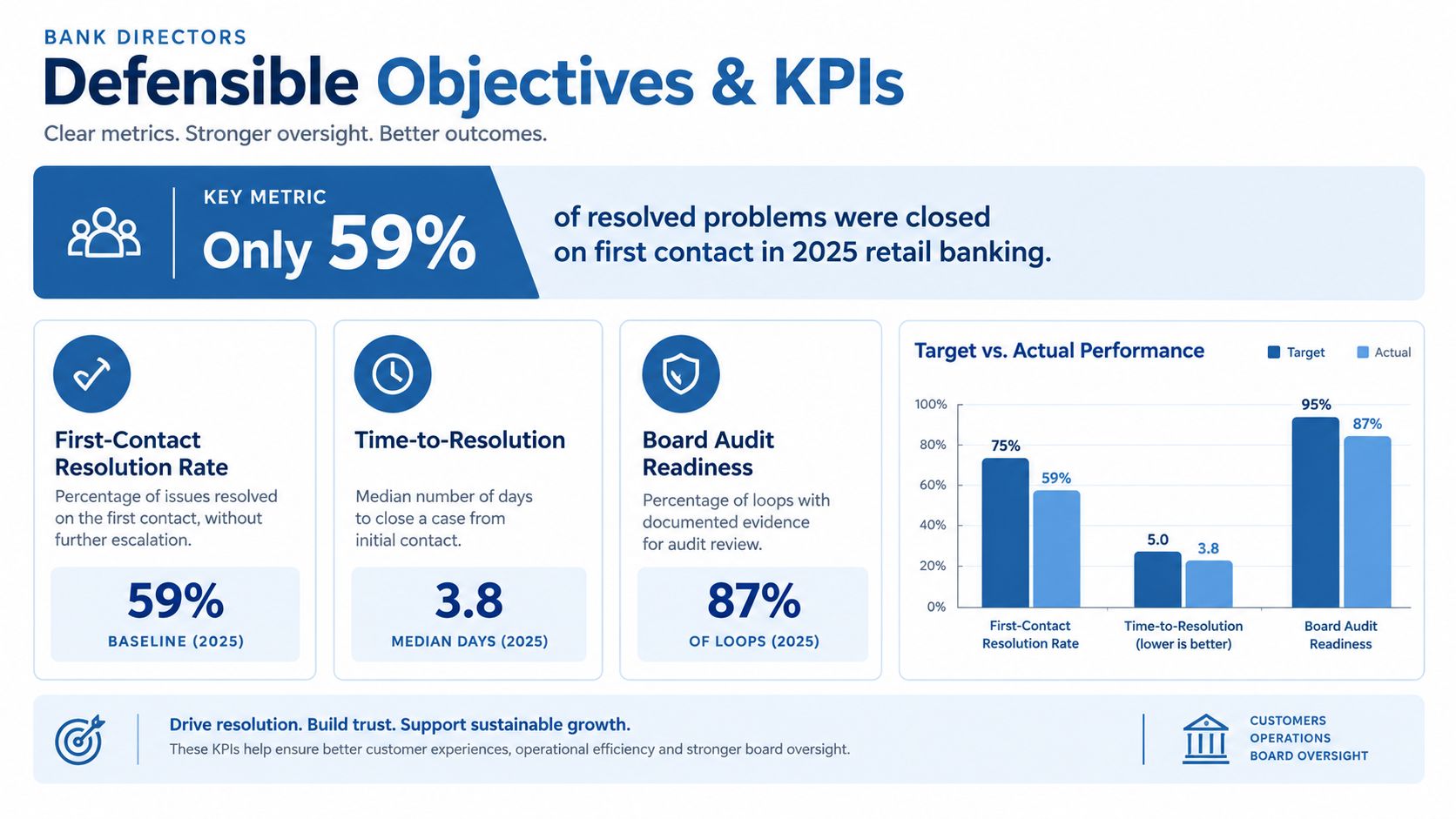
The 2025 J.D. Power U.S. Retail Banking Satisfaction Study analyzed 109,724 customers. It found that only 59% of customers whose bank resolved a problem had it resolved with one contact, 66% reported resolution within one day, and resolution was associated with a 246-point improvement in satisfaction. 2025 J.D. Power U.S. Retail Banking Satisfaction Study
Build a KPI hierarchy
Use the study as a benchmark, not as a universal target. Retail banking, commercial banking, wealth management, and digital-only journeys have different expectations and risk profiles.
A defensible scorecard should include:
- First-contact resolution: Track the share of cases resolved without repeat contact, then split it by product, channel, issue type, and customer value.
- Time-to-owner: Measure how quickly a named employee accepts responsibility. A case that sits unassigned is already an operational failure.
- Time-to-resolution: Report median and tail performance by severity. Averages can hide a small number of materially delayed cases.
- Repeat-contact rate: Identify customers who must explain the same issue more than once. This exposes handoff failures that satisfaction scores often obscure.
- Post-resolution behavior: Monitor retention, expansion, repeat usage, next-survey sentiment, and account changes after the bank closes the issue.
- Audit readiness: Require evidence of the original signal, decision rationale, communications, corrective action, and verification.
Aggregate NPS can remain a headline indicator, but it shouldn't be the decision metric. A strong score may coexist with a growing complaint rate in a high-value segment, while a weak score may reflect a channel mix change rather than deteriorating service.
Bank directors need the underlying operating detail. A performance measurement system should let them move from an aggregate result to the institution, product, owner, and process that produced it.
Board test: If management can't explain which owner changed which process, for which customer segment, and with what post-resolution result, the KPI isn't ready for board oversight.
Designing Signals Beyond the Survey
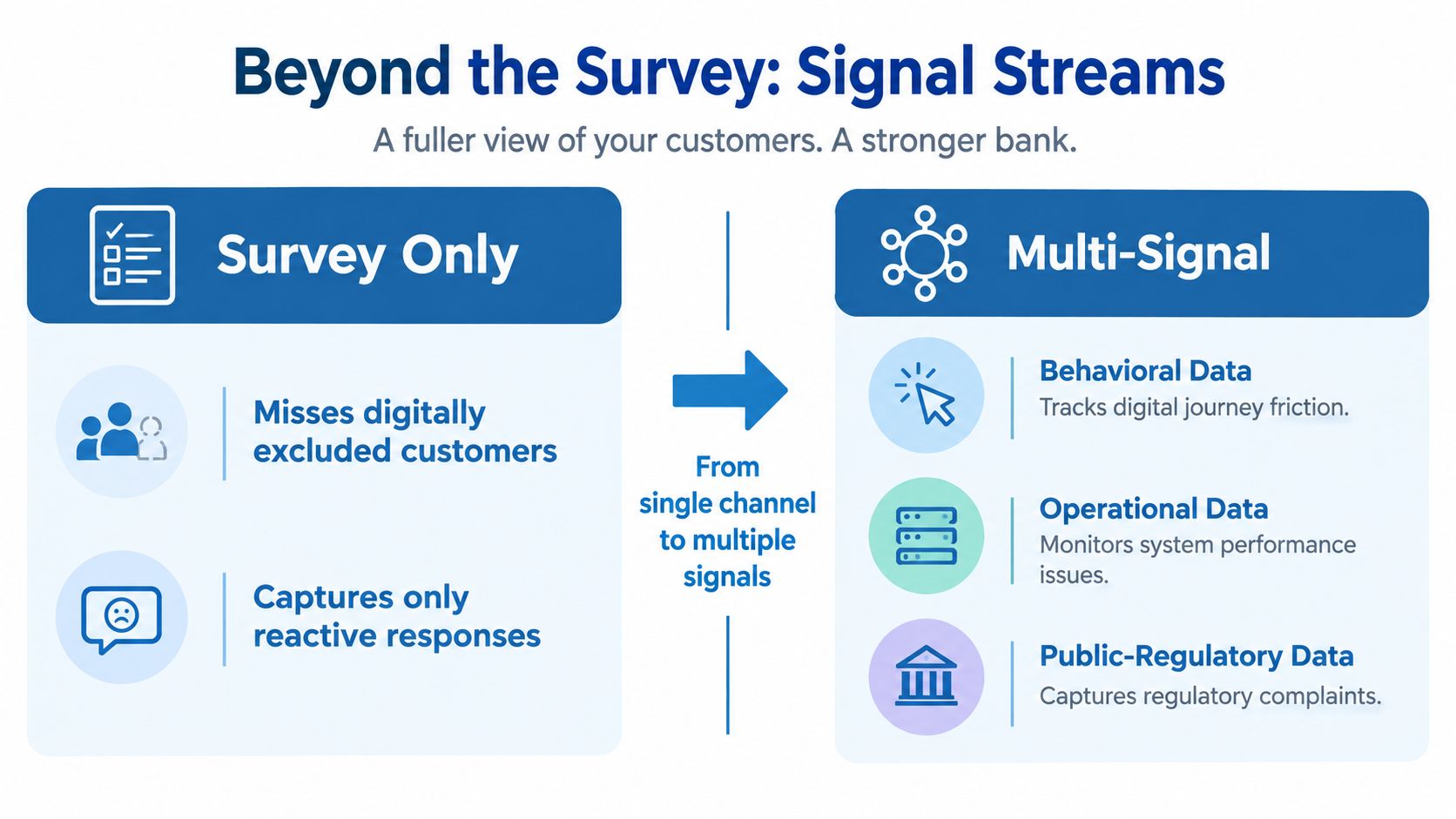
A survey captures what a customer chooses to report. It doesn't capture every failed login, abandoned application, repeated call, delayed payment, or silent departure. Banks that rely on one channel mistake respondent behavior for customer reality.
A 2025 survey of roughly 1,000 consumers found that 44% rated their in-person branch experience as excellent, compared with only 11% rating their digital experience excellent. The same research found that 59% of Gen Z and 55% of Millennials were comfortable receiving financial assistance through AI. 2025 banking technology and experience research
The implication is not that branches should replace digital channels or that AI is automatically a solution. It is that customer feedback must reflect how different groups experience the bank. A digitally active customer may answer an in-app prompt, while a less digitally engaged customer may reveal dissatisfaction through a branch conversation, a call-center repeat contact, or a missed product action.
Build a signal inventory
Treat each source as evidence with a specific use:
- Survey signals: Capture stated satisfaction, effort, sentiment, and reasons immediately after a meaningful interaction.
- Behavioral signals: Show abandoned applications, reduced usage, product switching, missed logins, and changes in account activity.
- Operational signals: Expose app unresponsiveness, login failures, delayed one-time passwords, call transfers, service incidents, and repeat contacts.
- Public and regulatory signals: Add complaint narratives, response outcomes, public reviews, and external sentiment to the internal record.
The quality test is representativeness, not volume. A large survey response count may still underrepresent customers who struggle with digital access, avoid surveys, or complain through human channels.
Executives should compare respondents with the eligible population by segment, channel, product, geography, accessibility need, and relationship value. Then compare what customers say with what they do. A customer who reports satisfaction but abandons an application deserves investigation, as does a customer who gives a neutral score while repeatedly contacting support.
The best feedback programs use surveys to explain behavior, not to replace behavioral evidence. They also use operational data to find problems before customers volunteer them. That combination gives directors a more credible view of service quality and a better basis for investment decisions.
The Eight-Step Closed-Loop Operating Model
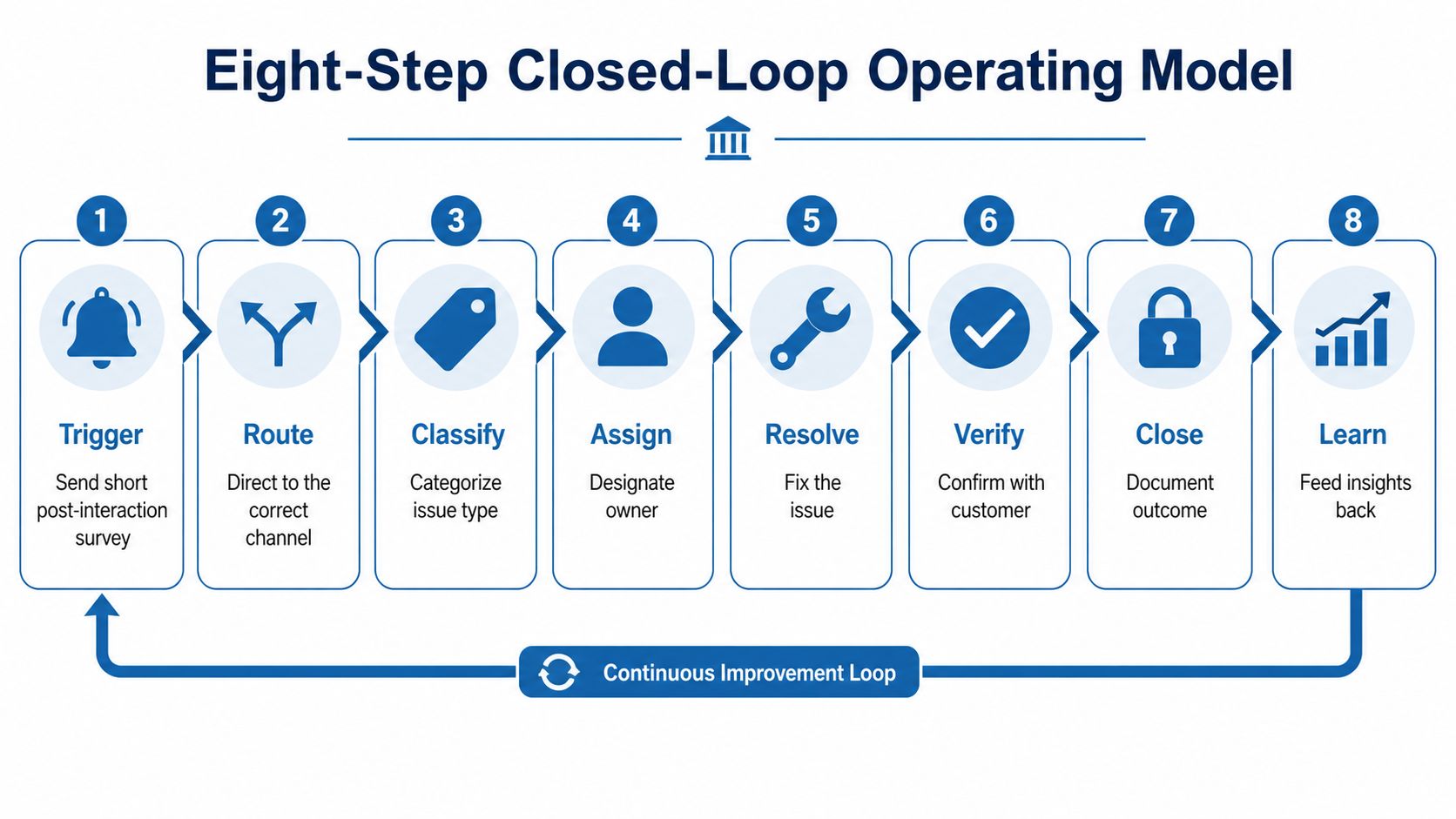
A bank needs a repeatable pipeline, not a pile of disconnected tactics. Treat the customer feedback loop as an operating model, with ownership, closure, and decision-ready analytics at every step from first signal to learning.
1. Trigger
Send a short survey after a meaningful event, such as onboarding, a credit decision, a relationship-manager meeting, service recovery, or a support interaction. Ask for a structured score and an optional reason. Do not interrupt customers with generic requests that lack a clear operational purpose.
2. Route
Direct the response to the right channel and team. A complaint about a commercial account should not disappear into a retail service queue. Routing should use account type, product, journey stage, issue category, severity, and relationship ownership.
3. Classify
Apply consistent categories and severity levels. A fee dispute, suspected fraud issue, mobile login failure, and product suggestion require different workflows. Preserve the original narrative, then add structured fields that let executives aggregate and compare cases.
4. Assign
Give each material issue a named owner and a service-level objective. A relationship-manager complaint from a commercial account may require an owner outside the relationship team, a 48-hour follow-up expectation, and escalation if the owner does not make contact. CustomerGauge follow-up research summary reports that follow-up within 48 hours increased retention by 12% and average NPS by six points.
5. Resolve
Fix the immediate issue where possible, then identify the process or root cause behind it. A refund may address one fee dispute, but recurring fee confusion calls for product, disclosure, or training changes.
6. Verify
Contact the customer and confirm whether the response addressed the issue. Verification should not mean asking the customer to repeat the entire complaint. The owner should explain what changed, what could not change, and why.
7. Close
Record the decision, communication, evidence, and final status as an auditable resolution event. “Closed with explanation” is not the same as “customer confirmed resolution,” and management should preserve that distinction.
8. Learn
Connect the case to retention, expansion, repeat usage, future sentiment, and recurring issue rates. Feed root-cause findings into journey redesign, employee coaching, product governance, and investment planning.
The most underfunded step is usually assignment through verification. Banks often have capable collection tools and weak ownership mechanics. A closed loop is incomplete until a person accepts responsibility and the bank tests the result in customer behavior.
Statistical Controls That Keep the Loop Honest
A dashboard can look exact while representing the wrong customers. Response rates vary by channel, timing, device, segment, and engagement level. Directors should require the eligible population, invitation count, completion count, and exclusions before accepting any score.
One benchmark covering 8,391 surveys from 1,087 companies found a median response rate of 29.05%. Contextual on-page surveys reached 55.07%, compared with 7.64% for widgets and 5.41% for Intercom surveys. It also reported average in-app response of 27.52%, with mobile at 36.14% versus web at 26.48%. Survey response-rate benchmark
Use these figures as channel references, not universal targets. A separate benchmark should be used to test whether the headline median holds for the bank's customer base before directors set performance thresholds.
| Channel | Median Response Rate | Strategic Implication |
|---|---|---|
| Overall benchmark | 29.05% | Use as a broad reference, not a universal target |
| Contextual on-page survey | 55.07% | Captures feedback close to the customer event |
| Widget | 7.64% | May overrepresent highly motivated users |
| Intercom survey | 5.41% | Results may reflect narrow coverage |
Controls directors should demand
- Invitation denominator: Report eligible customers, invitations sent, completed responses, and exclusions.
- Segment coverage: Break results down by channel, product, geography, customer type, relationship value, and accessibility needs.
- Population comparison: Compare respondents with eligible customers using relevant account and behavior attributes.
- Timing consistency: Standardize or randomize invitation timing so channels are measured at comparable journey stages.
- Weighting discipline: Weight results when respondent mix differs materially from the eligible population. Report segments separately when weighting could hide risk.
- Latency reporting: Track time-to-owner, time-to-contact, time-to-resolution, reopen rate, and repeat complaint rate.
- Outcome linkage: Compare pre- and post-resolution retention, expansion, usage, and later sentiment.
A board report should never show NPS without response coverage. A lower score may reflect poorer service, a changed channel mix, or a different respondent population. Each cause requires a different management decision. Statistical controls turn feedback from a collection count into evidence directors can act on.
Wiring Feedback Into BI, CRM, and Bank Intelligence
Feedback becomes valuable when it gains context. A complaint record alone tells management what a customer said. A joined record can show which account, product, relationship manager, journey stage, service incident, peer benchmark, and financial outcome sit behind the statement.
The data model should connect four layers:
- Customer voice: Survey scores, narratives, call notes, review content, escalation history, and response outcomes.
- Relationship context: Account, segment, product holdings, owner, tenure, commercial potential, and recent interactions.
- Operational evidence: Application abandonment, service incidents, authentication failures, processing delays, repeat contacts, and usage changes.
- External intelligence: Peer performance, regulatory complaints, market indicators, and institution-level financial trends.
That structure lets an executive distinguish a single unhappy customer from a systemic service problem. It also allows relationship teams to prioritize issues where customer friction intersects with retention risk, expansion potential, operational weakness, or a market-level pattern.
Make the data layer governed
A governed analytics layer must preserve source lineage, definitions, permissions, and audit history. It should keep qualitative narratives beside structured scores without pretending that one can replace the other. It should also make clear whether a case was answered, explained, resolved, reopened, or verified.
Teams implementing this model should establish field ownership, escalation rules, data-quality checks, and integration responsibilities before configuring workflows. Practical successful CRM implementation tips can help teams avoid a familiar failure mode, where a CRM becomes a larger repository without improving accountability.
Visbanking's BIAS unifies multi-sourced financial, regulatory, market, and people data into explainable analytics. In this context, its role is to place feedback alongside institution-level performance, peer benchmarks, and other decision signals rather than leaving customer narratives in a separate survey system. Banks can connect that intelligence to business intelligence and CRM workflows so relationship teams and executives work from the same operating picture.
The payoff isn't another dashboard. It is a decision record that answers what happened, who owns it, whether the issue recurred, and where the bank should allocate process, technology, or management attention.
Governance, Compliance, and the Director's Checklist
Banks need dual-loop governance. The first loop handles the individual customer quickly, with a named owner, communication standard, and resolution record. The second examines patterns over time, identifies root causes, and changes the process that generated repeated complaints.
The CFPB requires companies to provide complete, accurate, and timely responses to consumer complaints, generally within 15 calendar days. Complaints are then published in the Consumer Complaint Database after the company responds, confirms a commercial relationship, or reaches the 15-day threshold, whichever comes first. The database generally updates daily and exposes fields including date received, product, issue, company response, and timeliness. CFPB Consumer Complaint Database
That regulatory clock should be embedded in the feedback workflow from intake. Directors should be able to see whether cases were routed on time, whether responses were timely, whether explanations repeated across products, and whether narratives point to a broader control or design weakness.
A director-level checklist
- Ownership: Does every material signal have a named accountable employee and escalation path?
- Timing: Can management report time-to-owner, time-to-contact, time-to-resolution, and regulatory timeliness?
- Resolution quality: Does the bank distinguish explanation, remediation, customer verification, reopening, and recurrence?
- Representation: Do results cover branch, digital, phone, commercial, retail, and less digitally engaged customers?
- Root cause: Can the bank identify recurring issues by product, process, channel, geography, and institution type?
- Outcome: Are retention, expansion, usage, and repeat-contact measures connected to closed cases?
- Auditability: Can an independent reviewer reconstruct the signal, decision, action, communication, and evidence?
- Control environment: Are access, retention, workflow permissions, and evidence handling supported by appropriate governance tools, including a review of best SOC 2 software platforms where relevant?
A single satisfaction score can't provide that assurance. Directors should demand a system that handles immediate recovery while continuously testing whether the bank's processes are producing the same failures again.
Visbanking combines bank performance, regulatory, market, and relationship intelligence so executives can connect customer feedback with peer benchmarks, operational signals, and measurable account outcomes. Visit Visbanking to benchmark your institution and build a more accountable customer feedback loop.
Latest Articles
Brian's Banking Blog
Automated Alerts and Notifications for Banks

Brian's Banking Blog
Commercial Lending Trends: What Bank Executives Must Know

Brian's Banking Blog
Bank Marketing Dataset Analysis Strategy

Brian's Banking Blog
ESG Peer Benchmarking for Bank Leaders
Brian's Banking Blog
What Is Repricing Risk: A Bank Executive's Guide

Brian's Banking Blog