
Automated Alerts and Notifications for Banks
Brian's Banking Blog
Your Monday meeting starts with a familiar problem: treasury saw a funding change, commercial banking missed a prospect signal, and operations is still determining whether an overnight service interruption affected customers. The information arrived. The decisions didn't. For directors and executives, automated alerts and notifications should be judged by what people do next, not by how many messages the bank sends.
The Morning an Alert Should Have Changed the Quarter
Consider a hypothetical bank entering its morning operating meeting. Overnight, its systems flagged a portfolio shift, a competitor relationship change, and a processing disruption. The relationship manager dismissed the commercial signal as another routine update. Treasury never opened its queue. Operations acknowledged the disruption but didn't assign anyone to assess customer impact.
By the time the chief risk officer asks for an explanation, management can reconstruct message delivery but not decision ownership. Nobody can establish who reviewed materiality, whether the incident required regulatory escalation, or why the commercial opportunity went untouched. The technical controls worked. The operating controls didn't.
A quiet inbox isn't evidence of a successful alert program. A documented, defensible chain of decisions is.
The failure executives should investigate
The immediate question isn't whether the bank needs another detection model. It's whether existing signals reach people authorized to make the relevant decision. A relationship change needs a commercial owner; a funding concern needs treasury; a security incident needs an accountable escalation team.
The scale of ineffective alerting is visible in compliance. SymphonyAI's compliance-modernization findings report that more than 70% of financial institutions have AML false-positive rates above 25%, while 54% say fewer than 5% of alerts produce case escalation or a suspicious-activity-report filing. The same findings describe trade-surveillance false-positive rates above 25% at more than 70% of interviewed firms.
Those results don't measure commercial banking alerts. They illustrate why executives shouldn't confuse detection activity with useful work.
Every alert program needs to perform distinct jobs: detect a meaningful change, prioritize it, route it to an owner, and preserve evidence of the decision. If management can demonstrate only the first job, it hasn't completed the control.
What Automated Alerts and Notifications Actually Mean in Banking
An automated alert occurs when a data signal meets a documented condition that warrants review or action. A notification is the message that communicates that event. Treating those as interchangeable encourages banks to optimize delivery while neglecting the decision behind it.
A useful alert should connect a source record to a business question. Did a borrower's condition change enough to justify review? Did a prospect's leadership change create an opening? Has an operational disruption become material? The message should explain the change without requiring the recipient to reconstruct the analysis.
Match the channel to the decision
Push channels such as email, Slack, SMS, and CRM tasks bring information to recipients. Pull channels such as dashboards require users to retrieve it. A scheduled digest sits between those approaches: it delivers information but deliberately batches the review.
In a field study of mobile-notification engagement, researchers examined 794,525 notifications from 278 smartphone users, who received a median of 56 daily notifications; messaging notifications led to associated-app opening 63.67% of the time, group messaging 65.81%, and email 15.47%. These aren't bank-executive response benchmarks, but they show that delivery categories differ substantially in engagement.
Choose channels around urgency, recipient behavior, and evidence requirements, not a software vendor's default settings. AY Automate's resource on AI for finance workflow automation is a useful starting point for considering how notification delivery connects to broader workflow design.
Bank Intelligence's predictive risk and performance signals, delivered through email, Slack, and CRM integrations, should be evaluated on that same basis. The executive definition is straightforward: an alert program exists to put decision-ready evidence in front of an accountable person while action still matters.
The Four Core Alert Categories Every Bank Needs
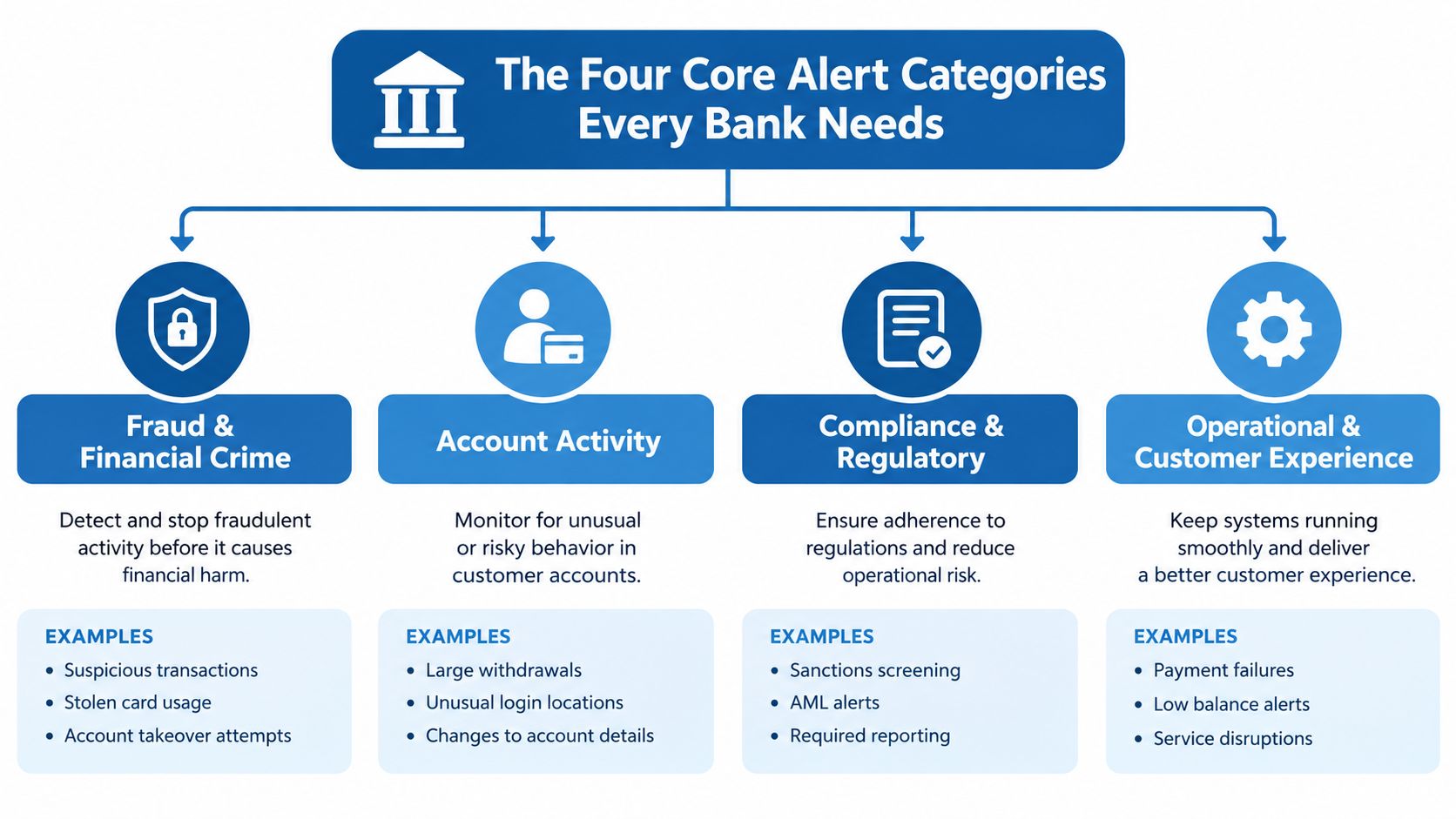
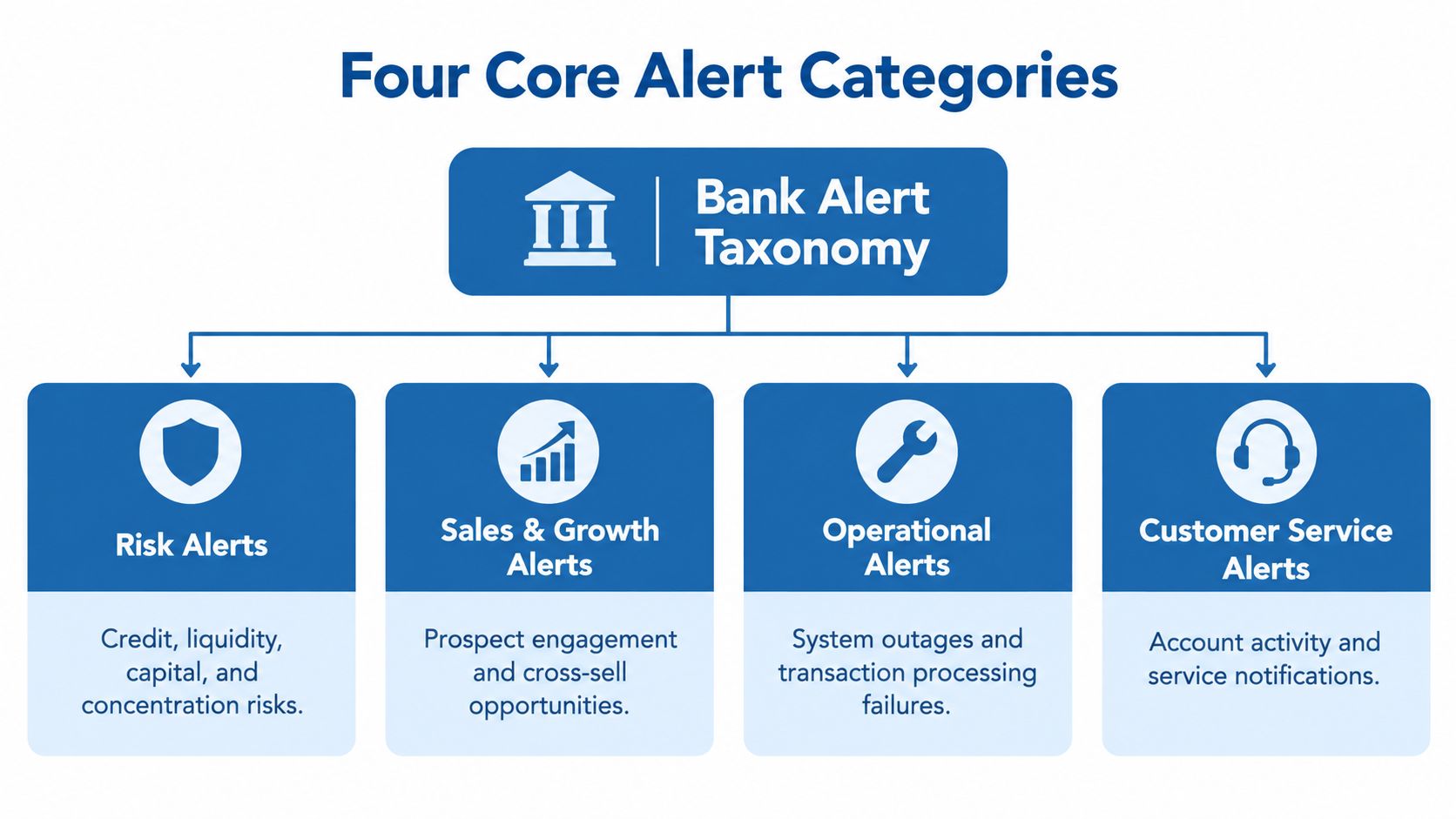
A quarter can turn on whether an executive receives the right signal in time to act. Organize alerts around management decisions, not the applications generating messages. Risk, sales and growth, talent, and regulatory-operational events form a practical operating taxonomy. Customer notifications should stay within the service workflows responsible for resolving them.
Cover financial and commercial decisions
- Risk alerts should cover credit, liquidity, capital, and concentration. For example, a hypothetical 12% decline in liquid-asset coverage could trigger a same-day treasury review. Treat that as an illustrative threshold, not a supervisory standard. Treasury must define the calculation, comparison period, materiality rationale, and evidence of review.
- Sales and growth alerts should surface relationship changes, product opportunities, and meaningful peer-performance drift. A hypothetical $40 million commercial prospect relationship with a new decision-maker calls for the commercial owner to validate the change and decide whether outreach is warranted. It should not automatically launch a generic campaign.
Peer context can reveal deterioration that an institution's absolute results obscure. Bank Performance supports benchmarking and historical analysis across 4,600+ institutions, while Talent draws on a 2.6M+ professional graph. Use these signals to distinguish meaningful changes from background movement, and retain the comparison that supports the decision.
Cover organizational and operating decisions
A producer's resignation should trigger an account-continuity review, not just a recruiting notification. Talent signals can identify relationship exposure and hiring opportunities, but a manager must verify the change and assess affected customers. Keep professional-profile signals distinct from confirmed personnel events, and record who validated the signal and what follow-up occurred.
Regulatory and operational alerts run on different clocks and need accountable workflow owners. BSA concerns, computer-security incidents, provider degradation, and filing anomalies should reach the teams responsible for investigation and escalation. A provider disruption is not a sales signal with a higher priority label. Define the required response and preserve proof of action for management, the board, or an examiner.
Review your operational risk indicators against this taxonomy. Pay particular attention to handoffs: a producer's departure can create customer-service risk, while an outage can affect liquidity operations. Assign an owner to each transition and document the resulting decision.
Alert Quality Is Not the Same as Alert Volume Reduction
Fewer alerts can mean better prioritization. They can also mean a less sensitive detection system. Executives should reject suppression counts as the primary measure of improvement.
The compliance findings described earlier justify examining false positives. They don't justify assuming that every reduction represents progress. Raising a threshold can remove distracting messages while also excluding emerging risks, smaller opportunities, or events affecting institutions with different business models.
Alert Quality Scorecard
| Dimension | What It Measures | Where Most Banks Fall Short |
|---|---|---|
| Signal precision | Whether flagged events genuinely warrant review | Treating closure as proof that detection was wrong |
| Actionability | Whether recipients can identify the next decision | Sending a metric change without business context |
| Time-to-response | How quickly an accountable person begins review | Measuring delivery instead of human response |
| Conversion to documented action | Whether review produces a recorded decision | Counting message opens as completed work |
| Missed-signal risk | Whether material events escaped detection | Testing generated alerts but ignoring absent ones |
Calibrate rules by institution size, business model, market, and user role. A commercial leader evaluating prospect activity shouldn't inherit the same materiality logic as a treasury officer assessing funding pressure. Even within a category, a threshold suitable for one portfolio may be inappropriate elsewhere.
Boardroom test: When management reports fewer alerts, ask which previously detected events the revised rules would no longer surface.
Require explanations before closure
For an explainable banking-intelligence workflow, require the source record, rule version, materiality rationale, and recommended next action. A recipient should be able to challenge the evidence without searching through disconnected systems.
Don't let automated filtering become automated judgment. If a system closes an alert, record the basis for closure and retain enough evidence to review that decision later. If a person overrides the recommendation, preserve the reason.
The standard isn't eliminating uncertainty. It's making uncertainty visible and decisions defensible. Management should be able to distinguish false positives, justified non-action, duplicate events, and useful alerts. Combining those outcomes into a single closure total conceals the information executives need.
Regulatory Clocks That Should Drive Alert Design
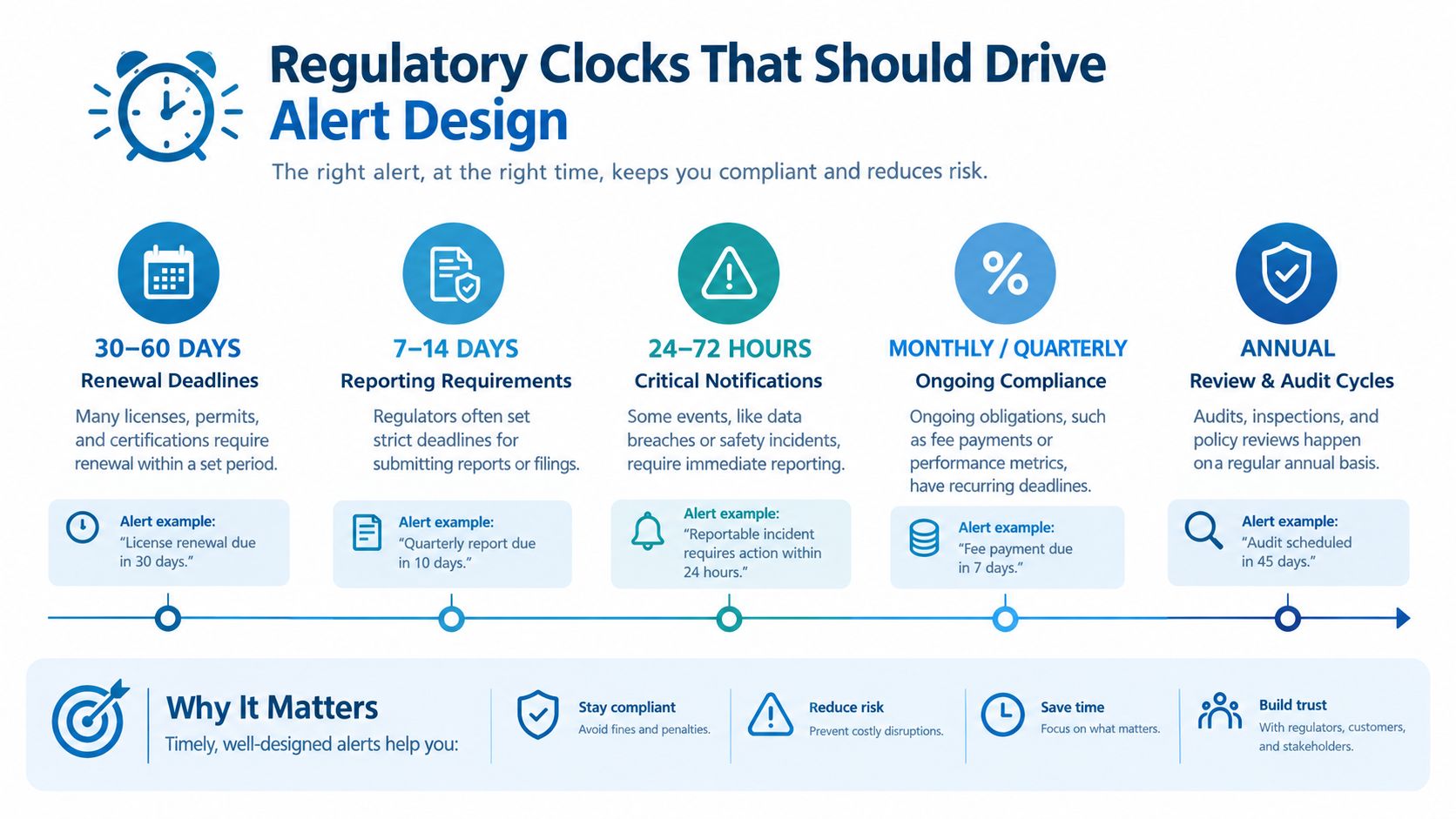
A regulatory clock begins at a defined event or determination, not when someone finally reads an email. Your alert architecture must preserve that distinction. Compliance and counsel should validate applicable requirements before technology teams encode them.
The banking agencies' computer-security incident notification rule requires an FDIC-supervised banking organization to notify the FDIC as soon as possible and no later than 36 hours after a good-faith determination of a qualifying notification incident; it also requires a bank service provider to notify a designated bank contact as soon as possible when covered services suffer, or are reasonably likely to suffer, qualifying disruption or degradation for four or more hours.
Record the determination, not just the outage
In a hypothetical scenario, a core processor reports degradation at 9:00 a.m., expected to continue through 1:00 p.m. The workflow should notify the designated contact promptly, preserve that forecast, and initiate bank-level impact assessment. Don't wait for the expected duration to elapse when the qualifying disruption is already reasonably likely.
Capture the affected services, customer impact, decision owner, determination time, notification evidence, and subsequent updates. A provider notification and a bank's regulatory determination are related but distinct events.
Separate legal triggers from investigative signals
The interagency funding and liquidity risk-management policy identifies early-warning indicators including negative publicity, worsening financial condition, widening spreads, and funding concerns. Treasury should connect these signals to the bank's risk profile and contingency decisions rather than label every indicator a fixed legal deadline.
BSA alerting likewise needs behavioral context and aggregation. Proximity to a currency-reporting threshold alone shouldn't become an automatic suspicious-activity filing instruction.
Maintain a controlled regulatory change management process so legal updates reach rules, owners, and evidence requirements. Institutions with Indian operations can separately consult DilicheckRep's practical DPDP readiness actions for India as a jurisdiction-specific planning resource, not as a substitute for U.S. banking requirements.
Designing Alerts Around the Human Workflow
Delivery is not completion. An alert becomes operationally useful when someone accepts responsibility, performs the review, and records an outcome. An unavailable employee, an anonymous queue, or an unmonitored collaboration channel can break that chain.
Javelin's research on customer reactions to alerts describes recipients who don't know alerts exist, find them repetitive, or perceive marketing disguised as useful information. Executive workflows aren't consumer workflows, but the design lesson is relevant: messages that fail to distinguish meaningful action from routine communication invite dismissal.

Give urgency an operating meaning
- Page-worthy events need an available decision-maker, an acknowledgment requirement, and a tested escalation path.
- Ticket-worthy changes need a named assignee, a deadline, and supporting evidence in the work record. A CRM task is appropriate for a commercial follow-up that doesn't warrant interruption.
- Digest-worthy trends belong in scheduled review. Quiet periods should protect attention without suppressing critical risk or mandatory escalation.
Deduplicate correlated messages with a stable event key. Define suppression windows so related updates enrich an existing case instead of opening parallel tasks. Assign fallback ownership before an employee goes on leave, not after a critical message sits unanswered.
Prevent unstable signals from becoming repeated interruptions
Google's practical alerting guidance recommends aggregation, deduplication, and severity-based routing, and describes requiring a condition to persist for at least two evaluation cycles to prevent rapidly changing conditions from causing alert flapping. Apply persistence rules carefully: a noise-control setting must not postpone an applicable regulatory obligation.
For email, Slack, and CRM routing, test the complete handoff. Can the recipient reach the source evidence? Does acknowledgment update the underlying case? Does escalation occur when nobody responds?
Vendor demonstrations should include unavailable recipients, delivery failures, duplicate signals, and reopened cases. A polished notification screen proves little about those operating conditions.
Implementation Checklist for Banking Alert Programs
Start with the decision, not the connector. A delivery team can build an elegant integration around an undefined business problem, and management will still be unable to explain why the alert exists.
Use a sequenced implementation plan with explicit acceptance criteria. Don't cut users over until business owners have reviewed both generated alerts and known events the rules failed to detect.
Build the operating controls before rollout
- Define decision jobs. Specify what treasury, risk, commercial banking, compliance, and operations are expected to decide. Identify who can approve action and who can override a recommendation.
- Inventory evidence. Map source availability, ingestion, transformations, entity matching, and missing-data handling. Bank Performance can supply peer context, Prospect relationship intelligence, and Talent organizational signals.
- Draft severity and routing. Separate urgency from financial magnitude. Confirm recipient coverage and escalation authority before configuring Bank Intelligence, including its beta predictive signals and automated delivery.
- Build the audit record. Preserve rule history, supporting data, acknowledgments, overrides, and resolution evidence. Link notification activity to the actual decision record.
- Run a controlled pilot. A hypothetical pilot covering 50 institutions with 14 days of shadow-mode evaluation is a planning example, not a validated implementation standard. Choose scope and duration around data cadence, operational risk, and the events you need to observe.
- Calibrate and approve cutover. Compare proposed triggers with actual outcomes, obtain business-owner signoff, and document rollback conditions.
Make freshness visible
Google's monitoring guidance warns that data more than four to five minutes stale can materially slow incident response and create misleading interpretations of cause and effect. That warning concerns operational monitoring; regulatory filings and other banking datasets have different publication cadences.
Show the source timestamp, ingestion lag, transformation status, and last successful evaluation. A recently delivered notification isn't necessarily based on recently available evidence.
Use a documented approach to create a workflow before broad rollout. Require latency dashboards and change-control records alongside business reports, and schedule quarterly threshold reviews as a management practice.
Instrument action rate, acknowledgment time, outcome conversion, and clock compliance from launch. Add missed-signal testing and evidence completeness to independent oversight rather than leaving them for an eventual examination.
KPIs, Executive Takeaways, and the Next Move
A board should be able to ask one precise question: Which decisions improved, who owned them, and what evidence supports that conclusion? Aggregate alert counts cannot answer it. Assign an accountable executive to each measure and preserve the cases behind the reported results.
A rising action rate does not prove better decisions. Staff may log superficial actions, thresholds may screen out difficult cases, or a shift in event mix may skew comparisons. Review related measures together, while keeping sales, risk, compliance, and operational workflows distinct.
Use measures that expose the decision chain
| KPI | Executive interpretation |
|---|---|
| Alert-to-action rate | Did review lead to a recorded business action or justified non-action? |
| Time-to-acknowledgment by severity | Did the responsible person respond within the bank's policy? |
| Decision-to-outcome conversion | Did the action advance an opportunity, complete a review, or mitigate an identified risk? |
| Regulatory-clock compliance rate | Did qualifying events meet their applicable notification obligations? |
| Missed-signal rate | Did back-testing reveal material events the rules failed to detect? |
| Audit-trail completeness | Can management reconstruct the evidence, owner, judgment, and resolution? |
A booked meeting does not prove a relationship advanced. An account review does not prove a risk was mitigated. Define the outcome before teams use these labels in executive reporting.
Management standard: No performance measure is complete without an owner, a definition, and a reviewable record.
Make the next decision concrete
At the next operating review, require each business leader to present a representative alert, its supporting evidence, and its completed decision record. Include an ignored alert and a material event that should have triggered one. These cases show whether the program produces defensible decisions, not merely fewer notifications.
Then choose the first failure to address: weak evidence, poor calibration, unclear ownership, or missing follow-through. Automated alerts and notifications should strengthen management judgment, not create a larger inventory of unattended signals.
Visbanking offers Bank Performance, Prospect, Talent, and Bank Intelligence for connecting banking data with performance, relationship, hiring, and risk decisions. Use those inputs to test whether each alert has a named owner, an applicable regulatory clock, and a reviewable record of the decision and action.
Latest Articles
Brian's Banking Blog
Customer Feedback Loop for Banks: A Practical Playbook

Brian's Banking Blog
Commercial Lending Trends: What Bank Executives Must Know
Brian's Banking Blog
Bank Marketing Dataset Analysis Strategy

Brian's Banking Blog
ESG Peer Benchmarking for Bank Leaders
Brian's Banking Blog
What Is Repricing Risk: A Bank Executive's Guide
Brian's Banking Blog