
Talent Market Intelligence: A Guide for Bank Leaders
Brian's Banking Blog
Employers expect 39% of workers' core skills to change by 2030, according to the World Economic Forum's 2025 Future of Jobs Report. That projection changes the question bank directors should ask about staffing. The issue isn't whether the bank has enough employees, but whether those employees have the capabilities its strategy will require.
What Talent Market Intelligence Means for Banks
Talent market intelligence is the continuous collection and linking of external labor-market information, including professional histories, hiring activity, compensation benchmarks, and occupational projections, to support decisions about capabilities, workforce capacity, and business relationships.
Think of it as a credit map for people. A lender who understands where borrowers, deposits, and industries are expanding can make more informed allocation decisions. A bank that maps expertise can similarly assess where to recruit, which capabilities to develop internally, and where a departure would create an unacceptable dependency.
The distinction from conventional HR reporting matters. A static candidate database records people identified during an earlier search, but it doesn't establish whether their skills, availability, or responsibilities remain current. A retrospective HR report explains completed hiring and departures, not the external alternatives available when management must act.
From staffing information to board decisions
Talent market intelligence should support recruiting, succession, and business development. These uses require different outputs: a defensible shortlist, an assessment of leadership continuity, or a verified map of decision-makers at a prospective client.
For covered large national banks, the governance connection is explicit. The OCC's heightened standards require talent development, recruitment, and succession processes so employees who make or influence material risk decisions possess the necessary knowledge, skills, and abilities.

The practical implication is to connect each critical role to demonstrated competencies, current coverage, and replacement options. A directory of impressive résumés isn't enough. Directors need evidence that management can translate market signals into a recruiting, development, or continuity decision.
Where the Signals Come From
Talent market signal sources and the questions they answer
| Source | What it measures | Banking question it answers |
|---|---|---|
| Professional graphs | Career histories, skills, role changes, tenure, and moves across firms | Who holds a capability, and where are a prospect's decision-makers? |
| Hiring activity | Job postings, applications, and openings by role and region | Which competitors are seeking a capability, and how difficult might hiring be? |
| Hiring outcomes (JOLTS) | Monthly openings, hires, and separations across the U.S. labor market | What is the turnover baseline, and does demand persist across the cycle? |
| Compensation trends | Pay benchmarks by occupation and metro area, plus documented skill premiums | Where might offers need to move to attract qualified candidates? |
| Occupational projections (BLS) | Ten-year employment change and separations across more than 800 occupations | Which roles warrant closer replacement planning? |
No source answers every question. Professional histories can indicate experience, but they don't confirm willingness to move. Postings reveal advertised demand, not completed hiring, and compensation benchmarks need adjustment for responsibilities, incentives, and location.
For geographically constrained searches, analysts can explore professional counts by geography through ProfessionLens as an initial market-sizing resource. They should then narrow the count to people with relevant qualifications rather than treating every listed professional as an available candidate.
Separate the baseline from the target market
The Bureau of Labor Statistics' JOLTS series recorded 7.242 million total nonfarm job openings in February 2025 and 7.089 million in July, while benchmarking revised the annual job-openings estimate from 7.762 million to 7.431 million, a reported 4.5% difference. Those national figures provide context, not a forecast for a bank's treasury vacancy.
Revisions are a reason to retain source dates and update estimates. An analyst shouldn't present a revised series alongside an unrevised competitor snapshot without identifying the mismatch.
More applicants don't establish abundant expertise
According to iCIMS' August 2024 workforce findings, applications for technology roles were 36% higher than at the start of 2023, while openings declined 7% and hires declined 6%. Separately, the Federal Reserve Bank of Atlanta counted nearly 628,000 U.S. job postings requesting an AI skill in 2024, representing 1.7% of all postings.
These measures don't prove scarcity in a specific banking specialty. They show why application volume and aggregate hiring can't settle the question: a bank must isolate the capability it needs.
Analyst's rule: Weight each signal by its proximity to the decision, and attach a source date to every record.
Why Skills Beat Job Titles
A title is the label on a jar. Skills are the contents. Before committing to a candidate, a bank needs to inspect what the person has really done.
Consider a treasury analyst who built liquidity-forecasting models and led a data-quality project. A title-only search for data-science talent could exclude that employee, even though the work warrants assessment. Conversely, a technology-oriented title doesn't establish experience deploying models under banking controls.
The World Economic Forum's skills outlook identifies AI and big data, networks and cybersecurity, and technological literacy as the fastest-growing skill categories. For executives, the decision is how to identify demonstrated capabilities without confusing terminology with competence.
Build an explainable skills assessment
Normalize the vocabulary. Translate different descriptions into a shared skills taxonomy. Liquidity forecasting and cash-flow modeling may overlap, but the system should preserve distinctions between operational forecasting, regulatory liquidity analysis, and model development.
Weight evidence, not adjectives. A delivered project, relevant credential, or documented responsibility deserves more weight than a self-description. Record the evidence behind the assessment so an interviewer can verify it.
Account for recency. Reduce confidence when a capability hasn't been demonstrated recently, particularly where tools or practices have changed. Don't erase older experience automatically; distinguish foundational knowledge from current proficiency.
Map adjacent capabilities. Identify which existing skills could support development into the target role. Adjacency should create an assessment or training opportunity, not an unsupported declaration that someone is already qualified.
Turn the assessment into a decision
A useful output connects the role requirement, supporting evidence, confidence level, and next action. A candidate might have strong evidence of forecasting experience but uncertain exposure to liquidity stress testing. The appropriate next step is a focused assessment, not an unexplained rejection or automatic advancement.
Avoid displaying a precise-looking composite score without the underlying reasoning. Directors and hiring managers need to understand which requirement remains unproven and whether that gap is trainable within the bank's timeframe.
The same discipline applies internally. Before authorizing an external requisition, management should check whether an employee with adjacent capabilities could meet the need through a defined development assignment. That isn't a presumption in favor of internal promotion. It's a requirement to compare alternatives using the same evidence.
Reading Supply Risk and Pay Pressure
Expected openings equal growth demand plus replacement demand. Flat employment doesn't mean a role will be easy to fill if departures continue to create vacancies.
The BLS Employment Projections program produces 10-year projections for more than 800 detailed occupations across roughly 300 industries, with occupational skill-importance measures introduced in the 2023–33 projections. These are useful inputs for workforce scenarios, but broad occupational categories need careful mapping to specialized bank roles.
Compare requirements with qualified supply
For a bank-specific model, estimate anticipated openings over a consistent planning period and divide them by the qualified candidate pool in the relevant geography. Count qualifications before counting profiles. A broad finance occupation isn't a substitute for demonstrated treasury expertise.
Illustrative ten-year supply risk for a hypothetical regional bank
The percentages below are hypothetical scenario assumptions, not observed market statistics. For this example only, classify below 10% as low risk, 10% to 20% as moderate, and above 20% as high.
| Role | Openings as share of pool | Supply-risk verdict |
|---|---|---|
| Treasury and liquidity specialist | 21% | High |
| Cybersecurity engineer | 29% | High |
| Branch operations manager | 6% | Low |
| Commercial relationship manager | 21% | High |
Treasury warrants attention because the assumed replacement and growth requirement is substantial relative to the specialized pool. Cybersecurity presents the greatest proportional exposure in this scenario, suggesting management should test a broader geography, development options, or retention measures.
Branch operations illustrates the opposite result. Even substantial replacement activity could remain manageable against a sufficiently large qualified pool. Commercial relationship management receives a high-risk classification, but management should further segment that pool by industry knowledge, market coverage, and client responsibilities.
Add compensation without creating false precision
The next question is whether the bank can attract qualified people on its current terms. Compare the proposed role with local compensation benchmarks, separating base salary, incentives, responsibilities, and location requirements.
If a high-risk role also requires an offer premium, management faces both timing pressure and cost pressure. That should prompt an explicit choice among paying more, changing the role, widening the search, or developing internal capacity. Retention deserves equal attention; a practical review of how to reduce employee turnover can complement the external supply analysis.
A supply-risk score is a planning assumption to challenge, not a prediction that a vacancy will remain unfilled.
Preserve the model's source vintage, pool definition, and replacement assumptions. A candidate pool can change through migration, training, competing demand, and willingness to relocate. Management should refresh the scenario rather than defend an aging score just because it appears on a dashboard.
Recruiting, Succession and Business Development Uses
The OCC Comptroller's Handbook on corporate and risk governance says succession should be a regular board topic, boards should approve policies addressing the loss of key executives, and succession plans should be reviewed and updated at least annually. For community-bank directors, the FDIC's succession guidance recommends planning generally across a three- to five-year horizon, beginning with potential internal successors and their development needs.
A director therefore needs more than a list of possible replacements. The dashboard should identify critical positions, candidate readiness, unresolved competency gaps, external alternatives, and the last review date.
Make continuity decisions visible
Consider a hypothetical $2 billion community bank whose chief risk officer resigns unexpectedly. Its succession dashboard separates a ready-now internal successor from a candidate requiring a hypothetical six-month development period and an external search needing specialized outreach.
The board's immediate decision concerns accountable coverage, not only the preferred permanent appointment. Management should show who can assume responsibilities now, which limitations require interim support, and what evidence is needed before approving a permanent successor.
- Recruiting view: Compare candidates against the approved role requirements and record unresolved questions.
- Succession view: Show readiness, development assignments, interim coverage, and decision ownership.
- Board view: Escalate gaps that could impair risk oversight or execution of the business plan.
This makes strategic workforce planning a continuing management process rather than a document retrieved after a resignation.

Use hiring signals to improve client conversations
A commercial client advertising treasury positions may be expanding internal cash-management capabilities. That is a reason for the relationship manager to investigate, not proof that the client needs a particular product.
The manager should verify the hiring initiative and ask whether the client is changing payment processes, liquidity management, or banking relationships. Outreach should reference a relevant business question without overstating what a posting reveals.
Alongside internal HR systems and CRM tools, Visbanking's Talent app provides a professional graph of more than 2.6 million profiles with AI-assisted outreach, while its Prospect app maps relationships and decision-makers at target firms. These capabilities support different workflows, but both require verified identities, appropriate access, and human review before action.
Choose an Integration Pattern Before You Buy
Talent intelligence integration patterns for CRM and ATS
| Integration pattern | How data moves | Best fit | Main risk |
|---|---|---|---|
| Manual export | Analysts export shortlists and import them into the ATS or CRM | A small pilot, hypothetically fewer than 100 profiles a quarter | Stale records and missing audit trails |
| Scheduled batch sync | Nightly or weekly pushes populate tagged fields | Relationship teams tracking multiple accounts | Duplicate contacts from weak matching rules |
| Native connector | A prebuilt connection exchanges records and status updates | Recruiting teams with defined requisitions | Limited mapping for custom bank roles |
| API integration | A custom service reads signals and writes scores or alerts | Banks with data teams and proprietary models | Maintenance costs and unclear ownership |
| Alerts plus CRM task | A signal generates a notification and follow-up task | Client hiring or leadership-change triggers | Alert fatigue from loose thresholds |
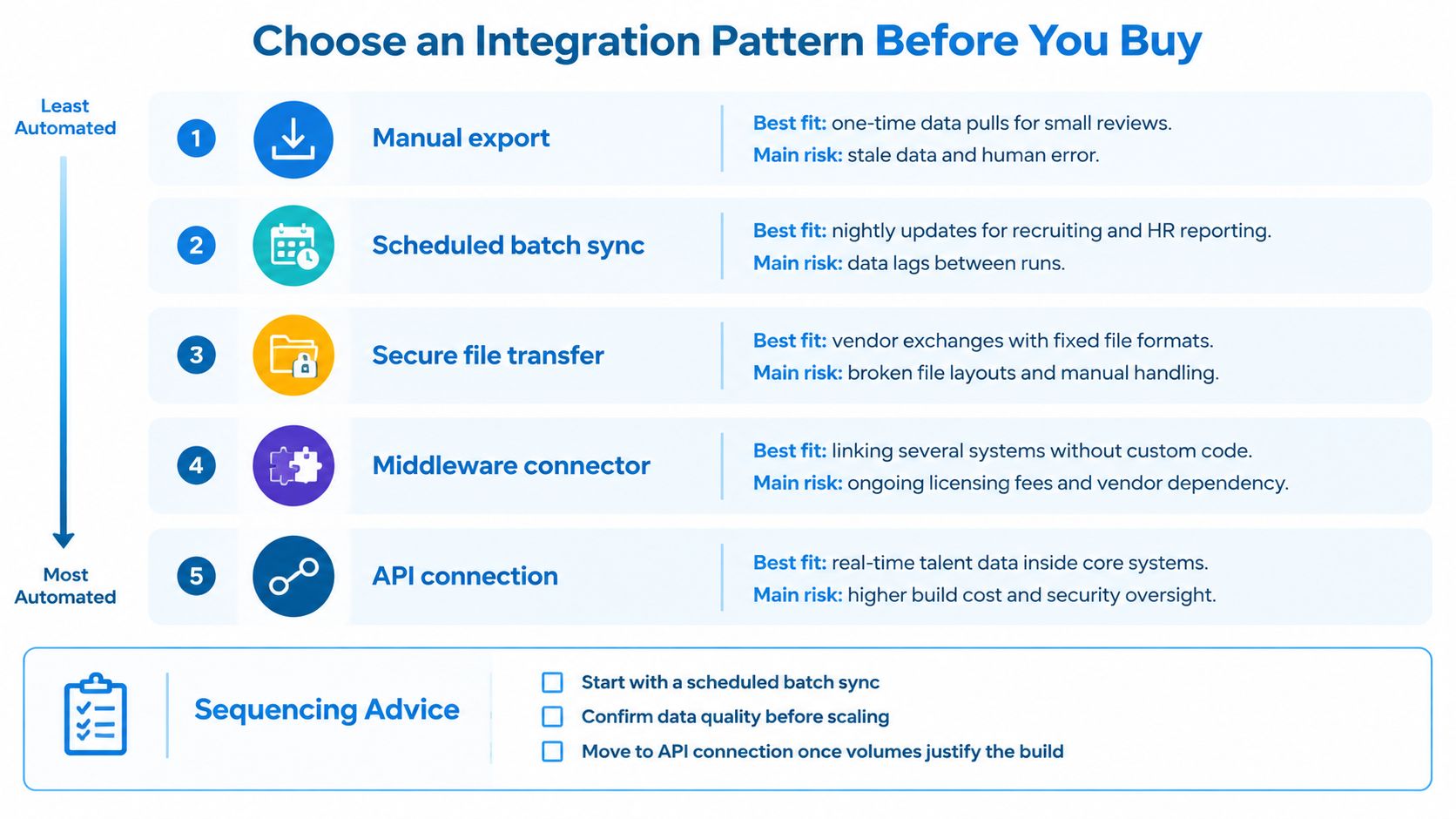
Begin with a scheduled batch sync or native connector where the existing workflow supports it. Pilot a role family through a complete review cycle, resolve identity matching and field ownership, and only then assess whether a custom API is justified.
The broader architecture choices below provide a useful implementation checklist.
Adoption isn't the same as trust
In ACCA's 2026 global survey of more than 11,000 accountancy and finance professionals, 55% of financial-services respondents lacked confidence in AI use for recruitment, and 56% of senior leaders expressed doubts about AI-based talent selection. Those findings concern confidence, not a measured error rate.
Meanwhile, Microsoft's 2024 Work Trend Index reported that 66% of business leaders said they wouldn't hire someone without AI skills. A bank can demand AI capabilities while its employees remain skeptical of AI-assisted selection. Management should assess internal readiness separately from external candidate supply.
Lower headcount doesn't settle the demand question
The Financial Services Skills Commission's 2026 Annual Skills Report reports that financial-services headcount fell 5% in 2025 while vacancy postings rose slightly. That sector-level finding doesn't establish what any particular bank is doing, but it directly challenges the assumption that falling headcount means weak hiring demand.
Before interpreting a competitor's workforce reduction, distinguish roles eliminated, departures not replaced, and capabilities still being recruited. Before connecting that interpretation to an offer or account plan, require:
- Current provenance: Confirm the source date and distinguish observed changes from inferred intent.
- Human approval: Review consequential scores and recommendations before acting.
- Documented assumptions: Preserve matching rules, exclusions, and confidence limits.
- Named ownership: Assign accountability for the integration, data quality, and corrections.
How to Run a Sourcing and Outreach Cycle
A useful documentation benchmark comes from an OCC enforcement agreement that required a bank to identify critical positions, evaluate expertise and staffing gaps, establish immediate-, short-, and long-term plans, and submit a revised succession plan within 90 days. That deadline was case-specific, not a universal hiring requirement.
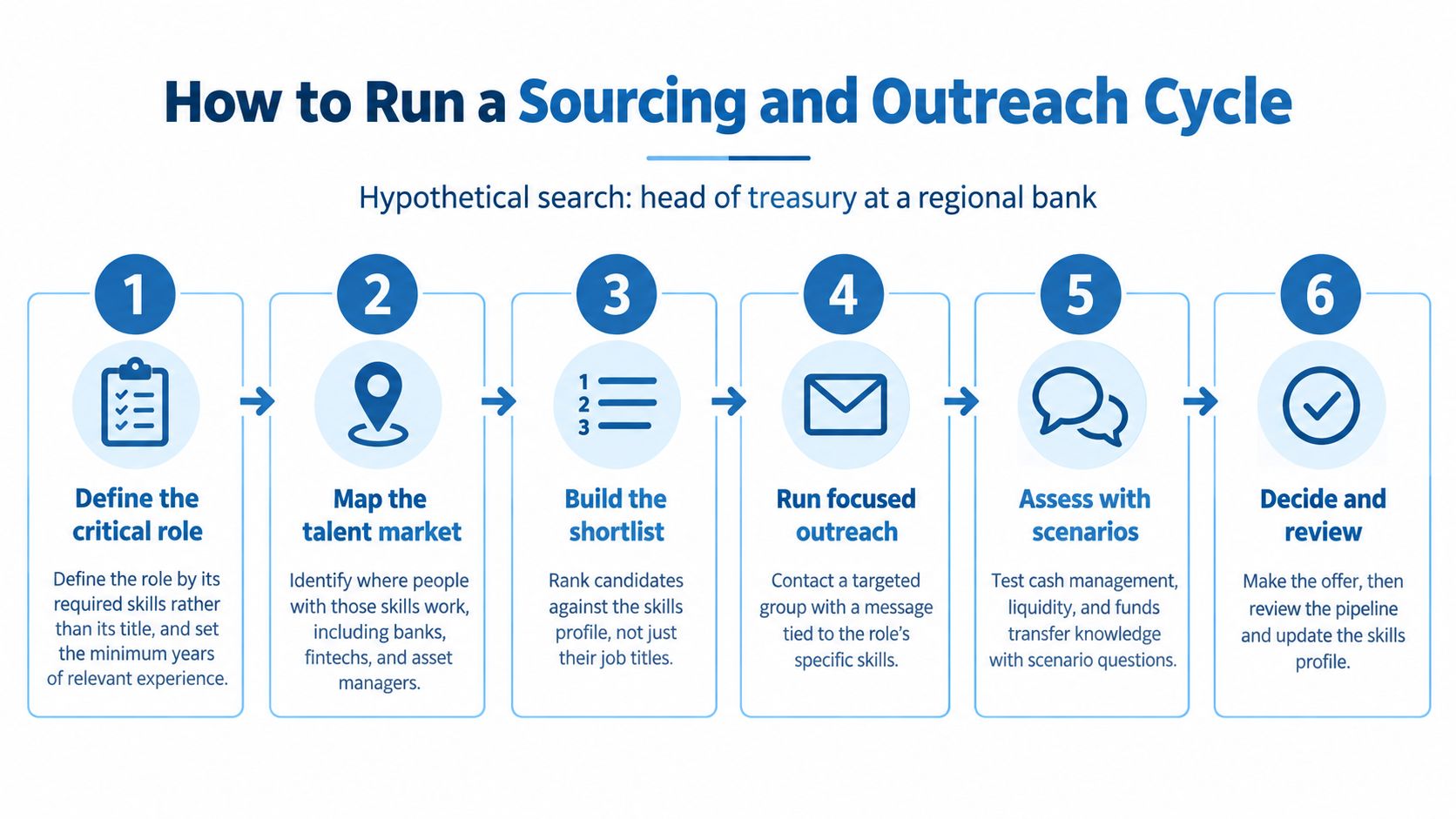
The broader lesson is operational: management should be able to explain the requirements, alternatives, decisions, and accountable owners. The following hypothetical head-of-treasury search turns that standard into a working cycle.
Keep a decision record at every stage
Define the critical role. Specify the required evidence for liquidity-risk management, cash forecasting, funding strategy, and governance responsibilities rather than relying on the title. Record which requirements are mandatory at appointment and which can be developed.
Pull the supply signals. Assemble occupational openings, replacement assumptions, compensation benchmarks, and the qualified local pool. Save the geography, source vintage, and exclusions so another analyst can reproduce the assessment.
Assess internal candidates first. In this hypothetical case, two internal candidates are available, but neither meets the defined liquidity-risk requirement. Document the evidence gap, potential development path, and interim coverage instead of recording only an unsuccessful assessment.
Build and qualify the external shortlist. As an illustrative working range, start with 25 to 40 profiles filtered by skill evidence and recency; the hypothetical geographic scan yields 18 qualified prospects. Separate qualified prospects from available or interested candidates, which remain unverified until contact.
Run focused outreach and assessment. A hypothetical three-touch sequence over 14 days can reference a relevant project or responsibility, with respectful follow-up and clear opt-out handling. Use structured liquidity and funding scenarios to test capabilities before treating an engaging response as evidence of suitability.
Synchronize every status change. Write the source tag, date, decision owner, and reason code into the ATS or CRM. Retain the distinction between insufficient evidence, candidate withdrawal, compensation mismatch, and a failed mandatory requirement.
Review the pipeline monthly. For this proposed operating cadence, refresh material signals, advance or close the search, and record why management changed direction. Escalate unresolved coverage risks rather than allowing an open requisition to stand in for mitigation.
The process below summarizes the recruiting decisions, while the operating record should retain the internal assessment and synchronization controls.
Judge the workflow by the decision it supports
For a banking executive search, the board-ready output should explain who meets the requirements, what remains uncertain, and how management will maintain coverage until appointment. A longer candidate list doesn't compensate for missing evidence.
Benchmark current staffing and external alternatives before committing to a sourcing workflow or integration architecture. The first approval should rest on a defined business need, a credible market assessment, and an auditable comparison of available options.
Visbanking offers bank, market, and professional intelligence to connect workforce decisions with peer performance, succession needs, and business-development opportunities. Visit Visbanking to explore the data and benchmark your bank's staffing and capability gaps before approving your next search or integration investment.
Latest Articles
Brian's Banking Blog
HMDA Data Reporting: How to File Without Costly Errors
Brian's Banking Blog
Bank Loan Performance: Metrics, Formulas and Benchmarks
Brian's Banking Blog
Predictive Risk Management for Banks
Brian's Banking Blog
Business Registration Data Banks Can Actually Use
Brian's Banking Blog
How to Secure REST API with JWT for Banking
Brian's Banking Blog