
A Data-Driven Guide to Banking Executive Search
Brian's Banking Blog
Finding the right banking executive is not an administrative task—it is a critical capital allocation decision. The process demands a meticulous, data-driven methodology to identify, assess, and secure leaders who can drive performance, satisfy regulators, and navigate complex market dynamics.
It is time to replace subjective judgment with objective intelligence to build a leadership team engineered for sustainable, superior performance.
Winning the War for Banking Talent
The pressure on bank boards and CEOs to secure top-tier executive talent has never been greater. Competition is intense, particularly for leaders with a demonstrable track record in digital transformation, risk management, and commercial growth.
A failed executive hire is a multi-year setback, both financially and reputationally. A single misstep in the C-suite can derail strategic initiatives, unnerve investors, and attract unwelcome regulatory scrutiny.
This high-stakes environment demands a fundamental shift in perspective. Executive search must be viewed as a core driver of bank performance. The right leader does not merely fill a vacancy; they unlock value, mitigate latent risks, and capitalize on opportunities others miss. The search process, therefore, must be as rigorous and data-informed as any major capital investment.
The Modern Executive Search Mandate
Today's banking leaders must operate at the intersection of finance, technology, and regulation. This requires a modern search process built on a foundation of hard data and market intelligence.
Consider the current landscape:
- Intense Market Competition: The pool of proven banking leaders is finite, and every institution is competing for the same top performers.
- Specialized Skill Demand: Expertise in fintech, cybersecurity, and data analytics is no longer a peripheral competency; it is a board-level imperative.
- Regulatory Demands: Leaders must possess the acumen to navigate an increasingly complex compliance framework.
- Financial and Reputational Risk: A poor hire can cost millions in direct expenses and lost opportunities, damaging the bank's standing with customers and shareholders.
A data-driven approach removes the search process from the realm of subjective preference and places it into the domain of objective intelligence. It empowers boards to define success with precision, identify candidates with a documented history of high performance, and make decisions based on evidence, not networks.
The market data confirms this urgency. The United States accounts for over 40% of the global executive search market, which is projected to reach $19.7 billion by the end of 2025. This figure directly reflects the critical nature of recruitment in the U.S. banking sector, particularly with CEO turnover reaching 18% in Q1 2025—the highest rate in over five years.
A successful search is the first step in aligning talent acquisition with the bank's most critical strategic objectives, a core principle of effective strategic workforce planning. By embedding data into every stage—from role definition to final offer—banks can construct leadership teams capable of delivering superior results.
Building the Ideal Candidate Profile with Data
A successful executive search begins long before reviewing the first resume. The foundation is not a generic job description but a precise, data-backed competency framework—a blueprint for the exact leader the bank requires to execute its strategy.
We must move beyond vague descriptors like "strong leadership skills" and define specific, measurable competencies tied directly to the bank's strategic goals.
This requires a rigorous analysis of the bank’s current position and strategic direction. Is the objective to capture a larger share of the commercial lending market or to improve operational efficiency and reduce costs? Each goal demands a distinct leadership profile and skillset.
Translating Strategy into Competencies
Consider a $2.5 billion community bank aiming to grow its commercial lending portfolio by 15% over the next 24 months, with a focus on the light industrial and healthcare sectors. A generic search for a "Chief Lending Officer" is insufficient. The board must define the required competencies with precision.
This is where bank intelligence provides a decisive advantage. By analyzing data like UCC filings and call reports from peer institutions, the board can identify competitors who are outperforming in these specific sectors. It can then reverse-engineer the profiles of the executives who drove that success, creating a data-driven model of excellence.
For this specific CLO role, the ideal profile becomes clear:
- Demonstrated Experience: A verifiable track record of growing C&I loan portfolios by at least 10% annually at a similarly sized institution.
- Sector-Specific Expertise: Deep, practical experience underwriting loans in the light industrial and healthcare industries, evidenced by their previous portfolio's composition.
- Market Penetration Skills: The proven ability to build and lead a team that can successfully win market share in a competitive environment.
This data-first methodology transforms the candidate profile from a subjective wish list into a set of verifiable qualifications, creating an objective scorecard for evaluating every candidate.
Defining Success with Measurable Metrics
The same data-driven logic applies to internally focused roles. Take the same $2.5 billion bank, which now needs a new CFO. The board's mandate is to reduce the bank's efficiency ratio from 65% to a target of 58% within three years.
This single metric becomes the cornerstone of the CFO search. The search is not for a generic finance leader but for an executive with a documented history of driving significant operational improvements.
A data-informed candidate profile transforms the executive search from a subjective exercise into a strategic acquisition. It ensures that the competencies you hire for are the same competencies that will drive the bank's most critical performance indicators.
The required qualifications are now quantifiable. Candidates must be able to demonstrate specific instances where they have executed successful cost-reduction programs, implemented technology to automate back-office functions, or restructured a balance sheet to improve the net interest margin. These are not abstract claims; they are tangible achievements that can be verified. Of course, building this profile requires understanding the critical balance between soft skills and hard skills, as both are essential for C-suite effectiveness.
Platforms like Visbanking provide the intelligence necessary to connect strategic goals with market realities. By benchmarking against peers, you can define what high performance truly entails and construct a candidate profile that reflects it, ensuring your next executive is not just a strong candidate on paper but the right leader to deliver the required results.
Sourcing and Identifying Top Banking Executives
The most effective banking executives are not actively seeking new roles. They are focused on delivering results for their current institutions.
A passive strategy of posting a job and awaiting applications is a formula for attracting mediocrity. To secure game-changing talent, you must proactively identify them. This requires a data-driven approach to map the market and pinpoint high-performing leaders who are already achieving the specific outcomes your bank needs.
This means moving beyond personal networks and employing structured intelligence. By integrating disparate data sources—professional graphs, call report data, and SEC filings—you can build a comprehensive view of the talent landscape. The search transforms from a speculative exercise into a targeted, intelligence-led operation.
The current hiring climate necessitates this precision. The financial services sector is engaged in a fierce competition for talent, with white-collar vacancies in the U.S. increasing by 21% year-over-year. Investment banking, in particular, has seen a hiring surge, intensifying the competition for proven executives.
From Competitor Analysis to Candidate Identification
The most direct path to identifying top-tier talent is to analyze your competitors and peer institutions.
Which banks are excelling in the specific area you aim to grow? Who has successfully executed the strategic pivot you are currently planning? The executives responsible for those achievements should be your primary targets.
The process hinges on connecting the bank's strategic goals to real-world performance. You must define what success looks like for the role before identifying potential candidates.
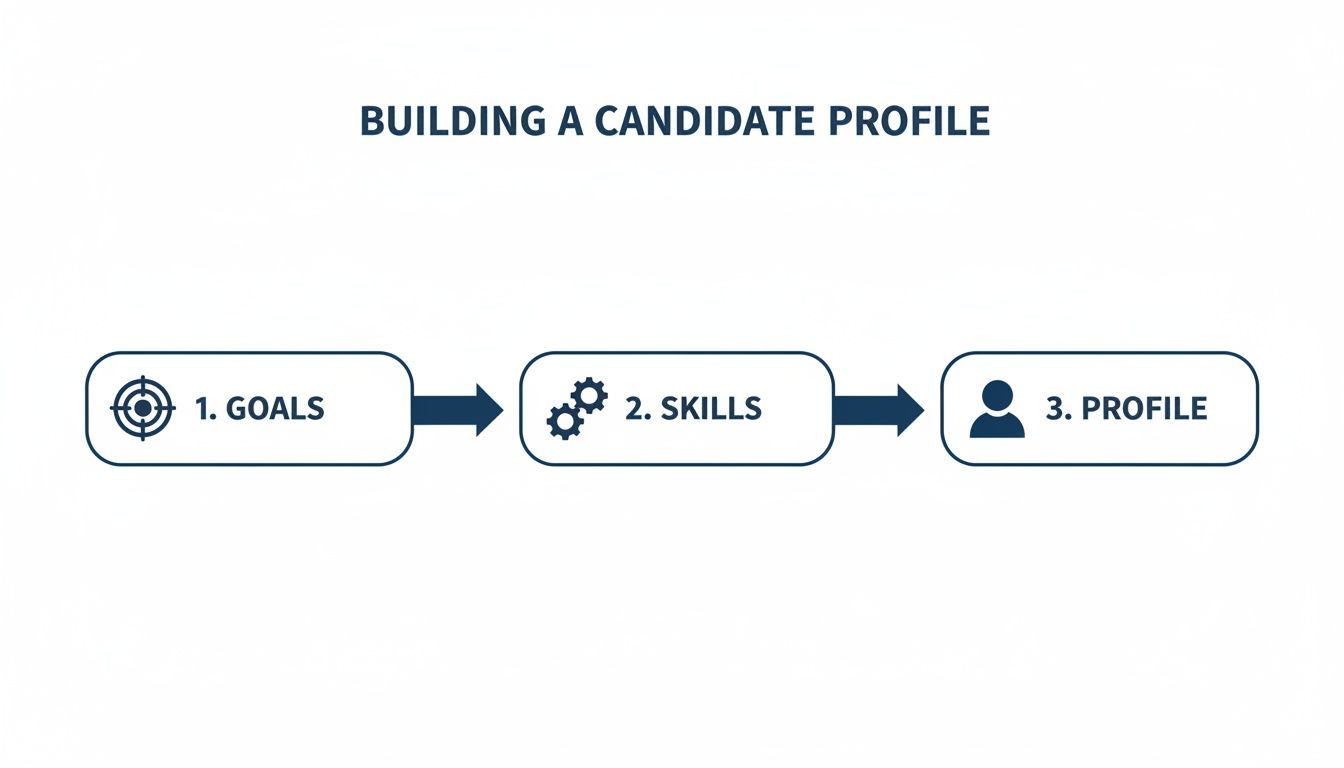
This model—Goals to Skills to Profile—serves as the guiding principle for the search, ensuring it remains anchored to tangible business outcomes rather than being diluted by irrelevant qualifications.
For example, a $5 billion regional bank prioritizes the aggressive growth of its digital deposit base. The board needs a new Head of Digital Banking. Instead of a broad search, they adopt a surgical approach.
Using a platform like Visbanking, they conduct a peer analysis focused on non-brokered deposit growth over the past three years. The data quickly identifies three competitor banks that have significantly outperformed the market, growing digital deposits by 25% annually.
The next step is where intelligence creates a decisive advantage: identifying the specific executives who were responsible for digital strategy at those banks during that exact period of growth. This is not speculation; it is verifiable intelligence that establishes a direct link between an individual and a desired business outcome.
This approach generates an immediate shortlist of proven leaders who would likely never be discovered through traditional search methods because they are not actively on the market.
Candidate Sourcing Methods Comparison
Traditional recruiting methods are no longer sufficient. Relying on personal networks or inbound applications is slow, risky, and often yields disappointing results. A data-driven approach fundamentally alters the dynamics of the search.
| Metric | Traditional Sourcing (Network/Job Boards) | Data-Driven Sourcing (Integrated Intelligence) |
|---|---|---|
| Speed | Slow, reactive. Waits for applicants. | Fast, proactive. Identifies targets in days. |
| Candidate Quality | Hit-or-miss. Limited to active job seekers. | High. Targets proven top-performers. |
| Market Coverage | Narrow. Limited to personal network & applicants. | Comprehensive. Maps the entire talent market. |
| Risk | High. Relies on self-reported achievements. | Low. Verifies performance with hard data. |
The conclusion is clear: while traditional methods may play a role, integrated intelligence provides a significant advantage in speed, candidate quality, and risk mitigation.
Leveraging Integrated Data for a 360-Degree View
A powerful executive search synthesizes information from multiple sources to build a complete, nuanced profile of each potential candidate.
A unified bank intelligence system is indispensable for this task, allowing you to cross-reference an executive's claims with verifiable facts.
- Call Reports (FDIC): Did a Chief Lending Officer candidate truly drive significant loan growth? The numbers in their former bank’s call reports provide the objective truth, allowing you to verify their actual impact on key metrics.
- SEC Filings (EDGAR): For publicly traded banks, proxy statements are invaluable. They reveal executive compensation, tenure, and board priorities, offering insights into what might motivate an individual to consider a new opportunity.
- Professional Graph Data: Mapping an executive's career trajectory and professional network provides crucial context. Understanding their professional relationships helps gauge their influence and leadership style.
By integrating these sources, you transition from a resume-based assessment to an evidence-based evaluation. As detailed in our guide on how to recruit banking talent faster using these integrated data methods, this approach not only identifies superior candidates but also significantly de-risks the hiring decision. You are not just hiring a person; you are acquiring a proven track record of success.
Executing a Rigorous Executive Assessment Process

You have identified a shortlist of strong candidates. Now begins the most critical phase: the assessment. This is where a resume's claims are tested against the real-world challenges your bank faces.
The objective is to move beyond conversational interviews and subjective impressions to conduct objective, evidence-based evaluations that predict on-the-job performance.
A weak, unstructured assessment process is a significant liability. It invites unconscious bias and often leads to hiring charismatic but ultimately ineffective leaders. A rigorous, data-backed process ensures you select the leader with the specific competencies required to execute your strategic plan.
From Vague Questions to Real-World Tests
Standard interview questions are largely ineffective for C-suite roles. An effective assessment process must blend behavioral interviews with practical case studies that mirror the challenges the new executive will face.
These assessments must be directly linked to the core competencies defined at the outset of the search.
For example, when hiring a new Chief Risk Officer, the generic question, "Tell me about a time you managed risk," is inadequate. A more effective approach is a real-world scenario test.
Case Study Example: The CRO Challenge
Present the candidate with a sanitized but complex segment of your bank's loan portfolio. The data may show strong growth but also concentrated risk, such as significant exposure to Commercial Real Estate in a single submarket with Loan-to-Value ratios approaching 85%.
The candidate is then tasked to:
- Analyze the data to identify primary and secondary risk factors.
- Quantify the potential impact on the bank’s capital under a defined stress test scenario.
- Develop a clear, actionable plan to mitigate this exposure over the next 18 months.
This single exercise provides more insight than a dozen interviews. It reveals their analytical skills, strategic thinking, and ability to communicate complex issues to a board—all non-negotiable competencies for the role.
An assessment built on realistic, data-centric challenges forces candidates to demonstrate their capabilities, not just describe them. It is the difference between hearing a narrative and seeing the evidence.
Trust, but Verify with External Data
A candidate’s resume is a marketing document, not a sworn statement. The most critical step in any executive assessment is the independent verification of their claimed achievements. External bank intelligence is essential for this due diligence.
Imagine a Head of Commercial Lending candidate claims to have grown their previous bank’s C&I portfolio by $500 million in three years. This is an impressive claim, but it requires verification and context.
Using a platform like Visbanking, you can analyze the call reports for their former institution covering that specific period. The data will reveal the full story. Perhaps the growth was achieved through low-margin loan participations, or it coincided with a significant deterioration in credit quality. This context is critical.
This verification process can be applied to any executive role:
- CFO Candidates: Did the bank's efficiency ratio or Net Interest Margin actually improve relative to its peer group during their tenure?
- COO Candidates: Do the financial statements show evidence of improved operational leverage or effective control over non-interest expenses?
- Marketing Executives: Did the bank’s deposit mix shift toward more valuable, low-cost core deposits under their leadership?
When you anchor your assessment in hard, verifiable data, you significantly de-risk the hiring decision. You are no longer relying on a candidate’s self-reported history; you are evaluating their documented track record. This level of due diligence is fundamental to sound governance and aligns with talent management best practices.
A structured, data-verified process provides the board with the confidence that their chosen candidate not only has an impressive resume but also possesses the proven ability to deliver the results your bank requires.
Structuring a Competitive Executive Compensation Offer
You have reached the final stage. Crafting the compensation offer is where months of rigorous work culminate. An error at this point can unravel the entire search. An offer that is too low may lose your top candidate, while an improperly structured one may be misaligned with the bank’s financial realities or shareholder interests.
Relying on outdated salary surveys or intuition is a significant liability. A modern compensation offer must be competitive, defensible, and built upon a foundation of real-time market data.
Benchmarking with Precision and Peer Data
Every robust offer begins with a detailed analysis of peer data. This goes beyond simple asset-size comparisons to include a range of performance and market factors.
Bank intelligence platforms are invaluable here. By leveraging public data from sources like SEC proxy statements (DEF 14A filings) and bank call reports, you can construct a highly relevant peer group and analyze their executive compensation structures in detail.
This data provides answers to critical questions:
- Base Salary: What is the median and 75th percentile base salary for this specific role at peer banks with similar asset sizes, geographic footprints, and performance metrics (e.g., ROA, efficiency ratio)?
- Incentive Structure: How are bonuses and long-term incentives structured? Is the emphasis on short-term cash or long-term shareholder value creation?
- Performance Metrics: What specific Key Performance Indicators (KPIs) drive incentive payouts? Is compensation tied solely to loan growth, or does it also reward deposit gathering and strong credit quality?
A Practical Example: Structuring a COO Offer
Consider a $3.5 billion community bank in a competitive Texas market seeking a new Chief Operating Officer. The board's mandate for this role is to drive operational efficiency and lead a digital banking transformation, with a non-negotiable goal of reducing the efficiency ratio from 62% to below 55% within three years.
Using a platform like Visbanking, the compensation committee analyzes the compensation packages for COOs at 15 peer banks in their region with assets between $2 billion and $5 billion.
The data reveals that the market-rate base salary is approximately $325,000, while top-quartile performers earn closer to $370,000. More importantly, the analysis shows that for the highest-performing COOs, 60% of their total compensation is variable and directly linked to measurable results.
The most effective offers are defined by alignment, not just quantum. Tying a significant portion of incentive compensation directly to the strategic goals of the role makes the executive's success inseparable from the bank's success.
Armed with this intelligence, the committee constructs an offer that is both competitive and strategically aligned:
- Base Salary: $350,000, positioning the offer to attract top-tier talent.
- Annual Bonus: A target of 40% of base salary. Critically, 75% of this bonus is tied to achieving specific milestones related to the efficiency ratio target and digital platform adoption rates.
- Long-Term Incentive Plan (LTIP): A grant of performance-based restricted stock units that vest over three years, contingent upon the bank achieving the sub-55% efficiency ratio target while maintaining a top-quartile ROA relative to its peer group.
This is not just an offer; it is a strategic proposition. It signals to the candidate that their performance will be rewarded based on achieving the specific outcomes they were hired to deliver. To successfully present such a data-backed offer, all parties should understand the real principles of negotiating.
When compensation discussions are grounded in verifiable market data, subjectivity and emotion are replaced by a defensible business case—one that demonstrates prudence to regulators and a commitment to performance to shareholders.
Ensuring Success Through Strategic Onboarding
Securing a signed offer letter is not the conclusion of the search; it is the beginning of the integration process. The first 90 to 180 days of an executive's tenure are critical and will determine whether the hire becomes a strategic asset or a costly mistake.
A structured, data-informed onboarding plan is essential to accelerate their effectiveness, ensure their retention, and realize a return on the significant investment made in the search.
Without a deliberate plan, a new executive is forced to navigate the bank's culture, politics, and unwritten rules independently, slowing their ability to make a meaningful impact. The objective is to move beyond a standard HR checklist to a strategic integration roadmap that connects the executive's daily activities to the bank’s overarching goals.
Setting Measurable First-Year Goals
Vague objectives like "improve operations" are insufficient. Onboarding goals must be specific, measurable, and directly linked to the competency framework established at the beginning of the search process.
Consider a newly hired Chief Lending Officer tasked with growing the commercial portfolio. Their 90-day plan must include concrete, actionable goals.
For example, a new CLO’s initial objectives might include:
- Meet with the top 25 commercial relationship managers to assess pipeline quality and team capabilities.
- Conduct a comprehensive review of the current credit policy and present three specific recommendations to the board’s risk committee.
- Personally engage with 10 high-potential prospects in key target industries to initiate new business development.
A well-architected onboarding plan serves as a bridge between the promises made during the interview process and the tangible results the board expects. It turns strategic imperatives into a clear, actionable agenda for the new leader.
Achieving these early milestones provides the new leader with immediate focus and opportunities for early successes, building momentum and instilling confidence across the organization.
Tracking Performance and Integration
Success must be measured by more than just financial metrics. It also encompasses cultural fit and team leadership. A balanced scorecard is necessary to provide a complete picture of performance.
Key metrics should include both leading and lagging indicators:
- Progress on Strategic Initiatives: Are they meeting the milestones outlined in their 90-day plan?
- Team Performance and Engagement: Monitor key metrics within their department, such as voluntary turnover and employee feedback scores. A 15% increase in attrition in their division is a significant red flag that requires immediate attention.
- Cross-Functional Collaboration: Solicit structured, candid feedback from their peers on the leadership team to assess their ability to build the internal relationships necessary for effective execution.
This ongoing measurement provides the board with objective data to support the new leader or to intervene if performance deviates from expectations.
External context is crucial here. Platforms like Visbanking can provide the benchmarks needed to evaluate internal performance against the market. By comparing your new executive's departmental results against peer banks, you can objectively assess their impact and ensure they are on track to deliver the market-leading performance for which they were hired.
A Few Common Questions About Banking Executive Searches
Boards and executive teams require clear answers to navigate the complexities of a critical leadership search. The following addresses common questions from the practical, data-first perspective that should guide any modern search.
How Long is This Going to Take?
A well-executed, retained search for a C-level banking executive should be completed within 90 to 120 days.
If a search extends beyond this timeframe, it is typically not due to a lack of qualified candidates. It is often an indicator of a flaw in the initial process—either the role was not defined with sufficient clarity or the sourcing strategy was too passive.
When a search stretches past four months, it’s a red flag. It suggests the foundational data analysis—defining the right competencies and identifying a precise target market—was inadequate. This leads to a reactive, inefficient process instead of a proactive, targeted operation.
What’s the Standard Fee for a Search Firm?
The industry standard for a retained executive search firm is 30-33% of the candidate's first-year total cash compensation.
This fee is typically paid in three installments: an initial retainer to commence the search, a second payment upon a key milestone (such as the presentation of the initial candidate slate), and the final portion upon the successful hiring of the candidate. This structure ensures mutual commitment throughout the process.
How Do We Keep This Confidential?
Confidentiality is paramount, particularly when replacing an incumbent. A reputable search partner operates with absolute discretion.
This includes the following protocols:
- Using a neutral project code name (e.g., "Project North Star") for all communications to protect the identity of the client.
- Requiring all serious candidates to sign a Non-Disclosure Agreement (NDA) before the bank's name is revealed.
- Limiting the internal team involved in the search to minimize the risk of information leaks.
By adhering to a disciplined, data-driven plan, your board can manage the entire process with the necessary precision and confidence.
At Visbanking, we provide the intelligence layer that powers these critical decisions. Our platform enables you to benchmark performance, analyze peer strategies, and identify the proven leaders who can drive your bank's success. Explore Visbanking's data intelligence platform to de-risk your next executive hire.
Related Articles

Visbanking Blog
Navigating the Landscape of Bank Recruitment in the U.S.

Visbanking Blog
Banking Talent Crisis: Why Top Professionals Are Leaving

Visbanking Blog
Revolutionizing Financial Hiring: How AI-Powered Talent Tools Transform Recruitment

Visbanking Blog
Navigating Bank Recruitment: Strategies for Success in the Financial Sector

Visbanking Blog
Capital Banking in the USA: An Overview of Investment Services, Financial Instruments, and Regulations

Visbanking Blog