
Bank Marketing Regulations: A Guide for Bank Executives
Brian's Banking Blog
The most popular advice about bank marketing regulations is to have legal review the copy before launch. That's necessary, but it misses the harder problem: a bank can approve one version and still lose track of what employees, agencies, affiliates, and partners publish across dozens of channels. The board-level question isn't only whether an ad was worded correctly. It's whether the bank can trace every claim to its terms, required disclosures, audience rationale, approver, and final published version.
Treat each campaign claim as a traceable data point. That approach makes compliance part of marketing operations, not a last-minute copy check, and gives executives evidence they can use to direct review effort toward the channels and products that need it most.
The Core Bank Marketing Rules at a Glance
Seven core rules and notice duties govern nearly every bank marketing claim. Each applies because of what a message says, where it appears, or whom it reaches. Regulation Z's advertising provisions also apply to persons covered by those provisions, not only institutions formally defined as creditors, so responsibility belongs with marketing and business development as well as legal.
Use this table to identify the governing rule before a campaign goes live.
Federal bank marketing rules by trigger
| Rule | Covers | Triggered by | Core requirement |
|---|---|---|---|
| Regulation DD, Truth in Savings Act | Deposit account advertising | Any stated rate of return or bonus | Use the term annual percentage yield and disclose the APY for each tier with its minimum balance requirements. |
| Regulation Z, Truth in Lending Act | Consumer credit advertising | Finance charge rates, promotional terms, or payments | Identify the rate as APR and disclose the promotional period and subsequent rate or payment with equal prominence. |
| Regulation Z mortgage advertising | Mortgage and closed-end credit ads | Any advertised rate or payment figure | Don't state a rate lower than the rate at which interest is accruing. |
| FDIC advertising statement | Insured institutions' deposit product ads | Deposit products or nonspecific banking products | Display a legible Member FDIC or equivalent statement, including on digital pages that function as ads. |
| Regulation B, Equal Credit Opportunity Act | Marketing, targeting, and creative | Imagery, copy, audience selection, and optimization | Don't signal that credit will be denied or offered on worse terms based on a prohibited basis. |
| FTC Act Section 5 | Every medium and channel | Any claim, including material omissions | Disclose material limitations clearly and conspicuously so the overall impression isn't misleading. |
| FDICIA-related non-insured notice | Institutions without federal deposit insurance | Deposit-taking locations and the main web page | Clearly and conspicuously state that the institution isn't federally insured. |
These rules aren't interchangeable. A deposit-rate claim calls for Regulation DD disclosures and, for an insured bank, the FDIC advertising statement. A credit promotion can trigger Regulation Z disclosures, while audience selection and creative can raise fair-lending concerns under Regulation B. The FTC Act also reaches claims that mislead by leaving out information a consumer needs to understand the offer.
The shared test is straightforward: can the bank trace the claim to actual product terms, and does the full message avoid misleading consumers through omission? If the answer isn't clear from the campaign record, the control isn't complete.
Deposit Advertising Rules Every Bank Must Follow
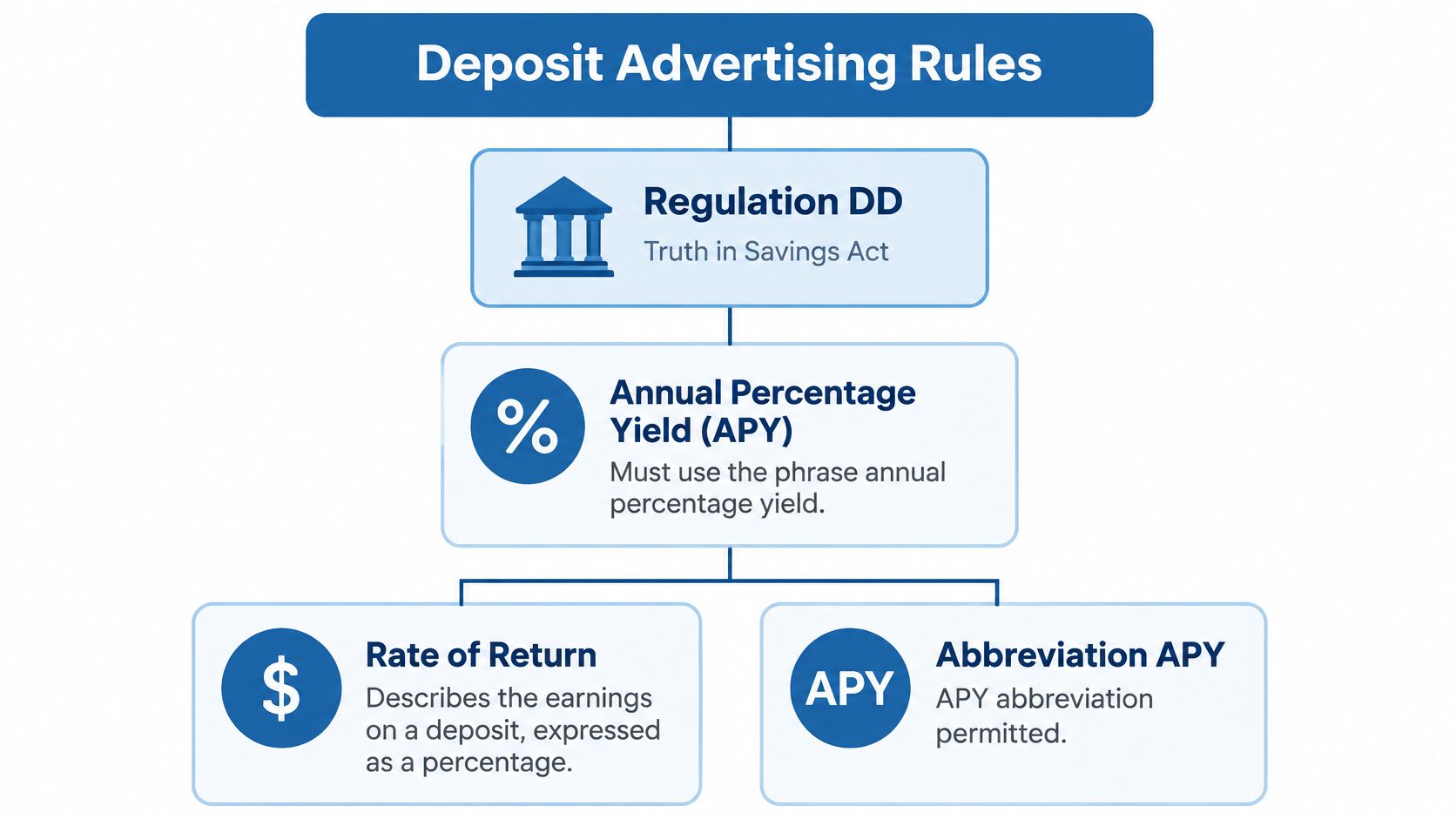
Start with the words consumers see. Under Regulation DD, which implements the Truth in Savings Act, a stated rate of return must be identified using the full term annual percentage yield. The abbreviation APY is permitted after that term has appeared at least once. Advertisements must also be accurate and not misleading, whether they appear online, in print, on broadcast media, or elsewhere, as the Consumer Financial Protection Bureau's Regulation DD advertising rule specifies.
Consider a hypothetical savings campaign offering an attractive yield. The headline may be compelling, but a compliance reviewer needs to see the product's full rate structure behind it.
Check the offer's rate structure
For a tiered-rate account, the ad must disclose the APY for each tier and the minimum balance required for each. A headline advertising 4.50% APY for a $5,000 minimum would leave out material context if the $0 to $9,999 tier earns 0.25% APY. The campaign's rate table, ad copy, and product terms need to agree.
A stepped-rate offer needs a different check: identify every rate and the period it applies. For example, if the hypothetical account pays 4.25% for the first 90 days and then 3.75%, the ad must not present the introductory rate as though it lasts indefinitely. Store the promotional dates alongside the rate fields, not in a separate file that reviewers may miss.
Online placement doesn't relax the disclosure standard. If a digital ad displays a triggering term such as an APY or bonus, it must clearly direct consumers to where the additional required information begins. A vague link label or a path that leads to general product information may leave the consumer without a clear route to the disclosures.
Verify the insurance message
An insured bank's deposit advertising must carry a clearly legible official FDIC advertising statement, such as Member FDIC or an equivalent permitted form. That includes a digital page or view that functions as an advertisement. The FDIC's advertising statement guidance also warns against suggesting that uninsured products, nonbank entities, or particular balances receive federal deposit insurance.
The audit standard for the hypothetical campaign is practical: retain the ad as published, its product terms, the APY for each balance tier, the minimum balance, the promotional dates, and the evidence that the required insurance statement appeared legibly. Every advertised yield should trace to the product terms, balance tier, and promotional period behind it.
Credit Advertising Rules and the Disclosures They Trigger
A credit ad can be technically accurate and still mislead if its headline rate hides the terms consumers will pay. Regulation Z, which implements the Truth in Lending Act, requires an advertised finance charge rate to be identified as an annual percentage rate (APR). If the APR may increase after the transaction is completed, the ad must say so. These requirements apply to internet ads, direct mail, signs, radio, television, and account-statement offers, as the Consumer Financial Protection Bureau's Regulation Z advertising provisions explain.

Review each campaign claim against the disclosure it triggers. Keep the claim, supporting terms, approval, and final published version traceable as one record. The risk often lies in losing oversight across many small channels, not just in drafting the original ad.
Sample campaign claims and the disclosures they trigger
| Campaign claim | Disclosure triggered | Compliant presentation |
|---|---|---|
| Auto loan advertised at 6.99% | APR and other required credit terms | Identify the APR beside the rate with equal prominence. |
| Payments from $299 per month | Qualifying loan amount, term, APR, and down payment | State each limitation clearly and conspicuously near the payment figure. |
| Mortgage payment rate of 3.25% with interest accruing at 5.00% | Accruing interest rate | Don't advertise a rate below the accruing rate. Rewrite the claim. |
Promotional APRs and payments need their own terms. State how long the promotion lasts and what rate or payment follows. Put those terms clearly and conspicuously near the headline offer, with equal prominence. A distant footnote or separate page is not an adequate substitute.
Rate comparisons need the same care. If an ad compares actual or hypothetical rates or payments with the advertised product, state the applicable figures and the periods they cover. Without that context, consumers may read the comparison as more favorable or directly comparable than it is.
Mortgage claims require a direct check against the loan's interest accrual. A closed-end mortgage ad can't state a rate below the rate at which interest accrues. A “3.25% payment rate” paired with interest accruing at 5.00% should be rewritten, not left for consumers to interpret.
A “payments from $299 per month” claim must also identify the qualifying loan amount, term, APR, down payment, and other material limitations clearly. The FTC's advertising guidance on deceptive claims and material omissions explains why the overall impression matters, not just whether the headline is true.
TILA also provides a three-day right of rescission for certain transactions secured by a consumer's principal dwelling, subject to exclusions such as purchase-money mortgages, as described in the Federal Trade Commission's Truth in Lending Act summary. Review landing pages and branch materials alongside rate sheets. The operating test is straightforward: each rate claim must match the disclosure the booked loan carries.
Fair Lending Limits on Targeting and Imagery
A campaign can comply word for word and still discourage applicants through its audience or imagery. Regulation B under the Equal Credit Opportunity Act bars statements, images, symbols, photographs, or videos that a creditor knows or should know would lead a reasonable person to believe credit would be denied or offered on worse terms because of a prohibited-basis characteristic. Its reach includes audience selection, copy, landing pages, and potentially algorithmic optimization.
The exposure often sits in the delivery pattern. Prospecting or retargeting rules can systematically exclude groups, and postal codes or other proxy variables warrant scrutiny when they may correlate with protected characteristics. Creative can also signal who belongs: who appears in an image, who is shown using the product, and how the landing page presents eligibility.
Director's test: Who received the offer? Who was excluded? What data drove that decision, and can the resulting pattern be explained?
Personalization needs oversight. For a propensity model, document the business purpose, screen inputs for prohibited-basis proxies, and monitor delivery and response outcomes across relevant segments. Treat each campaign claim and targeting choice as a traceable data point. The costliest exposure may be the inability to show oversight across many small channels, not a single sentence in the original ad.
Regulation B permits affirmative solicitation or encouragement of traditionally disadvantaged groups. The line is whether the communication invites applications or suggests that eligibility is restricted.
Before launch, require legal review of the audience and creative, screen targeting variables for prohibited-basis proxies, and document the rationale for each variable. After launch, monitor impressions and conversions by relevant segments. Keep campaign versions and decision logs so the bank can show what it intended, what it delivered, and what it changed.
Privacy and Customer Data in Targeted Marketing
A targeted audience is a data-use decision, not just a media purchase. The Gramm-Leach-Bliley Act sets safeguards for customer information and privacy practices. Regulation P implements notice and opt-out requirements, including an opt-out before certain disclosures of nonpublic personal information to nonaffiliated third parties. Banks should confirm that each audience's data use fits the applicable privacy notice and sharing permissions.
Consider a campaign that uses 40,000 deposit-customer records to build a prospecting audience through an outside vendor. Before launch, confirm that the privacy notice covers the use, suppress customers who opted out of relevant sharing, and contractually limit the vendor's use of the records to the bank's instructions. Record each check.
Set four controls: inventory audience data sources, map each use to the applicable privacy notice, check opt-out suppression before every launch, and review contracts with vendors handling audience data. Visbanking's bank data governance resources can help frame how data ownership and permitted use connect to decision-making. For email outreach, avoiding fines on cold email campaigns offers a comparison on permission, audience hygiene, and process controls.
Directors should require evidence of where each audience came from, why the bank may use it, what restrictions apply, and who approved the transfer.
Where Oversight Breaks Down Across Channels
A savings-rate offer appears on the bank's website, a branch display, an employee's social account, and a partner's paid placements. The website version is compliant. The branch display omits the FDIC statement, the employee post leaves out the tier table, and the partner placement has no archived copy. One campaign now presents four separate control failures.
For an insured bank, a missing statement on a deposit advertisement can create a compliance gap. For a non-federally insured institution, the notice obligation extends beyond campaign materials. Covered institutions must clearly and conspicuously disclose that they are not federally insured at deposit-taking stations or windows, their principal place of business, branches where deposits are accepted or accounts opened, and the main internet page. ATMs and point-of-sale terminals are excluded from the specified physical-location requirement, as the FTC's disclosure rule for non-federally insured institutions explains.
Required notices by customer-facing location
| Location | Required notice | Applies to |
|---|---|---|
| Deposit-taking station or window | Clear and conspicuous statement that the institution is not federally insured | Non-insured institutions |
| Principal place of business | Clear and conspicuous statement that the institution is not federally insured | Non-insured institutions |
| Branch that accepts deposits or opens accounts | Clear and conspicuous statement that the institution is not federally insured | Non-insured institutions |
| Main internet page | Clear and conspicuous statement that the institution is not federally insured | Non-insured institutions |
| ATM or point-of-sale terminal | Not required under the physical-location rule | Excluded |
| Insured bank digital page functioning as a deposit ad | Legible Member FDIC or equivalent statement | Insured institutions |
The second failure is incomplete inventory. Employees, affiliates, agencies, and influencers may publish outside the bank's central approval queue. Without a complete record, the bank cannot identify every live message, retrieve the exact version, locate its approver, or show whether anyone corrected it. The costliest exposure may be the inability to prove oversight across hundreds of small communications, rather than a flaw in the original ad.
Map every channel and customer-facing location to its required notice, accountable owner, and approval record. Use Visbanking's information on digital marketing for banks as a starting point for considering how digital activity fits into the bank's marketing controls.
The test: Can you list every live message, its channel, its required notice, and the person who approved it?
How to Build a Compliance Workflow Examiners Can Verify
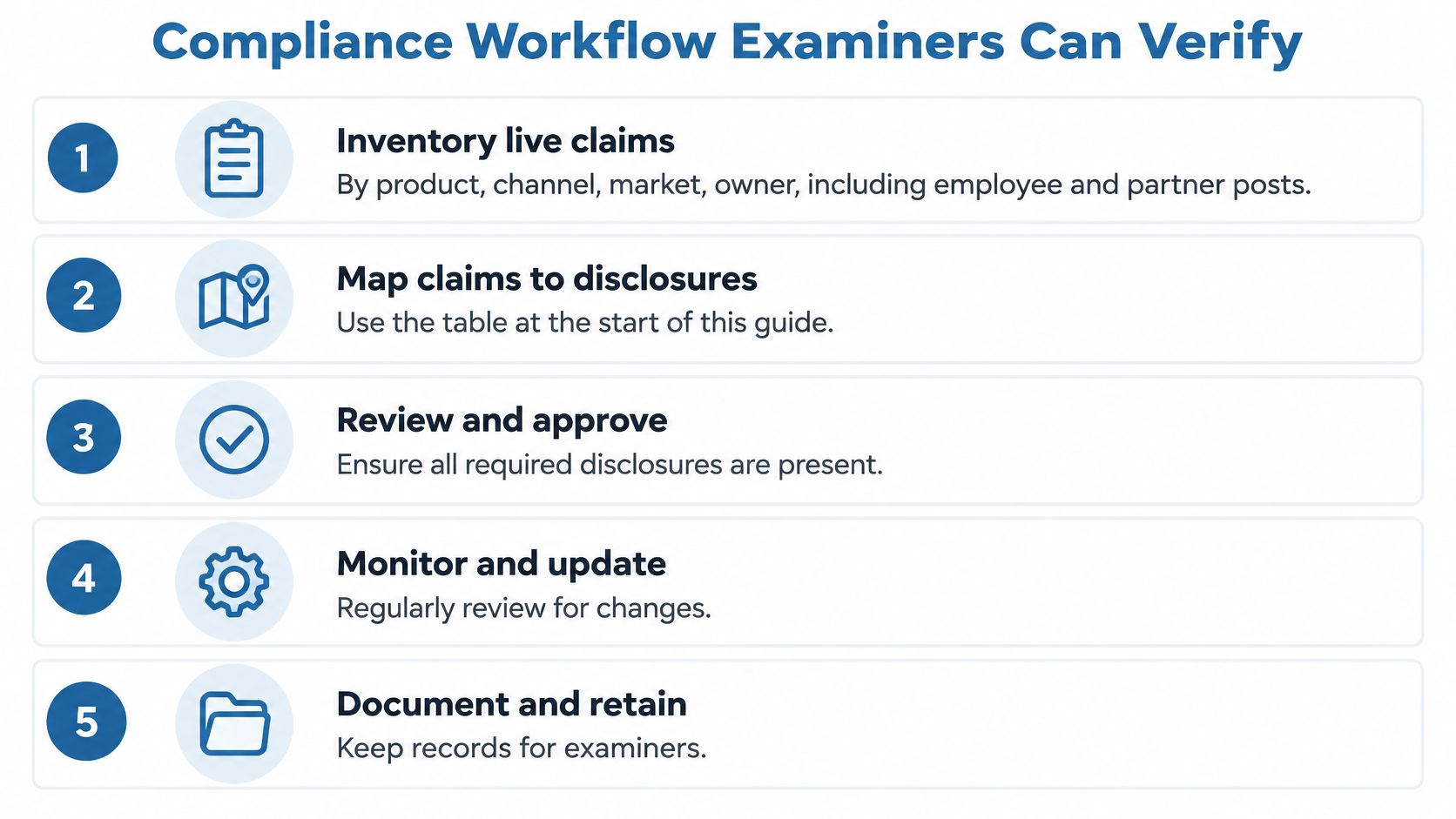
An examiner will not grade your intent. They will ask for the file. Build the workflow so every decision leaves a dated record, from the original claim to any correction. A 2024 American Bankers Association survey of 109 bank marketers found that 71% said their bank either lacked a written customer-data strategy or they were unaware of one, a gap that can leave data-driven targeting without a documented basis, according to the ABA's survey of bank marketers.
Use six steps, each with a specific evidence output.
Inventory live claims. Record each claim by product, channel, market, and owner, including employee and partner posts. Evidence: a dated campaign inventory that identifies every placement and accountable owner.
Map claims to disclosures. Match each claim to its governing rule and required disclosure. Flag missing or inconsistent terms before release. Evidence: a claim-to-disclosure matrix with the product terms that support each message.
Review targeting and approve. Conduct legal review, screen variables for prohibited-basis proxies, and record the business purpose for each targeting choice. Evidence: a dated approval, the audience logic, and the reviewer's decision.
Reconcile terms against outcomes. Each month, compare advertised rates with product terms and booked-loan economics. Evidence: a reconciliation report that identifies exceptions and assigns follow-up.
Monitor delivery by segment. Review impression and conversion patterns by relevant segments to identify possible disparate exclusion. Evidence: a monitoring record with any investigation or corrective decision.
Retain versions and corrective actions. Preserve rendered ads, approvals, targeting logic, and changes made after launch. Evidence: a campaign file that lets an examiner reconstruct what consumers saw and when.
A bank should make the evidence usable across teams, not just store it in separate folders. Visbanking follows SOC 2 standards and complies with GLBA. Compliance and security overlap, but they answer different questions. Teams that compare compliance and security requirements can separate evidence of oversight from evidence of protection.
A passing file has one record per campaign linking the claim, disclosure, data source, approver, published version, and corrective action. When a gap surfaces, use a compliance risk assessment framework to rank exposure by channel and customer impact, then assign the owner and date.
Benchmark Your Campaign Controls This Quarter
A clean original ad is rarely the exposure that costs the bank. The cost sits in hundreds of small placements the board cannot reconstruct: a branch poster, a partner banner, a rate on a landing page. Ask three questions this quarter. Can every advertised yield and rate be traced to product terms? Does every deposit-taking location and digital entry point carry the required notice? Can the bank produce the targeting rationale for its most recent prospecting campaigns?
If any answer is no, name an owner and a due date. A missing control across a branch network needs different attention from a missing record on one partner placement. Put review time where the footprint is widest, then confirm remediation reached every affected channel. Treat each claim as a record: the product term, the published version, the channel, and the person who signed off.
Visbanking's Quarterly Banking Report is a concise, data-driven snapshot of how banks and credit unions are performing, and Visbanking serves 10k+ banks and institutions. Use the bank's own campaign records alongside peer benchmarks and historical trend analysis so leadership can see which gaps are isolated before the next launch or examination.
Visbanking is a Bank Intelligence and Action System that brings together information on banks, credit unions, and the industry. Explore Visbanking to run peer benchmarks and historical trend analysis on your institution alongside its bank and credit union data.
Latest Articles
Brian's Banking Blog
What Is Predictive Analytics? a Guide for Bank Leaders

Brian's Banking Blog
Agentic AI in Banking: What It Is and How It Works

Brian's Banking Blog
Commercial Real Estate Intelligence for Bank Leaders
Brian's Banking Blog
Audit Assertions Explained: A Bank Executive's Guide

Brian's Banking Blog
Credit Risk Analytics Software: A Bank Buyer's Guide
Brian's Banking Blog