
Configure Price Quote Explained for Bank Executives
Brian's Banking Blog
A treasurer asks for the operating account, a sweep, and treasury services at last year's fees. The relationship manager agrees the waiver in the room. Credit confirms it by email. The quote leaves as a PDF. Six months later an examiner asks why the account paid no treasury fees, and no one can rebuild the concession.
Configure price quote (CPQ) is the sales-operations process that configures a valid product bundle, prices it under bank policy, and produces a customer-ready quotation. Run as a document tool, it only speeds that PDF. Run as a pricing-governance control, it sets which concessions policy allows, who must approve the exception, and whether the signed offer still earns its keep.
Banks already configure, price, and quote. Those steps often sit with different owners and different rules. Governed CPQ cuts quote iterations, shortens cycle time, and lowers errors because every offer uses the same policy. The result that matters sits beside speed: fewer unmanaged fee waivers, and a file that still explains the price when someone asks.
What Configure Price Quote Means for a Bank
CPQ joins three activities that most banks run in different systems with different owners. Configuration decides what can be sold together. Pricing decides what it costs under current policy. Quoting turns both into an offer with terms and an expiry date. The value shows up when all three draw on one set of rules.
The three CPQ activities at a glance
| Activity | What It Does | Bank Example |
|---|---|---|
| Configure | Assembles a valid bundle of products and options | Checking account with a treasury add-on that meets eligibility rules |
| Price | Applies price books, discounts and fees under policy | Relationship pricing with a fee-waiver band |
| Quote | Produces a customer-ready offer with terms and expiry | Term sheet for a $5 million operating account |
The sale usually starts as a conversation. The bank's exposure starts with the bundle on the tablet.

Aberdeen research published in 2015 put a number on the difference between leaders and everyone else: best-in-class organizations generated 10% fewer iterations of a typical sales proposal or quote than other organizations. Each of those saved rounds is a day of approval delay avoided and one less chance to introduce a stale rate or an incompatible product combination.
The adoption gap is the more telling finding. Aberdeen reported that 52% of best-in-class organizations planned to increase CPQ deployment over the following 12 months, against 32% of other organizations, a 20-percentage-point spread. Best-in-class firms were 63% more likely to plan that increase. Leaders were buying an operational capability for catalogs, discount rules, approvals and proposal workflows, not a document generator.
For a bank, the test isn't document quality. It's whether two relationship managers quoting the same customer on the same day reach the same price with the same paper trail.
A mortgage pre-approval is the right analogy. The offer doesn't leave the building until income, collateral and policy limits have been verified against source documents. Good CPQ does that for a treasury bundle, a commercial lending package or a merchant services proposal. The quotation itself is the least interesting output.
How a CPQ Workflow Runs From Request to Signed Quote
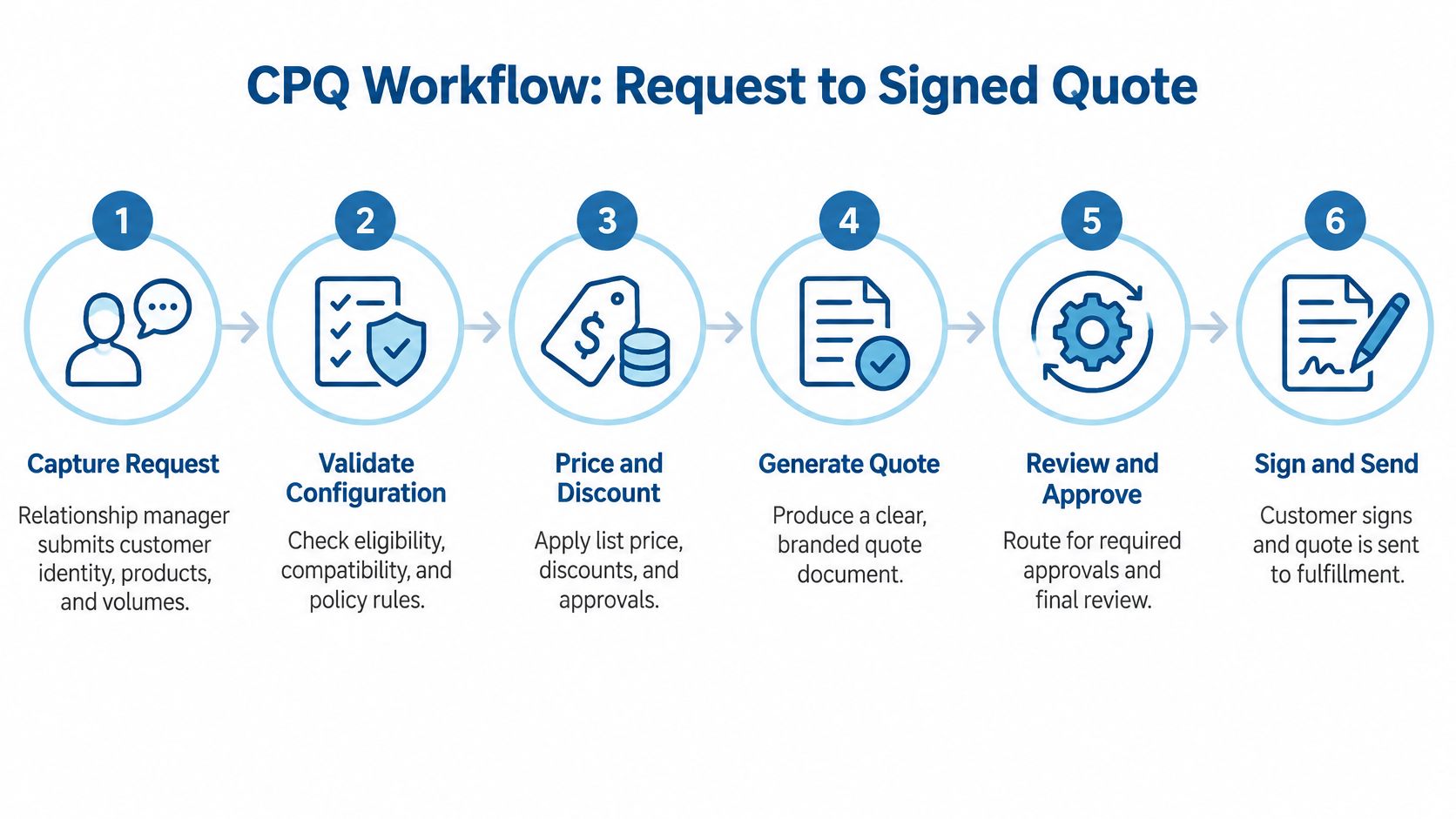
Six steps separate a request from a signed quote. Each exists to stop a specific failure, and each has a predictable slip.
Capture the request. The relationship manager records customer identity, the products in play, volumes and the relationship tier. The most common slip is unit confusion, such as annual transaction volumes entered into a price book built on monthly tiers.
Validate the configuration. Eligibility rules, required combinations and prohibited bundles get checked before anything is priced. Skipping this produces a bundle the bank can't lawfully or operationally deliver, such as a treasury product tied to a deposit balance the customer doesn't hold.
Calculate the price. The system pulls the current price book, applies the relationship tier and volume band, and computes fees and spreads. A stale rate table is the expensive slip here, because every quote built on it is wrong in the same direction and nobody notices until reconciliation.
Route the exception. Any deviation from policy goes to a named approver along with the data behind the request. When this step runs by email, the bank loses the record of who approved what and why, which is precisely the record an examiner will request.
Issue the quote. Terms, conditions, an expiry date and the assumptions behind the price. A quote with no expiry invites a customer to accept last quarter's pricing next quarter.
Record the inputs. The audit log captures source data, rule versions and the approver. This is the step banks skip and later regret.
Say a relationship manager is quoting a $5 million operating account with cash management, positive pay and a fee waiver. In an email chain the request bounces between the manager, a credit officer and finance over three days, and the final terms get rekeyed twice. In a governed workflow the standard bundle clears validation, lands inside its approved band and goes out the same day, with the waiver and the approver attached to the quote record.
The gap between a clean run and a slow one almost always sits in steps four and six. Teams that map the handoffs before buying software get further than teams that automate a process nobody has described. Wistec's guide to automation in sales covers how to sequence that automation without breaking the approval chain, which is the part banks usually get backwards.
A clean run passes one test: every price on the signed page traces to a dated source, and every deviation traces to a named approver. That's the standard to design toward, and it's the same discipline behind serious sales process optimization work.
Three Layers That Keep Bank Quotes Consistent
A CPQ system should model products as a governed knowledge base, not as a document template. The published CPQ implementation case study lays out the architecture in three layers, and the split matters more than the software choice.
The configuration layer holds the product definition: account packages, treasury services, lending products, attributes, compatibility dependencies and eligibility constraints. A commercial checking bundle that requires a minimum balance to include positive pay belongs here as a rule, not as a note in a sales playbook.
The pricing layer stores rate tables, fee schedules, relationship pricing tiers, waiver policies and approval thresholds. The bank's actual economics live in this layer, and it's the layer that ages fastest. A rate table updated quarterly with no version stamp is a liability disguised as a convenience.
The quote layer assembles the validated configuration and the calculated price into a commercial offer. It should contain nothing the first two layers didn't produce. Every field typed by hand at this stage is a field that can drift from policy.
The control that decides whether you can defend a quote
Separate immutable source facts from derived calculations, and version both. Rate tables and product eligibility are facts. Relationship pricing, waiver effects and fee totals are calculations. When the two get mixed in a spreadsheet, the quote becomes an opinion.
In the case study, a product "workbook" captured configuration rules, conditions, cost and price information before implementation, followed by explicit testing of rule completeness, attributes, prices, costs and configurability. That sequence is the unglamorous part of the program banks tend to compress.
The versioning rule: a relationship manager should be able to explain a quote dated March 14 by naming the rate table in force that day, the waiver-policy version applied and the approver who signed. If any of the three can't be produced, the quote isn't auditable.
Forrester's assessment of CPQ platform complexity frames the harder version of this problem: the market's examples are dominated by manufacturing SKUs, while a bank has to quote combinations of loans, deposits, treasury services, fees, covenants, collateral, relationship pricing and risk-adjusted terms. The design question isn't how to generate a document. It's how to make a quote commercially attractive, credit-policy compliant, explainable to approvers and traceable to current customer and market data at the same time.
The pricing layer also needs floors that reflect the market rather than last year's committee decision. Market and regulatory series do that work, and our data layer spans FDIC Call Reports, FFIEC and UBPR, NCUA 5300, SBA program data, UCC filings, SEC and EDGAR filings, BLS and BEA macro series and HMDA, which is the kind of evidence that sets a defensible floor instead of an assumed one.
Approval Rules That Govern Pricing Exceptions
Approval should run as a governed workflow, not an informal email exchange. Deloitte's CPQ capabilities analysis describes business rules that support parallel approvers, reroute requests, retain audit trails and automatically approve defined product bundles when customer or partner qualifications and preset discounts are met.
Approval routing by deviation from policy
| Deal Type | Example | Routing |
|---|---|---|
| Standard bundle within pricing band | Deposit and cash-management bundle | Approved automatically |
| Small concession | 10-basis-point rate concession | Relationship manager |
| Larger concession | Fee waiver above the policy limit | Credit or finance leadership |
| Nonstandard terms | Custom payment schedule | Credit committee review |
The table is the whole argument. A rule set that sends every quote to the same committee doesn't create control, it creates a queue and teaches managers to pad requests so the padded version survives review.
How to set the bands without guessing
Start with the last 12 months of realized deals, not with a policy document. Pull every closed commercial quote and record its deviation from list or target pricing: rate spread, fee waiver, term length, collateral treatment. The distribution tells you where routine business lands.
Then test the proposed rules against past approvals. Load last year's exceptions through the new logic and count how many the rules would have caught automatically and how many would have escalated. If the auto-approval band swallows 90% of last year's deals, the band is too wide. If it swallows almost none, you've built an expensive router for email.
Review the exception rate every quarter. A rising exception rate usually means the price book has drifted away from how the market prices, not that the sales team has gone rogue.
Practical rule: if a director can't say which concession types never reach a human, the approval framework is decorative.
Deloitte's framing is worth keeping in front of the board: the mechanics govern exceptions such as a commercial loan package priced below policy spread, a treasury bundle with waived fees, or nonstandard payment terms. Connecting those rules to current customer, product and peer data is what lets a director separate routine pricing from a decision that weakens relationship profitability.
Why Concessions Erode Relationship Profitability
Oracle's executive brief on bank pricing describes bank pricing as tending to be instinct-driven, and notes that banks may lack clarity on which customers are profitable over the long term and on their actual revenue and cost drivers. That's the soil in which bad quotes grow.
Consider a $15,000 annual treasury fee waiver offered to win a $5 million operating account. On a one-page comparison the deal looks attractive: a large balance, a multi-product relationship, a visible win. The quote only becomes honest when the bank models onboarding labor, expected service usage, deposit-balance volatility, the liquidity value of those balances and realistic cross-sell potential. Many waivers that look like growth are a discount paid for balances the bank could have won at half the price.
Set the rule explicitly. The concession is allowed only when modeled relationship value exceeds the waived revenue plus the required return. That single condition converts a judgment call into a testable one, and it gives the approver something to approve rather than something to feel good about.
Each product needs its own variables
Deloitte's retail banking pricing work examines value-based pricing across checking accounts, credit cards and mortgages, and the variety is the point. A single blanket discount policy will misprice all three.
- Checking accounts: balances, transaction volume and the service bundle drive economics, so a fee-waiver band is the natural control.
- Credit cards: risk, rewards economics and acquisition cost decide whether an offer is profitable before the first swipe.
- Mortgages: loan size, term, collateral and borrower characteristics set the risk-adjusted return, which is why concessions here need review rather than a band.
A checking bundle inside its fee band can clear automatically. A mortgage concession that falls below the target risk-adjusted return should route for review, because the exposure lasts years rather than a statement cycle.

The step most banks skip comes after the sale. Compare realized economics against the modeled case: actual service usage, actual balance behavior, actual fee revenue. That comparison, not the approval meeting, is what recalibrates the bands next year. It's the same logic that sits inside disciplined revenue management in any pricing-sensitive business.
Measuring Whether CPQ Improves Quotes, Not Just Speed
A treasury officer issues a same-day package quote. The clock looks good. The concession sits outside the approved band, and nobody flags it until the relationship is already booked. Speed recorded a win. Pricing governance did not.
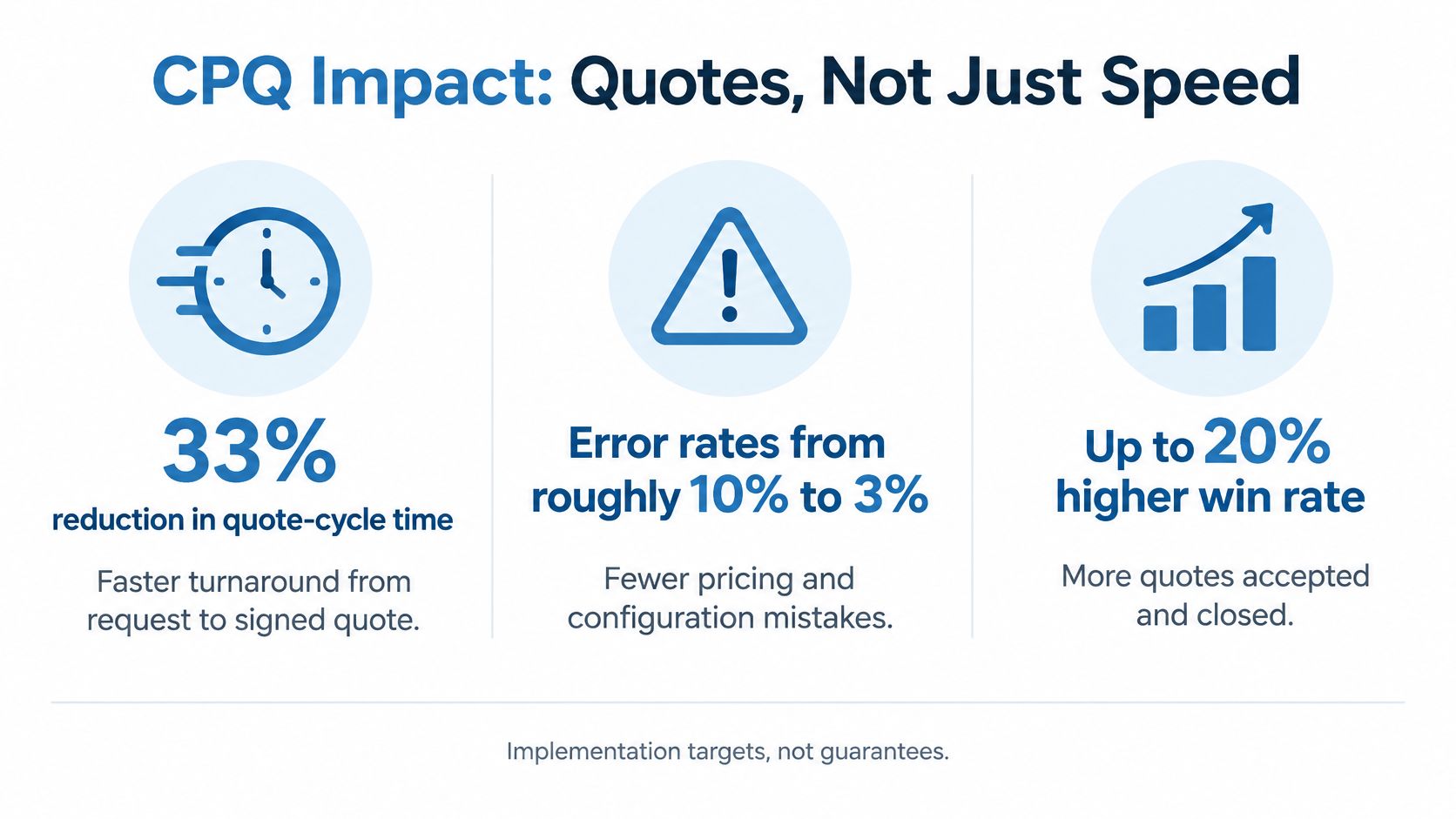
Research on structured CPQ optimization has been associated with a 33% reduction in quote-cycle time, error-rate reductions from roughly 10% to 25% in manual quoting environments to near zero, and productivity gains of up to 49%. Treat those figures as implementation targets, not promises. Results swing with catalog complexity, data quality, integration depth, and how tightly concessions are governed.
CPQ scorecard: speed alongside quality
| Metric | What It Shows | Better When |
|---|---|---|
| Median and 90th-percentile quote time | Typical and worst-case turnaround | Lower |
| Rework rate | Quotes revised after issue | Lower |
| Pricing overrides against policy | Discounts outside approved bands | Lower |
| Approval aging | Days waiting for an approver | Lower |
| Quote-to-account conversion | Share of quotes that become accounts | Higher |
| Downstream account-opening defects | Errors found after acceptance | Lower |
Track the 90th percentile as closely as the median. A bank can cut average quote time while a long tail of complex deals still stalls for two weeks. That tail is where the largest relationships live, and where an unreviewed concession does the most damage.
Speed and quality are not the same metric
Survey work on CPQ implementation points to integration with ERP or CRM systems and complex configurations as common obstacles. It also finds that many manufacturers can respond to RFQs quickly while still struggling with quoting quality. Fast output with weak price control is what you get when the second half of the scorecard never gets reviewed.
A same-day bank quote shows turnaround. It does not show a correct price, a supported concession, or a profitable relationship. The scorecard exists so that ambiguity does not reach a board packet as a success story.
Separate adoption from compliance. A sales force can log in every day and still route around the controls when the workflow does not match how deals close. Login counts flatter a program. Override rates and audit findings show whether the pricing rules held.
A performance measurement system ties quote data to realized outcomes instead of activity. Visbanking lets teams benchmark banks and credit unions side by side in a couple of clicks, and Performance carries charts, clear numbers, and regulatory-compliant data into board reporting. Quote quality then sits next to speed, not behind it.
Start With One Product Line and Benchmark It
A bank-wide CPQ rollout fails for the same reason most transformations do: nobody can prove the first win. Pick one product line with clean pricing rules, a treasury bundle or a deposit package, and run a controlled pilot.
Choose the narrowest line with real volume. A treasury or deposit package with published fee schedules beats commercial lending for a first outing, because the rules are already written down somewhere.
Capture a three-month baseline. Record median and 90th-percentile quote time, rework rate, pricing overrides against policy and approval aging before anything changes. Without that baseline, every later improvement claim is opinion.
Map the three layers and set the bands. Document configuration rules, price sources and approval thresholds, then derive the bands from the last 12 months of realized deals rather than from a committee's comfort level.
Run parallel for one quarter. Keep current quoting alive alongside the new rules and compare against the baseline, including quote-to-account conversion and downstream account-opening defects. Parallel running is slower and worth it.
Benchmark realized economics before you extend. Compare the pilot's relationship economics against peer banks and credit unions before adding loans, cards or mortgages. Expansion should follow evidence, not momentum.
The order matters more than the technology. Banks that baseline first tend to keep their CPQ program; banks that buy first spend the first year arguing about whether anything improved.
When you're ready to see how your pricing and performance compare with peers, go to visbanking.com, pick a product that fits your needs and request a demo. Signing up for an account is free, and pricing depends on your use case and team size, so the fastest path to specifics is the demo.
Visbanking gives bank executives a data-backed view of pricing, performance and relationship economics across 4,600+ institutions, drawn from FDIC Call Reports, FFIEC and UBPR, NCUA 5300, HMDA and related series, so a CPQ program can be judged against how peers price and perform rather than against internal memory. Use it to baseline before a pilot, to test whether a concession band reflects the market, and to put defensible numbers in front of your board. Visit Visbanking to explore the data and start the comparison.
Latest Articles

Brian's Banking Blog
8 Case Study Examples Banking Executives Can Reuse
Brian's Banking Blog
Bank Marketing Regulations: A Guide for Bank Executives
Brian's Banking Blog
What Is Predictive Analytics? a Guide for Bank Leaders

Brian's Banking Blog
Agentic AI in Banking: What It Is and How It Works

Brian's Banking Blog
Commercial Real Estate Intelligence for Bank Leaders
Brian's Banking Blog