
Regulatory Risk Banking
Brian's Banking Blog
Global bank fines reached $4.5 billion in 2024, but regulatory risk in banking isn't limited to avoiding penalties. It also determines capital adequacy, lending capacity, liquidity flexibility, and competitive positioning.
A Tuesday morning supervisory inquiry can expose all four pressures at once. The chief compliance officer may be preparing an examination response while the CFO is reviewing capital headroom and a relationship manager is pushing to close a major acquisition. None of these decisions can wait for a quarterly committee pack.
That pressure is why regulatory risk needs to be managed as a dynamic operating variable, not a static compliance checklist. A bank that sees capital trends, peer performance, liquidity constraints, enforcement exposure, and supervisory developments in one decision-ready view can respond earlier. A bank that relies on disconnected spreadsheets usually discovers the problem after it has already affected growth, earnings, or examiner confidence.
When Examinations Hit Unexpectedly
At 9:00 on Tuesday, a supervisor requests information about transaction monitoring, vendor oversight, and management reporting. By 10:00, finance sees the bank's Tier 1 position nearing an internal buffer threshold. Before lunch, corporate banking needs an answer on whether the institution can support a large acquisition that would expand the balance sheet.
The examination request is one event in a larger operating problem. Supervisory attention, capital capacity, and commercial timing can shift together, while policies remain technically compliant. Without linked data, management may struggle to show how exposures, models, controls, and capital interact.

Why periodic compliance reviews fall short
Preparation that starts after an examination is announced creates avoidable pressure. Teams collect evidence manually, reconcile departmental reports, and ask business owners to explain exceptions that operating data may have shown for months. The final response can be technically complete while directors still lack a timely view of the underlying risk.
The enforcement record shows why this approach is expensive. Regulators levied 80 fines totaling $263,252,003 in the first half of 2024, while a 2024 industry summary reported $4.5 billion in global bank fines for the year (Fenergo's review of regulatory penalties). These figures do not define every bank's exposure. They do show that enforcement can affect planning, capital decisions, and management credibility.
A better process begins before the inquiry. Management should track which portfolios drive risk-weighted assets, where liquidity depends on concentrated funding, which controls lack current evidence, and how the bank compares with relevant peers. Predictive indicators and real-time peer benchmarks help executives spot deteriorating conditions before an examiner asks for an explanation.
For broader context on investigative triggers, executives can review what triggers an SEC inquiry alongside the bank's regulatory preparedness work.
Practical rule: An examination should confirm what management already knows, not reveal the bank's risk profile for the first time.
How Bank Supervision Evolved
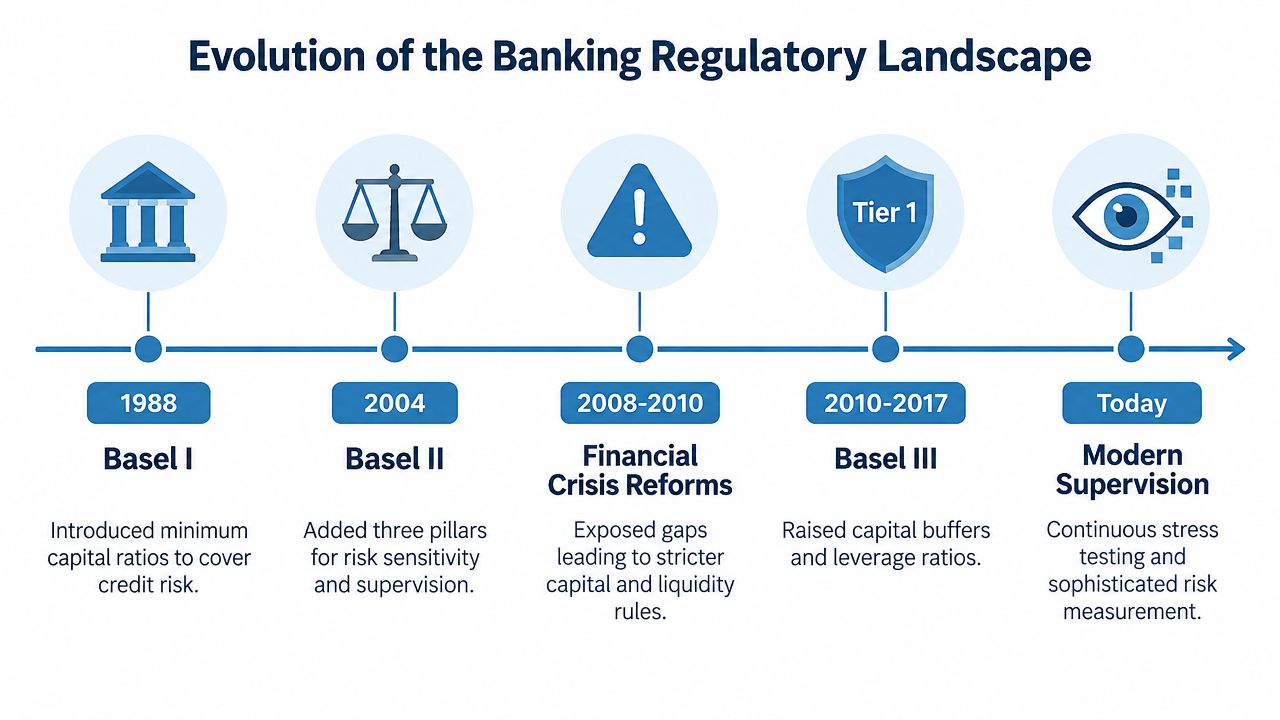
Modern bank supervision shifted from measuring balance-sheet size to assessing risk. Basel I, introduced by the Basel Committee in 1988, set the first international minimum capital requirement at 8% of risk-weighted assets for internationally active banks. The United States finalized its Basel I rules in 1989, requiring national banks to reach at least an 8% total capital-to-risk-weighted-assets ratio by December 31, 1992 (Federal Reserve History).
Credit risk became a central capital input, market risk was added in 1996, Basel II expanded the framework in 2004, and U.S. implementation followed in 2007. Basel III emerged after the 2008 financial crisis and raised the effective minimum capital standard to 10.5% of risk-weighted assets through the capital conservation buffer.
The capital stack is the operating constraint
Executives should not manage regulatory capital through one headline ratio. The Federal Reserve's 2025 final individual capital requirements set a minimum common equity tier 1 requirement of 4.5% for every bank, a stress capital buffer of at least 2.5%, and a separate systemic-risk surcharge for the largest firms, updated annually in the first quarter (Federal Reserve release).
Those requirements shape acquisition capacity, dividend planning, loan growth, and pricing. A product that looks attractive in accounting terms can consume more capital once exposure classification, model treatment, and risk weighting are applied. Directors need reporting that shows both the current ratio and the drivers changing it.
Data should connect each business decision to its supervisory owner and measure. Banks can map those responsibilities across the regulatory agencies for banks. The practical goal is not memorizing every rule. It is identifying the relevant authority, submission, capital measure, liquidity requirement, and control owner before a decision is approved, then benchmarking those indicators against comparable institutions.
Five Core Types of Regulatory Risk
Regulatory risk is easier to manage when each exposure has an accountable owner, measurable indicators, and early-warning thresholds. A single compliance score hides changes in capital usage, customer risk, funding, vendors, and model performance. These five categories give directors an operating map for turning supervisory signals into decisions.
Capital adequacy risk
Capital adequacy depends on the relationship between common equity, risk-weighted assets, stress results, and distribution plans. The U.S. capital conservation buffer requires banks to hold CET1 equal to at least 2.5% of risk-weighted assets to avoid restrictions on dividends and buybacks. As the buffer falls below 2.5%, restrictions tighten, and at 0.625% or lower, all capital distributions are prohibited (Congressional Research Service).
Track CET1, RWA growth, changes in the stress capital buffer, and the capital consumed by new products. A relationship manager proposing a large loan package should see its effect on capital headroom before promising terms. Predictive monitoring can flag when growth, concentration, or portfolio migration is likely to narrow that headroom.
AML, KYC, sanctions, and monitoring risk
This exposure creates direct enforcement risk, but the useful signals appear in daily operations. Monitor alert backlogs, investigation age, false-positive rates, customer-risk overrides, sanctions-screening exceptions, and unresolved data-quality issues.
Evidence must connect each control decision to the underlying risk. A policy in a manual will not protect the bank if management cannot show how alerts were prioritized, escalated, investigated, and closed. Trend analysis also helps distinguish a temporary workload spike from a control failure that requires staffing, rule, or data changes.
Liquidity risk
The Liquidity Coverage Ratio requires enough high-quality liquid assets to survive a 30-day stress scenario. A Columbia study found that quantity-based liquidity rules reduced bank liquidity risk, while the required buffer crowded out lending and shifted liquidity risk toward banks outside the rule perimeter.
Treasury should monitor compliance and commercial effects together, including funding concentration, HQLA accumulation, lending elasticity, and risk migrating to less-regulated affiliates. Real-time benchmarking against comparable funding profiles can identify deterioration before a ratio breach becomes the primary concern.
Third-party and technology risk
Cloud providers, embedded-finance partners, data processors, and AI vendors can place critical activities outside the bank's direct operating environment. The Basel Committee's updated principles, published in December 2025, emphasize principles-based third-party risk management tied to operational resilience (PRA priorities overview).
Executives need clear ownership, service dependencies, access controls, incident evidence, model explainability, and workable exit plans. Vendor performance data should feed the same risk view as internal operations.
Model and data risk
Stress tests and capital calculations depend on assumptions, data lineage, validation, and documented limitations. A model can produce a precise output while creating regulatory risk if no one can explain its inputs or challenge its assumptions. Assign model owners, set validation dates, record overrides, and test whether results remain credible as portfolio composition changes.
How Regulatory Risk Impacts Your Bottom Line
A bank can remain above its headline capital ratio while losing room to grow, lend, or absorb shocks. Regulatory risk reaches earnings through capital requirements, liquidity decisions, enforcement work, data quality, and the management time diverted from commercial priorities. The financial effect often appears before a formal breach, which makes scenario analysis and peer benchmarking more useful than a single threshold.
Capital requirements also operate as a stack. Banks must meet the 4.5% minimum CET1 requirement and a stress capital buffer of at least 2.5%. The largest firms also face a systemic-risk surcharge updated annually. These components can change the bank's usable capacity even when its reported ratio remains above the minimum, as outlined in the Federal Reserve requirements.
RWA inflation changes the business case
Basel III reforms can raise required capital through changes in risk-weighted assets, even when headline capital ratios appear stable. An EBA monitoring exercise estimated that the fully phased-in framework would increase Tier 1 minimum required capital by 18.5%. It also showed the total capital ratio falling from 18.2% to 15.3%, while the risk-based CET1 ratio for the full sample declined by 140 basis points (European Banking Authority monitoring report).
Rule design changes commercial planning well before implementation. One analysis estimated that large banks would need to increase highest-grade capital by 9% under the revised framework, compared with 16% to 19% under the original proposal (Harvard Law Banking and Finance Review). Treasury and business leaders should therefore model capital demand alongside loan growth, pricing, portfolio mix, and expected returns.
Enforcement costs create another drag. An industry review reported $26 billion in AML, KYC, and sanctions fines across the decade after the financial crisis. Those costs can reduce investment capacity, delay strategic initiatives, and expose weaknesses in controls that require further remediation.
Control effectiveness also depends on staff behavior. Employees need to follow procedures because controls protect customers and capital, not because a policy exists. Leaders assessing accountability and the gap between genuine compliance and surface conformity can use behavioral alignment at work as a practical reference.
Board reporting should connect regulatory submissions to decisions about capital, liquidity, products, and operating capacity. A strategic guide to regulatory reporting for banks provides a structured way to make that connection instead of treating reporting as an administrative endpoint.
Building a Practical Risk Management Framework
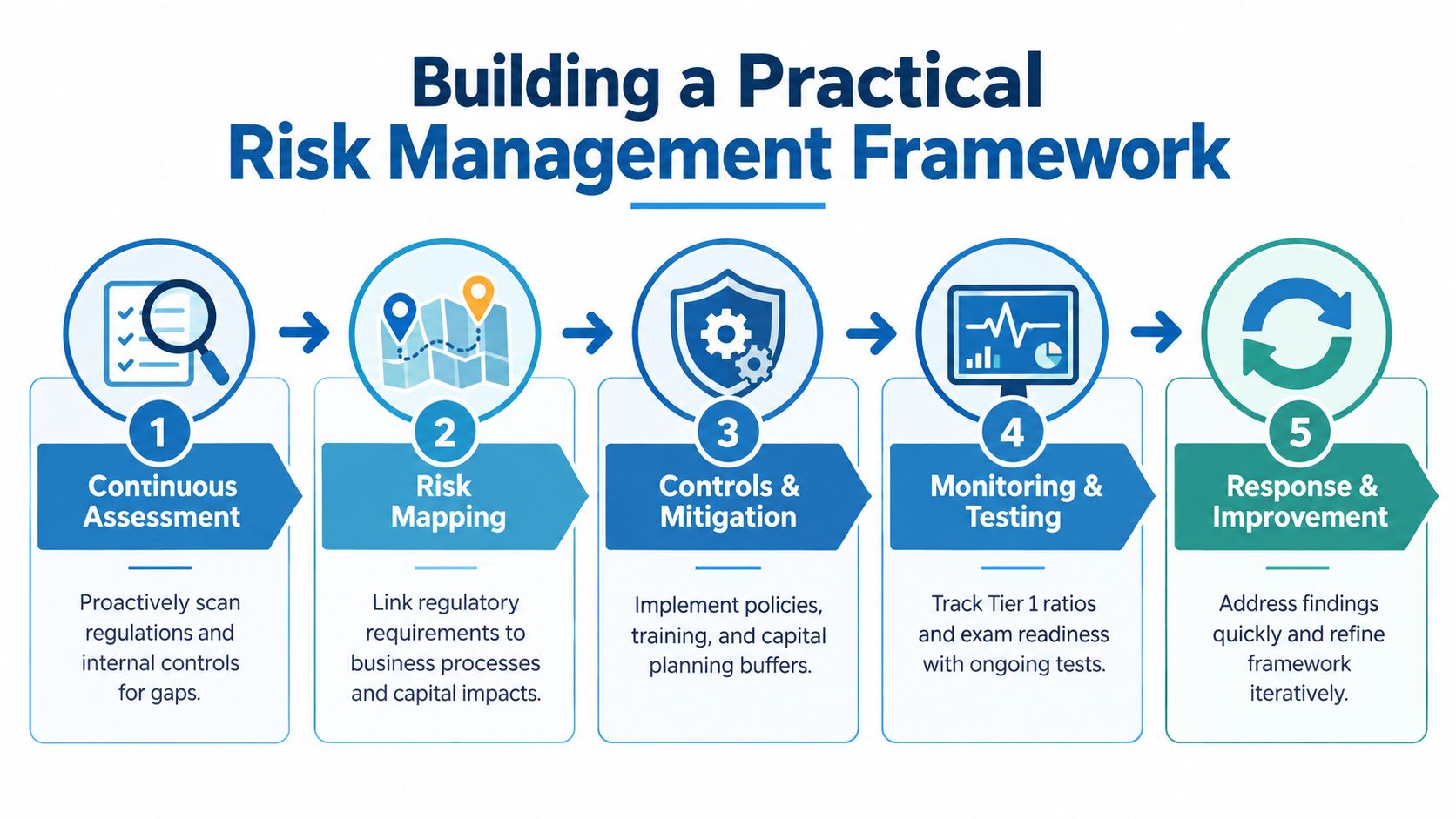
A practical framework turns regulatory signals into decisions. It should show executives what changed, why it matters, who owns the response, and how quickly the bank must act. The operating model below uses four connected pillars, supported by a five-step response loop.
1. Assess continuously
Begin with current exposure rather than the last examination report. Track capital ratios, RWA movement, liquidity composition, enforcement issues, model limitations, and third-party dependencies. Compare those measures with internal limits, supervisory expectations, and relevant peer groups. Trend data matters because a ratio can remain within limits while its direction signals a developing problem.
Assessment requires shared definitions across finance, risk, compliance, treasury, and business teams. If each group maintains a separate view of exposure, reconciliation delays decision-making and weakens accountability.
2. Map risk to decisions
Risk mapping links a regulatory requirement to a business process and its financial consequence. A change in exposure classification, for example, should flow through the loan product, model, RWA calculation, pricing decision, and capital forecast.
A useful map answers four questions:
- What changed: Identify the rule, data point, control exception, or portfolio movement.
- Who owns it: Assign responsibility to a named business or control owner.
- What is affected: Show the effect on capital, liquidity, earnings, customers, or reporting.
- What happens next: Set escalation, evidence, testing, and decision deadlines.
3. Control and mitigate
Controls should address a defined exposure. Use documented policies, model validation, vendor oversight, training, exception handling, and capital planning buffers that correspond to observed conditions.
Avoid paperwork that leaves decisions unchanged. A short, evidence-backed control that alerts treasury to deteriorating liquidity can provide more protection than a lengthy checklist reviewed after the event. The trade-off is deliberate: fewer controls, tied to measurable risks, are easier to test and maintain.
4. Monitor, report, and improve
Monitoring turns the framework into management action. Set alerts for mechanical thresholds, unusual RWA changes, a worsening peer position, overdue remediation, and data-quality failures. Reports should show trend, variance, cause, owner, and recommended action.
After an examination, near miss, model challenge, or vendor incident, update the risk map and test whether the revised control works. The platform approach described by Visbanking can bring together FDIC call reports, FFIEC UBPR data, NCUA 5300 filings, and predictive signals, with alerts delivered through email, Slack, and CRM workflows. Its value comes from linking evidence to action, not from adding another dashboard.
Leveraging Data Intelligence for Early Detection
A bank can look compliant at the last reporting date while its risk profile is already deteriorating. Periodic reviews explain what happened. Data intelligence identifies what is changing now and connects that change to a management decision.
Manual processes often place call reports, regulatory updates, peer metrics, and internal exceptions in separate files. An integrated process connects those sources, preserves data lineage, and measures movement against a defined baseline. That distinction becomes material when capital headroom narrows or a third-party dependency grows before the next formal filing.

Manual review versus intelligence-led monitoring
Manual review remains useful for judgment, investigation, and board oversight. It is a weak primary detection mechanism when analysts spend more time reconciling data than deciding how to respond.
An intelligence-led process should provide:
- Peer context: Compare capital, asset quality, liquidity, and performance trends with relevant institutions instead of interpreting one ratio in isolation.
- Explainable signals: Display the source data and alert rationale so risk officers can challenge the result and record the decision.
- Workflow delivery: Route material changes through existing communication and CRM channels to people who can act.
- Auditability: Retain source data, transformations, model assumptions, and user actions.
Visbanking's Bank Intelligence beta illustrates this approach. Its Bank Performance stream supports peer benchmarking across 4,600+ institutions, while Prospect covers relationships, products, and decision-makers, and Talent uses a professional graph of 2.6 million+ people. These figures indicate product coverage, not a guaranteed risk result. The practical benefit is bringing financial, regulatory, market, and people signals into decisions already made by relationship managers and executives.
Teams assessing these tools should first understand what regulatory intelligence is. Predictive models require production-grade data pipelines, MLOps, feature stores, observability, and secure APIs to produce repeatable, explainable outputs.
Analytics does not replace judgment. It gives judgment current, comparable, traceable evidence instead of a spreadsheet assembled under examination pressure. That change turns early warning from a reporting exercise into a decision discipline.
The Evolving Supervisory Philosophy
A bank can face less tolerance for process-heavy compliance theater while facing greater scrutiny of whether its controls address material risk. Current U.S. supervisory signals point toward fewer supervisory actions and more risk-based oversight, alongside efforts to remove reputation risk from bank supervision and modernize capital requirements, as outlined in Deloitte's banking regulatory outlook.
The shift changes what management must demonstrate. Examiners and directors need evidence that controls address financial, operational, compliance, and customer risks. A procedure created only to show activity may carry less weight than a simpler control that identifies exposure, assigns ownership, and produces reliable evidence.
Simplification requires proof
Executives should review legacy controls with discipline. For each one, ask:
- What risk does it mitigate?
- What data shows whether that risk is changing?
- What evidence proves the control operated?
- What could happen if the control were reduced?
- Which monitoring would detect deterioration?
The purpose is not casual removal of safeguards. It is disciplined reduction of duplication while preserving controls tied to capital, asset quality, earnings, liquidity, market sensitivity, customers, and legal compliance.
Risk-based supervision also raises the value of timely, comparable data. If management cannot explain why an issue is immaterial, how a threshold was set, or which portfolio drives the exposure, simplification can appear to be neglect. A documented assessment, clear ownership, and timely escalation show that fewer process layers reflect a considered risk decision.
That evidence must remain current. Static control inventories can confirm that a procedure exists, but they rarely show whether exposure is deteriorating between reviews. Trend analysis and peer benchmarking give directors a basis to distinguish an institution-specific problem from a broader market movement, then adjust monitoring before an examination forces the issue.
For business leaders, the commercial consequence is direct. Institutions under enforcement scrutiny often devote resources to remediation, reporting, and controls instead of growth. An early-warning view helps executives protect client confidence and choose opportunities that fit available capital and control capacity.
Why Bank Intelligence Is Essential in 2026
A sudden examination can expose a gap between documented controls and current risk. Capital planning, lending growth, acquisitions, liquidity management, vendor selection, and client coverage all depend on data that changes over time. Executives need a current view of exposure, capacity, and trend, not a periodic compliance snapshot.
Banks that connect regulatory information with financial performance can detect deterioration earlier, test alternatives, and explain decisions with evidence. The advantage is not a larger policy library. It is a faster, better-informed management response.
What executives should expect from the operating model
A practical bank-intelligence environment should provide:
- Benchmarking: Peer comparisons and historical trends showing whether a change is institution-specific or market-wide.
- Predictive monitoring: Signals that identify possible deterioration before it appears in a standard filing.
- Workflow integration: Alerts routed through email, Slack, CRM, or established risk processes.
- Explainability: Source data, assumptions, and reasoning that risk officers and examiners can review.
- Decision linkage: Clear connections between regulatory exposure, capital allocation, relationship strategy, and growth plans.
Visbanking combines financial, regulatory, market, and people data in workflow-ready applications. Its platform supports bank performance benchmarking, prospect and relationship intelligence, talent insights, and predictive bank signals through data pipelines, MLOps, feature stores, observability, and secure APIs.
The objective is to approach an examination with a defensible view of exposures, decisions, controls, and trends. Real-time alerts and peer comparisons help management distinguish emerging institution-specific risk from broader market movement, then adjust monitoring and resource allocation before findings force action.
That standard makes regulatory risk banking a management capability in 2026, not a document-production exercise.
Visbanking helps banks and credit unions connect regulatory, financial, market, and people data with peer benchmarking, predictive signals, alerts, and exportable reporting. Visit Visbanking to benchmark your institution, identify emerging risk signals, and build a faster path from data to executive action.
Latest Articles

Brian's Banking Blog
ISO 20022 Migration Strategy for Bank Leaders
Brian's Banking Blog
Lead Tracking Software for Banks: An Executive Guide
Brian's Banking Blog
What Are Key Metrics for Banks? a Decision Guide

Brian's Banking Blog
Customer Feedback Surveys: A Playbook for Banks

Brian's Banking Blog
How to Create a Dashboard That Banks Actually Use

Brian's Banking Blog