
Proactive Outreach for Banking Sales: A Playbook
Brian's Banking Blog
Your team opens the pipeline review with plenty of activity and too little decision context. Reps are calling banks after an RFP appears, pursuing institutions that have already changed direction, and sending the same product pitch to several executives who don't share the same mandate. The result looks busy in Salesforce, but it doesn't give a sales director confidence about what should happen next.
Proactive outreach fixes that problem by replacing calendar-driven activity with bank-intelligence signals. Call report shifts, officer moves, HMDA changes, branch activity, and product gaps give relationship managers a reason to act now, while the signal is still commercially relevant. The operating principle is simple: fewer, better-timed touches beat more generic touches.
Why Reactive Selling Drains Your Pipeline
A rep sees a new RFP, calls the bank, and discovers that the buying committee formed weeks earlier. The activity still appears in Salesforce, but the opportunity has already narrowed. Reactive selling rewards speed after the commercial window has closed.
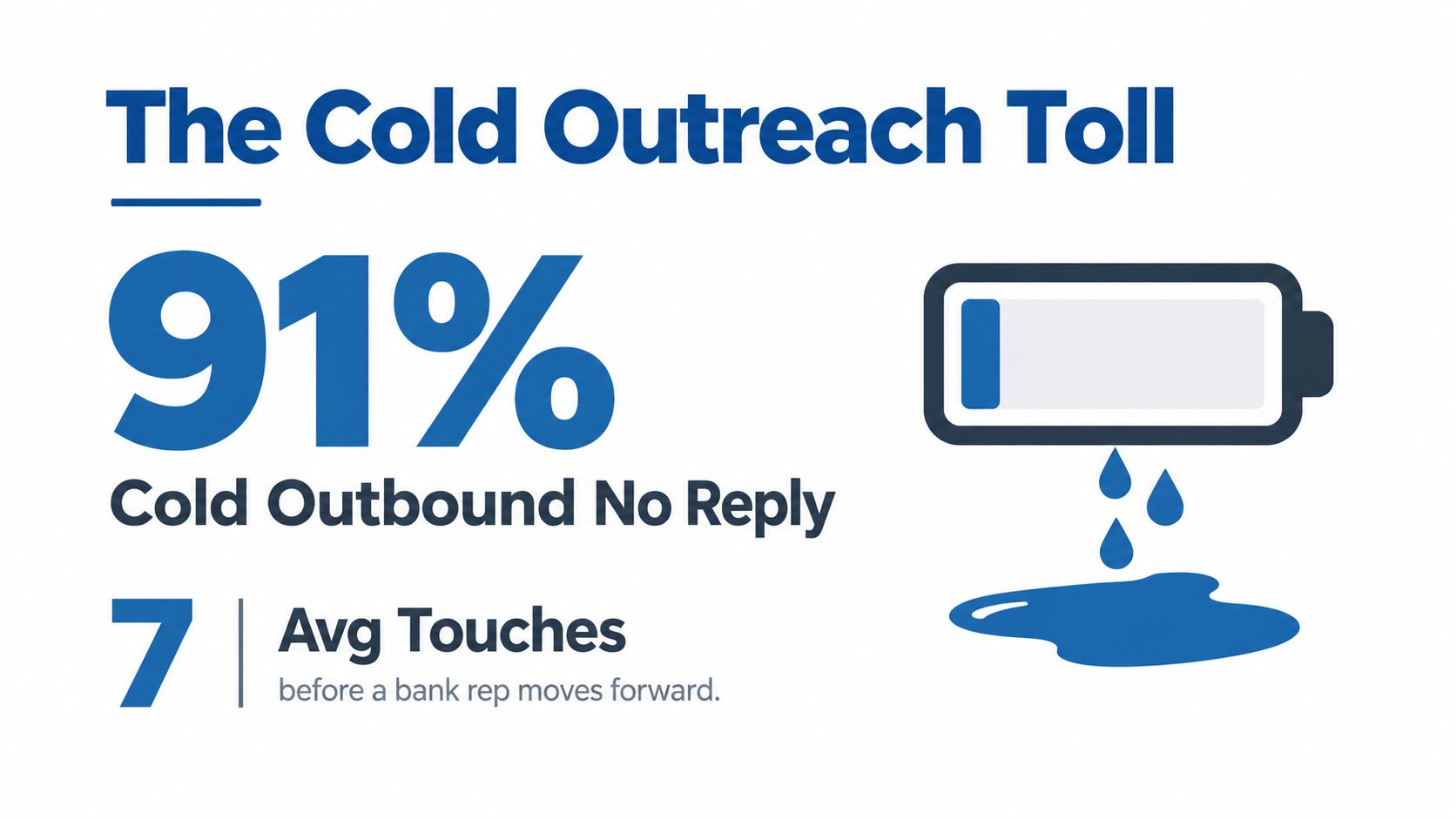
More touches do not automatically create more pipeline. An analysis of 12 million outreach emails found an average cold-outreach response rate of 8.5%, with more than 91% of initial messages receiving no reply. One follow-up increased replies by 65.8%, while two to three follow-ups raised average reply rates to about 27% (Cirrus Insight's follow-up statistics). Follow-up works when the message reflects a real business change. Without that relevance, each additional attempt consumes capacity without improving the opportunity.
Reactive bank selling creates three recurring leaks:
- Strategy changes go unnoticed. A bank shifts toward commercial deposits or expands its lending footprint, while the rep continues using a consumer-oriented message.
- Buying authority moves. A new senior treasury, capital markets, or commercial officer arrives. Competitors may reach that executive before the incumbent relationship team identifies the change.
- Product gaps disappear. The bank replaces a platform, fills a treasury need, or commits to another provider, yet the seller keeps presenting the same solution.
The practical rule is direct: require a documented signal before asking a rep for more outreach. Call report shifts, officer moves, HMDA activity, and product gaps provide that evidence. Platforms such as Visbanking can surface these bank-intelligence signals, but compliance still requires defined ownership, approved messaging, and an auditable reason for contact.
The market is already moving toward proactive coverage. Benchmark research found that 84.4% of companies were proactively reaching out to customers, up from 52.6% one year earlier. One-third of outbound interactions were AI-assisted, with a projection of 57.2% by 2028 (NICE's 2026 proactive outreach research). Banks should adopt the operating discipline without copying generic SaaS playbooks: act on observable institutional evidence before a buyer has to announce a need.
For a repeatable motion, BAMF's founder's playbook for pipeline building provides useful context on structuring outbound activity. The banking version should begin with institutional evidence, assign ownership, document compliance, and give every contact a defensible commercial reason.
Building a Bank-Specific ICP That Actually Fits
A commercial banking ICP should survive scrutiny from a sales director, finance leader, and compliance team. Build it from measurable filters rather than a broad label such as “regional bank” or “growth institution.”
Start with the deposit base. Tier 1 targets should generally sit between $500M and $10B in deposits when the data also indicates a gap in treasury, capital markets, HSA, or escrow capability. Institutions below $250M in deposits should be explicit disqualifiers for this motion unless a strategic exception exists.
Then examine the loan book and fee economics. A bank with three or more quarters of loan portfolio growth above 5% but flat fee income may have cross-sell headroom. The lending engine is producing activity, but the institution isn't capturing enough adjacent revenue from payments, treasury, syndication, or related services.
Use officer count and competitive density to refine the segment. A target with the right growth profile but no accountable commercial or treasury officer may not have an active buying center. Conversely, an institution operating in an MSA with fewer than three competitors offering comparable treasury capability can justify focused coverage, particularly if the bank is expanding commercial relationships.
| Tier | Deposit Base | Loan Growth (3Q) | Product Gap Signal | Officer Count |
|---|---|---|---|---|
| Tier 1 | $500M to $10B | Above 5% | Clear treasury, capital markets, HSA, or escrow gap | Relevant senior owner present |
| Tier 2 | Above $250M | Above 5% or improving | Partial gap or flat fee income | Commercial or treasury coverage |
| Nurture | Outside target range | No qualifying pattern | No confirmed gap | No identifiable owner |
The qualification discipline
Disqualify de novos under five years old when the motion depends on established operating scale, and exclude credit unions outside the applicable charter scope. These aren't judgments about quality. They're boundaries that protect rep capacity and prevent a bank sales team from treating every institution as equally addressable.
The discipline rule is fixed: if a prospect doesn't meet at least two of the four filters, it goes to nurture, not the active pipeline. Those filters are scale, growth, accountable officers, and product gap. Directors can adjust the thresholds by product, but they shouldn't remove the rule.
Teams building this process can use Visbanking's lead generation for banks as a reference point for organizing institution-level prospecting around bank-specific data.
The Signals That Should Fire an Outreach
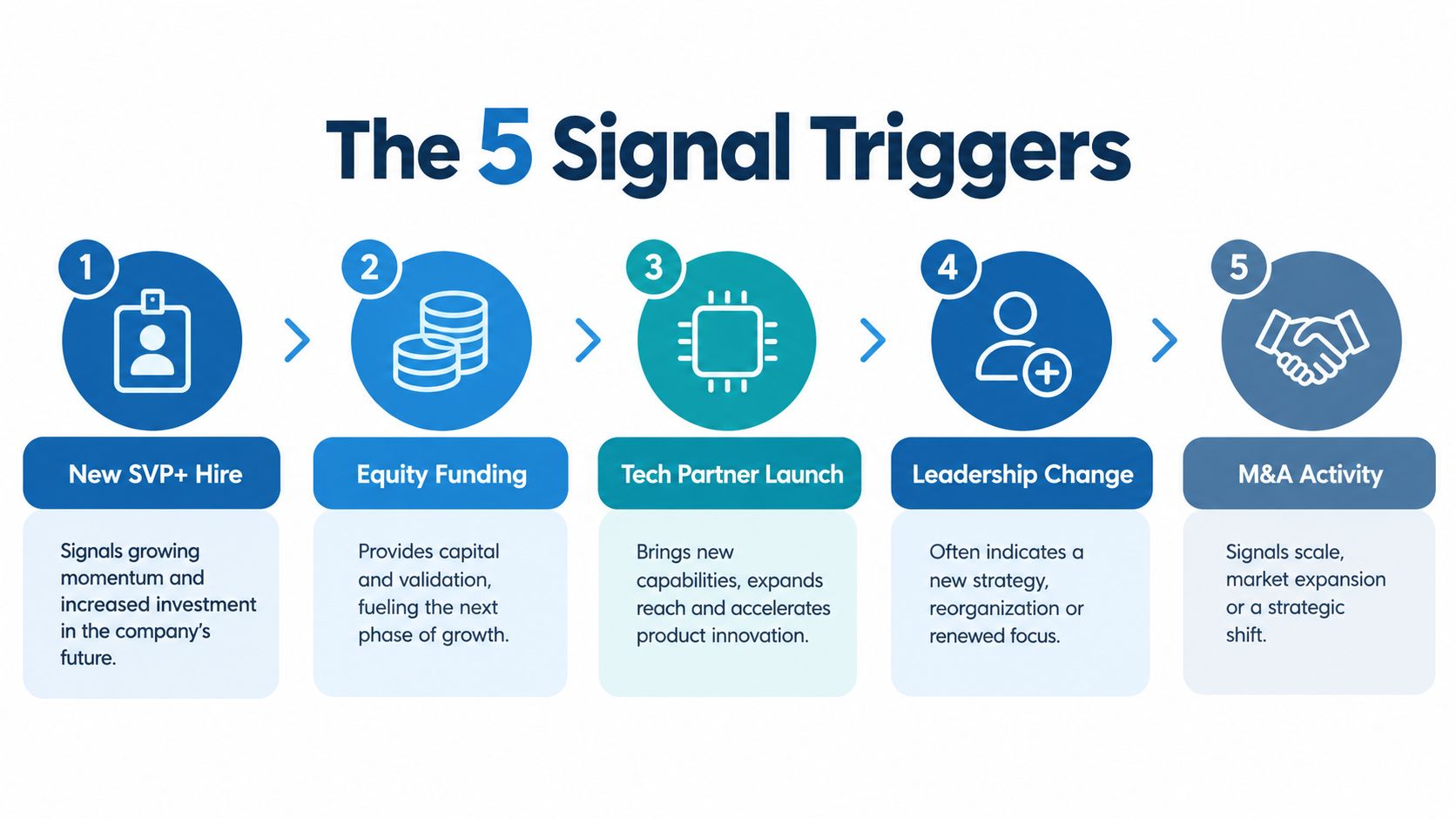
A signal has value only when it changes the next action. The five below should enter a sales workflow with an owner, a recommended channel, and a decay window. Without those controls, the team gets another dashboard instead of a reason to call.
Senior officer hiring
An SVP or higher hire in treasury, capital markets, or commercial banking often signals new authority, a mandate to change performance, or a portfolio handoff. Route the alert to the relevant relationship manager and send a concise introduction that acknowledges the role, not a generic product brochure.
Treat the first 14 days as the priority window. After that, the executive's inbox fills with introductions and the opportunity becomes less differentiated. If the bank already has an active relationship, route the alert to the existing owner rather than allowing a new-business rep to create an internal conflict.
Call report inflections
A 20% jump in non-interest income can indicate a strategic refocus, while a deposit mix shift toward commercial accounts can reveal a change in growth priorities. These signals should trigger a peer-benchmark review before a call. The rep needs to know whether the movement reflects a durable strategy, a one-period anomaly, or a reporting issue.
Use a call for a material, explainable inflection. Use an alert for a weaker movement that needs more confirmation. The message should name the observable change and ask whether the bank is evaluating the adjacent capability.
HMDA volume moves
HMDA volume changes can expose market expansion or contraction before the sales team hears it directly. A move into a new lending market should route to the mortgage or commercial owner, depending on the relevant product. A contraction should not trigger a cheerful growth pitch. It should prompt a diagnostic conversation about capacity, economics, and strategic intent.
Freshness depends on the reporting cycle, so use the latest validated movement and pair it with geography, branch activity, or officer coverage before contacting the bank.
Branch, charter, and core changes
New locations, mergers, and core conversions create operational pressure and decision windows. They can affect treasury processes, data integration, payment workflows, and relationship ownership. Route these alerts to the account executive or relationship manager responsible for the affected geography.
Use a 30- to 90-day window, depending on the event. A merger or core conversion may require executive coordination, while a new branch can support a more focused local conversation. The first contact should offer relevant operating insight, not assume the bank has already selected a vendor.
UCC filings and loan participation
A cluster of UCC filings can surface a borrower opening a new line, adding collateral, or expanding activity. Loan participation data can reveal mid-market deal flow that deserves treasury structuring, credit, or syndication attention. These signals belong with the banker who understands the account and the applicable confidentiality boundaries.
Use the filing as an internal trigger first. Compliance should approve any external reference to a public record before a rep mentions it. For a practical framework on how to score buying intent, the useful lesson is to combine signal strength with recency rather than treating every event equally.
Message Templates That Earn a Reply
The message should prove that the rep has a reason to contact the bank. It shouldn't force the executive to decode a broad pitch.
Cold outreach benchmarks commonly place broad campaigns around 3% to 6% reply rates, while personalized, signal-based outreach can reach 15% to 25%, roughly five times better than average (SalesMotion's outreach benchmarks). Those figures aren't a promise. They're a case for disciplined relevance.
Template one for deposit compression
Subject: Deposit strategy at [Bank Name]
Hi [First Name],
[Bank Name]’s deposit mix is moving differently from its peer group, particularly in [commercial deposits or named category]. That can create pressure on funding costs and relationship depth.
We've helped teams frame the peer gap before deciding whether treasury, payments, or coverage changes are warranted. Would a 20-minute deposit-strategy review be useful next week?
Best, [Rep]
Personalize the bank name, peer benchmark, relevant deposit category, and product gap. The single CTA is the review. Don't add a second request for a referral, introduction, or product demo.
Template two for a new C&I officer
Subject: Supporting [Officer Name]’s handover
Hi [First Name],
I saw that [Officer Name] joined [Bank Name] to lead [C&I segment]. New commercial leadership often inherits uneven portfolio data, account coverage, and treasury conversations.
We've put together a portfolio handover toolkit that helps the new owner identify priority relationships and open product gaps. Who owns the segment transition on your side?
Regards, [Rep]
This version uses the officer's name, role, bank, segment, and likely transition issue. The question is intentionally narrow. It invites routing without pretending the rep already knows the buying committee.
Template three for a UCC signal
Subject: New financing activity at [Borrower]
Hi [First Name],
A recent public filing suggests [Borrower] may be opening or expanding a credit line. If that activity is connected to [Bank Name]’s relationship, treasury structure and payment flows may deserve a quick review.
Would it make sense to compare notes for 20 minutes, or should I speak with the banker responsible for the account?
Best, [Rep]
Don't imply access to confidential borrower information. Keep the language conditional, state the public nature of the filing internally, and obtain compliance approval before external use.
Keep subject lines under 50 characters, make the first line specific to the trigger, and give every email one CTA. Before increasing volume, review the operational basics in MailGenius's guide to stopping email from going to spam in Gmail.
A weak message says, “I'd like to introduce our treasury platform and learn about your priorities.” A strong message says, “Your commercial deposit mix changed against peers, and I'd like to review the funding implication.” The latter gives the recipient a reason to respond.
For teams formalizing the motion, Visbanking's outbound lead generation approach provides a relevant reference for connecting prospect intelligence with action.
A Cadence Built Around the Trigger, Not the Calendar
A fixed sequence treats every prospect as if the buying context were identical. A signal-driven cadence starts on the event date, changes as new evidence appears, and stops when the account produces a clear outcome.
Use this 14-touch, 21-day cadence as the operating baseline:
- Day 1, email: Reference the triggering event and offer one relevant next step.
- Day 3, LinkedIn request: Mention the same signal. Don't send a generic connection note.
- Day 5, phone call: Call with a voicemail that connects directly to the email.
- Day 8, second email: Add new evidence, such as a peer benchmark or follow-on filing.
- Day 12, LinkedIn DM: Keep it short and advance the same business question.
- Day 15, breakup email: Explain why you're closing the sequence and provide one reason to respond.
- Day 21, reactivation: Re-enter only if a new signal fires. The remaining touches should be assigned according to channel response and account ownership, not duplicated automatically.
The schedule has gaps because the rep needs to add information between contacts. A second email that repeats the first message is not persistence. It's noise.
Breakout rules
The queue ends immediately when the prospect replies, a meeting is booked, or a new signal from another class appears. A response moves the contact into a human-led workflow. A meeting creates a preparation task. A new signal can change the message, owner, or priority.
Warm targets deserve a shorter path. Start with the relationship owner, use the signal to sharpen the conversation, and avoid treating an existing customer like a cold prospect. Cold targets need the full sequence only when the signal remains current and the account still meets the ICP.
Industry benchmarks report that first-touch response can be about 3%, while multi-channel sequences reach about 7% versus 5% for email-only sequences; broader cadence benchmarks put well-constructed multi-channel reply rates around 12% to 18% (Outreach's multichannel sequencing guidance). The practical advantage is not just more activity. It is better use of rep hours because each touch carries forward the same verified business context.
Wiring Signals Into CRM and Automation
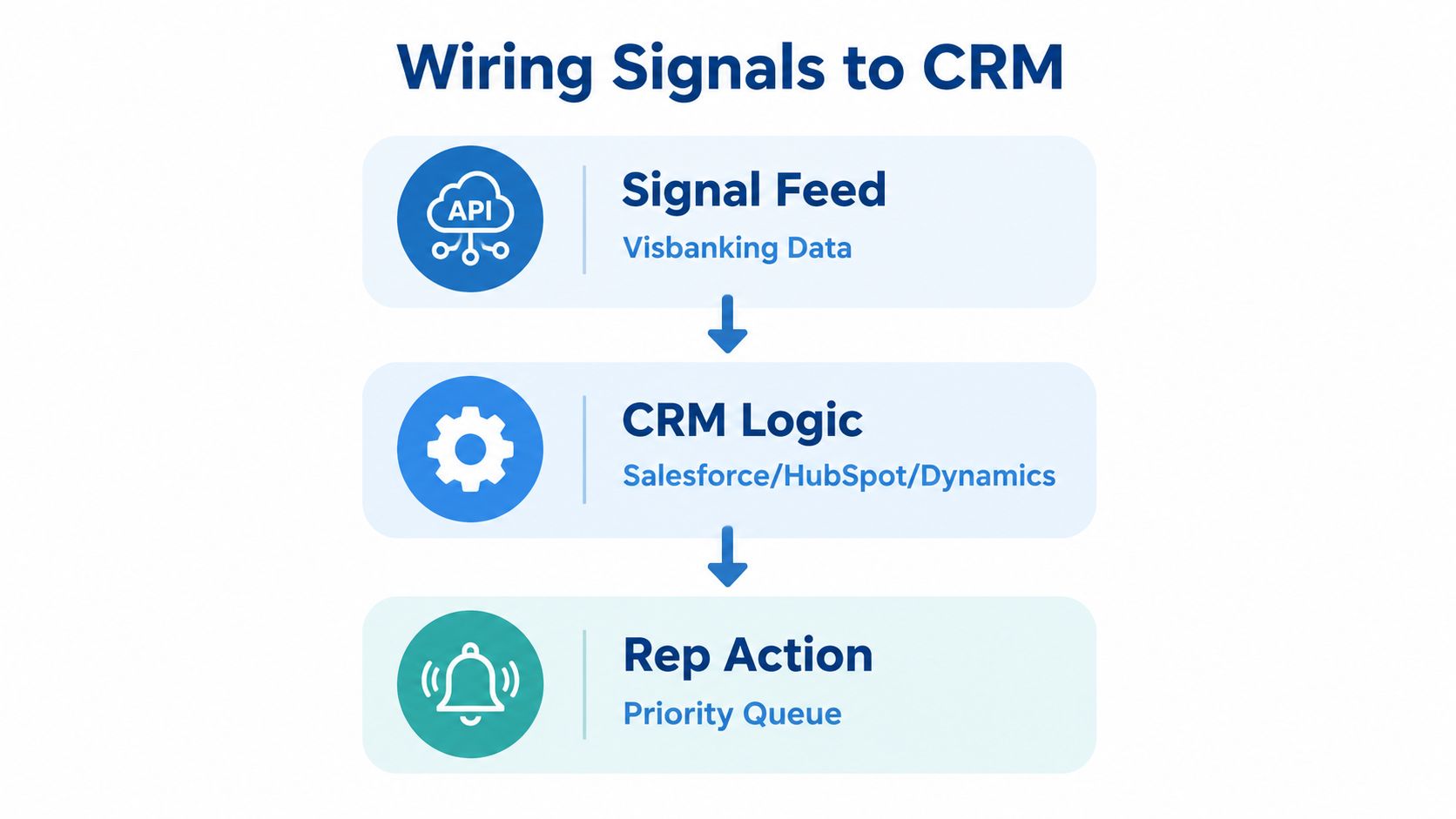
A signal becomes useful when the CRM turns it into an accountable task. The workflow should connect the data feed, routing logic, and rep activity without forcing sellers to interpret a separate research screen before every call.
The three integration layers
Signal feed: Pull officer moves, call report inflections, HMDA shifts, branch or charter changes, and UCC clusters into a monitored stream. Each event needs a bank identifier, event type, event date, source, confidence level, and freshness status.
CRM logic: Assign the alert using bank size, geography, product ownership, and existing relationship status. An officer move at an existing account should go to the relationship owner. A qualifying prospect with no owner should route by territory and product expertise.
Rep action: Create a task with the recommended channel, approved talking point, expiration date, and required next step. Write the outcome back against the originating signal, not merely against the contact record.
A sales operations lead can hand IT this architecture sketch:
Visbanking signal feed
        ↓
Deduplication and freshness rules
        ↓
Salesforce, HubSpot, or Microsoft Dynamics
        ↓
Routing by bank, geography, product, and relationship
        ↓
Priority queue for relationship manager
        ↓
Outreach, response note, stage change, attribution
The rep should update signal type, event date, source status, contact role, first-touch date, channel, response classification, meeting outcome, opportunity stage, and compliance approval status. For high-intent signals, set the first-touch SLA to under 48 hours. A late response can turn a useful trigger into historical background.
Before any outbound message references a public filing, compliance should confirm that the source is public, the language doesn't imply confidential knowledge, the recipient is appropriate, and the message doesn't make an unsupported credit or performance claim. Store that approval with the signal record.
Monitor three failure modes closely. Stale signals create embarrassing outreach. Duplicate alerts make several reps contact the same institution. Routing conflicts leave high-value events sitting between teams. A bank-prospecting system should expose those exceptions rather than passing them downstream. Visbanking's bank prospecting software is one example of a platform category designed to connect institution intelligence with prospecting workflows.
Measuring What Matters and Closing With One Next Step
Open rates and raw replies are easy to report and easy to misuse. A bank sales motion should measure whether a verified signal produced a qualified conversation, whether that conversation created an opportunity, and whether the process stayed within governance requirements.
Track five measures:
- Qualified-meeting rate: The share of signal-led contacts that produce a meeting with a relevant decision-maker or strong influencer.
- Opportunity creation rate: The share of qualified meetings that become opportunities with a defined need, owner, and next action.
- Pipeline contribution by signal source: The opportunities and pipeline associated with officer moves, call report changes, HMDA activity, branch events, or UCC data.
- Signal decay and campaign velocity: The time from signal creation to first touch, then from first touch to qualified outcome. Review which signals lose value fastest.
- Compliance-clean send rate: The proportion of outbound messages that pass the required review without correction, escalation, or withdrawal.
The point is attribution. If a rep creates an opportunity after researching a call report change, the CRM should preserve that origin. Otherwise, management will credit the inbox, the territory, or the rep's general activity instead of learning which bank signals produce commercial conversations.
| Metric | What It Measures | Why It's Vanity | Better Signal-Driven Alternative |
|---|---|---|---|
| Opens | Subject-line and delivery activity | Privacy controls and automated opens distort intent | Qualified-meeting rate by signal |
| Replies | Initial engagement | A reply can be vague, negative, or commercially irrelevant | Positive response leading to a defined next step |
| Touches | Rep activity | Volume can rise while targeting worsens | Time from alert to first relevant touch |
| Meetings | Calendar conversion | A meeting may lack authority or a defined problem | Qualified meeting with role and business issue |
| Opportunities | Stage creation | Reps can create poorly qualified records | Opportunity creation by originating signal |
| Pipeline | Reported potential value | Unverified pipeline can reward optimism | Pipeline contribution by signal source |
| Compliance sends | Message approval | Approval alone doesn't prove commercial value | Compliance-clean sends linked to outcomes |
The weekly operating review
A weekly review should answer operational questions. Which high-intent alerts missed the first-touch SLA? Which signals generated replies but no meetings? Which routes produced duplicate activity? Which messages required compliance correction?
Escalate stale high-intent alerts, unresolved ownership conflicts, and any outbound that referenced a filing without a documented approval. Kill sequences that produce repeated nonresponses after the signal has expired, especially when the rep has no new evidence to add.
The monthly management review
The monthly review should compare signal classes, segments, and owners. If officer moves produce qualified meetings but call report inflections produce only low-quality replies, change routing and messaging rather than just adding touches. If a product gap generates meetings in one deposit tier but not another, narrow the ICP or revise the offer.
Benchmark context matters. The large outreach analysis cited earlier shows why follow-up can change response behavior, but bank executives still need to separate response from revenue. A reply is a leading indicator. A qualified meeting, an opportunity with a real business issue, and pipeline tied to the originating signal are management outcomes.
The broader channel mix also supports a measured approach. Email remains the most common proactive channel at 69.1%, followed by phone at 46.1%, SMS at 43.3%, and in-app chat at 42.4% (Coworker's customer success trend data). Banks shouldn't interpret that as a mandate to contact customers everywhere. The correct channel depends on the trigger, customer segment, relationship permissions, and compliance constraints.
Bank of America illustrates the scale of proactive digital engagement. The bank reported that clients connected with their finances about 30 billion times in the prior year through digital logins and proactive alerts, a 14% year-over-year increase, including 16.6 billion logins, 13.3 billion alerts, and more than 38 million alert subscribers (BLOOMBERG's summary of the bank's proactive outreach). The lesson for executives isn't to copy those figures. It is to treat proactive contact as an operating capability that can be monitored, governed, and improved through data.
Your Monday-morning action is straightforward. Pick one commercial banking segment, wire one signal into the CRM, and instrument the path from alert to qualified meeting before scaling the touch count. If the team can't explain which signal created the opportunity, it isn't ready for more automation.
Visbanking brings bank, regulatory, market, people, and relationship intelligence into workflows that help teams identify relevant signals and route timely outreach. Visit Visbanking to benchmark a target segment, explore institution-level data, and build a governed path from bank signal to sales action.
Latest Articles
Brian's Banking Blog
How to Secure REST API with JWT for Banking
Brian's Banking Blog
Commercial Loan Analysis: A Bank Executive's Guide
Brian's Banking Blog
Understanding Statistical Significance in Banking
Brian's Banking Blog
Option Adjusted Spread: A Banker's Practical Framework
Brian's Banking Blog
How to Improve Margins: A Bank Leader's Playbook
Brian's Banking Blog