
Bank Cash Flow Analysis: A Practical Executive Playbook
Brian's Banking Blog
The most popular advice about bank cash flow analysis is also the least useful: check whether the bank has enough liquidity to cover projected outflows. That question matters, but it's incomplete. A bank can satisfy a headline liquidity test and still be exposed to rapid deposit runoff, concentrated wholesale funding, inaccessible collateral, or a funding mix that becomes expensive precisely when customers need certainty.
Executives should treat cash flow analysis as a forward-looking discipline for funding mix, runoff speed, and relationship decisions. The output shouldn't be a static report for treasury. It should tell the CFO which deposits need attention, the CRO where origination should slow, the treasurer which liabilities need restructuring, and relationship managers which clients require a call.
Why Most Banks Still Misread Cash Flow Analysis
“Are we covered?” is the wrong opening question. The better questions are: How quickly can deposits leave? How dependent is the bank on one wholesale channel? Where will the next liquidity need be funded?
Supervisors have long treated pro forma cash flow statements as a core liquidity tool. Federal Reserve guidance identifies them as critical for liquidity risk management and recommends liquidity gap analysis across time horizons, alongside stress tests for adverse funding conditions and orderly liquidation scenarios. The Federal Reserve's interagency liquidity guidance makes the point clearly: cash flow analysis supports forward-looking funding decisions, not merely accounting reconciliation.
The common failure is a static view of liquidity. Management reviews a buffer against a regulatory threshold, sees adequate coverage, and moves on. That process misses the behavior of the liabilities funding the balance sheet.
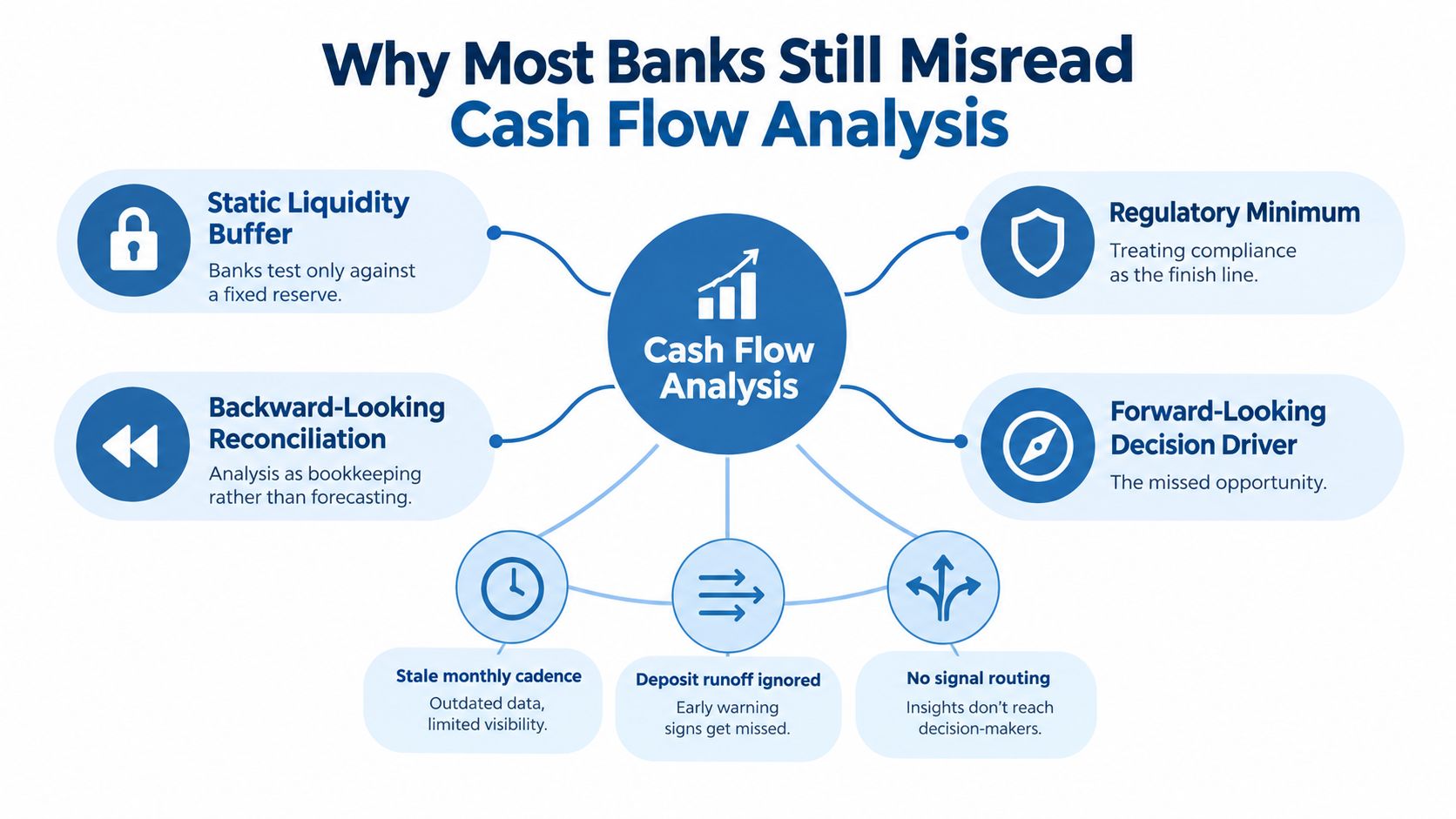
Three questions belong in the executive meeting
- Runoff speed: How fast could deposits walk under ordinary repricing pressure, a confidence event, or a digital outflow?
- Funding concentration: Which wholesale source, counterparty, or maturity bucket carries the greatest replacement risk?
- Funding optionality: Which assets can be converted to cash immediately, and which are technically liquid but operationally constrained?
Average balances conceal all three. They blend stable operating accounts with rate-sensitive balances, treat uninsured deposits as one category, and obscure maturity cliffs. A client's operating cash flow also isn't the same as the bank's funding cash flow. A commercial borrower may generate cash while moving deposits to another institution, or report strong earnings while drawing on its revolver.
For executives researching the mechanics of statements outside banking, Nexist's guide to how Australian cash flow statements work offers useful accounting context. Bank leadership, however, needs to go further. The question isn't only what cash moved. It's which funding behavior will move next, how quickly, and who must act.
Board standard: A liquidity report that doesn't identify the next funding decision is a historical report, not a management tool.
Building the Data Foundation for Cash Flow Work
Ratio analysis fails when the underlying data isn't reconciled, classified, and normalized. Start with the regulatory record, then add the bank's operating detail.
The Call Report and UBPR establish a standardized external view. They support peer comparison across liquidity, funding, asset composition, and earnings measures. Internal data supplies the behavioral layer: the general ledger, core deposits by customer segment, treasury settlement files, and loan-level cash flow for material exposures.
The first control is reconciliation. Match bank statements to the general ledger, investigate timing differences, classify every movement as operating, investing, or financing activity, remove non-cash items, and verify that beginning cash plus net cash flow equals ending cash. This sequence, also described in a practical guide to building a cash flow forecast, prevents a polished dashboard from resting on incomplete transactions or cutoff errors.
Normalize before calculating
Banks should document the treatment of unusual items before producing ratios. An IPO deposit, a tax-season surge, a sweep-account movement, or a one-time securities transaction can distort the apparent trend. Treasury should separate operational balances from non-operational balances and map sweep arrangements to the underlying customer relationship.
The data owner also needs to record the vintage, definition, and refresh frequency of every series. Internal segment codes must map into comparable peer buckets. A “commercial operating deposit” should mean the same thing in a management report as it does in a peer benchmark, or the comparison is decoration.
| Source | Use | Normalization step |
|---|---|---|
| Call Report | Regulatory liquidity and funding view | Align reporting periods and regulatory definitions |
| UBPR | Peer benchmarking and trend context | Match the peer set and map internal categories to comparable buckets |
| General ledger | Book-of-record reconciliation | Resolve cutoff differences and reclassifications |
| Core banking deposits | Customer and product behavior | Separate operational, non-operational, insured, and uninsured balances |
| Treasury settlement files | Daily funding movements | Remove duplicates and align settlement dates |
| Loan-level cash flow | Borrower repayment and exposure analysis | Use consistent assumptions and flag missing or stale schedules |
A defensible foundation has three named controls:
- Freshness: Treasury knows when each feed was last updated.
- Ownership: A named executive owns each definition and exception.
- Traceability: Every major adjustment links back to a source record and documented judgment.
Visbanking's bank liquidity management resource is relevant when designing this operating layer because liquidity decisions require regulatory data, internal behavior, and workflow ownership in one analytical process. Without that integration, downstream ratios may be numerically correct and strategically wrong.
The Ratios That Actually Move Decisions
Executives don't need a longer ratio inventory. They need ratios connected to pricing, credit, and funding actions.
The liquidity coverage ratio is a starting point, not a conclusion. Under the Basel III framework, covered banks must hold high-quality liquid assets equal to at least 100% of projected net cash outflows over a prospective 30-calendar-day stress period. The mechanics matter because the outflow assumptions drive the result. The cited FDIC proposal applies a 3% outflow rate to stable retail deposits and a 10% rate to other retail deposits. Those assumptions aren't interchangeable with a bank's observed customer behavior.
A bank reporting 118% LCR can be more fragile than a bank reporting 105% if the first bank's excess liquidity is concentrated in a single money-market fund counterparty while the second holds more diversified, immediately accessible assets. The headline percentage doesn't reveal concentration, collateral access, settlement timing, or the speed of a digital outflow. Executives should use liquidity coverage ratio calculation guidance to validate the mechanics, then challenge the assumptions.
Use trend logic, not averages
For commercial clients, DSCR should be read as a trend. A stable average can hide a deteriorating latest period, particularly when taxes, distributions, capital expenditures, and debt changes are omitted. Bankers should combine related business and personal cash flows and assess the most recent DSCR when the trend is weakening, rather than allowing a stronger historical period to dilute the warning.
Funding-mix ratios require the same discipline. Track uninsured deposits as a share of funding, the wholesale maturity ladder, digital deposit growth against branch runoff, and the replacement cost of each liability source. A shift from 60% insured and 40% uninsured funding to the reverse is not a symmetrical event. The second mix carries materially greater implicit runoff risk because more balances may respond quickly to confidence, pricing, or convenience signals.
| Ratio | Decision it informs | Watch-out logic |
|---|---|---|
| LCR | Near-term liquidity posture | Challenge outflow assumptions, asset concentration, and usability |
| DSCR trend | Credit capacity and pricing | Weight recent performance when repayment capacity deteriorates |
| Uninsured deposits to funding | Retention and contingency planning | Segment by behavior, not only legal classification |
| Wholesale maturity ladder | Refinancing and tenor decisions | Identify simultaneous maturities and channel dependence |
| Digital growth versus branch runoff | Distribution and deposit strategy | Distinguish new funding from migration within the franchise |
The executive weekly should show runoff alerts, funding concentration, major maturity gaps, and material changes in liquidity usability. ALCO can review the deeper monthly analysis, including scenario assumptions, collateral inventories, and structural balance-sheet choices. If a ratio never changes a decision, remove it from the executive pack.
Stress Testing That Mirrors Real Funding Risk
A stress test that assumes orderly customer behavior is a comfort exercise. Banks need scenarios that reflect how funding behaves when depositors can move money immediately and social signals travel faster than committee calendars.
Start with a baseline runoff grid by product. Separate DDA, savings, time deposits, reciprocal balances, and brokered funding. Apply asymmetric assumptions because these liabilities don't leave at the same speed or for the same reason. A time deposit has a maturity event. A brokered balance has a replacement and pricing risk. A transaction account can move after a relationship failure or operational disruption.
Build the scenario library around behavior
The scenario library should include at least three custom cases alongside regulatory templates:
- Deposit repricing: Stable balances become rate-sensitive, with runoff concentrated in segments that have weak relationship depth.
- Wholesale renewal stress: A major funding channel renews at a wider spread, reduces availability, or creates a maturity concentration.
- Digital confidence event: App-based customers transfer funds rapidly after a public rumor, service issue, or competitor promotion.
For each case, show the cash-gap waterfall. Identify which assets are consumed first, which are encumbered, and which require operational steps before use. The sequence may begin with unencumbered Treasuries, continue through FHLB stock redemption, and then reach fed funds sold, but management must verify that ordering against its own legal, operational, and collateral constraints.
The ECB has highlighted the importance of liquidity gaps, maturity buckets, and cash-flow analysis across banking systems. Its financial stability analysis of euro-area liquidity conditions also underscores why the composition of liquid assets matters. A larger paper buffer doesn't automatically mean faster cash access.
| Scenario Type | Shock Assumption | Spread Impact | Liquid Asset Sequence |
|---|---|---|---|
| Deposit repricing | Rate-sensitive balances reprice or run | Deposit cost rises | Unencumbered securities, then other accessible assets |
| Wholesale renewal | Maturities require replacement funding | Refinancing spread widens | Available secured capacity, then secondary funding |
| Digital confidence event | Rapid outflow concentrated in mobile segments | Funding replacement becomes expensive | Immediately usable assets first |
| Collateral constraint | Pledged assets cannot support new borrowing | Secured funding capacity falls | Unencumbered collateral and cash equivalents |
Each scenario needs a payout-recovery timeline, cumulative days of stress, and minimum operating cash. The board should see where management overrides the supervisory template, why those overrides are justified, and what action begins when the internal view is worse.
Liquidity risk indicators are useful only when they feed this scenario process. A risk indicator should expose the driver, quantify the gap, name the asset sequence, and trigger a decision owner.
Turning Liquidity Signals into Sales and Credit Action
A liquidity signal has no value until someone outside treasury changes behavior. The operating mistake is treating liquidity analytics as an ALCO deliverable instead of a CRM, pricing, and credit workflow.
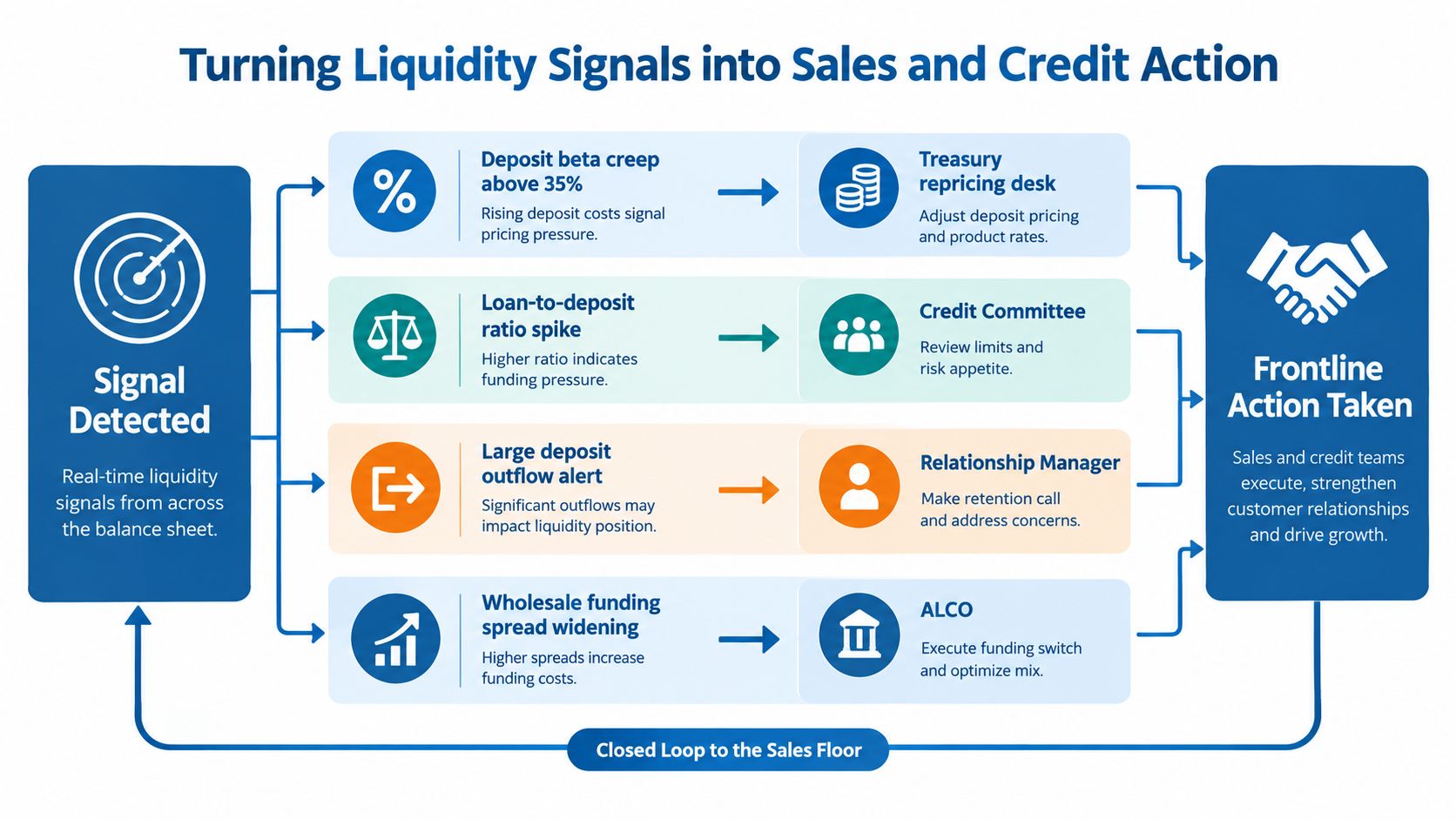
Define the trigger, owner, service-level agreement, source, and required action before the alert goes live. Four examples create a practical starting architecture:
- Deposit beta above 35%: Treasury repricing owns the immediate response, while the treasurer reviews affected relationships within 24 hours. The source is deposit pricing and balance data. The documented action is a repricing decision or relationship escalation.
- DDA runoff above 5% in 30 days: Sales routes the alert to the relationship manager for the top commercial relationships within 72 hours. The source is core deposit history. The required artifact is a retention call brief with balance movement, products held, pricing, and next contact.
- Wholesale cost of funds above the peer median: ALCO reviews tenor and channel structure within 168 hours. The source is internal funding cost plus standardized peer data. The action is a documented funding switch, repricing decision, or exception.
- Loan-to-deposit ratio above 92%: Credit receives the signal for origination threshold review within 24 hours. The source is the general ledger and regulatory reporting. The action is a temporary pause, tighter approval threshold, or documented override.
Give frontline teams one useful page
A relationship manager shouldn't receive a forty-page liquidity report. The manager needs a one-page brief tied to one signal:
- What changed?
- Which customer or segment drove it?
- What does the bank risk losing?
- Which action is authorized?
- When must the manager report back?
That format turns bank cash flow analysis into a growth discipline. A deposit runoff alert can uncover unused treasury services, weak operating-account integration, or a pricing issue. A rising wholesale cost can change how bankers price new loans. A loan-to-deposit trigger can redirect originators toward funded relationships instead of unfunded volume.
Operating rule: Every alert needs a named person, a deadline, and a recorded response. Otherwise, it's reporting theater.
An Executive Scenario in One Week
Consider a representative $6 billion community bank that treats cash flow analysis as an executive operating process rather than a monthly treasury package.
On Monday, the CFO compares UBPR peer data with internal call reports. The bank's cost of funds has risen 38 basis points in 60 days, while the peer set is at plus 12 basis points. The immediate driver is 22% growth in brokered CDs, which changes both pricing pressure and renewal dependence. Treasury doesn't debate the headline. It traces the funding mix.
On Tuesday, the treasury team reconciles the data to the general ledger and core deposit file. It isolates $180 million in CDs maturing inside 90 days and revises the runoff probability to 14%, compared with the prior 7% assumption. The change isn't a forecast ornament. It defines the amount of funding the bank may need to replace and the price it may have to pay.
On Wednesday, the team adds a digital outflow overlay. The worst case shows a 21% drop in under-40 balances tied to a fintech competitor's rate promotion. The scenario is clearly labeled as a management stress assumption, not a historical fact. That distinction matters when directors approve actions and later review outcomes.
Decisions by Thursday
ALCO approves a three-part response:
- Reposition $90 million into three-year FHLB locked advances.
- Reprice the relationship-tier deposit beta by midweek.
- Pause non-PPP commercial originations above $2 million.
On Friday, the CRO issues the origination memo. The board receives a one-page dashboard showing the trigger, response, owner, and projected NIM recovery within two quarters.
The value of the process is speed with control. The bank moved from standardized data to a funding decision, a sales action, and a credit constraint in five business days. The analysis didn't predict the future with false precision. It exposed the funding choices that would become expensive if management waited.
Your Executive Checklist and How to Benchmark Next
A CRO or treasurer should be able to audit the following in one meeting:
- Treasury: Reconciled bank statements to the ledger, with a documented cash-flow file.
- Treasury: Classified operating, investing, and financing movements consistently.
- Finance: Recorded data vintage, definitions, exceptions, and ownership.
- Treasury: Produced an LCR trend chart with outflow assumptions and asset usability.
- Credit: Reviewed current DSCR trends for material exposures.
- Treasury: Maintained a runoff scenario log by product and customer behavior.
- ALCO: Reviewed wholesale maturities, concentration, and replacement cost.
- Sales: Received a signal-to-action matrix with named relationship owners.
- Credit: Documented origination thresholds linked to liquidity triggers.
- Executive team: Held a weekly liquidity stand-up and archived management overrides.
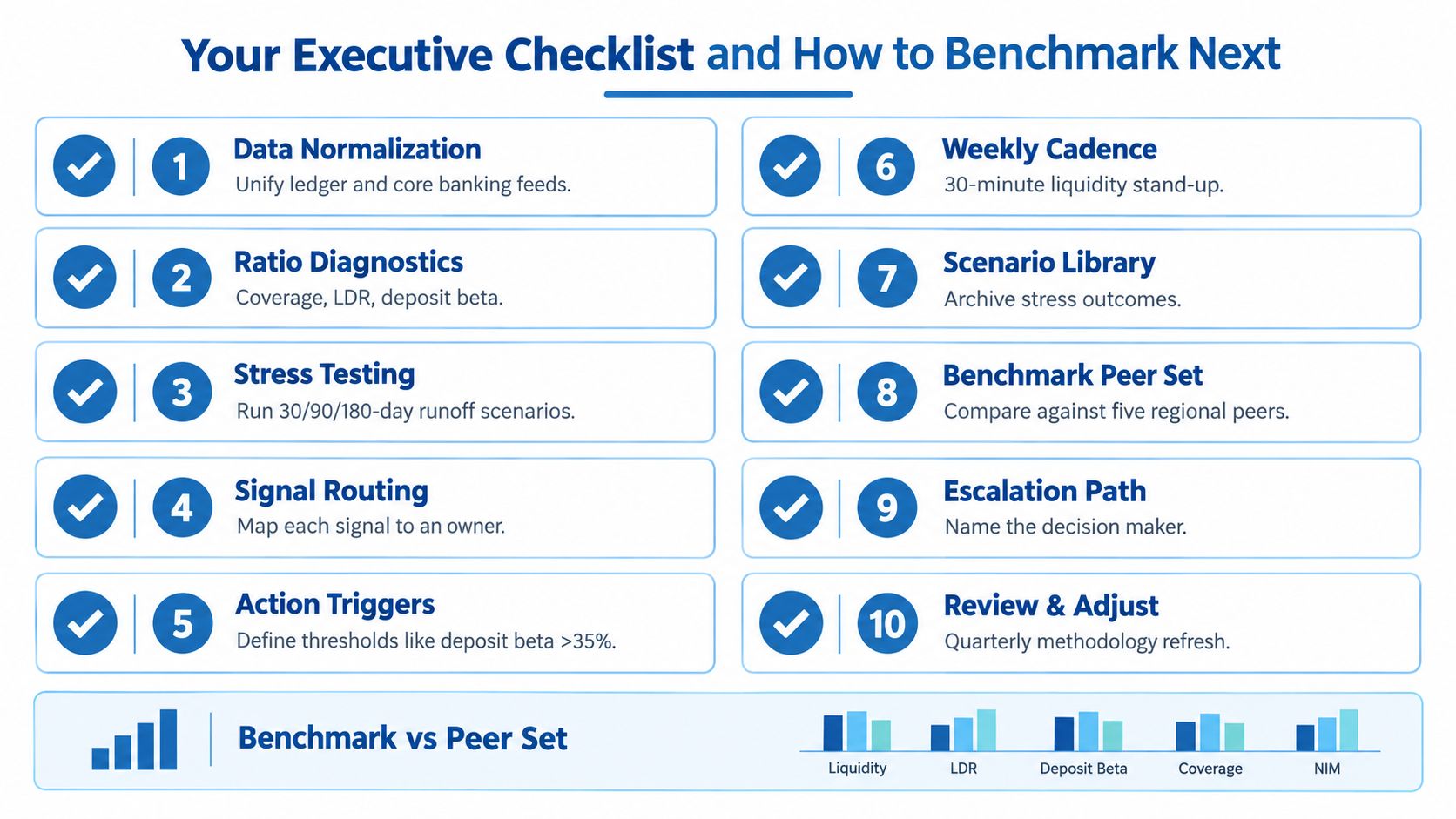
Peer comparisons only work when definitions are standardized. Benchmark the bank's liquidity, funding mix, deposit behavior, and runoff speed against a consistent peer distribution, then route the gaps to treasury, credit, sales, and relationship management.
Visbanking provides standardized bank intelligence, peer benchmarking, regulatory and market data, predictive signals, and workflow-ready analytics that can help executives connect cash-flow signals with funding and relationship decisions. Visit Visbanking to benchmark your bank's liquidity and funding position, identify the gaps that matter, and turn the signed-off checklist into an action plan.
Latest Articles

Brian's Banking Blog
How to Secure REST API with JWT for Banking
Brian's Banking Blog
Commercial Loan Analysis: A Bank Executive's Guide
Brian's Banking Blog
Understanding Statistical Significance in Banking
Brian's Banking Blog
Option Adjusted Spread: A Banker's Practical Framework
Brian's Banking Blog
How to Improve Margins: A Bank Leader's Playbook

Brian's Banking Blog