
Bank Prospecting Software: A Guide to Driving Loans & Deposits with Data Intelligence
Brian's Banking Blog
Effective prospecting is no longer about relationships alone; it is about strategic intelligence. Bank prospecting software is not merely another CRM but an analytical engine that transforms raw market data into decisive growth opportunities. It pinpoints high-value commercial relationships, moving your business development from intuition to a data-driven discipline.
Why Traditional Prospecting Is a Competitive Liability
The relationship-banking model built on local networks and gut feelings is obsolete. In a crowded, fast-moving market, relying on instinct for growth is a strategic failure.
Market consolidation has intensified the competition for quality commercial clients. Simultaneously, digital-first competitors are eroding customer loyalty with targeted, data-backed offers. Your commercial lending team cannot afford to waste time chasing leads from stale lists or anecdotal referrals.
Every hour spent pursuing a dead-end prospect is an opportunity seized by a competitor leveraging data to be faster and more precise.
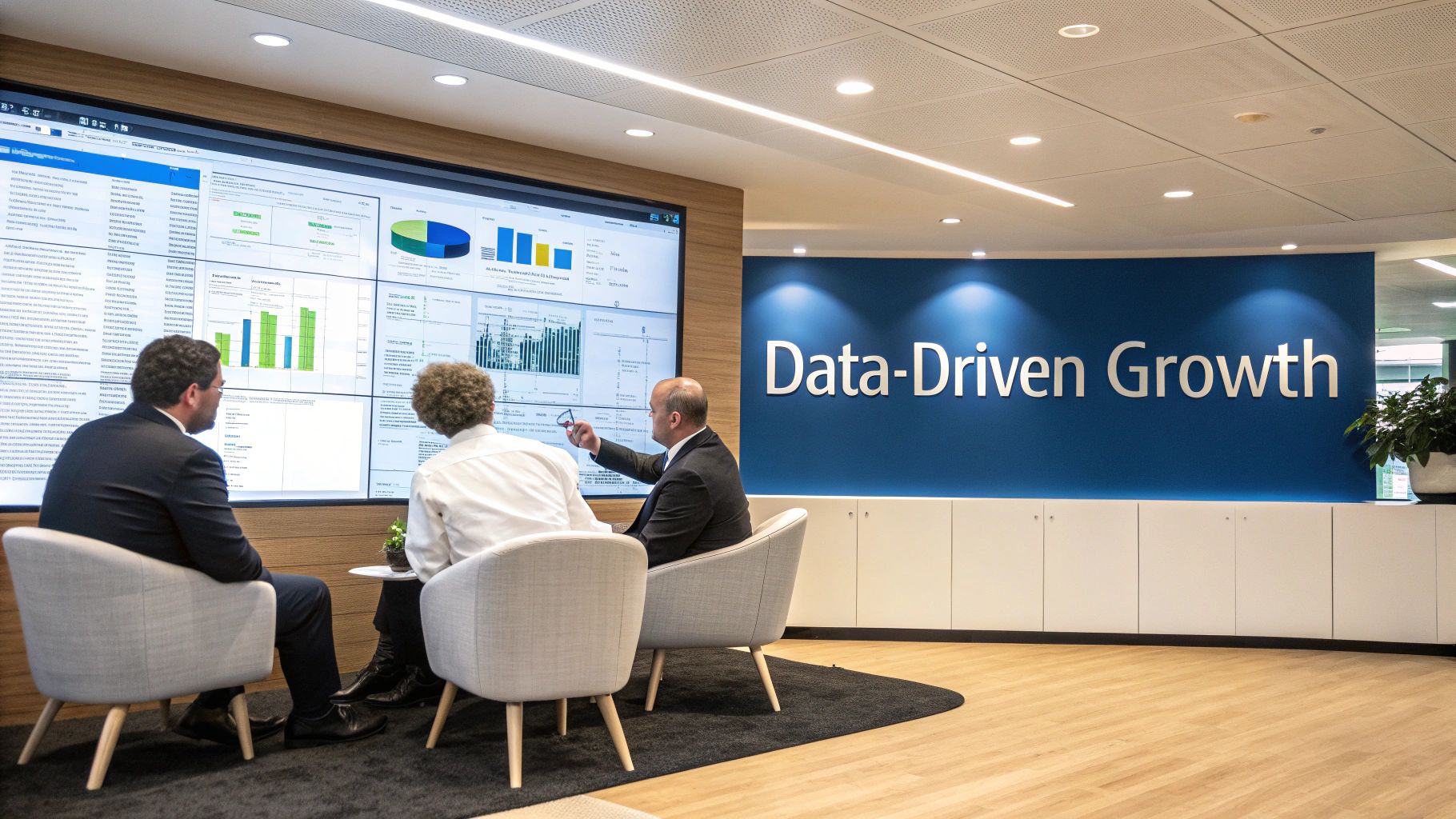
The High Cost of Outdated Methods
Outdated prospecting directly impacts your bottom line. Consider a scenario where a commercial lender invests 80 hours pursuing 20 local businesses, only to find that two are qualified for a loan. This is not just a poor conversion rate; it is a profound misallocation of your most valuable asset—your lender’s time.
A data-driven approach is not about working harder; it is about focusing capital and talent with precision. It is the difference between casting a wide net and using sonar to identify precisely where the most valuable opportunities lie.
This outdated model creates significant strategic disadvantages:
- Reactive Market Position: Your team is consistently the last to learn of a competitor’s maturing loan or a local business’s financing needs.
- Limited Market Visibility: Lenders operate with a narrow view, missing substantial segments of opportunity within their designated territories.
- Inefficient Use of Talent: Top-performing lenders are relegated to low-value administrative tasks instead of building relationships and structuring deals.
The Shift to Strategic Intelligence
To win in this environment, bank leadership must equip their teams with tools that provide a clear signal through the market noise. Bank prospecting software is a non-negotiable component of a modern growth strategy. It is a competitive weapon.
This software analyzes vast datasets—from FDIC call reports to UCC filings—to uncover opportunities that are otherwise invisible.
Instead of guessing which businesses require capital, your team can identify companies with documented financial triggers, such as aging equipment liens or recent credit events. This forms the foundation of effective lead generation for banks, enabling your team to engage at the exact moment a prospect requires a solution.
The objective is to ensure every conversation and meeting is substantive. A robust data intelligence platform like Visbanking empowers your team to concentrate on high-value relationships that drive profitable growth. The first step is acknowledging the old playbook is broken. The next is to quantify the data-driven opportunities you have been missing.
What Exactly Is Bank Prospecting Software?
Fundamentally, bank prospecting software is a strategic intelligence system engineered for a singular purpose: to identify and deliver qualified, high-value growth opportunities. It removes guesswork from business development by systematically identifying, vetting, and prioritizing potential clients for both major commercial loans and significant deposit relationships.
Your team currently views the market from street level, relying on existing contacts and local reputation. This software provides the satellite view—the entire competitive landscape. It reveals untapped customer segments, highlights competitor weaknesses, and pinpoints prime territories for expansion with analytical clarity.
From Raw Data To Actionable Strategy
The core function of this software is to transform thousands of disparate data points into a coherent, actionable growth map. It aggregates and analyzes large datasets that are impossible to compile or interpret manually.
It systematically scans key sources, including:
- FDIC Call Reports to reveal competitor lending patterns and portfolio performance.
- UCC Filings to identify businesses that have recently taken on equipment debt, signaling a prime opportunity for refinancing.
- Business Demographics to target specific industries, revenue brackets, and employee counts that align with your ideal customer profile.
- SBA Loan Data to find growing businesses poised to graduate to conventional financing.
This fusion of data allows lenders to move from cold calls to strategic conversations. Instead of asking, "Do you need a loan?" they can state, "I see the equipment loan you hold with a national lender is maturing in six months. We should discuss a more competitive rate." This is the power of turning data into a tangible competitive advantage. The Visbanking Prospect module was built to transform its growth strategy with smart targeting.
Manual prospecting is an expensive and inefficient relic. It drains resources, demoralizes lenders with low success rates, and cedes market share to competitors who have adopted a data-first approach.
The distinction is clear.
Traditional Prospecting vs Data-Driven Prospecting
| Metric | Traditional Methods (Manual, CRM-based) | Bank Prospecting Software (Data-driven) |
|---|---|---|
| Lead Quality | Low; based on cold calls, stale lists, and referrals. | High; based on verified financial triggers and ideal client profiles. |
| Lender Efficiency | Very low; 70-80% of time spent on non-revenue generating activities. | High; lenders focus exclusively on pre-qualified, high-potential opportunities. |
| Market Insight | Limited; restricted to existing networks and anecdotal evidence. | Comprehensive; provides a full view of competitor portfolios and market gaps. |
| Strategic Focus | Reactive; chasing opportunities as they arise. | Proactive; systematically targeting specific market segments for growth. |
| Conversion Rate | Typically in the low single digits. | Significantly higher due to informed, timely outreach. |
| ROI Measurement | Difficult; attribution is unclear and often based on intuition. | Direct; clear line from identified lead to closed deal. |
The comparison is stark. The objective shifts from generating more leads to engaging the right leads at precisely the right time.
This isn't just about finding more leads; it's about finding the right leads at the right time. It shifts your business development from a high-effort, low-yield activity to a precise, data-guided function that directly fuels the balance sheet.
When you provide your team with a true intelligence platform, you are not just acquiring software. You are investing in a more profitable, efficient, and defensible growth model for modern banking. The next step is to discover what this solution can uncover in your market.
Key Features That Fuel Strategic Growth
Effective bank prospecting software is more than a glorified lead list; it is a strategic intelligence system designed to provide a decisive market edge.
Its value is not in its technical specifications but in how its core features convert raw data into measurable balance sheet growth. For executives, this means empowering lenders to cease guessing and start executing with analytical precision.
The process transforms a mountain of fragmented information into a clear roadmap for growth.
The system synthesizes raw market data—such as call reports and UCC filings—into an actionable growth map, revealing exactly where your best opportunities are concealed.
Market and Competitor Intelligence
To understand your market, you must first understand your competitors. Modern prospecting platforms provide an unparalleled view into rivals' loan portfolios, exposing their strategic weaknesses and your greatest opportunities.
This is not anecdotal intelligence from your lenders. It is a granular, data-backed analysis of their commercial and industrial (C&I), commercial real estate (CRE), and agricultural lending activities.
Instead of reacting to market shifts, you can anticipate them.
For example, an analysis of a competitor’s CRE portfolio might reveal they hold $75,000,000 in loans set to mature in the next 18 months, all within a single county. This is not just a data point; it is a qualified campaign list for your lending team, enabling proactive outreach with superior terms.
Ideal Customer Profile Targeting
Not all growth is beneficial. Pursuing businesses that do not align with your bank's risk profile is a significant waste of resources.
Superior prospecting software allows leadership to define and target an Ideal Customer Profile (ICP) with surgical precision, ensuring every business development effort supports the bank’s overarching strategic objectives.
This fundamentally changes how lenders approach a territory. A lender can apply specific filters to isolate perfect-fit prospects.
By filtering for businesses within your target NAICS codes, revenue range, and desired loan exposure, you eliminate the noise. This ensures your team spends its valuable time building relationships with companies that strengthen your portfolio, not dilute it.
Suppose your bank aims to expand its healthcare lending. You can filter for medical practices with annual revenues between $5,000,000 and $20,000,000 that currently bank with a large, impersonal national competitor. The system instantly generates a list of high-potential targets that match your strategic focus.
Qualified Lead Generation
The single greatest drain on a commercial lending team is the pursuit of unqualified leads.
A true bank prospecting platform solves this by identifying businesses with documented financial needs. It transforms cold calls into strategic conversations by providing your team with a compelling, data-verified reason to engage.
Consider a common scenario. Instead of indiscriminately calling every manufacturer in an industrial park, the software identifies one company with a five-year-old UCC filing for heavy machinery. This signals aging assets and a potential need for equipment financing.
Your lender can now approach this prospect with a tailored proposal that addresses a specific, data-verified problem. This is the fundamental shift from activity-based selling to results-driven business development.
Actionable Data Visualization
For bank executives and board members, complex spreadsheets impede swift, decisive action. The best prospecting platforms translate dense market data into intuitive dashboards and visual reports.
This is a critical feature. Clear visualization transforms complex intelligence into clear strategic directives. Platforms like Visbanking excel at this, providing the visual tools at the heart of modern banking data analytics.
It is crucial to note this is not a standard feature in most core banking platforms. The core banking software market—projected to reach $21.61 billion by 2030—is focused on transaction processing, not front-end prospecting intelligence. This highlights the need for dedicated tools.
A visual map showing your loan concentration against a competitor's, or a chart breaking down maturing loan opportunities by quarter, allows leadership to grasp the strategic landscape in seconds. This speed and clarity are paramount when capitalizing on market opportunities before rivals even recognize them.
How Winning Banks Use Prospecting Data
Features are irrelevant without tangible results. For bank executives, the true test of prospecting software is its direct impact on the balance sheet—its ability to drive strategic loan and deposit growth. The most successful banks use this data not merely to find leads, but to engineer a sustainable competitive advantage.
The goal is to shift from a reactive to a proactive posture. Instead of waiting for opportunities to materialize, winning banks use market intelligence to anticipate needs, exploit competitor weaknesses, and execute targeted campaigns with precision. It is the difference between navigating with an old compass and having a live satellite feed of the entire market.

Uncovering and Seizing Market Share
Consider a hypothetical "Midwest Regional Bank" aiming to expand its commercial real estate portfolio into an adjacent county. The traditional approach would involve costly market research and speculative calls—an expensive, low-probability gamble.
Using bank prospecting software, the executive team executes a more intelligent strategy. In under an hour, they obtain a complete analysis of the target county's CRE market. The platform reveals that three competitors hold 70% of the CRE loans.
The critical insight, however, is that over $150,000,000 of these loans are set to mature in the next 18 months. This single piece of intelligence transforms the entire initiative. Midwest Regional is no longer just entering a new market; it possesses a target list of businesses with a documented, time-sensitive need to refinance. Its lenders can now engage with perfect timing and superior proposals, long before competitors realize those relationships are at risk.
Proactive Client Retention and Defense
Market intelligence is as crucial for defense as it is for offense. In a competitive environment, retaining your best clients is paramount. Prospecting software provides the foresight to protect your portfolio.
Imagine "Coastal Community Bank" faces a new, aggressive credit union entering its primary market with low introductory rates on commercial lines of credit. Instead of reacting defensively, Coastal's leadership uses their prospecting platform to analyze their own client base, cross-referencing it with market data to identify the most valuable and vulnerable relationships.
The system flags 40 high-value commercial clients whose financial profiles make them prime targets for the competitor's offer. This is not guesswork; it is a data-backed conclusion based on their industry, loan-to-value ratios, and credit structures.
Armed with this intelligence, Coastal launches a preemptive retention campaign. Its relationship managers contact these specific clients before the credit union does, reinforcing the partnership and proactively reviewing their terms. The result: the bank secures 95% of this at-risk portfolio, preventing millions in potential runoff and demonstrating the powerful ROI of a data-driven defense.
Precision Targeting for Commercial Lenders
Ultimately, the objective is to enhance the effectiveness of your lending team. Advanced bank prospecting software eliminates wasted effort by focusing lenders exclusively on high-probability opportunities that align with the bank's strategy.
Consider a lender tasked with expanding the healthcare portfolio. Without a data platform, they operate with limited information, relying on generic lists and cold calls with predictably low success rates.
With a tool like Visbanking, the approach is surgical. The lender applies precise filters:
- Industry: Healthcare and Social Assistance (NAICS Code 62)
- Annual Revenue: Between $5,000,000 and $25,000,000
- Current Lender: Filter for specific national banks known for impersonal service
- Financial Triggers: Identify recent UCC filings for medical equipment, a strong indicator of a financing need
The software instantly generates a curated list of ideal prospects. These are not just businesses that fit a profile; they are companies with a high probability of being receptive to a new banking relationship now. This transforms the lender's role from a cold-caller to a strategic advisor, equipped with the right information for the right client at the perfect moment.
These examples illustrate a fundamental shift. Winning banks are no longer just participating in the market; they are shaping it. The logical next step is to discover what this level of intelligence can reveal in your own institution.
Maximizing ROI on Implementation
Adopting powerful bank prospecting software is a strategic business decision, not an IT project. The primary objective is a measurable return on investment, realized through increased loan volume, enhanced lender efficiency, or a stronger market position. Achieving this requires a results-oriented implementation plan from day one.
The process begins with executive alignment. The business case must be framed in the language of results, not technical features. For example, position the investment as the key to achieving a 15% year-over-year increase in qualified commercial loan applications or boosting lender productivity by 25% through the elimination of manual prospecting.
Integration, Not Interruption
For any new technology to be effective, it must simplify workflows, not complicate them. The best prospecting platforms are designed to integrate seamlessly with your bank’s existing CRM and daily operations. The goal is a fluid handoff where a qualified opportunity identified in the software is assigned directly to a relationship manager for immediate action.
This tight integration prevents the software from becoming another underutilized data silo. When information flows freely, a lender can move from identifying a prospect with a maturing $2,500,000 CRE loan to logging their initial call in the CRM within minutes. Platforms like Visbanking are designed for rapid adoption, minimal disruption, and a shorter path from insight to a closed deal.
Define and Measure Success
From the outset, leadership must define what success looks like. Vague goals like "improve prospecting" are insufficient. You must establish specific, quantifiable targets with clear timelines.
Effective KPIs include:
- Achieve a 20% increase in new business meetings with ideal client profiles within the first 90 days.
- Build a qualified pipeline of $50,000,000 in new commercial loan opportunities within six months.
- Reduce the average sales cycle by 15% due to higher quality, pre-vetted leads.
These benchmarks create accountability and provide a clear framework for measuring ROI. While market data on "bank prospecting software" as a distinct category can be limited, its value is evident when tied to your bank's specific growth targets. For a broader market perspective, consider analysis from sources like the banking software market on Precedence Research.
Cultivate a Data-Driven Culture
Ultimately, the success of implementation depends on user adoption. This requires more than a single training session on software features; it demands the cultivation of a data-driven mindset.
The real ROI is realized when your lenders see the platform not as a task list but as a strategic weapon. Train them to think like market analysts—to identify trends, pinpoint competitor vulnerabilities, and build a compelling, data-backed case for why a prospect should bank with you.
When a lender uses the platform to identify not just one company but an entire cluster of businesses financed by the same competitor, they have advanced from lead chasing to strategic market penetration. This is how a software investment becomes a durable competitive advantage.
Time to Sharpen Your Edge in a Data-Driven Market
In today's competitive banking landscape, the winners are those who use superior data to make smarter decisions, faster. A passive approach to growth is a losing strategy. The market rewards proactive institutions that are guided by solid data intelligence.
Bank prospecting software is no longer a niche tool; it is a foundational component of a modern growth engine. It provides the market visibility and sharp insights required to outperform competitors, defend your client base, and build a high-quality loan portfolio. It is not a luxury—it is an essential capability.
The core principle is simple: Cut through market noise to find a clear signal for growth. The single most impactful step a bank's leadership can take for its future is shifting from an intuition-based sales culture to a strategy driven by empirical data.
The path forward is clear. The next logical step is to see how this intelligence applies directly to your institution and your specific market. It is time to stop guessing where your next opportunity lies and start knowing.
Examine how Visbanking’s Prospect module can provide a benchmark of your market position and reveal how granular data can unlock your bank's true growth potential.
Common Executive Questions
When discussing this technology with bank executives and directors, several key questions consistently arise. Here are direct answers to what is likely on your mind.
"How is this different from our CRM?"
Your CRM manages existing relationships. It is your system of record for clients you already have.
Bank prospecting software, in contrast, is an intelligence engine that finds new relationships. It analyzes the entire market—including businesses banking with your competitors—to identify precisely who you should be targeting next. It provides the "where to hunt" that feeds the "how to engage" functions of your CRM.
"Is this just for the big national banks?"
No. Community and regional banks often realize the greatest ROI. Large national institutions maintain in-house data science teams to perform this type of analysis. Prospecting software levels the playing field.
It equips your team with the same powerful market intelligence, enabling you to compete directly, defend your market from larger players, and execute a strategic growth plan without the corresponding overhead. It is a true force multiplier.
"What is a realistic ROI?"
While specific ROI varies by institution, it is measured in tangible outcomes: lender hours redirected to high-value activities, higher conversion rates, and the total value of new loans and deposits acquired.
As a practical example, identifying and closing one or two significant commercial loans that would have otherwise been missed—such as a $750,000 C&I loan or a $1,200,000 CRE deal—can often justify the annual subscription cost. Every subsequent deal contributes directly to profit, making it a highly accretive investment.
The banks that win today are the ones using better data to make smarter, faster moves. The next logical step is to explore Visbanking. Benchmark your position in your market and discover how the right data can unlock the growth you are seeking.
Discover what opportunities you are missing in your market with Visbanking.
Related Articles

Visbanking Blog
Revolutionize Your Banking Operations with Data-Driven Insights from BIAS

Visbanking Blog
Prospect AI Tool: Transforming Your Bank's Growth Strategy with Smart Targeting

Visbanking Blog
Make More Informed Decisions with BIAS, the Data-Driven Banking Solution

Visbanking Blog
Banking Data Analytics: Turning Information Into Profit

Visbanking Blog
In the world of banking, digital transformation is no longer a 'nice-to-have'. It's a necessity

Visbanking Blog