
First Contact Resolution for Banks: A Practical Playbook
Brian's Banking Blog
A 71% first contact resolution rate is the long-running industry average across more than 500 North American call centers measured by SQM Group over 25 years. That leaves roughly 29% of customers making another contact about the same problem, and only 5% of centers reach the 80% or higher level considered world-class. SQM Group benchmark data makes the executive implication clear: FCR isn't primarily an agent-coaching problem. It's a test of how well the bank has designed its processes, systems, policies, and customer journeys.
Why First Contact Resolution Is a Bank Problem Worth Solving
A customer who starts in mobile banking, moves to chat, and ends up on the phone doesn't experience three separate service events. They experience one unresolved problem. If the agent can't see the prior interaction, if authentication fails between channels, or if the case lands with a team that can't complete the required action, the bank has designed the repeat contact into the journey.
That matters to the operating model. Every repeat interaction consumes contact-center capacity, increases the work required to understand the account history, and gives the customer another reason to question whether the bank is in control. FCR should sit beside cost-to-serve, customer satisfaction, NPS, and primary-account retention in executive reviews because it connects service design to commercial outcomes.
The industry average is not a target worth celebrating. SQM's data places 46% of centers in the 70% to 79% “good” range, while the measured range extends from 40% to 91%. That spread points to process quality, knowledge access, routing, and system support as major determinants of performance, not just individual agent effort. The banking customer experience perspective from Visbanking is useful here because it treats service data as an operating signal rather than a scorecard ornament.
The system defects behind repeat contacts
Four defects appear repeatedly in bank contact-center war rooms:
- Broken channel handoffs: A customer repeats the issue after moving from app messaging to voice because the conversation context didn't follow them.
- Authentication friction: The bank authenticates the customer again, but the new channel doesn't inherit the previous verification or case details.
- Missing account context: The agent can't see recent transactions, prior complaints, pending disputes, or the status of a back-office action.
- Policy and ownership gaps: The frontline employee identifies the right answer but lacks authority or system access to complete it.
Coaching has a role, particularly when agents misunderstand products or fail to clarify intent. But coaching can't repair a dispute workflow that requires several teams, or a CRM that hides the customer's previous contact. A COO or Head of Contact Center should therefore ask a sharper question: Which repeat-contact signals point to a design defect we can remove this quarter?
Defining First Contact Resolution in a Banking Context
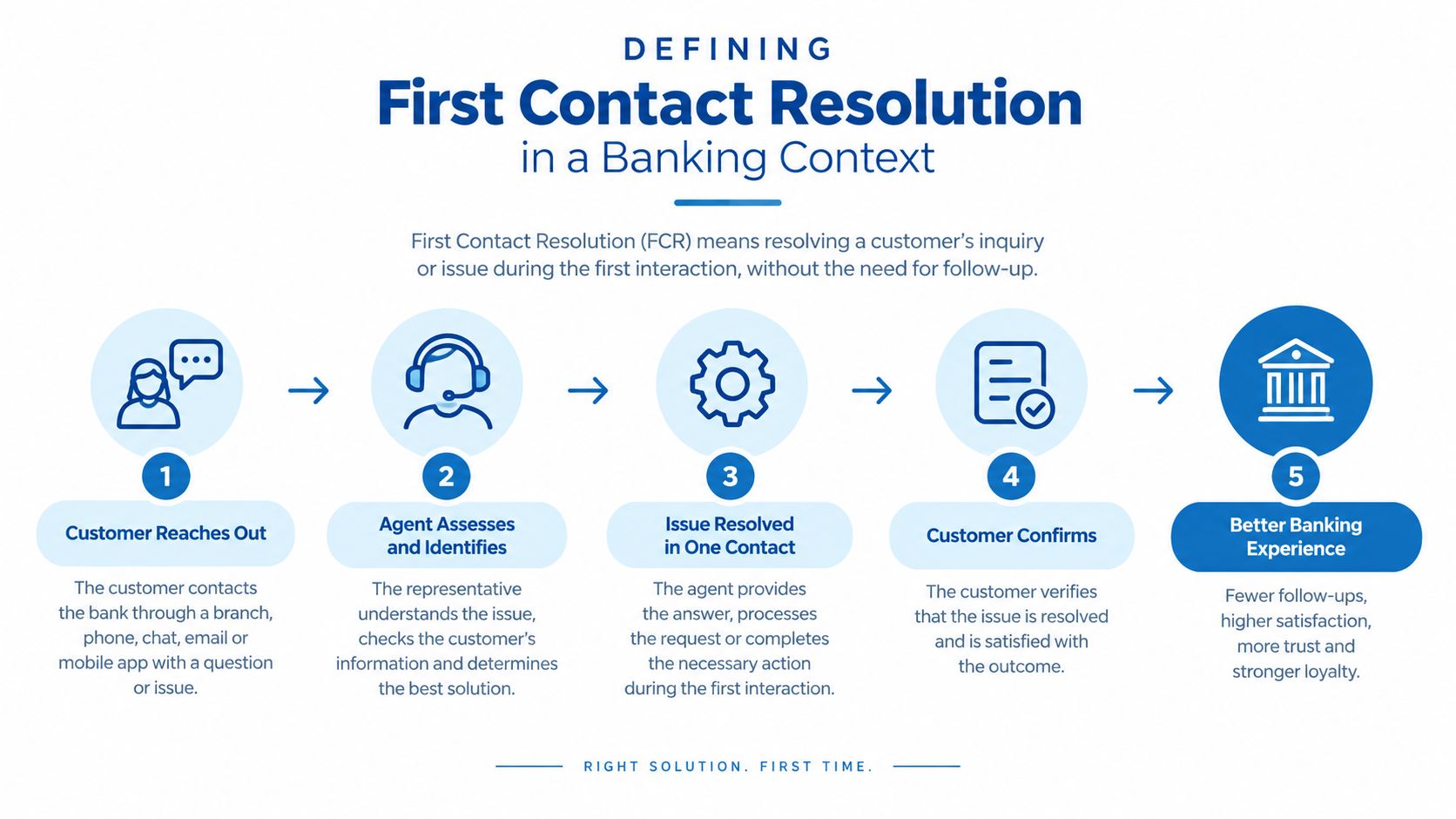
In banking, first contact resolution measures whether the customer's issue was fully resolved through the first interaction, without a follow-up, callback, reopened case, or escalation. A practical formula is:
FCR = issues resolved on first contact ÷ total issues × 100
The numerator needs a precise definition. A contact counts as resolved only when the customer doesn't need to initiate another interaction about the same intent, and when the bank hasn't left a required action incomplete. A quick answer that merely postpones the work isn't a successful resolution.
Two measures, one operating truth
Executives should report operational FCR and customer-stated FCR separately.
Operational FCR uses contact records to identify whether the customer made another contact about the same account and intent within a defined observation window. It covers a broad population and can be calculated continuously, but it can miss a customer who gives up, changes the wording of the issue, or contacts the bank through a channel the matching logic can't connect.
Customer-stated FCR comes from a post-contact question asking whether the issue was resolved completely and how many times the customer contacted support. It captures perceived resolution, which operational records can't reliably infer. Its weakness is response bias and limited coverage, so leaders should report response volume and channel mix beside the rate.
A naive one-touch definition fails in omnichannel banking. Consider a customer who reports a fraudulent card charge in the mobile app. A bot provides instructions, the customer escalates to an agent, and the agent transfers the case to disputes. Counting the app message as a successful first touch would overstate FCR. Counting the transfer as a separate customer failure would obscure the fact that the journey had one intent and one human-assisted resolution path.
The correct attribution follows the customer's intent, account relationship, and journey sequence. The bank should treat the connected interactions as one case, then determine whether the dispute was completed or whether the customer had to return. For a broader view of how channels should work together, this resource on a unified customer journey in banking provides useful context.
A bank shouldn't force operational and customer-stated FCR into one blended number. The gap between them is itself a diagnostic signal. A high operational rate with weak customer-stated resolution usually means the bank's matching rules, closure logic, or customer communication needs attention.
Measuring and Reporting FCR Without Gaming the Number
A defensible FCR program begins with an attribution policy approved by operations, analytics, compliance, and customer experience. Don't let each channel, vendor, or business unit define resolution differently. That produces attractive local dashboards and an unusable enterprise metric.
Establish the measurement rules
Start with four decisions:
- Define the issue: Match the interaction to an account or customer relationship and an intent category, such as card dispute, payment failure, loan status, or account access.
- Set the observation window: Use a shorter window for time-sensitive transactional issues and a longer window for advisory or status-related issues. Publish the rule by intent instead of applying one arbitrary window to every journey.
- Separate follow-through from a repeat contact: If an agent resolves the matter and the bank sends a digital confirmation, count that confirmation as follow-through. It shouldn't become a failed FCR event when the customer didn't initiate it.
- Document exceptions: Do not exclude anything without record. If a contact can't reasonably be resolved in one interaction, label that intent and report it separately rather than removing it from the denominator without explanation.
When a journey spans channels, count the first human-assisted touch as the FCR point if the digital interaction was an intake or automation step. Subsequent digital confirmations remain part of the same journey. This approach reflects what the customer experienced and prevents a bot handoff from artificially inflating or depressing performance.
Sample customer perception properly
Customer-stated FCR should use a short, direct survey:
- Was your issue resolved completely?
- Did you need to contact the bank again about the same issue?
- Which channel did you use first?
- Which channel completed the resolution?
Report the result by contact reason and channel, not only as an enterprise average. A strong voice result can conceal a weak app-to-agent journey, while a healthy overall number can hide poor performance for disputes or account access.
Practical rule: Never publish an FCR rate without the definition, observation window, attribution logic, and response context beside it.
A useful reporting structure looks like this:
| Cadence | FCR Type | Granularity | Primary Owner | Key Cut |
|---|---|---|---|---|
| Weekly | Operational FCR | Intent, team, channel, journey | Contact-center operations | Repeat contacts and transfers |
| Monthly | Customer-stated FCR | Contact reason and originating channel | Customer experience | Resolution perception and response mix |
| Quarterly | Cohort view | Issue cohorts and process versions | COO or service governance | Regressing journeys and unresolved root causes |
The main gaming risks are predictable. Agents may close tickets before the customer confirms resolution. Supervisors may narrow the observation window when performance weakens. Survey programs may overrepresent satisfied customers. Audit checks should compare closure timestamps with subsequent contacts, review overrides, reconcile channel records, and sample closed cases for evidence of completed action.
Banking Benchmarks and Root Cause Analysis
A bank needs a benchmark, but the benchmark must not become a substitute for diagnosis. Verified industry data places average FCR around 70% to 71%, with broad benchmark pages often citing roughly 70% to 75%. In financial services, published figures commonly place FCR around 70% to 80%, while an industry report cited by Finopotamus put banking first-contact resolution at 67%. Banking benchmark context from Qiscus
Those figures are useful for orientation, not for ranking institutions with different intent mixes. A bank with complex fraud, lending, and business-account contacts shouldn't compare its headline rate with a digital institution handling mostly simple balance inquiries. The executive task is to explain the gap between the current result and the bank's attainable result by root cause.
Four buckets explain most avoidable failure
| Root-Cause Bucket | Diagnostic Question | Signals to Monitor | Fixable Defect |
|---|---|---|---|
| Knowledge gaps | Did the agent have the correct answer and procedure? | Search behavior, escalations, QA findings, repeat intent | Repeated uncertainty or inconsistent answers for the same issue |
| Process handoffs | Did ownership move between teams or channels? | Transfer paths, queue changes, reopened cases | Recurring transfers for an intent that should have one owner |
| System latency | Could the agent complete the action during the interaction? | Pending status, delayed updates, failed integrations | Customers return because the bank's systems haven't reflected the action |
| Policy friction | Did a rule prevent the frontline team from resolving the issue? | Approval requests, exceptions, complaints | Repeated approval or documentation steps for routine cases |
Use tagged CRM reasons and transfer data to assign each non-FCR event to a primary bucket. Then compare the tag with the next contact, the account state, and the final resolution. At this point, data intelligence becomes practical. A director shouldn't hear that “agents need more ownership.” They should see that a specific card-decline intent generates transfers, repeat contacts, and policy overrides in a consistent pattern.
Find the root cause before changing the target
The 40% to 91% measured FCR range demonstrates how different operating environments can be. SQM Group's benchmark reference also shows that only 5% of centers reach 80% or higher, so a bank shouldn't impose a world-class target without funding the workflow, access, and governance changes required to support it.
Map every missing FCR point to a reason code, then rank causes by repeat volume and customer harm. Visbanking's customer journey mapping resource offers a useful framework for connecting journey stages to measurable service outcomes. The goal isn't to produce a more detailed dashboard. It's to identify which defect deserves the next process redesign.
What Actually Moves the Needle on FCR
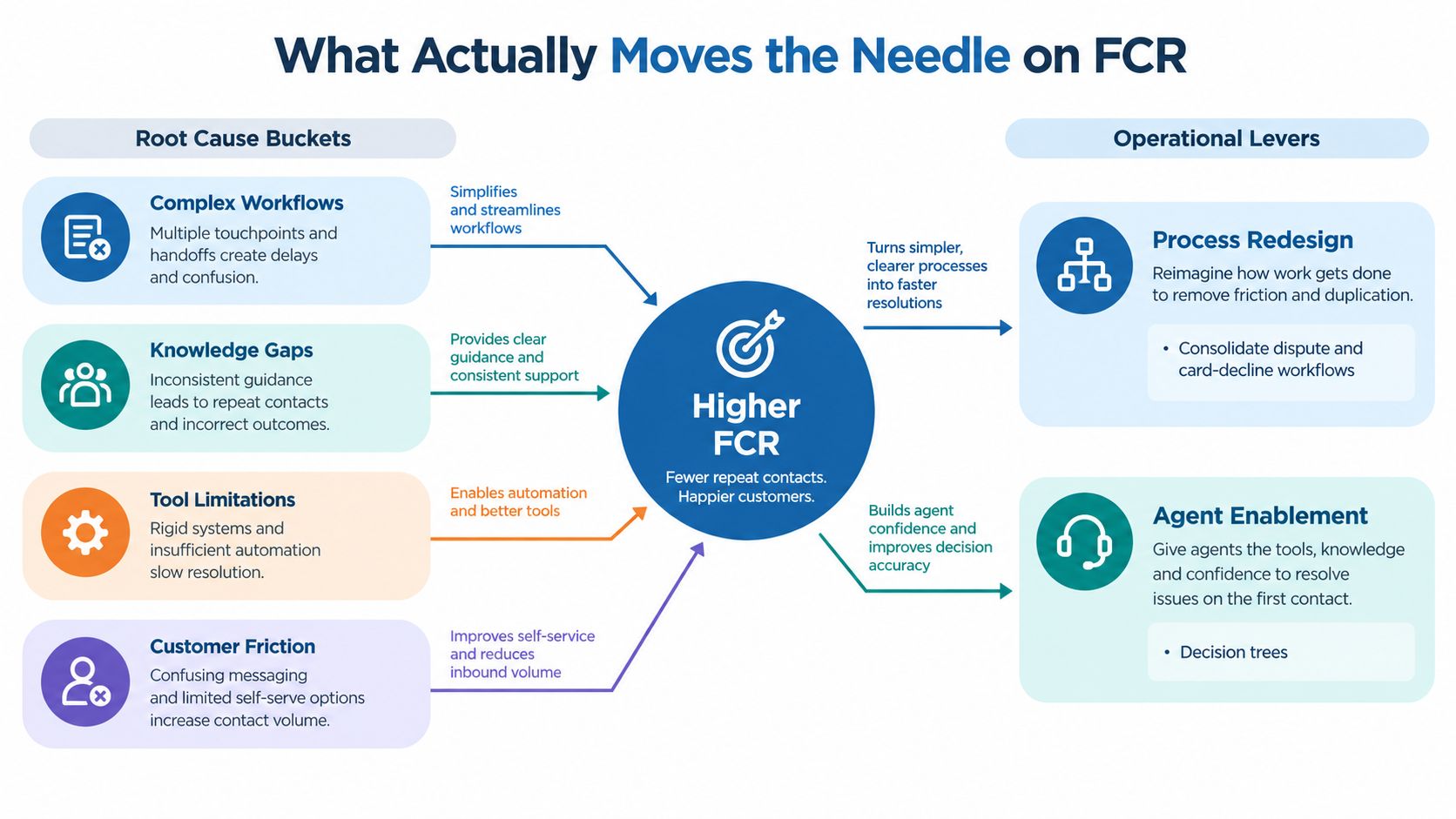
The strongest FCR programs don't begin with a generic coaching campaign. They connect each failure bucket to an operational lever and a measurable signal.
Redesign the work before retraining the people
If disputes and card declines move through separate workflows but require the same account verification, transaction review, and customer explanation, consolidate the shared steps. Give one team clear ownership where the risk and policy environment allow it. Track transfer rate, repeat intent, and unresolved status after the change.
Agent enablement should put decision trees inside the desktop, not in a separate knowledge portal that agents must search while the customer waits. The content needs approval controls, visible effective dates, and direct links to the action the agent can take. Review searches that return no useful result, escalations after knowledge searches, and repeat contacts tied to recently changed policies.
Channel design matters, but self-service shouldn't become a dumping ground. Balance and statement requests are natural candidates for authenticated self-service. Complex disputes and account-level exceptions need a clear path to a capable human. Offer a callback when queue waiting would force the customer to abandon the interaction, and measure whether the callback resolves the original intent rather than merely shifting the channel.
Use analytics to expose the second contact
A bank should flag repeat contacts at the journey level, not wait for a monthly complaint report. Connect the account, intent, channel, agent, transfer path, and final action. Then let supervisors inspect the first interaction alongside the return interaction.
Predictive routing can use intent and customer context to direct a case to the team with the right authority and knowledge. A unified operational view can also show whether the customer already attempted self-service, whether authentication succeeded, and whether a back-office action remains pending. Visbanking's platform unifies financial, regulatory, market, and people data into decision-ready analytics, which can give banking teams a structured way to connect operational signals with broader institution data.
Coaching still matters, but it should follow diagnosis. Coach an agent when the evidence shows an individual skill gap. Redesign the process when many agents produce the same repeat-contact pattern. Don't ask training to compensate for missing permissions, fragmented systems, or contradictory policy.
Language access also belongs in the operating design. Banks serving multilingual communities should define when bilingual support improves comprehension, routing, and completion, and should train managers to evaluate resolution rather than language fluency alone. A practical bilingual customer service representative guide can help leaders think through the role requirements before they change staffing or routing.
A One-Quarter Plan to Lift First Contact Resolution
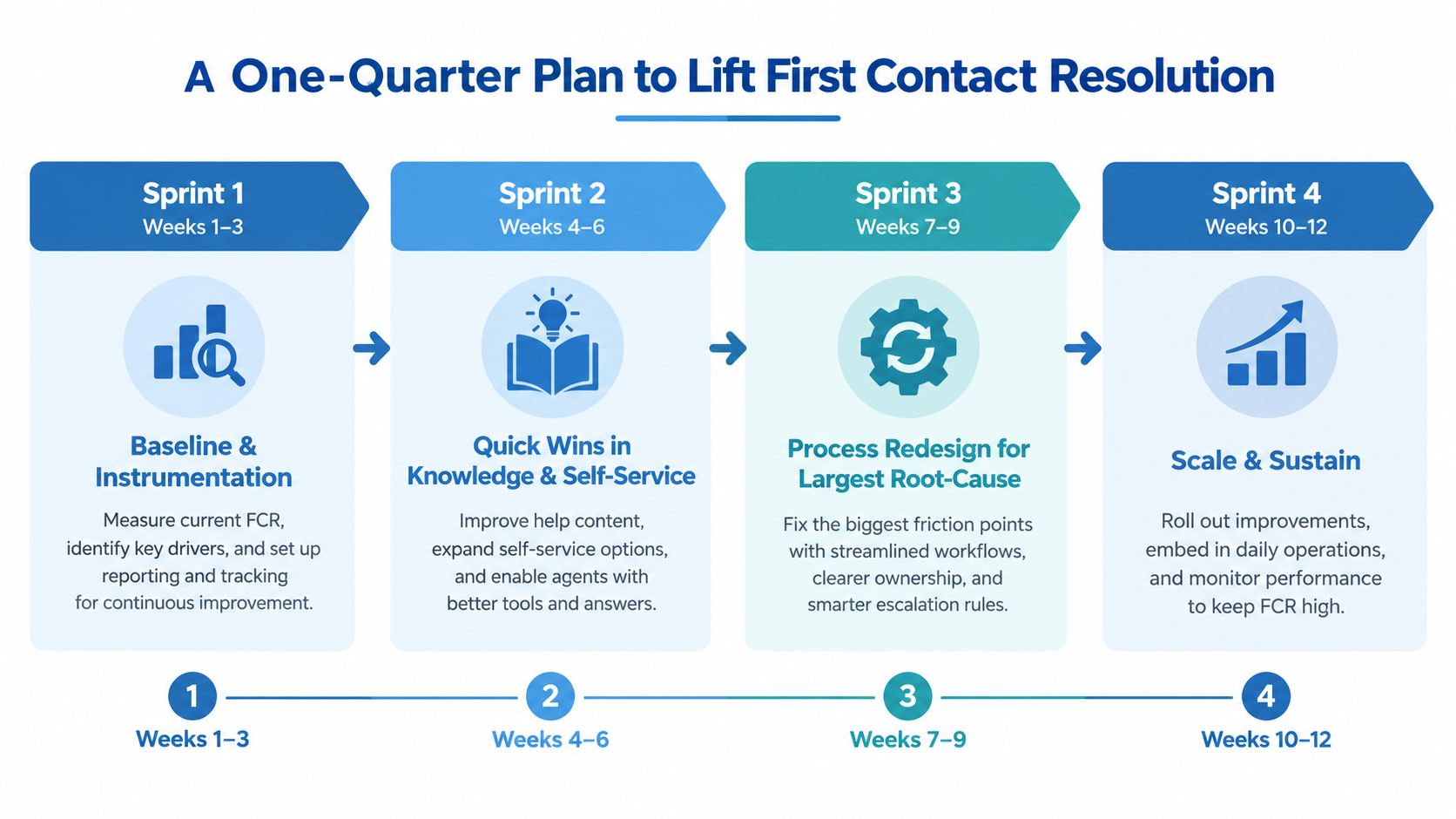
A quarter is long enough to expose root causes and deliver targeted changes, but short enough to keep ownership visible. Run the program as four sprints, with one accountable executive and one operational owner for every change.
Sprint one, baseline and instrumentation
During the opening sprint, the Head of Contact Center owns the baseline. Analytics should reconcile telephony, CRM, chat, mobile-app messaging, and case-management records. Publish FCR by intent, channel, team, and transfer path, then validate a sample of closed cases against subsequent contacts.
The weekly meeting should include operations, analytics, digital, disputes, lending, and compliance. The output isn't a target alone. It's a ranked list of repeat-contact causes with named owners.
Sprint two, quick wins in knowledge and self-service
The knowledge leader owns content corrections, while digital banking owns the highest-volume self-service journeys. Fix decision-tree gaps, remove contradictory instructions, and improve authenticated guidance for straightforward requests. Measure repeat contacts and customer-stated resolution, not article views or bot containment by itself.
Sprint three, redesign the largest defect
The process owner for the largest root-cause bucket takes control. If transfers dominate, consolidate ownership. If system latency dominates, expose status and completion expectations. If policy friction dominates, bring compliance and risk into the redesign instead of asking agents to work around the rule.
Sprint four, sustain and expand
In the final sprint, operations owns the control plan. Keep the successful fix, document the attribution logic, and choose the next intent only after confirming that the first change didn't move repeat contacts into another channel.
A weekly scorecard should include:
| KPI | Owner | Decision Use |
|---|---|---|
| FCR | Contact-center operations | Shows whether the journey resolved |
| Repeat-contact rate | Analytics | Confirms whether FCR movement is real |
| Transfer rate | Workforce and routing | Identifies ownership and skills defects |
| Average handle time | Operations | Detects efficiency tradeoffs |
| CSAT | Customer experience | Tests customer perception of the result |
Roll a fix forward when operational FCR improves without a deterioration in repeat contacts or customer-stated resolution. Cut or redesign it when the headline rate rises but customers return, transfers increase, or handle time falls because agents are closing contacts prematurely.
At the week-12 review, the COO or CRO should ask: Which intent improved? Which root cause remains dominant? Did the customer experience confirm the operational result? Did any channel absorb the repeat contact? Who owns the next process change, and what evidence will determine whether it worked?
Keeping the FCR Program Honest After Launch
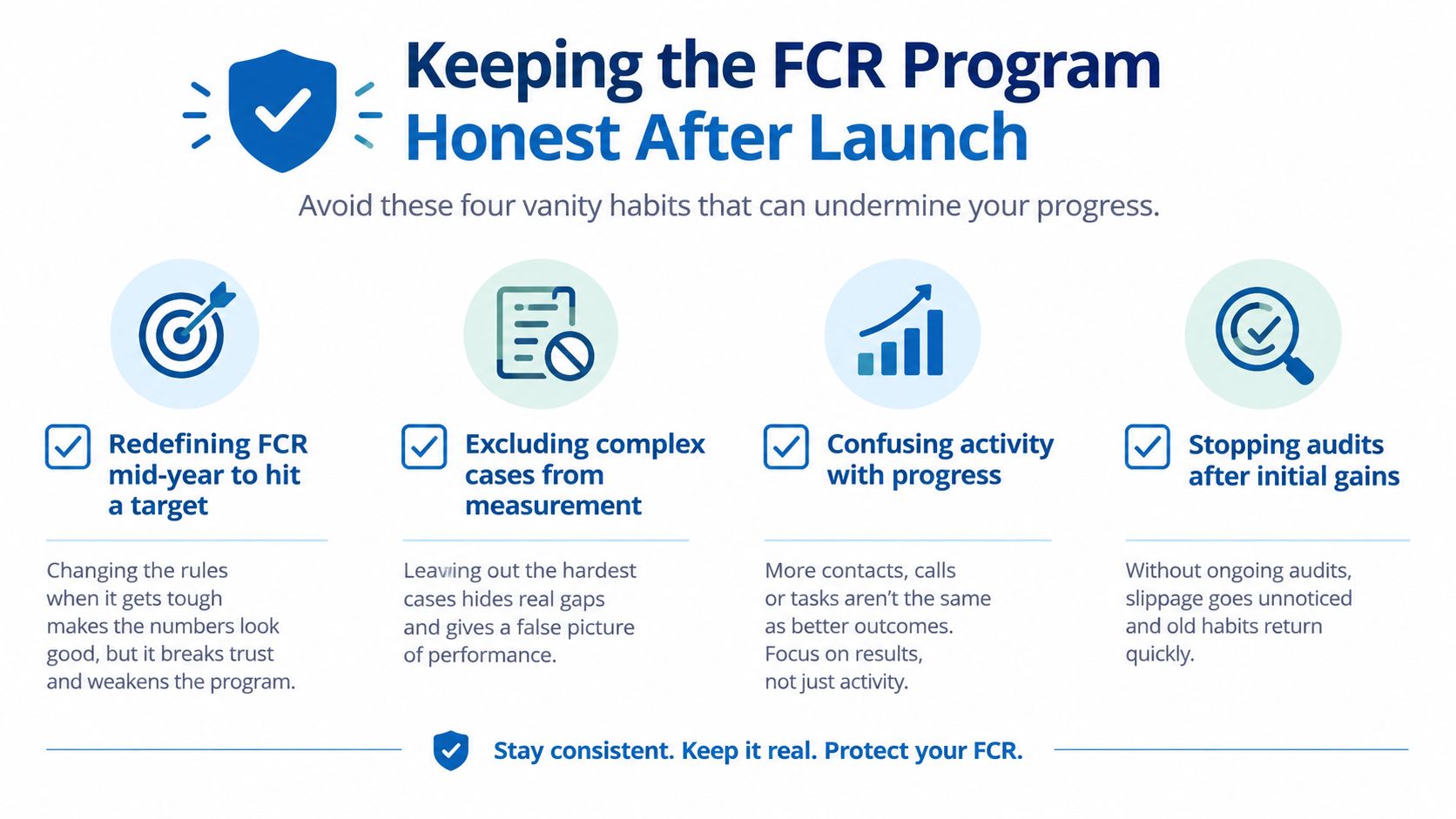
FCR programs lose credibility when leaders confuse dashboard activity with resolution. Four habits are especially damaging: redefining FCR halfway through the year to hit a target, excluding complex tiers, surveying only happy customers, and celebrating lower average handle time without checking repeat-contact data.
Use a fixed integrity checklist
At each quarterly review, confirm:
- Data lineage: Every included contact can be traced from intake through closure.
- Channel coverage: Survey response and operational data are visible by originating and completing channel.
- Repeat-contact correlation: The FCR result reconciles with subsequent contacts and reopened cases.
- Cohort stability: Changes in issue mix don't explain the apparent improvement.
- Blind-spot testing: A sample of journeys is reviewed without telling agents which contacts will be checked.
Run a monthly KPI review with operations and analytics. Recalibrate attribution rules quarterly, and use a semi-annual external audit or peer benchmark to challenge internal assumptions. Customer feedback software for banks can support the feedback side of this control system, but the governance decision still belongs to bank leadership.
Watch for three early warnings. Rising repeat contacts within the chosen observation window should trigger a root-cause review. Declining survey completion should trigger a channel and sampling audit. Attribution overrides above 5% should trigger case-level review because the reported metric may no longer reflect the standard definition.
Visbanking helps banks and credit unions combine operational, financial, regulatory, market, and customer signals into explainable analytics and decision-ready reports. Visit Visbanking to benchmark service performance, connect repeat-contact signals to bank intelligence, and turn FCR findings into accountable operating actions.
Latest Articles

Brian's Banking Blog
How to Secure REST API with JWT for Banking

Brian's Banking Blog
Commercial Loan Analysis: A Bank Executive's Guide

Brian's Banking Blog
Understanding Statistical Significance in Banking
Brian's Banking Blog
Option Adjusted Spread: A Banker's Practical Framework
Brian's Banking Blog
How to Improve Margins: A Bank Leader's Playbook

Brian's Banking Blog