
Data-Driven Lead Generation: A Strategic Mandate for Banks
Brian's Banking Blog
For too long, lead generation for banks has been a game of volume—cast a wide net and hope for the best. Sustainable growth, however, is not a function of volume. It is a function of precision. The imperative is to identify high-value commercial and private clients who align with your bank’s strategic objectives, whether that is expanding a commercial loan portfolio or increasing assets under management.
From Volume Chasing to Precision Targeting in Bank Lead Generation
The legacy model dictated that more leads equaled more customers. This flawed logic forced relationship managers to spend invaluable hours sifting through low-quality prospects to find a handful of viable opportunities. This is not only a significant drain on institutional resources; in today's market, the volume-based model is fundamentally broken.
The critical shift for bank executives is to reframe lead generation not as a marketing expense, but as a core strategic function and a predictable revenue engine. This requires a fundamental change in mindset: from chasing quantity to targeting quality with surgical, data-driven accuracy.
The Financial Drag of an Outdated Model
The traditional model is a direct path to high client acquisition costs and low conversion rates.
Consider a bank that allocates $150,000 to a broad marketing campaign, yielding 1,000 leads. If only 2% of these leads—just 20 clients—convert, the acquisition cost per client is a staggering $7,500. This approach fails to ask the most critical question: is this client a strategic fit? It ignores alignment with long-term goals and the potential for high lifetime value.
Focusing on lead volume over quality is a costly strategic error. It exhausts your team on low-probability pursuits and erodes profitability. Growth is driven by fewer, better leads.
The New Mandate: Data-Driven Execution
Modern lead generation is powered by intelligence. It requires blending proprietary client data with external market and competitive analytics to construct a precise ideal client profile. This is where a platform like Visbanking provides a decisive advantage, delivering the granular data required to stop guessing and start executing with confidence.
With a data-first methodology, your institution can:
- Identify lucrative niches and establish a presence before competitors recognize the opportunity.
- Allocate resources exclusively to prospects with validated high-potential.
- Equip relationship managers with insights that foster meaningful, strategic connections from the initial conversation.
This guide provides a blueprint for implementing this precise, data-centric strategy. The objective is to drive smarter decisions, optimize team performance, and deliver a measurable return on investment.
A prudent first step is to benchmark your current performance. This analysis will reveal your next significant growth opportunity.
Pinpointing High-Value Markets with Competitive Intelligence

Identifying your best clients begins long before the first meeting. It starts with a rigorous, data-driven analysis of the market landscape. Effective lead generation for banks is not about pursuing every potential deal; it is a calculated effort to uncover and dominate lucrative market segments that others overlook.
Competition for these clients is intensifying. Between 2019 and 2024, assets managed by the global banking system grew by an average of 7.0% annually, outpacing global GDP. Private capital funds expanded even more rapidly, at 17.2% per year. This crowded field makes a precise targeting strategy a competitive necessity.
Competitive intelligence provides the critical edge. By analyzing regional economic data, industry growth trends, and competitor market share, your bank can identify and penetrate underserved niches with precision.
Uncovering Competitor Blind Spots
Market intelligence enables a shift from a reactive to a proactive posture. Instead of waiting for opportunities, you can actively identify them using data as your guide. A robust competitor analysis framework is essential to this process, allowing you to systematically deconstruct rivals' strategies and identify their operational gaps.
For example, a community bank using a data intelligence platform like Visbanking might identify a 30% year-over-year increase in new logistics company formations in an adjacent county. This single data point signals an untapped market for equipment financing, commercial real estate loans, and treasury management services. While competitors focus on saturated markets, this institution can deploy a targeted campaign to capture a new, high-growth segment.
Strategic growth lies in the gap between market needs and competitor offerings. Data intelligence illuminates that gap.
Turning Data into Actionable Strategy
Analyzing a rival's loan portfolio reveals their strategic priorities and, more importantly, their blind spots. If their portfolio shows low concentration in a high-growth sector like healthcare technology or specialized manufacturing, you have identified a clear market opening. For a deeper examination of this process, our guide on what competitive intelligence is and why it matters provides a comprehensive framework.
This methodical approach elevates lead generation from a marketing tactic to a core strategic function. Instead of casting a wide, generic net, your relationship managers can focus on the specific industries, geographies, and client profiles where your bank possesses a demonstrable competitive advantage. The objective is to act with conviction, supported by empirical evidence of a market opportunity.
Building Your Ideal Client Profile with Granular Data

Once a high-value market is identified, the next step is to define precisely who to target. Superior lead generation for banks transcends generic filters like industry or zip code. It requires building a multi-dimensional client profile using granular data that signals a clear opportunity.
This involves integrating your internal data with powerful external intelligence to form a complete picture. For commercial clients, this means looking beyond surface-level firmographics to analyze annual revenue, cash flow trends, recent financing activity, and UCC filings. For wealth management, it means understanding assets under management, investment history, and critical liquidity events.
From Data Points to Actionable Profiles
Consider a mid-sized manufacturing firm. A basic profile might identify it as having $10 million–$20 million in revenue. This is a starting point, but it lacks the detail required for decisive action.
An enriched profile, powered by a platform like Visbanking, tells the real story. The firm has $15 million in annual revenue, recently increased its payroll by 25%—a key growth indicator—and operates in a high-demand sub-sector of advanced manufacturing. A vague prospect is instantly transformed into a prime candidate for a working capital line of credit or equipment financing.
An ideal client profile is not a static document; it is a dynamic, data-driven framework that filters out noise and focuses your team's efforts exclusively on high-probability opportunities.
This level of detail ensures your relationship managers engage only with qualified prospects. They enter every conversation armed with genuine insight, positioning the bank as a strategic partner from the outset. Executing this requires a disciplined approach to generating B2B leads that convert by focusing on this precision.
Before constructing these profiles, it's crucial to identify the metrics that truly matter. The table below outlines key data points that distinguish a high-value lead.
Key Metrics for High-Value Lead Profiling
| Data Point | Commercial Lead Example | Wealth Management Lead Example | Strategic Value |
|---|---|---|---|
| Revenue Growth | 15% year-over-year revenue increase | N/A (focus on AUM) | Indicates a growing business with expanding credit and treasury needs. |
| Employee Count Change | Added 50 employees in the last 12 months | Key executive at a company that just IPO'd | Signals expansion, requiring payroll services or business expansion loans. |
| Recent Financing Activity | Recently closed a Series A funding round | Recently sold a business for $5,000,000+ | Shows a need for sophisticated cash management or investment advisory. |
| Industry-Specific Trends | Operates in the booming logistics software sector | Founder of a successful biotech firm | Puts the client in a high-growth context, signaling long-term potential. |
This table provides a basic framework. The goal is to build a comprehensive view that aligns directly with your bank's product strengths and strategic growth objectives.
The Strategic Value of Precision
This focused methodology directly impacts your bottom line by improving the efficiency and effectiveness of your business development process. Building robust profiles is the foundation of intelligent bank customer segmentation.
When your team understands the operational and financial DNA of a top-tier client, every action becomes more targeted and every budget dollar is deployed more effectively. Using Visbanking’s data, you can benchmark your current client base against these ideal profiles to uncover immediate, actionable growth opportunities.
Automating and Refining Lead Qualification
Manual lead qualification is a critical bottleneck. It consumes the valuable time of your most skilled relationship managers. Every hour spent vetting low-potential inquiries is an hour not spent cultivating high-value relationships. This inefficiency costs more than just time—it costs opportunities.
For bank leadership, the objective is clear: implement a system that automatically identifies and prioritizes your best leads. This means moving beyond simple contact forms to an intelligent qualification engine that operates in real-time, ensuring your top talent engages only with top prospects.
Integrating Data for Instant Enrichment
Effective automation hinges on enriching leads with financial and firmographic data the moment they enter your system. Tools that integrate directly with your CRM are essential for this function.
When a company submits a general inquiry on your website, instead of it languishing in a queue, an automated system instantly cross-references it with external data sources. Within seconds, you have their annual revenue, employee count, recent financing activity, and corporate structure. A name and email are transformed into a rich, actionable profile.
By automating lead qualification, you shift from a reactive to a proactive model. High-potential leads are scored and routed to the correct expert in minutes, not days. This speed creates a significant competitive advantage.
This data-first approach allows you to establish rules that automatically score leads against your ideal client profile. For instance, a commercial lead with $20 million+ in revenue, 15% year-over-year growth, and a recent UCC filing suggesting equipment needs would receive a high score and be routed directly to a senior commercial lender for immediate follow-up.
From Automation to Actionable Intelligence
The impact of this approach is direct and measurable. A global bank integrated Moody’s data to link external financial intelligence with its internal client systems. This automated lead routing, eliminated manual bottlenecks, and ensured immediate lead assignment. By enriching profiles with details like corporate holdings and board memberships, the bank's team was able to offer more tailored financial solutions and significantly improve cross-selling within its investment banking division.
This level of advanced targeting fundamentally transforms your team’s efficiency. Specialized tools from Visbanking enable even more sophisticated targeting. For a deeper analysis, review our guide on transforming your bank’s growth strategy with smart targeting.
Automating the qualification process does more than accelerate the sales cycle. It equips your relationship managers with the critical context needed for a powerful first conversation. They enter the discussion with a comprehensive understanding of the prospect's business, which improves conversion rates and helps build stronger, more profitable relationships from the start.
Nurturing Strategies That Convert High-Value Leads
Acquiring a qualified lead is a critical first step, but the ultimate value is realized in the subsequent nurturing process. Converting a promising prospect into a long-term, high-value client requires a strategic approach.
For banks, this means replacing generic email campaigns with intelligent, data-informed nurturing that builds trust and demonstrates expertise.
The Centrality of Personalization
Effective nurturing is contingent on personalization. A business owner who downloads your whitepaper on succession planning requires a targeted follow-up from a wealth advisor. A generic offer for a business credit card signals a lack of understanding and undermines credibility.
This precision demonstrates that you comprehend their specific challenges and positions your institution to provide genuine value, not just another product.
From First Contact to Strategic Partner
The objective is to deliver the right information at the right time, based on a lead’s profile and demonstrated interests. This requires a multi-channel approach focused on substance over salesmanship.
Consider a commercial real estate developer who has engaged with your bank’s content on opportunity zones. A strategic nurturing sequence would unfold as follows:
- Initial Contact: A personalized email from a commercial real estate lender referencing the content viewed and offering a relevant case study on a similar project your bank financed.
- Targeted Invitation: A follow-up invitation to an exclusive webinar on regulatory changes impacting real estate in their specific market.
- Proprietary Insights: A timely market report from your bank’s analysts, featuring proprietary data on local property values and investment trends.
Each step delivers tangible value, positioning your bank as a strategic partner long before a loan application is discussed. This is how you build the credibility required to close complex, high-value deals.
The Mandate for Data-Driven Nurturing
Focusing on lead conversion is a strategic imperative. Nurtured leads generate 20% more sales opportunities, a clear indicator of efficacy. This is particularly true in banking, where 97% of unsolicited cold calls are ignored, making sophisticated nurturing essential. Further lead management statistics underscore this reality.
Effective nurturing is not about constant contact; it is about meaningful engagement. Every interaction must be fueled by data and designed to advance the relationship by showcasing your bank's unique expertise.
A data intelligence platform like Visbanking is indispensable here. Deep insights into a prospect’s business, market, and financial activities enable you to tailor every touchpoint. You can identify trigger events—such as a new UCC filing or a significant expansion—that signal an immediate need, allowing your team to present the right solution at the perfect moment.
The modern playbook for lead generation for banks demands this level of intelligence. To assess your institution's current capabilities, benchmark your performance and identify where data-driven nurturing can produce the greatest impact.
Your Path to Data-Driven Growth
The future of lead generation for banks is not about casting a wider net; it is about knowing precisely where to fish. The focus must shift from volume to precision.
The strategies outlined here—market intelligence, granular profiling, automated qualification, and strategic nurturing—form an integrated system. They create a reliable pipeline that consistently delivers the right kind of leads to your bank.
This process can be distilled into a clear operational flow.
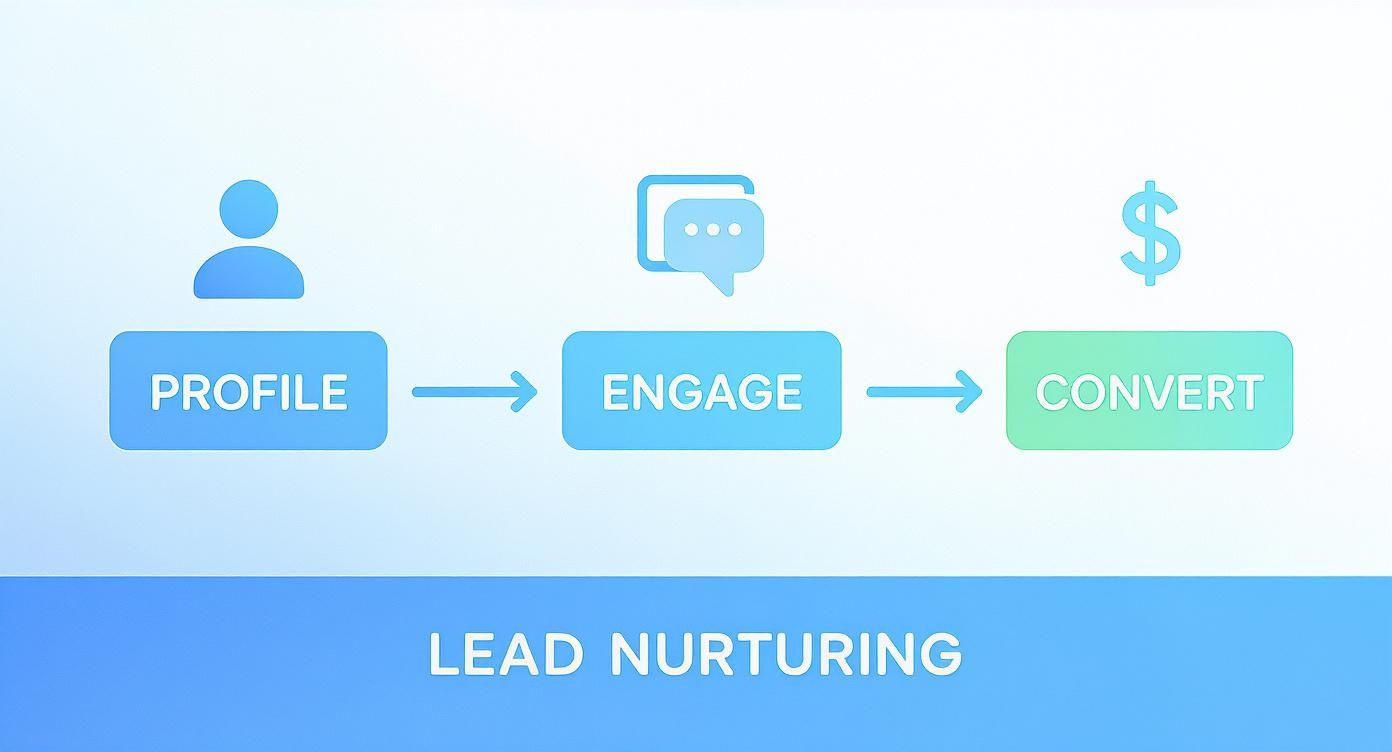
The underlying principle is straightforward: conversions occur when you move seamlessly from deeply understanding a client (profiling) to engaging them with relevant, high-value insights (engagement).
The Executive Mandate for Intelligence
For banking executives, the conclusion is clear. Investing in a robust data intelligence platform is not a marketing expense; it is a direct investment in your bank's revenue engine. Moving beyond surface-level data creates a sustainable competitive advantage.
True growth is not a marketing initiative. It is a strategic imperative fueled by superior intelligence. When your teams are empowered with the right data, every decision becomes sharper, faster, and more profitable.
Providing your team with the right tools and data delivers a clear, measurable return. One bank executed this strategy by targeting a niche segment of medical practices with over $5 million in annual revenue. The results were a 30% reduction in their average client acquisition cost and a 45% increase in the average lifetime value of those relationships within two years.
This is not theoretical. It produces tangible outcomes:
- Reduced Client Acquisition Costs: Resources are focused exclusively on high-probability targets, eliminating waste.
- Increased Lifetime Value: Starting with the ideal client fosters deeper relationships and greater cross-selling opportunities.
- Stronger Competitive Positioning: Acting on market signals before competitors allows you to secure the most attractive opportunities.
Ultimately, the choice is between operating on legacy methods and institutional intuition, or building a data-driven culture that produces predictable, profitable growth. The next step is to assess your current position and explore how data can illuminate the path forward.
At Visbanking, we provide banking leaders with the intelligence to act decisively. Our platform helps you identify high-value opportunities and build a more resilient growth engine. Benchmark your institution today.
Related Articles

Visbanking Blog
Banking Data Analytics: Turning Information Into Profit

Visbanking Blog
In the world of banking, digital transformation is no longer a 'nice-to-have'. It's a necessity

Visbanking Blog
Fastest Growing Banks: Who's Winning the Asset Race?

Visbanking Blog
Revolutionizing Financial Hiring: How AI-Powered Talent Tools Transform Recruitment

Visbanking Blog
BIAS: The Future of Banking Intelligence and Action System

Visbanking Blog