
API Security Solutions for Regulated Banks
Brian's Banking Blog
An API breach leaks at least 10 times more data than an average security breach, and 96% of surveyed financial services organizations reported an API security incident in the prior 12 months. The right API security solutions therefore must identify which interfaces expose sensitive banking data and protect those interfaces without degrading customer-facing performance.
A familiar incident starts with a routine release. A mobile banking team deploys a new account endpoint, a partner adds an open banking integration, and a legacy service remains available because nobody owns its retirement. Authentication works, the firewall reports normal traffic, and the API still permits one customer to alter an object reference and retrieve another customer's account information.
That failure isn't primarily a perimeter problem. It's a visibility and authorization problem, followed by a data-governance and response problem. Bank directors should evaluate API security as a control over customer information, payment operations, partner access, and evidence for regulatory review.
The New Banking Security Frontier
A bank can approve a mobile release, onboard a partner, and retain a legacy service while losing track of which APIs expose customer or payment data. Each interface supports a business capability, yet many bypass the traditional user interface and connect directly to sensitive systems.
The exposure is already material. Akamai reported 108 billion API attacks from January 2023 through June 2024, while web application and API attacks increased 49% between Q1 2023 and Q1 2024 (Akamai's API security research). The implication for directors is direct: API security investment must show both attack pressure and the data at risk.
A breach-to-exposure ratio of at least 10 times more data means one mis-scoped endpoint can outweigh an entire quarter of perimeter investment. Blocking suspicious traffic is not enough if the bank cannot identify which responses contain account, identity, or payment data.
During an incident, “we protect our APIs” is not evidence. Leadership needs answers: which endpoints were reachable, what data they returned, who called them, and whether authorization held at the object level. Those answers also determine notification scope, customer impact, and the quality of regulatory reporting.
Why perimeter controls miss banking abuse
A WAF remains useful for common web attacks, and an API gateway can enforce authentication, routing, quotas, and basic schema policies. Neither automatically recognizes that a valid customer token is requesting another customer's account object, or that an authorized transfer sequence is being automated outside the bank's intended workflow.
The bank therefore needs inventory before enforcement. Build a living map of public, private, partner, legacy, shadow, and deprecated APIs. Link every interface to an owner, data classification, authorization policy, and runtime profile. This practical overview of API security provides useful control vocabulary, but executives should apply it to the bank's actual data flows rather than buy API protection as generic infrastructure.
Board-level rule: If security cannot associate an API with a data class, business owner, authorization policy, and runtime profile, the bank lacks sufficient control evidence.
Runtime performance belongs in the same decision. A control that detects abuse but adds unacceptable latency under load can damage payment operations and customer access. Selection must therefore test detection quality, data visibility, and latency against production-like traffic.
Directors should approve API security solutions against three outcomes: complete exposure visibility, enforceable data access, and measurable runtime resilience. A longer feature list does not prove stronger control.
Comparing Core API Security Approaches
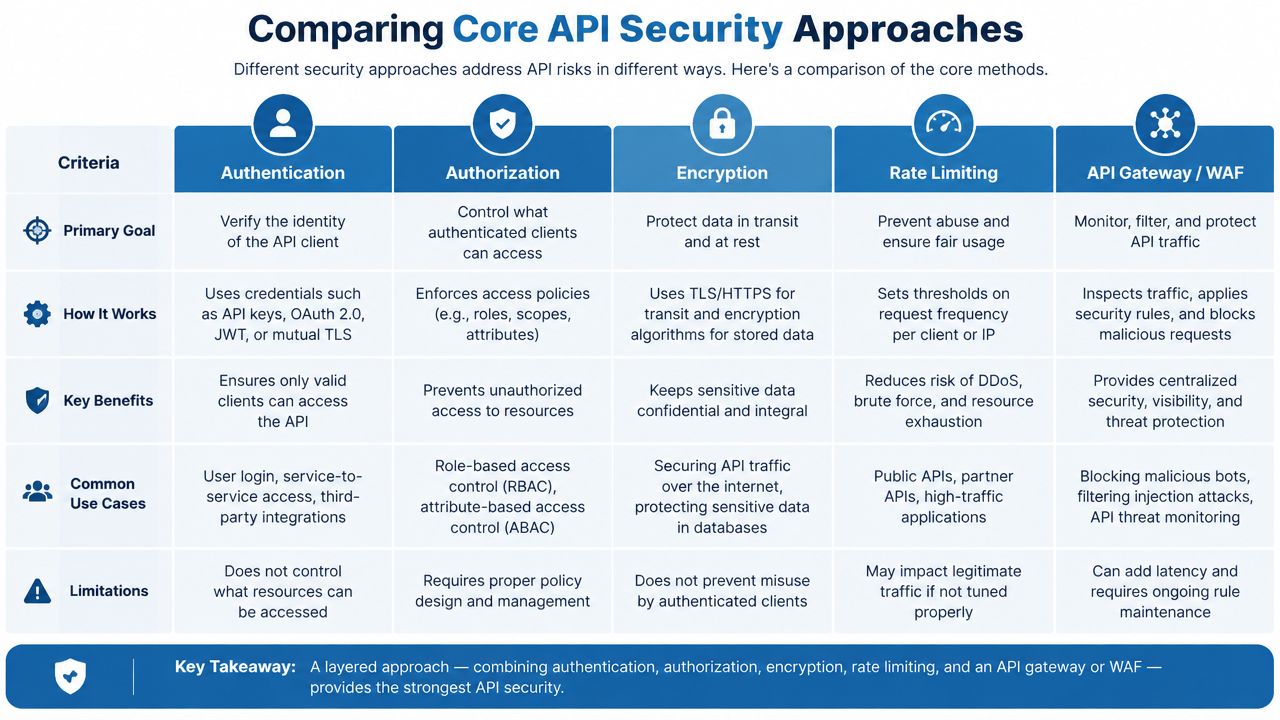
Banks usually encounter three overlapping approaches. The mistake is treating them as interchangeable.
A WAF or WAAP sits at the traffic edge and filters known attack patterns, malicious automation, and suspicious HTTP behavior. It's effective as a broad perimeter layer, particularly for public APIs and internet-facing applications. Its limitation is context. A WAF may recognize an injection attempt, but it usually won't understand the relationship between a user, an account object, and a permitted transaction workflow without additional application knowledge.
An API gateway provides centralized policy enforcement. It can authenticate callers, route requests, apply quotas, validate basic contracts, and create consistent control points across services. Gateways are valuable where the bank wants governance and standardization, but they can become bottlenecks when every request must travel through a central inspection path.
A dedicated API security platform focuses on discovery, posture management, behavioral analysis, and runtime threat detection. It should identify undocumented interfaces, map sensitive responses, detect abnormal object access, and connect findings to development and operations workflows. It won't replace a gateway or WAF. It supplies the API-specific context those layers often lack.
Match enforcement to the transaction path
Latency matters in mobile banking, card authorization, real-time fraud decisions, and partner APIs. A neutral industry guide states that centralized enforcement can add 50 to 200 milliseconds per request, while distributed architectures are expected to keep p95 latency under 10 milliseconds by processing controls closer to traffic flow (Azion's API security tool guide).
That doesn't mean every bank should abandon centralized governance. Use centralized controls for policy administration, audit evidence, and consistent identity integration. Use distributed or edge enforcement where origin round trips would affect customer experience or transaction throughput. The architecture should follow the workload, not the vendor's preferred deployment diagram.
For specialized environments, bank architects may also review adjacent models such as trust infrastructure for Web3 platforms, particularly when evaluating machine-to-machine identity, policy, and integration patterns. The relevant lesson is architectural, not sector-specific: trust must travel with the request.
A bank's API integration strategy should therefore define where authentication, authorization, schema checks, rate limits, monitoring, and blocking occur. Buyers should demand a request-path diagram showing every control, its failure behavior, and its latency impact under representative load.
Mapping OWASP API Top Ten Risks to Banking Controls
A payment API can pass authentication checks and still expose the wrong customer's account, beneficiary, loan, or transaction. Banks should therefore rank OWASP API risks by the data and actions each endpoint handles, then connect every risk to a control that can be tested in production-like conditions.
API1:2023 Broken Object Level Authorization, or BOLA, is OWASP's top API risk (OWASP API Security Project). A valid caller may still lack permission for a specific object. The server must authorize every requested object instead of trusting an account ID, transaction ID, or other client-supplied reference. That decision protects customer boundaries and gives the board evidence that access controls operate at the data layer.
Convert risk categories into controls
| Banking risk | Control that should be tested | Evidence executives should request |
|---|---|---|
| Object-level authorization failure | Server-side authorization for every object | Negative tests showing cross-customer access is denied |
| Function-level authorization failure | Role and entitlement checks on administrative and payment functions | Test results for privileged operations |
| Excessive data exposure | Response schemas and field-level authorization | Sample responses mapped to data classifications |
| Unrestricted resource consumption | Rate limits, quotas, payload limits, and workflow controls | Block and alert behavior under abusive request patterns |
| Inventory and version failure | Continuous discovery and ownership records | Current inventory with lifecycle status and accountable owners |
| Unsafe API consumption | Validation of partner responses and integration boundaries | Partner-control attestations and failure-mode tests |
The visibility gap directly affects incident scope. Akamai's 2026 API study found that only 23% of organizations know which APIs return sensitive data. That capability determines whether a bank can identify exposed records, assign owners, prioritize remediation, and show regulators how sensitive data is controlled across the API lifecycle.
Function-level authorization requires server-side role enforcement for beneficiary creation, payment submission, account closure, and administrator actions. Resource-consumption controls should reflect transaction risk, not just available infrastructure. Quotas, rate limits, payload limits, and workflow checks must protect high-impact operations without imposing unnecessary latency on normal traffic. Misconfiguration and inventory failures require secure defaults, ownership records, version control, and evidence that retired interfaces no longer accept requests.
OAuth flows need separate review because delegated access can create a valid route to unintended data. Security teams evaluating seasonal campaigns or unusual consent activity can consult holiday season Oauth exploit awareness. The bank's authorization model, logs, and incident records remain the governing evidence.
The operating rule is direct: map every API to the sensitive data and business action it controls, then test authorization with both permitted and invalid identities. Measure the control's runtime latency under load as well as its security result. OWASP coverage has value only when it exposes production behavior, identifies accountable owners, and supports decisions about performance and risk.
Vendor Feature Comparison and Selection Criteria
Bank buyers should reject feature-sheet procurement. Every shortlisted vendor can claim authentication support, OWASP alignment, discovery, analytics, and runtime protection. The meaningful differences appear in coverage, context, latency, false positives, integration, and evidence quality.
Independent testing recently subjected applications and APIs to more than 1,360 attack types, emphasizing verified attack coverage, false-positive behavior, and sustained runtime efficacy rather than simple checklist claims (independent WAAP testing coverage). Require vendors to explain their methodology, not just display a coverage badge.
| Selection criterion | Why it matters for regulated banks | What to verify with evidence |
|---|---|---|
| Sensitive-data discovery | The bank must know which responses expose regulated or confidential data | Inventory exports, response mapping, and sample detection results |
| Object-level authorization detection | Valid credentials can still access the wrong account or transaction | Controlled BOLA tests with denied and permitted cases |
| Runtime latency | Inline controls can affect mobile, payment, and partner experiences | p95 results under representative load and fail-open behavior |
| Attack coverage | Checklist compliance doesn't prove sustained protection | Independent test results, attack methodology, and false-positive rates |
| CI/CD integration | Unreviewed releases create a gap between development and runtime | Pipeline logs showing API testing and release gates |
| Auditability | Regulators and boards need explainable control evidence | Immutable logs, policy history, alert decisions, and exportable reports |
| Deployment flexibility | Banks operate across legacy systems, cloud services, and partners | Architecture diagrams and migration plans for each environment |
| Response workflow | Findings must reach owners before risk becomes an incident | Ticket, SIEM, SOAR, and escalation integrations |
Demand proof under realistic conditions
Run the proof of value against representative APIs, not a vendor-hosted demo. Include a mobile endpoint that returns customer data, a payment workflow with multiple steps, a partner integration, and an older service with incomplete documentation. Ask the platform to discover what your inventory misses, classify sensitive responses, identify authorization failures, and report the evidence in a format audit and engineering teams can use.
Latency testing needs equal discipline. Measure normal traffic, peak-like traffic, blocked traffic, and dependency failure. A product that delivers impressive detection but adds unacceptable delay to account balances or payments may be unsuitable for inline enforcement. Deploy it out of band for discovery and analytics if that is the safer architecture, then reserve blocking for high-confidence policies.
False positives also carry a banking cost. Excessive alerts train operations teams to ignore the platform, while aggressive blocking can interrupt legitimate customer and partner activity. Require a clear explanation for every high-severity finding, including the request, response, identity context, policy decision, and recommended owner.
Evaluate tools by lifecycle coverage. A scanner that works only before deployment won't reveal runtime shadow APIs. A runtime platform that has no development integration won't prevent recurring defects. The strongest procurement decision may combine a gateway or WAAP for edge enforcement, dedicated discovery and runtime analysis, and pipeline testing for release control.
Banking Use Cases that Determine Tool Choice
A bank rarely has one API risk profile. Tool selection should begin with the transaction, the data, and the caller.
Mobile account access
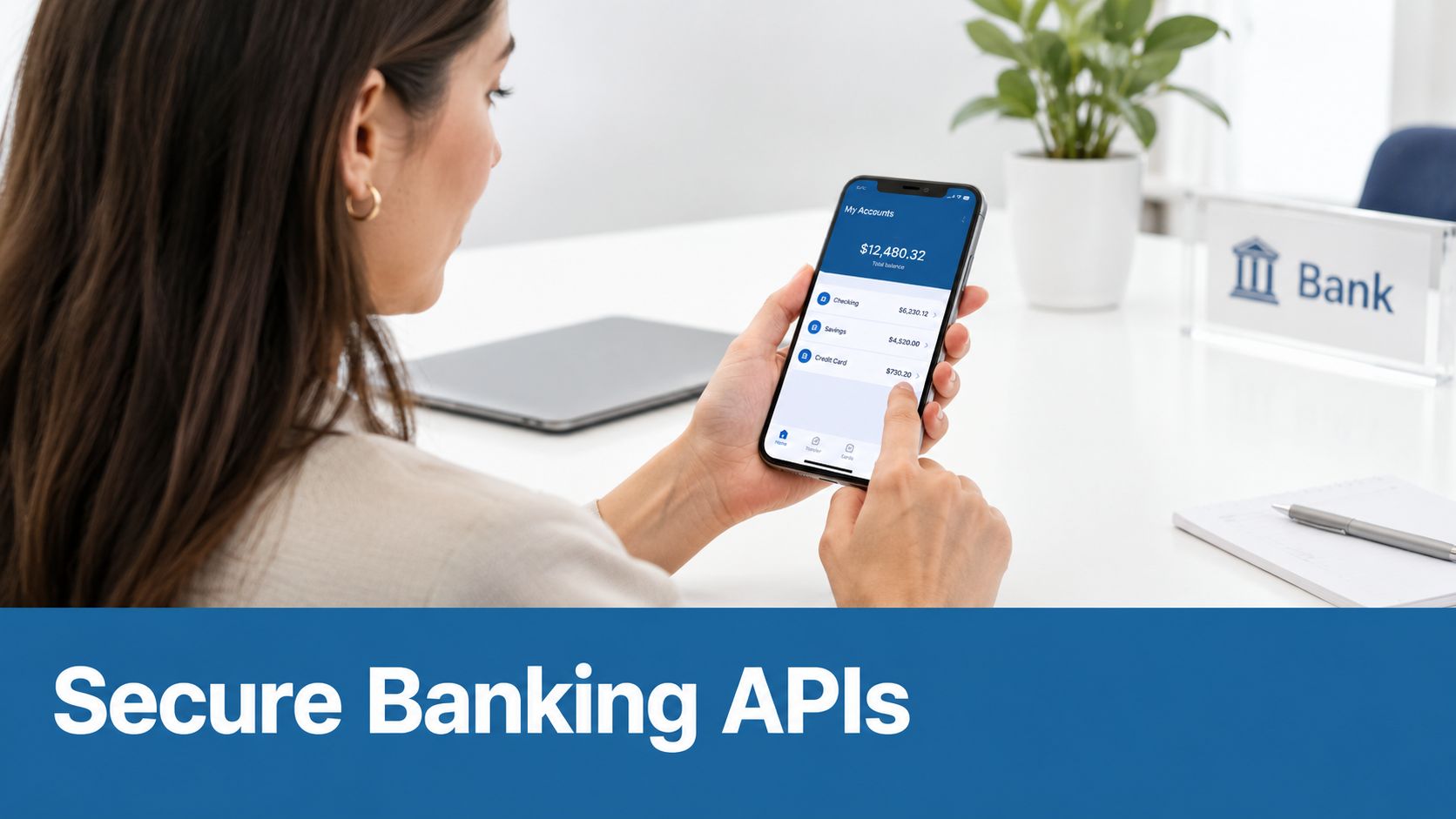
A mobile banking API may handle frequent balance checks, transaction searches, card controls, and profile changes. The key controls are strong token validation, object-level authorization, response minimization, bot and automation detection, and latency close to the user. A centralized inspection path may simplify governance, but the bank should test whether added delay affects customer journeys during busy periods.
The decision should favor distributed inspection or a carefully optimized edge layer for latency-sensitive calls, with centralized policy management and evidence collection. Security teams should also test whether a valid session can enumerate account or transaction objects by changing identifiers.
Open banking and partner exchange
Partner APIs create a different challenge. The bank must govern delegated permissions, certificates or token scopes, data minimization, partner lifecycle, and response validation. Discovery alone isn't enough because the bank needs a reliable record of which partner can access which data and why.
The best fit combines gateway policy enforcement with dedicated posture management. Every partner route should have an owner, a data classification, an expiry or review process, and observable authorization decisions. Security leaders should require evidence that revoked or narrowed permissions take effect across every relevant service.
AI-linked and machine-to-machine access
AI-connected APIs deserve their own operating model. Recent security reporting found that nearly half of API incidents in financial services involved APIs linked to AI technologies, while dedicated API security adoption remains far behind general WAF coverage (Salt's report on agentic security).
An agent or automated service can make valid calls at a speed and volume that changes the risk calculation. Traditional perimeter controls may authenticate the system while missing excessive retrieval, unexpected chaining, or privilege drift. Banks should assign machine identities, constrain tool permissions, log every action, limit high-impact operations, and require human approval for sensitive workflows where appropriate.
The tool choice here should prioritize behavioral analysis, fine-grained authorization, and complete action trails. Don't approve an AI integration because it passes a WAF test. Approve it only when the bank can explain what the agent can call, what data it can retrieve, what actions it can initiate, and how the bank will stop it.
Procurement and Deployment Path for Banks
A bank can buy an API security platform and still lack a reliable view of which interfaces expose sensitive data. Start with an inventory, not a purchase order. Catalog production, staging, legacy, cloud, partner, and internal APIs. Each record needs an owner, purpose, authentication method, data classification, exposure status, and retirement decision.
Run a proof of value against the bank's traffic and representative test cases. Measure discovery coverage, sensitive-data identification, BOLA detection, false positives, alert quality, integration effort, and runtime latency under load. Require each vendor to show how an analyst moves from an alert to the affected API, data class, accountable owner, and remediation ticket.
A phased path reduces transition risk
Establish the baseline. Export gateway, application, cloud, and source-control records. Reconcile them with observed traffic to identify undocumented and apparently inactive interfaces.
Classify exposure. Mark APIs returning customer, payment, identity, lending, or partner data. Rank them by business impact and external reach, then set remediation priorities.
Test before blocking. Begin discovery and detection in monitoring mode. Validate findings with application owners and tune policies before applying inline enforcement to critical customer journeys.
Protect priority flows. Block high-confidence authorization, schema, rate-limit, and known-attack violations. Maintain a tested rollback path and name the approver for emergency policy changes.
Shift controls into delivery. Add API contract checks, authorization tests, and security scanning to release workflows. Most banks still treat testing as a release gate rather than a pipeline control, leaving runtime platforms to compensate for defects that should have been caught before deployment. Make pipeline coverage a board-visible remediation objective.
Operationalize evidence. Send findings to the SIEM, ticketing system, and incident process. Review inventory changes, sensitive-data mappings, exceptions, and unresolved high-risk findings on a defined cadence.
Performance belongs in every deployment decision. Test peak customer journeys, partner calls, and failure handling before expanding enforcement. A control that improves detection but adds unacceptable latency to payment or authentication flows is not ready for production.
Vendor dependencies require the same discipline. Use the vendor risk management process to assess API security providers and critical partners, including access, subprocessors, incident obligations, data handling, resilience, and audit rights.
Roll out by risk tier, not by organizational convenience. Protect one high-value flow, validate detection, latency, analyst response, and rollback, then expand. A single large cutover creates concentration risk and makes vendor failures harder to separate from policy or application defects.
Turning API Security into Actionable Bank Intelligence
API security produces its greatest value when leaders can connect technical exposure to institution performance, data sensitivity, operational dependency, and risk appetite. A discovery report becomes decision-ready when it shows which business services rely on an exposed API, which partner owns the call path, and what remediation changes the bank's risk position.
Visbanking's perspective fits that operating model. Its platform unifies financial, regulatory, market, and people data into explainable analytics, while its secure APIs, role-based access, audit trails, dashboards, and exportable reports support governed decision workflows. Used alongside API security telemetry, that context helps executives benchmark preparedness, prioritize investment, and move from alerts to accountable action.
Visbanking helps banks and credit unions turn multi-source institutional data into decision-ready intelligence for performance, risk, relationships, and planning. Visit Visbanking to benchmark your institution's data and explore analytics that can complement a disciplined API security strategy.
Latest Articles
Brian's Banking Blog
How to Secure REST API with JWT for Banking

Brian's Banking Blog
Commercial Loan Analysis: A Bank Executive's Guide
Brian's Banking Blog
Understanding Statistical Significance in Banking
Brian's Banking Blog
Option Adjusted Spread: A Banker's Practical Framework
Brian's Banking Blog
How to Improve Margins: A Bank Leader's Playbook
Brian's Banking Blog