
Commercial Loan Analysis: A Bank Executive's Guide
Brian's Banking Blog
You're sitting in credit committee with a clean borrower package, a relationship manager who's already promised a timeline, and one uncomfortable question you can't shake. The ratios pass today, but will this credit still work when revenue softens, the revolver doesn't clean up, or three other borrowers in the same market hit stress at the same time?
That's where disciplined commercial loan analysis earns its keep. It's not a thicker memo. It's a workflow that pairs borrower-level cash flow with portfolio-level concentration telemetry, so you can price, structure, approve, or intervene before delinquency tells you what you missed.
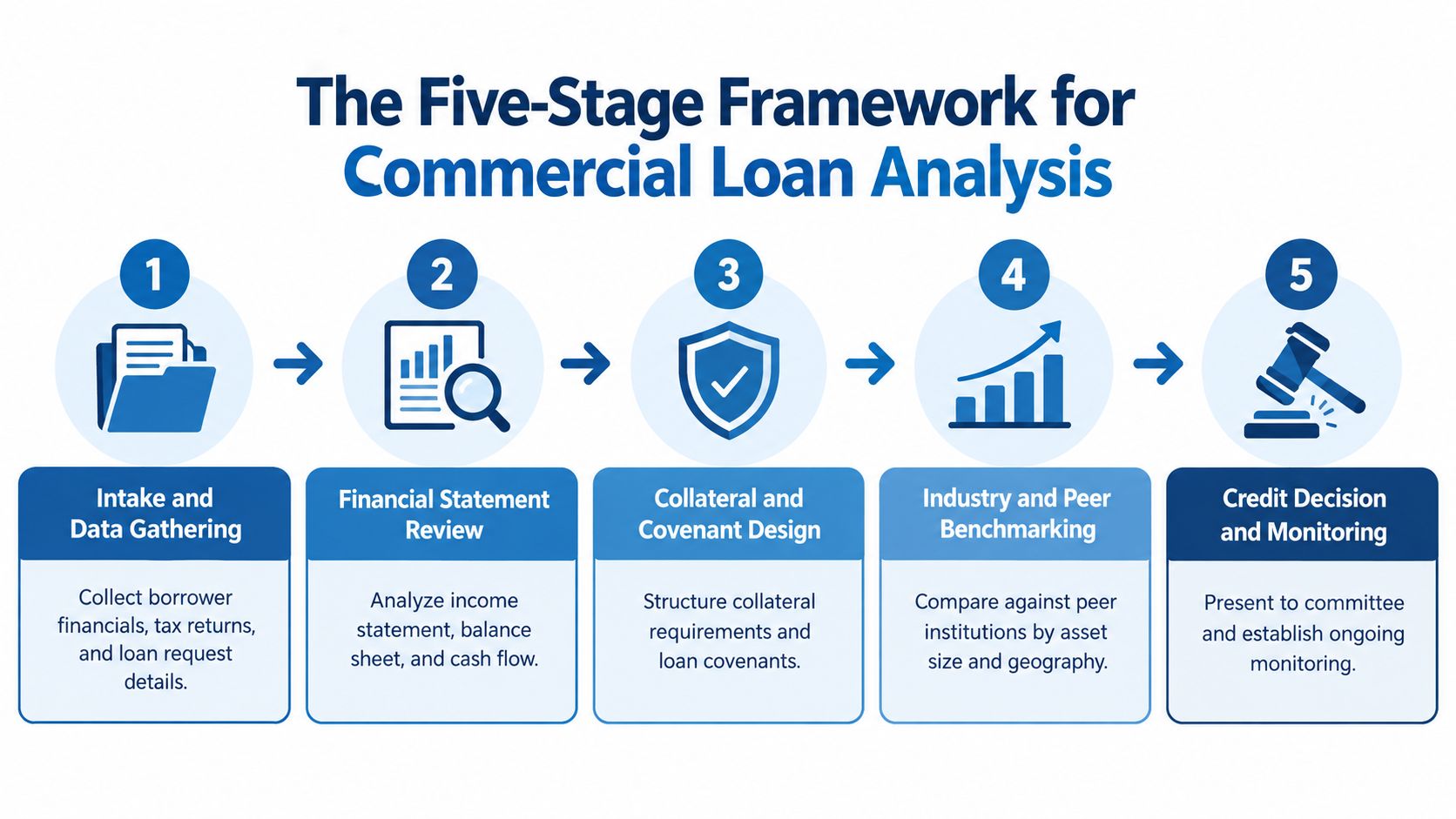
The Five-Stage Framework That Anchors Every Commercial Loan Analysis
Every credit officer knows the room. A stack of financials, a clock, and a request that sounds reasonable until someone asks about total debt service. A five-stage framework keeps that conversation in the right order, because sequence matters as much as substance.
Start with intake, but don't treat it as clerical work. You're verifying what the borrower is, what the money will do, and whether the file contains enough history to judge a cycle, not a quarter.
Stage One Through Three Build the Credit Story
Stage 1, intake and data gathering, collects financial statements, tax returns, debt schedules, guarantor information, and the purpose of the facility. Missing interim results or an incomplete debt stack should stop the analysis, not produce a footnote.
Stage 2, financial statement review, tests whether earnings are recurring and whether cash flow covers the full obligation. A defensible process should verify the borrower's financial condition using the two most recent completed fiscal years plus interim results, normalize earnings for nonrecurring items, and model total debt service under base and downside projections.
Stage 3, collateral and covenant design, comes after repayment capacity, not before it. Collateral is your secondary support. Covenants are your early warning system, and they only work if they're tied to the borrower's actual fragility.
For perspective on how nonbank lenders sequence the same discipline, private lending underwriting insights from LendingXpress offer a useful comparison point for structure, even though your regulatory burden is different.
Stage Four and Five Put the Loan in Context
Stage 4, industry and peer benchmarking, answers whether this credit, and your portfolio's exposure to its segment, look sound relative to comparable institutions. A borrower can look acceptable in isolation while your bank is already concentrated in its geography, sponsor, or collateral type.
Stage 5, risk grading and stress testing, converts analysis into a decision with consequences. The grade should drive pricing, approval authority, monitoring frequency, and exception documentation. If the grade doesn't change behavior, it's decoration.
Committee rule: If you cannot identify the primary source of repayment, the downside that breaks it, and the trigger that alerts you early, the analysis isn't finished.
That ordering is what separates underwriting that survives an examiner's questions from underwriting that anticipates them. You gather verified facts, you normalize cash flow, you structure protection, you benchmark context, and only then do you grade and approve.
Financial Statement Analysis That Survives the Credit Committee
Committees don't reject loans because an analyst missed a ratio. They lose confidence when the ratios don't reconcile to cash. Read the statements in an order that forces that reconciliation.
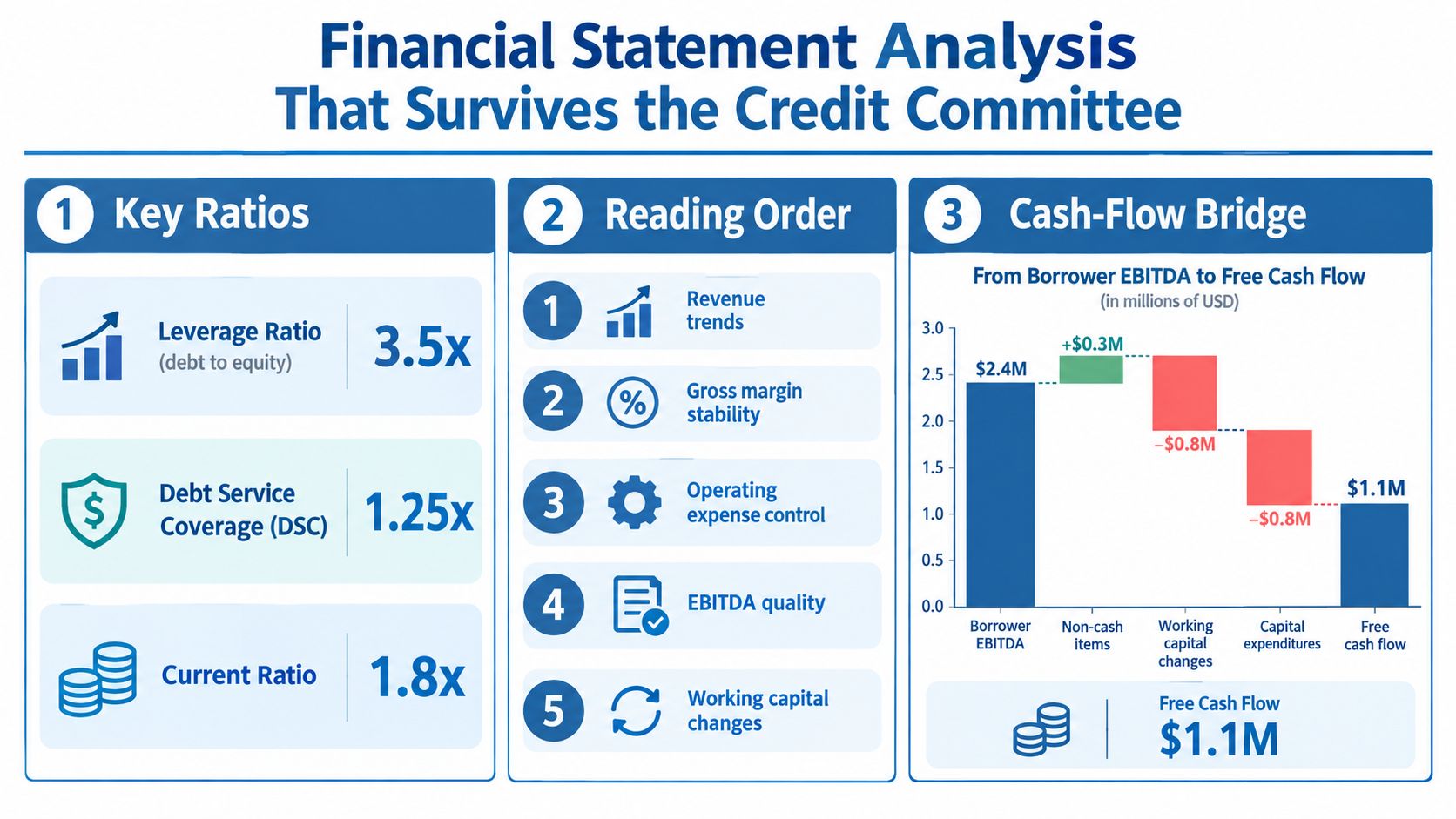
Start with revenue quality and customer durability, then margins, then operating expenses, then working capital. Only after that should you trust an EBITDA figure, because EBITDA presented by a borrower often includes add-backs that won't service debt next year.
Build the Cash Flow Bridge Before You Quote Coverage
Convert reported earnings into recurring cash available for debt service. Remove nonrecurring gains, owner compensation anomalies, and one-time expense savings. Then subtract cash taxes, maintenance capital expenditures, required working capital investment, and distributions that the business cannot realistically suspend.
Test the borrower's total debt stack, not just your proposed facility. A new term loan can look covered while existing equipment notes, a shareholder loan that's really payable, and a permanent revolver balance consume the cash flow first.
Use three decision-linked questions for every credit:
- Leverage test: Can the borrower absorb a revenue decline without breaching its balance sheet capacity?
- Coverage test: Does recurring cash flow cover total debt service in the downside case, not just the base case?
- Liquidity test: How many months can operations continue if receivables slow or a major customer delays payment?
Each answer should map to an action. Approve as structured, price for the risk, require an equity injection, shorten the maturity, add a guarantor, or decline. A ratio without a consequence is just reporting.
Trend Matters More Than a Single Year
A manufacturer with stable top-line growth and compressing margins tells a different story than one with flat sales and improving cash conversion. Look at whether receivables are growing faster than revenue, whether inventory is absorbing cash, and whether payables are financing operations. Those movements often appear before coverage deteriorates.
Delinquency data reinforce why segment-level reading matters. At year-end 2023, total loan delinquency was below 1% while commercial real estate delinquency reached 0.9%, a five-year high. A healthy portfolio average can hide a weakening segment, just as a healthy borrower average can hide one product line carrying the rest.
Bring the committee a bridge, a trend, and a breaking point. Show where coverage falls below policy, what assumption causes it, and what structure protects the bank if that assumption proves optimistic. That's analysis a committee can act on.
Collateral, Covenants, and the Structure That Actually Protects You
Collateral doesn't repay a loan. Cash flow does. Collateral determines how much you may recover after the credit decision has already failed, so rank it correctly in the analysis.
The OCC framework requires lenders to analyze repayment structure and sources, collateral and loan-to-value ratios, guarantor support, financial trends, commitments, and contingent liabilities. That order is instructive. Repayment comes first.
Match the Facility to the Borrowing Need
Distinguish seasonal working capital from permanent working capital. A seasonal line should be supported by a trade cycle that can produce a complete payout. Permanent working capital debt must generate cash flow after debt service, capital expenditures, and other operating needs.
Consider a manufacturer with a $10 million revolving facility and a 90-day inventory cycle whose balance remains near $9 million year-round. Payments may be current, but that pattern signals permanent financing carried in a revolver. You've got renewal and liquidity risk dressed up as a performing line, and the fix is term structure, equity, or a reduced commitment, not another clean renewal.
For movable assets, verify ownership, liens, and enforceability before you assign value. The principle is the same in other jurisdictions, where a rego-based vehicle check Australia from Carify illustrates how lenders and buyers confirm encumbrances before relying on a vehicle as security.
Design Covenants That Trip Early Enough
| Facility | Primary Financial Covenants | Reporting Cadence | Trigger Logic |
|---|---|---|---|
| Revolving working capital | Borrowing base, minimum liquidity, cleanup requirement | Monthly borrowing base, quarterly financials | Availability tightens as eligible collateral or liquidity falls |
| Term loan to an operating company | Maximum leverage, minimum debt service coverage | Quarterly testing | Breach prompts pricing, amortization, or equity cure discussion |
| Owner-occupied real estate | Global debt service coverage, maximum loan-to-value | Annual valuation review, quarterly borrower reporting | Global cash flow deterioration triggers review before maturity |
| Income-producing real estate | Property debt service coverage, occupancy or rollover reporting | Quarterly rent roll and operating statements | Tenant loss or coverage decline prompts cash management or reserves |
Good covenants are few, measurable, and connected to action. Don't collect certificates you never test. Don't set a trigger so loose that the borrower is already in workout when it trips.
Guarantor support needs the same discipline. Test liquidity outside the borrowing entity, contingent liabilities from other projects, and willingness to support across entities. A guarantee from a sponsor whose wealth sits in the same stressed properties isn't diversification.
When the collateral is real estate, tie advance rates, appraisal refresh dates, and refinance assumptions directly to your commercial real estate lending discipline. Structure wins in workout because it gives you options early, while liquidation math only tells you the size of the loss late.
Benchmarking Against Peers to Set the Right Price and Structure
A ratio is not good or bad until you know the comparison set. Peer benchmarking turns internal reporting into a decision about whether your growth, pricing, and concentrations make sense for a bank of your size, charter, and geography.
Build the comp set deliberately. National averages blend money-center banks, community banks, and specialist lenders into a number that describes nobody. Segment peers by asset size, market footprint, portfolio mix, and funding profile, then compare trends over time rather than a single quarter.

What to Benchmark Before You Price
Focus on measures that change a credit decision:
- Growth by segment: Are you expanding faster than peers in a category where your underwriting staff and appraisal review capacity are already stretched?
- Yield relative to risk: Are you earning enough for the segment's loss behavior, maturity, and collateral volatility?
- Delinquency and criticized migration: Is deterioration specific to your bank, or is the peer group moving the same way?
- Concentration relative to capital: Does your exposure look ordinary for your peers, or are you carrying an outlier position?
- Exception volume: Are policy exceptions occasional and documented, or have they become the de facto policy?
A community bank may view its commercial and industrial performance as satisfactory in isolation. Against regional peers with similar borrowers, that same performance may sit near the weak end of the group. The conclusion isn't automatically to stop lending. It may be to reprice, tighten advance rates, shift mix, or examine whether one industry or lending team is driving the gap.
Good and Good for Us Are Different Questions
Use peer analysis that compares your institution with a defined peer group to separate market conditions from bank-specific choices. If peers are tightening while you're easing, require the credit memo to explain why your information is better. If peers are growing a segment profitably while you're absent, ask whether you're missing an opportunity or correctly avoiding a risk you cannot monitor.
Benchmarking should change at least one of four things: price, structure, approval authority, or appetite. If it changes none of them, it's a chart for the board package, not a management tool.
Bring peer context into the loan discussion before approval, not into a quarterly lookback after the exposure is booked. That's how data intelligence improves origination quality instead of merely explaining outcomes.
Risk Grading and Stress Testing That Reveal What Ratios Hide
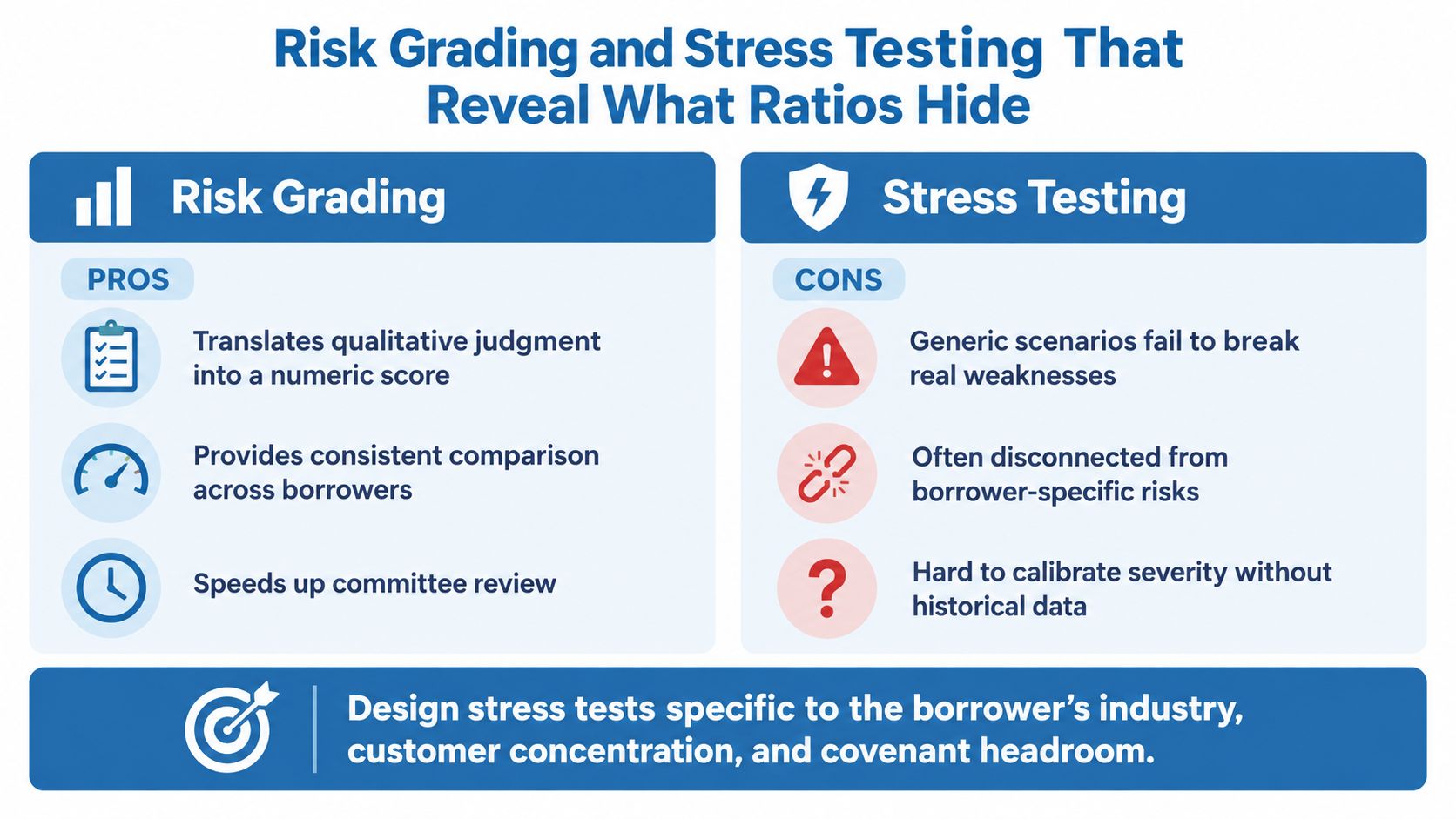
A risk grade is a translation exercise. You're converting financial performance, management quality, industry position, collateral support, and payment behavior into a consistent signal that drives pricing and monitoring. If two analysts would grade the same borrower differently for undocumented reasons, the system isn't working.
Grade the borrower first, then consider facility support. Strong collateral can improve loss severity, but it shouldn't disguise weak repayment capacity. Keep the rationale visible, including the factors that prevented a better grade and the evidence that would justify an upgrade.
Design Stress Around the Borrower's Actual Fragility
Generic rate shocks are easy to run and easy to ignore. Build the downside from the borrower's business model.
For a manufacturer, stress the loss of a concentrated customer and a longer cash conversion cycle. For a hotel or other income property, stress weaker revenue, higher operating expenses, and a harder refinance at maturity. For a contractor, stress delayed receivables, cost overruns, and reduced backlog conversion.
Your scenario should answer four questions:
- Coverage break: At what revenue or margin level does debt service coverage fall below policy?
- Liquidity break: When does the borrower need the revolver for permanent support rather than timing?
- Collateral break: What valuation change eliminates the equity cushion?
- Refinance break: Can the borrower refinance the remaining balance without heroic assumptions?
Then connect the result to the grade. A borrower that passes the base case but fails a plausible downside shouldn't receive the same grade, price, or maturity as one that retains headroom. You may still approve the loan, but approval should carry compensating structure, such as faster amortization, additional equity, tighter covenants, or a guarantor with verified liquidity.
Monitor the Signals That Move Before the Grade
Annual financial statements arrive too late to be your only warning. Track covenant headroom, revolver utilization, cash conversion, payment behavior, deposit trends, tenant rollover, and appraisal aging. A borrower doesn't need to miss a payment before you act. Persistent overadvance requests, slower receivable turnover, and shrinking covenant headroom are actionable signals.
Document overrides plainly. Relationship value, local knowledge, and sponsor history can matter, but they don't repeal cash flow arithmetic. When you override a quantitative grade, state the compensating factor, assign an owner, and set a review date.
Stress testing earns credibility when it changes terms before closing. If every downside case still ends in the same approval at the same price, the committee will learn to ignore it.
Concentration Risk Is the Threat Most Underwriting Misses
Most banks have better single-name logic than portfolio logic. Each loan receives a memo, a grade, and a vote. The correlated exposure created by approving all of them receives a quarterly chart, often after the growth has already occurred.
Regulators define a credit concentration as direct, indirect, or contingent obligations that exceed 25% of a bank's Tier 1 capital plus its allowance for credit losses. For a bank with $200 million in Tier 1 capital and $4 million in allowance reserves, that threshold is $51 million. Those figures come from the OCC concentrations framework and should be calculated at relationship level before additional credit is approved.
Name Diversification Is Not Risk Diversification
Eight borrowers can share one risk. They may sell to the same employer, depend on the same sponsor, operate in the same trade area, or rely on the same collateral valuation assumptions. Approving loan seven and loan eight on standalone merits misses the point if a single plant closure, sponsor liquidity event, or property market decline impairs all eight.
Aggregate exposure by borrower, guarantor, sponsor, industry, geography, collateral type, maturity year, and repayment source. Then compare each segment with capital and liquidity, not just with a policy limit copied from last year.
Commercial real estate requires special vigilance. Interagency guidance identifies heightened supervisory analysis when construction, land development, and other land loans reach 100% or more of total capital, or when total CRE loans reach 300% or more of total capital and the portfolio has grown by at least 50% during the prior 36 months. These aren't automatic prohibitions. They are warning thresholds that should trigger segmentation, stress testing, and board-level discussion.
A bank with $250 million of capital and $800 million of CRE loans sits at 320% of capital. If that portfolio grew from $500 million three years earlier, it also meets the growth condition. The correct response isn't panic. It's to segment the exposure and identify which property types, sponsors, and maturity years create correlated loss potential.
Turn Concentration Telemetry Into Decisions
Use concentration risk analysis that aggregates related exposures before approval to decide where to expand, reprice, or pause. Dashboards should track segment growth, criticized migration, covenant breaches, appraisal refresh dates, exception aging, and maturity walls, with escalation rules tied to capital capacity.
Portfolio rule: The question isn't whether the next loan is good. It's whether the next loan makes the portfolio more fragile.
When a segment approaches its limit, act early. Raise pricing, lower advance rates, shorten maturities, require more equity, increase approval authority, or stop originations. Waiting for delinquency to validate a concentration concern wastes the only advantage portfolio data gives you, which is time.
Red Flags, Approval Checklist, and Putting It to Work
Escalate early when you see a revolver that never cleans up, receivables growing faster than sales, repeated appraisal assumptions that preserve value, shrinking covenant headroom, or a sponsor supporting multiple stressed projects. Payment slippage on a thin-coverage credit deserves a downgrade discussion, not a wait-and-see note.
Banks with meaningful CRE exposure are expected to stratify portfolios into segments with common sensitivities and perform portfolio-level stress testing rather than rely on a single CRE total. Apply that same segmentation logic to your approval checklist:
- Repayment verified: Recurring cash flow covers total debt service in base and downside cases.
- Structure matched: Facility type fits seasonal or permanent need, with covenants that trigger action.
- Support tested: Guarantor liquidity and collateral values are current, documented, and enforceable.
- Context checked: Peer, industry, concentration, and maturity effects are explicit in the memo.
- Monitoring assigned: Risk grade, review date, data triggers, and exception owner are recorded.
Run that checklist before signing, then keep the file alive after closing. The best commercial loan analysis doesn't end at approval. It becomes the baseline for earlier intervention next quarter.
Benchmark your commercial loan growth, peer positioning, and concentration signals against relevant institutions so your next credit decision starts with portfolio context, not just a borrower package. Explore the regulatory, market, and peer data available through Visbanking and turn that intelligence into earlier pricing, structure, and intervention decisions.
Latest Articles
Brian's Banking Blog
Understanding Statistical Significance in Banking
Brian's Banking Blog
Option Adjusted Spread: A Banker's Practical Framework
Brian's Banking Blog
How to Improve Margins: A Bank Leader's Playbook

Brian's Banking Blog
Automated Alerts and Notifications for Banks
Brian's Banking Blog
Customer Feedback Loop for Banks: A Practical Playbook

Brian's Banking Blog