
How to Secure REST API with JWT for Banking
Brian's Banking Blog
A bank's data team may be preparing peer-performance analysis while a relationship manager reviews prospect activity and risk signals. The APIs behind those workflows need to do more than accept a valid login: they must keep each institution's information within its authorized boundary, and produce evidence when something goes wrong. That's why a secure REST API with JWT is an operating discipline, not a token configuration exercise.
For bank executives and directors, the practical question isn't whether an API uses JSON Web Tokens. It's whether the people, services, keys, authorization rules, and audit controls around those tokens protect the data decisions depend on.
Why JWT Security Starts With Bank Risk
Consider a representative failure. A bank integration presents a correctly signed token from the expected identity provider. The API verifies the signature, then accepts an institution identifier supplied in the request and returns another institution's data. The token is valid. The access decision is not.
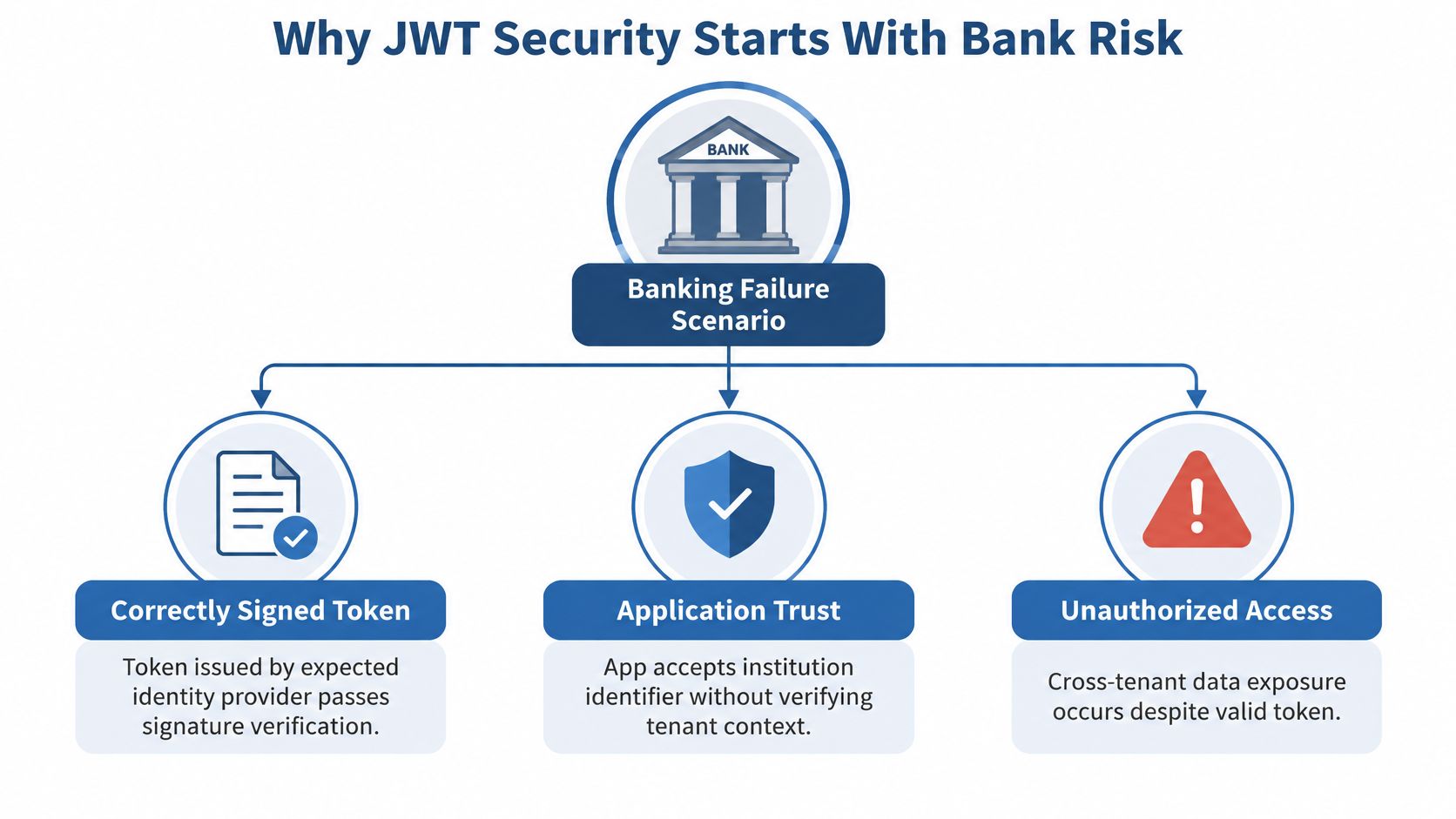
Authentication establishes which principal a token represents. Authorization determines whether that principal may access a particular institution, portfolio, prospect, or administrative operation. Confidentiality protects information from disclosure, while operational accountability gives the bank enough evidence to investigate misuse. A signature addresses only part of that picture.
JWT became a formal internet standard in May 2015, when RFC 7519 defined it as a compact, URL-safe format for representing claims between parties (RFC 7519's place in API security guidance). A conventional JWT contains three Base64URL-encoded segments, header, payload, and signature, separated by periods. The signature can establish integrity and authenticity: it helps the API detect that a signed token has been altered. It does not make the payload confidential. Anyone holding an ordinary signed token can generally decode its claims.
Treat three controls as distinct. TLS protects a token while it travels between client and API. Signature validation detects tampering and verifies the token against a trusted key. Encryption is needed when the token's contents themselves must be kept confidential. Customer, banking, or credit data doesn't belong in an ordinary signed JWT unless it receives additional protection.
Executive test: A valid signature answers whether the token passes cryptographic verification. It doesn't answer whether the caller may see the requested bank data.
For a bank, the operating model must connect those controls: authenticate the principal, authorize every requested resource, protect tokens and sensitive information, and preserve audit evidence. If any one is missing, a technically correct JWT implementation can still expose the wrong data.
Create and Sign Tokens Safely
Token issuance should start only after the application has authenticated the user and established the user's permitted institution context. The token then carries a minimal set of claims that the API can verify and use in later authorization decisions. Claims aren't a substitute for checking access against the resource being requested.

Issue claims for a defined purpose
A bank's issuance service might construct a claims object like this:
{
  "iss": "trusted-identity-service",
  "aud": "bank-data-api",
  "sub": "authenticated-principal",
  "typ": "access",
  "iat": "issued-at-time",
  "nbf": "not-before-time",
  "exp": "expiration-time",
  "kid": "signing-key-identifier",
  "scope": ["benchmark:read"],
  "jti": "unique-token-identifier"
}
These illustrative values describe claim purposes, not real credentials or a required schema. The issuer identifies the trusted token source; the audience identifies the intended recipient; the subject represents the authenticated principal. The token type, time claims, key identifier, scope, and unique identifier support validation and operational controls.
Keep the payload lean. Don't put account details, customer records, credit information, or other sensitive banking data in an ordinary signed JWT. Claims can support a decision, but the API should fetch protected data from its authorized source rather than treating the token as a confidential data container.
Protect signing authority
The signing service should choose its permitted algorithm from server-side configuration, not accept an algorithm selected by a token header. Verification keys must be bound to a trusted issuer, and key-location claims or URLs must not be trusted without an explicit policy (RFC 8725 guidance on JWT implementation).
Keep private signing keys in protected key-management infrastructure or an equivalent controlled secret store. Limit access to the services and personnel that need it, separate key administration from routine application deployment, and record key use and changes. The signing key must never appear in an API response, source repository, or client configuration. Return only the compact token over a protected connection, along with any response metadata the client needs to handle it.
This approach makes issuance controlled and claims useful, without confusing possession of a signed token with a blanket right to access bank data.
Verify Every JWT Request in Order
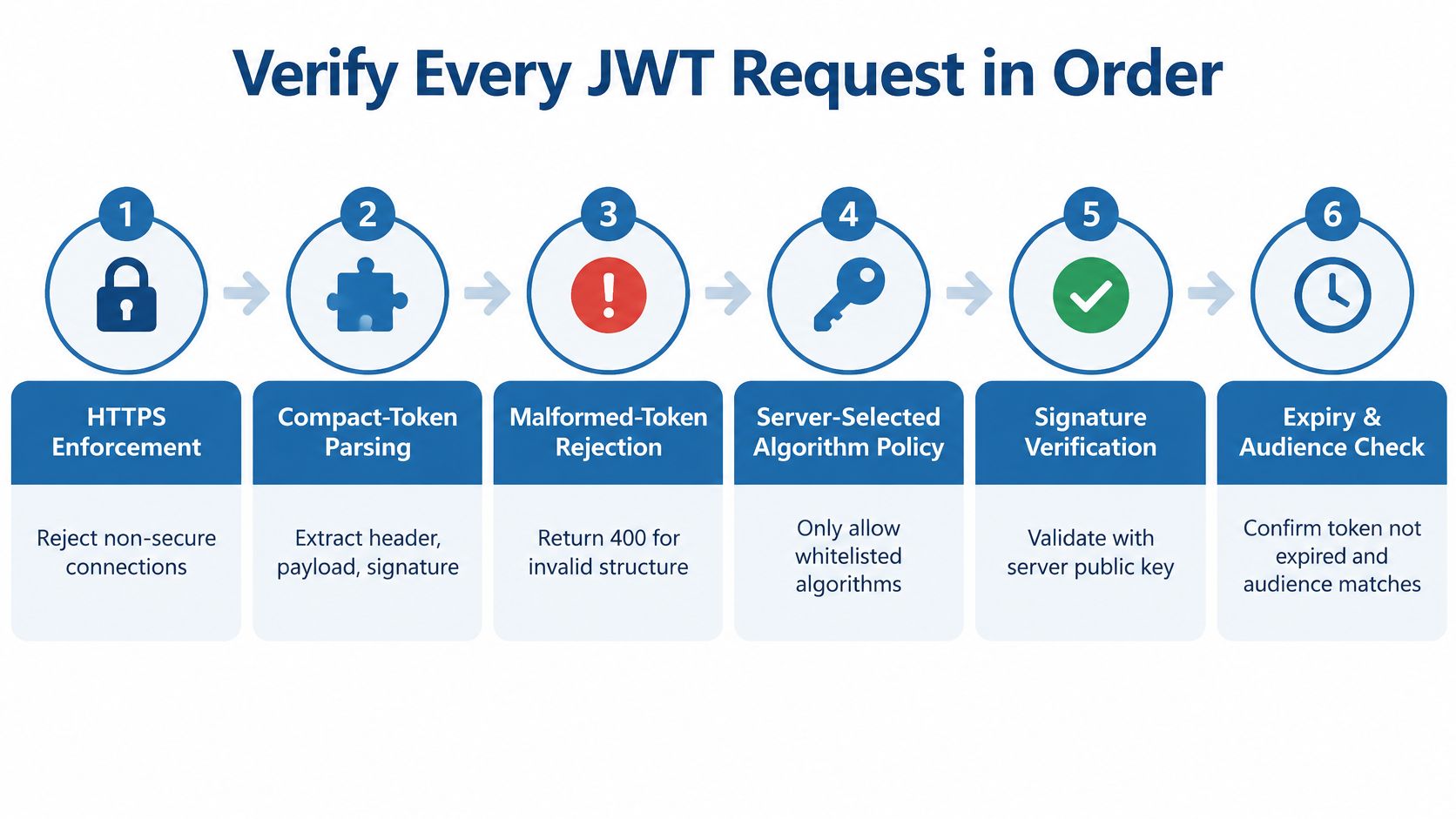
Middleware should apply a fixed validation sequence and fail closed. If a check fails, the request must not continue to application logic. The API should not try a permissive fallback because a token nearly passed.
Build a fixed validation pipeline
- Require HTTPS. Reject requests that arrive over an unprotected connection. A bearer token can be reused by whoever obtains it.
- Parse the compact token. Reject malformed structures before application code attempts to use claims.
- Choose policy on the server. Select the permitted signing algorithm from configuration. Don't let the token header dictate what the verifier accepts.
- Verify the signature. Use a verification key obtained through the API's controlled trust path and associated with the expected issuer.
- Validate claims. Check the exact issuer and audience, expiration, not-before time, and required token type. Reject a token that is expired or not yet valid under the API's clock policy.
- Check access requirements. Confirm the required scopes or roles, then authorize the principal against the requested resource.
At the standards level, RFC 8725 requires applications to restrict supported algorithms, use each key with exactly one algorithm, validate cryptographic operations, and reject the complete token if an operation fails. OWASP also identifies acceptance of unsigned or weakly signed JWTs, including alg:none, as an authentication vulnerability (OWASP API Security Top 10 guidance).
A language-neutral middleware sketch makes the rejection path explicit:
if connection is not HTTPS: reject
if token structure is malformed: reject
algorithm = serverConfiguredAlgorithm
if token algorithm is not allowed: reject
if signature verification fails: reject
if issuer or exact audience is wrong: reject
if token time boundaries or type are invalid: reject
if required scope or role is absent: reject
authorize principal for the requested resource
continue
Suppose a relationship manager's verified token permits reading peer-performance data for an assigned institution. A request for another institution's records must still be denied, even if the token's signature and general claims are valid. The API should derive the principal from verified claims and compare that identity and tenant context with the requested resource, not rely on an institution identifier supplied in a query or request body.
Teams coordinating financial data across jurisdictions may also find this API for South African finance teams useful context when assessing integration requirements. For a broader view of the controls surrounding request validation and access decisions, see Visbanking's API security overview.
Authentication establishes who the token represents. Authorization still decides what that principal may do.
Manage Refresh Revocation and Key Rotation
Stateless verification reduces the need to keep session state for every API request, but it doesn't eliminate the operational need to respond to logout, employee departures, compromised credentials, or key changes. A production design needs a deliberate revocation and rotation policy.
Separate token responsibilities
An access token should be short-lived and limited to the API and actions the client needs. A refresh token supports obtaining a replacement access token without asking the user to authenticate again. It has a different risk profile and should be protected accordingly. Browser and mobile clients both need a clear storage and handling policy; their implementation constraints differ, so a bank should assess each client rather than assume one storage pattern fits all.
When a refresh token is used, the service can issue a replacement and invalidate the token presented. If the old token is presented again, the service can treat reuse as a security signal and respond according to policy. This introduces state and operational work, but it gives the bank a way to detect reuse that a purely stateless access-token model cannot provide.
Restore immediate invalidation where needed
For explicit logout, employee offboarding, suspected theft, or policy-driven termination, the service can place a unique server-issued jti on a denylist until the token expires. OWASP recommends short-lived access tokens, protected refresh-token flows, and this jti approach when immediate invalidation is needed (OWASP REST Security Cheat Sheet). A denylist adds a stateful control plane and lookup responsibility. That cost may be justified when waiting for normal token expiry is unacceptable.
Key rotation also needs coordination. Where multiple API services verify tokens, use a controlled key-distribution path and plan for overlapping validity while services move to the new key. Services should reject unknown key identifiers and algorithm mismatches rather than searching untrusted locations for a key.
For investigations, log issuer, subject, audience, key identifier, decision reason, and correlation identifier. Don't log raw tokens or sensitive claims. A useful alert should help an investigator connect repeated signature failures or unexpected validation decisions to a request and service, without creating another store of credentials.
Integrate JWT With Banking Authentication Flows
A relationship manager signs in to review institution benchmarks, prospect relationships, and risk signals. The secure design begins before a JWT exists: the identity service verifies the person's credentials and confirms the application can establish the person's permitted institution context. In a bank, that context usually comes from an entitlement process tied to role, region, or customer coverage, and the token should carry the result of that process rather than re-derive it on every call.
Keep identity and resource decisions server-side
After successful authentication, the service issues an access token with the intended issuer, audience, subject, and limited scopes. It may also provide a refresh token through a protected flow. The client sends the access token to the API over HTTPS; it should not send identity claims in a request body and expect the API to trust them.
The API verifies the token, then applies authorization policy to the verified subject. Two decisions happen on every call: whether the caller may invoke the function at all, and whether the specific institution, portfolio, or prospect in the request falls inside the caller's access. Deny a request for an unauthorized institution even when the caller alters an identifier in the URL or body. On refresh, the service validates the flow and applies its rotation and reuse policy; on logout, it applies the revocation policy rather than assuming client-side deletion invalidates anything.
That division of labor is the point of an authentication vs authorization guide: authentication establishes who the principal is, while authorization decides each action. OWASP's broken object level authorization guidance makes the same point for APIs, because tampering with an object identifier is the cheapest way to turn a valid token into unauthorized data access.
Service-to-service calls follow the same discipline. Issue a token for the intended integration, with an audience limited to the receiving API and scopes restricted to the required operations. A data-exporting service should not gain broad administrative access because it needs to read one dataset.
Data intelligence supports sound banking decisions only when institution boundaries, explainability, and auditability hold. A well-governed bank API integration makes each access decision traceable: which verified principal requested which resource, under which policy, and with which outcome. That record gives risk and audit teams evidence for operational review without making the token itself the authority for every downstream decision.
Test Common JWT Failure Modes
A successful login proves little about how an API behaves under attack or misconfiguration. Test rejection paths as deliberately as the normal request path. The expected result should be a denial that prevents protected data from reaching application logic; malformed input may receive a client error, while authentication or authorization failures should use the API's documented denial behavior.
| Test case | Expected result | Control exercised |
|---|---|---|
Unsigned token or alg:none |
Reject; do not process claims | Algorithm allowlist and signature requirement |
| Algorithm-confusion attempt | Reject | Server-selected algorithm and key binding |
| Altered payload | Reject | Cryptographic signature verification |
| Unknown key identifier | Reject | Trusted key selection |
| Malicious key URL | Reject | Controlled key retrieval and trust policy |
| Expired token | Deny request | Server-side expiration validation |
| Not-yet-valid token | Deny request | Server-side nbf validation |
| Incorrect issuer | Reject | Trusted issuer validation |
| Wrong audience | Reject | Exact audience validation |
| Replayed bearer token | Deny when revocation or sender constraints apply | Replay and revocation policy |
| Reused rotated refresh token | Reject and raise a security signal | Refresh-token rotation and reuse detection |
| Cross-tenant object identifier | Deny access | Object-level authorization |
Run the matrix against middleware and the actual resource authorization path. A token can pass signature verification and still fail the tenant check. Client-side expiration checks may improve the user experience by avoiding requests with an expired token, but they don't enforce security. The server's validation decision is authoritative.
Use a correlation identifier to connect a failed request with service logs and investigation records. Record the reason for rejection and relevant token metadata, but don't copy raw tokens or sensitive claims into logs. Make the rejection consistent enough for monitoring while avoiding error details that disclose unnecessary information to callers.
A signed payload remains readable to anyone who holds the token. Keep sensitive banking data out of it unless the payload receives separate protection.
Apply a Production JWT Security Checklist
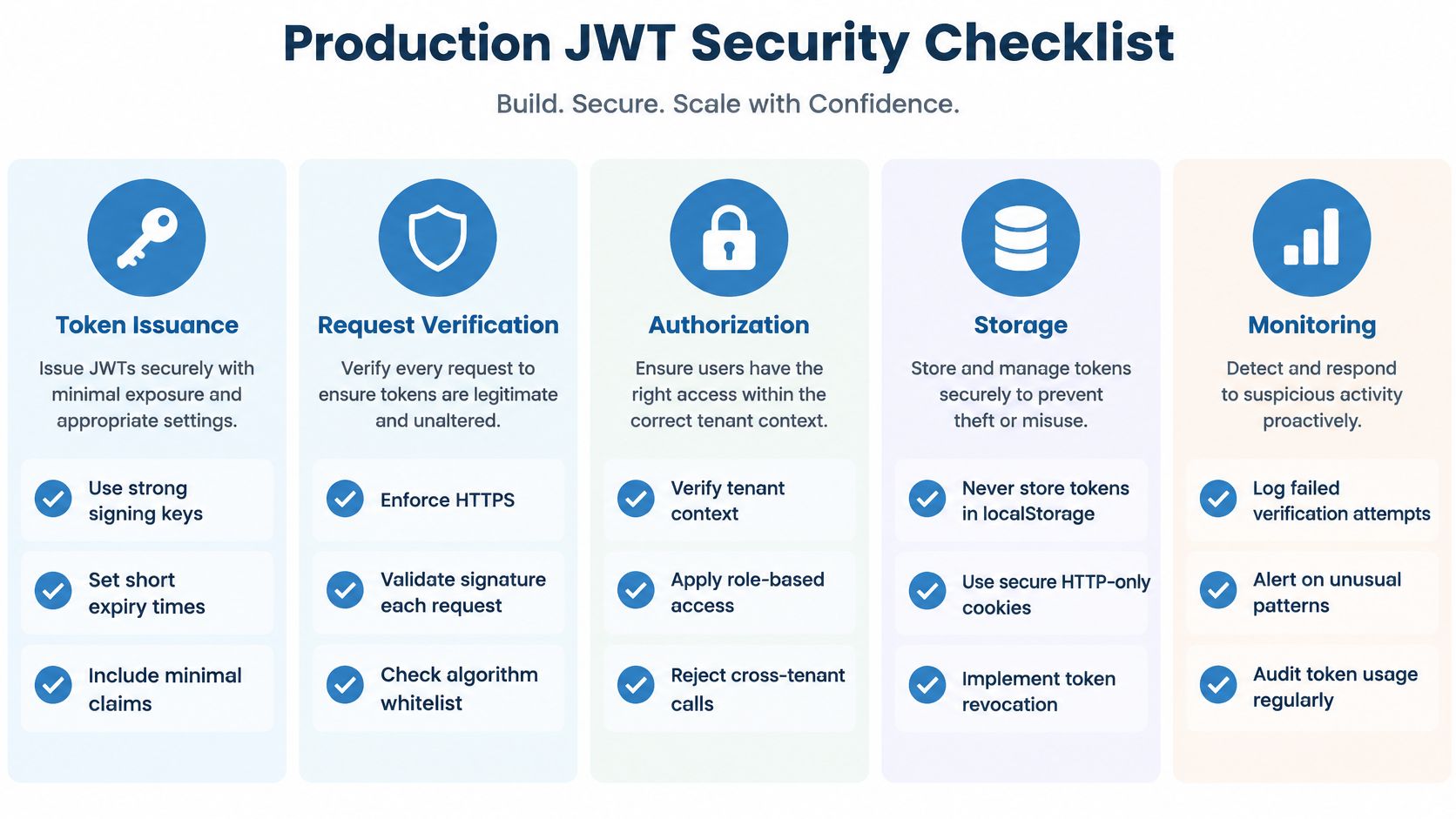
Bank leaders can use this checklist to review whether JWT controls operate as one system:
- Issuance: Issue tokens only after authentication and tenant context are established. Include minimal claims and protect signing keys.
- Verification: Require HTTPS, apply a server-side algorithm allowlist, validate signatures and claims, and fail closed.
- Authorization: Check tenant, object, and function permissions for every request. A token isn't blanket access.
- Storage and transport: Protect access and refresh tokens in each client environment, and never send them over an unprotected connection.
- Key governance: Control key access, retrieval, rotation, and the response to unknown or mismatched keys.
- Revocation and monitoring: Define logout, offboarding, and compromise procedures; retain useful audit fields without recording raw tokens.
- Continuous testing: Exercise negative cases, including cross-tenant access, and review the evidence those tests produce.
For high-risk banking actions, consider whether bearer tokens alone are sufficient. A stolen bearer token can be replayed until it expires. DPoP binds an OAuth access or refresh token to a client-held public key and requires a proof-of-possession JWT with each request; it can reduce replay of a leaked token, but not protect a compromised device whose private key has also been stolen (RFC 9449 on DPoP). Sender-constrained tokens add client key-storage, replay-window, and compatibility responsibilities, so reserve them for workflows where the added protection justifies the operational burden.
For broader controls around sensitive information and API operation, review data security best practices. The leadership takeaway is direct: trustworthy APIs protect the data foundation behind benchmarking, risk signals, relationship decisions, and operational alerts.
Visbanking brings financial, regulatory, market, and people data together in decision-ready banking intelligence, with secure APIs and auditability supporting how teams use that information. Benchmark your institution's performance or explore the data behind your next banking decision with Visbanking.
Latest Articles

Brian's Banking Blog
Commercial Loan Analysis: A Bank Executive's Guide

Brian's Banking Blog
Understanding Statistical Significance in Banking

Brian's Banking Blog
Option Adjusted Spread: A Banker's Practical Framework

Brian's Banking Blog
How to Improve Margins: A Bank Leader's Playbook
Brian's Banking Blog
Automated Alerts and Notifications for Banks
Brian's Banking Blog