
Talent and Intelligence: A Guide for Bank Leaders
Brian's Banking Blog
High performance isn't evenly spread, and banks feel the same pattern in their hiring markets. In the OECD's 2022 PISA assessment, 238 points separated the highest and lowest performing systems in mathematics, with Singapore at 575 points against an OECD average of 472 points. That spread carries a direct lesson for bank leaders. Capability can be measured consistently at scale, but a single score never tells you where talent sits, what experience sits behind it, or whether it fits your strategy. Talent and intelligence work only when you combine standardized signals with evidence from real banking work.
Why Talent and Intelligence Now Decide Bank Performance
Say two banks each hold about $3 billion in assets and employ 12 commercial relationship managers. Bank A hires on titles, school names, and years in seat. Bank B tracks which officers grow deposits, win renewals, and explain pricing decisions clearly to customers and directors. After a year, Bank B knows which skills produce revenue. Bank A knows only who looked qualified on paper.
Executives need plain definitions. Talent means the people and career signals that show who can do the job, including role history, leadership moves, and tenure in a local market. Intelligence means the speed and quality of judgment a person applies to financial information. It isn't an IQ label. It's observable in how someone reads a credit file, challenges a forecast, or turns a peer comparison into a pricing decision.
Where the Two Data Sets Meet
Professional data shows who's moving and where skills sit today. Financial signals from FDIC call reports, UBPR peer ratios, and loan growth trends show where your bank needs those skills next. Put together, they turn strategic workforce planning from a headcount exercise into a growth plan. Teams already managing talent with HR Management 365 or a similar system can add this market layer without replacing their internal records.
Two forces make this urgent. AI is changing which tasks still require human judgment, so routine skill sets lose value while interpretation and accountability gain it. Competition for experienced specialists is also tighter at community banks and credit unions, which can't match large bank compensation. The framework that follows gives you a way to act this quarter, starting with role level signals.
Talent Signals That Predict Results in Each Banking Role
| Role | Learning and cognitive evidence | Bank-specific knowledge | Outcome evidence |
|---|---|---|---|
| Relationship manager | Learns new product rules within one review cycle | Knows the bank's deposit and loan mix | Portfolio growth and renewal rate |
| Credit analyst | Finds errors in sample financial spreads | Applies underwriting policy without escalation | Loss rate on assigned loans |
| Risk officer | Explains model and exception outliers clearly | Maps risks to call report and UBPR metrics | Exceptions resolved within policy timelines |
| Financial analyst | Builds and tests a forecast from peer data | Interprets local deposit and loan trends | Forecast accuracy against actual results |
| Personal financial advisor | Assesses client risk tolerance and portfolio change | Knows product suitability and disclosure rules | Client retention and assets under management growth |
| Branch or market leader | Spots shifts in competitor pricing early | Understands local labor and deposit markets | Deposit growth and staff retention |
Read each row as the minimum evidence you need before trusting a candidate or prospect in that role. It isn't a checklist to pass. A relationship manager who grows a portfolio but can't explain your deposit mix will sell the wrong products. A credit analyst who's fast but misses errors in a sample spread will create losses you won't see for quarters.
Two Roles Where the Definition Is Already Written
For financial analysts, the Bureau of Labor Statistics occupational profile for financial analysts describes work that requires evaluating financial information, measuring risk, forecasting growth, and communicating recommendations clearly. Test exactly that. Hand the candidate peer data and ask for a forecast with stated assumptions, then score whether the recommendation follows from the numbers.
Advisors need a wider lens. The Bureau of Labor Statistics profile for personal financial advisors identifies analytical, interpersonal, mathematical, and sales skills as important qualities, including assessing client risk tolerance. A technically strong advisor who can't build trust won't retain assets, so retention and referral trends belong in the evidence file.
Practical rule: Pick one role, collect two signals from each column, and compare every candidate on the same evidence. Consistency beats volume.
That discipline also protects you from title inflation. Two candidates can share a vice president title while carrying very different books, limits, and loss histories.
How Much Intelligence Should Weigh in Each Role
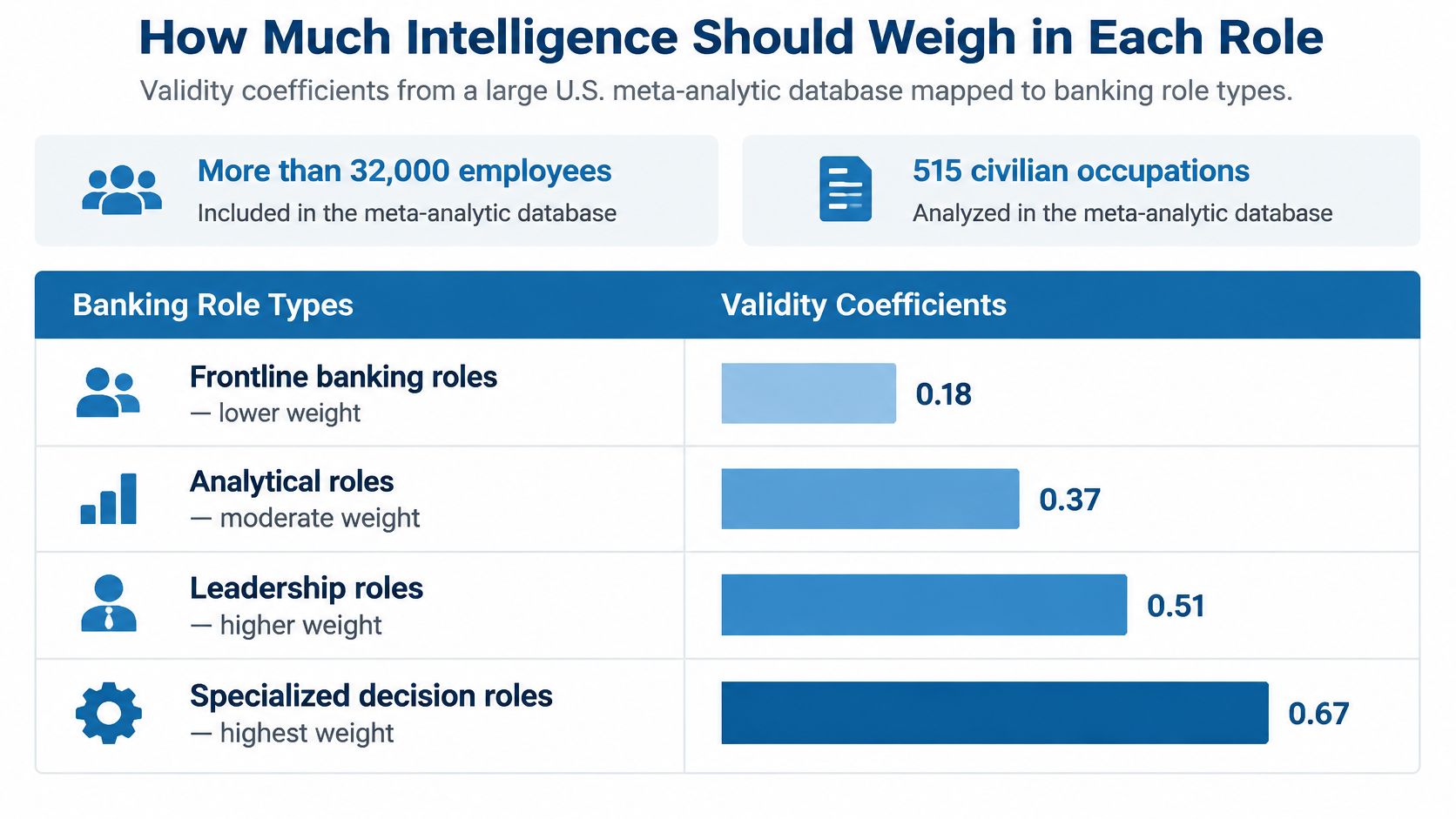
| Job complexity | Validity coefficient | Typical banking roles | How to weight the signal |
|---|---|---|---|
| Professional-managerial | .58 | Branch, commercial and executive leaders | Heavy weight, paired with leadership track record |
| High-complexity technical | .56 | Credit underwriting, model risk, treasury | Heavy weight, paired with work samples and certifications |
| Medium-complexity | .51 | Loan officers and financial analysts | Moderate weight alongside role knowledge |
| Semi-skilled | .40 | Operations and service specialists | Moderate weight, emphasizing process reliability |
| Unskilled | .23 | Routine processing such as data entry | Light weight, emphasizing reliability and training speed |
These coefficients come from a large U.S. meta-analytic database covering more than 32,000 employees across 515 civilian occupations, which reported approximately .58 for professional-managerial roles and .23 for unskilled jobs. A higher coefficient means cognitive signals predict job performance more strongly. It doesn't mean the score decides the hire.
The mechanism is straightforward. Cognitive ability speeds learning, problem solving, and adaptation to unfamiliar tasks. Its value rises as a role demands more information processing and judgment. Weight it heavily for leadership, credit structuring, and risk. Weight it moderately for analysts and relationship roles, and lightly for routine processing, where reliability and training speed matter more.
A Worked Candidate Comparison
Say two candidates for a commercial credit role score equally on a cognitive test. One brings three years of construction lending experience. The other doesn't. Rank the candidate with domain depth higher, because job knowledge is a plausible route through which intelligence affects performance. Treat that route as a hypothesis, since the full mediation finding comes from one study in a peer-reviewed review of intelligence and job performance, where cognitive ability explained about 12% of performance variance in cited experimental work. Test it in your own hiring data by tracking whether domain knowledge at hire predicts later credit quality better than test scores do.
Keep intelligence as one explainable feature in your talent model. Never use it as a standalone pass or fail, because the same score carries different meaning across occupations.
Measuring Applied Intelligence in Real Banking Work
Applied intelligence is the ability to combine domain judgment, collaboration, data literacy, and AI use in real workflows. That's the capability banks need most. In KPMG's 2025 banking CEO outlook survey, 79% of banking and capital-markets CEOs say AI is redefining entry-level skills, while 83% of surveyed CEOs prioritize workforce reskilling compared with 34% who anticipate workforce reductions. AI raises the value of human judgment. It doesn't remove it.
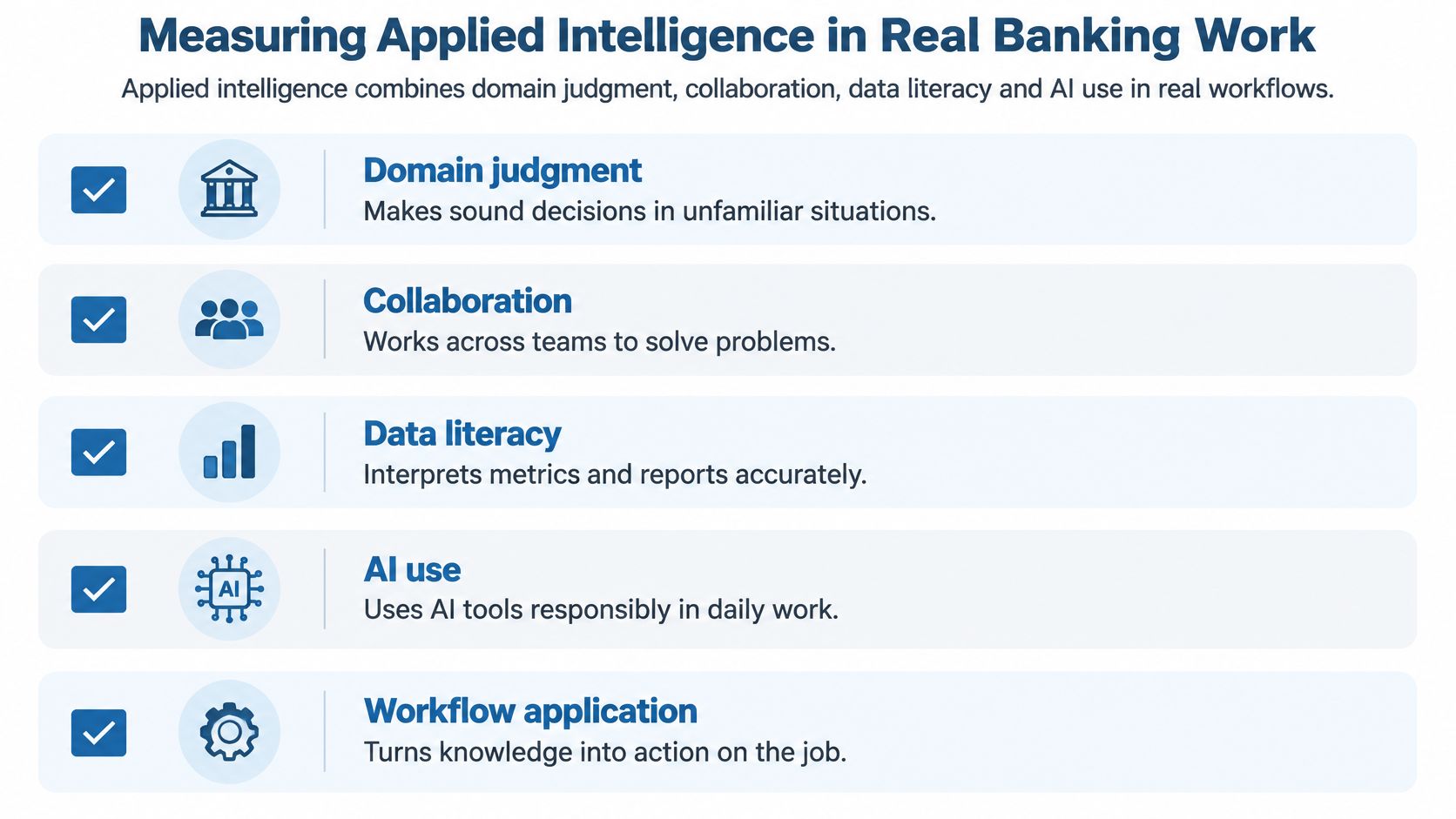
| Behavior | Test that produces the evidence | What the score rests on |
|---|---|---|
| Quality of peer analysis | Live review of a sample credit memo | Whether conclusions follow from the data, on three levels |
| Speed from signal to action | Timed run from a market alert to a documented customer call or pricing decision | Elapsed time and quality of the documented decision |
| Explainability | Candidate explains one recommendation to a non-specialist director | How clearly a non-specialist director can follow the reasoning |
| AI use with accountability | Review of how model output is verified, assumptions logged and errors flagged | Verification and logging evidence, not tool usage alone |
| Customer trust | Retention, referrals and complaint trends on assigned accounts | Trend measured against a baseline for the same book |
How to Score Without Bias
Score each behavior on a shared rubric with three levels per item. Score the evidence before you review titles or credentials, so resume prestige doesn't anchor the rating. Pair the rubric with critical thinking training for hiring managers, so raters learn to separate a confident presentation from sound reasoning.
AI use deserves special care. Ask candidates to show how they'd verify a model output, log their assumptions, and flag an error they'd caught. Teams building internal training material can borrow structure from a practical AI content generation guide to turn these tests into repeatable exercises. Directors reviewing a rubric should ask for the evidence behind each score, not only the score itself.
Experienced Hires Versus Early-Career Builders
Boards ask the same question every planning cycle. Should we buy experience or grow it?
| Criteria | Experienced hire | Early-career builder | Measure to track |
|---|---|---|---|
| Learning velocity | Slower on new systems, faster on known deal types | Fast when paired with coaching | Time to first independent sign-off |
| Judgment under uncertainty | Strong, drawn from past credit and rate cycles | Developing, needs structured review | Error rate on stress-test scenarios |
| Customer impact | Immediate on inherited relationships | Builds across the first year on supervised accounts | Portfolio growth and retention trend |
| AI-assisted productivity | Adopts tools selectively | Adopts tools quickly | Output per analyst hour with verified accuracy |
The labor market is already tilting toward experience. Randstad's analysis of global financial-services postings found postings for workers with 0 to 2 years of experience fell 24% from January 2024, while postings requiring 10 or more years rose 6%, with routine roles such as data entry and payroll declining especially sharply. Yet 83% of organizations surveyed are adopting skills-first hiring and development, which points the other way.

The Choice Is False
Use experienced bankers for judgment-heavy relationship, risk, and regulatory work. Build structured pathways for early-career staff through data-rich assignments, coaching, and measured milestones. The trap is an experience premium that locks out diverse entry-level talent and thins your future pipeline. When a search requires outside sourcing discipline, the same logic applies to revenue roles, which is why some firms Hire BDRs against defined activity and conversion measures rather than years alone.
A bank that stops hiring beginners doesn't save money. It rents its future leadership from competitors at market price.
Say a hypothetical 60 person community bank replaces eight positions over two years. It fills four with experienced risk and lending hires and four with early-career analysts paired with senior mentors. Both groups face the same four criteria at six and twelve months. That comparison tells the board what experience bought.
Combining Talent Data With Call Report Trends in Practice
Say a hypothetical $2.5 billion community bank with 500 employees is weighing a commercial lending expansion. The board wants evidence, not enthusiasm. Here's the sequence that produces it.
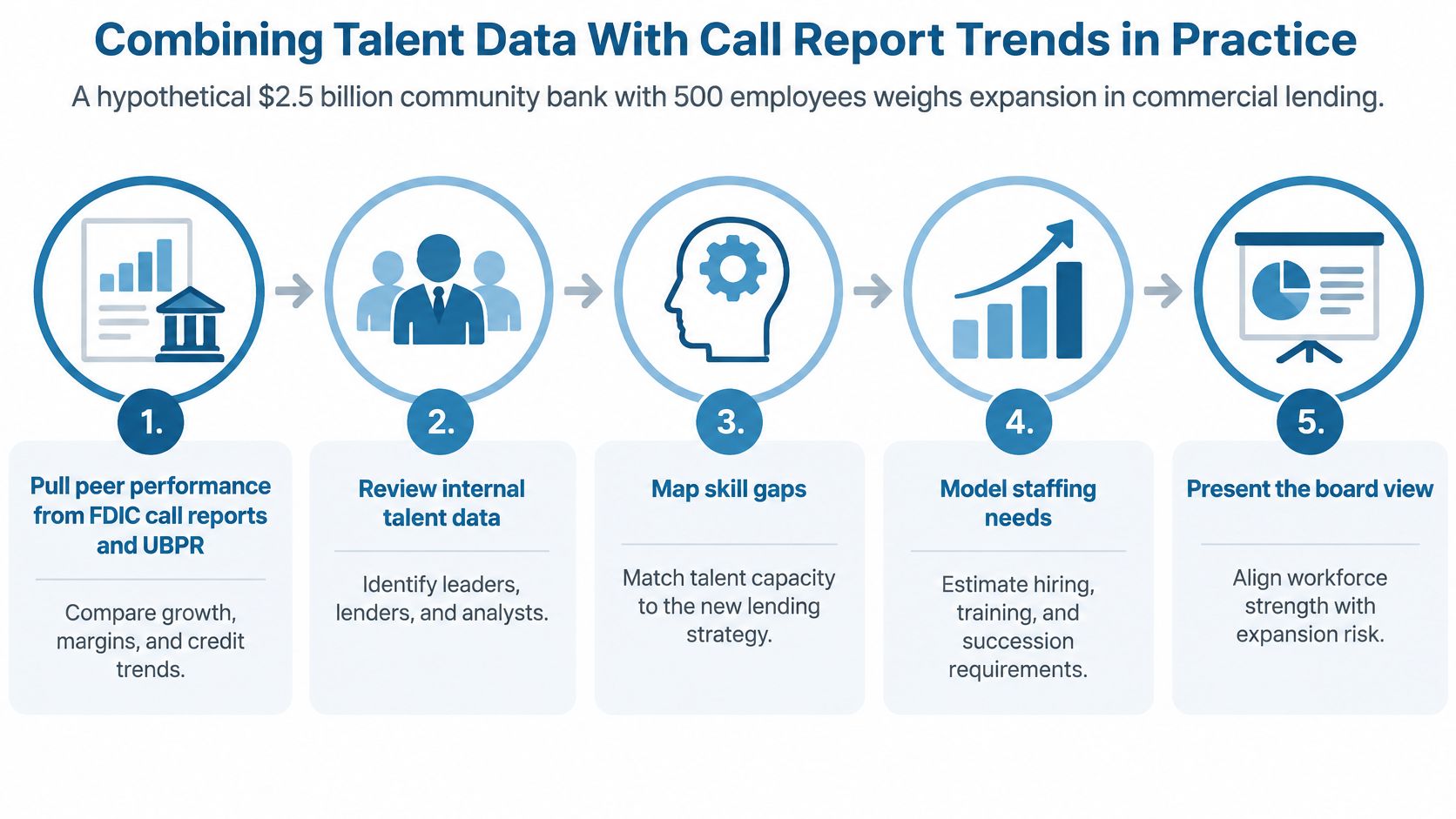
- Pull peer performance: Compare FDIC call report and UBPR ratios against similar institutions. In this scenario, loan growth trails peers by four percentage points while deposit costs rise, so growth capacity and funding discipline both need attention.
- Map who's moving: Use professional graph data to see which competitors recently changed commercial leadership and which relationship managers moved between institutions in your market.
- Overlay the two views: Identify where your lending teams are thin and where a competitor's leadership change or a departure creates an opening with prospects.
- Convert findings into a staffing plan: At 8% attrition, a 500 person workforce needs roughly 40 replacement hires before any growth. Rank which roles to fill first and which prospects to target with those seats.
- Set measurement and go to market: Track portfolio growth, time to fill, and retention at six and twelve months. Turn the prospect list into sales targets by pairing competitor accounts and departing relationship managers with the lending roles you filled first, so sales capacity and lending capacity grow together.
Know What the Data Can't Tell You
Market data shows where talent is moving, not why it moved. A departure can signal a weak manager, a compensation gap, or a personal relocation. Interviews and manager judgment still decide. What data adds is traceability. Explainable outputs and audit trails let directors follow each conclusion back to its source, whether that's a call report line, a peer ratio, or a verified career move.
Replacement demand alone justifies the discipline. The Bureau of Labor Statistics business and financial occupations outlook projects approximately 886,600 annual openings from 2025 through 2035, driven by growth and replacement needs. Your competitors face the same math. The bank that maps talent against financial signals first hires with intent while others react to resignations.
Govern Your Talent Models and Benchmark Your Bank
AI use inside banks is spreading faster than oversight. Deloitte's banking AI governance assessment reports 63% of bank employees use AI weekly, while only 13% of banks reach leading AI-governance maturity and 87% could significantly improve their governance capabilities. When adoption outpaces controls, talent scoring becomes a control issue, not a technology feature.
Directors should require four things. Track AI use by function. Assign an accountable executive for each talent model. Document inputs and outputs so any ranking can be reviewed later. Examine hiring screens for exceptions and bias, using the same discipline you'd apply to machine learning model validation in credit or fraud.
A 90 Day Sequence
Start narrow and prove the method.
- Choose three roles: Use the signal table to pick roles where evidence is already collectible, such as credit analyst, financial analyst, and relationship manager.
- Pull baseline data: Record current time to fill, six month retention, and outcome measures for each role before you change anything.
- Build the rubric: Apply the three level scoring from the applied intelligence framework and score evidence before credentials.
- Benchmark against peers: Compare your results with institutions of similar size competing for the same people in your markets.
A benchmark answers the question directors ask. Where does our talent position stand against the banks and credit unions hiring from the same pool? Our Talent app gives access to 2.6M+ bank and finance professionals across both banks and credit unions, tracks leadership changes, career shifts, and organization structures, and includes AI Outreach for candidate engagement with integration into Salesforce and HubSpot. Benchmark your talent position against peers, or explore the data to see where your next hire or relationship should come from.
Benchmark your bank's talent position against peers competing for the same lenders, analysts, and leaders, using professional data tied directly to call report and market signals. Visit Visbanking to explore the Talent app and see which roles, markets, and prospects deserve your next investment.
Latest Articles
Brian's Banking Blog
Regulatory Rules for U.S. Banks: What Matters in 2026
Brian's Banking Blog
8 Bank Lending Trends Reshaping Credit Strategy in 2026
Brian's Banking Blog
CRM for Credit Unions: A Practical Buyer's Guide
Brian's Banking Blog
Bank Benchmark Rate: How Banks Price and Compare
Brian's Banking Blog
Predictive Risk Analysis for Bank Decisions
Brian's Banking Blog