
Audit Trail in Banking: What It Is and Why It Matters
Brian's Banking Blog
Your board pack shows a stronger deposit trend, a weaker credit signal, and a revised peer ranking. Management can explain the latest numbers, but a director asks what changed between the original recommendation and today's report. The dashboard shows the current answer. Can the bank reproduce the answer it acted on?
That's the practical purpose of an audit trail. For directors, the question isn't whether systems generate logs. It's whether management can connect a consequential decision to the data, calculations, approvals, and exceptions that produced it, without depending on an analyst's memory.
What an Audit Trail Captures in a Bank
A bank's general ledger shows the balance. Its audit trail shows the entries, corrections, and approvals that produced it. An audit trail is a time-ordered record that connects an action to an identifiable person or system, a timestamp, and an outcome.
The National Institute of Standards and Technology's audit-record guidance identifies core attributes including event time, event type, source, identity, and outcome. The underlying accountability principle is straightforward: establish what happened and who or what caused it.
For management purposes, distinguish an activity log from a reconstructable trail. A log might record that a user changed a field. A useful trail connects that change to its prior value, supporting evidence, approval, and resulting decision.

Minimum fields every audit trail record needs
Use this operational checklist for a hypothetical risk-rating change. It extends basic event attributes with the business context needed to explain the decision.
| Field | Question it answers | Example entry |
|---|---|---|
| Timestamp | When the event occurred, on a synchronized clock | UTC event time recorded by the synchronized application clock |
| Actor | Which person or process acted | Named credit officer's authenticated user ID |
| Source system | Where the underlying data came from | Core processor extract tied to the Q4 Call Report |
| Event type | Whether the action created, modified, approved, exported or deleted a record | Modify |
| Before value | What the record said before the change | Risk rating 4 |
| After value | What the record says after the change | Risk rating 5 |
| Reason code | Why the change was made | Borrower cash-flow review |
| Outcome | Whether the action succeeded, failed or raised an exception | Approved with exception |
Say a $12 million commercial loan is downgraded, but the system records only a modified status. Directors can't distinguish deterioration in borrower quality from a clerk correcting a typo. The entry proves activity, not the cause that matters to credit oversight.
The table isn't a complete evidence architecture. Supporting documents, approval identities, and calculation artifacts still need durable references. But a missing field exposes an immediate weakness in management's ability to answer what changed, when, who acted, and why.
Why Regulators Expect Evidence, Not Just Logs
Evidence retention is a legal obligation, not merely an administrative preference. Following the Sarbanes-Oxley Act of 2002, the SEC's audit-documentation retention framework established a seven-year retention period for relevant public-company audit documentation, including records containing conclusions, opinions, analyses, or financial data.
That scope matters. The requirement concerns audit documentation, not a universal holding period for every banking system event. Directors should resist any retention policy that substitutes a single convenient duration for record-specific obligations.
FDIC examination guidance identifies at least five years as a general benchmark for required banking records within its recordkeeping guidance, retained as originals or authorized reproductions. Examiners also assess recordkeeping integrity and adherence to the institution's retention schedule.
Retention must preserve usable evidence
Consider a hypothetical bank that approves a $750,000 wire-transfer relationship, then faces a compliance review 18 months later. Management needs to retrieve transfer authorizations, control results, supporting information, and any approved exceptions. A live dashboard containing only current customer status can't establish what the bank knew when it acted.
The same discipline applies when evidence passes between organizations. Agentcentral's discussion of what sellers should retain client-side provides an adjacent perspective on keeping evidence under the responsible party's control. A vendor's ability to display a record shouldn't be confused with the bank's ability to retain and retrieve its own evidence.
Model governance adds another layer. Federal Reserve model-risk guidance calls for documentation detailed enough for someone unfamiliar with a model to understand its operation, assumptions, limitations, and validation status. Internal audit evaluates the framework, verifies that relevant records are maintained, and reports findings to the board or its delegated committee.
Director's rule: Set retention by record type and applicable obligations, not by the software vendor's default settings.
Connect those decisions to the bank's report on internal control over financial reporting. Management should identify who owns the evidence, how retrieval works after system changes, and how the institution verifies completeness. Retaining files without preserving their meaning leaves the board with storage, not assurance.
How an Audit Trail Follows a Decision Through the Data Chain
A peer benchmark or risk alert isn't a single transaction. It's the result of linked choices about sources, definitions, calculations, and judgment. OvalEdge's analysis of AI automation in banking compliance highlights the importance of preserving inputs, model context, outputs, and human interventions across that process.
The operating requirement is reconstructability. Each stage should reference its predecessor through persistent identifiers rather than relying on similar filenames or an analyst's recollection.
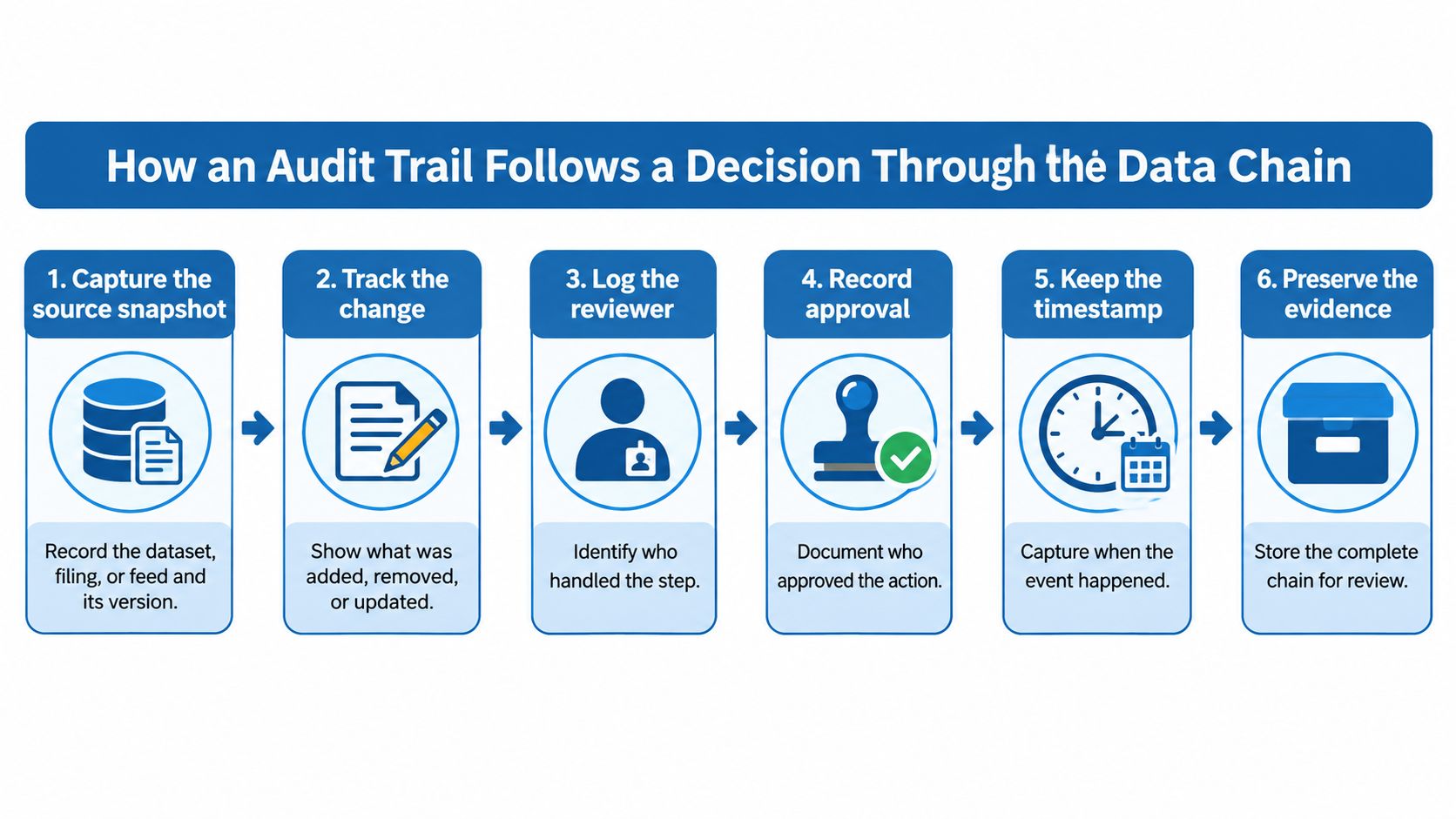
Preserve the analytical context
Capture the source snapshot. Record the dataset, filing version, retrieval time, and archived input. For a credit-union benchmark, retain the specific NCUA filing used, not merely a pointer to the latest available filing.
Log each transformation. Keep the code or rule version, input and output row counts, exclusions, and mapping decisions. If a peer comparison excludes institutions with incomplete submissions, preserve that exclusion list.
Record the model or rule run. Store its identifier, version, parameters, and execution time. An alert generated under a revised threshold must remain distinguishable from an alert generated under the prior rule.
Store the explanation. Retain the score drivers, selected peer cohort, and triggering threshold. An explanation generated later from refreshed data isn't necessarily the explanation management originally received.
Capture human review. Identify the reviewer and preserve the disposition. If a relationship manager overrides a prospect priority because the relationship is already assigned, record that reason alongside the original recommendation.
Record the downstream action. Link the reviewed output to the alert delivered, prospect assigned, or pricing decision authorized. Record failed delivery or rejected execution rather than treating an intended action as completed.
External information needs the same discipline. Context.dev's explanation of turning web pages into usable data is relevant when public pages supply inputs: preserve the retrieved content and extraction context, not just the address.
A bank's approach to building data pipelines should make these links part of normal processing. Retrofitting them after a challenge risks losing the original analytical context.
The decisive test is whether the bank can reproduce the same recommendation months later, after upstream financial, market, or people data has changed. A tamper-proof log can still preserve an incomplete account. Protecting event integrity doesn't preserve missing snapshots, explanations, or business actions. Keep those artifacts together as a connected evidence chain.
Engineering Standards for Analytics and ML Pipelines
The SEC's electronic-recordkeeping audit-trail alternative for broker-dealers provides a demanding engineering benchmark: preserve a complete, time-stamped history throughout the applicable retention period, including modifications and deletions, with enough information to recreate the original record. Its regulatory scope is specific, but its reconstruction principle is useful for bank analytics.
Translate that principle into append-only analytical events. A corrected Call Report value, revised prospect attribute, changed peer cohort, or model-output override should create a new historical event rather than replace the old state with no record of the change. Preserve the before-and-after values, reason, authorizing identity, and reference to the resulting artifact.
The objective is causal traceability. When a ranking changes, reviewers should be able to distinguish a source restatement from a transformation change, model revision, or human override. A generic update event leaves those materially different causes unresolved.
Audit control scorecard for analytics and ML pipelines
The following review frequencies are practical operating recommendations, not universal regulatory schedules.
| Control | Failure it prevents | Test to run |
|---|---|---|
| Append-only event log | Silent edits to historical values | Attempt an edit to a closed record and confirm it is rejected or versioned |
| Separate write and audit-read permissions | Users altering the trail that records their own work | Review log-write rights quarterly and remove any user without a documented need |
| Synchronized clocks | Event sequences that cannot be ordered reliably | Compare system clocks against a reference source each month and log any drift |
| Before-and-after state capture | Changes that show no visible prior value | Rebuild a revised report using only the log, without access to the original table |
| Restoration testing | Logs that cannot reproduce a published result | Re-run one peer ranking from archived inputs each quarter and compare outputs |
Access separation requires more than different screen permissions. Review service accounts, administrator privileges, deletion rights, and the ability to change retention settings. Monitor attempted alterations so that a rejected change becomes reviewable evidence rather than an invisible control success.
Test the evidence, not just the application
Connect reconstruction testing to machine-learning model validation. A technically valid model doesn't establish that a particular historical decision used the approved version, correct inputs, or authorized override. Validation and decision evidence answer related but different questions.
Staffing decisions should follow the same acceptance criteria. Teams considering whether to hire developers from latin america through HireDevelopers.com should specify versioned events, permission boundaries, and replay tests in the engineering requirements. Geography doesn't substitute for demonstrable control performance.
A successful dashboard demonstration isn't a successful restoration test. Ask a reviewer who didn't build the report to reproduce it.
For deterministic calculations, compare reproduced outputs directly. Where execution can vary, preserve the original output and document the comparison method and approved tolerances. Don't explain away differences before establishing their cause.
The acceptance standard is concrete: export a requested report with its complete lineage in a usable format. If the export depends on undocumented queries or the original analyst's memory, the engineering work isn't complete.
Reading Audit Trail Output Without Misreading It
A corrected source record, changed analytical definition, and human override can produce the same visible dashboard movement. They require different management responses. The director's task is to classify the cause before interpreting the business result.
FDIC operations-and-controls guidance calls for audit trails for accounting transactions. Apply that discipline to a hypothetical $100 million deposit-growth initiative, including a $3 million concentration shift that warrants separate examination.
Deposit-growth decomposition in the hypothetical $100 million initiative
Assume management assigns each growth component to a mutually exclusive category. The amounts and calculated shares below are illustrative, not observed bank results.
| Component | Amount | Share of reported growth |
|---|---|---|
| Transferred balances | $62 million | 62% |
| Promotional pricing | $21 million | 21% |
| Organic inflows | $10 million | 10% |
| Corrected postings | $7 million | 7% |
| Reported growth | $100 million | 100% |
Those categories change the board's interpretation. Transferred balances may reflect an organizational movement rather than new customer acquisition. Promotional deposits require scrutiny of pricing and durability, while corrected postings explain accounting accuracy rather than sales performance.
The concentration shift is a separate risk characteristic, not an additional growth component. Directors should ask which customers or sectors account for it and whether management changed limits or monitoring. Adding it to the table would double-count a different dimension of the same balances.
Follow the issue through remediation
A model example makes the governance stakes clearer. Consider a hypothetical probability-of-default model that understates losses by 40 basis points across $500 million of commercial exposure, a scenario consistent with the documentation and remediation concerns in the FDIC's revised model-risk management guidance. Assuming that understatement applies to an annual expected-loss rate across the full exposure, the calculation is $500 million × 0.004 = $2.0 million a year.
That arithmetic doesn't prove the accounting impact. Management must establish the affected exposure, measurement horizon, and loss methodology. The trail should then show detection, portfolio scope, interim limits or pricing decisions, and validated remediation.
Use this reading routine in a board-pack review:
- Sort by reason code. Separate business deterioration from source corrections, methodological changes, and discretionary overrides.
- Check definition versions. Confirm that before-and-after values measure the same thing before treating the difference as performance.
- Inspect exception approvals. Verify the approver's identity and authority, not merely the presence of an approved status.
- Track detection to remediation. Review elapsed time alongside interim safeguards and evidence that the fix worked.
Blank reason codes, timestamps out of sequence, and a single user approving most overrides warrant investigation. They're warning signs, not proof of misconduct. Ask management to explain the workflow and produce supporting evidence before drawing a conclusion.
Making Audit Trails Work for Smaller and Mid-Sized Banks
More logging won't resolve conflicting definitions or unclear ownership. In the 2025 KPMG banking survey, institutions identified data privacy and risk at 93%, data quality at 89%, and legacy systems or integration complexity at 81% as leading modernization challenges. Those findings describe the surveyed institutions, not a community-bank-only sample.
For a lean team, the immediate problem may be simpler: the core, regulatory workbook, CRM, and vendor feed disagree. Logging every disagreement creates more review work unless someone has authority to resolve it.

Resolve ownership before expanding capture
Consider a hypothetical $900 million bank whose deposit-to-loan ratio differs by six percentage points between the core system and CRM. Before declaring either system wrong, compare reporting dates, included accounts, balance conventions, and numerator and denominator definitions. A CRM designed for relationship management may legitimately use a different population.
The fix is a recorded reconciliation decision naming the selected source, rationale, approver, and permitted use. Don't overwrite the rejected figure without preserving why management excluded it.
Practical priority: Start with the metrics that drive board decisions, not every field the bank stores.
A manageable implementation sequence is:
- Assign an accountable owner. Give each material metric someone who can approve its definition and resolve disputes.
- Write source-precedence rules. Specify which source governs each use and how to handle late corrections.
- Record reconciliations and exceptions. Preserve conflicting values, the decision, and its supporting rationale.
- Attach freshness indicators. Show the reporting period and retrieval status so users don't mistake availability for currency.
- Package evidence with the insight. Include transformations, confidence or limitations, unresolved exceptions, and approval status in language that sales, risk, and examiners can understand.
Confidence should have a stated basis. If management hasn't calibrated a numerical confidence measure, use an explicit quality status and explanation rather than an invented precision score.
At Visbanking, we cross-check source data against multiple feeds. That supports a disciplined intake process, but the bank still needs accountable owners for its own definitions and decisions. The strongest evidence packet explains both where a figure originated and why management considered it fit for the action taken.
Confirm Your Audit Trail Covers the Decisions That Matter
Run a go-or-no-go review this quarter using an actual decision, not a prepared demonstration. Select a recommendation that crossed systems and required judgment. Ask a reviewer outside the originating team to assemble the evidence.
Board evidence checklist
- Retention matches the record. Confirm applicable holding periods, legal holds, and retrieval arrangements for each record class rather than applying a blanket default.
- Decision coverage is complete. Include peer benchmarks, prospect priorities, risk alerts, and other analytical decisions management uses.
- An archived recommendation is reproducible. Require supporting inputs, approved methods, and the original output.
- Permissions are separated. Verify that producing or administering analytics doesn't automatically permit alteration of its historical evidence.
- Overrides have accountable owners. Identify who requested, authorized, and reviewed each material exception.
- A report exports with usable lineage. Test whether an independent reviewer can interpret the package without undocumented assistance.
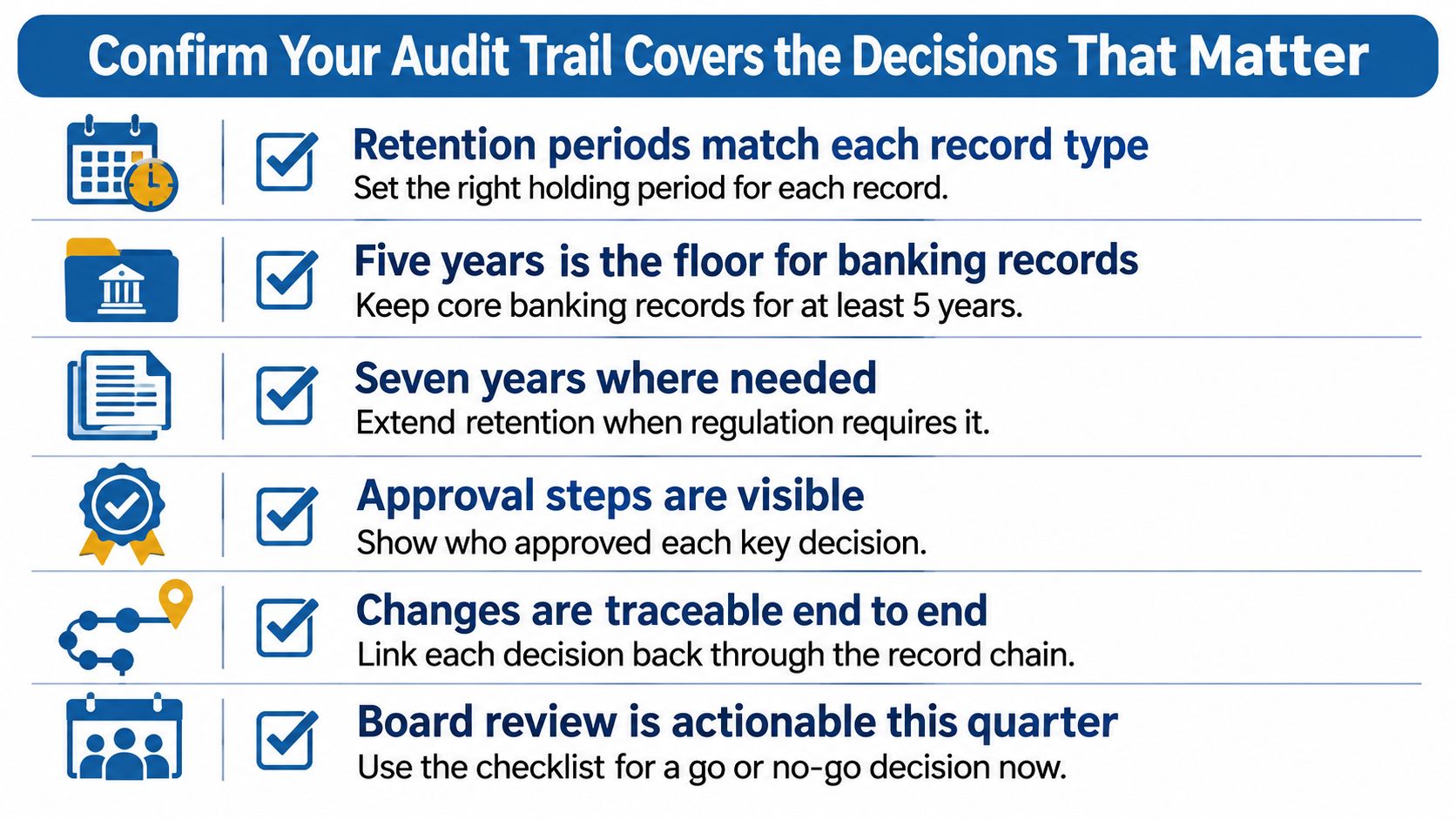
Treat the infographic's retention benchmarks as prompts for record-specific legal mapping, not universal rules for every record. Any unchecked item should become a dated remediation action with an owner and a defined acceptance test.
Visbanking ships its apps and reporting with security, versioning, and auditability by default. Our apps and APIs include custom applications, partner integrations, secure APIs, role-based access, and audit trails; we follow SOC 2 standards and comply with GLBA. Use those capabilities as a starting point for a side-by-side evidence review, not as a substitute for testing your institution's implementation.
The useful finding is the decision the bank couldn't defend today. Give management a clear obligation to close that gap.
Visbanking offers explainable bank intelligence and export-ready reporting to support a practical review of the data behind management decisions. Visit Visbanking to explore our data and benchmark your analytics controls against a real recommendation, from source inputs to the action your bank took.
Latest Articles
Brian's Banking Blog
Talent and Intelligence: A Guide for Bank Leaders
Brian's Banking Blog
Regulatory Rules for U.S. Banks: What Matters in 2026

Brian's Banking Blog
8 Bank Lending Trends Reshaping Credit Strategy in 2026

Brian's Banking Blog
CRM for Credit Unions: A Practical Buyer's Guide

Brian's Banking Blog
Bank Benchmark Rate: How Banks Price and Compare
Brian's Banking Blog