
Automated Alert Triage: Fewer Alerts, Faster Response
Your risk committee packet shows a manageable alert backlog. Your analysts tell a different story: they're clearing routine notifications while consequential signals wait for someone to gather the context. The board's question shouldn't be how many alerts the bank closed. It should be which decisions the bank delayed, what those delays put at risk, and whether anyone can reconstruct the judgment behind each closure.
Why Alert Volume Outpaces Bank Review Capacity
Consider a hypothetical $6.5 billion community bank running five monitoring systems: fraud, BSA/AML, cyber, credit watch, and liquidity. Assume those systems generate 2,800 alerts in a week, while two analysts can investigate 200 at depth. Management closes 1,736 alerts, or 62%, in bulk, leaves 864 waiting, and records a median 3.4 business days before a high-severity signal receives its first human touch.
Those are scenario assumptions, not industry benchmarks. But the management problem is recognizable: the bank has purchased detection capacity without funding an equivalent decision process. Adding another dashboard won't resolve that mismatch.
The backlog is a decision problem
Each monitoring system sees a different slice of the institution. A deposit movement can look routine to operations, concerning to treasury, and commercially important to a relationship manager. Without a common case record, employees repeat lookups, apply different priorities, and contact customers without knowing another team is already investigating.
Directors should require a closure rationale, not just a closed status. Give internal audit and examiners a record showing the evidence reviewed, the decision-maker, the reason for disposition, and any follow-up obligation. An alert log proves that software generated a notification; it doesn't establish that the bank made a defensible decision.
Board test: A smaller backlog is useful only if the bank can explain what happened to the risk and opportunity inside it.
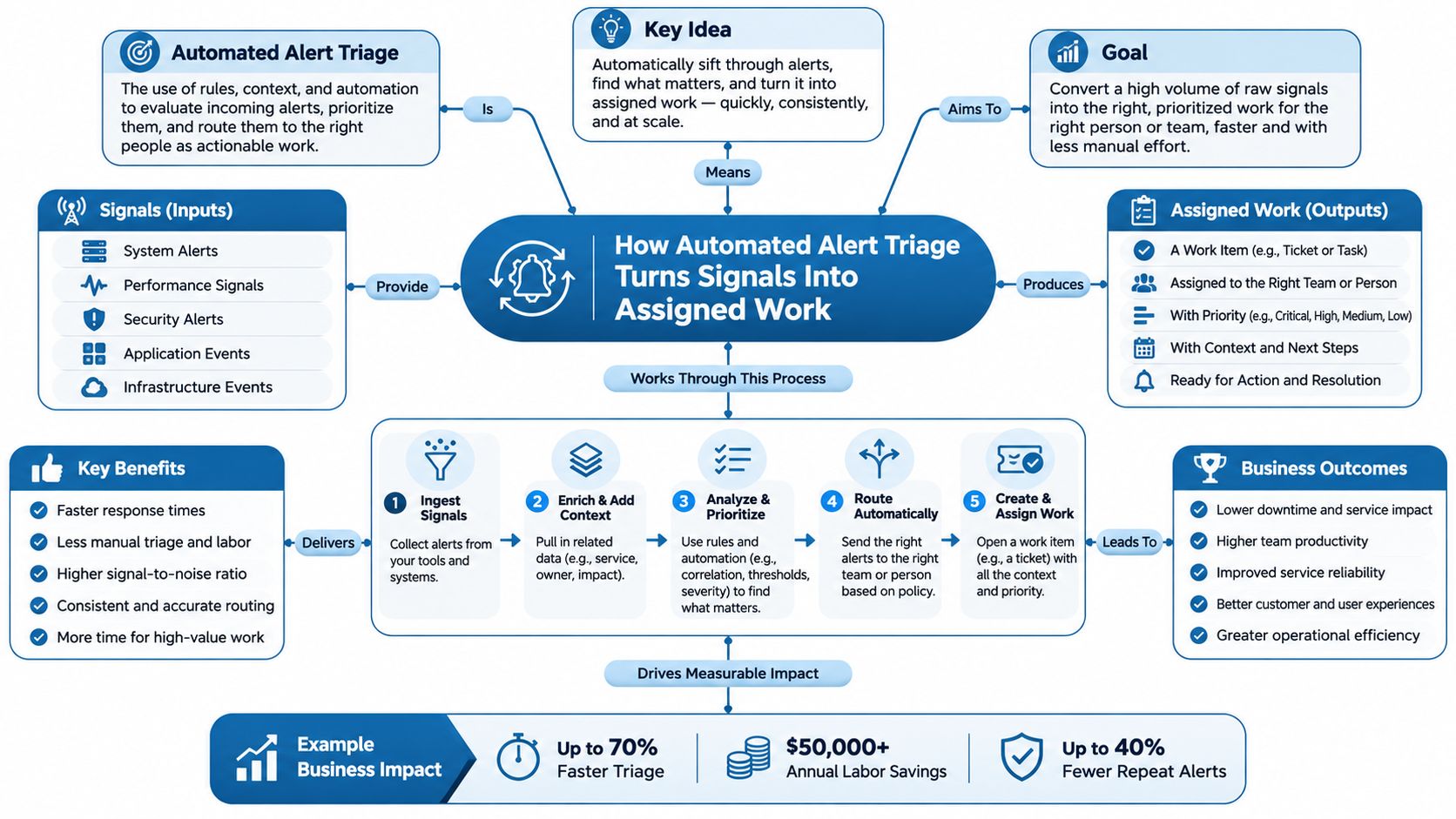
Automated alert triage is a rules-and-model layer that ingests alerts across monitoring systems, attaches institution and relationship context, ranks expected impact and urgency, and routes each case to a named owner with a recommended action and escalation path. That changes monitoring from notification into documented decision-making. Judge the investment through operating benchmarks, a four-tier routing model, a bounded production pilot, failure controls, and a purchase test grounded in your own queue.
How Automated Alert Triage Turns Signals Into Assigned Work
An emergency department's charge nurse doesn't treat patients in arrival order; the nurse reads vital signs, history, and presenting symptoms before assigning acuity and a treatment bay. Bank triage requires the same distinction between arrival time and consequence.
Build the decision packet before assigning work
Normalize and deduplicate. Put fraud, AML, cyber, credit, and liquidity alerts into a common schema with institution identifiers, event timestamps, exposure, and source references. In a hypothetical case, a $30 million deposit withdrawal triggers liquidity, relationship, and market-signal alerts on the same morning. Link those signals to one underlying event without deleting their separate evidence.
Enrich with banking context. Attach asset size, peer group, filing trends, current exposure, relationship history, and outcomes from similar cases. A deposit decline at an institution already under review deserves a different interpretation from a seasonal movement supported by customer history. Record when each contextual field was last refreshed.
Score consequence and urgency. Use calibrated impact multiplied by urgency rather than automatically accepting the originating system's severity label. Keep the underlying components visible: analysts need to know whether a high score reflects exposure, time sensitivity, or uncertain information. Missing evidence should trigger investigation, not lower priority.
Route and escalate. Create a ticket with a named accountable employee, response window, recommended next action, and recorded handoff. Escalate when the window expires, and distinguish acknowledgment from completed investigation. An employee opening a ticket hasn't necessarily contained the problem.
Make workflow part of the control
NIST incident-response guidance recommends filtering large event datasets into a subset suitable for human analysis, estimating impact and scope, validating reports before assigning severity and urgency, and prioritizing according to risk. It also recommends automatically creating and assigning tickets when specified alerts occur. These mechanisms make triage an incident-management control rather than an analyst convenience.
For a cross-industry view of intake and assignment, Vight's explanation of how MSPs prioritize incoming tickets is a useful workflow reference. Banks should adapt that discipline to exposure, regulatory obligations, and customer consequences rather than import a service-desk priority scheme unchanged.
Apply the same design when establishing an early-warning system for banks. Detection logic should specify what evidence the receiving employee needs and what action that employee is authorized to take. Keep triage separate from irreversible response: recommending a review isn't permission to freeze an account or terminate access.
Triage is a decision with an audit trail, not a filter.
The Results Banks Should Expect From Automated Triage
Put the following benchmarks in front of the CFO and CRO at the first vendor meeting. These are security-operations findings, not promised banking outcomes: IBM's security overview reports the investigation, workload, and machine-learning figures summarized below.
Measured outcomes of automated alert triage
| Metric | Reported value | What it means for a bank |
|---|---|---|
| Share of alerts investigated in an unaided queue | 48% | In the reported setting, approximately half received no investigation |
| Legitimate alerts never investigated | 50% | Unreviewed alerts can include consequential signals, not just noise |
| Security leaders reporting rising alert volume | 34% | Test whether workload growth is exceeding available review capacity |
| Tier 1 human triage time after machine-learning triage | Down 70–80% | Screening capacity can shift toward consequential decisions |
| Machine scale of a production triage system | 2 trillion logs per month | Machine processing must precede selective human investigation |
| Analyst decisions used as training data | 1.5 million triaged alerts | Historical analyst judgments can inform model training |
Don't turn those findings into claims they don't establish. Rising volume doesn't, by itself, prove that headcount grew more slowly. Training on analyst decisions doesn't prove that a vendor's model understands your bank's escalation judgment. Require a local evaluation.
Convert time savings into usable capacity
For a hypothetical business case, recovering 600 analyst hours per quarter at a fully loaded $85 per hour produces $51,000 in quarterly capacity. That isn't necessarily a cash saving: unless staffing or external spending changes, management has recovered employee time. Name the work those employees will perform instead, such as investigating complex cases or reviewing previously unattended relationship signals.
Set an explicit pilot hurdle rather than accepting a headline percentage. An illustrative target is to halve Tier 1 review time within two quarters while holding actionable-signal detection above 95%. Treat those as proposed acceptance criteria, not published banking benchmarks, and reject aggregate results that conceal deterioration in a critical alert category.
Include commercial consequences
The scorecard should distinguish operational efficiency from business outcomes:
- Analyst hours recovered. Compare equivalent case types and include time spent correcting automated recommendations.
- Critical-alert coverage. Measure recall against independently adjudicated actionable cases, including sampled closures.
- Time to decision. Track elapsed time to a documented disposition, not merely ticket acknowledgment.
- Missed revenue signals. Count high-value relationship signals closed without action each quarter, then have relationship leaders assess the opportunity. Don't book every ignored signal as lost revenue.
- Customer friction. Count unnecessary contacts per affected customer and record avoidable restrictions or repeated information requests.
Suppressed-alert totals belong in an operating appendix. The investment case belongs in capacity recovered, important signals reviewed, and better customer and commercial decisions. A vendor that can demonstrate only fewer notifications hasn't demonstrated better risk management.
How Alerts Get Ranked and Routed to an Owner
Set priority as expected impact multiplied by urgency. Build expected impact from expected loss, customer harm, regulatory exposure, and relationship value; use urgency to reflect how quickly delay changes the outcome. Keep those inputs separate before combining them so that management can challenge the weighting.
The same unusual activity can indicate fraud, a cross-sell opportunity, a weakening relationship, or legitimate seasonal behavior. An inherited severity label can't resolve those interpretations. The bank needs corroborating evidence and an accountable business owner.
Adopt explicit routing commitments
The following is a proposed operating model, not a regulatory timetable. Its thresholds and response windows are illustrative policy choices for risk-committee approval; they aren't universal materiality standards.
Ranking and routing model for bank alerts
| Tier | Representative signal | Accountable owner | Response window | Escalation path |
|---|---|---|---|---|
| Tier 1 Critical | Hypothetical: $30 million deposit withdrawal paired with a sanctions hit or credential-takeover indicator | Chief Risk Officer with the fraud or information security lead | 1 hour | Chief Executive Officer and board risk committee within 24 hours |
| Tier 2 High | Illustrative trigger: nonperforming assets up more than 2 percentage points in a quarter, or an ALLL coverage flag on a peer institution in the portfolio | Chief Credit Officer | Same business day | CRO review at the weekly credit committee |
| Tier 3 Moderate | Illustrative trigger: deposit outflow of 8% quarter over quarter, or a relationship with declining fee income and rising deposit balances | Relationship manager | 3 business days | Market or regional president |
| Tier 4 Low | Data-quality flag, stale filing, or a threshold signal with no corroborating evidence | Operations or data analyst | Weekly batch | Data governance owner at the monthly review |
A lack of corroboration must not automatically make a potentially critical event low priority. Use the final tier for routine quality exceptions; route incomplete, potentially severe cases for urgent evidence gathering. The owner remains accountable even when another employee performs the investigation.
Apply operating rules that protect coverage
Aggregate related alerts into incidents. A hypothetical event producing eleven notifications shouldn't create eleven unrelated tickets. Preserve the original signals beneath a common case so investigators can reconstruct the sequence without repeating the same work.
Set asymmetric thresholds. Penalize a missed fraud, liquidity, cyber, or compliance signal more heavily than an unnecessary review. This means accepting additional investigation workload where the cost of a miss is materially greater. Let the risk committee approve that trade-off rather than allowing a model developer to embed it implicitly.
Expose the evidence behind the score. Show feature values, comparison periods, source records, and contradictory observations. A relationship manager should be able to distinguish an actual change in institution behavior from a filing correction or mismatched entity identifier.
The TEQ framework evaluation reported 22.9% faster response for actionable incidents, 54% false-positive suppression while retaining a 95.1% detection rate, and 14% fewer alerts investigated per incident on real-world operational alerts. Those findings support evaluating actionability and incident grouping together; they don't validate the illustrative banking thresholds above.
Assign the case to a person, with a designated backup. Routing to a shared team inbox rebuilds the original queue under a different name.
A 90-Day Sequence for Putting Triage in Production
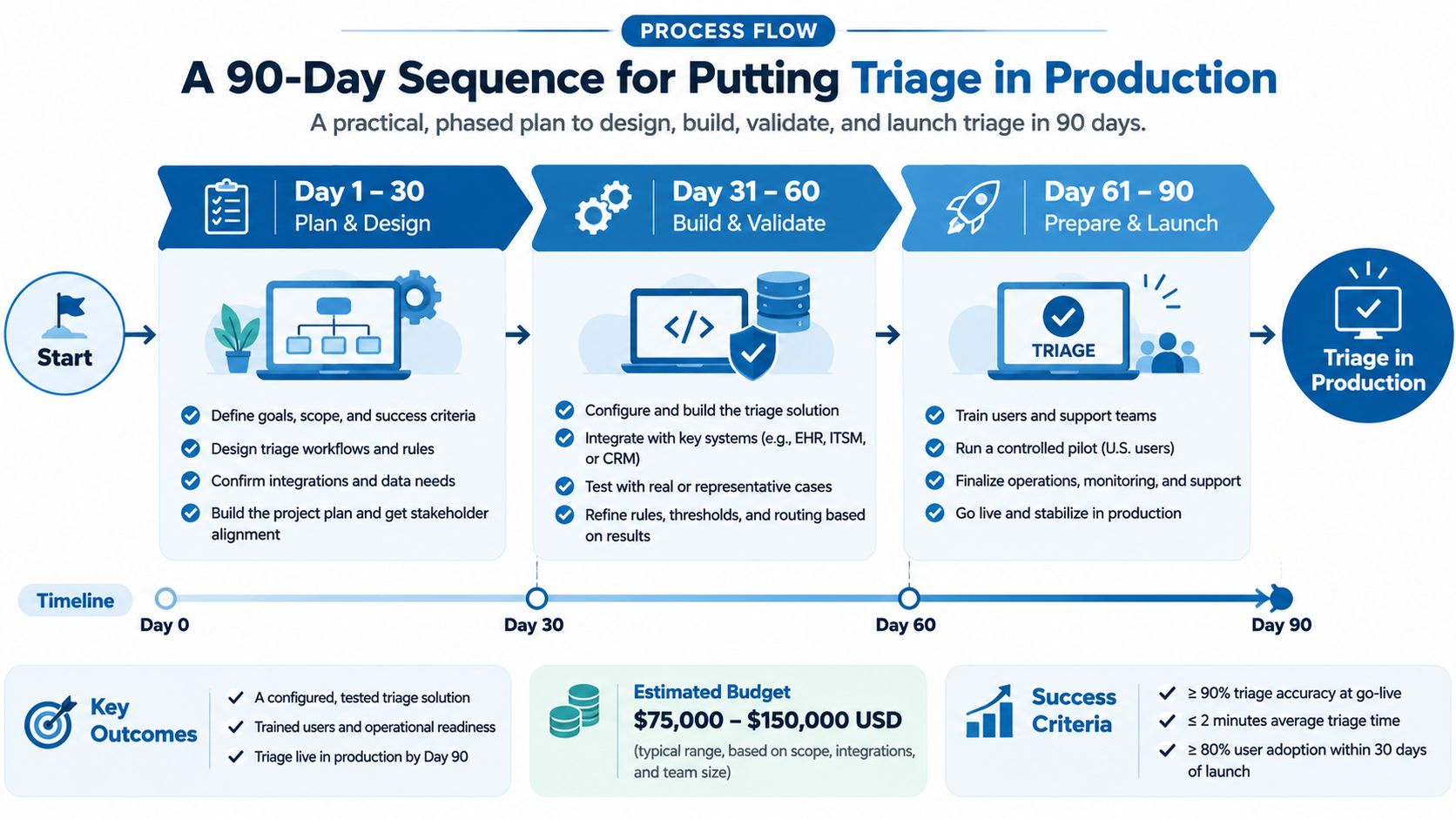
Authorize a 90-day pilot on the noisiest queue, not a bank-wide rollout. Select a source with an accountable business sponsor, accessible historical records, and outcomes that reviewers can adjudicate. Don't begin with a queue whose underlying records the bank can't reconcile.
Before configuration, collect five pre-purchase measures: weekly alerts by source, share investigated, median time to first touch, analyst override rate, and signals missed in the last two incidents or examinations. These are proposed baseline measures, not industry performance claims. Where override history doesn't exist, record that control gap rather than inventing a baseline.
Give each phase an owner and an acceptance artifact
Days 1–15. Baseline the queue. The operations lead should review the preceding 30 days of alerts by source, noise closures, median time to first touch, and recorded overrides, then deliver a one-page queue profile. The failure to prevent is skipping the baseline and leaving management unable to distinguish improvement from a change in alert mix.
Days 16–30. Approve impact tiers. The CRO should obtain risk-committee approval for exposure thresholds and mandatory-review conditions, producing a signed decision matrix. For example, the pilot might require review above a hypothetical $250,000 exposure threshold or whenever an institution is already on the watch list; the mistake is allowing technical staff to determine business materiality without risk ownership.
Days 31–45. Enrich before ranking. The data owner should connect asset size, peer group, filing trends, relationship exposure, and prior outcomes, producing a documented field map with freshness checks. Loading available fields without validating institution identifiers can attach convincing context to the wrong bank.
Days 46–60. Configure accountable routing. Business-line leaders should approve named owners, backups, response windows, and escalation destinations, then test completed handoffs. Retire shared inboxes as the final destination; sending a notification without confirming acceptance doesn't establish ownership.
Days 61–75. Run in shadow mode. The model-risk lead and experienced analysts should compare automated rankings with human decisions, logging every disagreement and its reason. Don't allow the model to execute consequential actions during this phase, and don't treat analyst agreement as ground truth without reviewing difficult cases independently.
Days 76–90. Tune and authorize bounded production. The CRO and technology owner should approve asymmetric thresholds, escalation, audit logging, and a monthly scorecard covering hours recovered, recall, and time to decision. The output is a documented go-live decision with rollback conditions; the mistake is launching because the calendar expired rather than because acceptance criteria were met.
Make the release reversible
Use the workflow design process to document the handoff from signal to action before connecting production notifications. Record who may change thresholds, who approves suppression rules, and who can suspend automated dispositions.
Release condition: Keep the previous review path available until management can demonstrate that the new process meets its coverage and accountability requirements.
A delayed launch is preferable to an untestable control. If case adjudication remains unresolved, extend shadow operation and resolve the disagreement before increasing autonomy.
Where Automated Triage Fails and How to Contain It
Automation can replace a visible backlog with invisible omissions. Contain that risk through evidence retrieval, explicit abstention, and independent review, not through confidence scores alone.
Suppression without coverage occurs when legitimate signals disappear alongside routine noise. Require independent sampling of suppressed cases and a documented process for reopening affected cases when reviewers find an error.
Stale context occurs when enrichment no longer describes the filing, institution, or relationship under review. Attach effective dates and freshness rules, and prevent outdated information from supporting an automatic low-risk disposition.
Require verification, not just classification
Opaque scores encourage analysts to bypass recommendations without documenting why. Require reason-coded overrides and retain the evidence available at decision time, so model-risk reviewers can separate poor ranking from missing information or policy disagreement.
One-pass classification assigns a verdict before retrieving corroborating records. Require the engine to gather relevant evidence, reconcile conflicts, and abstain when the remaining uncertainty could change the response.
The Alert-Bench evaluation replayed 1,247 alerts through a live SIEM across a four-day, multi-stage attack scenario, and every evaluated LLM-based approach missed at least 40.4% of attack-related alerts. That's a bounded experimental finding, not an estimate of banking loss rates. Its production lesson is to test retrieval and verification directly rather than infer reliability from fluent explanations.
Every production decision packet should contain:
- Provenance. Original source, source-system identifier, event timestamp, and retrieval timestamp.
- Scoring evidence. Feature values, comparison periods, missing fields, and material contradictions.
- Corroborating records. Accessible supporting documents and the results of attempted retrievals.
- Disposition history. Recommendation, reviewer decision, override reason, subsequent reassignment, and final action.
Preserve the analyst's authority
Allow the system to abstain and escalate when it encounters unfamiliar patterns, incomplete records, or conflicting sources. Fluidwave's explanation of why Fluidwave blends automation with assistants offers a useful human-in-the-loop workflow perspective; banks must define their own approval boundaries around consequential decisions.
Review missed-signal rates, evidence-retrieval failures, abstention rates, and analyst overrides by alert type monthly as a proposed operating cadence. Preserve those records in an audit trail that supports reconstruction, not merely activity reporting.
Automation should remove repetitive information gathering and routine screening. It doesn't remove the consequential call or management's obligation to prove that an authorized person made it.
Benchmark Your Alert Queue Before You Buy
Measure your queue, then require the vendor to compete against that baseline. Don't buy a reduction in notifications without testing what the bank stops seeing. Use adjudicated cases, include difficult exceptions, and require results by business use case.
European Central Bank supervisory work explains that fraud-detection AI generally produces alerts requiring expert investigation and that human oversight remains especially important for high-risk and real-time decisions. The purchasing objective is therefore a shorter path to a better human decision, not a queue with nobody in it.
Buy business intelligence that supports action
Require each proposed disposition to identify expected loss, customer harm, regulatory exposure, relationship value, and urgency. A fraud concern should reach the appropriate investigator; a credible commercial opportunity should reach the relationship owner. Don't let a compliance-only queue absorb signals that require sales, treasury, or credit judgment.
At Visbanking, our Bank Intelligence app is in beta and sends actionable alerts with email, Slack, and CRM integration. Its Watch Panel shows active Watch signals across growth, allowance, nonperforming, and charge-off portfolios. Use that institution-level intelligence to support an explicit investigation and action process, not as a substitute for the bank's own exposure records or approval authority.
Make the purchase decision conditional on a pilot with defined evidence, coverage, and ownership requirements. Start with the noisiest source and expand only after the responsible executives accept the results.
Visbanking offers guided demos and pilot programs to help you evaluate how bank intelligence supports alert review and action. Visit Visbanking to request a guided pilot, benchmark your queue against peer data, and apply the 90-day sequence to your noisiest alert source first.
Related Articles
Brian's Banking Blog
Importance of Trend Analysis for Bank Leaders
Brian's Banking Blog
8 Sources of Lead for Banks: Prioritize with Data
Brian's Banking Blog
Prospect Review: How Banks Judge Which Prospects to Pursue
Brian's Banking Blog
Data Integration vs ETL for Bank Decisions
Brian's Banking Blog