
What Is Prospect Research? How Banks Use It to Win
In a survey of 406 U.S. and Canadian banking managers and individual contributors, 53% named a shortage of high-quality leads as their biggest barrier. Excessive administration and difficult meeting preparation ranked among the other leading problems.
Prospect research is the structured process of identifying, evaluating, and prioritizing prospects by capacity, need, relationships, decision authority, and prior activity. Research teams routinely check a prospect's professional interests and prior giving or philanthropic ties before deciding whether to pursue it. On many bank sales floors that work still ends as a static list.
A company is findable once it has a name. It is actionable only when the file also carries a reason to call, a person who can decide, and a date that still holds. Those signals need a refresh rule and an owner for the handoff. Without both, a researched profile sits unused. A company name with no trigger is a database row, not an opportunity.
Officers then spend the week rebuilding context that research should already have ranked, so the meeting never gets a slot.
What Prospect Research Means for Bank Executives
A loan officer walking into a credit committee doesn't ask whether the borrower exists. The file answers three harder questions: can this borrower pay, does it need funding now, and can we reach it through someone we already know. Prospect research applies that same test to accounts the bank doesn't have yet.

A contact list and a research function are not the same instrument. A list names companies. Research explains why one of those companies should get a call this quarter and why the other eleven shouldn't.
The 2019 study of prospect researchers and major-donor fundraisers at UK higher-education institutions is a useful baseline because it measures what practitioners do rather than what they say the discipline is. 97% conducted research into professional interests either "all the time" or "quite often," and 89% researched prior giving and philanthropic affiliations. 64% of fundraisers used professional history to gauge gift capacity, and another 64% used philanthropic interests for the same purpose.
The same multidimensional logic applies to a commercial prospect. Wealth screening estimates financial capacity and stops there. Prospect research also weighs willingness, affiliations, past purchasing behavior, and the relationship pathway into the account. A large manufacturer with a strong balance sheet and no reason to change banks isn't an opportunity. A mid-sized distributor with a maturing credit facility and a newly appointed CFO is.
Who runs it. A research analyst assembles the file; a relationship manager or sales lead acts on it. That division keeps the definition honest. The function produces a defensible, dated argument for contact, not a longer list.
Why Prospect Research Matters for Business Development
Outreach capacity is fixed. A relationship manager covers a defined territory, and every hour spent on a poor-fit account is an hour not spent on a live one. The question is never whether to research prospects. The question is who gets the next call.
Fundraising has already run this experiment at scale. The Association of Fundraising Professionals' Fundraising Effectiveness Project estimated that total charitable dollars increased 5.0% in 2025 compared with 2024 while the number of donors declined 3.6%, extending a year-over-year decline that began in 2021. Revenue grew as the addressable base shrank. Growth came from targeting, not volume, and the same arithmetic is now visible in commercial coverage models where territories are wider than the teams covering them.
Research does two jobs, and commercial teams fund only one of them. The first job is identification: surfacing accounts that fit the territory, the product set, and the balance-sheet profile a bank wants. The second job is exclusion: documenting why an apparently attractive name should be passed over this quarter. Practitioners consistently endorse both in principle. In practice, exclusion is where the discipline breaks down, because saying no to a big name feels like lost opportunity even when the evidence says otherwise. Ranking gets the budget. Exclusion gets the shrug.
The cost of that missing second job shows up in the calendar. A relationship manager blocks out an afternoon and spends three hours on an account with no active need and no identifiable decision-maker, then forty minutes on a competitor's client that just drew down a construction loan and hired a CFO from outside the market. Same afternoon, different quarter. Multiply that misallocation across a team of eight, fifty weeks a year, and the territory's coverage math changes completely. No hire fixes it. Only a filter does.
Practical rule: if a prospect carries no documented business reason to talk this quarter, the correct output of research is a no, delivered early.
Banking managers describe the same problem from the other side. Too few qualified leads, too much administration, and meeting preparation that eats the hours meant for meetings. That pattern points to a research design failure rather than a work-ethic failure. More effort applied to an unfiltered pipeline produces more unfiltered activity.
Two habits correct it. Treat research as a workflow that ends in a timed action plan with an owner, an offer, and a contact date, rather than a file of names. A file of names is an input. An action plan is an output, and only the output changes what happens on Monday morning. Second, keep the exclusion discipline: a ranked list with no rejections is a list that hasn't been ranked, because ranking without rejection just reorders the same calls.
The public sector offers a working model of this discipline. FederalPipeline's guide to federal opportunity research shows how buying signals get assembled and scored before a single outreach attempt, with eligibility and timing gates that disqualify poor-fit opportunities early. The commercial equivalent, a review of where bank lead sources originate and how they feed the qualification process, is worth reading alongside it. Teams that study both tend to converge on the same conclusion: the quality of a pipeline is set before anyone picks up the phone, in the rigor of what gets kept out.
Five Signals That Make a Prospect Worth Pursuing
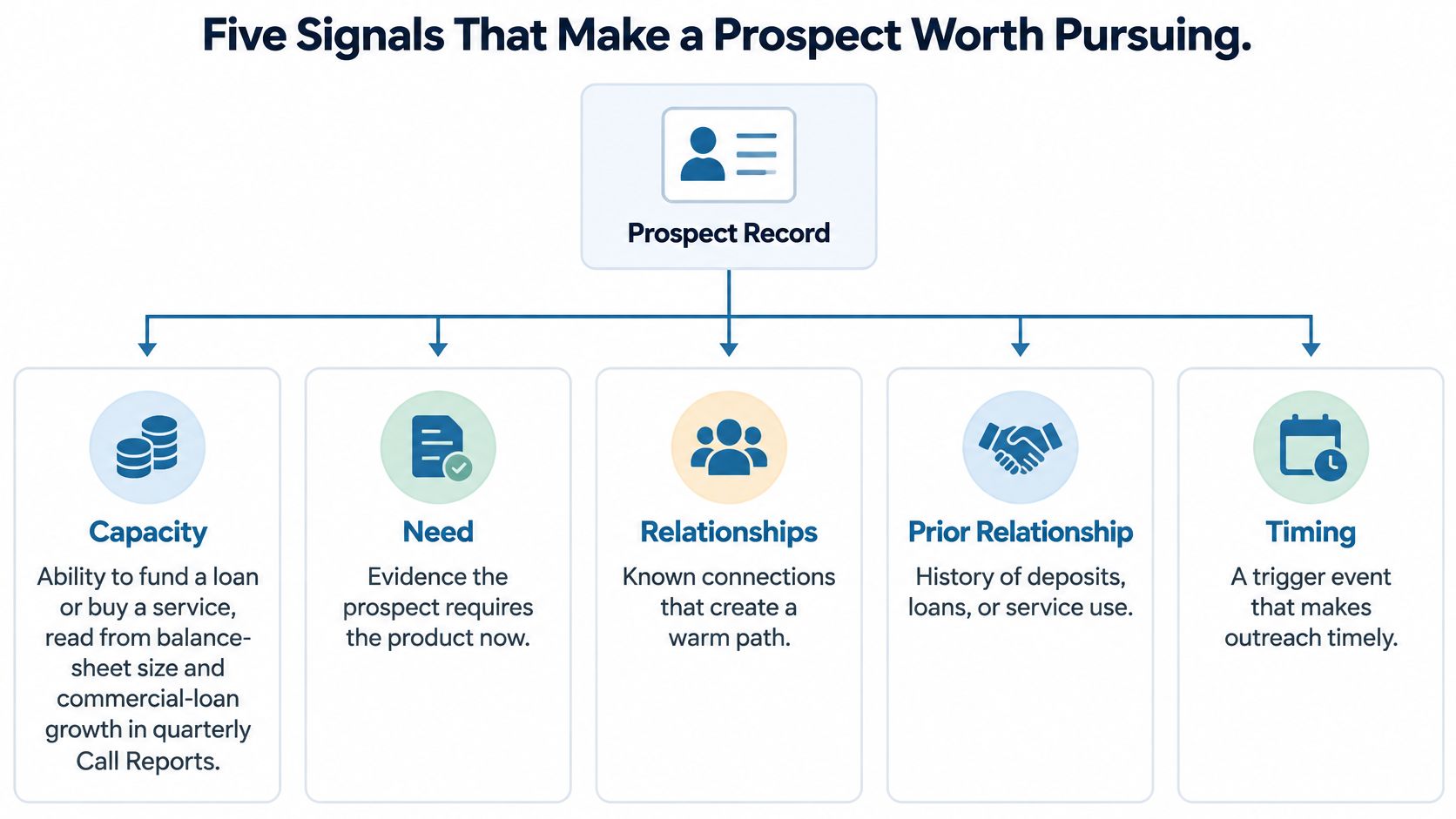
A prospect is worth a call only when five signals carry current evidence. Findable is not the same as actionable this quarter. Each signal has a record behind it, and each has a failure mode that should stop the pursuit.
| Signal | What it reveals | Banking evidence |
|---|---|---|
| Capacity | Ability to fund or buy | Balance-sheet size and commercial-loan growth from quarterly Call Reports |
| Need | Business reason to engage now | Weakening net interest margin or liquidity ratios |
| Relationships | Existing connections and products | Where the prospect banks and which products it uses |
| Decision authority | Who can say yes | Executive and management changes at the target institution |
| Prior activity | Track record of borrowing or buying | SBA 7(a) and 504 approvals, and HMDA application outcomes |
The five signals form one qualification view, refreshed as new filings arrive, rather than five separate checks.
Capacity is the easiest to read and the easiest to misread. Every national bank, state member bank, insured state nonmember bank, and savings association files a Consolidated Report of Condition and Income, the Call Report, at the close of business on the last day of each calendar quarter. Balance-sheet size and commercial-loan growth then compare across institutions on the same date, with no private estimate required. One quarter of growth proves very little. Require two or more consecutive periods before calling it a trend.
Need is the signal that drops names out of a static list. A weakening net interest margin or a thinning liquidity ratio, taken from the same filings as capacity, is a fact-based reason to discuss funding, risk management, or technology now. A ratio that looks weak on its own may be a deliberate strategy. Check the peer group before building a pitch on it.
Relationships show where the prospect already banks and which products it holds. A shared director, a vendor tie, or an existing treasury services relationship changes the opening line. An existing relationship inside your own bank counts only if the CRM has recorded it. Otherwise the person making the call cannot use it.
Decision authority is the signal teams skip. A profile that names a controller when the treasurer signs wastes the quarter. Management changes are the tell. A newly appointed CFO or chief credit officer typically re-examines inherited bank and vendor relationships within the first year. That window is when the prospect is actionable, not merely listed.
Prior activity is the track record: SBA 7(a) and 504 approvals, mortgage application outcomes, and past borrowing. A bank with heavy small-business lending and no SBA history is a different conversation from one running a mature 504 practice.
Minimum bar: no prospect enters a pipeline without at least one documented signal for capacity, need, and decision authority.
That bar is the governance rule. A prospect strong on three signals and weak on the fourth should be approached through the strongest existing relationship, not cold. Re-score when the next Call Report lands or a leadership change appears. The output is a prioritized pipeline, not a sorted database of names.
Public Data Sources and What Each Reveals About a Bank
The value of public data isn't volume. It's comparability. Four sources do most of the work in bank-focused prospect research, and each answers a different question.
| Source | Update timing | What it shows | Prospect use |
|---|---|---|---|
| Call Report | Quarterly, at each calendar quarter close | Condition, income and risk profile of each institution | Screen balance-sheet and profitability trends |
| UBPR | Usually within one day of the Call Report; peer averages about 30 days later | Ratios compared with peer-group averages | Compare loan growth against liquidity and capital |
| HMDA | Annual filings; CFPB national datasets updated weekly | Mortgage applications, originations and denials | Separate origination volume from application conversion |
| SBA lender reports | Lender reports issued as downloadable spreadsheets or CSV files | 7(a), 504 and Microloan approvals by state, lender and segment | Compare product mix and origination capacity |
The UBPR Benchmarks a Bank Against Its Peers
The FFIEC's Uniform Bank Performance Report is designed for supervisory, examination, and management use, and it shows how management decisions and economic conditions affect a bank's performance and balance-sheet composition. Its data supports evaluation of earnings, liquidity, capital, asset and liability management, and growth management. The detail that makes it a prospecting tool rather than a compliance artifact is the summary ratios, which include a peer-group-average column.
Timing matters as much as content. UBPRs are generally published within one day of the underlying Call Report filing, while peer-group averages typically become available about 30 days after the Call Report date, once enough filings are processed. A team that checks manually once a quarter sees the picture weeks after a team that monitors automatically.
Take a $2.5 billion bank whose loan growth outruns its peer average while liquidity or capital trends lag the group. That pattern says the institution is growing faster than its funding base. Outreach that opens with balance-sheet optimization or funding capacity lands differently than a generic treasury pitch, because it starts from the bank's own reported numbers.
HMDA Separates Volume From Conversion
HMDA is the most extensive publicly available source of information on the U.S. mortgage market, and many financial institutions must collect, report, and publicly disclose mortgage-loan information through it. The CFPB's HMDA data shows whether applications were originated, denied, withdrawn, or otherwise resolved, with modified loan-level records for individual institutions and dynamic national datasets updated weekly for reporters.
The signal isn't the raw count. A lender originating 1,200 mortgages a year and a lender receiving 2,000 applications but converting only 45% have materially different business-development profiles. The second has a process problem, which is a conversation about underwriting turnaround, workflow, or technology. The first has a demand problem, which is a different conversation entirely. Combining institution-level HMDA activity with market, branch, and peer data shows where a bank is gaining share, losing applications, or hitting an operational bottleneck.
SBA Reports Show Product Mix, Not Just Volume
The SBA's lender reporting summarizes 7(a) and 504 loan approvals by state, lender, and market segment in downloadable spreadsheet or CSV formats. Because SBA lending splits into three principal programs (7(a), CDC/504, and Microloan), the data lets you distinguish a bank's participation by product instead of treating all small-business lending as one category.
Two banks in the same state can look identical in aggregate and opposite in mix. One may lead in 7(a) approvals with limited 504 activity, which points to origination capacity or referral partnerships. The other may sit in a different borrower segment altogether. Those differences set the opening question, and they're invisible on a list built from deposits alone.
Where the Sources Combine
No single source justifies a call. A Call Report trend tells you a bank's commercial loan book is growing while margin compresses. A UBPR peer comparison tells you whether that compression is unusual for an institution of its size and model. An HMDA conversion rate tells you whether the lending engine is converting the demand it generates. SBA product mix tells you where the institution places small-business risk.
Stack all four and you have an argument: this institution, this business reason, this decision-maker, this quarter. Visbanking provides U.S. banking data and analytics that put regulatory filings, peer benchmarks, and public lending records on the same footing, and lien activity from UCC filings adds another layer by showing which lenders already finance a prospect's equipment and receivables.
Sequencing rule: confirm the trend in the filing, confirm it's unusual against the peer group, then confirm it's current before it reaches a call plan.
How the Prospect Research Workflow Runs, Step by Step
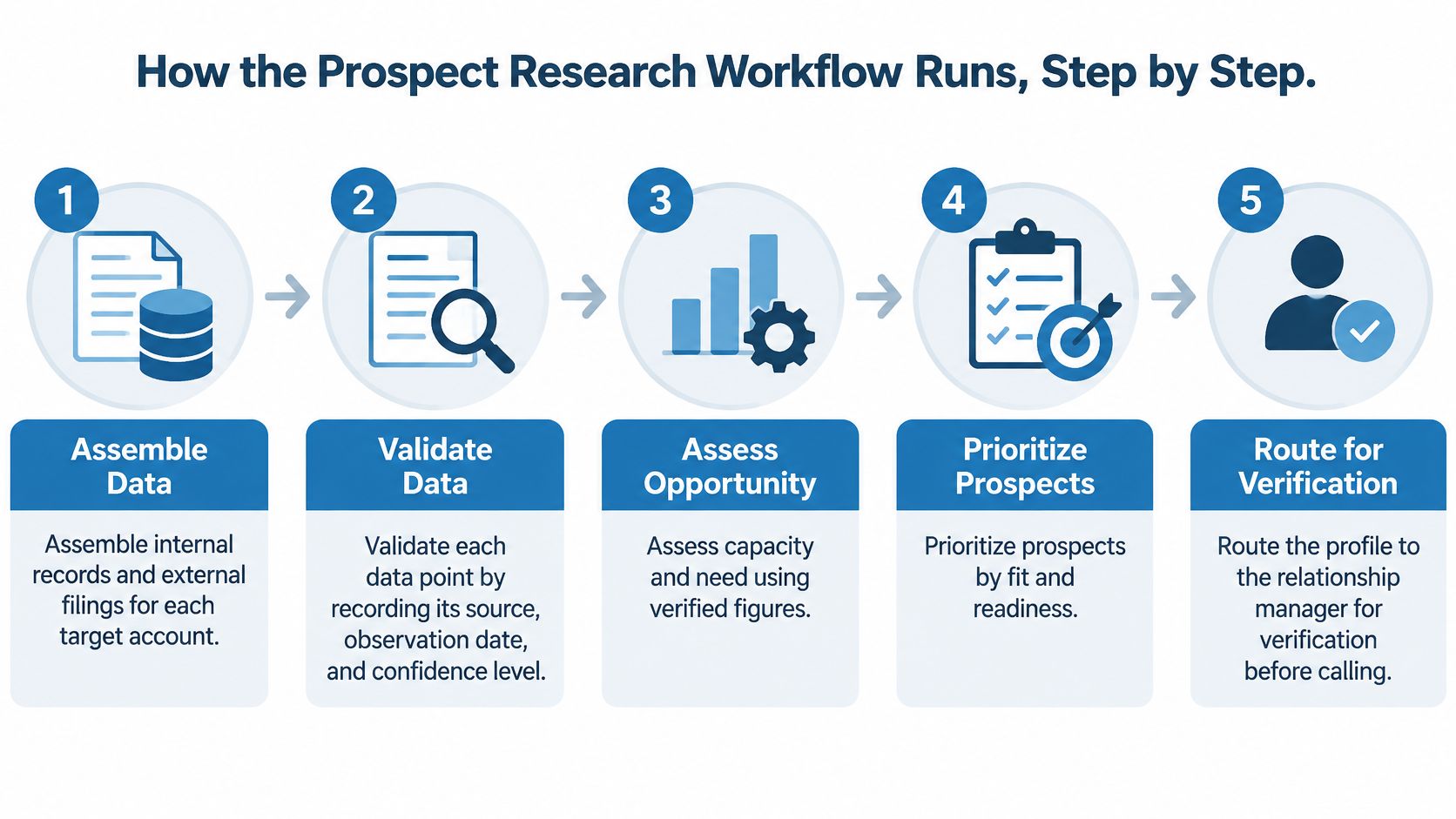
A call plan is only as strong as the weakest step behind it. Six steps turn scattered records into that plan, the order matters more than the tooling, and each step has a predictable way to go wrong.
- Assemble internal records and external filings. Pull CRM history, deposit and loan relationships, and the public filings for each target account into one place. A profile built only from public data misses the relationship your own bank already has, which is usually the shortest path in.
- Validate every data point. Record the source, the observation date, and a confidence level for each input. This is the step teams skip, and skipping it is why scores rest on stale or unverified figures that nobody can defend in a pipeline review. A filing observed eighteen months ago describes a different institution than the one you would call this quarter.
- Assess capacity and need against the five signals. Score what the evidence supports and leave the rest blank. A blank is information; a guess is a liability.
- Map relationships and decision-makers. Mark existing ties separately from whitespace, and route both to the right owner. Warm referrals die when they sit in someone's inbox instead of the CRM, so treat how to find decision makers as a data discipline rather than a networking skill.
- Score, rank, and write down the reason. Every rank needs a sentence explaining it. A ranking without written reasons can't be challenged, which means it can't be corrected, improved, or defended when a relationship manager disagrees with it. The written reason is also what makes the workflow repeatable: next quarter's analyst can audit this quarter's logic instead of starting from zero.
- Translate the ranking into a timed action plan. Name an owner, an offer, and a contact date. Without that, the file closes and reopens next quarter with the same unanswered question.
The workflow is a loop, not a line. Step six feeds step one, because every contact attempt, every response, and every outcome goes back into the internal record and changes what the next validation pass confirms. A bank that runs this sequence once has a list. A bank that runs it continuously, with each step's output governed by the step before it, has a signal system that reprioritizes itself as filings, leadership changes, and lien activity accumulate.
A prospect should be contacted only when the plan names a specific business reason, the decision-maker, and a date.
That standard is what separates actionable from merely findable. Hundreds of institutions are findable in any given quarter. The ones worth a call are the ones where all six steps converge on the same answer.
Limits, Privacy Rules and Common Misconceptions
Three assumptions about prospect research cause most of the trouble in a bank.

A high score is not a decision. A ranking is a hypothesis that a relationship manager verifies before calling. The moment a score becomes an authorization, the team stops checking and starts dialing.
More data is not better. European guidance warns that organizations may collect more personal data than necessary because it could be useful later. The European Data Protection Board's guidance on AI and technology states that profiling for marketing requires a lawful basis, transparency, fairness, accountability, and the ability for individuals to oppose profiling. Collect what supports the business rationale, and stop there.
Explainability is not optional once AI ranks companies or people. An unexplainable ranking produces two failures at once: relationship managers ignore it, and compliance can't defend it. The controls that fix this are operational, not philosophical:
- Separate company signals from personal attributes. Growth, filings, and management changes are fair game. Sensitive personal characteristics that could produce discriminatory outcomes belong outside the scoring model.
- Record source and confidence for every input. If you can't say where a number came from or when it was observed, you can't use it in a prioritization decision.
- Require human review of every top-ranked prospect. The reviewer's name belongs in the record.
- Restrict access by role. Organizations often collect more personal data than the person making the call needs.
- Document the business rationale for outreach. One sentence per prospect is enough, and it settles most arguments later.
Timing is the last limit. A Call Report reflects a past quarter, so a fresh signal should be verified before it drives a conversation. That's a habit, not a barrier.
Turn Prospect Research Into Your Next Bank Decision
Start with five accounts already in your territory and score each one against the five signals. For every score, cite the evidence: the Call Report quarter, the UBPR peer comparison, the HMDA conversion rate, or the SBA product mix. Mark each missing data point as a gap instead of filling it with an assumption.
Give the exercise thirty days, then review the output. A useful result is a ranked list where every entry carries a source date and a business reason, and where the top prospects have a named decision-maker. That review also tells you which signals deserve the most weight in your market, which is territory-specific knowledge no vendor can hand you.
The Prospect app identifies prospects by size, location, and bank relationships, shows where they bank and which products they use, and gives direct access to key contacts at target businesses, with data updated constantly. Guided demos and pilot programs let a team test the approach against its own territory before committing.
Visbanking combines Call Report, UBPR peer benchmarks, HMDA, SBA, and people data into one view, so your team can see which prospects show the strongest combined signals and act on them the same week. Benchmark your own institution against its peers, then run the five-account exercise against real data instead of a static list. Visit Visbanking to explore the platform and request a demo for your territory.
Related Articles
Brian's Banking Blog
Data Unification Platform: What Banks Should Know
Brian's Banking Blog
7 Bank Marketing Products to Evaluate in 2026
Brian's Banking Blog
Automated Alert Triage: Fewer Alerts, Faster Response
Brian's Banking Blog
Importance of Trend Analysis for Bank Leaders
Brian's Banking Blog