
7 Bank Marketing Products to Evaluate in 2026
A community bank with $1.5 billion in assets and 18 branches spends $240,000 a year on marketing. Its checking activation rate sits near 30%, deposit campaigns run without a reliable attribution model, and compliance sign-off on creative takes three weeks. Budget size isn't the main constraint here. The problem is a fragmented stack that separates customer data, campaign execution, and balance-sheet measurement.
Across the industry, customer acquisition still commands the largest share of marketing dollars. According to the American Bankers Association's bank marketers survey reported by eMarketer, 32% of bank marketing budgets in 2025 went directly to new-customer acquisition. Yet too many executive teams evaluate bank marketing products in isolation, comparing software feature grids without tying each tool to a concrete balance-sheet decision. Whether your board is focused on choosing a bank marketing partner or rebuilding an internal stack, the right purchase starts with the bottleneck you need to fix. Below are seven platforms worth evaluating in 2026, mapped to the exact executive decisions they support, the data questions to verify before signing, and how to judge returns against peers.
1. Visbanking
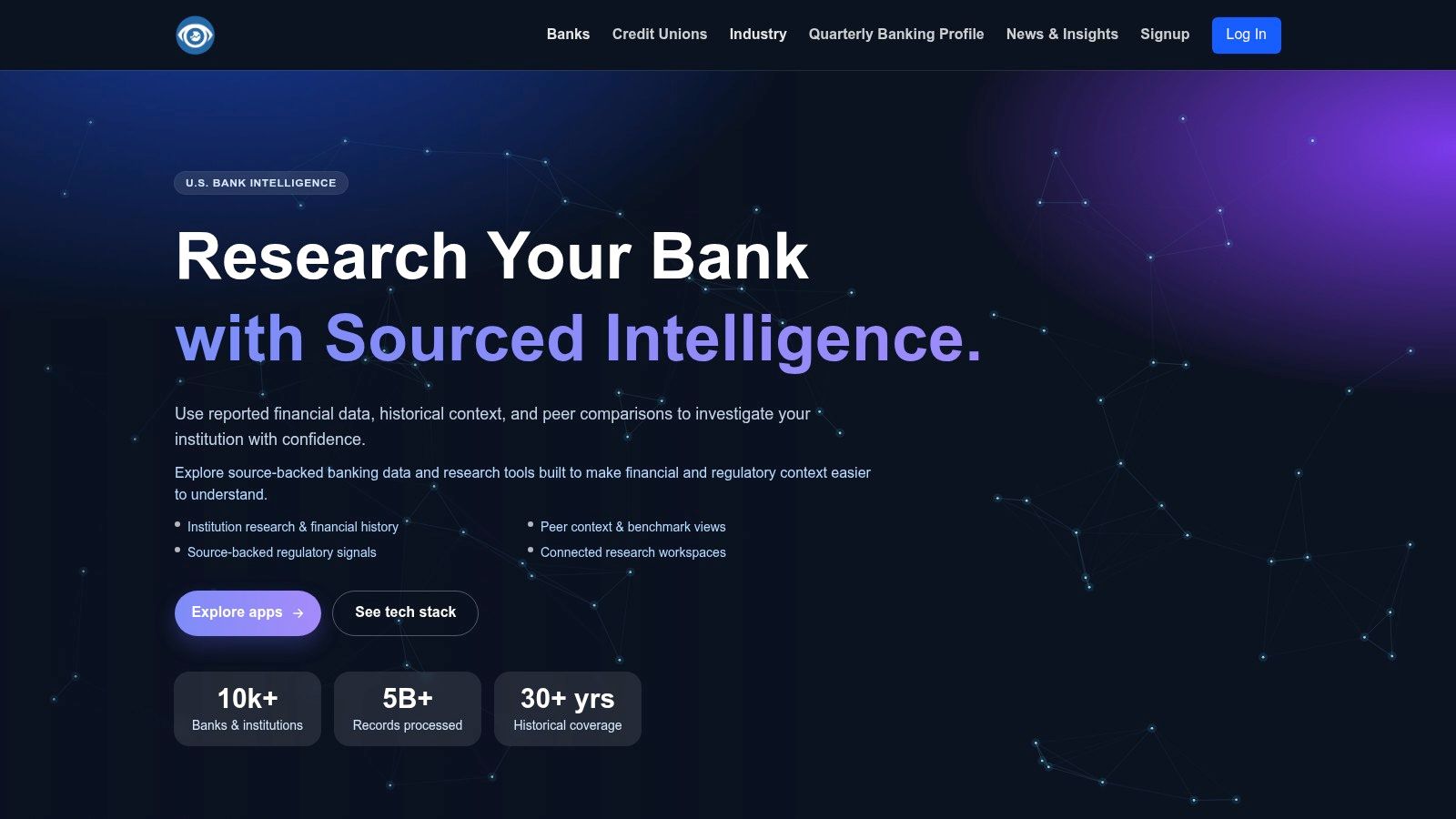
Visbanking earns its place before campaign execution, when executives decide which markets, products, and peer gaps justify investment. Its Bank Intelligence and Action System (BIAS) brings external financial, regulatory, market, and people intelligence into those decisions. The platform combines FDIC Call Reports, FFIEC and UBPR filings, NCUA 5300 data, SBA 7(a), 504, and PPP records, multi-state UCC filings, SEC and EDGAR disclosures, HMDA records, and BLS and BEA macro indicators into decision-ready analytics.
The executive question is specific: does a deposit campaign address a funding need, or generate activity? Compare peer loan growth, deposit trends, and funding composition before setting acquisition targets. Internal engagement metrics cannot establish that competitive context. For mortgage-market analysis, the FFIEC national aggregate reports provide a broader lending reference, rather than a measure of bank-wide deposit funding.
Modular Apps Built for Bank Decisions
Visbanking serves 10,000+ banks and institutions and offers 30+ years of historical coverage. BIAS organizes that intelligence into workflow-ready modules, with connections to CRM, HR, and PowerBI tools. Choose the module against a defined decision, rather than buying analytics without an owner.
- Bank Performance: Supports benchmarking and historical trend analysis across 4,600+ institutions. Compare deposits, asset quality, capital, and quarterly call report trends, using location and asset-size peers to frame realistic targets. Fit: validating growth ambitions against comparable banks.
- Prospect: Reveals commercial relationships, products, and decision-makers to focus business-development outreach. Give relationship managers a clearer account context before they approach a prospect. Fit: directing commercial acquisition toward relevant relationships.
- Talent: Uses a 2.6M+ professional graph and AI-assisted outreach to support recruiting. Its place in the growth discussion is staffing market expansion, rather than managing campaigns. Fit: hiring relationship managers to support expansion.
- Bank Intelligence (Beta): Surfaces predictive risk and performance signals with automated alerts through email, Slack, and CRM. Keep its beta status explicit in purchasing discussions. Fit: teams evaluating alerts alongside established reporting.
Mortgage teams can apply the same peer discipline to local lending. The Consumer Financial Protection Bureau's 2024 HMDA release covered approximately 4,898 reporting financial institutions, providing application and origination data for market comparisons. If a regional lender attracts applications but trails comparable peers in originations, use those patterns to identify where further investigation belongs. Review pricing, product structure, and follow-up before increasing paid-lead spending. HMDA and call report comparisons frame the investigation; internal application data is needed to diagnose the conversion problem.
Trade-Offs and Executive Fit Verdict
Visbanking offers custom applications, secure APIs, role-based access, and audit trails. These capabilities support controlled access and review; they do not replace the bank's compliance process. Use the Sales contact for pricing, demos, and enterprise questions. Guided demos, pilot programs, and live training sessions help teams assess workflow requirements before committing.
Executive checkpoint: Ask which peer group supports the growth target, which data feeds inform the decision, and who will act on the findings. Require a demonstration of how those findings reach existing CRM workflows.
Fit verdict: Visbanking fits banks that need external intelligence to set growth priorities and validate performance. Buy it to strengthen targeting and executive decisions, with a clear owner for translating analysis into action.
2. Connect by Main Street (Main Street Inc.)
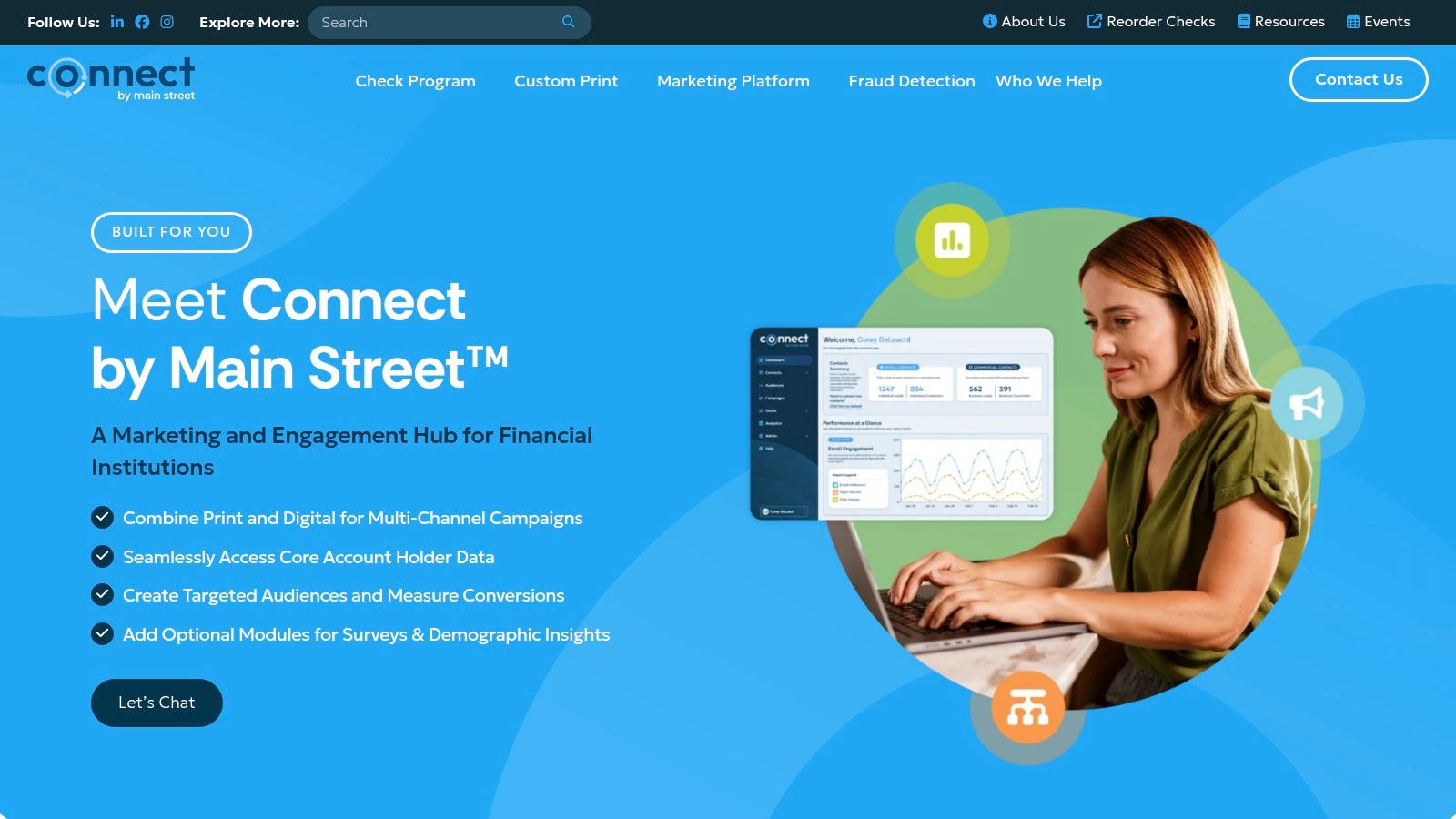
Say a community bank launches a money market promotion, only to realize 40% of its older checking households have no valid email address on file. Digital-only automation leaves those depositors untouched while direct-mail vendors operate on disconnected spreadsheets. Connect by Main Street targets that exact gap by linking core banking data directly to coordinated email and physical direct-mail execution.
Bank marketing technology has moved firmly past early experimentation. An American Bankers Association survey covered by ABA Banking Journal found that 72.6% of surveyed U.S. banks now use at least one marketing-technology tool, nearly 45% run marketing-automation platforms (up from 35% the prior year), and 52% regularly analyze customer data for sales or service opportunities. Owning software is no longer an advantage. Operational integration between the core system and outbound channels is what turns dormant account records into funded balances.
What to Verify Before Signing
Main Street Inc. structures the platform around community bank and credit union workflows, bundling implementation, unlimited users, campaigns, contacts, and creative support into its plans according to vendor documentation. That all-inclusive approach appeals to small marketing teams that don't have in-house HTML coders or direct-mail print brokers.
- Core-Data Mapping Scope: Connecting core fields cleanly requires IT involvement up front, so ask your core administrator to audit field availability and refresh frequency before committing to launch timelines.
- Automatic Print Fallback: Verify how the platform triggers printed postcards when an email address is missing or bounces, and confirm unit print and postage costs separately from software fees.
- Attribution Reporting: Test whether campaign reporting tracks actual account openings and deposit balance lifts rather than stopping at email opens and postcard delivery dates.
Pricing is quote-based and isn't listed publicly, which means finance leaders should compare total annual cost (platform fee plus mail volume) against incremental deposit acquisition costs.
Fit verdict: Connect by Main Street is a practical choice for community banks and credit unions with older or mixed-channel depositor bases that need automated digital and print journeys without expanding headcount.
3. Marquis Marketing Products
More than 60% of digital banking customers believe AI will significantly change how they work with their financial institution within five years, according to a Temenos and Celent global banking release. That rising expectation creates an immediate frontline risk. When marketing sends a targeted loan or treasury offer and a branch banker or relationship manager has no idea the customer received it, trust evaporates on the first phone call.
Marquis Marketing Products addresses that disconnect by unifying customer data, CRM, digital communications, click tracking, and frontline visibility under one bank-focused vendor. Marquis reports more than 35 years of industry experience serving banks and credit unions, and its suite is built for institutions trying to consolidate separate point tools.

Suite Depth Versus Implementation Weight
The core appeal rests on how the modules talk to each other. The Marketing Data Platform pulls records from multiple internal systems to build unified customer profiles and trend views, while the built-in CRM manages relationship activity. Click tracking monitors transactions, events, and customer behavior, and CommLink lets frontline staff see the exact emails and letters sent through Marquis systems.
Frontline visibility isn't a nice-to-have feature. If a relationship manager can't see yesterday's outbound offer during today's client call, automation works against your brand.
That breadth brings real operational trade-offs. Deploying a multi-module suite demands far heavier discovery, data cleansing, and staff training than rolling out a standalone email or social tool. Public pricing isn't available, and buyers must verify in writing which integrations, data feeds, and modules are included in the base contract versus billed as add-ons. Executives structuring integrated marketing and campaign management programs should also confirm how Marquis exports conversion outcomes back to executive reporting dashboards.
Fit verdict: Marquis fits mid-sized community banks and credit unions that want one vendor connecting customer data, CRM, and branch visibility, provided leadership commits the project management discipline a full-suite rollout requires.
4. Strum Platform
Personalization in banking suffers from a wide credibility gap. Research from Celent and Temenos on U.S. banking consumers found that roughly 70% of consumers want personalized financial advice, yet only 42% say they receive it. Meanwhile, 53% expect financial providers to use data they already hold to tailor experiences, even as privacy and trust remain firm boundaries. Generic rate blasts fail both groups: they ignore existing relationship context while irritating customers who expect relevant guidance.
Strum Platform is built to close that gap by pairing a financial-institution customer data platform (CDP) with multichannel marketing automation. Its Strum Voice product handles personalized outreach across email, direct mail, and SMS, pulling from unified account data to run segmented onboarding and cross-sell journeys.
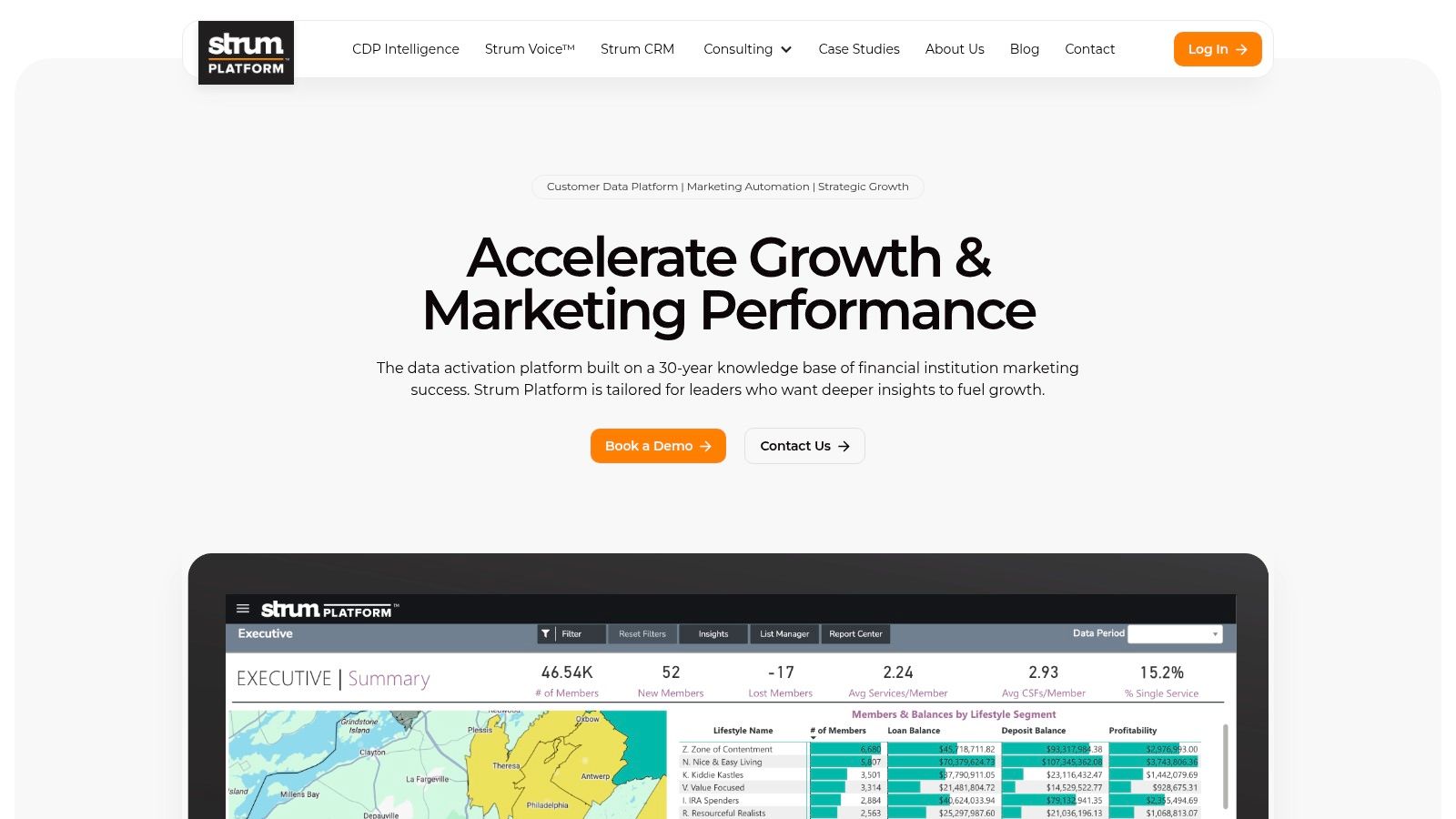
- Unified Account Segmentation: Consolidates core and account-level signals so teams can build segments around deposit shifts, product holdings, and household depth rather than basic demographics.
- Multichannel Execution: Coordinates email, SMS, and direct mail inside automated lifecycle journeys, reducing manual list pulls between departments.
- Conversion Analytics: Measures campaign performance beyond click rates by tying outreach back to product adoption and conversion metrics.
Diligence Questions Before Buying
Vendor-published customer examples highlight deposit growth and marketing-system cost savings, yet executives should treat any vendor-reported case study as directional rather than guaranteed. Pricing and packaging aren't published online, so demand a line-item breakdown of core integration fees, data-source connectors, and ongoing segmentation setup. Just as important, verify how Strum enforces consent rules, suppression logic, and reason codes. Personalization only builds loyalty when compliance officers and bankers can trace exactly why a depositor received a specific offer.
Fit verdict: Strum Platform is a strong contender for growth-oriented banks and credit unions ready to replace fragmented lists with a dedicated financial CDP and multichannel automation, assuming IT validates core-connector effort up front.
5. Digital Onboarding
Digital adoption hasn't automatically fixed digital sales. A McKinsey digital banking report found that active digital banking usage across emerging and developed markets climbed from 54% in 2017 to 88% in 2021, while digital touchpoints rose from 41% to 72%. Yet only about 20% to 30% of surveyed consumers said they had purchased a banking product through a mobile app or online channel. Opening an account is only step one; turning a newly opened checking account into a primary, funded relationship is where most banks leak profitability.
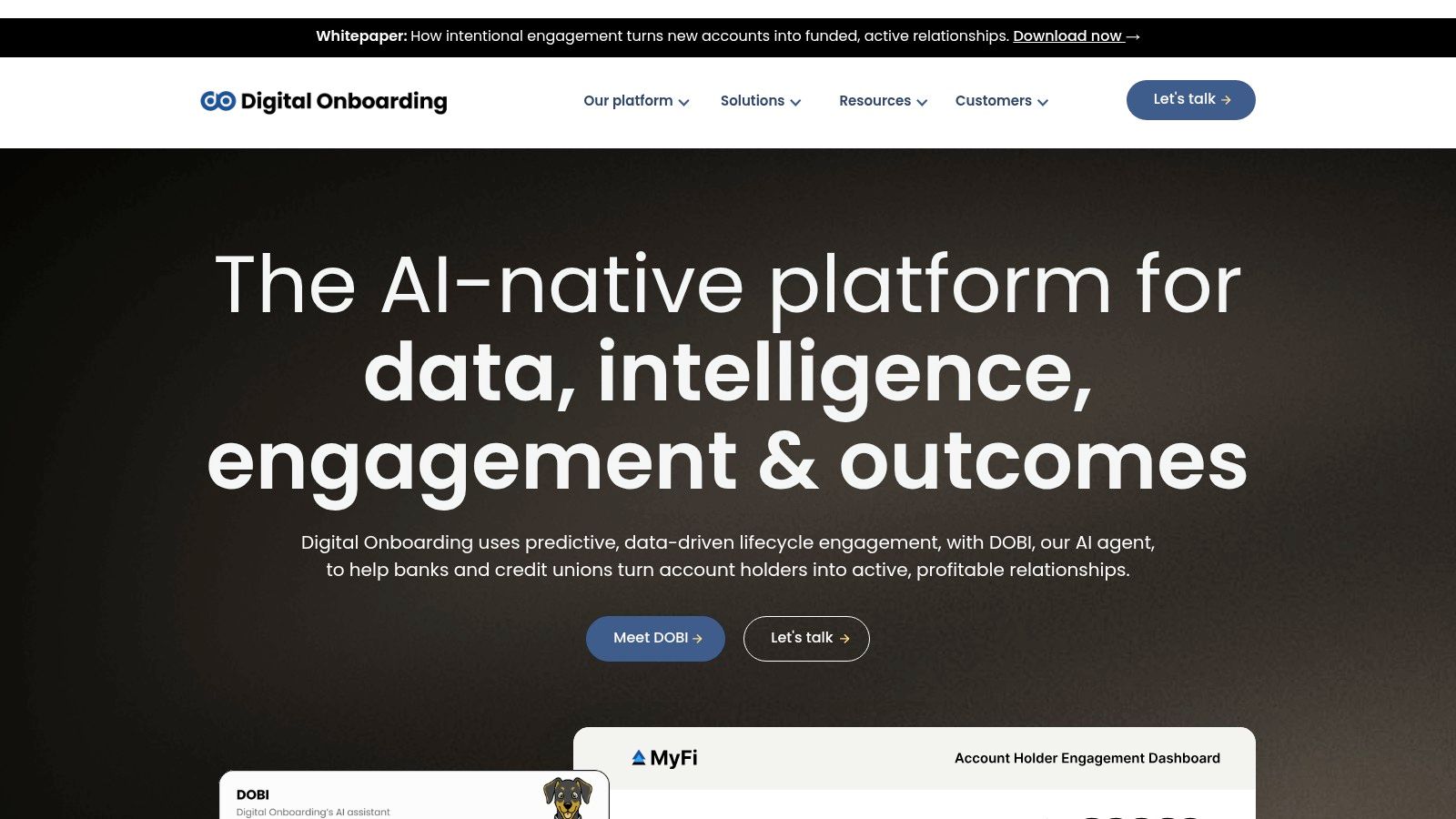
Digital Onboarding zeroes in on that post-opening conversion gap. Instead of sending static welcome emails that point customers to generic web pages, the platform delivers personalized emails and texts linked to branded microsites. Each microsite walks an account holder step by step through high-value actions like switching direct deposit, enrolling in online banking, activating a debit card, or adding a second product.
Where Focus Beats Breadth
The same McKinsey analysis noted that top-performing institutions doubled cross-selling rates through mobile apps and online banking between 2015 and 2019 when they designed structured journeys. Digital Onboarding gives lean teams a direct path to apply customer onboarding best practices without building custom web portals from scratch.
- Prebuilt Financial Templates: Accelerates launch for checking activation, digital conversion, cross-sell, and account-dormancy prevention campaigns.
- Flexible Data Ingestion: Supports automated targeting through API, SFTP, or CSV imports, letting banks start quickly even if real-time core APIs aren't ready yet.
- Action-Level Measurement: Tracks completed customer behaviors and product adoption rather than stopping at vanity open rates.
Don't confuse an onboarding accelerator with a full marketing stack. Digital Onboarding solves account activation and early engagement, not enterprise CRM or commercial prospecting.
Because pricing isn't publicly listed and campaign capacity varies by package, confirm annual contact tiers and service-level support before signing. If your checking activation rate sits near 30%, fixing the first 90 days often generates faster return than increasing paid acquisition spend.
Fit verdict: Digital Onboarding is the sharpest single-purpose tool on this list for banks losing money on unfunded, inactive new accounts that need measurable post-opening activation.
6. Social Assurance (Marketing Management)
Many bank executives talk about AI-driven marketing, yet operational readiness lags far behind ambition. An American Bankers Association survey reported by ABA Banking Journal on AI readiness showed that only 17% of surveyed banks were using AI-powered marketing tools, with 23% planning to start within 12 months, even though 44% expected marketing technology, analytics, and AI to significantly improve effectiveness. The holdup is rarely enthusiasm. It's governance: regulated banks can't accelerate outbound publishing until review queues, audit logs, and archiving hold up under examination.
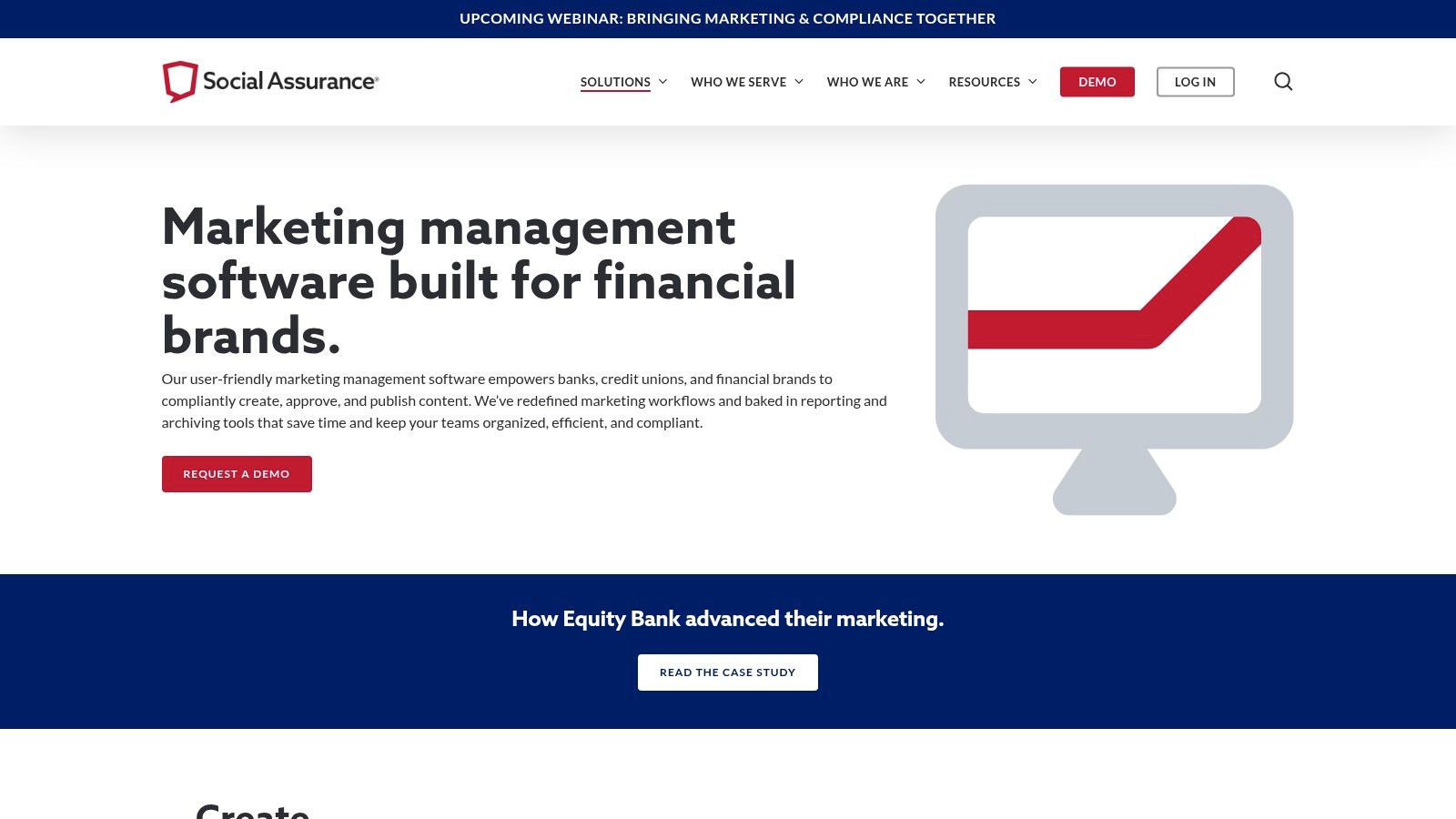
Social Assurance tackles that exact operational bottleneck. Rather than competing as a customer data platform or CRM, its marketing management software focuses on creating, approving, publishing, and archiving content across social and traditional channels for financial brands.
Built for Distributed Compliance Control
When marketing approvals take three weeks because drafts bounce across email chains and shared drives, rate promotions miss seasonal windows, and branch leaders post unapproved updates anyway. Social Assurance puts every step inside one auditable workflow designed for banks and credit unions.
- Structured Approvals and Archiving: Logs edits, compliance sign-offs, and published versions automatically so examiners can review historical campaigns without manual reconstruction.
- Unified Content Calendar: Coordinates social posts alongside traditional marketing materials across regional branches and local lenders.
- Financial-Brand Library and Preapproved Responses: Equips distributed teams with compliant templates and pre-vetted social replies, cutting legal bottlenecks without loosening brand standards.
Be clear on what you're buying. Social Assurance isn't a CRM, a core-integrated CDP, or a deposit-attribution engine. Pricing isn't published online, and compliance officers should verify during demos that the platform's retention schedules, export formats, and role permissions match internal audit policies word for word.
Fit verdict: Social Assurance belongs in the stack of multi-branch banks and credit unions where slow compliance reviews and scattered social management are delaying campaigns and creating exam exposure.
7. Kasasa
Sometimes marketing software isn't the missing piece. If your flagship checking account looks identical to every regional bank down the street, better email automation only amplifies an undifferentiated offer. Kasasa takes a product-and-marketing model built specifically for community banks and credit unions, pairing rewards-based retail accounts with ongoing go-to-market strategy and consulting support.
Instead of licensing a pure SaaS tool, participating institutions roll out structured rewards checking and savings accounts (plus optional borrower-focused and digital-banking offerings) backed by Kasasa's marketing specialists. Banks can deploy Kasasa's consumer-facing brand or wrap the same account mechanics under their own institutional brand.
Stress-Testing the Unit Economics
Before signing a packaged growth contract, the CFO and head of retail banking should model the balance sheet, not just the creative deck. Say a community bank targets meaningful growth in new retail checking and savings balances through a rewards account structure. Management needs to compare total all-in funding cost (reward payouts, program fees, and marketing spend) against wholesale borrowing rates, brokered CDs, and expected debit interchange revenue. Running that comparison alongside disciplined deposit growth strategies keeps deposit campaigns aligned with net interest margin targets.
- Product Differentiation: Rewards-based accounts give marketing a concrete consumer hook when competing against megabanks and digital-only challengers.
- Embedded Strategic Support: Vendor-provided marketing consultants help community institutions that lack senior product-marketing staff execute launches consistently.
- Commercial Trade-Offs: Because Kasasa blends product design with marketing services, it won't fit banks that want standalone campaign software for existing accounts, and public pricing isn't listed.
"Treat packaged retail deposit programs as an asset-liability decision first and a marketing purchase second."
Validate contract length, brand-ownership terms, and qualification rules (such as debit transaction minimums) against your local customer demographics before committing.
Fit verdict: Kasasa fits community banks and credit unions that need a differentiated retail deposit product and turnkey go-to-market muscle rather than another internal software license.
How the seven bank marketing products compare on focus, pricing transparency, and best fit
| Item | Primary Focus | Public Pricing | Best For |
|---|---|---|---|
| Visbanking | Banking intelligence, benchmarking, prospecting, and talent research | Not publicly listed | Banks and credit unions seeking data-driven research and workflows |
| Connect by Main Street, Main Street Inc. | Bank and credit union marketing campaigns across email and direct mail | Quote-based; not publicly listed | Community institutions coordinating multichannel marketing |
| Marquis Marketing Products | Customer data, CRM, digital communications, and frontline visibility | Not publicly listed | Institutions seeking a broad, integrated marketing suite |
| Strum Platform | Financial-institution data platform and marketing automation | Not publicly listed | Banks and credit unions activating customer data for targeted campaigns |
| Digital Onboarding | Account onboarding, activation, cross-selling, and engagement | Not publicly listed | Institutions focused on product adoption and account-holder actions |
| Social Assurance, Marketing Management | Marketing content planning, approvals, publishing, and archiving | Not publicly listed | Financial brands coordinating distributed content workflows |
| Kasasa | Branded banking products with marketing and consulting support | Not publicly listed | Community institutions seeking differentiated products and go-to-market support |
Turning Product Choice Into a Measurable Growth Decision
No single product solves every bank marketing problem. Buying a broad suite before naming your constraint usually produces shelfware, frustrated IT teams, and another annual renewal the board questions. Start with the exact decision your executive committee needs to improve over the next four quarters, then shortlist the two or three tools engineered for that bottleneck.
- If market blind spots drive weak targeting: Start with peer benchmarking and external financial intelligence so deposit, mortgage, and commercial campaigns focus on winnable markets.
- If new accounts stay unfunded: Pair core data with focused onboarding workflows to lift checking activation before raising acquisition budgets.
- If compliance bottlenecks delay launches: Standardize approval queues and digital archiving first so marketing can hit seasonal demand windows.
- If frontline bankers miss campaign context: Unify CRM visibility with outbound communications so relationship managers act on timely, explainable triggers.
Benchmark Before You Negotiate
Before you invite vendors into a procurement cycle, establish your baseline against peers of similar asset size and geographic footprint. Say your bank carries $1.5 billion in assets and spends $240,000 annually on marketing, yet your core insured deposit growth lags regional peers while noninterest expense sits above median. Knowing that gap in advance changes every vendor conversation: instead of buying generic promises, you set concrete pilot metrics around cost per funded account, activation lift, and relationship-manager follow-up speed.
We built Visbanking to give bank executives that exact vantage point, combining peer benchmarking, 30+ years of historical trend analysis, and explainable signals that tie marketing execution directly to balance-sheet outcomes. Our Sales team handles pricing, custom enterprise questions, guided demos, and pilot programs, while our Support team backs live deployments via email, phone, and video calls. When your leadership team evaluates bank marketing products against real peer performance, software stops acting like a cost center and starts functioning as a measurable growth engine.
Visbanking equips bank executives, marketers, and relationship managers with our Bank Intelligence and Action System, uniting regulatory filings, market benchmarks, and commercial prospecting signals so every campaign targets measurable balance-sheet growth. Explore peer performance, benchmark your institution, and request a guided demo or pilot program at Visbanking.
Related Articles
Brian's Banking Blog
Automated Alert Triage: Fewer Alerts, Faster Response
Brian's Banking Blog
Importance of Trend Analysis for Bank Leaders
Brian's Banking Blog
8 Sources of Lead for Banks: Prioritize with Data

Brian's Banking Blog
Prospect Review: How Banks Judge Which Prospects to Pursue
Brian's Banking Blog