
Data Unification Platform: What Banks Should Know
The usual advice on choosing a data unification platform starts with connectors: connect more systems, consolidate more records, build better dashboards. Bank directors should start elsewhere. Can management defend the resulting number, including its definition, reporting period, source records, and revisions, when an auditor or board member challenges it?
A platform that can retrieve a figure but can't explain it hasn't solved the bank's decision problem. Before committing budget, executives should evaluate the evidence behind the output, not just the breadth of the inputs.
What a Data Unification Platform Does
Most banks don't have a shortage of records. Consider a bank whose core system, Call Report, CRM, and market file describe the same lending business differently. Finance counts outstanding balances, a relationship manager includes commitments, and the board receives an unexplained comparison between them.
A data unification platform pulls records from multiple sources, maps them to shared definitions and identifiers, and produces a consistent view that users can query, benchmark, and explain. Think of a treasurer converting balances into a common unit of account. Unification performs a similar conversion for data meaning, not just currency.
Storage isn't agreement
Copying those records into a warehouse doesn't settle which loan definition belongs in the board pack. The bank still needs matching rules, a common model, and a documented way to resolve conflicts. The NIST history of scientific-data standards explains how consistent recording formats, data dictionaries, and interoperability standards developed to support reliable exchange across systems.
The finance example of tracking landed costs with Zaro offers a useful parallel: a decision-useful total requires agreement on its components, not merely access to separate records.
Budget test: Require a common definition for each intended use, traceable source records, and a result management can reproduce at the next review.
Approve unification for that capability, not for storage consolidation alone.
Which Bank Data Sources to Unify
Core bank data sources and what each one answers
| Source | What It Covers | Typical Bank Use |
|---|---|---|
| FDIC Call Reports | Quarterly balance sheet, income and capital data for insured banks | Peer benchmarking and trend analysis |
| FFIEC and UBPR | Standardized bank performance ratios with peer-group averages | Board performance review and peer gap analysis |
| NCUA 5300 | Quarterly call report data for federally insured credit unions | Credit union peer comparison and competitive tracking |
| SBA 7(a) and 504 | Small-business loan program activity by lender and area | Small-business prospecting and share analysis |
| UCC filings (multi-state) | Secured lending and collateral filings across states | Borrower relationship and credit signals |
| SEC and EDGAR | Public company filings and disclosures | Holding company and investor context |
| BLS and BEA macro series | Employment, income and output by region | Local market conditions behind loan demand |
| HMDA | Mortgage application and origination records | Mortgage market share and lending pattern analysis |
Regulatory filings provide the financial backbone. At Visbanking, we pull data directly from regulatory filings, including FDIC, NCUA, and FFIEC filings.
But coverage isn't comparability. Quarterly Call Reports, annually published HMDA records, and state-specific UCC filings represent different reporting cycles and populations. Align periods and institutional scope before calculating a market opportunity.
For a practical discussion of fragmented inputs, SourceX insights on scattered data provides useful context. A relationship manager might combine SBA lending activity, internal CRM relationships, and county employment trends to prioritize outreach.
Decide which business question each feed answers before connecting it.
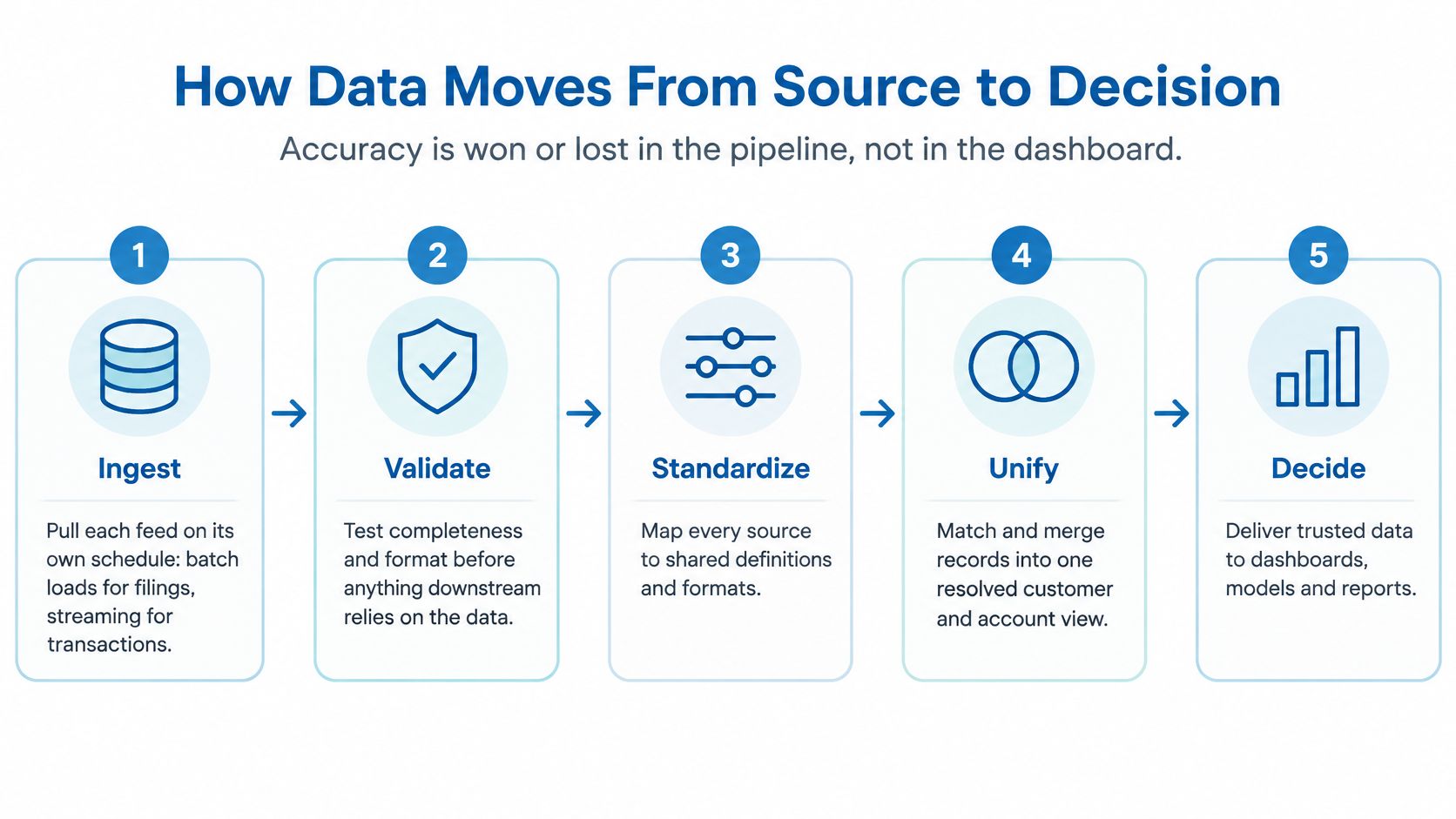
How Data Moves From Source to Decision
Accuracy is won or lost in the pipeline, not in the dashboard. A visually polished report can still compare different consolidation scopes, carry an uncertain entity match, or conceal a stale filing.
The Basel Committee's risk-data aggregation principles establish the relevant discipline: banks should aggregate material risk data across business lines, legal entities, asset types, industries, and regions while maintaining reconciliation and validation controls. Treat the following stages as control points, not engineering tasks alone.
Build controls into the handoffs
Ingest on the source's schedule. Use batch loads for regulatory filings and streaming where the underlying market or transaction feed supports it. Preserve the original input and record receipt time so the bank can distinguish a delayed publisher from a failed ingestion job.
Map to a canonical model. Maintain source-to-target mappings that translate fields into approved business definitions, including total loans and the relevant consolidation scope. Don't force unlike measures into the same field just because their labels look similar; record exclusions and calculation rules.
Resolve entities explicitly. Match banks, holding companies, and borrowers using stable identifiers before applying less certain name or address matching. Store match confidence and route ambiguous cases for review rather than merging them.
Validate before publication. Test completeness, reconciliation variance, duplicate rates, and conformity to expected formats. Assign freshness service levels to individual feeds, with a defined response when a failed check could affect a management decision.
Attach lineage and versions. Each published metric should retain its source, reporting period, transformation logic, consolidation scope, and validation status. Preserve the distinction between the value originally available to management and a subsequently revised value.
Route exceptions to accountable owners. Put unresolved breaks in a queue with a named owner, severity, and aging clock. A failed reconciliation shouldn't disappear because the next processing run completed successfully.
Publish governed outputs to workflows. Benchmarks, prospect lists, and alerts should read approved tables rather than independently calculated extracts. Carry relevant limitations into the output so users know when a figure is provisional or a comparison needs qualification.
Preserve business meaning through revisions
Suppose a filing is restated after management has reviewed a peer comparison. The bank needs both the corrected analytical view and the evidence of what directors received. Overwriting the original input would make that distinction harder to establish.
The operational question is therefore broader than whether extraction and loading succeeded. Our discussion of data integration versus ETL helps separate data movement from the wider work of maintaining a usable, governed analytical system.
At Visbanking, our end-to-end delivery includes source integration, production data pipelines, modeling, application development, and decision-ready analytics. That delivery sequence matters because technical completion and business acceptance are different milestones.
Authorize production use only when the business owner can explain how an input becomes a decision, including what happens when that input fails validation or changes later.
Five Tests Every Platform Must Pass
Use this scorecard in vendor meetings. Ask for working evidence from the bank's own records, not screenshots of a prepared demonstration.
Evaluation scorecard for a data unification platform
| Test | Question to Ask | Evidence to Request |
|---|---|---|
| Source coverage | Which regulatory, market and CRM feeds are native, and which need custom work? | Connector list with refresh schedule for each feed |
| Entity resolution | How are the same bank, holding company or borrower matched across sources? | Match rules and match-rate results on a sample of the bank's own records |
| Lineage | Can every metric be traced to its source record and transformation? | Lineage view for one metric, from source filing to displayed figure |
| Reproducibility | Can a benchmark be recalculated six months later and return the same result? | Versioned snapshots and a change log for source revisions |
| Governance and approvals | Who can change a definition, and how are alerts reviewed before action? | Permission matrix and documented approval workflow |
Separate access from operational use
A connector demonstrates that software can obtain information. It doesn't establish whether employees can incorporate that information into a controlled workflow. The federal health IT interoperability brief distinguishes sending, receiving, and querying information from integrating it into operational records, a useful distinction for evaluating bank platforms without treating healthcare results as banking performance evidence.
Governance becomes more consequential when unified data supports AI. The 2025 IIF-EY survey identified data quality as a top AI-development challenge for 79% of financial-services firms overall and 100% of global systemically important banks and insurers.
A separate 2025–2026 financial-crime survey described in the same publication found that only 33% of respondents were mostly or very confident in their data, 17.2% had fully defined and operational AI-governance frameworks, and 22.8% reported no AI-governance structure. Those findings make a practical point: a data connection cannot substitute for documented responsibility.
Score evidence, not promises
Apply consistent dispositions:
- Pass: The capability works on the bank's sample, with evidence retained for review.
- Conditional: A specific gap has an owner, remediation plan, and restriction on use until acceptance.
- Fail: The vendor can't demonstrate the control, or the bank can't independently inspect the evidence.
Our guidance on how to ensure data quality provides additional context for defining acceptance checks. Keep the procurement record precise: identify what was demonstrated, which data was used, and what remained untested.
A platform that passes source coverage but fails lineage or reproducibility should not support board benchmarking or regulated reporting.
Run every test against a peer group selected by the bank before approving the purchase.
How to Govern Predictive Risk Signals
A dashboard isn't enough once a signal influences credit, pricing, or customer outreach. At that point, management needs to establish whether the signal is fit for its intended use and who remains accountable for acting on it.
The Federal Reserve and OCC model-risk guidance, SR 11-7, calls for sound model development, implementation and use, effective validation, and sound governance, policies, and controls; its illustrative application here is a hypothetical model that flags 100 commercial relationships, of which only 20 later show meaningful deterioration. Validation means checking whether the model performs as expected, consistent with its design objectives and business uses.
Judge outcomes, not alert volume
The hypothetical result doesn't, by itself, prove that the model is useful or defective. Management must define deterioration, specify the observation period, and establish whether subsequent interventions changed borrower outcomes. It must also examine relationships the model didn't flag.
A model can generate plausible alerts while missing the exposures the bank most needs to identify. Conversely, an intentionally sensitive review tool may justify more investigation than a model used to support an immediate pricing action. The acceptable trade-off depends on the intended decision, the cost of unnecessary review, and the consequences of missed deterioration.
Before a relationship manager acts, the workflow should provide:
- Supporting records: The financial, regulatory, market, or relationship evidence that contributed to the alert.
- Change interpretation: An explanation of whether the movement reflects economic deterioration, a classification change, or a reporting correction.
- Revision status: Whether the signal remains valid after a source restatement.
- Approved use: Clear boundaries between prompting human review and supporting a consequential decision.
Make human review reviewable
Record the reviewer's disposition, not just whether someone opened the alert. A relationship manager should be able to mark a signal as substantiated, explained by a known event, or awaiting additional information, with supporting notes.
Maintain a separation between the model output and the employee's judgment. Otherwise, management can't distinguish a weak prediction from an inconsistent review process when evaluating results.
Our discussion of predictive risk intelligence connects early-warning analysis to that operating discipline. The evidence behind a signal should remain available to risk, management, and independent reviewers, subject to appropriate permissions.
Operating boundary: No signal should reach a credit, pricing, or outreach decision without a named owner, a documented threshold, and a recent validation result.
Approve the decision process together with the model, not after deployment.
Benchmarks That Hold Up in a Board Review
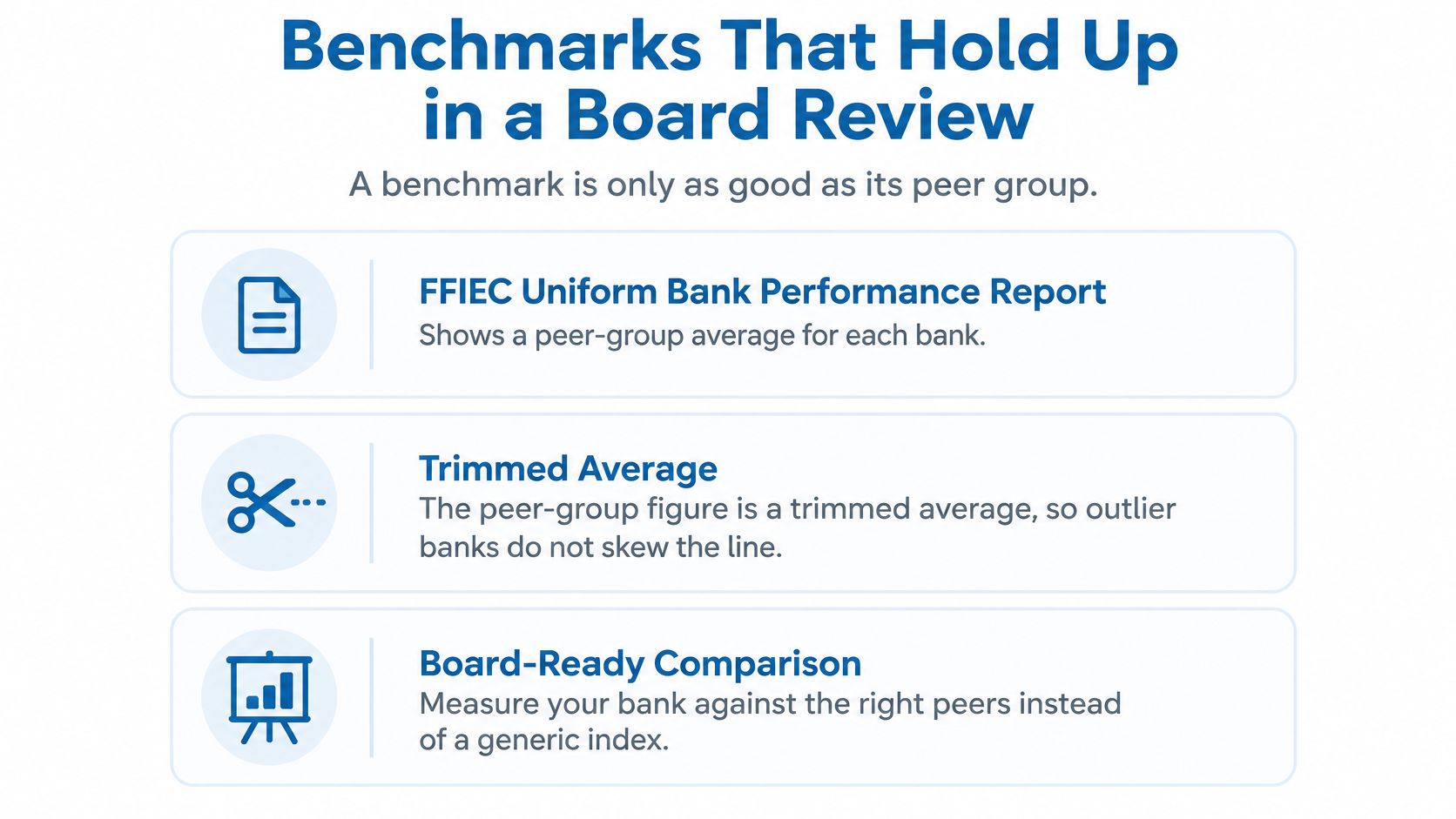
A benchmark is only as good as its peer group. Directors should question the comparison population before debating whether management's result is favorable.
The FFIEC Uniform Bank Performance Report reports the selected bank's peer-group average in its PG # column using trimmed averages of individual bank ratios; consider a hypothetical bank with a 3.25% net interest margin and a 40-basis-point peer shortfall. Trimming reduces the influence of unusually high or low observations, but management must still determine whether the assigned comparison answers the strategic question.
Diagnose the margin gap before prescribing growth
For the hypothetical margin result, beating or trailing a national figure isn't the decisive test. Directors should ask whether the bank trails its assigned peers across reporting periods and whether funding costs, asset pricing, or portfolio composition explain the difference.
Each explanation implies a different response. Expensive funding calls for a deposit and liability-pricing review; weak asset yields call for loan-pricing analysis; a different portfolio mix may justify a strategic choice rather than an immediate correction.
The board pack should distinguish those explanations instead of presenting a highlighted variance as a diagnosis. Management should also show whether an apparent improvement comes from operating changes or a different comparison population.
Test growth and profitability together
Consider a hypothetical $5 billion bank growing loans 8.0% annually against the FDIC's fourth-quarter 2025 industry profile, which reported 5.9% year-over-year loan growth, the fastest annual pace in 11 quarters, and a 3.39% net interest margin. The bank's faster expansion is a starting point for inquiry, not proof of superior performance.
Management should test whether its margin clears the industry reference, then examine the more relevant peer comparison. Faster growth supported by appropriate pricing and credit discipline has a different meaning from expansion obtained through concessions or concentrated exposure.
The community-bank lens can change the discussion again. The FDIC's first-quarter 2025 profile reported community-bank loan balances up 4.9% year over year; against that specific reference, hypothetical growth of 9.0% warrants concentration and credit-quality review, while 2.0% may warrant a targeted origination strategy.
Those examples concern different reporting periods and must not be combined into a single contemporaneous peer ranking. A board-ready comparison labels both period and population prominently.
For a growth review, require:
- A comparable denominator: Institution type, asset profile, geography, and relevant portfolio characteristics.
- An economic explanation: Pricing, funding, mix, acquisition effects, or changes in risk appetite.
- An assigned action: Repricing, reallocating lending capacity, or investigating a specific peer gap.
Visbanking's benchmarking perspective follows that sequence: normalize the comparison, explain the variance, and set a measurable next step. Directors should approve the resulting action only after management separates genuine performance differences from differences in measurement.
Rolling Out Without a Modernization Project
Can a data unification platform go live without becoming a core-replacement program? Treat that as a scope decision before treating it as a technology promise.
A 2025 IBM Institute for Business Value study covering more than 500 banking CIOs and nearly 200 chief data and AI officers reported that 94% of core-banking modernization projects exceeded planned timelines, while more than half of CIOs reported higher-than-expected costs.
Separately, the financial-services survey discussed in that publication found 64% of firms lacked confidence in making informed decisions with current data, 59% reported duplicate records, and 52% reported siloed datasets. Those findings support a narrower implementation question: which decision can the bank improve without first rebuilding its operating environment?

Approve a thin-slice deployment
Start with a bounded workflow, such as refreshing a prospect list, preparing a board benchmark pack, or reviewing early-warning exceptions. Keep the core system in place and deliver approved outputs through APIs, exports, or an existing reporting interface.
Define what stays outside the initial scope. Transaction posting, enterprise-wide customer-master replacement, and automated credit decisions need not become dependencies for a peer-analysis workflow. That exclusion should appear in the approval document, alongside the required security and access reviews.
Establish a source hierarchy before loading conflicting records. For a regulatory benchmark, the authoritative filing may govern the reported financial measure; for outreach ownership, the approved CRM assignment may govern. Name a data owner to adjudicate exceptions rather than relying on whichever source refreshed most recently.
Measure use before expanding coverage
Use a staged acceptance schedule, with the thin-slice approach in the IBM publication informing proposed reviews at 30, 60, and 90 days:
- Initial review: Confirm that users can complete the workflow and measure time to insight against the existing process.
- Operating review: Examine actual use, unresolved conflicts, and manual work avoided.
- Outcome review: Assess the relevant business result, such as outreach conversion or forecast accuracy, without attributing every change to the platform.
Choose measures appropriate to the workflow. A board-pack pilot should emphasize preparation effort, reconciliation quality, and decision usefulness rather than sales conversion.
Expansion should follow demonstrated use, not completion of another connector.
If the initial workflow can't show a measurable result within a quarter, narrow the scope before authorizing a broader rollout.
Pick One Workflow and Benchmark It This Quarter
Choose a single workflow and benchmark it this quarter. The strongest initial commitment isn't an enterprise-wide architecture purchase; it's a controlled comparison between a proposed analytical process and the process management uses today.
Make the pilot decision explicit
- Choose the workflow. Use the next board peer review or a defined loan-growth analysis, with an executive sponsor.
- Set the comparison population. Begin with the institution's assigned peers rather than defaulting to the national average.
- Assign source owners. List the required inputs and identify who resolves a disputed value.
- Define acceptance criteria. Make lineage and reproducibility minimum conditions, alongside the remaining scorecard tests.
- Run the benchmark. Compare preparation time, accuracy, unresolved discrepancies, and the management action each process supports.
Visbanking unifies public and proprietary sources into a consistent model with entity resolution, quality checks, and version control. Customers can add multiple users, customize permissions, and keep the team on the same platform.
Our team helps customers set up the platform, and most customers are fully operational in a single afternoon. That setup milestone isn't a substitute for the bank's own acceptance review.
Commit further budget only when the pilot produces an answer management can defend and an action it can assign.
Visbanking brings financial, regulatory, and market information into a consistent analytical view so bank teams can move from a peer variance to a documented next step. Visit Visbanking to benchmark your bank against its peers or explore the data for your next board review.
Related Articles
Brian's Banking Blog
7 Bank Marketing Products to Evaluate in 2026
Brian's Banking Blog
Automated Alert Triage: Fewer Alerts, Faster Response
Brian's Banking Blog
Importance of Trend Analysis for Bank Leaders
Brian's Banking Blog
8 Sources of Lead for Banks: Prioritize with Data
Brian's Banking Blog