
Prospecting Rules for Banks: How to Build and Score Them
Brian's Banking Blog
The most popular prospecting advice is also the least useful to a bank board: make more calls, send more emails, and keep the pipeline full. That approach rewards activity before anyone establishes whether the prospect has a measurable need or whether the proposed contact is permissible.
Prospecting rules should govern decisions, not reward contact volume. Start with segment fit, peer position, and a fresh reporting trigger. Then determine who may contact the prospect, what they may say, and what evidence the bank must retain.
The Six Prospecting Rules Every Bank Needs
Ordinary B2B outreach and regulated product solicitation are different decisions. Put both on one tree. Peer position and the Call Report calendar choose the branch. Contact volume does not.
The first three rules qualify the bank. The last three govern the contact. Run them in that order. Relationship managers should not clear outreach to institutions the bank should never pursue.
Core prospecting rules for bank relationship teams
| Rule | Trigger condition | Data source | Action | Compliance check |
|---|---|---|---|---|
| Segment fit | Size, market, and products match the best existing relationships | Call Report and UBPR | Add to target list | Document the firmographic basis |
| Peer gap | Capital ratio below the peer average and efficiency ratio above the peer average for two consecutive quarters | UBPR peer percentile | Route to advisory team | Use firmographic data only |
| Filing trigger | Commercial real estate loans up 12% quarter over quarter | Call Report filed within 30 days of quarter-end | Contact within the reporting cycle | Confirm existing relationship status |
| Relationship status | Residential telephone solicitation only: transaction within 18 months or inquiry within 3 months | Internal CRM record | Permit that consumer call after the remaining checks | Record relationship basis and end date |
| Calling window | Residential telephone solicitation only: recipient local time between 8:00 a.m. and 9:00 p.m. | Recipient time zone | Dial a residence only after clearance | TCPA time restriction met |
| Campaign quality | Reply rate below 2% | Campaign log | Diagnose targeting before adding volume | Abandonment at or below 3% on covered predictive campaigns |
Treat the peer-gap persistence test and the commercial real estate growth figure as illustrative policy choices, not regulatory thresholds. Read each ratio in the direction that signals weakness. Capital below the peer average is thin capital. An efficiency ratio above the peer average is weaker efficiency, because a lower ratio means less expense per dollar of revenue. Require both gaps for two straight quarters before you route an advisory conversation.
Do not paste those telephone rules onto business prospecting. The FDIC's TCPA examination guidance describes the 18-month transaction and 3-month inquiry relationship periods, the general 8:00 a.m. to 9:00 p.m. recipient-local-time restriction for residential telephone solicitations, and the 3% abandonment cap for covered predictive campaigns. Commercial outreach needs its own gate: relationship owner, product offered, and whether the message is ordinary B2B contact or a solicitation compliance must review.
Separate eligibility from permission
Fail segment fit or the peer-gap test and the name never reaches a dialer. A pass still does not open every channel. A commercial relationship on the CRM is not the residential TCPA relationship period, and it is not permission to call a consumer at home.
Use the campaign-quality row as an internal diagnostic. A reply rate under your 2% line means the list is wrong. Fix targeting. Do not add dials because an account score looks healthy, and do not treat the 3% abandonment cap as cover for campaigns outside residential predictive dialing.
Launch standard: Every row needs a named owner, an execution log, and a review date before it goes live.
Rerun the tree each quarter on the new Call Report and current peer position. Compliance owns the residential-solicitation gates. Finance owns the capital and efficiency signals. Sales leadership owns the action after a pass.
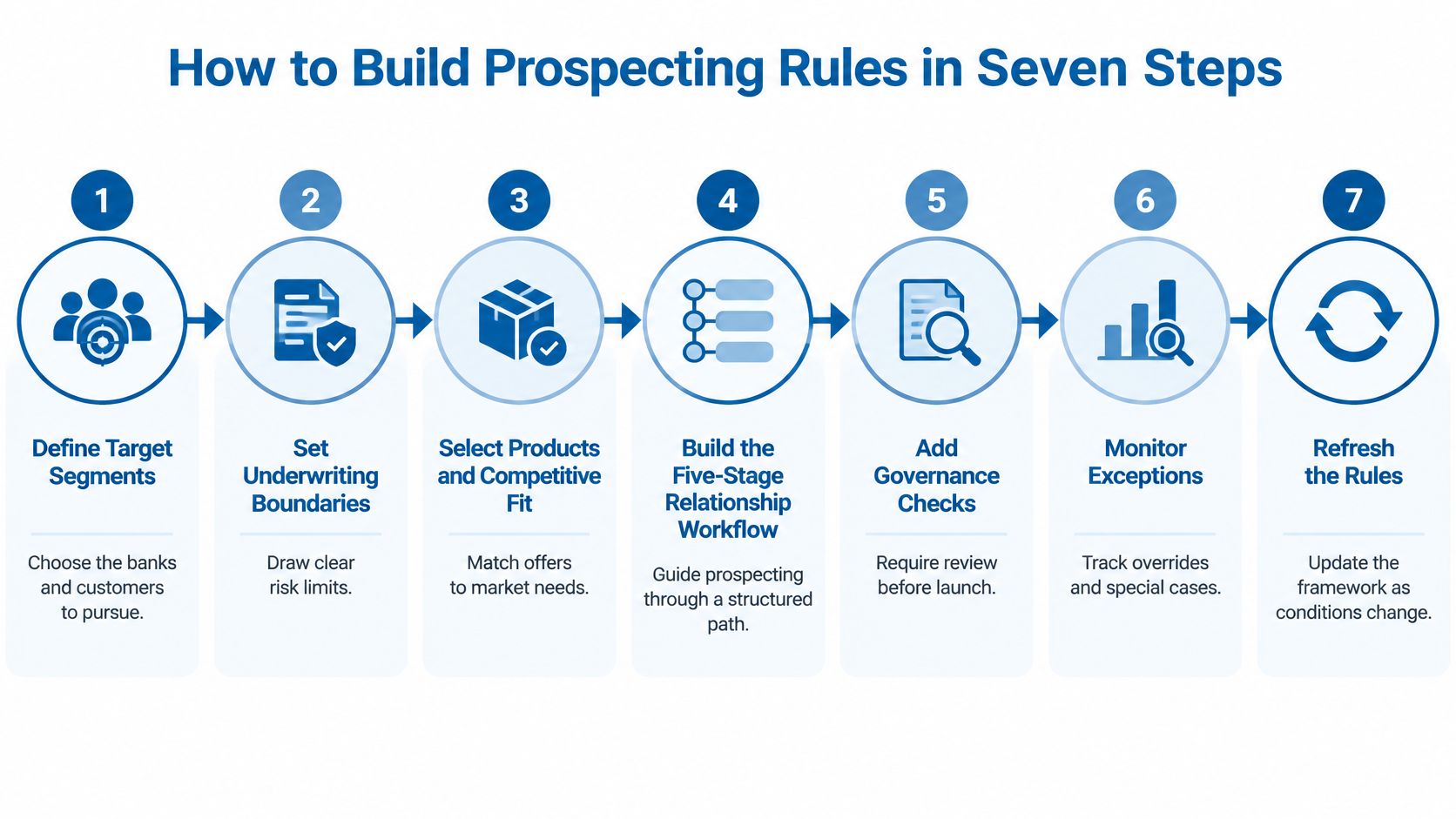
How to Build Prospecting Rules in Seven Steps
A workable rule connects a target, supporting evidence, a permitted action, and an accountable employee. A rule that merely says pursue growing businesses leaves relationship managers to invent the operating details.
The Iowa Bankers relationship-prospecting methodology provides the foundation: define the market, prioritize prospects, source names, research relationships, and diagnose needs before proposing a solution. Add account-level planning and funnel governance to make that workflow manageable.
Build the relationship workflow
Define the target and the boundaries. Specify segments, underwriting limits, products, geographic coverage, and competitive strengths, then name profitable existing relationships that demonstrate the fit. The common mistake is defining an attractive market without identifying what the bank can credibly deliver or what credit risk it won't accept.
Prioritize by relationship economics. Use industry, geography, products used, pricing, fees, and service requirements to identify prospects resembling profitable customers. Don't copy the largest relationships automatically, because balances alone won't reveal servicing costs or whether the relationship depends on uneconomic concessions.
Source names through accountable channels. Draw from current customers, referrals, directors, accountants, attorneys, public records, trade associations, and market surveys, recording provenance when each name enters the CRM. Pipecorn's guide to B2B prospect list tools is useful when comparing list-building approaches, but a tool's contact coverage shouldn't substitute for the bank's qualification standard.
Research before making contact. Review the company, industry, officers, existing banking relationship, and the evidence supporting the proposed conversation. A relationship manager who knows only the prospect's title will struggle to distinguish a genuine operating need from a financial movement that has an ordinary explanation.
Earn a decision-maker appointment. Use open-ended questions to diagnose the problem, listen for constraints, and connect the proposed solution to a specific customer need. Don't turn discovery into a product presentation before confirming who owns the issue, how urgent it is, and what changing providers would require.
Add the governance banks skip
Write the account plan and prospecting objective. State the desired next decision, the responsible employee, the supporting evidence, and the conditions that would end pursuit. An individual marketing plan prevents repeated outreach when nobody has established a credible reason for the prospect to act.
Track the funnel separately from activity. Record qualified prospects, decision-maker conversations, meetings, diagnosed opportunities, proposals, and wins as distinct stages. Calls and emails describe effort, while stage movement reveals whether targeting, access, diagnosis, or conversion is failing.
Keep the operating record simple enough for relationship managers to maintain. Require a source, a reason for contact, a next action, and a disposition rather than an elaborate narrative nobody updates.
Managers should review stalled accounts by stage. A prospect that never reaches a decision-maker needs a different intervention from an account that receives proposals but never commits.
The practical test is straightforward: every prospecting rule must trace to a workflow step and have a named owner. If neither is clear, the rule isn't ready for production.
Scoring Prospects on Peer Position and Direction
Asset size tells a sales team whether an institution fits its coverage model. It doesn't establish what the institution needs or whether executives have the capacity to pursue the proposed opportunity.
The FDIC's UBPR overview explains that the report combines several years of quarterly measures with peer-group averages and percentile rankings for most ratios. That structure lets an analyst distinguish a large prospect from a relevant prospect.

Similar institutions can require different conversations
Consider a hypothetical comparison: banks with identical assets and similar revenue, but Bank A sits at the 75th percentile for capital, while Bank B sits near the bottom of its peer group. The FDIC's discussion of regulatory peer comparisons supports evaluating capital against both regulatory minimums and relevant peer averages.
Bank A may have greater flexibility to discuss expansion. Bank B may first need a conversation about capital efficiency, risk, or balance-sheet constraints. Neither conclusion should become a recommendation until the relationship manager understands management's plans.
Similarly, suppose a rapidly growing lender ranks in the bottom quartile for liquidity and credit quality. Its growth headline may attract attention, but a growth-only pitch ignores the pressures that could dominate the executive team's agenda.
Service-line ratios for prospect scoring
| Service line | Ratio to score | Signal to look for |
|---|---|---|
| Process automation | Efficiency ratio | Deteriorating ratio while assets expand |
| Growth lending | Capital ratio | Percentile position against peer average |
| Treasury products | Liquidity ratio | Percentile position and multi-quarter direction |
Score the need, not the headline
- Select relevant measures. Choose three to five ratios tied to the service line rather than including every available field.
- Establish peer position. Determine whether the prospect is an outlier within an economically relevant comparison group.
- Add direction. Assess whether the condition is improving, deteriorating, or stable across reporting periods.
- Validate the interpretation. Check for acquisitions, business-model differences, seasonal patterns, or other explanations before routing the account.
A deteriorating efficiency ratio alongside asset expansion deserves more attention from a process-services team than a stable ratio at a similarly sized institution. But percentile rank isn't a universal quality score: a higher value can mean strength for one measure and weakness for another.
Use a consistent peer-analysis framework to document the comparison group, ratio definition, and direction of concern. Visbanking's perspective is to standardize financial measures and historical comparisons so managers can explain why an account was prioritized, rather than defend an opaque score.
Keep firmographic features separate from consumer eligibility information. Record the source and permitted use of every model feature, and send eligibility-derived inputs for legal review before activation.
A high prospect score earns a conversation, not a pitch.
Which Prospecting Moves Trigger Regulated Review
A conversation with a CFO isn't automatically low-risk because it began as ordinary business-to-business outreach. Risk follows the audience, calling method, product, employee role, information used, and claims made.
For covered residential telephone solicitations, the operating gate is local time: don't initiate before 8:00 a.m. or after 9:00 p.m. Established-business-relationship analysis generally looks back 18 months for a transaction and 3 months for an inquiry, unless the relationship has been terminated; covered predictive campaigns must monitor the 3% cap on abandoned live-answered calls over a 30-day campaign period.
Those controls don't answer what an employee may say once someone answers. A permissible call can still become an improperly controlled product solicitation.
Use intent to determine the control
The FDIC's retail investment-sales examination guidance addresses personnel designation, customer-information use, supervision, scripts, advertisements, compliance procedures, and suitability analysis for securities recommendations. It illustrates why banks need more than a channel checklist.
Prospecting activity by intent and required control
| Activity | Risk level | Required approval | Disclosures or licensing check | Evidence to retain |
|---|---|---|---|---|
| Relationship discovery | Low, business-to-business conversation | Relationship manager sign-off | Caller ID and do-not-call check | Call notes and suppression status |
| General capability discussion | Low to moderate, rises when products are named | Compliance review of talking points | Approved script in use | Script version and call log |
| Product promotion | Moderate, marketing claims apply | Product owner and compliance approval | Disclosures and deposit insurance wording checked | Approved materials and distribution record |
| Individualized recommendation | High, suitability analysis may apply | Designated or licensed staff only | Licensing check completed | Suitability file and customer profile |
| Application solicitation | High, credit and consumer rules apply | Credit and legal approval | Applicable full disclosures and opt-out handling | Application trail and opt-out log |
This is a proposed internal control matrix, not a statement that identical legal approvals apply to every product. Counsel should tailor it to the bank's charter, state requirements, customer type, and internal policy.
Discovery asks about operating priorities without prescribing a financial product. Retain the business purpose, source of the contact, suppression check, and substantive notes.
A general capability discussion explains what the institution can do using approved talking points. Once an employee shares a deposit-rate comparison, treasury-product claim, or attached advertisement, the product-promotion controls should apply.
An individualized recommendation requires a different review from a general description. For securities, confirm the employee's designation or licensing requirements and complete the applicable suitability process; don't extend securities-specific requirements indiscriminately to unrelated products.
Application solicitation introduces product-specific intake, disclosure, credit, and recordkeeping obligations. The handoff should identify which team owns those obligations before the relationship manager invites an application.
Review the data as well as the script
A practical compliance risk assessment should identify these transitions before launch. Any move from discovery into a product claim should trigger documented review, whether through preapproved materials or an account-specific escalation.
The FDIC's compliance violation-code guidance identifies restrictions under the Fair Credit Reporting Act and Regulation V on affiliate-supplied eligibility information used for marketing unless an exception applies, and addresses misleading FDIC-insurance representations. Don't imply coverage a product lacks or use the FDIC name or logo deceptively; lack of knowledge doesn't make misleading conduct acceptable.
Route prospect lists combining eligibility data, public filings, and inferred business needs through compliance before the first call. More precise targeting isn't automatically safer targeting.
Timing Triggers to the Call Report Calendar
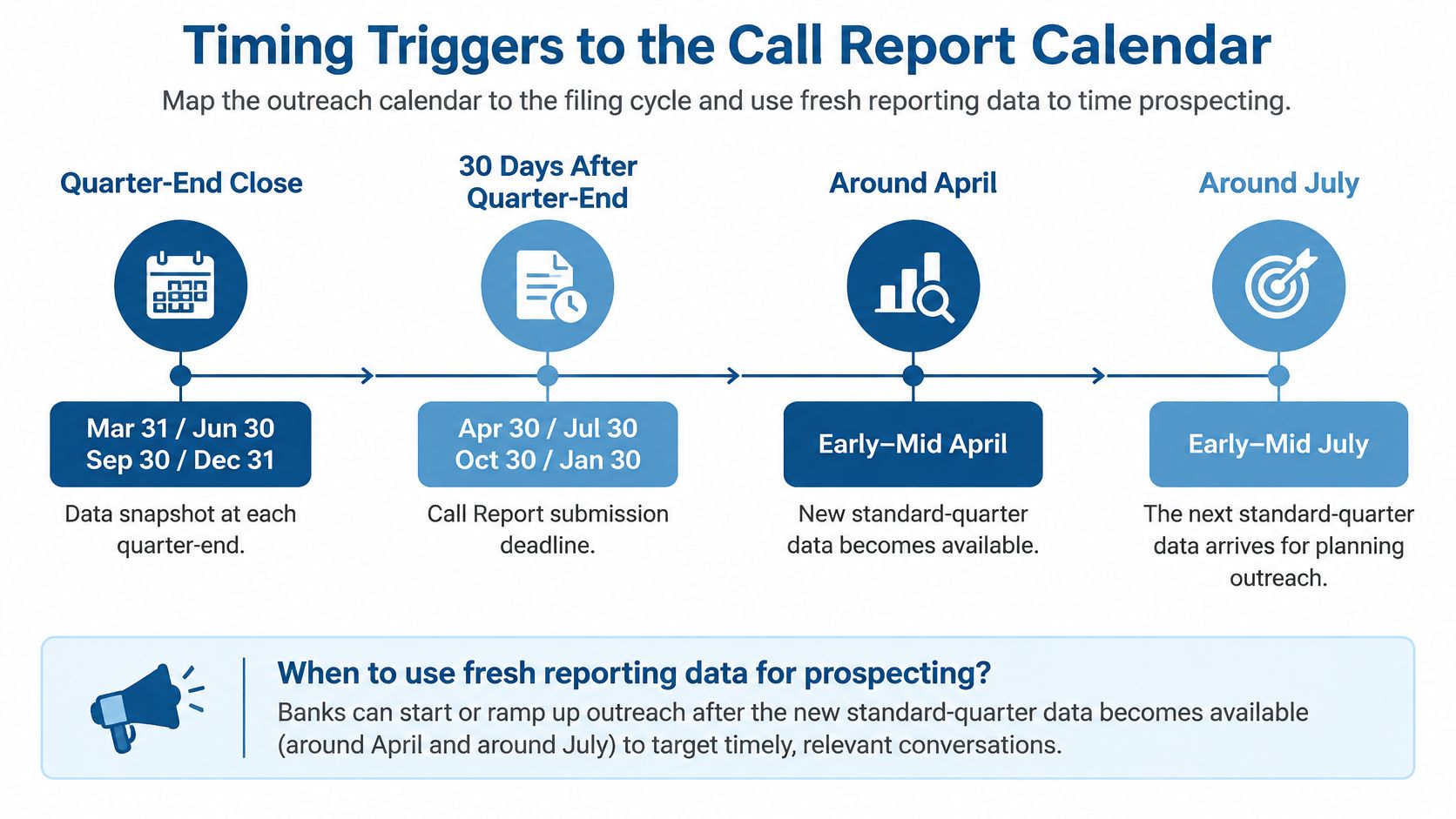
The Call Report cycle provides bank prospecting with a defensible timetable. Relationship teams should refresh account hypotheses when financial evidence changes, not only when a calendar reminder says to contact the CFO again.
The FDIC's Call Report instructions generally require covered institutions to report as of each quarter-end and submit electronically within 30 days, except for certain institutions with foreign offices. The calendar below translates that reporting cadence into a proposed target-list refresh.
Call Report filing calendar and target list refresh
| Quarter-end | Call Report due | Target list refresh |
|---|---|---|
| March 31 | April 30 | Week after filing |
| June 30 | July 30 | Week after filing |
| September 30 | October 30 | Week after filing |
| December 31 | January 30 | Week after filing |
Treat those dates as filing deadlines, not promises that every record is available and validated simultaneously. Confirm ingestion, amendments, and data quality before launching a sequence.
Give each trigger a different conversation
- Growth trigger. An illustrative 12% quarter-over-quarter increase in commercial real estate loans opens questions about growth plans, concentration management, and lending capacity. It doesn't prove that management wants more exposure.
- Deposit trigger. A material decline opens a funding or treasury discussion. Define materiality against the institution's history and business model rather than imposing an arbitrary universal percentage.
- Peer-gap trigger. A widening gap over two consecutive quarters, as an internal persistence test, opens a diagnostic discussion. Ask what changed before proposing a remedy.
Use the Call Report interpretation guide to align field definitions before comparing institutions. A trigger built from inconsistent categories will create plausible-looking but unreliable account priorities.
Sequence the account, not just the phone number
A practical sequence starts with account research, followed by an email, a call, and a follow-up within the same week, then a pause before the next cycle. Refresh the research before each touch, honor suppression preferences, and give every message a distinct purpose.
For a hypothetical quarterly campaign, suppose analysts flag 40 banks and select 12 for multichannel sequences. Track qualified meetings per 100 banks contacted, rather than celebrating the number of alerts or touches; these are planning assumptions, not industry results.
Route validated alerts into the CRM with the reporting period, underlying measure, assigned relationship manager, and approved next action. That record keeps managers from contacting the same institution with conflicting explanations.
A trigger that repeatedly fires without producing a relevant conversation needs recalibration. Don't repeat a weak hypothesis merely because new filings make it easy to automate.
Measuring Rule Performance Against Your Own Baseline
Suppose a peer-gap rule produces 4 meetings from 50 contacts, an 8% meeting rate, while a growth trigger produces 1 meeting from 80 contacts, a 1.25% rate. These hypothetical results suggest a targeting or message problem in the growth cohort, not a reason to increase its volume.
Adopt a firm retirement standard: a rule that fails across two full quarters under comparable conditions is paused, rewritten, or removed. Log the change, the evidence behind it, and the employee approving it.
Make comparisons defensible
Before judging performance, segment campaigns by institution size, market, executive role, trigger, and channel. Record delivered messages, unique human replies, positive replies, meetings, opportunities, and wins separately.
The Scalelist prospecting-statistics compilation reports cold-email reply ranges of 0.45%–3.43% in one source and 3%–6% as a broader B2B planning range in another, alongside a commonly reported 2%–3% cold-calling meeting conversion range. These aren't bank-specific promises or interchangeable measures.
Use the calling range as a conservative planning reference, not a performance target or guaranteed floor. An email reply, a qualified meeting, and a funded opportunity represent different levels of commercial progress.
Measurement discipline: Compare cohorts only after equivalent follow-up treatment and the same opportunity to mature.
Diagnose before increasing volume
Treat replies below 2% as an internal investigation threshold, not proof that a market is unattractive. Check delivery, contact accuracy, executive-role fit, and message relevance before changing the underlying segment strategy.
- Separate human responses. Remove automated replies from the human-reply measure and classify negative responses separately from commercial interest.
- Attribute downstream outcomes. Preserve the originating rule as accounts move into meetings, proposals, and funded relationships.
- Control follow-up. Apply equivalent sequence length, channel treatment, and qualification standards before comparing rules.
- Inspect capacity. Check whether delayed relationship-manager follow-up, rather than the trigger itself, caused the cohort to stall.
Hold a monthly operational review to diagnose execution problems while they're still correctable. Give directors a quarterly summary showing which rules produced qualified opportunities, which consumed capacity without progress, and which were retired.
A winning rule should survive scrutiny beyond its reply rate. Executives should be able to see the economic opportunity, the conversion path, and the control evidence behind continued investment.
Benchmark Your Prospecting Rules This Quarter
Don't launch a library of prospecting rules. Select the few that matter most to the bank's strategy and establish whether they improve decisions under controlled operating conditions.
- Assign ownership. Pick the three rules with the largest expected impact and name the executive accountable for each.
- Confirm provenance. Record the data source, reporting period, refresh event, and employee responsible for validation.
- Run a controlled quarter. Establish a baseline and apply identical follow-up rules so differences in execution don't obscure differences in targeting.
- Benchmark before setting thresholds. Compare the current prospect list with relevant peer positions before deciding what qualifies as an actionable gap.
The benchmark should reflect the target segment and your institution's capacity to serve it. A generic growth threshold won't tell directors whether the team is pursuing relationships the bank can win profitably.
Our Prospect app identifies prospects by size, location, and bank relationships, with constantly updated data. Prospect and Talent integrate with popular CRMs, including Salesforce and HubSpot, so teams can connect account selection to an accountable workflow.
Make the decision explicit before launch: which rule will your team test first, and what result would make you retire it?
Visbanking brings together bank financial intelligence, peer comparisons, and prospecting data to help teams turn evidence into accountable outreach decisions. Visit Visbanking to benchmark your current prospect list against UBPR and Call Report measures, then choose the first rule your team will test this quarter.
Latest Articles
Brian's Banking Blog
Predictive Risk Intelligence for Banks: A Practical Guide
Brian's Banking Blog
Audit Trail in Banking: What It Is and Why It Matters
Brian's Banking Blog
Talent and Intelligence: A Guide for Bank Leaders
Brian's Banking Blog
Regulatory Rules for U.S. Banks: What Matters in 2026
Brian's Banking Blog
8 Bank Lending Trends Reshaping Credit Strategy in 2026
Brian's Banking Blog