
FDIC Call Report Instructions How to File Accurately
Brian's Banking Blog
Quarter-end arrives with the usual pressure. Finance is closing the books, operations is reconciling loan and deposit systems, and the regulatory reporting team is trying to determine whether a variance reflects a real balance-sheet change or a mapping problem. Meanwhile, executives and directors are waiting for a reliable view of capital, liquidity, credit exposure, and earnings.
That pressure makes FDIC Call Report instructions more than a compliance reference. They define the data discipline behind supervisory reporting and, when handled well, give leadership a consistent basis for peer comparison and decision-making. The strongest banks treat the filing as a controlled data process, not a form-filling exercise.
Why FDIC Call Report Accuracy Matters for Bank Leaders
A bank can survive an inconvenient quarter-end. It can't afford to make strategic decisions from numbers that haven't been reconciled. When the chief financial officer presents loan growth, deposit movement, investment positions, or income trends to the board, directors need confidence that those figures connect to the same underlying records used in the regulatory filing.
The Call Report creates that discipline because institutions report on a standardized quarterly cycle. Comparable reporting makes it possible to examine a bank's position against peers, identify unusual movements, and challenge assumptions before they become operating problems. The value isn't limited to regulators. Management can use the same structured information to ask better questions about pricing, concentration, funding, credit administration, and balance-sheet capacity.
Executive principle: Treat the Call Report as a controlled management dataset that also satisfies a regulatory obligation.
Accuracy protects decisions and credibility
A reporting error can begin with a small classification issue and end with a difficult conversation. A loan balance may be pulled from the wrong subsystem. A schedule may fail to tie to the general ledger. A current-quarter figure may look plausible but differ sharply from the prior report without an explanation. Each issue weakens confidence in the filing and in the internal controls supporting it.
The FDIC's regulatory reporting resources reflect the practical reality that filing data can support more than submission. It can also support trend analysis, benchmarking, and executive review when the bank preserves definitions, ownership, and source lineage.
Consider a hypothetical board meeting. The credit committee sees a reported commercial loan balance of $1,250,000, while the relationship team's portfolio report shows a different total. The discrepancy may be explainable, but the board should not have to discover it after the filing. A disciplined Call Report process forces the institution to resolve the difference before executives rely on either figure.
The reporting team needs executive sponsorship
Preparers own the mechanics, but executives own the environment in which those mechanics succeed or fail. If finance, risk, treasury, lending, and technology each maintain separate definitions, the filing team will spend quarter-end negotiating numbers instead of validating them.
Leadership should require three things:
- Clear ownership: Every material data element has a responsible business or finance owner.
- Traceable evidence: Each reported amount can be tied to a source system, reconciliation, and approved adjustment.
- Documented judgment: Estimates, classifications, and unusual movements have explanations that another reviewer can understand.
Accurate filing data then becomes a foundation for performance management. Visbanking's perspective is useful here because it connects regulatory data with broader bank intelligence, allowing executives to move from “what did we file?” to “what changed, why did it change, and what action follows?”
Understanding Filing Requirements and Deadlines
The filing calendar is straightforward, but it must be managed as an operating deadline rather than a date on a compliance spreadsheet. The FDIC Call Report filing system uses a quarterly reporting cadence. Each national bank, state member bank, insured state nonmember bank, and savings association must file as of the close of business on the last calendar day of each quarter. The completed report is generally due no more than 30 calendar days later, as described in the FDIC filing notice for the fourth quarter.
For example, a report as of March 31 is due by April 30, and a report as of June 30 is due by July 30. An institution with more than one foreign office receives an additional five calendar days to submit electronically. That allowance should be built into the close calendar from the start, not discovered when an overseas entity misses an internal handoff.
Establish the filing framework first
Before pulling balances, confirm the institution's reporting profile and the applicable form. Form selection depends on foreign-office status and asset size:
| Institution profile | Applicable form |
|---|---|
| Institution with foreign offices | FFIEC 031 |
| Institution without foreign offices with assets of at least $300 million | FFIEC 032 |
| Institution without foreign offices with assets of at least $100 million but less than $300 million | FFIEC 033 |
| Institution without foreign offices with assets under $100 million | FFIEC 034 |
The current FDIC materials also identify FFIEC 031 and 041 forms, supporting schedules RC and RC-A through RC-V, and the separate FFIEC 051 version for smaller institutions. The current Call Report forms and instructions should be the controlling reference for the bank's active filing package. Don't let a prior quarter's saved workbook become the de facto rulebook.
Submit through the Central Data Repository
The filing process is electronic. Banks may prepare the data with software and submit it directly to the FFIEC's Central Data Repository, or CDR. Paper filing directly to the FDIC or Federal Reserve isn't acceptable. The submission date is the date the CDR must receive the completed file, so internal approval deadlines need to precede the regulatory deadline.
The filing package includes the applicable form and required schedules. Management should verify that the software environment contains the current forms, that users understand the submission workflow, and that evidence of final transmission is retained. A bank that treats the CDR as a last-minute upload destination is exposing itself to avoidable operational risk.
The practical sequence is simple:
- Confirm the as-of date and applicable form.
- Set internal close, review, approval, and transmission milestones.
- Map source data to the required schedules.
- Run edits and resolve exceptions.
- Obtain officer sign-off and transmit through the CDR.
- Retain the filing package and supporting workpapers.
Mapping Your Data Sources to Call Report Schedules
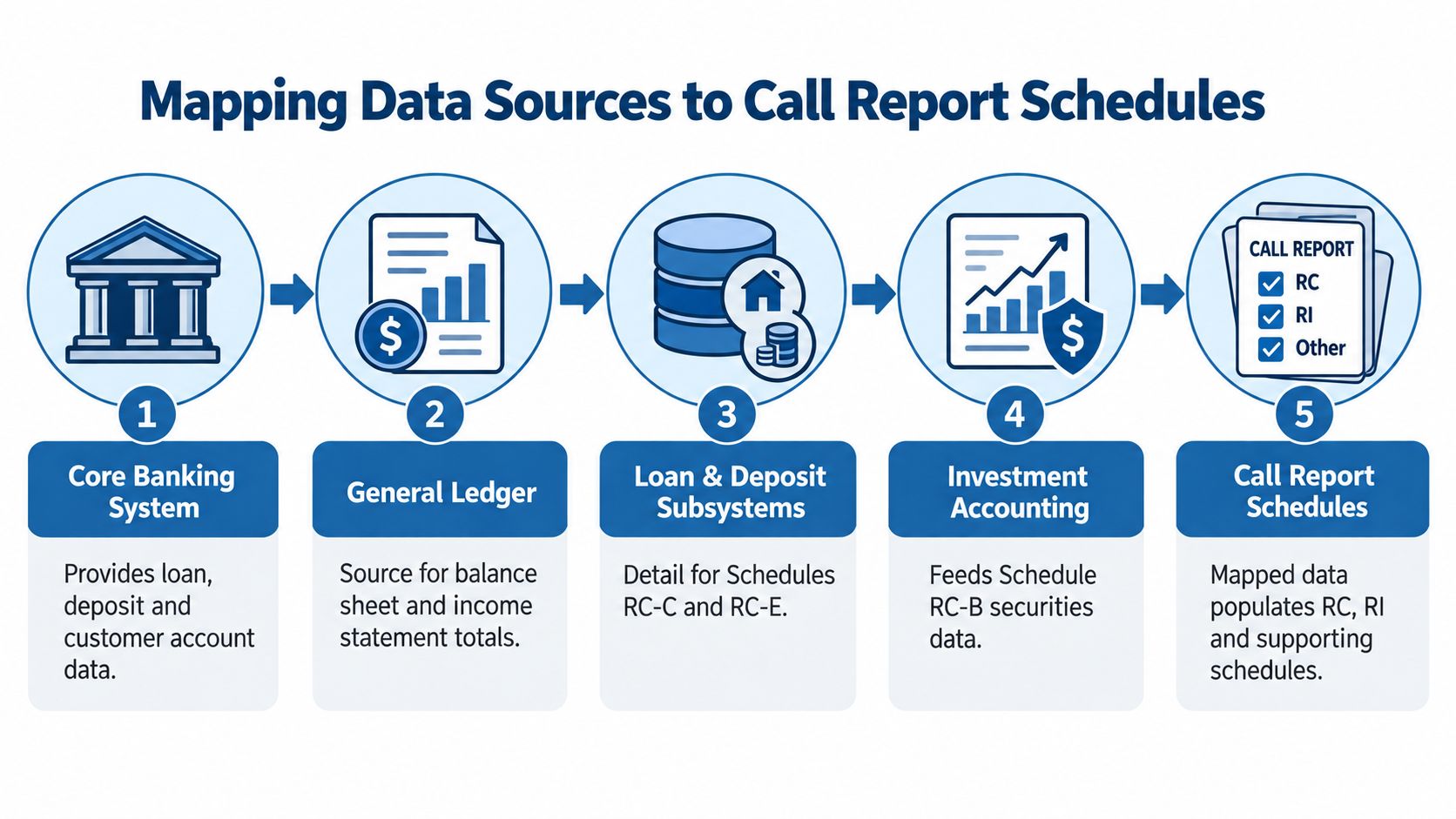
A sound filing starts with source architecture. The question isn't merely whether a number exists. The question is whether the bank can explain where it came from, who owns it, how it was transformed, and why it belongs in a particular schedule.
The general ledger usually anchors balance-sheet and income-statement totals. The core banking system provides loan, deposit, and customer-account information. Loan and deposit subsystems provide the detail needed to classify balances, while investment accounting supplies securities information. The Call Report schedules then organize those inputs into the regulatory presentation.
Build a source-to-schedule map
A useful mapping document should name the source field, destination schedule and item, transformation rule, responsible owner, and reconciliation method. It should also identify manual adjustments. Manual entries aren't automatically wrong, but unexplained manual entries are a control weakness.
| Source | Primary contribution | Control question |
|---|---|---|
| Core banking system | Loan, deposit, and customer-account data | Does the extract include the correct as-of population? |
| General ledger | Balance-sheet and income-statement totals | Do schedule totals tie to the ledger after approved adjustments? |
| Loan subsystem | Loan classifications and detail for Schedule RC-C | Are balances classified consistently with the reporting rules? |
| Deposit subsystem | Deposit detail for Schedule RC-E | Do product categories reconcile to the ledger? |
| Investment accounting | Securities data for Schedule RC-B | Are positions, classifications, and valuation inputs complete? |
A hypothetical example illustrates the point. Suppose the general ledger reports $1,250,000 in loans, while the loan subsystem reports $1,245,000. The difference may reflect accrued interest, charge-off timing, a general-ledger adjustment, or a missing account in the extract. The preparer shouldn't force the subsystem total to match. The preparer should identify the reason, document it, and establish which figure feeds the relevant schedule.
Assign ownership before quarter-end
Finance should own the final filing control, but it shouldn't own every source definition. Lending operations should explain loan classifications. Treasury or investment accounting should explain securities. Deposit operations should confirm product mapping. Technology should protect extract integrity and preserve repeatable jobs.
Use a standing data dictionary with stable definitions across quarters. If a field changes meaning, document the change and assess its effect on historical comparisons. That simple practice prevents a familiar problem: a quarter-over-quarter variance that appears operational but results from a mapping revision.
The Visbanking multi-source data integration approach is relevant to this operating model because decision-ready reporting depends on bringing together multiple financial and regulatory sources with clear lineage. Whether a bank uses an internal data platform, a vendor, or controlled spreadsheets, the requirement remains the same. Every reported value needs a defensible path back to source data.
Preserve the audit trail
A complete workpaper package should include source extracts, mapping tables, reconciliation results, adjustment support, reviewer comments, edit explanations, and final submission evidence. Store the package where finance, internal audit, and examiners can locate it without relying on one preparer's personal files.
The best test is practical. Select a reported item and ask someone who wasn't involved in preparation to reproduce it. If they can trace the figure from the schedule to the source, understand the transformation, and locate the approval, the bank has a functioning reporting pipeline. If they can't, the bank has a documentation problem even if the filed number happens to be correct.
Validating Data and Clearing FFIEC Edits Before Submission
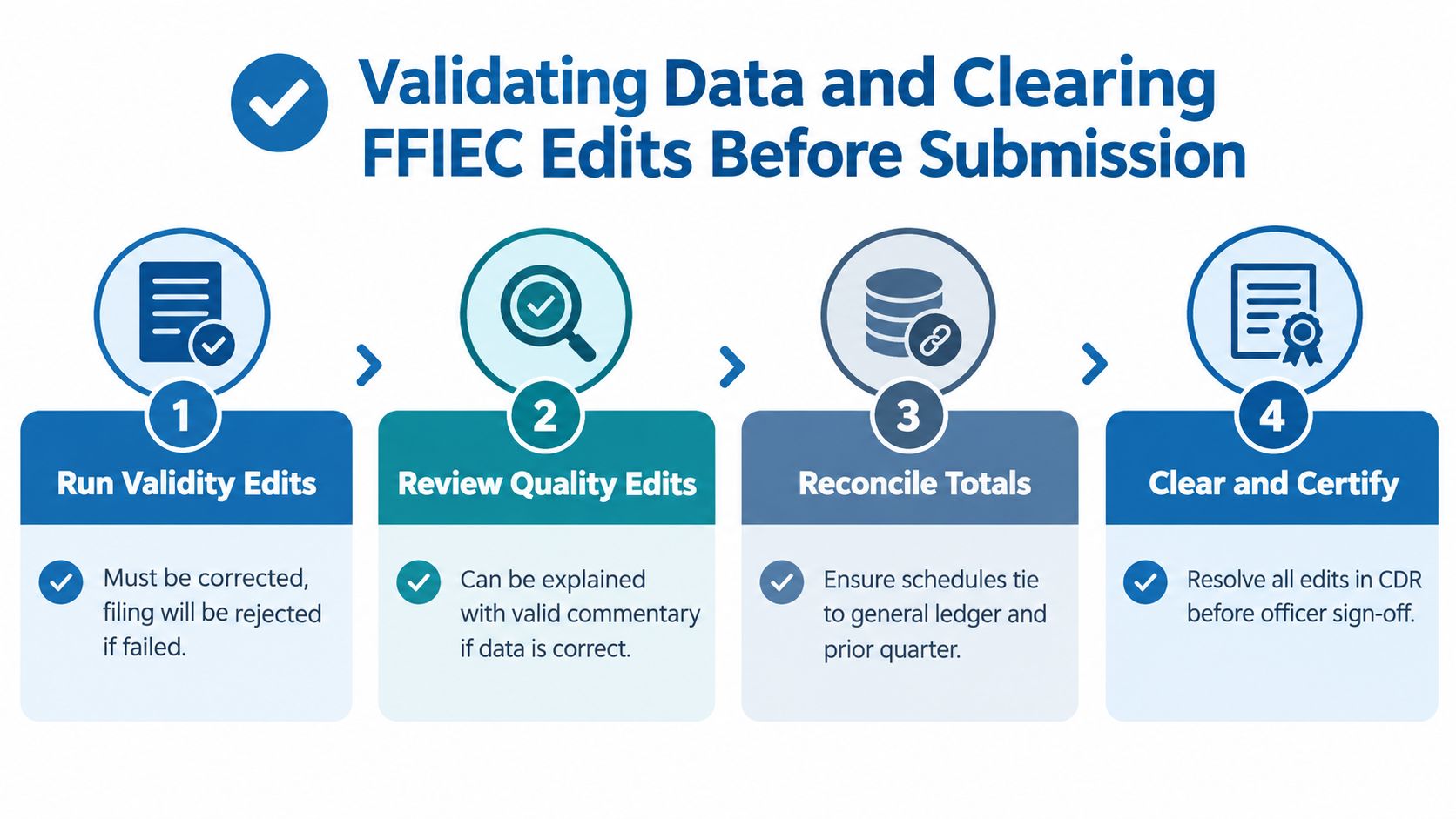
Validation is the quality gate between preparation and transmission. The FFIEC edit process doesn't replace management review, and passing an automated check doesn't prove that the underlying data is right. It confirms that the filing meets defined structural and logical conditions.
The distinction between validity edits and quality edits matters. Validity edits must be corrected before submission. Quality edits can be addressed either by correcting the underlying item or by providing a predefined explanation together with a narrative comment in the software's explanation field, as set out in the FFIEC general instructions for Call Report preparation.
Separate rejection issues from explainable exceptions
A validity edit is a hard stop. The bank must correct the filing before it can submit. A quality edit is different. It signals that a relationship, movement, or value deserves review, but the reported data may be correct if the institution can explain the result in the required format.
That distinction should shape the review queue:
- Validity edits: Assign an owner, correct the data, rerun the edit, and retain evidence of resolution.
- Quality edits: Investigate the business reason, verify the source records, select the appropriate predefined explanation, and add a concise narrative comment.
- Unresolved items: Escalate them to the controller or designated filing officer rather than allowing a preparer to dismiss them informally.
Practical rule: A vendor can prepare or transmit the file, but the bank remains responsible for accuracy.
Use a disciplined reconciliation sequence
Start with the arithmetic. Reconcile totals and subtotals, then double-check additions and subtractions within each schedule. A total that looks reasonable can still contain an offsetting error, so reviewers should examine the components rather than relying on the final line alone.
Next, compare current-quarter balances with the prior report. A meaningful change isn't necessarily an error, but an unexpected movement needs a business explanation. Ask whether the movement reflects actual growth, a sale, a charge-off, reclassification, accounting treatment, or a source-system issue.
A strong review sequence looks like this:
- Reconcile schedule totals to the general ledger or approved source control total.
- Recheck additions, subtractions, and subtotals.
- Compare current balances with prior-quarter figures.
- Investigate unusual changes with the business owner.
- Correct validity edits before transmission.
- Document quality-edit explanations in the filing software.
- Rerun the full edit set and obtain independent review.
Make explanations useful to the next reviewer
A weak comment says that an item is “reasonable.” A useful comment identifies the business event, the affected balance, the reason the edit triggered, and the evidence reviewed. Keep the explanation specific enough that a controller, director, internal auditor, or examiner can understand it without interviewing the original preparer.
The Visbanking data quality perspective reinforces an important management principle. Quality is not a final spreadsheet check. It is a repeatable process involving source integrity, validation rules, ownership, and observability. Banks that build those controls into the close process reduce the number of surprises waiting at transmission.
Navigating Quarterly Updates and Special Filing Situations
Experienced reporting teams still make a predictable mistake. They read the core instructions, assume the quarter is unchanged, and miss a supplemental instruction that changes implementation. The solution is to review both layers separately and record the outcome in formal change control.
The March 2026 materials provide a clear example. The core FFIEC 031, 041, and 051 instructions had no new data items or instruction updates for that quarter. The supplemental instructions nevertheless added, revised, or removed topics involving the Enhanced Supplementary Leverage Ratio, FDIC Special Assessment, and SAB 122, as shown in the March 2026 supplemental instructions.
Run a two-layer change review
The review should produce two distinct conclusions:
| Review layer | Executive question |
|---|---|
| Core instructions | Did the form, item definitions, or standard preparation requirements change? |
| Supplemental instructions | Did quarterly guidance alter how an existing item should be prepared or interpreted? |
This separation improves governance. The controller can report that the core forms were unchanged while still documenting the operational impact of supplemental guidance. Technology can update mappings without unnecessarily rebuilding the filing package. Internal audit can test whether the bank's change-control record matches the actual quarter's requirements.
Don't rely on email summaries alone. Assign a reviewer, record the documents examined, identify affected schedules or processes, and obtain sign-off from the responsible finance or regulatory reporting officer.
Coordinate foreign-office calendars
Institutions with more than one foreign office face a distinct timing issue. The additional five calendar days for electronic submission can help, but it doesn't eliminate the need to coordinate data collection, local close activities, currency processes, review, and remediation across entities. The FDIC first-quarter filing notice identifies the standard electronic filing expectation and the foreign-office timing allowance.
The bank should maintain one integrated calendar with entity-level milestones. Each foreign office needs an internal deadline that leaves time for consolidation, edit resolution, and officer approval. A late local submission can consume the buffer before the central reporting team has reviewed a single quality edit.

The governance test is simple. Can management identify what changed, which entities are affected, who owns the response, and when the updated process will be tested? If not, the bank is treating regulatory change as reading material instead of an operational control.
Compliance Checkpoints and Turning Reports Into Action
The final review should be short, explicit, and owned by named people. Executives don't need another general reminder to “check the filing.” They need evidence that the bank has completed the controls that matter.
The executive-ready checkpoint list
- Confirm the reporting profile: Verify the as-of date, institution type, foreign-office status, and applicable FFIEC form.
- Check source completeness: Confirm that the general ledger, core system, loan and deposit subsystems, and investment accounting extracts are complete for the reporting date.
- Review schedule tie-outs: Require documented reconciliations for material schedules and investigated differences.
- Clear validity edits: Don't authorize transmission while a required correction remains unresolved.
- Document quality edits: Ensure explanations identify the business reason and supporting evidence.
- Review changes: Separate core instruction updates from supplemental guidance and record the implementation decision.
- Approve transmission: Obtain the designated officer's sign-off and preserve evidence that the CDR received the completed file.
- Turn data into questions: Compare filed results with peers and prior periods, then assign management actions for material changes.
The last checkpoint is where many banks leave value on the table. A filed report shouldn't disappear into an archive. It can support board reporting, peer benchmarking, market planning, credit strategy, and funding decisions. Visbanking's Bank Intelligence and Action System combines financial, regulatory, market, and people data, while its Bank Performance application supports peer benchmarking and historical trend analysis across 4,600+ institutions, according to the publisher's product description.
The executive mandate should be direct: file accurately, preserve the evidence, and use the resulting data to challenge performance. A Call Report is not the end of the quarter-end process. It is one of the clearest structured views management has of how the bank is performing relative to its operating plan and competitive environment.
Use Visbanking to connect Call Report data with peer benchmarking and broader bank intelligence, then turn reconciled regulatory data into focused questions for finance, risk, lending, and the board. Explore the platform and benchmark your institution's performance before the next quarter-end review.
Latest Articles
Brian's Banking Blog
Automated Alerts and Notifications for Banks
Brian's Banking Blog
Customer Feedback Loop for Banks: A Practical Playbook

Brian's Banking Blog
Commercial Lending Trends: What Bank Executives Must Know

Brian's Banking Blog
Bank Marketing Dataset Analysis Strategy

Brian's Banking Blog
ESG Peer Benchmarking for Bank Leaders
Brian's Banking Blog