
CRM for Credit Unions: A Practical Buyer's Guide
Brian's Banking Blog
In a 2025 survey of 149 financial-institution CEOs, 30% of credit unions planned to include a public, cloud-native core in their strategic plans during the following two years, according to CU Management's report on core upgrades. That single fact should change how you buy CRM for credit unions. If your core, digital banking, and data-sharing obligations are moving, a CRM that cannot prove where its data came from, who saw it, and what outcome it produced is a liability, not a growth tool.
Buy a governed data-and-risk system first. Treat campaigns, queues, and personalization as outputs of that system, not as substitutes for it. Every demo should end with two questions you can answer with evidence. Can this platform survive an examination, and can it show a measurable change in funded products, retained balances, or member retention?
Core Features Every Credit Union CRM Needs
A credit union CRM holds one governed relationship record per member, connecting who the member is, what they hold, how they've been served, and what should happen next. If a vendor cannot show that record clearly, with its history and permissions attached, stop the demo. You're looking at a contact list with better graphics.
Start with member identity and household view, because every later metric depends on it. Duplicate records inflate outreach lists, distort product penetration, and embarrass staff who contact the same household twice with conflicting offers. Product and balance holdings come next, since relationship managers need to see checking, savings, loans, and cards together before they can judge depth, risk, or opportunity.
What to test before you discuss price
| Capability | What It Does | Why Credit Unions Need It | Demo Test |
|---|---|---|---|
| Member identity and household view | Merges records into one member and household profile | Keeps member counts and outreach accurate | Merge two duplicate records live |
| Product and balance holdings | Shows every account, loan and card held by each member | Reveals cross-sell gaps and balance declines | Filter members with checking but no card |
| Interaction and service history | Logs calls, branch visits and digital events | Preserves member knowledge when staff change | Open one member's full history on a single screen |
| Event alerts | Flags triggers such as a loan inquiry or a sharp balance decline | Turns signals into timely outreach | Set a balance-decline alert and confirm it fires |
| Next-best-action queues | Ranks offers and tasks for each relationship manager | Focuses limited staff time on the right members | Show the rule behind each recommendation |
| Consent and audit logs | Records preferences, access and every change | Supports examinations and member trust | Export the complete audit trail for one member |
Interaction and service history protects institutional memory. When a branch manager retires or a lender changes roles, the next employee should see prior complaints, promises made, documents requested, and unresolved service issues without searching email. Ask the vendor to open one member and reconstruct the last several interactions in order, including channel, employee, and outcome.
Event alerts separate a working CRM from a reporting archive. A loan inquiry, a matured certificate, a stopped direct deposit, or a sharp balance decline should create a task while staff can still act. Require suppression rules as well, so a member in collections, in an active complaint, or recently declined for credit doesn't receive an inappropriate automated offer.
Next-best-action queues should rank work by expected member and institutional value, not by whichever campaign marketing launched most recently. Make the vendor display the rule, data fields, and exclusions behind each recommendation. If staff can't challenge the recommendation and record why they overrode it, the queue will lose credibility quickly.
Practical rule: Don't score a demo run on vendor sample data. Bring a controlled sample of your own member records, including known duplicates and multi-product households.
Close the evaluation with consent and audit logs. Export one member's complete record of preferences, disclosures, reads, changes, exports, and campaign inclusion. Count how many sample records the system merges correctly, how many it flags for review, and how many it gets wrong. Sign only when those results meet a threshold your operations, compliance, and lending leaders set in advance.
Why a Credit Union CRM Needs a Different Design
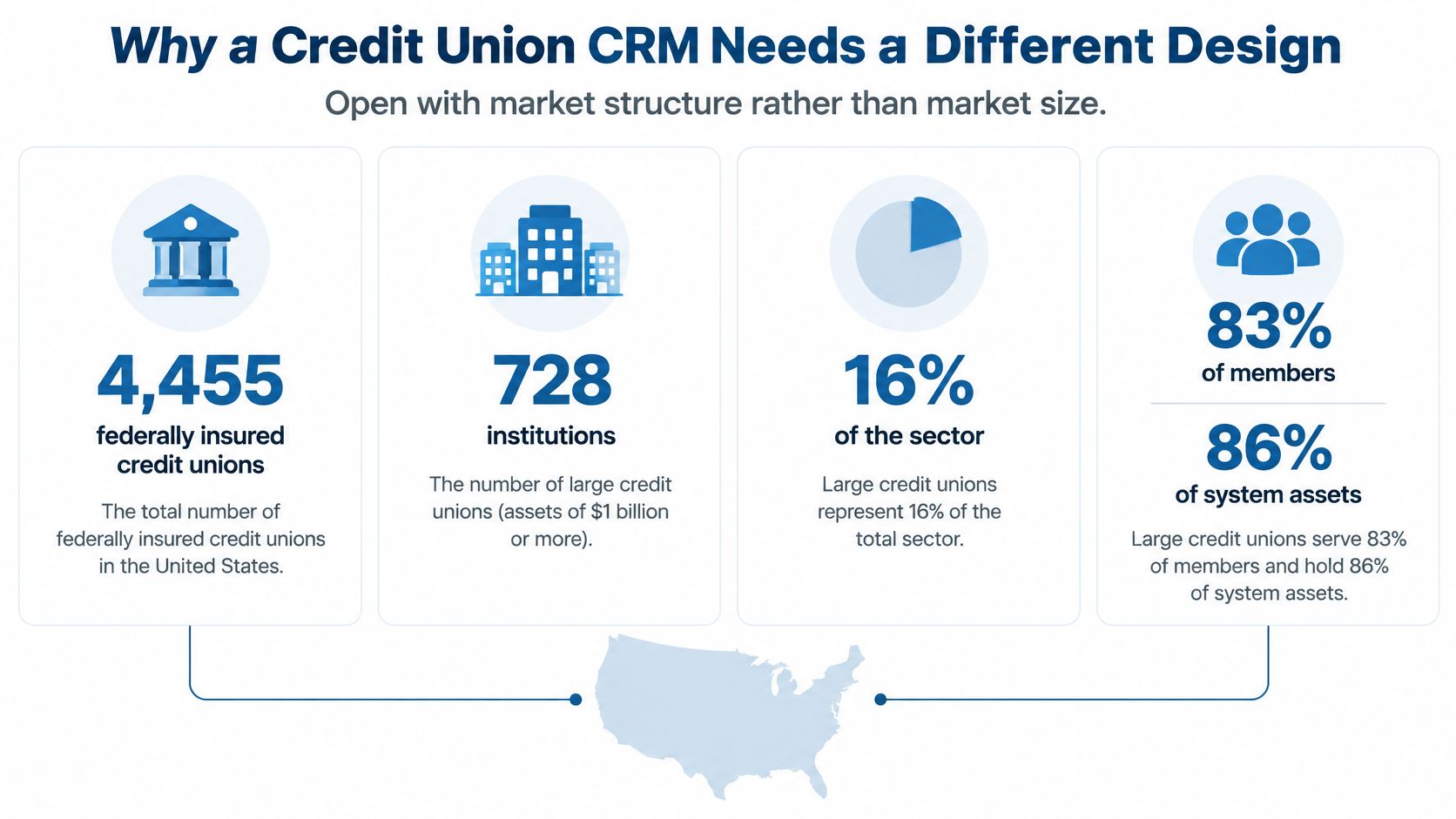
Market structure, not market size, should drive your design. The National Credit Union Administration 2024 annual report reported 4,455 federally insured credit unions serving 142.3 million members and holding approximately $2.31 trillion in assets as of December 31, 2024. Within that system, 728 institutions, only 16% of federally insured credit unions, accounted for 83% of members and 86% of system-wide assets.
That concentration creates two different buying problems. Large institutions need enterprise-scale member intelligence across broad product portfolios, multiple service teams, and high interaction volumes. Their central test is whether the CRM can unify many channels and business lines without creating another reporting silo or forcing staff to reconcile conflicting records manually.
Smaller institutions face a different constraint. They need the CRM to organize relationship histories, surface cross-sell opportunities, and preserve institutional knowledge with leaner staffs. Their central test is whether the vendor delivers usable queues, clean identity matching, and credible reporting without requiring a large internal analytics team to maintain the system.
Match the platform to your operating model
- Large credit union test: Can the CRM reconcile core, lending, digital, card, and service records at full volume while keeping permissions and household relationships accurate?
- Smaller credit union test: Can a branch manager or lender see the complete relationship, act on an alert, and log the outcome without analyst support?
- Board-level test: Can management connect CRM activity to member growth, product depth, balances, and service cost using definitions the finance team accepts?
Don't copy a design built for the largest institutions and assume it will work at a smaller credit union. The workflows, staffing model, integration burden, and acceptable cost per member are different. Conversely, a lightweight tool that works for a single-branch institution may fail when several lending teams and service centers need the same governed record.
Think of the CRM as a shared member ledger, not a rolodex. Every employee action should trace back to the same member record, and every change should update the institution's understanding of that relationship. Choose the simplest design that maintains that ledger reliably at your asset size, product breadth, and staffing level.
Building One Member View From Scattered Systems
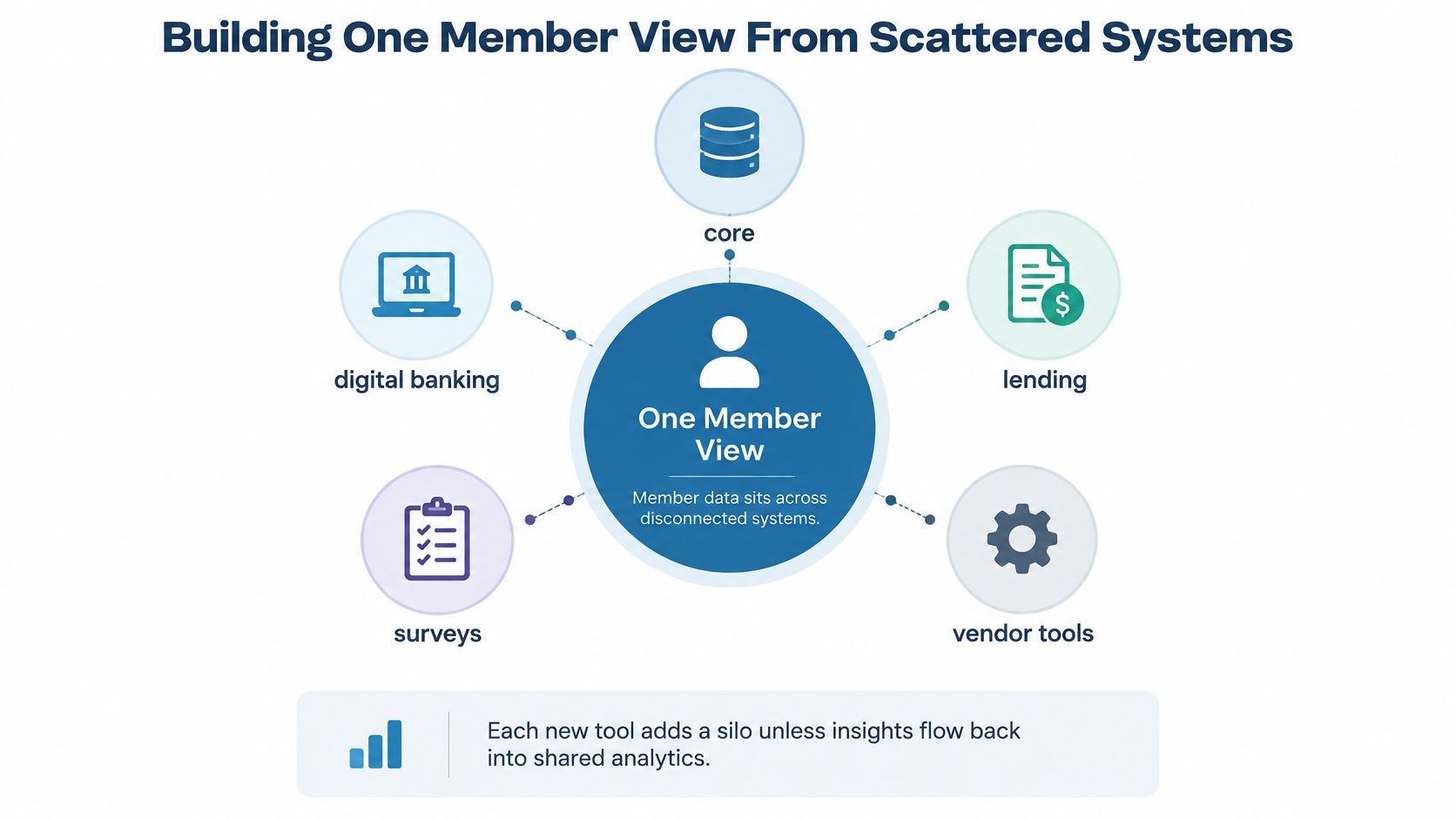
Your member data already exists. It's scattered across the core, digital banking, loan origination, card systems, surveys, coaching tools, and vendor platforms. Filene's review of member financial well-being measurement reports that member information commonly remains distributed across coaching systems, digital-banking engagement platforms, survey tools, and vendor environments, and insights often fail to flow back into enterprise analytics workflows. Each disconnected tool becomes another silo.
Treat the CRM as an integration and data-governance layer. Its job is to establish one canonical member identity, apply a governed data model, and move reliable signals into the workflows where employees act. Review your credit union core systems alongside the CRM shortlist, because the core's data model and integration options will constrain what the CRM can deliver.
Define the integration contract first
- Identity matching: Specify deterministic matches on member number or tax identifier, then define when probabilistic matching on name, address, phone, or email requires human review.
- Attribute ownership: Name the source system that owns each field, such as the core for balances and the loan system for application status.
- Freshness targets: Set an update expectation for each feed based on how staff will use it, and alert operations when a feed misses that target.
- Consent propagation: Send preference and authorization changes to every connected campaign, service, and analytics system.
- Reconciliation controls: Compare record counts, balances, product totals, and unresolved exceptions between source systems and the CRM.
Say a household appears once under a primary member in the core and again under a spouse in a survey platform. A periodic file import can leave that household split, send both records the same offer, and report two shallow relationships instead of one deep one. An event-driven design can reconcile the identity, attach the survey response to the household, and suppress duplicate outreach.
The same design difference affects timing. If a member submits a loan inquiry or stops using digital banking, a governed event feed can create a follow-up task the same day. A stale import may surface the signal after the member has funded elsewhere or disengaged further. For a practical primer on the mechanics behind this work, review the guidance on connecting CRM with your business apps before you write integration requirements.
Require every vendor signal to carry provenance, timestamps, and confidence scores. Staff should know which system produced a recommendation, how current the underlying data is, and whether identity matching was certain or probable. Track match rate, duplicate rate, pipeline latency, and the share of insights returned to frontline workflows. If those measures aren't visible, you don't have one member view. You have another dashboard.
Security, Consent and Audit Controls That Examiners Check
Member data is a regulated security boundary, not a marketing asset. Build the CRM specification accordingly. NCUA examiner guidance on systems and technology risk management identifies individualized user accounts, strong authentication and access controls, accurate audit trails, role-appropriate permissions, encryption in transit and at rest, continuous monitoring, and regular control testing as core practices.
Put the reporting clock in the specification from the start. NCUA's 2025 supervisory priorities state that federally insured credit unions must report qualifying cyber incidents within 72 hours and emphasize ongoing due diligence of critical service providers. Your CRM monitoring therefore needs to surface bulk exports, unusual query volume, privilege escalation, and failed authentication patterns quickly enough for management to investigate and decide.
| Control | What Examiners Expect | What the CRM Must Do |
|---|---|---|
| Access control | Individualized accounts, strong authentication, role-appropriate permissions | Least-privilege role-based access and automated deprovisioning on role change |
| Audit trails | Accurate, complete records of access and changes | Immutable logs of every read and change, with separation of duties for high-risk actions |
| Data protection | Encryption in transit and at rest | Field-level protection for sensitive personal data and encrypted transport |
| Incident monitoring | Continuous monitoring and reporting of qualifying incidents within 72 hours | Alerts on bulk exports, unusual query volume, privilege escalation and failed logins |
| Vendor and integration risk | Due diligence on critical service providers before data exchange | Scoped tokens, mutual authentication where appropriate and vendor-risk evidence on file |
| Consent and preferences | Member authorization tracked for each data-sharing request | Consent capture, revocation handling and reconciliation with source records |
Specify controls at field and action level
Role-based access by department isn't enough. A lender, collector, marketer, and contact-center employee need different fields, export rights, and approval authority. Apply field-level protection to sensitive personally identifiable information, separate duties for high-risk changes, and remove access automatically when an employee transfers or leaves. Integrations should use scoped tokens and encrypted transport, with vendor-risk assessments completed before member or behavioral data moves.
Consent creates scale quickly. Say a credit union has 20,000 members and 10% authorize a personal-finance integration. That's 2,000 member profiles requiring consent capture, revocation handling, third-party identification, and reconciliation between external feeds and internal account records. A spreadsheet or free-text note won't control that workload.
If you can't reconstruct what was shared, who authorized it, who received it, and when authorization ended, don't launch the integration.
The CFPB Personal Financial Data Rights rule announcement requires covered financial institutions to make specified consumer data available without charging a fee when the consumer requests access or authorizes a third party. Covered data includes transaction information, account balances, information needed to initiate payments, upcoming bill information, and basic account-verification information. Compliance is phased by provider size, so confirm your institution's phase-in date and any exclusion before scoping consent features.
Set a deployment gate and enforce it. Require current access reviews, penetration testing, incident-response playbooks, backup restoration tests, and complete lineage from source record to campaign or relationship-manager action. Also require evidence for any AI-assisted recommendation, including how the product functions, what data it uses, and how staff can challenge its output. No evidence, no production release.
How to Score CRM Vendors Against Credit Union Criteria
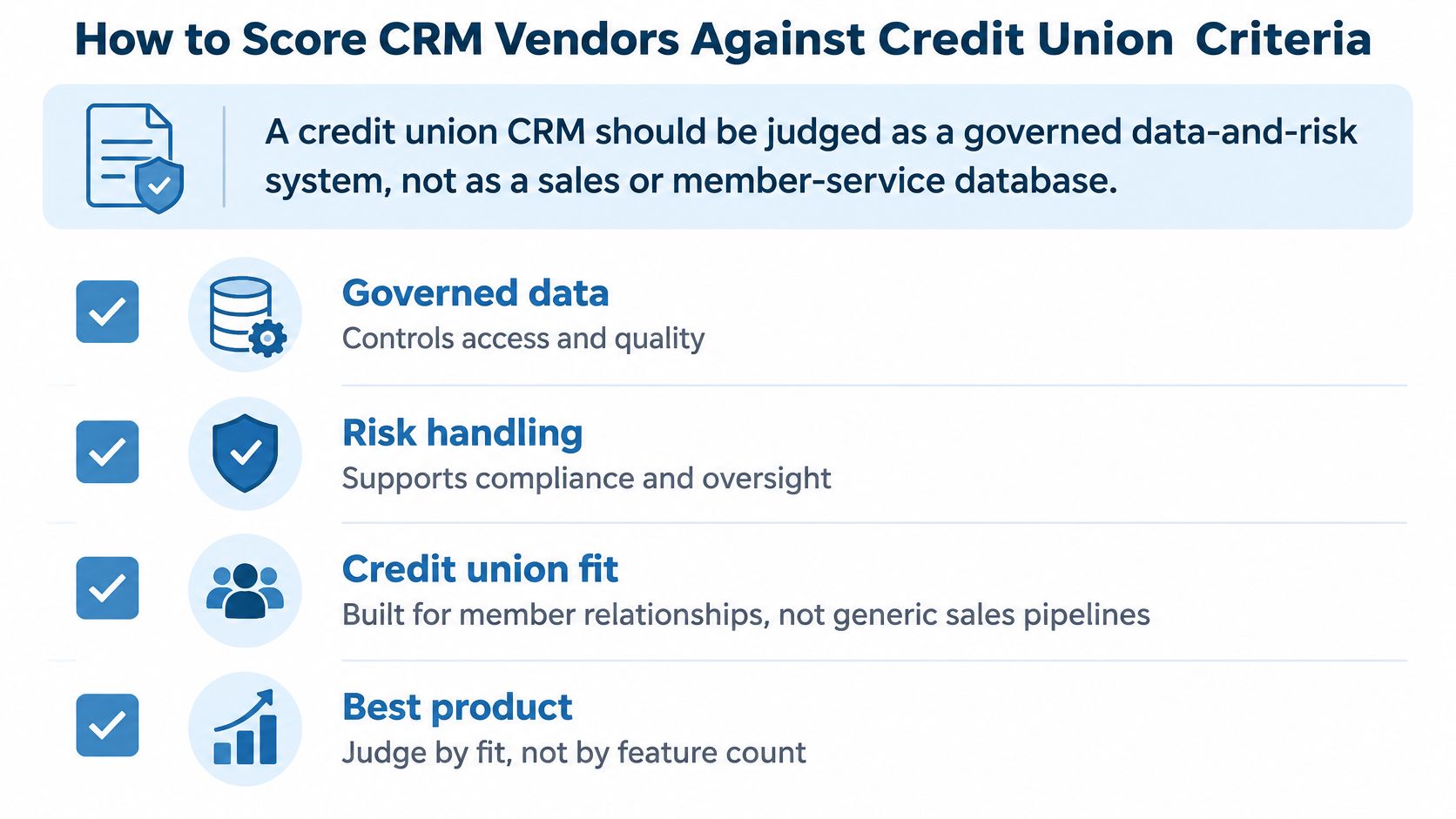
Judge a credit union CRM as a governed data-and-risk system, not as a sales or member-service database. The best product may not have the most automation. It may be the product that proves its data is accurate, permissioned, explainable, and usable when an examiner asks how a member received an offer or why an employee accessed a record.
Most demos emphasize campaign builders and a polished member view. Force the conversation deeper. Ask how the vendor reconciles core, loan-origination, digital-banking, and external prospect data, which fields require consent or restricted access, how staff can challenge a recommendation, and what evidence management should retain for AI-assisted outreach. Vague answers here predict implementation and examination problems later.
| Criterion | Strong Answer | Red Flag |
|---|---|---|
| Data lineage | Traces any field from source record to campaign or action | Cannot say where a field came from |
| Role-based access | Least-privilege roles with admin controls for the IT team | Shared logins or all-user admin rights |
| Audit and explainability | Complete change history and a reason for every recommendation | Recommendations with no visible rule |
| Vendor-risk evidence | Penetration test results, incident playbook and access review records | Evidence offered only on request after signing |
| Data model and integration | Documented identity matching and event-driven feeds to core and digital channels | Periodic file imports as the only option |
| Human routing | Defined rules that send sensitive cases to staff | Fully automated outreach with no override |
Weight governance before features
Assign the most points to data lineage, access control, auditability, and integration. Give campaign breadth and interface polish fewer points. A beautiful queue built on unreconciled data will produce faster mistakes, while a simpler queue built on trusted data can improve as workflows mature.
Score admin control explicitly. Can your IT team manage user access, roles, retention rules, and deprovisioning without filing a vendor ticket for routine changes? Can compliance export the complete history behind a recommendation without paying for a custom report? Can operations disable a faulty rule immediately? Those are purchase criteria, not implementation details.
Test human routing with uncomfortable cases. Route a member with a recent hardship discussion, an active fraud concern, a complaint, or a declined application through the proposed workflow. The vendor should show suppression logic, escalation to an employee, and a documented override path. Fully automated outreach with no human control should lose points, even if the automation library looks impressive.
Lock the weighting before demos begin, and require every evaluator to score the same live tests. Don't let a strong presentation erase a failed lineage export or a weak access model. Your decision record should show which vendor proved control, which one merely promised it, and why the selected platform fits your institution's risk and staffing model.
How to Roll Out a Credit Union CRM in Six Steps
Define the member count before any build. NCUA's Form 5300 call report instructions require every federally insured credit union to report the actual number of current members, not the number of accounts, in Account 083. The instructions separately require a reasonable and supportable estimate of potential members in Account 084.
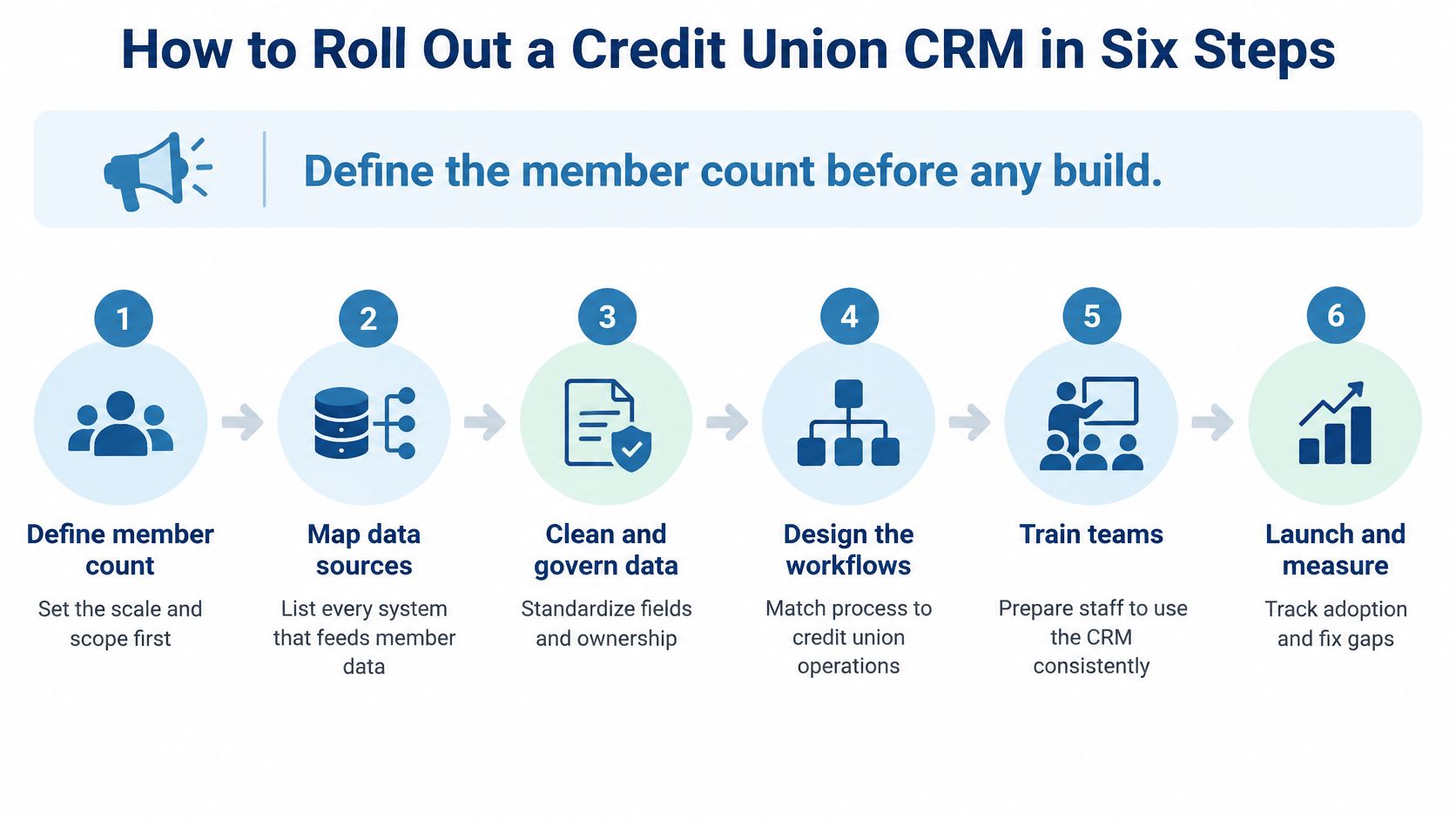
Define the member and the account. Use one member base for penetration, products per member, campaign eligibility, and board reporting. A household with checking, an auto loan, and a credit card remains one member for regulatory membership reporting. The common mistake is counting accounts as members, which inflates penetration and misleads directors.
Map source systems and name attribute owners. Inventory the core, digital banking, lending, cards, surveys, and service tools, then assign an internal owner for each critical field. Don't let the vendor own definitions your credit union must govern.
Set identity matching and freshness rules. Document exact-match fields, probable-match review, duplicate handling, and update targets for each feed. Run reconciliation reports during implementation and after launch. The common mistake is accepting periodic files that repeatedly split households.
Pilot one segment against a control group. Choose one branch, employer group, or product team and compare funded products, retained balances, and completed follow-ups with similar members outside the pilot. Don't judge success on clicks or tasks created.
Train frontline staff on action and override. Employees need to know what each alert means, what response is expected, when to escalate, and how to override a recommendation with a reason. As you document those workflows, evaluate the best knowledge base software options for keeping procedures, scripts, and escalation rules current. Without an override path, staff become order-takers and stop trusting the system.
Review controls and retire weak rules monthly. Inspect access changes, match rates, duplicate queues, audit exports, alert outcomes, and unresolved exceptions. Retire any rule that doesn't produce a measurable outcome or can't be justified to an examiner.
Keep the rollout narrow until the data proves itself. A clean pilot with trusted identities, trained staff, and measurable outcomes gives you a defensible case for expansion. A broad launch built on duplicate records and unexplained alerts creates rework in every department.
Measuring Relationship Value Beyond Engagement Metrics
Adoption counts and campaign clicks don't prove CRM value. They show activity. Executives need to know whether the platform increases funded loans, deposits, retained balances, and member retention after accounting for staff time and servicing cost. If a dashboard can't connect an alert or campaign to one of those outcomes, treat it as operational reporting, not evidence of return.
Institution-level measurement matters because sector averages can hide weak performance. NCUA's 2026 second-quarter data summary reported 4,214 federally insured credit unions with 146.1 million members as of June 30, 2026, and membership increased by 2.3 million over the preceding year. Yet median credit-union membership declined 0.6% over the same period. Your CRM must distinguish acquisition, attrition, dormancy, product penetration, and changing member activity at your institution, not hide behind system growth.
| Metric | What It Measures | Signal of a Working CRM |
|---|---|---|
| Qualified opportunities per relationship manager | Qualified leads reaching each manager | Rising count with stable manager workload |
| Conversion by product and segment | Share of offers that become funded products | Gains concentrated in segments the CRM targets |
| Balances retained | Deposits and loan balances kept after a trigger event | Fewer balance exits after alerts are actioned |
| Time to next-best action | Delay between a trigger and the staff response | Shorter delay on high-value triggers |
| Revenue net of servicing cost | Income from CRM-driven activity after service costs | Positive net return by segment and branch |
Test outcomes, not enthusiasm
Compare targeted members with a similar control group whenever the workflow permits it. Report results by product, segment, geography, channel, and branch so management can see where the CRM creates value and where it merely creates work. This is also where disciplined measurement supports improving customer lifetime value, because retained balances and additional funded products matter more than a temporary lift in message engagement.
The demand for better measurement is clear. In Wipfli's 2025 survey of more than 100 U.S. credit-union executives, 58% identified improving digital customer engagement as a top strategy, 57% cited data analytics or AI, and 90% said they use AI-based tools or plan to adopt them within 12 months. Those priorities make governance more important, not less. Poorly governed segmentation can increase privacy, bias, vendor, and fraud exposure while producing engagement numbers that look impressive and contribute little income.
Keep sensitive cases with a person. Hardship, fraud, complaints, complex lending, and signs of financial distress require judgment and documented human review. Measure those workflows on resolution quality, timeliness, and member outcome, not automation volume. A CRM earns its cost when managers receive better opportunities, act faster, retain more balances, and can prove the result segment by segment.
Benchmark Your Relationships Before Your Next Vendor Demo
Before the next vendor demo, establish where your credit union stands against similar institutions. Don't let a vendor define the problem using generic engagement benchmarks. Start with your own member growth, product depth, loan growth, delinquency, liquidity, and capital position relative to peers of comparable asset size and market composition.
NCUA's quarterly credit union data summary is built from Form 5300 Call Reports submitted by all federally insured credit unions, making it a consistent supervisory source for benchmarking liquidity, capital, loan growth, delinquency, membership, and other operating measures. Use that peer view to decide which relationship problems the CRM must solve first. Then use internal CRM data to locate the employer groups, branches, products, or relationship managers behind the variance.
Say two credit unions report similar asset sizes, but one produces stronger membership growth and lower delinquency. Ask whether the gap reflects market mix, underwriting, product mix, pricing, or follow-up discipline. If peer data shows weaker member growth but sound credit performance, prioritize identity quality, onboarding, and qualified opportunity queues. If delinquency is the outlier, prioritize service history, hardship routing, and documented follow-up over new campaign automation.
Three actions before you shortlist
- Pull the peer set: Select institutions by asset size and relevant operating characteristics, then identify the relationship measures where you lag or lead.
- Score every vendor the same way: Apply your governance, lineage, access, integration, and human-routing criteria to live demonstrations using your sample records.
- Require proof in the demo: Make each vendor trace one field from source to action, export one member's audit trail, and explain one recommendation.
Our data covers credit unions as well as banks, and customers can benchmark banks and credit unions side by side with a couple of clicks. Use credit union data analytics to connect peer financial performance with the relationship outcomes your CRM investment must improve. That turns the purchase discussion from feature preference into an evidence-based decision about resource allocation, risk, and member growth.
Benchmark your credit union against relevant peers before you commit to a CRM, using regulatory financials and institution-level trends to identify where relationship performance is lagging. Visbanking brings bank and credit union intelligence together so your team can compare performance, prioritize opportunities, and set measurable targets for the platform you select.
Latest Articles
Brian's Banking Blog
Bank Benchmark Rate: How Banks Price and Compare
Brian's Banking Blog
Predictive Risk Analysis for Bank Decisions
Brian's Banking Blog
Data Pipelines with Apache Airflow for Banks

Brian's Banking Blog
Bank Shares Performance: Metrics That Drive Returns

Brian's Banking Blog
Help to Identify Bank Prospects and Risk Signals
Brian's Banking Blog