
ML Pipeline Example for Bank Intelligence
Brian's Banking Blog
A board meeting is approaching, and the numbers look polished. A portfolio-risk model has a strong offline score, the dashboard refreshes on schedule, and the prototype is ready for production. Then a source system changes its schema, a late-arriving record shifts a feature, or the serving environment applies a different transformation than the training job. The model keeps returning predictions, but the bank can no longer explain whether those predictions are current, consistent, or safe to use.
That is why an ML pipeline example for banking must be more than a training script. Executives need a controlled workflow that connects data ingestion, feature logic, model decisions, monitoring, ownership, and audit evidence. The question isn't whether a model can produce a result in a notebook. The question is whether the bank can rely on that result when a relationship manager prioritizes a prospect, a risk team reviews an institution, or a director asks how a signal was produced.
Why Bank Executives Need Production-Grade ML Pipelines
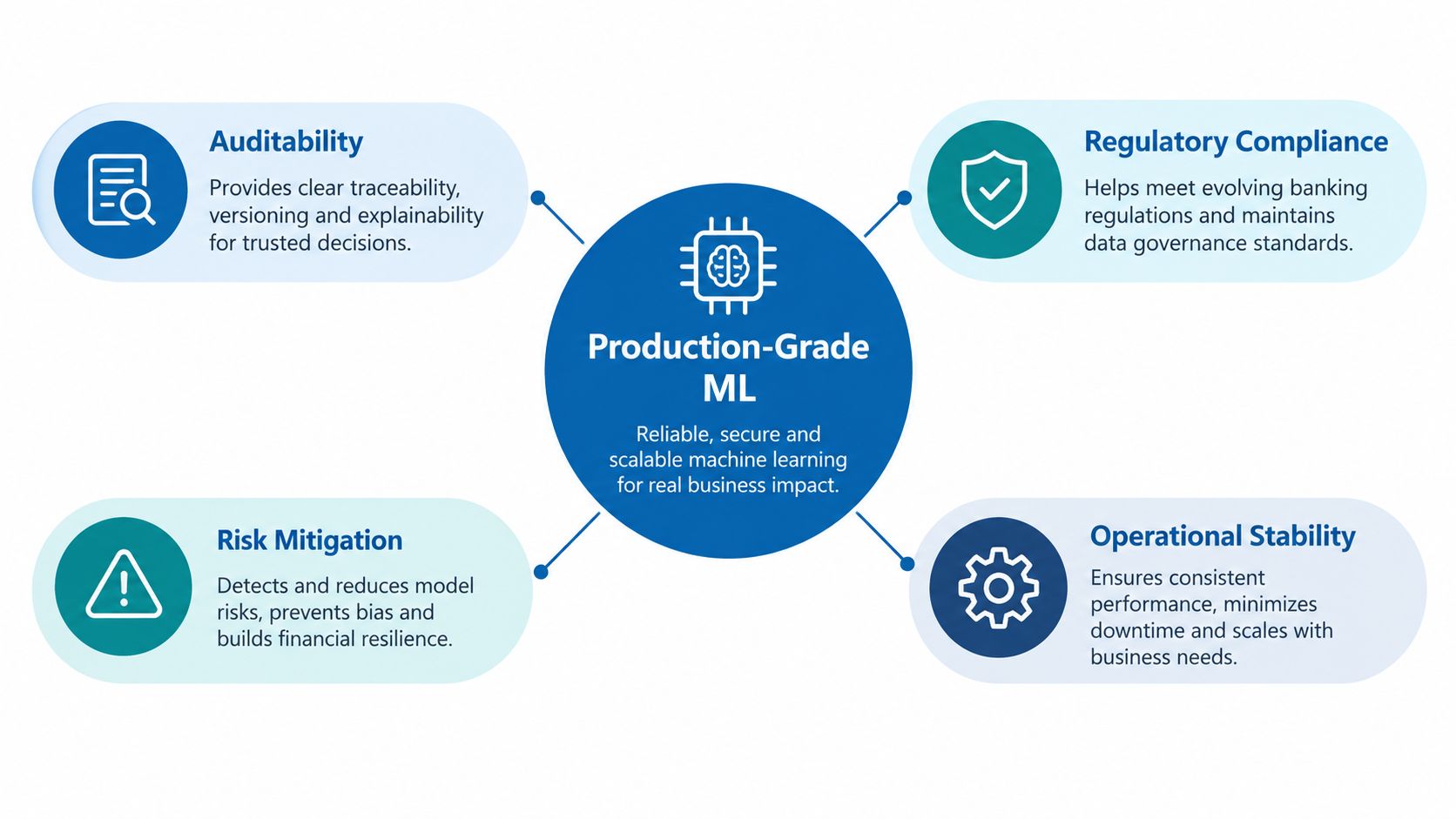
A model can pass validation and still fail during a credit review, portfolio assessment, or relationship-prioritization workflow. A changed source field, late record, inconsistent transformation, or unanswered alert can make a prediction difficult to reproduce when an executive, auditor, or risk officer asks how it was produced.
Most introductory ML pipeline examples stop at training. They show records entering a transformation step, a model returning a score, and an accuracy result. That sequence teaches the mechanics, but a bank needs a controlled workflow that preserves lineage, assigns ownership, records approvals, and detects operational failure after deployment.
MLOps formalized the shift from manual, script-based model building to managed model lifecycles. The 2015 paper, Hidden Technical Debt in Machine Learning Systems, by Sculley et al. helped establish the engineering case for reproducibility, version control, dependency management, and monitoring. IBM described MLOps as an assembly line for building and running ML models, with data processing, feature selection, training, deployment, and monitoring treated as connected stages.
The production baseline
A bank-grade pipeline should answer five questions before its output enters a business process:
- What entered the system? Record the source, ingestion time, schema, validation outcome, and processing status.
- What changed the data? Version feature definitions, transformations, parameters, and dependencies.
- Why was this model promoted? Attach evaluation results, approval records, and the model artifact.
- What happens after release? Monitor inputs, predictions, drift, serving health, and alert status.
- Who owns the response? Assign a team to investigate failed checks, stale data, unexpected predictions, and rollback decisions.
The difficult work usually begins after the first release. Empirical research on production machine learning pipelines shows that deployed workflows require sustained maintenance and operational attention, not a one-time training exercise. The study of production machine learning pipelines provides evidence for evaluating pipeline activity as an ongoing engineering responsibility.
Executive test: If a team can show model accuracy but cannot show data lineage, feature versions, alert history, approval records, and rollback criteria, the bank has a prototype rather than a production pipeline.
This standard should guide how leaders assess machine learning in financial services. Executives can also compare workflow automation with governance requirements by reviewing Agentic AI implementation examples.
Building an ML Pipeline Example from Banking Data Sources
A credit team may need to assess a borrower before the latest regulatory file is complete, while compliance still requires a defensible record of every input. That tension shapes a useful ML pipeline example. Start with source discipline, not algorithm selection. A banking workflow may combine FDIC call reports, HMDA loan/application registers, UCC filings, SEC/EDGAR records, SBA program data, and macroeconomic series. Each source has different update schedules, field conventions, ownership, and compliance implications. Combining them without explicit controls creates uncertainty before modeling begins.
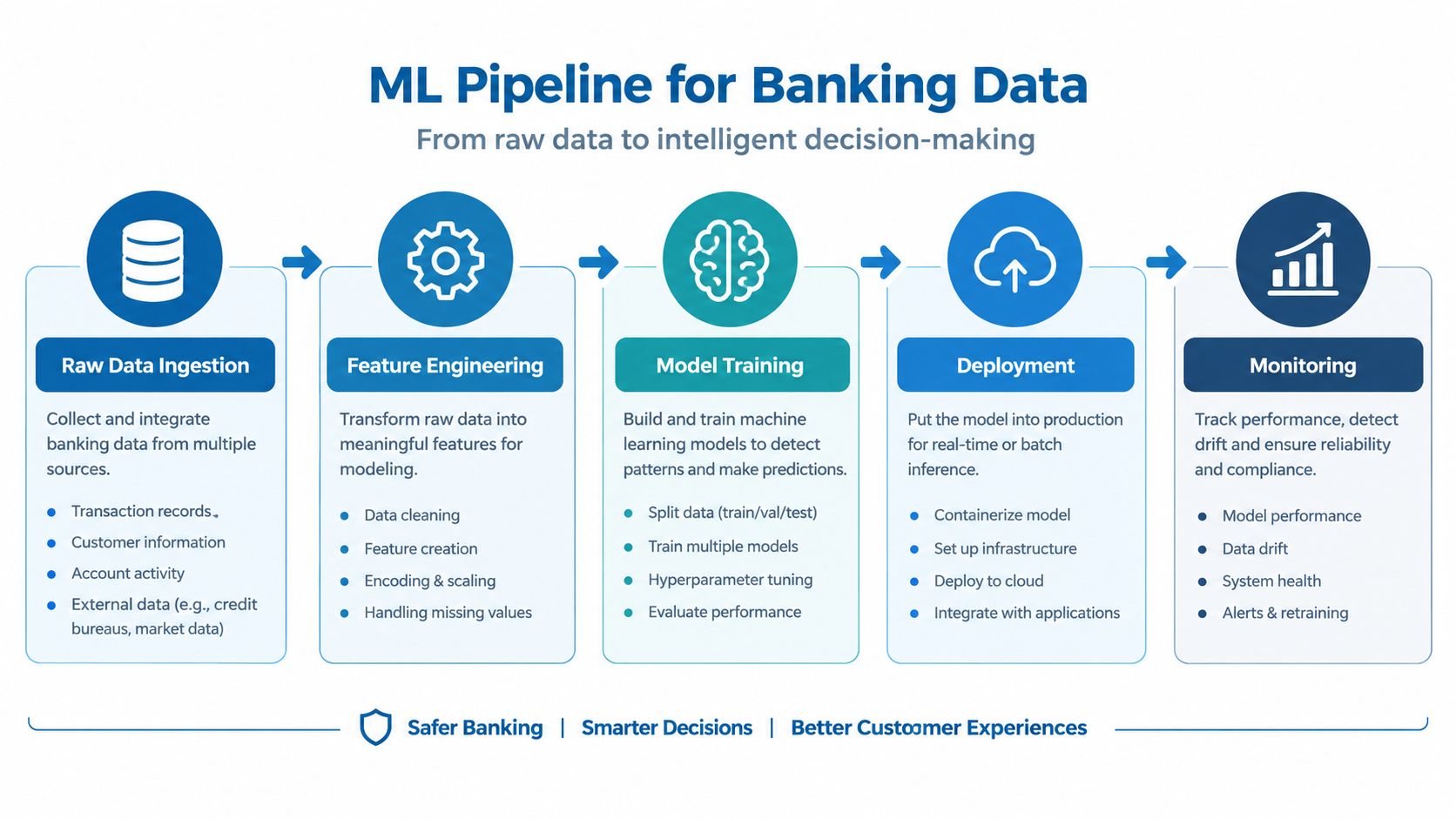
A production architecture should pass through five controlled stages:
- Ingest raw records. Preserve source files or responses in their original form. Add source identifiers, ingestion timestamps, and processing status. A normalized table cannot show exactly what the bank received when a decision was made.
- Validate and normalize. Run schema checks, required-field tests, type validation, duplicate detection, and date controls. Keep rejected records visible and route them to an exception queue.
- Reconcile entities. Map institutions, borrowers, facilities, products, and counterparties to stable internal identifiers. A technically healthy model can still produce unusable intelligence if it joins the wrong institution.
- Create versioned features. Build features from approved transformations with event timestamps and effective dates. Historical snapshots must remain separate from current values, so training data does not include information unavailable at decision time.
- Publish decision-ready datasets. Expose validated outputs for training, reporting, peer comparison, prospecting, and risk workflows. Models should consume a traceable dataset version rather than an unexamined database query.
Filing mechanics affect architecture
HMDA demonstrates why regulatory requirements belong in pipeline design. Its filing rules affect accepted file structure, reporting calendars, validation logic, exception handling, and retention. Teams should confirm current requirements against official HMDA and agency documentation before implementing controls. The CFPB's reference materials cover reportable HMDA data and annual reporting expectations.
Call Report data presents a different control problem. It supports bank analysis, peer comparison, and regulatory supervision, so the pipeline must preserve reporting periods, revisions, and institution identifiers. Google Cloud's MLOps pipeline architecture guide is a vendor reference for continuous delivery and automation patterns, not FFIEC documentation. For broader production-tool comparisons, this overview of MLOps frameworks and production tools can help teams assess orchestration, monitoring, and deployment choices.
Batch and streaming paths also require parity. If a daily regulatory batch calculates institution trends while a live service calculates current signals, both paths need shared definitions, comparable validation, and clear handling for late or revised records. Otherwise, offline model performance can conceal inconsistent production behavior.
A practical implementation makes every handoff observable. A malformed file, changed SEC field, or incomplete macroeconomic series should create a visible exception with an owner and resolution status. This guide to building data pipelines provides useful context for separating ingestion, transformation, quality control, and delivery instead of hiding all logic inside one scheduled job.
Designing a Feature Store for Bank Intelligence
Feature engineering is where many banking prototypes become unreliable. A data scientist may calculate a deposit-growth feature in a notebook, save the result, and later reproduce a similar calculation in a serving service. The two calculations can differ in date boundaries, missing-value treatment, entity joins, or treatment of late records. The model still runs, but the training evidence no longer matches the live input.
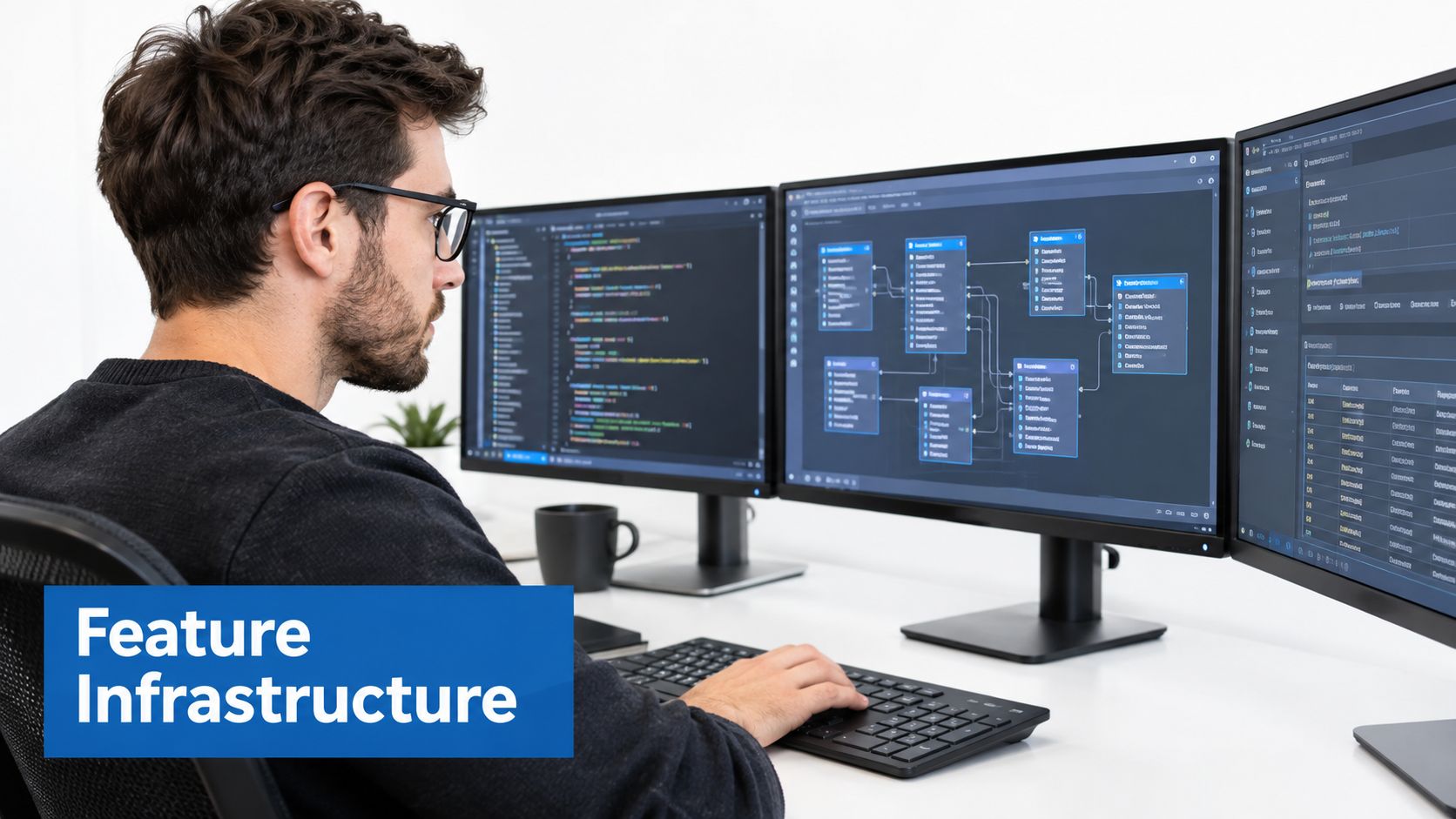
A feature store addresses this by centralizing the definition, storage, and access of ML features. The same transformation used for historical training can be reused at serving time, reducing training-serving skew. Google's MLOps guidance describes feature stores as supporting both high-throughput batch serving and low-latency real-time serving, and lists them as an optional but important component of level 1 ML pipeline automation, as reflected in this feature store overview.
One definition, two serving paths
Bank intelligence often needs both historical analysis and current signals. A batch path might calculate institution-level trends from periodic regulatory data. A streaming or low-latency path might update an alert when a new transaction event, relationship signal, or market observation arrives.
The design should keep the feature logic common while allowing the storage and serving mechanism to differ:
- Batch features use point-in-time joins, historical snapshots, and reproducible backfills for model training and retrospective analysis.
- Streaming features use event timestamps, deduplication keys, watermarks, and controlled handling of late-arriving records for current decisions.
- Reconciliation rules specify whether a late record updates the historical feature, the online value, or both.
- Schema controls define how the system responds when a source adds, removes, or changes a field.
Time alignment deserves executive attention because temporal leakage can make a model appear persuasive while giving it information that wasn't available when the decision occurred. For example, a risk feature should use the information available at the decision timestamp, not a later corrected value that entered the warehouse during a backfill.
Version the feature definition, source fields, transformation code, timestamp policy, and serving configuration together. Log the feature values used for material decisions where privacy and retention policies permit it. The feature store guidance for financial services provides a useful frame for treating feature logic as governed infrastructure rather than disposable analytical code.
Avoiding Training-Serving Skew and Offline Accuracy Traps
A model can perform well against a static test set and still fail in production. Offline accuracy measures behavior under the conditions represented in the test data. A live bank system must also handle changing source distributions, bursty workloads, fault tolerance, tail-latency requirements, missing values, and operational outages.
The MLSys Book discussion of benchmarking warns that narrow benchmarks can mislead teams when they don't represent the actual production workload. This is especially important when executives compare models solely by an offline metric. A slightly stronger test result may matter less than consistent features, predictable serving behavior, and a clear response when the data changes.
Compare the two environments
Training and serving should be tested as two views of the same decision system:
| Training environment | Serving environment |
|---|---|
| Historical records and point-in-time joins | Current records and online feature retrieval |
| Batch transformations | Batch or low-latency transformations |
| Known schema and complete test inputs | Evolving schemas and incomplete inputs |
| Offline evaluation metrics | Latency, availability, drift, and prediction behavior |
| Reproducible dataset snapshot | Logged request, feature, and model versions |
Training-serving skew is a practical failure mode, not a theoretical concern. One production survey-style summary reports that inconsistencies between training and serving environments account for the majority of production ML failures, with feature inconsistency described as nearly half of breakdowns. The exact proportions vary by study, but the engineering implication is consistent: feature definitions, dataset versions, and environment parity deserve more attention than adding model complexity.
Before promotion, require quality gates that test the whole path:
- Schema gate: Reject unexpected types, missing required fields, and incompatible dimensionality.
- Parity gate: Run identical records through training and serving transformations, then compare feature outputs.
- Workload gate: Test realistic volume patterns, fault conditions, and response-time behavior.
- Drift gate: Monitor input distributions and prediction distributions after release.
- Rollback gate: Define the conditions that return traffic to an approved model or suspend automated action.
Monolithic evaluation scripts don't age well. A changed field, new category, missing value, or model-specific limitation can break an otherwise opaque test process. Modular checks make failures attributable, which allows a bank to correct the source or transformation instead of retraining and hoping the score improves.
MLOps Practices That Make Banking Pipelines Auditable
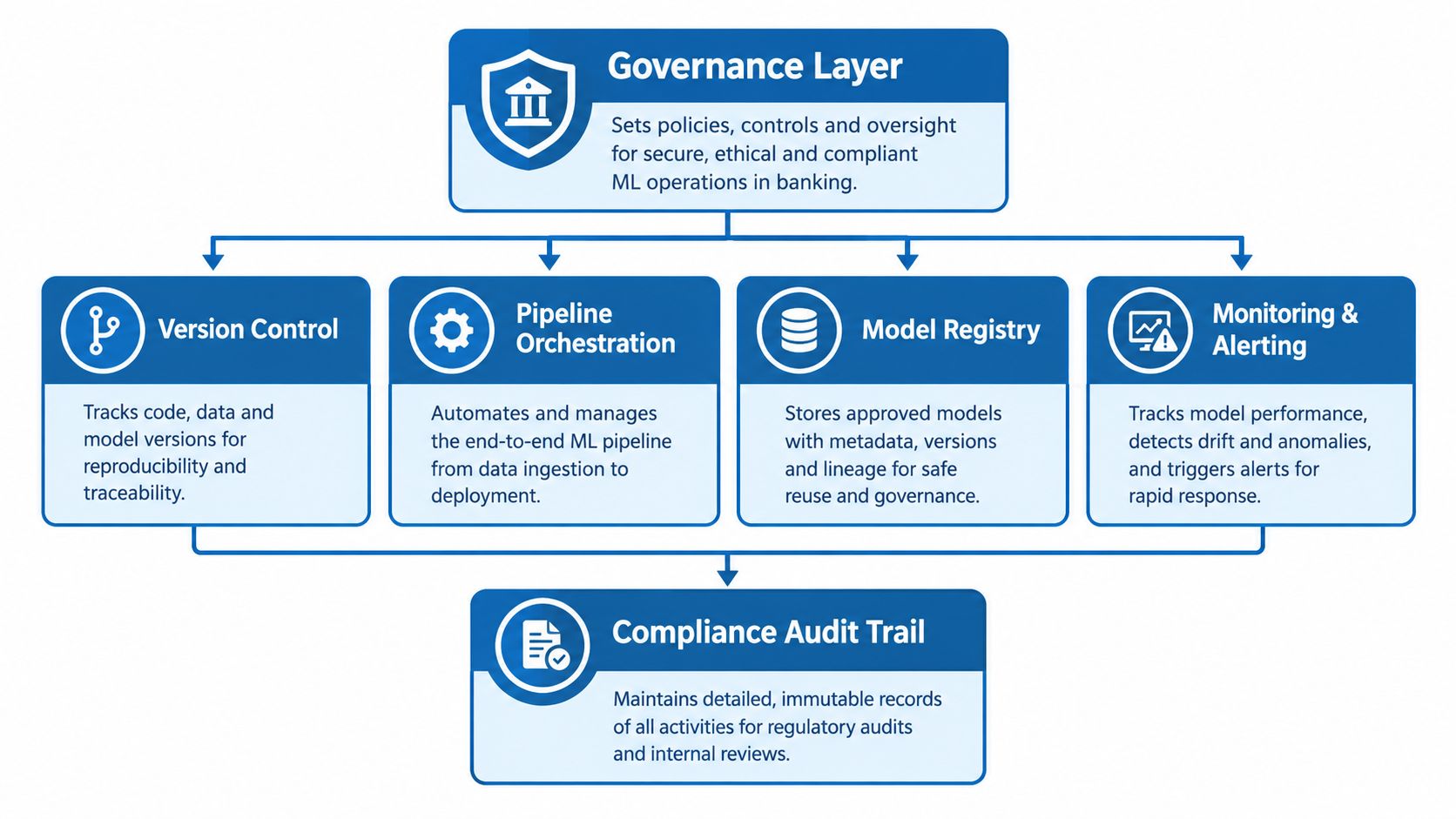
A bank intelligence pipeline becomes auditable when every production prediction can be traced to the inputs and decisions that produced it. Version the dataset, feature definitions, parameters, model artifact, software dependencies, evaluation results, deployment configuration, and approval record. This record gives executives a way to distinguish a controlled service from a prototype that happens to run.
Governance controls also protect reliability. Automated checks should stop promotion when data quality falls below an agreed threshold. An approval workflow can route material model changes to risk, compliance, or the business owner. A rollback process should restore a previously approved artifact without reconstructing the release from memory.
Freshness has a cost
Continuous retraining can increase data movement, validation work, compute usage, review requirements, and downstream operational impact. Incremental loads improve freshness while limiting processing volume. Full loads simplify reconciliation and help recover from upstream corrections, but they can consume more resources and lengthen processing windows.
Choose the loading pattern from the decision latency, source behavior, correction frequency, and consequences of stale data. A risk alert based on rapidly changing information may justify frequent updates. A peer benchmark built from periodic regulatory filings may need stronger completeness and reconciliation controls than constant refresh.
Batch and streaming paths also require shared definitions. Timestamps, late-arriving records, deduplication rules, and schema changes must produce consistent results offline and online. Otherwise, a pipeline can pass a training test while serving different evidence at decision time.
Build the evidence trail
A mature workflow should capture:
- Quality results: Store validation outcomes, rejected records, and exception resolution.
- Promotion evidence: Keep approval decisions, evaluation results, and model lineage with the artifact.
- Runtime telemetry: Log service health, input distributions, prediction behavior, and alert state.
- Retraining triggers: Define whether drift, new labels, source changes, or scheduled review starts retraining.
- Rollback conditions: Specify which failures suspend a model, revert a version, or route a decision to a human.
Production pipelines are long-lived systems. Research on pipeline activity found an average active lifetime of 36 days, with some systems operating throughout a 130-day observation window, and reported more than 1.9 times growth in pipeline activity in GitHub-based datasets, according to the production pipeline study. Feature stores likewise became a more established part of the tooling ecosystem as production platforms expanded, including Uber's Michelangelo.
For a broader governance comparison, MLOps for auditable systems explains how operational controls differ from conventional software delivery. A model registry without monitoring is incomplete. Monitoring without a named owner is only a dashboard. Auditable banking ML requires both evidence and accountability.
Turning an ML Pipeline Example into Actionable Bank Intelligence
A pipeline earns its place in a bank when it improves a decision, not when it produces a model artifact. The same controlled workflow can support peer benchmarking, prospect identification, relationship prioritization, risk forecasting, and automated alerts, provided the data is timely, the features are explainable, and the output reaches the team responsible for acting.
The common linear diagram, ingestion, feature engineering, training, evaluation, deployment, and monitoring, hides the hardest design issue. Banking systems often need batch and streaming inputs at the same time. The team must keep feature definitions, timestamps, late-arriving records, and schema changes consistent across offline training and online inference. Recent architecture guidance highlights schema evolution, deduplication, real-time features, and centralized feature stores as controls against skew, while noting that toy pipelines can fail through temporal leakage, backfills, or changing source systems in regulated environments, as discussed in this MLOps interview and architecture guide.
From signal to operating decision
A bank intelligence workflow can connect each pipeline stage to a business action:
- Peer benchmarking: Normalize regulatory and financial data so leaders can compare institutions using consistent periods and definitions.
- Prospect identification: Combine institutional signals with relationship, product, UCC, SBA, and market context to prioritize outreach.
- Risk monitoring: Score changes in performance or exposure, then route exceptions to risk owners with the underlying feature lineage.
- Relationship management: Deliver current signals through approved channels instead of requiring every user to inspect a static dashboard.
- Executive oversight: Show source freshness, model version, alert history, and unresolved data exceptions alongside the recommendation.
Visbanking's Bank Intelligence and Action System is one example of this operating approach. It unifies financial, regulatory, market, and people data across sources such as FDIC Call Reports, FFIEC and UBPR, NCUA 5300, SBA program data, UCC filings, SEC/EDGAR, BLS/BEA macro series, and HMDA, then supports decision-ready analytics, production pipelines, feature stores, observability, secure APIs, and workflow integrations. Its applications connect peer benchmarking, prospect and relationship intelligence, talent workflows, and predictive risk or performance signals with delivery through email, Slack, and CRM systems.
The evaluation standard for executives should remain practical. Ask whether the pipeline preserves raw inputs, validates every handoff, prevents temporal leakage, serves batch and streaming use cases consistently, records approvals, detects drift, and routes outputs to a named decision owner. If those controls are missing, a more refined algorithm won't solve the underlying operating problem.
Visbanking helps banks and credit unions turn multi-source financial and regulatory data into auditable pipelines, predictive signals, peer benchmarks, and workflow-ready intelligence. Visit Visbanking to benchmark your institution, explore decision-ready data, and connect production analytics to the teams responsible for growth and risk.
Latest Articles
Brian's Banking Blog
How to Secure REST API with JWT for Banking
Brian's Banking Blog
Commercial Loan Analysis: A Bank Executive's Guide
Brian's Banking Blog
Understanding Statistical Significance in Banking
Brian's Banking Blog
Option Adjusted Spread: A Banker's Practical Framework
Brian's Banking Blog
How to Improve Margins: A Bank Leader's Playbook
Brian's Banking Blog