
FDIC Call Report Software: What Bank Executives Need to Know
Brian's Banking Blog
By 2005, the FFIEC required approximately 6,127 banks to file quarterly Reports of Condition and Income electronically in XBRL, and 95% of submitted data met FFIEC validation requirements. That record proves modern FDIC call report software is no longer just a form-completion utility. It is compliance automation and a foundation for real-time decision intelligence.
The counterintuitive point is that the filing itself is only the visible output. The greater executive value sits upstream, where software validates data, identifies exceptions, preserves an audit trail, and turns regulatory information into insight about capital, liquidity, profitability, lending, and competitive position. Banks that treat the quarterly report as a deadline will keep fighting recurring fire drills. Banks that treat it as a controlled data system can improve both supervisory readiness and commercial judgment.
Understanding Modern FDIC Call Report Software
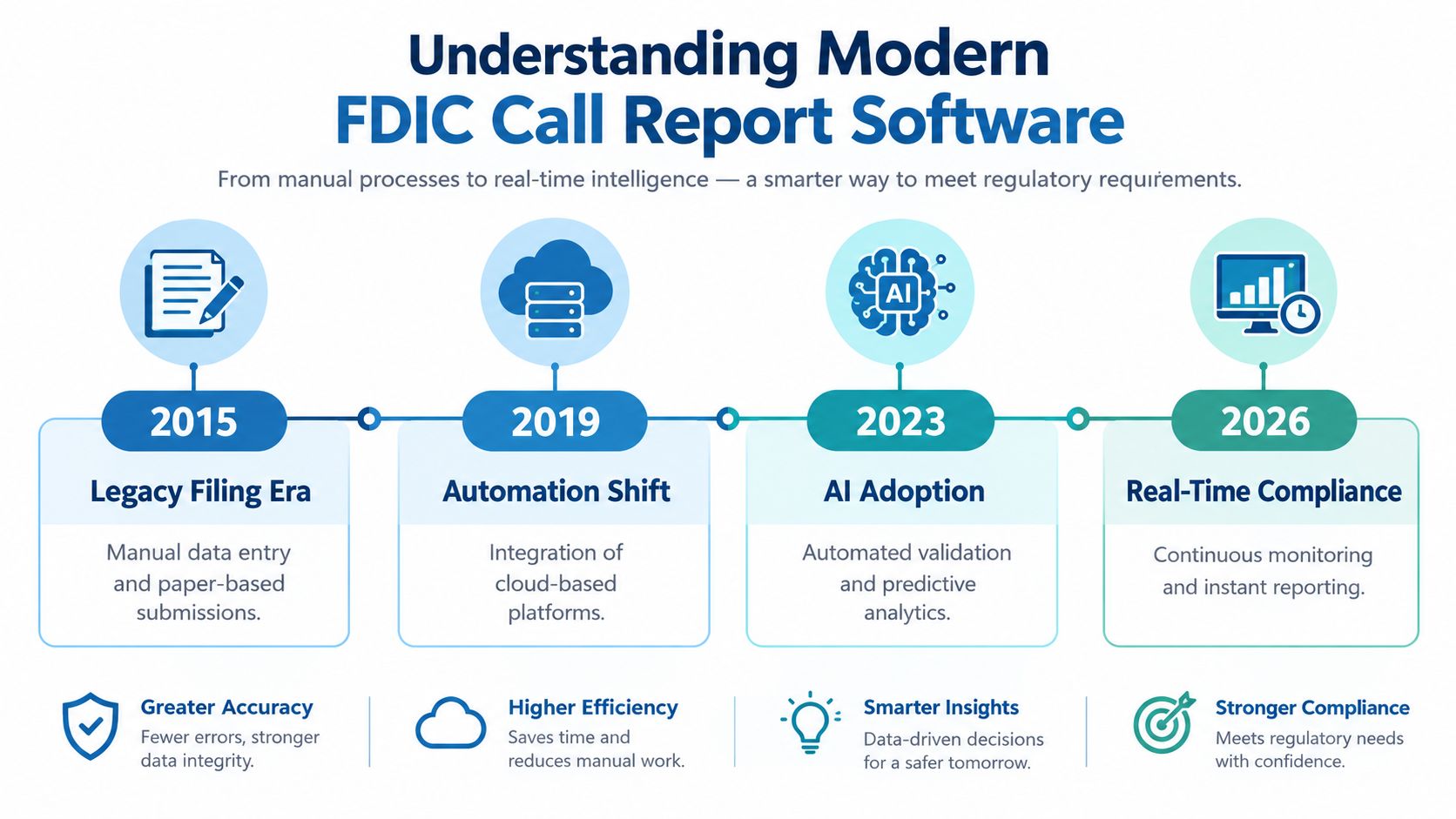
The decisive shift happened when the banking industry moved from fragmented, manual reporting into a shared electronic infrastructure. By 2005, the FFIEC required banks under its jurisdiction to submit quarterly reports in XBRL, covering approximately 6,127 banks. The transition improved both accuracy and speed. 95% of submitted data met FFIEC validation requirements, 100% met mathematical validation requirements, and legacy-system mathematical validation stood at 70%, while public data became available immediately after quarter-end instead of weeks later, as documented in the history of FDIC reporting in XBRL.
That infrastructure is the Central Data Repository, or CDR, shared by the FDIC, Federal Reserve, and OCC. Every national bank, state member bank, and insured nonmember bank must file a Call Report at the close of business on the last day of each calendar quarter. The institution can submit directly through computer software or use a vendor-assisted paper-to-electronic conversion process, but the resulting file still has to meet the CDR's technical requirements.
The software is part of the control environment
A compliant platform does more than collect balances. It maps source data to the required taxonomy, applies validity edits, runs quality edits, generates a CDR-processable file, and records who changed what and why. If the structure or edit logic fails, the CDR can reject the filing workflow before acceptance.
Executives should distinguish two types of controls:
- Validity edits prevent logically or mathematically unacceptable submissions from moving forward.
- Quality edits flag information that may be unusual or inconsistent and require an explanation when unresolved.
That distinction matters during examination. A system that merely highlights an error leaves staff to diagnose and document it manually. A production-grade system gives the preparer a clear message, routes the exception, preserves the response, and maintains the evidence needed for review.
A useful starting point for executives is the FDIC Call Report instructions and filing guidance. The right question isn't whether the bank can complete a form. It's whether the software can protect the integrity of the data before the form ever reaches the CDR.
Practical rule: Buy software that treats filing acceptance, traceability, and management insight as one workflow. A faster data-entry screen isn't enough.
Core Technical Requirements and Validation Standards
The technical standard is straightforward: software must produce a file the CDR can process, and it must help the bank resolve the edits that stand between source data and acceptance. Banks may use vendor software or build their own, but either approach must support FFIEC validity edits, quality edits, and compliant output generation. The FFIEC general instructions for Call Report preparation make the dependency clear. Front-end data entry and downstream acceptance are inseparable.
The evaluation should begin with the validation engine, not the user interface.
What production-grade software must do
A serious platform should:
- Validate in real time. The system should identify an invalid relationship while the preparer is entering or importing data, not after a file has been assembled.
- Explain the exception. Error messages should tell staff which field, relationship, or calculation requires attention.
- Separate hard failures from explainable conditions. A validity edit can stop a submission. A quality edit may require a documented explanation. The workflow must handle both.
- Preserve submission integrity. The final file should reflect approved source data, completed edits, explanations, and authorized changes.
- Create a defensible audit trail. Management and examiners should be able to reconstruct the preparation and approval process.
The FFIEC publishes criteria for vendors whose products have been successfully tested, and current FDIC materials identify multiple products that meet the CDR processing specification. The benchmark isn't a marketing label. It is whether the software can consistently pass the relevant validation requirements while retaining a complete quarterly record. The FFIEC's published FFIEC 051 reporting form and validation material provides an appropriate reference point for vendor diligence.
Put document review in the right place
Call Report preparation involves instructions, schedules, edit messages, internal policies, and supporting documentation. A document-analysis service such as LegesGPT AI document analysis can help compliance teams extract obligations and compare language across those materials. It shouldn't replace the bank's filing controls, but it can reduce the time spent searching for the rule behind a question.
Ask vendors to demonstrate a complete exception from source import through final approval. Don't accept a slide showing a green validation badge. Require the vendor to show the original value, the failed edit, the corrective action, the explanation, the approval, and the retained record. That demonstration reveals whether the product supports compliance operations or only makes data entry look modern.
Required Data Inputs and Integration Architecture
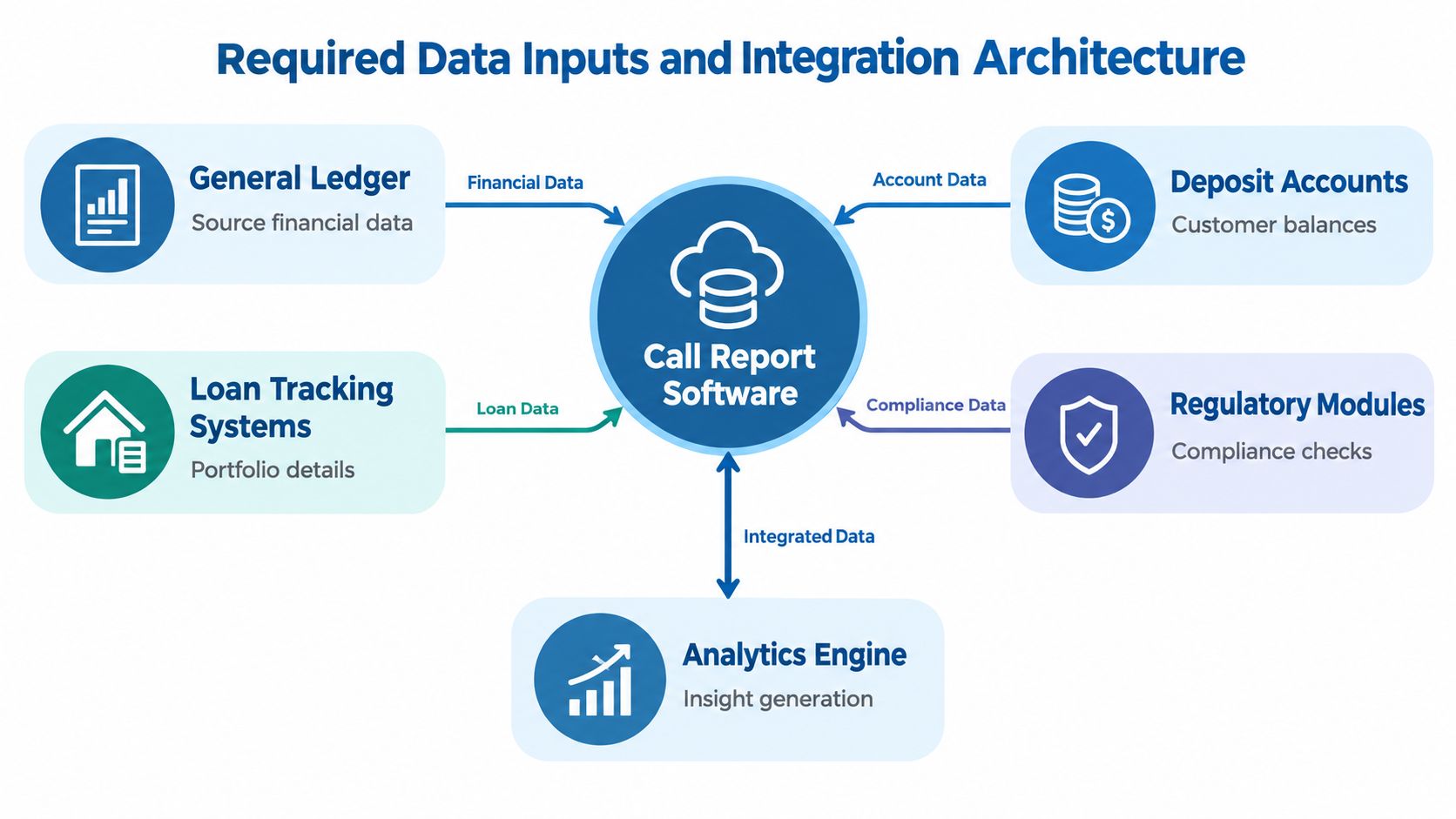
Call Report software becomes strategically useful when it sits on top of a controlled data architecture. The General Ledger remains essential, but it isn't sufficient for executive intelligence. A bank needs loan-level context, deposit behavior, regulatory comparisons, market information, and relationship data if it wants to move from quarterly preparation to active portfolio management.
The architecture should connect source systems to a governed reporting layer, then expose approved information to analytics and workflow tools. The CDR supplies a standardized regulatory foundation. Internal systems add operational detail. External datasets add context. Together, they let executives ask not only what the bank reported, but why performance changed and what management should do next.
Build the data flow around decisions
A practical architecture includes:
- Core financial systems: General Ledger feeds establish the accounting source for balances, income, capital, and liquidity measures.
- Portfolio systems: Loan tracking systems provide exposure, product, maturity, collateral, and performance detail that a high-level regulatory snapshot can't show alone.
- Customer systems: Deposit accounts and relationship records reveal concentration, funding stability, product penetration, and opportunities for targeted outreach.
- Regulatory and market sources: FDIC Call Reports, FFIEC and UBPR data, NCUA 5300 reports, SBA program information, UCC filings, SEC and EDGAR records, BLS and BEA macro series, and HMDA records add peer and market context.
- Analytics and workflow: A governed analytics engine turns the combined data into dashboards, exception queues, watch rules, alerts, and reports that managers can act on.
The multi-source data integration approach matters because isolated systems force executives to reconcile conflicting views by hand. A unified layer can show a change in commercial lending alongside peer performance, local economic conditions, borrower relationships, and internal risk indicators.
From quarterly snapshot to operating rhythm
The best design doesn't wait for the next filing deadline to surface a material change. It monitors approved inputs continuously, identifies exceptions, and gives the responsible team enough context to investigate. That could mean a credit officer reviewing an unexpected concentration, a finance leader examining a liquidity movement, or a relationship manager finding an underpenetrated customer segment.
The objective isn't to turn every operational system into a regulatory filing engine. It's to establish one trusted data model that supports filing accuracy and management action without forcing executives to work from disconnected spreadsheets.
Selection Criteria for Banking Teams
Most procurement mistakes happen because teams compare screens and feature lists instead of testing the full operating process. A bank should evaluate FDIC call report software against its risk tolerance, filing model, data maturity, and commercial ambitions. A small institution with a lean finance team has different support needs from a complex bank with multiple source systems, but neither should accept weak validation or poor traceability.
Use a decision matrix that separates baseline compliance from strategic capability.
| Evaluation area | Filing-focused option | Executive-grade option |
|---|---|---|
| Validation | Runs checks before submission | Runs checks in real time and routes exceptions |
| Output | Produces a CDR-processable file | Produces the file with complete approvals and audit evidence |
| Data scope | Imports selected accounting feeds | Connects financial, regulatory, market, and relationship data |
| Reporting | Shows filing status | Adds peer benchmarking, trends, alerts, and management views |
| Authentication | Reacts to access changes | Has a documented MFA rollout and vendor coordination plan |
| Support | General help desk | Named escalation process for filing-critical issues |
Questions to put in the vendor demonstration
Ask the vendor to show how the platform handles an unresolved quality edit, a corrected source value, a late approval, and a rejected output file. Ask where the explanation is stored and how an internal auditor retrieves it. Ask whether the bank can export the underlying data and decision history without opening a support ticket.
Then test the analytics, not just the filing workflow. Can the chief credit officer compare the bank with a relevant peer group? Can the CFO trace a ratio back to its source? Can a relationship manager move from a market signal to a prospect record? If the answer is no, the bank is buying compliance software, not a broader intelligence capability.
MFA readiness deserves its own procurement line. Vendor contracts should define implementation responsibility, user support, access recovery, testing, and communication. A platform that passes technical validation but leaves authentication coordination to the bank at the last minute creates avoidable operational risk.
Real-World Applications for Relationship Teams
A relationship manager rarely needs another static report. The manager needs a defensible reason to call a prospect, a clear view of the institution's capacity to serve that prospect, and evidence that the conversation is relevant.
Consider a hypothetical commercial bank reviewing a regional manufacturing company. The relationship team starts with internal deposit and lending information, then adds public regulatory data, peer comparisons, UCC filings, economic indicators, and the company's SEC filings where available. The objective isn't to make a generic sales pitch. It is to understand funding needs, current banking relationships, operating pressure, and the bank's own risk appetite before requesting a meeting.

Turn data into a specific conversation
The team might discover that the prospect has a growing working-capital requirement, limited use of treasury services, and a financing profile that resembles borrowers the bank already serves successfully. That does not guarantee approval. It gives the relationship manager a better opening question and allows credit staff to prepare around the actual business model rather than a thin prospect record.
The same process works for existing customers. A banker can compare relationship profitability, deposit behavior, loan exposure, and available products against the bank's broader portfolio. If the customer's operating deposits are strong but treasury adoption is limited, the next conversation can focus on payment controls and cash visibility. If an industry signal suggests pressure, the banker can contact the customer before a routine review becomes a problem.
Give commercial teams controlled intelligence
Data should sharpen judgment, not automate judgment away. Relationship teams still need credit policy, human review, and customer context. The software's role is to reduce the time spent assembling facts and increase the time spent deciding what those facts mean.
Useful workflow outputs include:
- Peer context: Show how the bank's capital, liquidity, profitability, or lending position compares with relevant institutions.
- Historical movement: Identify whether a change is isolated or part of a sustained pattern.
- Relationship prompts: Surface customers, products, or decision-makers that deserve attention.
- Risk alerts: Route unusual movements to the appropriate credit, finance, or executive owner.
- Evidence packs: Give bankers a concise, traceable set of facts for a meeting or review.
The payoff is better prioritization. A banker with a ranked list of opportunities and a documented rationale can spend time where the institution has both a credible value proposition and a manageable risk profile.
Common Pitfalls and Implementation Risks
The most dangerous assumption is that passing validation means the bank has solved reporting risk. It hasn't. Validation can catch defined inconsistencies, but it won't ensure that the source data is complete, the audit trail is usable, the right person reviews an exception, or the bank notices a weakening trend between filing cycles.
The 2025 MFA rollout exposed a related operational weakness. The FDIC said software vendors would need phased MFA implementation in the third and fourth quarters of 2025, while institutions could continue filing through software or paper-to-electronic conversion workflows. That combination created a coordination risk for banks dependent on third-party filers, as described in the FDIC communication on second-quarter 2025 Call Report filing.
Where implementation breaks down
- Vendor coordination: The bank assumes the vendor owns every access, identity, and recovery issue. The contract doesn't define responsibilities, so a user loses access during a filing window.
- Point-in-time controls: Staff validate only at quarter-end, then spend the closing period resolving problems that could have been found earlier.
- Weak explanations: Quality edits receive vague comments that don't help a reviewer understand the business reason or the corrective action.
- Siloed ownership: Finance owns the filing, IT owns the integration, risk owns the alerts, and no executive owns the data model.
- Underused analytics: The bank buys dashboards but doesn't assign managers to review signals or act on them.
Treat the filing calendar as a risk boundary
Reports must be submitted electronically to the CDR no later than 30 days after the report date, with institutions that have more than one foreign office receiving an additional five calendar days. For a March 31, 2026 report, the deadline was April 30, 2026, or May 5, 2026 for certain foreign-office filers, according to the FDIC first-quarter 2026 filing notice.
The bank should work backward from that deadline with an internal schedule for source lock, validation, remediation, approval, transmission, and contingency handling. It should also test access changes before the filing window, document escalation contacts, and rehearse recovery from a failed submission.
Don't confuse a polished interface with a mature control environment. The test is whether people, data, software, and vendor support work together under pressure.
ROI and Strategic Next Steps for Executives
Modern FDIC call report software earns its keep by reducing rework, shortening the path from source data to management action, improving peer context, and giving commercial teams dependable intelligence. Those gains require an operating model with clear ownership and defined responses to exceptions.
Executives should ask one direct question: what does the bank learn from its Call Report, and how quickly does someone act on it? The CDR uses mathematical formulas to define which concepts an institution must report or provide on an instance document, as explained in the CDR reportability guidance.htm). That machine-readable structure supports controlled analytics alongside the filing itself.
A practical executive action plan
- Map the current process. Record each source system, spreadsheet, manual adjustment, validation, approval, and vendor handoff.
- Test control evidence. Select a recent filing and trace a reported value to its source, edit history, explanation, and approval.
- Review MFA readiness. Since the 2025 MFA rollout, assign ownership for implementation, user support, recovery, testing, and communications across the bank and its filing vendor.
- Define decision use cases. Select recurring questions about peer performance, liquidity, credit concentration, profitability, prospecting, and risk alerts.
- Assign action owners. Every alert or exception needs a responsible executive, a response expectation, and a disposition record.
- Measure time to insight. Track whether managers receive trusted information earlier, spend less time reconciling data, and make decisions with clearer evidence.
A bank's regulatory data should serve directors, finance leaders, credit officers, and relationship teams rather than sit in a compliance folder. A platform that combines Call Report views, historical time series, peer comparisons, validated pipelines, and watch rules, as described in this overview of bank regulatory reporting, can support that shift. The missed opportunity is treating Call Report data as a quarterly filing instead of a source of continuous performance intelligence.
Start with one quarter, one workflow, and one executive use case. Benchmark the existing stack against the bank's actual filing and decision processes. If the software cannot provide traceable data, timely exceptions, and decision-ready context, it does not meet the institution's strategic requirement.
Visbanking helps banks and credit unions turn FDIC Call Report data into peer comparisons, historical performance views, and actionable intelligence for finance, risk, and relationship teams. Visit Visbanking to benchmark your institution, explore your data, and identify where better reporting can support faster decisions.
Latest Articles
Brian's Banking Blog
Predictive Risk Management for Banks
Brian's Banking Blog
Business Registration Data Banks Can Actually Use
Brian's Banking Blog
How to Secure REST API with JWT for Banking
Brian's Banking Blog
Commercial Loan Analysis: A Bank Executive's Guide
Brian's Banking Blog
Understanding Statistical Significance in Banking
Brian's Banking Blog