
A Strategic Guide for Bank Executives on the 2026 Nacha Rules
Brian's Banking Blog
The ACH landscape is undergoing its most significant compliance overhaul in two decades. The 2026 Nacha rule changes are not a routine update; they fundamentally redefine fraud monitoring responsibilities for both Originating and Receiving Depository Financial Institutions (ODFIs and RDFIs). By March and June 2026, the entire network must adhere to new, stricter standards.
The core mandate is clear: every institution must implement risk-based fraud monitoring for all ACH credits. This shift places the burden of detection on every participant in the transaction chain, a direct response to the rising threat of sophisticated credit-push fraud—a problem projected to cost the industry $3 billion annually by 2028. This is no longer business as usual.
A Fundamental Shift in ACH Risk Management
For bank executives, the era of passive, rules-based ACH monitoring is over. The 2026 mandate requires a strategic pivot from viewing compliance as a cost center to treating it as a cornerstone of institutional stability and client trust. The new rules are a necessary modernization of the network's risk framework, acknowledging that fraud can originate at either end of a payment and requires a shared, proactive defense.
This is not just about updating software; it's about adopting a data-driven mindset. Success will hinge on your ability to translate raw transaction data into actionable intelligence, identifying anomalies before they escalate into losses and regulatory scrutiny.
A Phased Mandate for Universal Compliance
Nacha has structured the rollout in two phases, providing a clear implementation path that prioritizes the largest players while ensuring comprehensive network security.
Phase 1 (March 20, 2026): High-volume institutions are the first to comply. This includes Originators processing over 6 million ACH credits annually and RDFIs receiving over 10 million. Their risk-based fraud monitoring systems must be fully operational by this date.
Phase 2 (June 19, 2026): Three months later, the requirement extends to all remaining Originators, ODFIs, and RDFIs, irrespective of transaction volume. This measure levels the playing field and fortifies the entire ACH network against systemic risk.
The infographic below illustrates these non-negotiable deadlines.
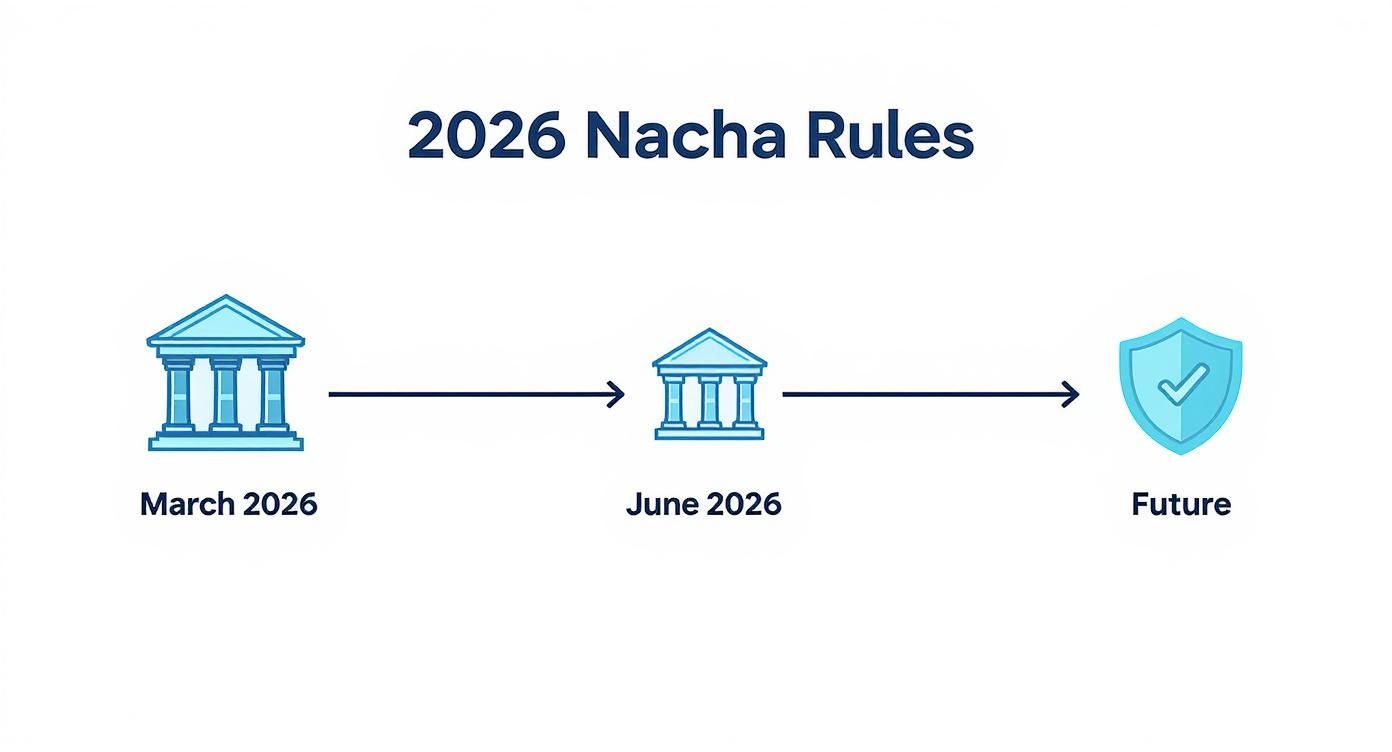
The compliance window is closing quickly, particularly for institutions that must procure, implement, and validate new monitoring technologies.
Key Deadlines for the 2026 Nacha Rules
This table provides a concise overview of the critical compliance dates and the parties affected in each phase.
| Compliance Deadline | Affected Participants | Core Requirement |
|---|---|---|
| March 20, 2026 | High-volume Originators (>6M TX/yr) & RDFIs (>10M TX/yr) | Implement risk-based ACH fraud monitoring. |
| June 19, 2026 | All remaining Originators, ODFIs, and RDFIs (regardless of volume) | Extend risk-based ACH fraud monitoring across the network. |
These dates require that strategic planning and execution begin now to avoid operational disruption and regulatory penalties.
From Compliance Burden to Strategic Modernization
The data driving this change is compelling. In 2023, 80% of organizations were targeted by payments fraud, with ACH credits becoming a primary vector for business email compromise schemes. This two-phase enforcement is the most significant regulatory action in 20 years, a necessary defense for the more than $23 trillion that moves through the ACH network annually. You can analyze these fraud trends and their vendor management impact.
Viewing this mandate as a mere compliance exercise is a strategic error. It is a catalyst for essential modernization. Legacy systems, with their static rules and batch-processing limitations, are ill-equipped to counter today's dynamic fraud patterns. A data-driven, risk-based approach is the only viable path forward.
This isn't just about buying new software; it's about adopting a new mindset. Success will hinge on your ability to turn raw transaction data into real intelligence, spotting red flags before they turn into losses and headlines.
For leadership, the task is to benchmark current capabilities against the new requirements. A bank intelligence platform like Visbanking is indispensable here. By comparing your institution’s ACH activity, return rates, and fraud exposure against peer data, you can build a quantitative, data-backed business case for the necessary investments. It is time to move from reviewing dashboards to making decisions that ensure your institution is not just compliant, but secure.
Getting Real About Risk-Based Fraud Monitoring
The 2026 Nacha rules mandate "risk-based fraud monitoring," a deliberately flexible term that necessitates a significant operational shift away from static, threshold-based systems. For banking leaders, the challenge is to translate this concept into a concrete, defensible strategy. This requires a fundamental change in how your institution interprets transaction data to preempt fraudulent activity.
Legacy systems typically operate on rigid rules, such as flagging any transaction over $100,000. This approach is easily circumvented by sophisticated actors who structure payments to remain below such thresholds, resulting in high false positives for legitimate transfers and a failure to detect nuanced threats.
A modern, risk-based system operates on intelligence. It analyzes behavioral patterns and contextual data to assess the probability of fraud, shifting the focus from transaction amount to transaction behavior.
It's All About Behavior, Not Just Big Numbers
Consider two practical scenarios that illustrate the difference:
Scenario A (Legacy Approach): A long-standing corporate client initiates a scheduled $150,000 ACH payment to a known vendor they have paid monthly for five years. The legacy system flags the transaction based solely on its value, triggering a manual review and delaying a legitimate, low-risk payment.
Scenario B (Risk-Based Approach): The same client, who consistently processes payroll bi-weekly on Fridays, initiates a $5,000 payment on a Thursday to a newly added bank account. The beneficiary details do not match any historical records. A risk-based system flags this transaction not for its amount, but for its anomalous behavior: the timing is unusual, the beneficiary is new, and the action is inconsistent with the client’s established payroll cycle.
The second scenario is a classic indicator of a potential business email compromise or authorized push payment (APP) scam. These imposter scams, which have plagued the P2P space, now represent a significant threat to ACH transactions.
Building a Framework That Can Defend Itself
Implementing a robust, risk-based framework requires referencing modern AI fraud detection strategies and defining key risk indicators (KRIs) tailored to your specific client base and their transactional behaviors.
A truly risk-based system doesn't just ask, "Is this transaction large?" It asks, "Is this transaction normal?" Answering that question requires deep, contextual data that legacy systems were never designed to process.
This is where a dedicated bank intelligence platform transitions from an ancillary tool to a strategic necessity. Platforms like Visbanking provide the critical capability to benchmark your institution’s fraud exposure and transaction patterns against anonymized peer data. This comparative intelligence is invaluable for validating your risk models and identifying systemic threats that may target institutions with a similar profile.
By integrating internal transaction data with external peer benchmarks, you create a dynamic monitoring framework that continuously learns what "normal" behavior looks like for your clients. This is the only practical way to meet the 2026 Nacha requirements and transform compliance from a reactive burden into a proactive defense. The logical next step is to benchmark your current capabilities to precisely identify your gaps.
How Standardized Entry Descriptions Take the Guesswork Out of Fraud Detection
One of the most impactful changes in the 2026 Nacha rules is the mandate to standardize the Company Entry Description field. This is not a simple administrative adjustment; it is a direct measure to eliminate the ambiguity that fraudsters have long exploited.
For years, transaction feeds populated with vague descriptions like "Direct Deposit" or "ACH Payment" have allowed malicious actors to camouflage fraudulent payments within high-volume streams. This lack of clarity complicates automated fraud detection and necessitates costly manual reviews. The new rules are designed to bring precision and transparency.
Turning Vague Descriptions into Hard Data
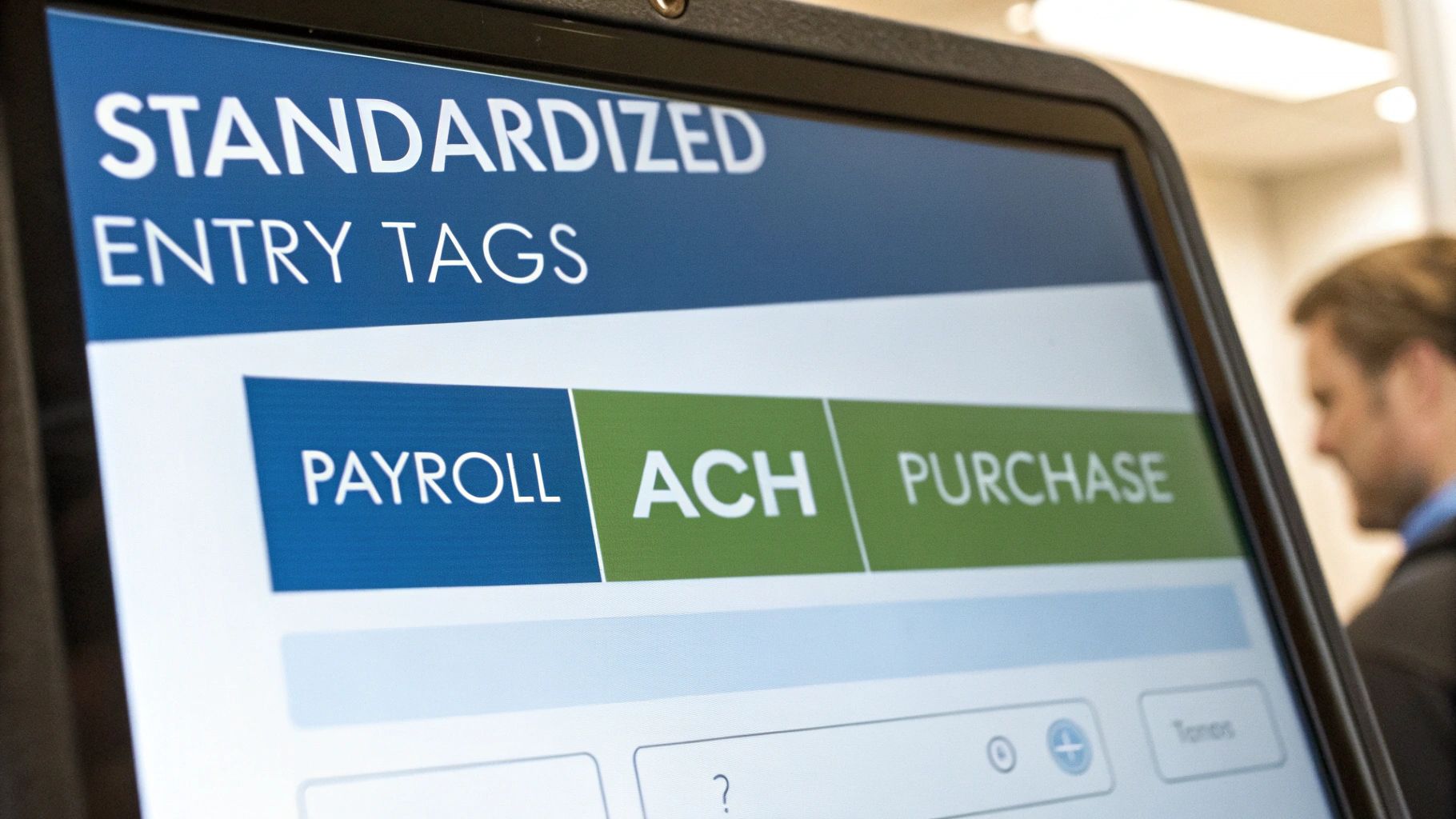
Beginning in March 2026, Originators of payroll transactions will be required to use the standardized description "PAYROLL" for all PPD credits. Similarly, merchants and billers must use "PURCHASE" for WEB debits related to online or mobile payments.
More detail on the specifics can be found in the new Nacha requirements. This change is transformative because it makes ACH entries instantly machine-readable and classifiable, removing the camouflage criminals depend on.
Consider its impact on a common fraud scheme like payroll redirection, where a criminal compromises an employee’s email, convinces HR to alter direct deposit details, and diverts the salary.
Under the old system, that fraudulent transaction looked identical to every other legitimate payroll deposit. With the new 'PAYROLL' standard, a bank’s monitoring system can now ask much smarter questions.
A system can now flag a "PAYROLL" transaction directed to a new account that has no history of receiving payroll credits. For example, a system could automatically flag a transaction designated "PAYROLL" for an amount of $2,500 being sent to an account that has only ever received small P2P transfers. This transforms a generic payment stream into a structured, verifiable dataset.
From Compliance Chore to Strategic Advantage
Effectively implementing this change requires both technological upgrades and procedural adjustments. Your institution must enforce these standards for originating clients while simultaneously leveraging the structured data from other RDFIs to refine your own fraud models. A modern ACH processor with a robust analytics platform is no longer optional.
These systems can automate the validation and monitoring of the new entry descriptions, transforming a potential compliance bottleneck into a powerful, automated risk management tool. You are not just fulfilling a Nacha requirement; you are adding a critical layer of intelligence to protect your institution.
With a bank intelligence platform like Visbanking, this data becomes even more valuable. You can analyze transaction patterns associated with "PAYROLL" or "PURCHASE" descriptions across your peer group to benchmark your detection rules and identify emerging threats. For instance, if your institution flags an anomalously low number of "PAYROLL" transactions for review compared to peer institutions, it could indicate a blind spot in your monitoring logic. This standardization provides the clean, structured data essential for the sophisticated, risk-based monitoring the 2026 rules demand.
The Strategic Imperative for ACH Modernization
The 2026 Nacha rules represent a strategic inflection point for financial institutions. The critical question is not if you will comply, but how you will leverage this mandate to modernize your payments infrastructure. Treating this as a perfunctory compliance task guarantees you will fall behind competitors and expose your institution to unnecessary risk.
Legacy ACH systems, designed for batch processing and static rules, are ill-suited for the real-time demands of the modern payments ecosystem. They are outmatched by the velocity of credit-push fraud and struggle to support the exponential growth in Same Day ACH volume. This operational friction increases risk and degrades the client experience, particularly for high-value commercial customers who expect both security and efficiency.
The Rising Tide of Faster Payments
The market demand for speed is unrelenting. The ACH Network handles immense volume—in the third quarter of 2023 alone, it processed 7.8 billion payments valued at $20.2 trillion.
The critical data point for executives is the growth in faster payments: Same Day ACH volume grew by 23.3% in the third quarter of 2023. As detailed in this comprehensive guide to ACH payments, this trend is redefining cash flow expectations for both businesses and consumers.
This acceleration places enormous pressure on fraud monitoring systems. As transaction velocity increases, the window for fraud detection and intervention shrinks dramatically. Modernization is no longer a choice; it is a prerequisite for survival.
Building the Business Case for Investment
The business case for investing in a modern ACH processing environment extends far beyond regulatory compliance. It is a direct investment in your institution's operational resilience, efficiency, and market reputation. A proactive investment now is significantly less costly than a reactive, post-breach response.
A modern payments infrastructure delivers tangible returns:
- Pre-Wired Fraud Detection: Advanced systems integrate behavioral analytics and machine learning to identify subtle fraud indicators, shifting your posture from reactive to predictive.
- Operational Efficiency: Intelligent automation reduces manual reviews and false positives, freeing operations teams to focus on strategic initiatives and genuine threats.
- Enhanced Customer Trust: For high-value commercial clients, a secure and modern payments platform is a key differentiator and a powerful tool for client acquisition and retention.
The decision to modernize isn't just an IT project; it's a core business strategy. It aligns your institution with where the entire payments industry is headed, making sure you can compete as real-time payments become the norm.
This initiative is part of a broader industry transition toward instant payments. The principles of real-time monitoring and security, as detailed in our guide to the FedNow real-time payment system, are directly applicable to ACH modernization.
Framing the 2026 Nacha rules as the catalyst for this upgrade provides a clear, forward-looking objective for the entire organization. The first step is to conduct a data-driven assessment of your current position. Benchmarking your ACH activity and fraud exposure against peers will illuminate the risks and build an undeniable case for action.
Your Game Plan for the 2026 Nacha Rule Changes
The March and June 2026 Nacha deadlines are imminent in terms of institutional planning cycles. A reactive approach will introduce unnecessary risk and expense. A phased, deliberate strategy is the only way to ensure compliance and extract strategic value from this regulatory shift.
This is not merely an IT project; it is a fundamental re-engineering of risk management that requires executive sponsorship and cross-functional collaboration. The following roadmap provides a clear path for leadership to guide their institution toward confident compliance.
Phase 1: Assemble Your A-Team
The first step is to establish a dedicated, cross-functional task force. The 2026 Nacha rules impact the entire organization; a siloed approach will fail. This team requires the authority to make decisions and allocate resources.
Core members must include senior leaders from:
- Operations: To map current ACH workflows and identify operational impacts.
- Compliance: To interpret regulatory nuances and ensure the proposed solution is defensible.
- IT and Systems: To provide a realistic assessment of current technological capabilities and limitations.
- Risk Management: To define new risk thresholds and monitoring parameters.
This group’s initial mandate is to develop a project charter that clearly defines objectives, timelines, and accountabilities.
Phase 2: Get Real with a Gap Analysis
Next, conduct a rigorous gap analysis to benchmark your current capabilities against the new rules. This requires an objective assessment of your systems, policies, and personnel.
Key questions to address include:
- Can our current systems support real-time, behavior-based monitoring, or are they limited to static, batch-based rules?
- Do we have effective monitoring for both originated and received ACH credits?
- What data sources are we currently using for fraud detection, and what additional data will be required?
An internal assessment is insufficient. A platform like Visbanking provides objective context by allowing you to compare your ACH volumes, return rates, and fraud metrics against peer institutions. This is not just data; it is an objective measure of your risk posture that identifies your most critical vulnerabilities.
For example, discovering that your institution's rate of ACH returns related to payroll is 2.5x higher than the average for peer banks of a similar asset size is a significant red flag. It suggests an existing vulnerability that requires immediate attention and becomes a clear priority in your implementation plan.
Phase 3: Talk to Your Tech Partners
Your core and ACH processing partners are critical to this initiative. You must engage them now to understand their product roadmap for 2026 Nacha compliance.
Demand specific details. How will their solutions facilitate risk-based monitoring and the new standardized entry descriptions? Vague assurances are unacceptable. If they cannot provide a clear and credible plan, it is time to evaluate alternative vendors.
Phase 4: Overhaul Your Policies and Risk Frameworks
The new rules render many existing risk assessment frameworks obsolete. Your task force must lead the effort to rewrite internal policies to reflect the new paradigm of proactive, risk-based fraud monitoring.
This involves building a modern compliance risk management framework, defining new key risk indicators (KRIs), establishing clear protocols for investigating suspicious activity, and ensuring all processes are documented for regulatory review.
Phase 5: Get Your Customers in the Loop
Finally, engage your commercial clients. Originators have new responsibilities under these rules and will look to your institution for guidance. A proactive communication plan explaining the changes, particularly the new entry description standards, is essential.
This is not only good client service; it reinforces your role as a trusted advisor and reduces your own risk by helping your clients remain compliant.
This checklist outlines the strategic milestones for executive oversight.
Executive Checklist for 2026 Nacha Readiness
| Phase | Key Action Item | Primary Stakeholders | Success Metric |
|---|---|---|---|
| 1. Foundation | Establish and empower a cross-functional task force. | C-Suite, Operations, Compliance, IT, Risk | Project charter approved; team roles defined and accepted. |
| 2. Assessment | Complete a gap analysis comparing current state to rule requirements, using peer data for context. | Task Force, Department Heads | Gap analysis report with prioritized vulnerabilities completed. |
| 3. Partnership | Secure vendor commitment and roadmap validation for necessary system upgrades. | IT, Vendor Management, Operations | Signed vendor agreements or project plans for 2026 compliance. |
| 4. Governance | Update and approve all relevant risk management policies and procedures. | Compliance, Risk, Board of Directors | Board-approved policies reflecting new Nacha requirements. |
| 5. Execution | Implement and test new monitoring systems and internal workflows. | IT, Operations, Project Team | Successful completion of end-to-end system testing. |
| 6. Communication | Launch a proactive education campaign for commercial customers. | Marketing, Treasury Management, Relationship Managers | Customer training sessions completed; inquiry volume managed. |
By executing these deliberate steps, you can transform the 2026 Nacha rules from a compliance burden into a strategic upgrade for your institution. The first move is to pull the data and see where you stand.
Using Data Intelligence for Proactive Risk Mitigation
The 2026 Nacha rule changes mandate a shift from reactive compliance to proactive, data-driven risk management. For banking leaders, this is where competitive advantage will be gained. Meeting the minimum standards is merely the starting point; outperforming the market in risk mitigation is the strategic goal.
To achieve this, you must look beyond your own internal data. True insight comes from understanding how your institution's ACH activity and risk profile compare to the broader industry.
Benchmarking for a Stronger Defense
How do you objectively validate the effectiveness of your fraud models? Without external context, internal metrics are incomplete. This is why peer benchmarking is now a non-negotiable component of executive-level risk management.
Consider a practical example. Your institution might report a 0.05% return rate on originated payroll files, a figure that seems acceptably low in isolation. However, if peer institutions of a similar size and business mix are averaging a 0.02% return rate, your "low" number is exposed as a significant outlier, signaling a potential vulnerability that requires immediate investigation.
Data intelligence takes compliance out of the realm of guesswork and turns it into an objective, evidence-based strategy. It gives the board concrete, defensible proof that the bank’s risk profile is not just understood, but actively managed against what's happening in the real world.
From Compliance to Competitive Edge
Platforms like Visbanking provide this critical external context, enabling executives to validate risk models and identify emerging fraud trends before they result in material losses. It is about entering the boardroom with data-backed confidence. The use of such tools is central to the future of compliance and artificial intelligence, allowing your institution to not just adhere to regulations, but to master its risk environment.
The logical next step in your strategic planning is to benchmark your own ACH activity and fraud exposure. By knowing precisely where you stand today, you can build a data-driven roadmap to meet the 2026 Nacha requirements and strengthen your institution for the future.
FAQs: What Bank Leaders Are Asking About the 2026 Nacha Rules
As executive teams begin to strategize for the 2026 Nacha mandate, several key questions are consistently being raised. These rules represent a fundamental shift in risk management, and the implications extend beyond the operations floor to the boardroom. Here are direct answers to the most common executive-level inquiries.
What’s the Single Biggest Operational Challenge We Should Expect?
The most significant operational challenge is the transition from manual, batch-based review processes to automated, near-real-time monitoring. The velocity and sophistication required to analyze ACH credits on a risk basis will overwhelm legacy systems. A system that flags a single $1.2 million transaction is useful, but it is blind to a coordinated attack involving one hundred separate $12,000 payments to new beneficiaries over a 30-minute period. This new environment demands a significant systems upgrade or a new vendor partnership capable of real-time data ingestion and analysis.
How Do These Rules Change Our Liability in Credit-Push Fraud?
The 2026 Nacha rules formalize a shared-responsibility model. While liability is not unilaterally shifted, an institution's position in a dispute will increasingly depend on its ability to demonstrate a robust, data-driven monitoring program. The ability to produce evidence of a defensible, risk-based system—including documented policies, system-generated alerts, and investigation logs—is now the primary defense in liability negotiations and regulatory examinations. Claims of ignorance or finger-pointing will no longer be viable.
What Kind of Reporting Should Our Board Expect on This?
The board requires a concise, data-driven dashboard, not a narrative project update. Reporting must evolve from tracking implementation milestones to measuring risk management performance. This provides the concrete assurance that the institution is not just compliant, but is effectively mitigating risk.
The executive dashboard should focus on key performance indicators:
- Fraud Detection Rate: The percentage of fraudulent transactions identified and prevented.
- False Positive Ratio: The number of legitimate transactions incorrectly flagged, a measure of operational efficiency.
- Implementation Velocity: Progress against the project timeline and budget.
- Peer Benchmarks: A comparison of the institution's fraud rates and key operational metrics against a cohort of similarly sized peers.
The inclusion of peer benchmarks transforms a status report into a strategic risk management tool, enabling the board to make fully informed governance decisions.
Navigating the 2026 Nacha rules requires clear, comparative intelligence. Visbanking is the bank intelligence platform that allows you to benchmark your performance and risk against the industry. Understand where you stand and build your strategy on a foundation of data. Explore the platform at https://www.visbanking.com.
Related Articles

Visbanking Blog
Digital Banking Security: Protecting Your Money in Cyberspace

Visbanking Blog
Bank Capital Requirements: The Ultimate Survival Guide

Visbanking Blog
Bank Regulatory Compliance: Navigating the Complex Maze

Visbanking Blog
The FFIEC: Regulating and Supervising Financial Institutions to Maintain a Safe and Sound Financial System

Visbanking Blog
Within 5 years, core banking functions will be completely commoditized.

Visbanking Blog