
Data Integration vs ETL for Bank Decisions
Brian's Banking Blog
ETL remains a substantial part of data-integration spending, but it does not cover every need. Nightly ETL can support reconciled peer and regulatory reporting. Alerts, CRM actions, and decisions that depend on links across sources may need a broader integration path.
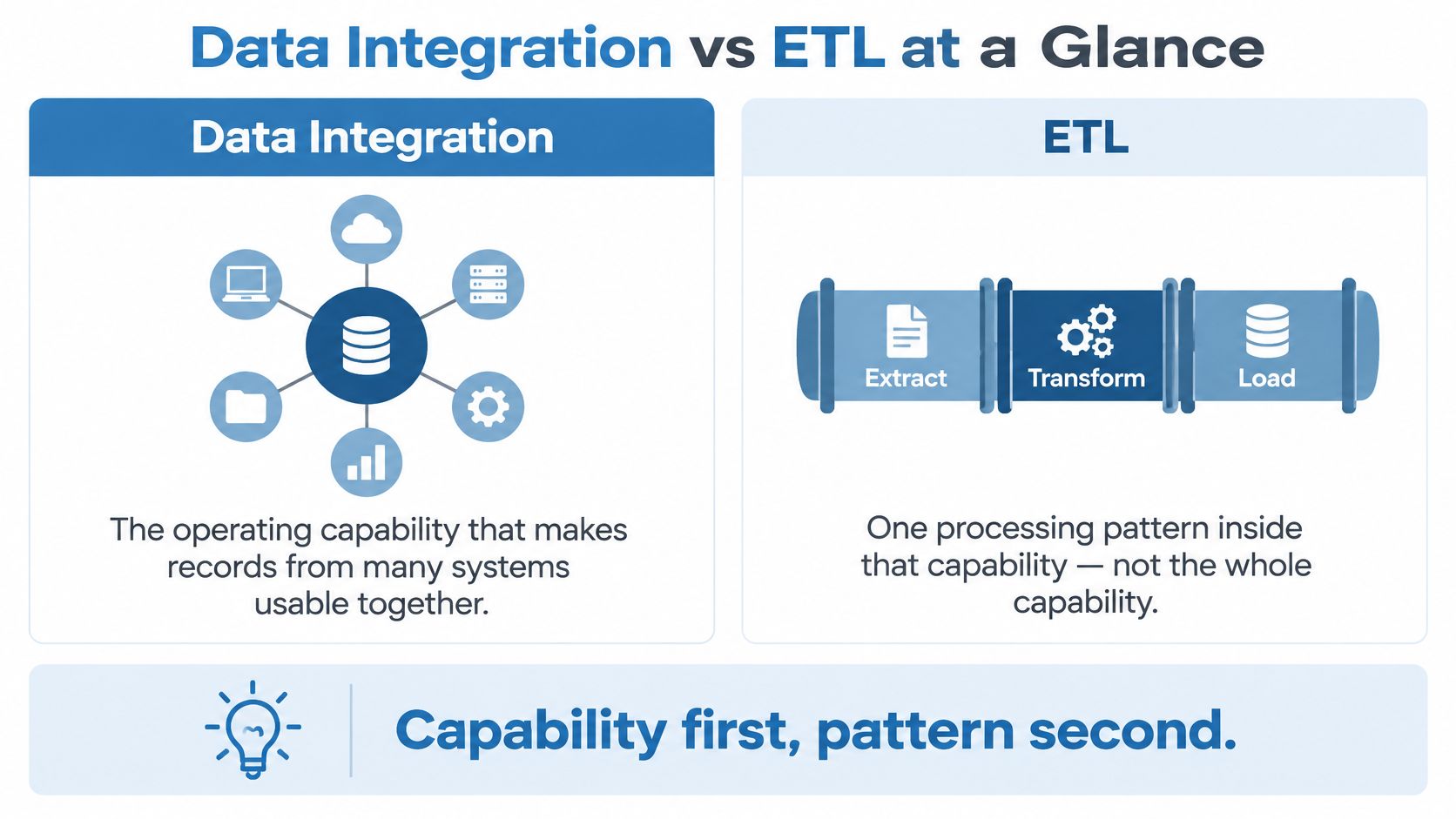
The choice is not between real time everywhere and ETL everywhere. Data integration is the operating capability that makes records from multiple systems usable together; ETL is a governed pattern within it. Set freshness according to the decision, then fund only the speed that decision requires.
Directors should ask whether a pricing committee, credit officer, or relationship manager can defend the figure in front of them. Millisecond delivery is no advantage if the result cannot be reconciled.
Data Integration vs ETL at a Glance
Data integration vs ETL is not a vendor bake-off. Integration is the enterprise capability across analytical and operational systems. ETL is the processing pattern that extracts data from source systems, cleans it, standardizes it, validates it, applies business rules, and loads a warehouse, database, or curated table. IBM treats ETL as a foundational method inside that broader discipline, not as a synonym for the field, and traces it to the 1970s, when organizations needed a repeatable way to combine operational data for analysis. It later became the primary warehouse method, commercial tooling followed, and Informatica was founded in 1993 to build that software market.
| Criterion | Data integration | ETL |
|---|---|---|
| What it is | Enterprise capability across analytical and operational systems | Extract, clean, standardize, validate, and load into a destination |
| Typical timing | Batch plus APIs, change data capture, replication, and events | Scheduled batch, often nightly |
| Where transformation sits | Before load, after load, or both, plus semantic mapping | Staging area before the target |
| Who consumes it | Warehouse, APIs, alerts, CRM, and operational apps | Warehouse, database, or curated reporting table |
| Control emphasis | Lineage, access, entity resolution, and freshness | Predefined schema and business rules before load |
| Best bank fit | Prospect signals, risk alerts, CRM actions, relationship intelligence | Historical peer benchmarking and reconciled regulatory reporting |
Two rows that settle most committee debates
Historical peer benchmarking belongs on scheduled ETL. A call-report cycle already has a calendar, a filing definition, and a board pack that should not change between drafts. A nightly job creates a centralized copy optimized for that reporting. You do not need an event stream to explain last quarter's loan growth against a stable peer set.
Current prospect signals, risk alerts, CRM actions, and cross-source relationship intelligence do not fit that copy. Those uses need synchronization, APIs, event streams, replication, metadata, governance, and identity resolution. A warehouse table that landed at 2 a.m. can still be the system of record for the board and be the wrong system for a banker who has to call a borrower before lunch.
Hiring managers should test for that distinction before they test for tool trivia. A practical screen is the data engineer interview questions for 2026 set from TekRecruiter, because candidates who can only describe a batch job will rebuild last decade's warehouse and call it a platform.
Real time is a business requirement, not a technical badge. Many executive workflows need trustworthy daily or intraday figures rather than millisecond delivery.
Why Banks Outgrew a Nightly Load
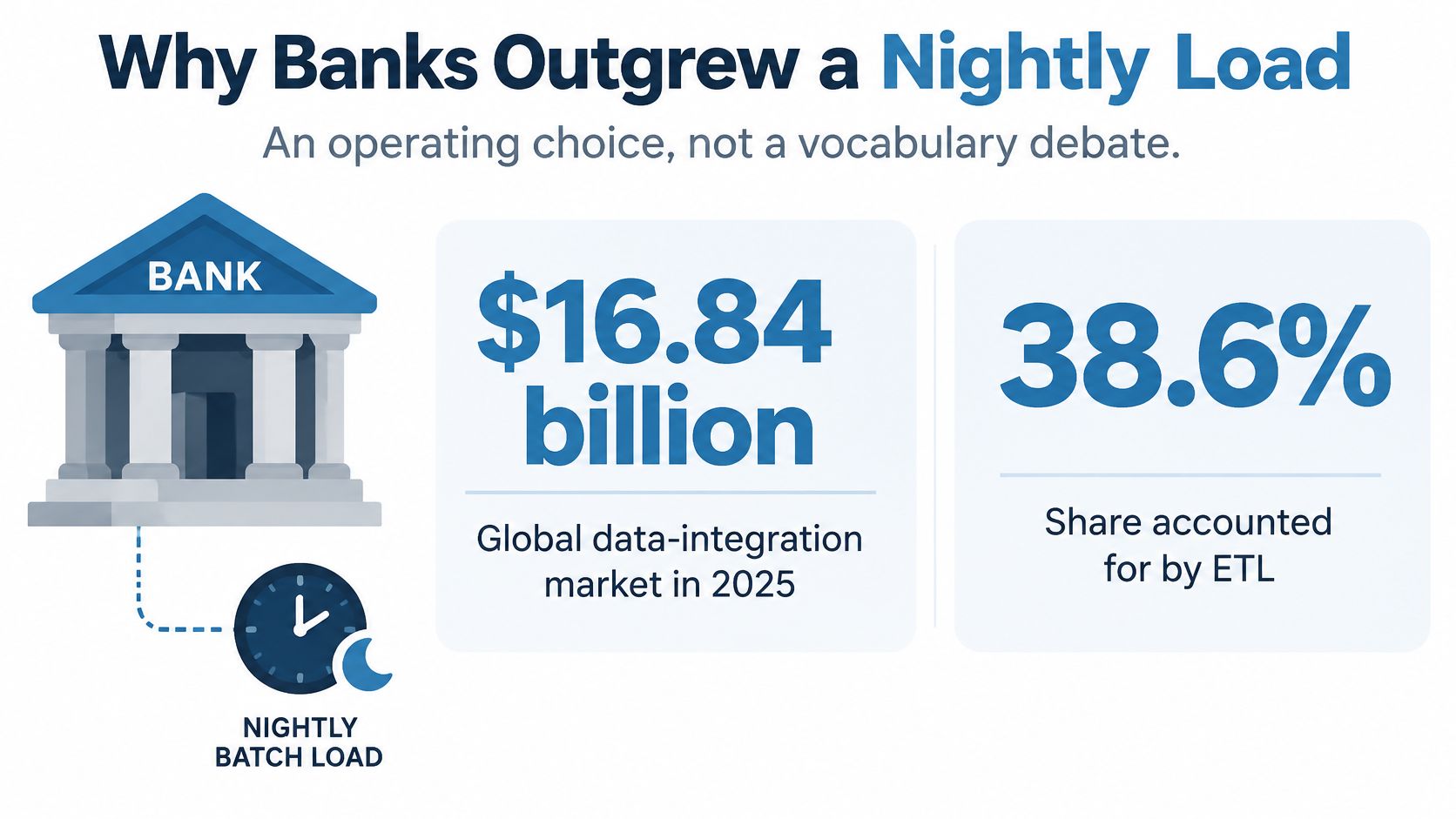
Treat the market figures as an operating choice, not a vocabulary debate. The global data-integration market reached $16.84 billion in 2025, and ETL accounted for 38.6% of it, according to Emergen Research. Most of the money already sits outside classic extract-transform-load. Budget the capability. Fund ETL as the governed batch slice inside it, not as the entire program.
The ETL market itself was valued at $7.3 billion in 2025 and is projected to reach $16.5 billion by 2032, a 12.3% compound annual growth rate, according to Global Industry Analysts. That growth projection is not permission to buy another scheduler. Mordor Intelligence puts cloud ETL solutions at 66.35% of the ETL market in 2025, and banking, financial services, and insurance at 22.86% of end use. Banks are already a large buyer. Moving the same nightly pattern into a cloud account does not fix identifiers that never matched.
Banks already mix patterns
A 2024 survey of 750 respondents by Hanover Research, sponsored by Boomi, found that 50% used ETL to integrate data sources, compared with 59% using APIs and 47% using iPaaS solutions, in the Boomi data liquidity study. Read those shares as evidence, not as a shopping list. Institutions that rely on one pattern are the exception. A bank that funds only the ETL half will keep discovering, mid-quarter, that the CRM and the risk desk never received the same entity.
Fragmentation is the bill you are already paying
A 2022 451 Research advisory survey on federal-government data environments found that 41% of respondents reported 11 to 50 data silos, 27% reported 51 to 100, and 16% reported 101 to 500. In total, 68% said they had between 11 and 100 silos, with the number expected to rise over the following two years, according to the Databricks 451 Research advisory. A community bank is not a federal department, and the count still describes the operating problem. Core processors, card platforms, CRM, regulatory filings, people records, and market feeds do not share identifiers, formats, or calendars.
Copying each table into a warehouse on a schedule can leave the source systems disconnected and the definitions incomparable. The practical standard is one consistent model, entity resolution, quality checks, and version control. That is the work an enterprise data strategy has to specify before a tools committee picks a logo. Visbanking unifies public and proprietary sources into that kind of model so a peer metric and a relationship record point at the same institution.
- Buy the capability first. Integration covers lineage, access, and freshness across analytical and operational use.
- Buy ETL as a slice. Use it where a scheduled, validated load is the control you want.
- Refuse a second silo. If the new platform cannot resolve a legal entity to a CRM account, it is another copy, not a system of record.
Where Transformation and Latency Sit
The mechanical split is where the transformation runs. In ETL, data is transformed outside the final target, usually in a staging area, and only the approved result is loaded. In ELT, raw data lands in the target first and is transformed there. IBM's comparison of ELT and ETL puts ETL with structured data and a predefined schema, and ELT with structured, semi-structured, and unstructured data using schema-on-read at the destination.
Ten million rows, two controls
Say a bank receives 10 million transaction rows from a core processor and two card platforms. An ELT design can land all 10 million raw rows quickly, then build separate models for fraud, deposit retention, and profitability without extracting the sources again. An ETL design can enforce a predefined schema and mask sensitive fields before anything enters an executive reporting environment. That second design is often the right control for a board pack. You do not want analysts inventing a new net-interest-margin definition the night before a committee.
Transforming before the load can cut downstream compute, because the warehouse stores the governed result rather than every raw variant. Transforming after the load can shorten the first landing and speed iteration when definitions change. Neither virtue survives a bad test.
The test a finance or risk lead should demand
Do not accept a single vendor throughput number. TPC-DI was created because the industry lacked a standard method for measuring data-integration performance on realistic, scalable, end-to-end workloads rather than isolated transform speed. A review of big-data integration architectures treats compatibility across sources, large-volume processing, and scalable modeling as the standing problems. Those problems, not a logo, should set the scorecard.
Replay representative monthly regulatory files, daily market feeds, and near-real-time relationship updates at 1x, 4x, and 8x volume. Then record, in this order:
- End-to-end latency: Time from source availability to query or API visibility, at p50 and p95.
- Sustained throughput: Records or gigabytes per minute while the replay is still running, not on a five-minute demo.
- Freshness lag and backfill duration: How far behind the source the consumer sits, and how long a missed day takes to rebuild.
- Pipeline success rate and recovery time: What fails, and how long operators need after a failure.
- Duplicate and error rate: Counted against a reconciliation total, not hidden in a warning log.
- Point-in-time reproducibility and alert timeliness: Whether yesterday's figure can be rebuilt, and whether the alert fired inside the decision window.
- Cost per processed record: Warehouse compute plus pipeline run time, at 8x as well as at 1x.
If the vendor will not replay your files at 8x and show reconciliation totals, the throughput slide is a brochure.
Source coverage, change-data capture or events, schema-drift handling, quality rules, lineage, replayability, and API freshness belong on the same evaluation sheet. Raw transformation speed is one line on that sheet.
Match the Pattern to the Bank Decision
Use ETL when the decision is periodic, the schema is known, and audit outweighs speed. Use broader integration when someone must act during the business day. Use both when the same entities feed a governed benchmark and an operational alert. Indiscriminate real-time architecture adds complexity without improving the outcome. The European Central Bank's 2025 reporting initiative puts the weight on integrating reporting requirements across institutions to reduce costs and improve data quality. Standardization and reconciliation can be worth more than a faster pipe.
| Workload | Freshness that matters | Control need | Fitting pattern |
|---|---|---|---|
| Peer benchmarking | Quarterly filings, refreshed for the board cycle | Reconciled definitions and a stable peer set | Scheduled ETL into a benchmark table |
| Regulatory and finance reporting | Batch close | Predefined schema, validation, and audit trail | ETL |
| Intraday risk alert | Same day | Lineage plus a traceable threshold | Integration with change data capture |
| Prospect and relationship action | Daily to near real time | Resolved company and person identity | Integration into CRM |
| Definition change or replay | Point in time | Ability to recompute history | ELT retention of raw sources plus governed models |
Five decisions, not one platform slogan
1. Peer gap on a call-report cycle. Say a $2.4 billion community bank shows a 3.15% net interest margin against a 3.42% peer median, and 4.8% loan growth against 7.1%. The inputs are quarterly FDIC call reports and UBPR. Scheduled ETL builds the benchmark table. The action is to reprice, or to explain the gap with a mix and funding story the board can audit. Streaming would not make 3.15% more true.
2. The finance close. Keep it on ETL. Predefined fields, validation rules, and an audit trail matter more than landing raw files ten minutes sooner. If two packs can print two capital ratios, the pipeline has not finished, whatever the job monitor says.
3. Same-day liquidity or concentration. This cannot wait for a 2 a.m. batch. Change-data capture, with a named threshold and a traceable lineage, opens the risk review while the exposure is still today's exposure. Our batch and streaming pipelines, orchestration, and data-quality checks exist so that alert is a controlled path, not a side script.
4. Prospecting. Joining UCC filings, HMDA, and relationship-manager activity is an integration job into the CRM. A one-week lag can lose the meeting. Identity has to resolve the company and the person before anyone writes a call note. A feature prepared for that match, rather than a fresh extract for every campaign, is the point of a feature store.
5. A definition change. When capital, profitability, or deposit logic moves, ELT that retained the raw rows lets you replay history. ETL that threw away the unapproved fields cannot. Most of our core datasets update quarterly, and some refresh monthly or weekly, which is another reason streaming is not the house standard for regulatory history.
Our sources for that work include FDIC Call Reports, FFIEC and UBPR, NCUA 5300, UCC filings, SEC and EDGAR, HMDA, plus SBA program data and BLS and BEA macro series. Visbanking's multi-sourced set covers financials, performance, news, and regulatory insight on those same entities, so a benchmark row and a prospect record are not two unofficial spreadsheets.
Approve batch ETL for board and finance packs. Approve streaming or change-data capture for alerts and CRM actions that must happen the same day. Approve ELT retention where you may have to recompute history. Anything else is a tool preference dressed up as architecture.
When a Finished Load Is Still Wrong
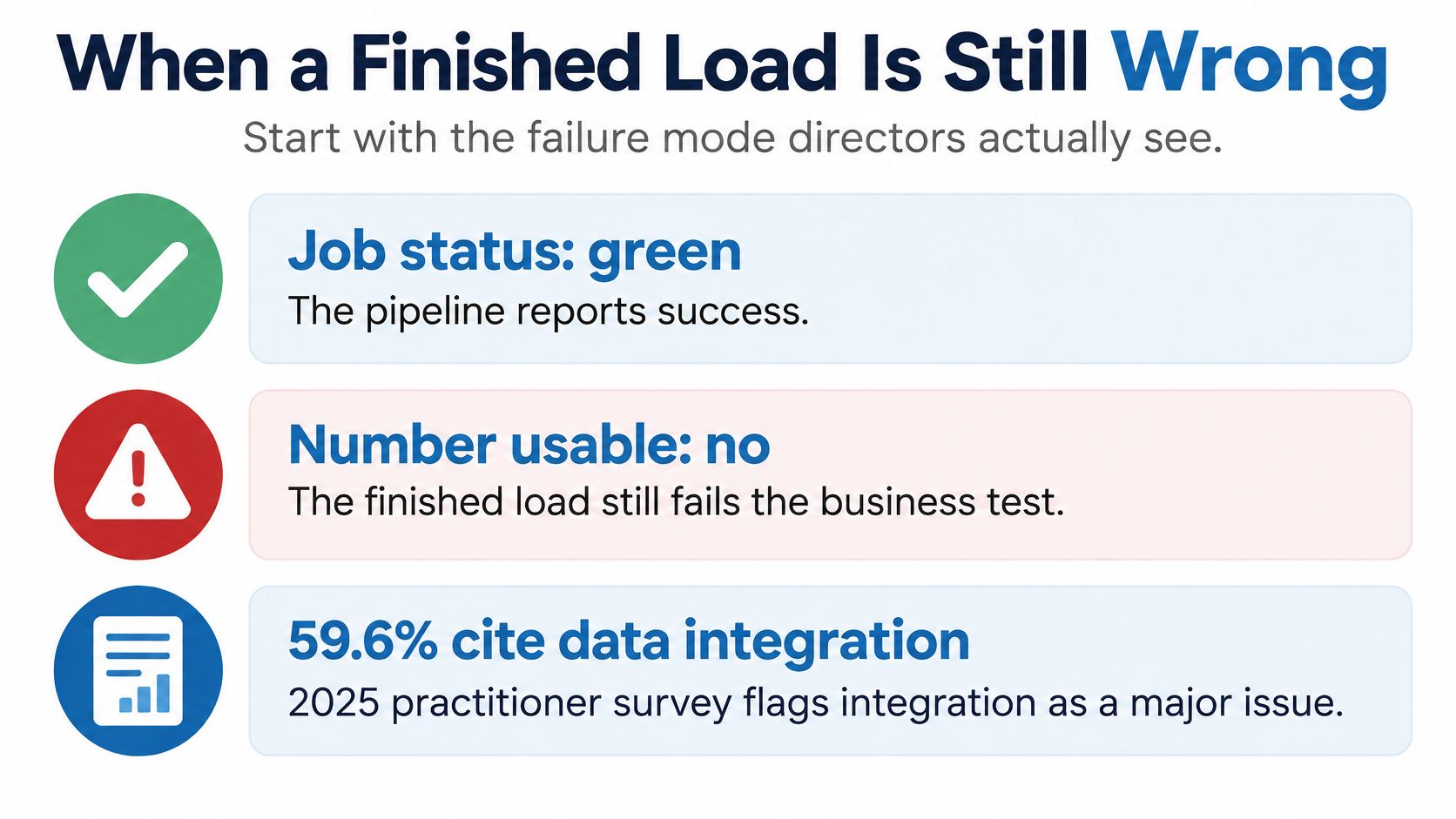
The failure directors see is a green job and a number nobody will sign. Independent practitioner research in 2025 found that data integration was cited by 59.6% of respondents as a major data-engineering difficulty, while adoption of lakehouse table formats stayed relatively modest, according to DataTalks.Club's 2025 practitioner survey. Newer storage formats have not retired broken definitions, duplicate entities, or stale attributes.
A scorecard, not a status light
Impose this order before any vendor demo. A dashboard screenshot is not evidence.
- Source coverage. Every filing, market feed, and customer system the metric claims to use is in the run.
- Freshness lag. The lag matches the decision, not the pipeline team's convenience.
- Reconciliation breaks. Breaks are counted, assigned, and closed. They are not a footnote.
- Duplicate and error rate. A technically successful load with a 0.8% duplicate rate on legal entities can shift a peer percentile and fire a false deposit-growth alert.
- Lineage completeness. An executive can walk from the printed figure to source and version.
- Definition consistency. “Loan growth” means the same thing in the board pack and in the CRM alert.
- Alert resolution time. Measured in hours, from signal to a named owner.
- Whether a decision changed. If no pricing, credit, or coverage action moved, the pipeline did not earn its keep.
That 0.8% case is ETL finished while integration is still failing. Cross-checks across feeds are the proof. We cross-check source data with multiple feeds, and we ship reporting with security, versioning, and auditability by default, because a committee will ask who changed the rule and when. Data observability is how you see lag, breaks, and failed jobs before a director sees them in a pack.
Set three conditions before a demo starts. Every executive metric must trace to a source and a version. Reconciliation breaks must have an owner. Alert-to-action time must be measured in hours. Standardization still beats a faster pipe when the definitions do not match.
Integration is complete only when a user can trace the figure, compare it with a peer, and act without a follow-up argument about definitions.
Benchmark One Decision Before You Rebuild
Name one decision for this quarter. Deposit pricing against peers, or a credit-concentration review. Write the freshness standard and the audit standard before anyone commissions a pipeline. If the source is a quarterly filing and the audience is the board, fund the reconciled ETL benchmark first. If the action must reach a relationship manager or a risk officer the same day, specify the alert path and the owner. Do not open a platform rebuild to settle a question a peer table can answer.
A practical way to see the difference is to benchmark the institution against a consistent U.S. peer set instead of debating architecture in the abstract. Teams that need history they can recompute, rather than a one-time load, can look at how others keep time-stamped records queryable. The Faberwork time series case study from Faberwork LLC is a useful outside illustration of that discipline on Snowflake, not a template you should copy line for line.
Signing up for a Visbanking account is free. Alerts can go by email, Slack, or CRM. We will prepare a report for executives, vendors, or analysts when you ask. Data can leave as CSV or Excel, through an API, or through a custom integration, so the benchmark does not have to live in yet another silo.
Stop collecting figures nobody will defend in a committee. Make the next pricing, credit, or growth decision from a number the bank can trace.
Visbanking's Bank Intelligence and Action System turns regulatory, financial, market, and relationship records into figures a pricing or credit committee can trace, with ETL where the pack must reconcile and broader integration where an alert or CRM action cannot wait. Benchmark your institution against a consistent U.S. peer set before you fund another pipeline. Visit Visbanking and run one decision on data you can defend.
Latest Articles
Brian's Banking Blog
8 Trend Analysis Examples Every Bank Executive Needs

Brian's Banking Blog
Annual Contract Value Explained: Formula and Examples

Brian's Banking Blog
8 Case Study Examples Banking Executives Can Reuse

Brian's Banking Blog
Configure Price Quote Explained for Bank Executives
Brian's Banking Blog
Bank Marketing Regulations: A Guide for Bank Executives
Brian's Banking Blog