
Data Pipelines with Apache Airflow for Banks
Brian's Banking Blog
Your credit committee is waiting for a peer pack. Finance has one version, risk has another, and neither team can establish whether the comparison uses the same reporting period. In a hypothetical $4.8 billion bank, directors wait three days, only to receive last quarter's UBPR figures alongside this week's macroeconomic series.
The missing control isn't a chart. It's the execution record behind the number. When teams build data pipelines with Apache Airflow, the objective should be a defensible decision, not a green status indicator.
Why a Bank Number Needs an Orchestrator
In that hypothetical bank, analysts ran three scripts by hand, in the wrong order. Nobody preserved which source file supplied the final result. The committee can discuss the apparent performance gap, but it can't establish whether the gap reflects the bank's performance or the analyst's file selection.
Airflow addresses coordination. Its history runs from Airbnb in 2014, through Apache incubation in March 2016, to Apache Top-Level Project status on January 8, 2019, according to the Apache Airflow overview. That lineage matters because banking workflows need maintained infrastructure, not another analyst-dependent script.
Operating rule: A task that finishes isn't the same as a figure the board can defend months later.
An orchestrator establishes which work must finish before another task can begin. For a bank, that means coordinating FDIC, NCUA, HMDA, SEC, and BLS inputs without treating arrival, validation, and publication as the same event. Open-source governance also gives engineering more freedom to change integrations without rebuilding around a single vendor's workflow conventions.
Approve the operating contract first
Directors don't need to approve Python code. They need management to specify the decision, the reporting cutoff, the publication authority, and the evidence required when someone challenges an output.
The engineering contract should identify validate, ingest, transform, reconcile, publish, and notify as distinct responsibilities. It should also say whether publication follows a fixed business cutoff or a verified data-ready signal.
Approve that contract before funding a larger feed inventory. Otherwise, engineering may automate an unreliable reporting process more efficiently.
Six Stages a Bank Pipeline Must Finish
Production stages for a bank Airflow DAG
| Stage | Output | Idempotency control | Stop if |
|---|---|---|---|
| Validate snapshot | Schema and source checksum | Fixed file or API snapshot, not latest | Schema drift or missing period |
| Ingest raw | Immutable raw partition | Write once by logical date | Row count outside tolerance |
| Transform | Curated tables | Deterministic upsert or atomic replace | Non-repeatable join keys |
| Reconcile | Quality evidence | Checksums, counts, metric tolerances | Failed gate or quarantined spike |
| Publish | Versioned warehouse or feature table | Version tied to run ID | Upstream gate not passed |
| Notify | Audit event, then alert or CRM | Deduplication key per run and entity | Duplicate or unapproved payload |
Give engineering this contract and reject a single notebook that performs every operation without distinct checkpoints. The Airflow best-practices documentation supports small, independently retryable tasks, repeatable outputs, and processing outside the scheduler. Each stage needs an owner and an observable failure condition.
Stop the misleading comparison before publication
Consider a hypothetical $2.4 billion bank comparing return on assets and efficiency ratios with 180 peers. Reconciliation finds that its FDIC extract contains 1,200 fewer institutions than the prior-quarter extract. That difference doesn't prove corruption, but it demands an explanation before anyone publishes rankings.
The correct outcome is a stopped publication task and an exception for investigation. It isn't a refreshed dashboard accompanied by a warning buried in a log. Relationship managers shouldn't receive an apparent prospect-performance gap that exists only because the comparison population changed.
Separate source completeness from peer eligibility. An institution may legitimately leave the eligible group after a merger or a change in the bank's selection criteria. Finance should approve that explanation rather than letting engineering widen a tolerance until the task passes.
Make retries safe before enabling them
Idempotency means that the same logical date and input version produce the same result when a task runs again. Airflow retries individual tasks rather than automatically replaying the entire graph. Without repeatable writes, a recoverable interruption can become duplicated deposits, mismatched aggregates, or repeated CRM activity.
Use deterministic upserts where records have stable keys. Use an atomic replacement when publishing a complete curated partition. Avoid appending another copy of financial records due to a worker restarting.
Keep raw payloads immutable and partition them by logical date. Never resolve an input by asking for whichever file happens to be newest during execution. That shortcut makes a rerun dependent on what arrived after the original calculation.
Quarantine rejected records with the run ID, operator identity, transformation version, and validation result. Preserve both the rejected payload and the reason it failed. Investigators need to distinguish a source defect from a transformation defect without reconstructing the original failure from memory.
The published table is the artifact management approves. An alert is merely its delivery mechanism. Record the audit event before releasing the alert, and use a deduplication key so repeating a notification task doesn't create another sales assignment.
How to Build the DAG from Feed to Alert
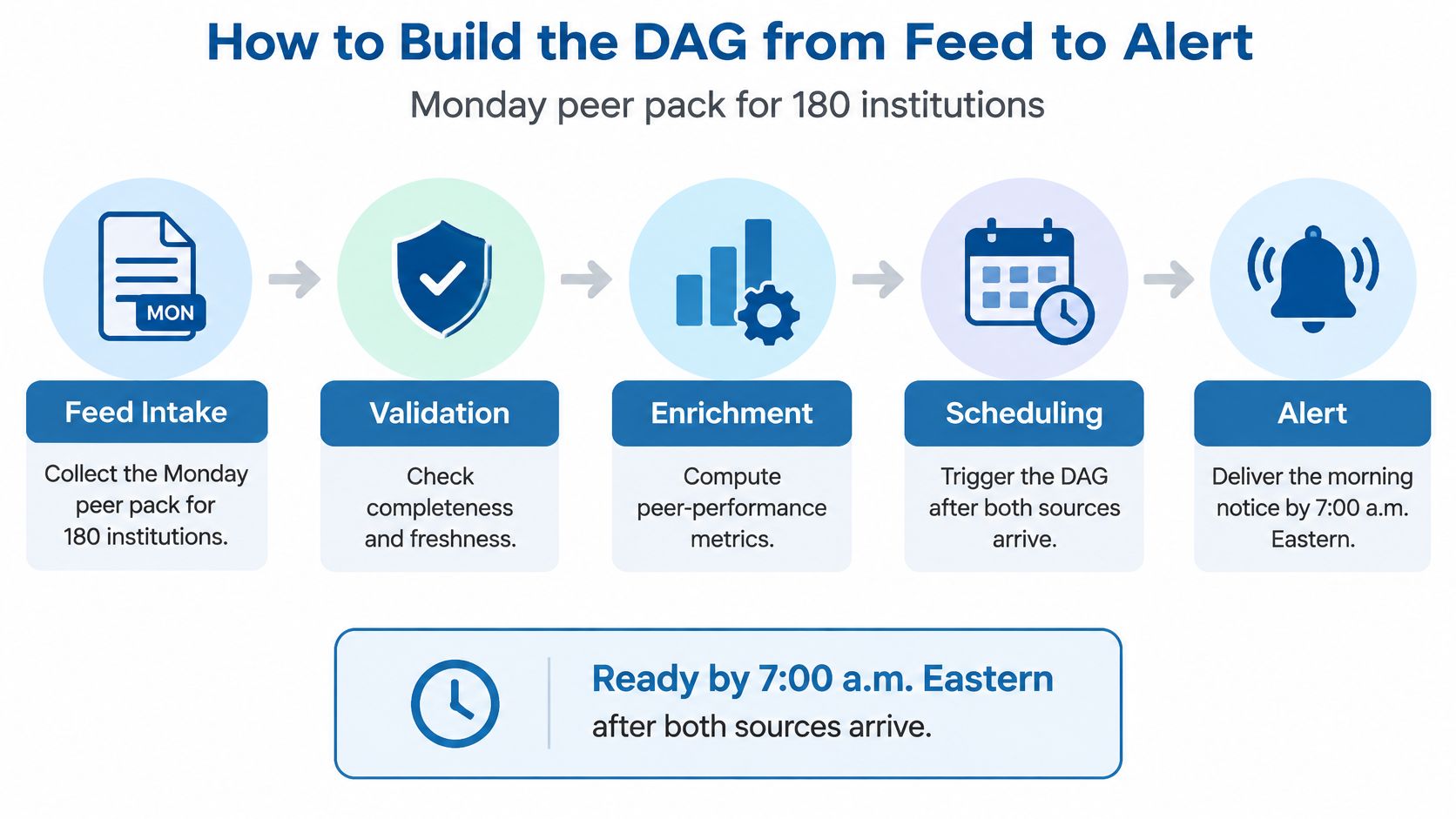
Build around a named banking decision, not a collection of available connectors. Airflow represents workflows as Directed Acyclic Graphs, or DAGs, with explicit task dependencies; its scheduler determines readiness, an executor arranges execution, and its metadata database records workflow state, as described in the Airflow documentation.
Define the decision and wire the dependencies
Name the deliverable. For a hypothetical deployment, define a Monday peer pack covering 180 institutions, ready by 7:00 a.m. Eastern after the call-report extract and macroeconomic series arrive. Make the promise conditional on validated inputs, with an escalation if a source misses its deadline. The committee needs to know whether it's receiving current results or a delayed publication.
Register controlled connections. Configure the relevant FDIC or NCUA, FFIEC UBPR, HMDA, SEC, and BLS or BEA connections. Store secrets outside DAG code and grant each service identity only the access it needs. A peer-reporting workflow shouldn't inherit authority to change unrelated banking datasets.
Declare explicit dependencies. Match tasks to the approved stage contract and make publication depend on successful reconciliation. Have finance review the dependency diagram alongside engineering. A data-integration practices checklist can help structure the discussion around source ownership, mappings, and handoffs.
Separate raw storage from execution history. Store raw files by logical date in the designated raw-data store. Keep Airflow's metadata database for operational history, not call-report analytics. That separation lets operators investigate runs without turning scheduler queries into analytical workloads.
Delegate the calculations. Execute heavy joins and peer calculations in the warehouse or distributed processing engine. The scheduler should determine readiness rather than calculate the bank's efficiency-ratio distribution. A slow analytical query shouldn't prevent unrelated workflows from being scheduled.
Test the output and the delivery
Encode failure conditions. Check counts, checksums, period alignment, and metric movements. In this hypothetical deployment, an unexplained 8-basis-point net-interest-margin swing could require review rather than automatic publication. Finance must define whether the check applies to an institution, a peer aggregate, or a change in calculation logic.
Separate model features from executive reporting. Publish versioned model features independently of the executive table so model development doesn't move the committee's reporting baseline. For specialized first-person training inputs, TrueLabel's guide to organize egocentric data for model training offers an adjacent reference. Don't confuse that training-data design with approval of financial reporting.
Release notifications deliberately. Send Slack, email, or CRM messages only after recording the approved output. Suppress repeat delivery for the same run and entity. Relationship managers need an actionable assignment, not multiple pages caused by infrastructure recovery.
Prove reconstruction before promotion. Test a manual run, a scheduled run, and a prior-quarter backfill. Confirm that reviewers can recover the inputs, executed code, and published result for each. Promote the same reviewed code through development, test, and production rather than editing production DAGs by hand.
Clock Schedules Versus Data Ready Triggers
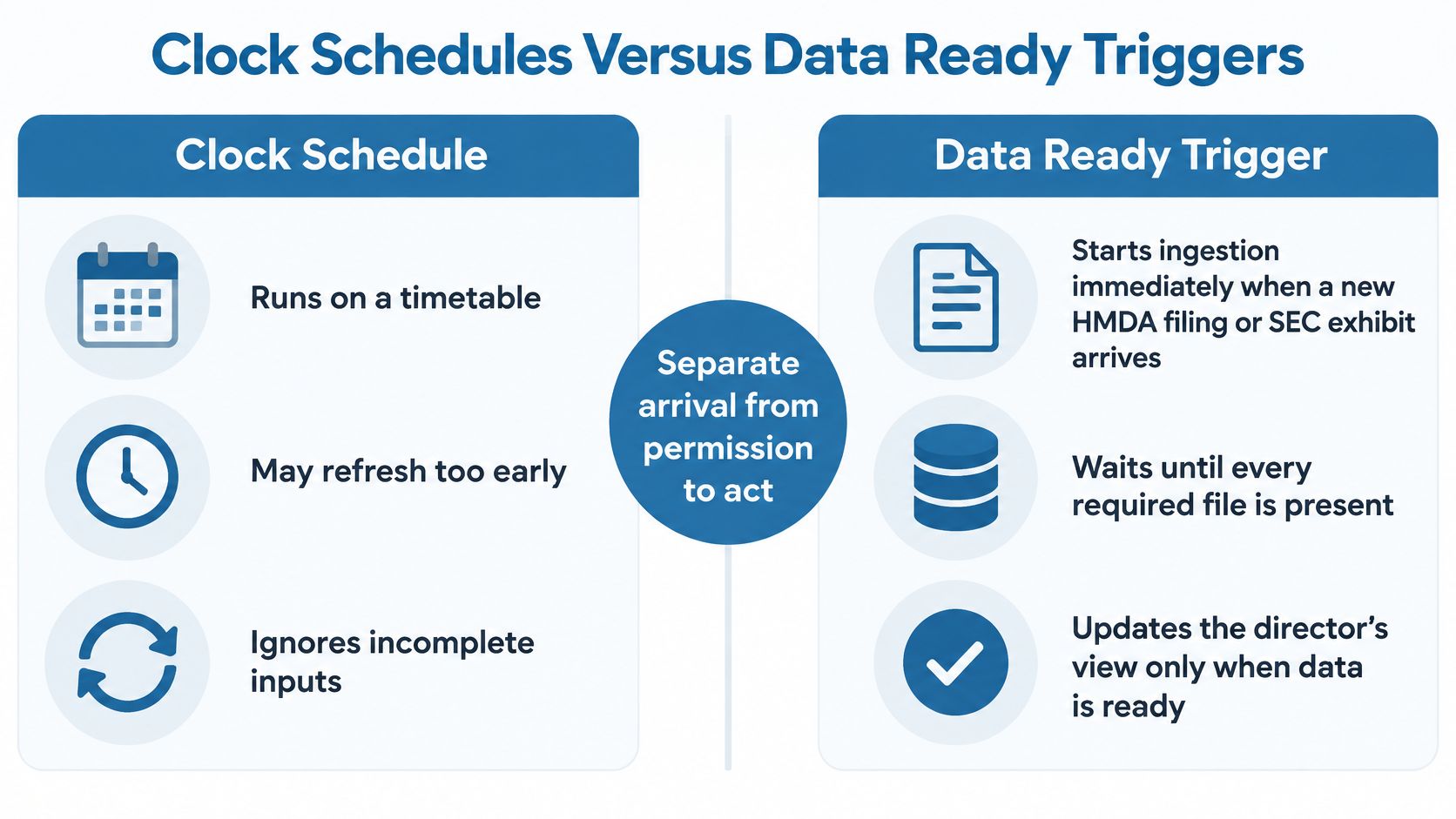
A Monday pack built from refreshed macroeconomic data and stale regulatory financials can be precisely calculated and still be unsuitable for comparison. Separate arrival from permission to act. A new HMDA filing or SEC exhibit can justify immediate ingestion without justifying an immediate change to a director's peer view.
Trigger choice by banking decision
| Decision | Trigger | Publish when | Main failure |
|---|---|---|---|
| Quarterly peer benchmark | Clock plus dataset gate | Both financials and macro series validated | Rankings on a partial peer set |
| New regulatory filing alert | Event for ingest, gate before alert | Deduplicated and schema-valid | Duplicate pages or a false flag |
| Feature-store refresh for ML | Hybrid watermark | Complete, versioned features | Training on a moving label |
| Executive Monday pack | Fixed business cutoff | Reconciliation passed for that date | A number that cannot be tied out |
| Historical backfill | Manual or ranged schedule | Same code version as the original rule | Mixed logic across quarters |
Airflow's data-aware scheduling documentation explains that a failed or skipped producer doesn't mark its dataset updated. A consumer requiring multiple datasets waits until all have been updated since its previous run. Configure the producer's success condition to include validation, not merely a completed download.
Use lower latency where it changes an action
Airflow 3.0 expanded event-driven workflow support, according to the Airflow release notes. That capability doesn't establish a business case for continuously refreshing every bank metric. Leadership should ask which action would change if an approved signal arrived earlier.
A filing alert may help a relationship manager prepare for a conversation. A quarterly peer rank usually benefits more from consistent periods and a complete comparison population. Faster ingestion and stable reporting can coexist.
For source-delivery design, RichAPI's explanation of choosing webhooks over API polling is useful context. A webhook reduces the need to repeatedly ask whether something arrived. It doesn't establish that the payload is complete, unique, or approved for publication.
Start ingestion when the event arrives. Let the business rule determine when people may act.
Control revisions and replay
Use a watermark to identify the latest complete, approved input boundary. A hybrid workflow can ingest continuously while publishing only when that boundary satisfies the reporting rule. Late revisions should create an identifiable revised output rather than overwriting an executive's earlier view.
Duplicate events and replay storms require separate handling. Deduplicate source events before launching unnecessary work, and suppress alerts that don't represent a new approved business condition. Otherwise, a source-system recovery can flood relationship managers with old news.
Pin in-flight execution to its intended DAG and code version. A Tuesday deployment shouldn't inject new logic into a Monday reporting run. When management deliberately recalculates history under a revised method, label the result as a restatement rather than presenting it as the original figure.
Concurrency Retries and Freshness Targets
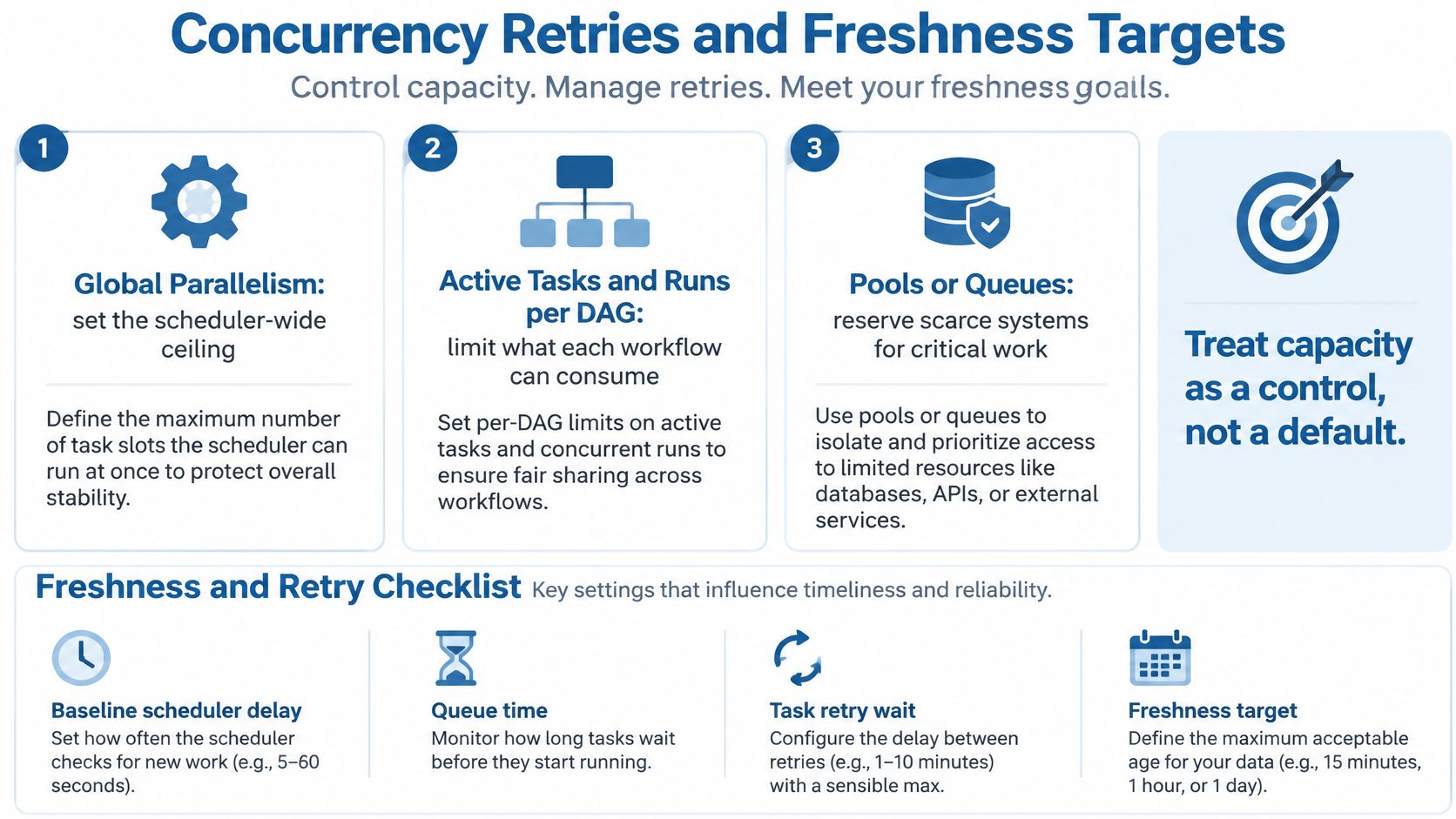
Start with measured delay. Before adding workers, establish scheduler delay, task queue time, runtime, metadata-database latency, and worker saturation. A backlog caused by a constrained regulatory endpoint won't disappear because engineering allows more simultaneous requests.
The Airflow operational FAQ describes concurrency controls across deployment parallelism, DAG tasks and runs, and task-level limits or pools. Use them as protections for shared systems, not as settings to maximize indiscriminately.
Airflow controls and bank operating targets
| Control | Starting point | Protects | Watch |
|---|---|---|---|
| parallelism | Raise only after a baseline | Whole deployment | Metadata-database latency |
| max_active_runs_per_dag | For a hypothetical report DAG, 1; higher for isolated ingest | Conflicting publications | Overlapping backfills |
| max_active_tasks_per_dag | Sized to warehouse slots | Worker and query pileups | Queue time |
| Pools for regulatory APIs | Fixed small slot count | FDIC, FFIEC, NCUA, SEC limits | Pool starvation |
| Retries with backoff | Few attempts and a maximum delay | Transient endpoint failures | Silent incomplete extracts |
| Freshness SLO | Approved business cutoff plus measured p95 scheduling-delay target | Decision cutoff | End-to-end lag, not task green |
Protect scarce capacity
Put regulatory API calls into constrained pools, and reserve capacity for time-sensitive alerts. Historical backfills shouldn't consume every warehouse connection just because they contain more work. Establish priority explicitly rather than relying on which task enters the queue first.
Prefer deferrable or rescheduling patterns for long waits. A worker shouldn't remain occupied while an external filing is unavailable. Keep DAG parsing lightweight, and bound dynamic task mapping so an unexpectedly large input cannot create an uncontrolled workload.
Add schedulers only after measurements show that scheduling capacity is the bottleneck. If the metadata database or warehouse is already saturated, additional scheduling pressure can make diagnosis harder.
Recover without concealing incompleteness
Airflow supports retry counts, delays, exponential backoff, and maximum retry delays through its task retry controls. Use these for transient endpoint failures. A persistently incomplete extract should remain a visible exception, not become acceptable because the workflow exhausted its attempts.
Capacity discipline: Measure success at the decision cutoff, not at the last successful task.
For a hypothetical operating target, management could require the peer pack by 7:00 a.m., with p95 scheduling delay below five minutes. Test that promise under normal volume, doubled volume, and peak backfill conditions before approving production.
Apply data observability practices to distinguish source delay from execution delay. For relationship-management outputs, Fetchin's discussion of keeping B2B contact data current adds a useful distinction: a newly delivered record can still contain stale business information. Monitor the age of the underlying facts as well as pipeline completion.
Audit Evidence from Snapshot to Decision
Managed Airflow doesn't automatically mean compliance. The bank still owns authorization, exposure, lineage, and publication authority. Ask whether an independent reviewer could reconstruct and challenge the reported output months later.
Airflow 3.0, released April 22, 2025, introduced remote task execution and an Edge Executor, according to its release notes. Map identity propagation, network access, and execution evidence across those trust boundaries.
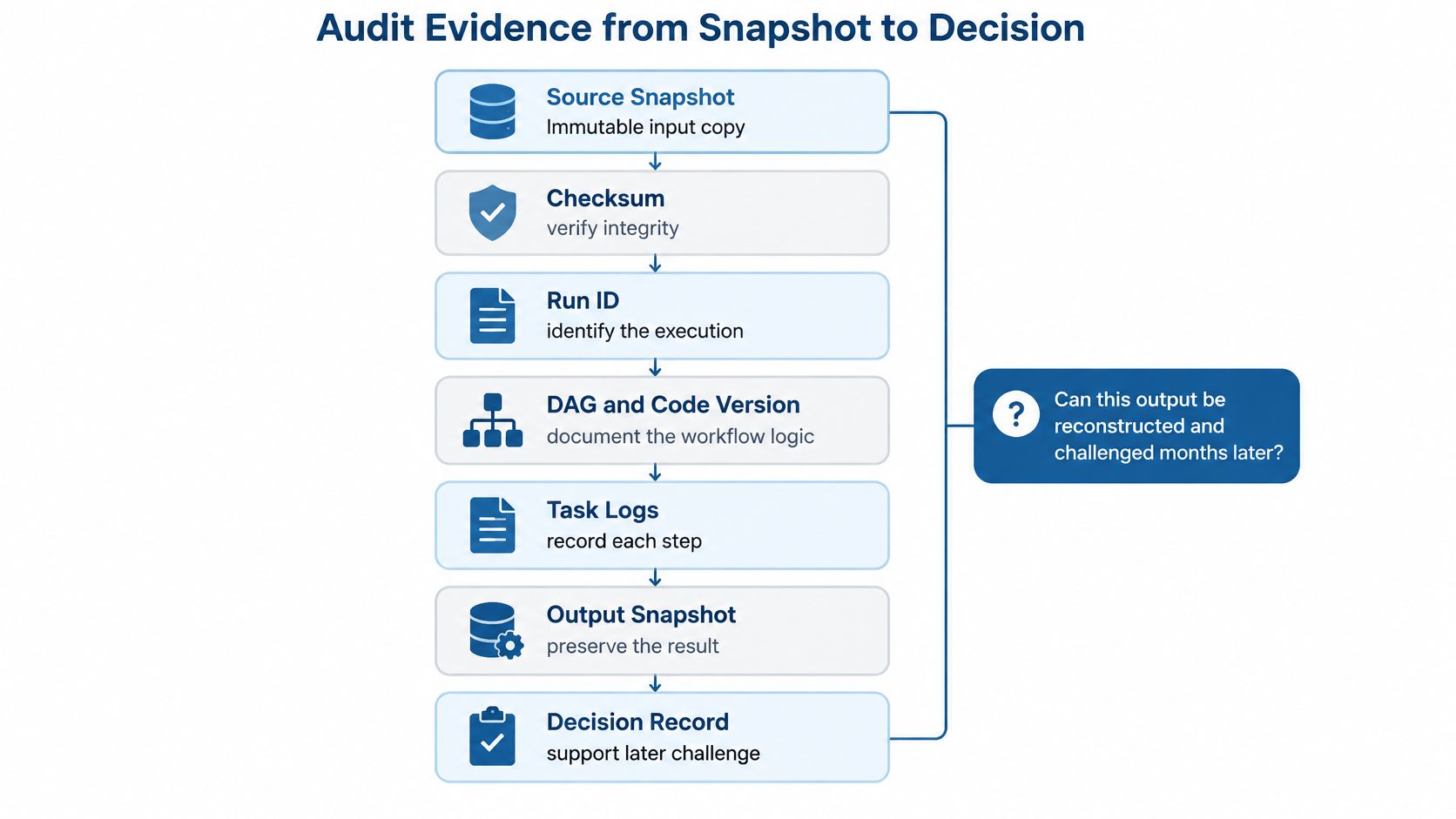
Evidence an examiner will request
| Artifact | Where it lives | Retention |
|---|---|---|
| Source snapshot and checksum | Immutable raw store, written once by logical date | Exam and audit window |
| Run ID, DAG version, and code version | Airflow metadata database, with durable execution-manifest reference | Exam and audit window |
| Operator or service identity | Identity and access logs | Internal audit window |
| Validation and reconciliation results | Warehouse audit table | Exam and audit window |
| Rejected-row quarantine | Warehouse quarantine schema | Exam and audit window |
| Published table version | Warehouse or feature store | Life of each reported figure |
Assign authority as carefully as storage
Map FDIC, FFIEC UBPR, NCUA 5300, HMDA, SEC, and macroeconomic feeds onto this evidence chain. Record late arrivals and revisions. Keep analytical facts in the warehouse or feature store, not in Airflow's operational database.
Require independent approval before someone who changes a transformation can republish a board figure. Align retention with the bank's examination and internal-audit requirements, including recoverable execution manifests if operational metadata is purged. Incorporate these responsibilities into the bank's data-governance framework, rather than leaving them solely with infrastructure administrators.
Benchmark the Peer Set Before You Expand
Don't fund another pipeline until the first changes a decision management can name. Start with a question already on the executive agenda: why the efficiency ratio trails comparable institutions, or which relationships deserve attention after a new filing changes the bank's view.
Run that question at an approved cutoff and compare the result with the spreadsheet executives currently use. Check the institution population, reporting period, metric definition, and treatment of revisions before debating whose dashboard is right.
Require an observable business result
Record the analyst effort avoided and every figure that would otherwise have reached a decision-maker incorrectly. Don't treat time saved as sufficient if the new workflow merely reproduces an unchallenged calculation. The more valuable finding may be an exclusion rule that had distorted the peer comparison.
- Resolve disagreements before expansion. If the orchestrated output differs from an independent benchmark, establish whether the cause is the snapshot, institution mapping, or formula.
- Name the action owner. Assign the finance, risk, or relationship-management leader who will act on the approved result.
- Expand by decision. Add the next executive question only after the current output has a clear use, accountable owner, and accepted evidence.
The immediate benchmark action is straightforward: select an approved peer group and reconcile its performance measures against the committee's existing pack. Publish the differences with explanations, not just replacement charts.
Collect less for its own sake. Data has to change a decision, not fill a dashboard.
Visbanking's Bank Intelligence and Action System brings financial, regulatory, market, and people data into peer and performance views that help banking teams act on validated information. Visit Visbanking to benchmark your institution's peer set and compare your current executive pack with explainable bank intelligence before expanding your pipeline program.
Latest Articles
Brian's Banking Blog
Bank Shares Performance: Metrics That Drive Returns
Brian's Banking Blog
Help to Identify Bank Prospects and Risk Signals
Brian's Banking Blog
API Security Testing Tools: 10 Options for Banks in 2026
Brian's Banking Blog
HMDA Data Reporting: How to File Without Costly Errors
Brian's Banking Blog
Talent Market Intelligence: A Guide for Bank Leaders
Brian's Banking Blog