
Data Driven Partners for Banks: A Practical Guide
Brian's Banking Blog
Banks aren't short of data partners. They're short of partners whose data survives an audit and changes a decision. That gap is visible in KPMG's 2025 banking technology survey, where 79% of surveyed banks said they would prioritize improving governance if restarting GenAI implementation, while only 16% of use cases reached full deployment, according to the 2025 KPMG Banking Tech Survey.
Treat data driven partners as an operating decision system, not a vendor list. Judge each one on outcomes, lineage, and whether a director can trace an action back to its evidence.
What Data Driven Partners Mean for Banks
A data driven partner supplies, connects, or analyzes information a bank can act on, and that information has to change a named decision. A chief lending officer who reprices construction loans has one. A dashboard nobody opens before committee does not. If procurement cannot name the owner and the decision, the bank has bought a subscription.
The Market Has Already Moved
Partnerships at this scale are already common. A peer-reviewed study of 400 of the largest banks in Canada, France, Germany, and the United Kingdom identified 500 bank-fintech alliances, and a preliminary review of 150 alliances found that 17% had ended by 2020.
That sample is not a U.S. census. Read it as a market signal: alliances form often, and a meaningful share end when integration or strategic fit fails. U.S. directors should treat the failure rate as a warning about decision fit, not as a domestic benchmark.
| Partner type | Typical data supplied | Primary bank use | Main risk |
|---|---|---|---|
| Regulatory data platform | Call report and regulatory filing data | Peer benchmarking and trend analysis | Peer sets that do not match the bank's size or charter |
| Prospecting and relationship provider | Business contacts, decision-makers, product holdings | Prospect prioritization and outreach | Stale contacts and unclear consent |
| Open-finance transaction data source | Permissioned account and cash-flow data | Credit monitoring and underwriting | Consent, governance and API reliability |
| Payments or fraud partner | Transaction and fraud signals | Risk screening and money movement | Outcome reporting that is hard to verify |
| Analytics and modeling partner | Custom models, forecasts and dashboards | Predictive signals and executive reporting | Unexplained outputs and model drift |
An ordinary vendor purchase ends at delivery. A partnership starts there, because value depends on whether the data reaches credit, pricing, prospecting, or the board packet in a form a director can audit. Contract size says almost nothing about that path.
Sourcing models decide whether the path holds. Visbanking's data as a service approach for banks treats external data as a managed input to those decisions. Boards replacing aging extracts should evaluate data modernization services against the same test: which decision improves, who owns it, and how the bank will prove the improvement.
A partner that can't name the decision it changes is selling content, not intelligence.
Selection Criteria and a Partner Scorecard
Use a scorecard in the vendor review itself, not after a pilot has created internal momentum. Seven criteria matter most, and each needs a verification question plus a red flag that can stop the deal.
Start with data lineage. Ask which feeds supply each field and how often they refresh, then request named feeds and update dates. If sources are described only as proprietary, stop. You can't defend a credit or pricing decision built on unnamed inputs.
Fit, Matching, and Reliability
Coverage and peer fit come next. A bank with $5 billion in assets shouldn't be benchmarked against an all-bank average, so request peer sets built for its size, charter, and geography. Broad coverage is worthless if the comparison group misleads the board.
Third, test entity matching and quality. Ask how duplicate institutions are resolved and whether the partner cross-checks multiple feeds. We unify public and proprietary data sources into a consistent model with entity resolution, quality checks, and version control, and that's the reference point to demand from anyone. No stated quality process means your team becomes the quality process.
API reliability needs operational metrics, not assurances. Measure authorization success rate, response latency, data completeness, refresh frequency, and revocation handling. The OECD report on shifting from open banking to open finance found that 21 of 33 responding countries reported positive effects from open-banking data-sharing frameworks, yet connectivity alone doesn't create those effects without standardized consent, consistent semantics, authentication, access controls, and reliability monitoring.
| Criterion | What to verify | Evidence to request | Red flag |
|---|---|---|---|
| Data lineage | Source and refresh timing for each field | Named feeds and update dates | Sources described only as proprietary |
| Coverage and peer fit | Institution types, sizes and geographies covered | Peer sets for a bank of your size | Only all-bank averages offered |
| Entity matching and quality | Duplicate handling and cross-checks across feeds | Documented quality checks and version control | No stated quality process |
| API reliability | Authorization success, latency, completeness | Service-level targets for each metric | No uptime or latency commitments |
| Governance and permissions | Permitted use, retention, onward sharing | Written data-use terms | Vague rights to reuse bank data |
| Explainability and audit | Traceable outputs and stated confidence | Audit trail and change log | Scores with no stated method |
| Outcome linkage | Tie to revenue, approval quality, cost or risk | Pilot results against a baseline | Success measured only by partner count |
Governance, Audit, and Outcomes
Governance must be written down before data moves. Cover permitted use, retention, onward sharing, model development, and incident response in plain terms. Vague rights to reuse bank data create regulatory and commercial exposure you won't discover until renewal.
Explainability and audit follow. Every output should trace to its source, carry a confidence level, and sit in a change log. For shortlisting itself, tools built around AI-driven prospecting for strategic partnerships can help structure fit assessment, but they don't replace your own audit trail.
Finish with outcome linkage. Measure revenue, approval quality, operating cost, or risk reduction, never partner count. Tie the review into your vendor risk management process for banks so the scorecard becomes a recurring control, not a one-time procurement exercise.
Weight the criteria against your most important decision. Say a $5 billion bank prioritizes credit approval: weight outcome linkage at 25%, data lineage at 20%, explainability and audit at 20%, API reliability at 15%, entity matching and quality at 10%, and coverage plus governance at 5% each. Any partner at red-flag level on lineage or audit fails regardless of its total score.
Benefits Banks Can Measure Today
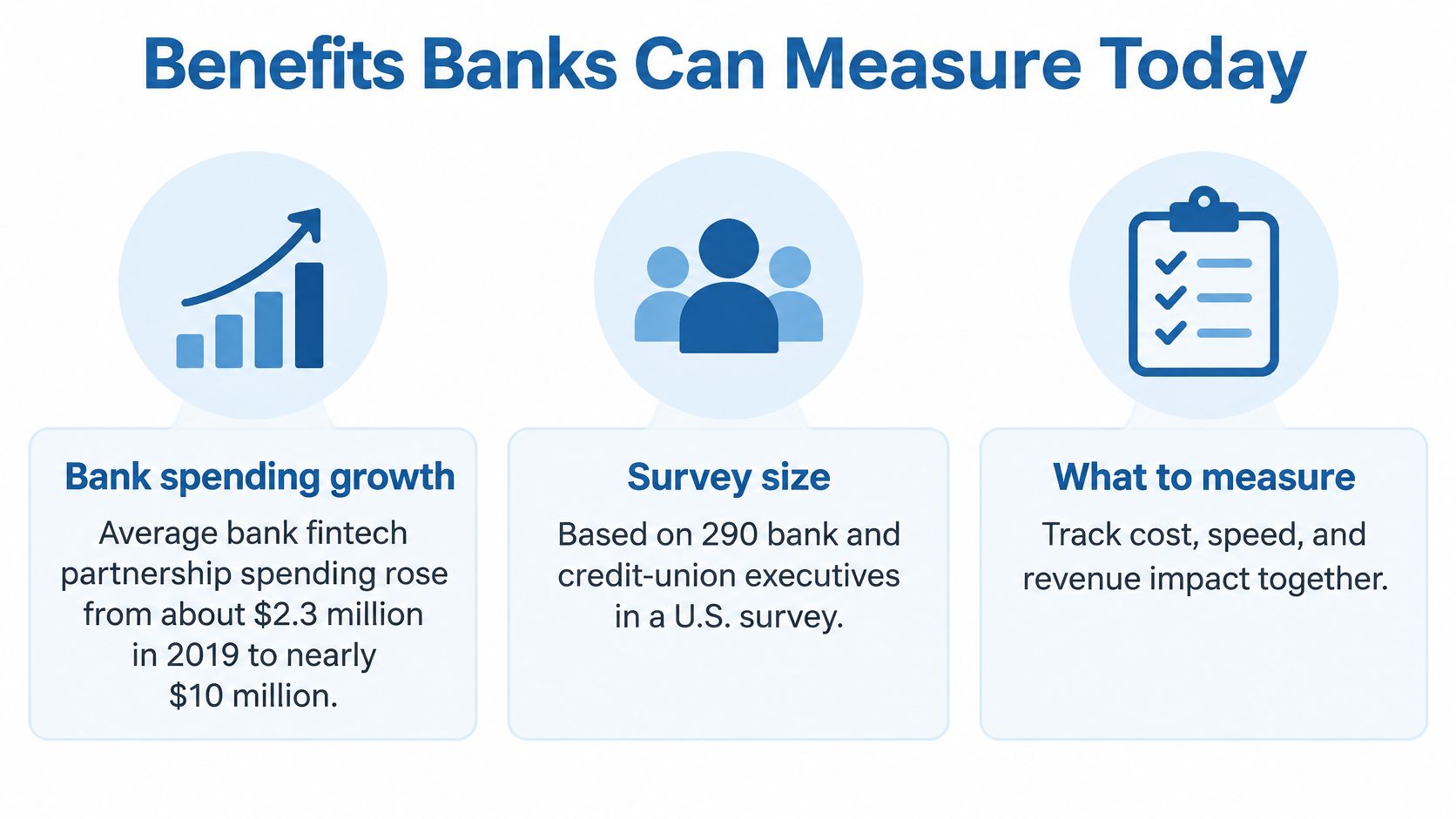
Spending has already committed the industry to this model. In a survey of 290 U.S. bank and credit-union executives, average bank spending on fintech partnerships rose from approximately $2.3 million in 2019 to nearly $10 million in 2021, while the average number of fintech partnerships per bank increased from 1.3 in 2019 to 2.5 in 2021.
Hold that against the warning from the same research: roughly two-thirds of partnerships fell below expectations. Money and partner count aren't benefits. They're inputs that need proof.
Four Benefits You Can Test
- Faster prospect prioritization: Rank institutions and businesses by signal strength, then track qualified meetings per 100 contacts against the month-one baseline. Longer lists don't count as progress.
- Peer benchmarking with controls: Compare margin, growth, and efficiency only against institutions of similar type and size. The metric is your gap to the peer median, not your gap to a national headline.
- Credit and portfolio monitoring: Use fresher partner signals to flag exposures between quarterly reporting cycles. Track the share of flagged exposures your team reviews within 30 days.
- Payments and fraud performance: Adoption is deepest here, and it's measurable in losses per $1 million of payment volume. Set the prior 12 months as the baseline before launch.
Demand is concentrated in operational areas for a reason. In payment facilitation and money movement, 39% of surveyed institutions had already partnered and another 39% planned to do so, which tells you where executives expect near-term returns. It doesn't tell you whether any individual partner delivered them.
| Benefit | Metric to track | Baseline to set |
|---|---|---|
| Faster prospect prioritization | Qualified meetings per 100 contacts | Current meetings per 100 contacts, recorded in month one |
| Peer benchmarking | Net interest margin gap to peer median | Margin against banks of similar asset size and charter |
| Credit and portfolio monitoring | Share of flagged exposures reviewed within 30 days | Review timing under the quarterly reporting cycle |
| Payments and fraud performance | Fraud losses per $1 million of payment volume | Losses in the 12 months before the partnership starts |
Set the baseline before signing, name the metric, and fix the review date. A benefit is real only when a partner's output changes a recorded decision and the result shows up in that metric. Everything else is vendor reporting.
Three Partner Profiles With Worked Numbers
Abstract value claims collapse under arithmetic. These three hypothetical profiles show how a director can check a partner's worth with numbers the bank already tracks.
Profile one is a $1.2 billion community bank using call report data to track net interest margin against the median for banks of similar asset size. Its question isn't whether margin rose. It's whether margin rose faster than comparable institutions managed in the same rate environment.
Profile two is a $500 million regional bank where 30% of CRE exposure, or $150 million, sits in construction and land development. A partner tracking product-level lending standards can flag when that segment tightens faster than multifamily lending, giving the chief credit officer time to adjust advance rates, coverage requirements, or concentration limits before the portfolio forces the issue.
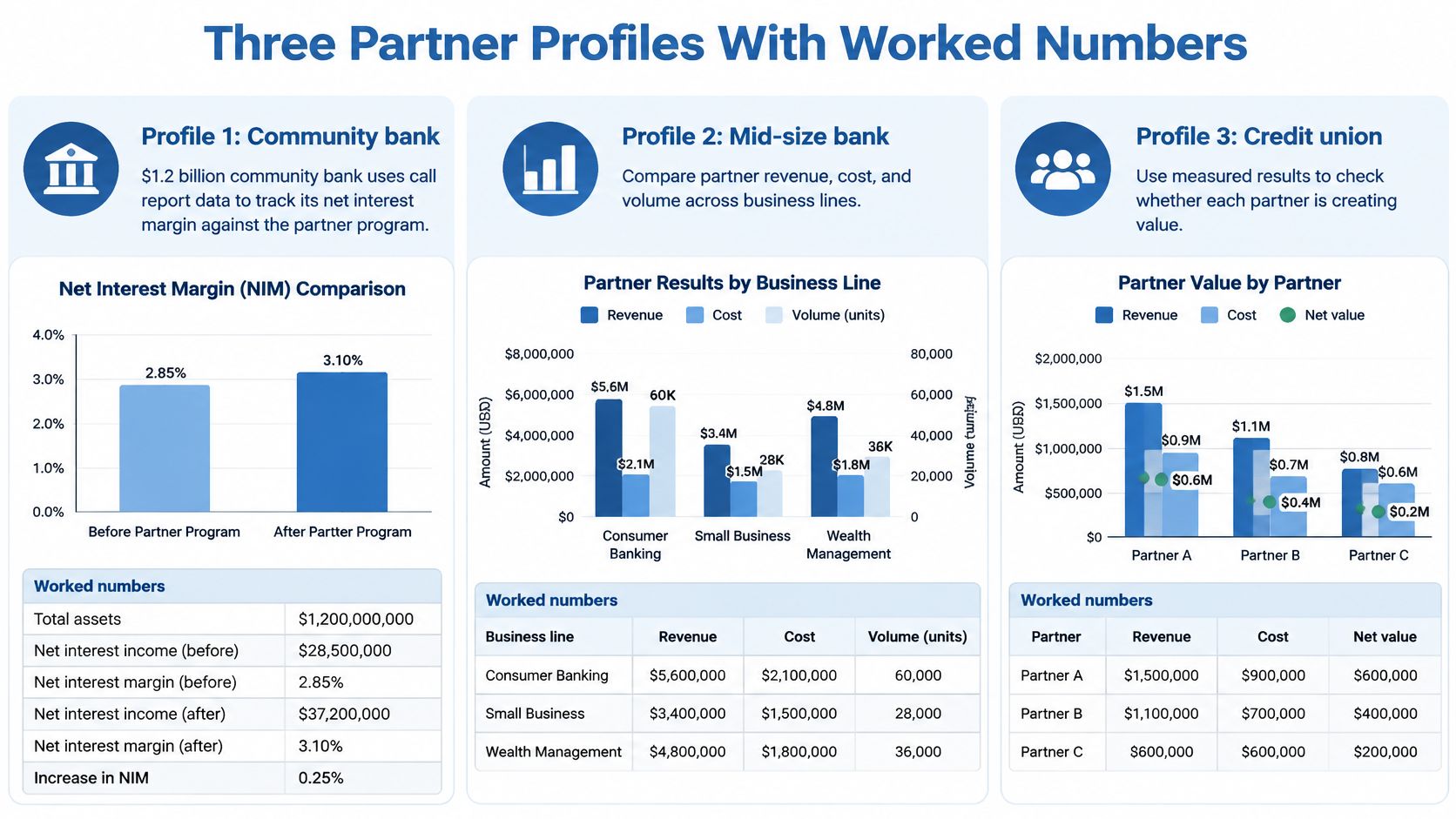
Profile three is an $800 million credit union using business relationship and product data to prioritize outreach. It tracks qualified meetings per 100 contacts against a baseline set in month one. If meetings don't rise, the contact data isn't better than the list it replaced, whatever the enrichment rate says.
| Partner profile | Bank example | Partner data | Metric to track |
|---|---|---|---|
| Peer benchmarking partner | $1.2 billion community bank | Call report data for banks of similar asset size | Net interest margin gap to peer median |
| Concentration monitoring partner | $500 million regional bank with $150 million construction exposure | Product-level lending standards by quarter | Construction share against the concentration limit |
| Prospecting partner | $800 million credit union | Business contacts and product holdings | Qualified meetings per 100 contacts, baseline set in month one |
Why the Peer Set Decides the Answer
The FDIC Quarterly Banking Profile for the fourth quarter of 2025 reported that U.S. banks' industry net interest margin reached 3.39% in the fourth quarter of 2025, while community banks recorded a 3.77% margin. The gap is 0.38 percentage points, or 38 basis points, purely from which group you choose as the comparator.
Run the money. A bank with $5 billion in earning assets earning a 38 basis point advantage on the same balance sheet generates roughly $19.0 million more in annual net interest income. That's $5,000,000,000 multiplied by 0.0038, and any director can verify it on a phone calculator.
Director's check: If changing the peer set changes the conclusion by $19.0 million, the peer set is the analysis.
Each profile starts from one decision, one partner data source, and one metric. Scale only after that first chain produces a result you can defend in committee. A partner who resists this discipline is telling you how the renewal conversation will go.
Embedding Partner Data in Bank Workflows
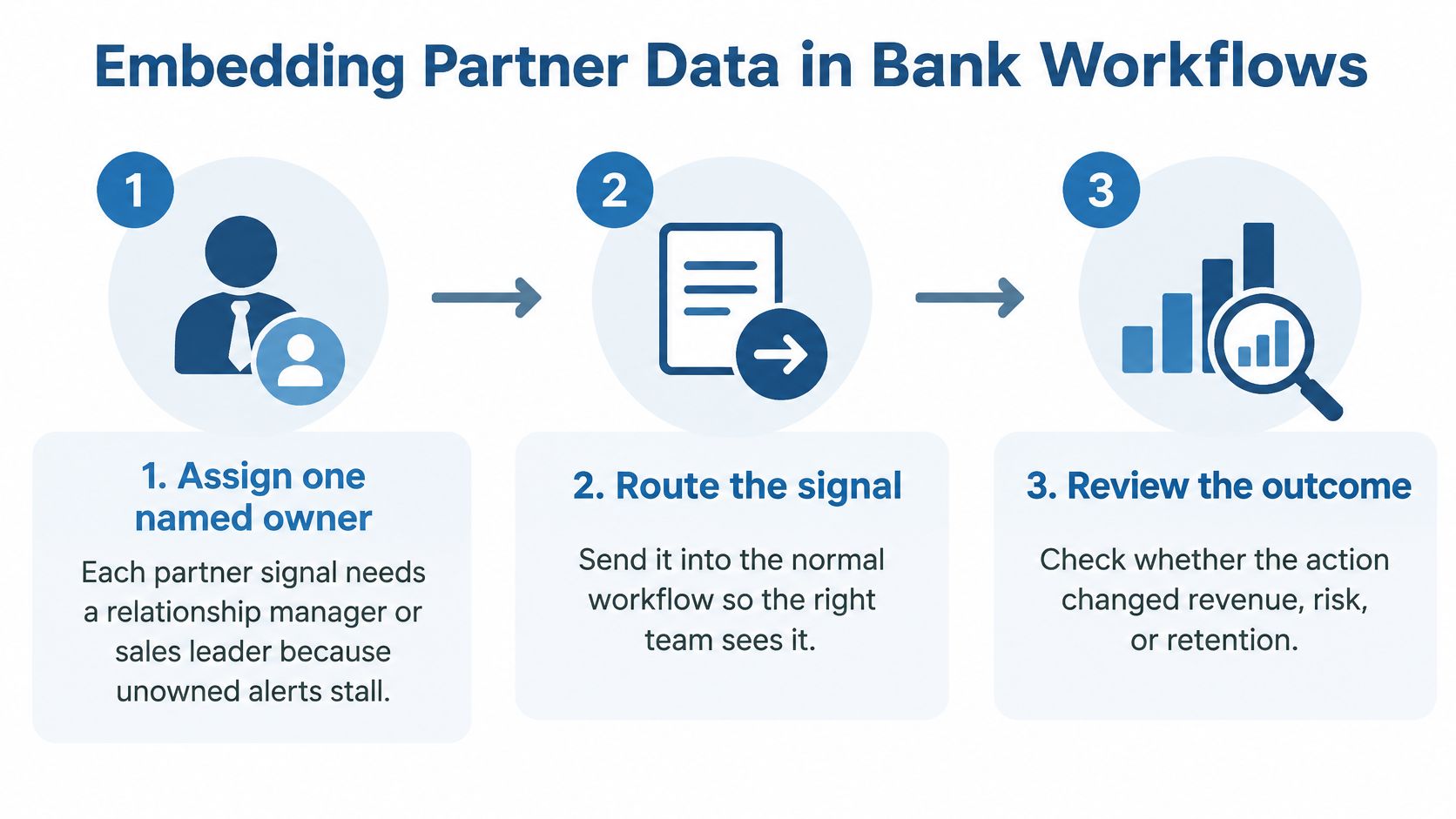
Partner data rarely fails inside the model. It fails at the handoff, once a signal moves from an analyst's queue to a banker's desk. A signal that arrives with no owner, no deadline, and no record of what happened next is indistinguishable from no signal at all. The fix is a routine with named owners and fixed dates, run the same way every quarter.
- Assign one named owner. Give each partner signal to the relationship manager or sales leader who will act on it. Unowned alerts get ignored, and shared ownership is unowned ownership.
- Define a time-bound action. Attach a specific step, such as a call within 10 business days, to every alert type. Without a deadline, urgency decays to whenever someone has spare time.
- Route the signal into the existing workflow. Deliver it inside the CRM or queue where the owner already works. Bankers will not maintain a second system to check a partner's output.
- Record the evidence. Capture source, date, data points used, and confidence level at the moment of action. Months later, that record is the difference between an auditable decision and an assertion nobody can reconstruct.
- Track the outcome at 90 days. Score the result against the baseline and metric set in advance. Ninety days is long enough for outreach or repricing to show an effect.
- Set rollback criteria. Decide before signing which missed metric pauses or replaces the partner, and by what date. Rollback agreed at signing is governance. Rollback improvised later is conflict.
Where to Start
Start with one signal, one team, and one metric. A single CRE concentration alert routed to one lending team teaches more about a partner's production quality than a six-month enterprise rollout. Expand only when that loop closes cleanly.
The plumbing behind the signal matters as much as the routine. Visbanking's source data is cross-checked with multiple feeds, and its end-to-end delivery includes source integration, production data pipelines, modeling, application development, and decision-ready analytics, so the chain behind each output stays visible to the team relying on it. Preserving that chain is what multi-source data integration for banks is built to do. CRM fields stay current through approaches like rule-based syncing without manual re-entry rather than spreadsheet uploads, which keeps the routed alert and the relationship record in agreement.
Apply one test before scaling anything. Can a director trace an action from signal to outcome in under five minutes, using records the team already keeps? If the trail takes longer, the workflow is decoration around a data feed. Auditability, not the number of connected partners, is the standard a renewal should be judged against.
Where Partnerships Fail and How to Prevent It
Most failures trace to three patterns, and none of them is a technology shortage. They're measurement choices executives made at signing.
The first pattern is counting partners instead of outcomes. A bank can hold several partnerships and still show no gain in approval quality, cost, or revenue. Fix it by setting a baseline before you sign and scoring each partner only on the outcome metric it was hired to move.

The second pattern is benchmarking against averages. A community bank compared with an all-bank figure can look like a leader while trailing its true peers, and that false comfort delays pricing and mix decisions. Fix it by benchmarking only against institutions of similar size and charter, every quarter, without exceptions for flattering comparisons.
The third pattern is unmonitored models. The Bank Director 2025 Technology Survey found that nearly two-thirds of CIOs and CTOs cited lack of predictability as a barrier to scaling AI, more than half cited inadequate model monitoring, and only 7% reported fully integrated model-monitoring standards.
Fix that before partner output touches a credit or pricing decision. Require drift checks, challenger models, and a human escalation path for anomalous cases, with monitoring results reported to the same committee that approved the partnership. A model nobody monitors is an uncontrolled policy change.
A failing partner gets paused on a fixed date, not extended by default while the team hopes the trend turns.
Start Your Partner Benchmark This Quarter
Choose one partner signal this quarter and benchmark it before you sign anything new. Start with the decision carrying the largest margin or risk effect, whether that's net interest margin against your peer median or construction concentration against your limit.
Set the baseline against institutions of similar size and charter. Then assign the owner, the time-bound action, and the 90-day review, and record the evidence behind the first actions your team takes. One completed loop will tell your board more than a year of vendor status meetings.
We provide U.S. banking data and analytics built for exactly this comparison. BIAS is the Bank Intelligence and Action System offered by Visbanking to help banks drive their institution forward, and it supports peer benchmarking across groups and historical trends with alerts that flag shifts before quarterly reports arrive.
Request a benchmark of your institution against its peer set, or use the data to structure your next partner review. Either way, hold every candidate to the same standard.
A partner is only as valuable as the decision it changes.
Request a peer benchmark of your institution and see which partner signals would change your next credit, pricing, or growth decision. Explore the U.S. banking data and analytics behind BIAS at Visbanking and bring evidence, not vendor claims, into your next partner review.
Latest Articles
Brian's Banking Blog
Prospecting Rules for Banks: How to Build and Score Them
Brian's Banking Blog
Predictive Risk Intelligence for Banks: A Practical Guide
Brian's Banking Blog
Audit Trail in Banking: What It Is and Why It Matters
Brian's Banking Blog
Talent and Intelligence: A Guide for Bank Leaders
Brian's Banking Blog
Regulatory Rules for U.S. Banks: What Matters in 2026
Brian's Banking Blog