
Business Registration Data Banks Can Actually Use
Brian's Banking Blog
The usual advice on business registration data is to find new filings and contact the owners before another bank does. That skips the decision that matters most: whether the filing represents an operating business worth pursuing. Directors should demand evidence of commercial activity before treating a larger registry as a reason to add bankers, increase deposit targets, or expand credit appetite.
Why Registry Counts Mislead Bank Executives
A commercial director sees a large business registry and approves a more aggressive growth plan. Relationship managers receive longer prospect lists, but conversations, operating accounts, and financing requests don't follow. The planning error began when the bank treated legal existence as customer demand.
Freshness can matter more than registry size. Only 31% of statistical business-register programs update company-registration inputs in less than one month, while 22% update annually; some remain dependent on economic censuses conducted every seven to eight years, according to the United Nations global assessment of statistical business registers.
Those differences should change how directors interpret a market dashboard. A recently downloaded file may still contain old underlying information. A legally active company may have stopped trading, relocated, or never started operating.
Replace the headline count with a qualification test
Before changing sales quotas, management should ask what proportion of the registry the bank can validate. The useful distinction isn't registered versus unregistered. It's whether the available evidence supports outreach, onboarding, lending review, or continued monitoring.
Ask the data team to distinguish:
- Legal evidence: The entity appears in the relevant register with an identifiable status.
- Operating evidence: Payroll, employment, tax, revenue, or other permitted records indicate commercial activity.
- Relationship evidence: Existing accounts, lending connections, or verified ownership links establish a banking context.
- Exit evidence: Closure, deregistration, or contradictory activity records require suppression or review.
Planning rule: Don't increase a sales quota because a registry expanded. Increase it when the bank can demonstrate a larger, reachable pool of operating prospects.
This approach also changes how management interprets poor conversion. Weak results may reflect stale records or an unsuitable legal-entity population rather than ineffective bankers. Directors should separate those explanations before changing compensation or staffing.
The right executive question is therefore not how many businesses appear in the database. It's how many records contain sufficiently current, corroborated evidence to support the next banking decision.
What Business Registration Data Actually Measures
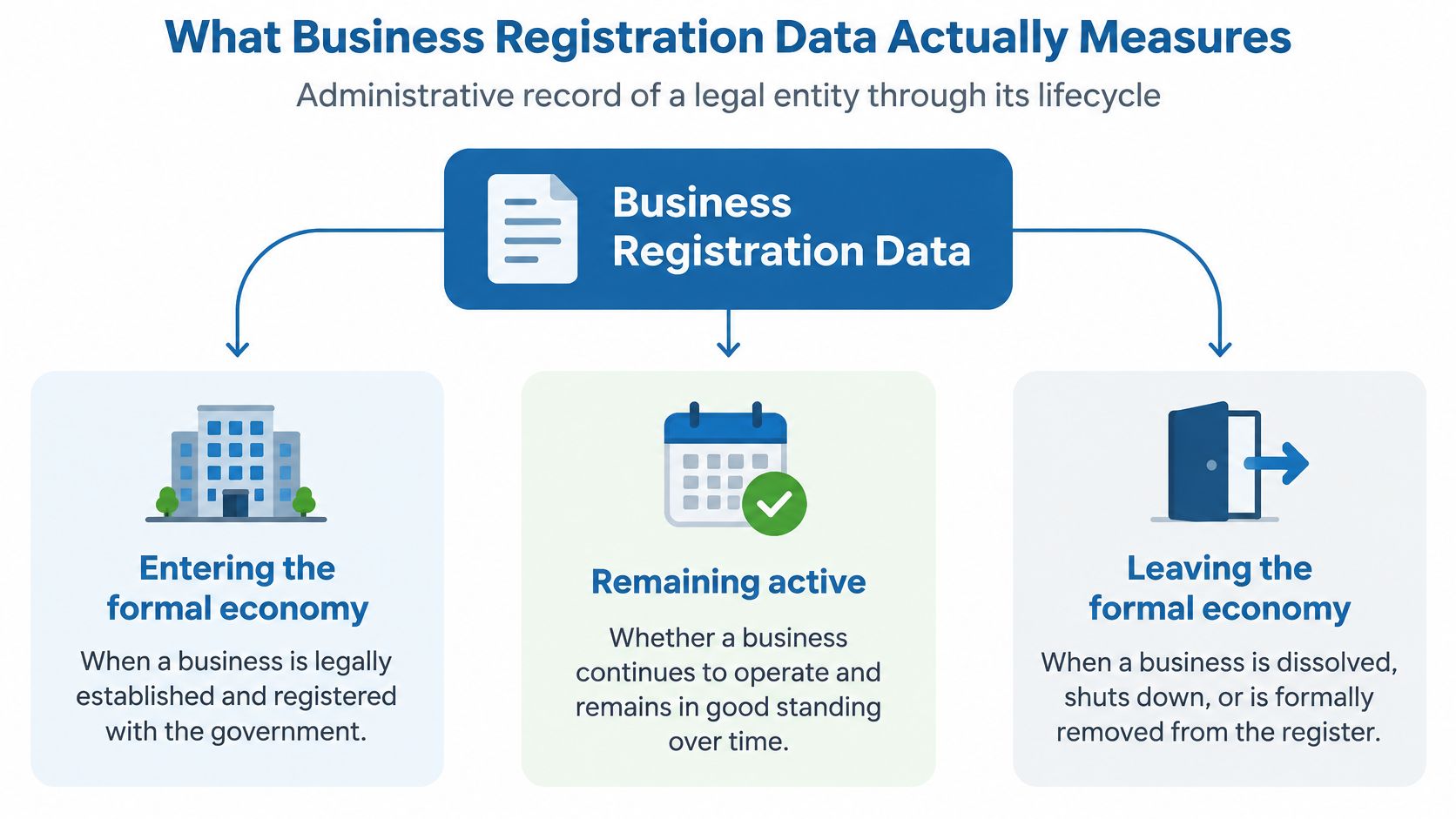
Business registration data records a legal entity entering, remaining in, or leaving a formal register. It describes administrative status, not every form of entrepreneurship. A bank needs that boundary before comparing markets or estimating potential customers.
First published in 2011, the World Bank Entrepreneurship Database's latest reported edition covers 188 economies and annual formal-sector entry and exit from 2006 through 2024; it also provides sex-disaggregated information for 117 economies covering 2014–2024, as detailed in the World Bank Entrepreneurship Database overview.
Its core measures are newly registered firms, total registered firms, and firms closed or deregistered. The principal registration indicator focuses on newly established private limited-liability companies or their national equivalents. Informal businesses and many sole proprietorships can therefore fall outside the series.
Read the lifecycle without assuming activity
The administrative lifecycle is useful for organizing records, but a company's continued presence in a register shouldn't be read as independent evidence of ongoing trade.
For geographic comparisons, use new business density: newly registered limited-liability firms per 1,000 working-age people aged 15–64 per calendar year, under the World Bank's entrepreneurship methodology. This normalization prevents population size from dominating the comparison.
The distinction matters internationally. New-business density rose from 2.9 in 2006 to 4.3 in 2024, approximately 50%, while the 2024 averages were about 7.0 in high-income economies and 0.7 in low-income economies, according to the World Bank's global entrepreneurship trends analysis.
Those differences support market investigation, not automatic market entry. Higher density may justify examining formal-sector demand, but directors still need industry composition, operating evidence, and the bank's ability to serve those businesses profitably.
- Use counts for scale: They describe the volume of recorded entities within the series.
- Use density for comparison: It makes differently sized populations more comparable.
- Use activity evidence for execution: It determines whether an individual record belongs in a commercial workflow.
A market can have strong registration intensity and still offer a poor fit for a particular bank's products or underwriting standards. Density identifies where to investigate. It doesn't establish whom to lend to.
Authoritative Sources and the Fields That Matter
A registry extract, an application series, and an ownership filing answer different questions. Combining them without preserving their definitions creates a database that looks thorough but gives bankers ambiguous instructions.
Source authority is question-specific. A national registry can establish legal identity. An application series can indicate entrepreneurial intent. An ownership filing can help identify control. None should substitute for another.
Which Registration Source Answers Which Banking Question
| Source | Primary measure | Banking question | Do not treat it as |
|---|---|---|---|
| National business registry | Legal registration and recorded status | Which legal entity are we evaluating? | Proof of trading activity |
| Statistical business register | Business population and demographic classifications | Which entities meet the relevant statistical definition? | A real-time sales directory |
| Census Business Formation Statistics | Applications and formation indicators | Where is business-creation momentum changing? | A list of creditworthy borrowers |
| Beneficial-ownership filings | Reported ownership or control | Who may control this entity? | Independently verified operating status |
| Employment or turnover evidence | Economic activity during a reporting period | Is there evidence of an operating enterprise? | A complete credit assessment |
For U.S. analysis, Census Business Formation Statistics begin with Employer Identification Number requests submitted through IRS Form SS-4. An application signals intent, not proof of an account, employees, revenue, or repayment capacity.
Document interpretation also needs jurisdictional context. For teams reviewing incorporation paperwork across borders, Smart Classic Business Hub's resource on mainland and free zone certificates offers a document-level reference. Keep such explanatory material separate from the authoritative record used to establish identity.
Store enough context to resolve disagreement
A bank should preserve the information needed to explain why records were joined and why an analyst trusted a particular field.
- Identity fields: Legal name, stable identifier, jurisdiction, legal form, and address.
- Lifecycle fields: Formation date, activity dates, legal status, filing date, and retrieval date.
- Relationship fields: Officers, owners, and parent–subsidiary connections.
- Commercial fields: Industry classification and available employment or turnover evidence.
Don't overwrite an older address or ownership entry without retaining its provenance. A disagreement may reflect a genuine change, different reporting dates, or an incorrect match.
The director's test is straightforward: can a reviewer trace a prospect's identity, status, and supporting evidence back to their respective sources? If not, the bank has assembled a contact list rather than a decision-ready entity record.
Four Banking Jobs Registration Data Can Support
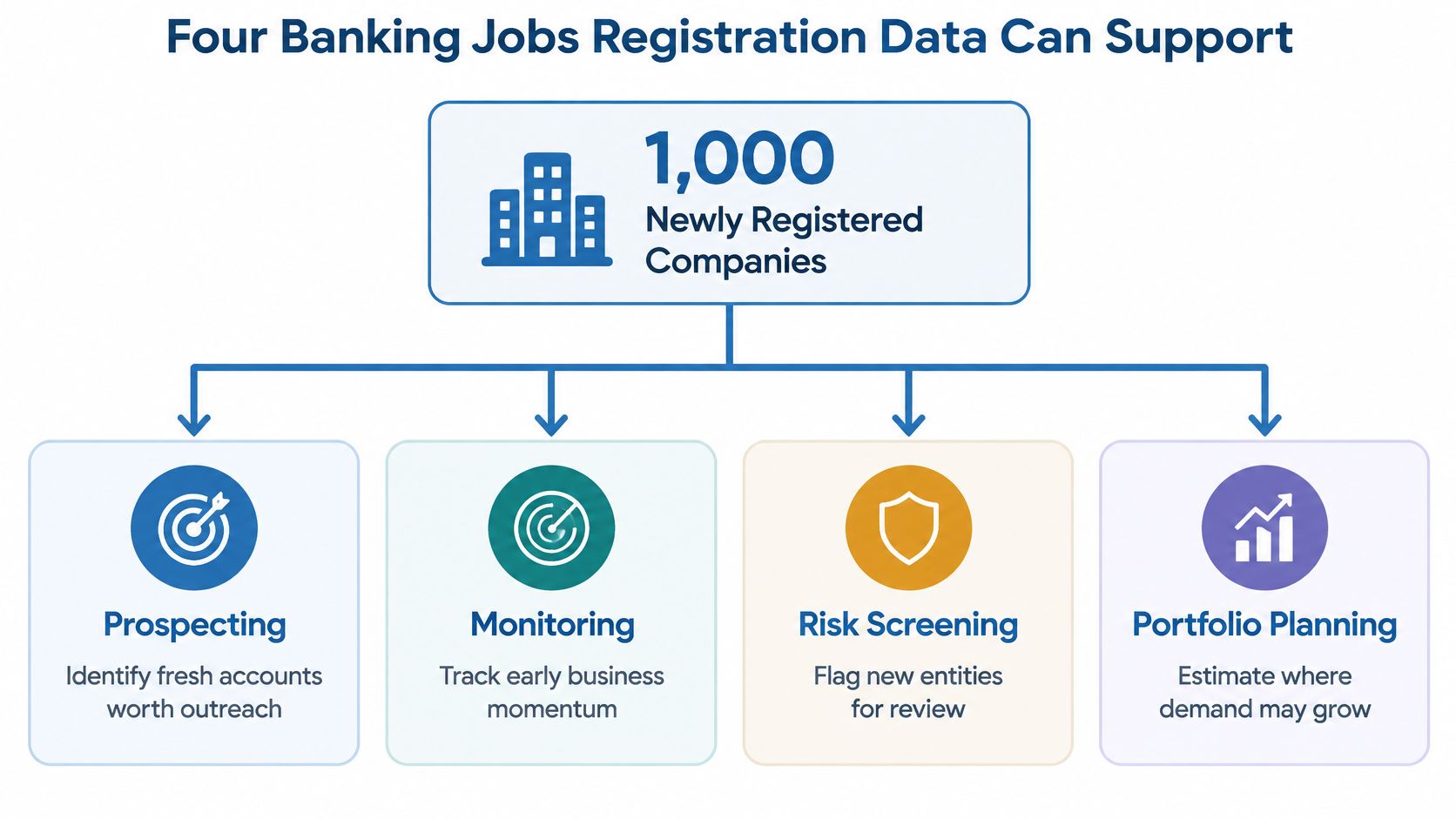
Consider a hypothetical cohort of 1,000 newly registered companies, using the prospecting scenario described alongside FinCEN's original beneficial-ownership reporting framework. The same cohort can support distinct banking jobs, but each job requires a different qualification standard.
The diagram summarizes the operational destinations. The bank should assign a record to a workflow only after checking the evidence relevant to that decision.
Prospecting and onboarding require different gates
For prospecting, a relationship manager narrows the cohort to relevant industries, serviceable locations, and identifiable decision-makers. Multiple owners or an apparent financing need can justify investigation, but neither should trigger an unqualified sales assignment.
Take a hypothetical newly incorporated supplier. The banker should establish what it plans to sell, whether operations have begun, and which banking needs are immediate. Capital Express's explanation of business funding eligibility with Capital Express can serve as a discussion resource, not a substitute for the bank's credit policy.
For KYC and AML, formation dates help determine which historical reporting context applies. FinCEN's BOI rule took effect on January 1, 2024; its original framework set January 1, 2025 for older companies' initial reports and described a general 30-day window for newer entities, as explained in the historical fact sheet cited above. These are historical framework details, not current filing instructions, and compliance staff must validate applicable requirements before acting.
Credit screening and relationship mapping answer separate questions
Credit staff should connect the supplier to industry and geographic exposures before booking a facility. Registration may explain when the legal borrower was created, but repayment analysis requires operating and financial evidence.
A UCC filings search can belong in the broader diligence workflow. Analysts should preserve the distinction between a filing, an existing financing relationship, and verified current indebtedness.
Relationship mapping then connects the supplier's owners, applicants, and related companies. A shared address is a lead for review, not enough to merge entities or assume common control.
Route a qualified commercial opportunity to a banker. Route unresolved identity or ownership questions to review. Don't disguise uncertainty as a sales lead.
The cohort becomes useful when management can distinguish those destinations, rather than reporting every registration as an equivalent opportunity.
Formation Numbers That Change Staffing and Credit
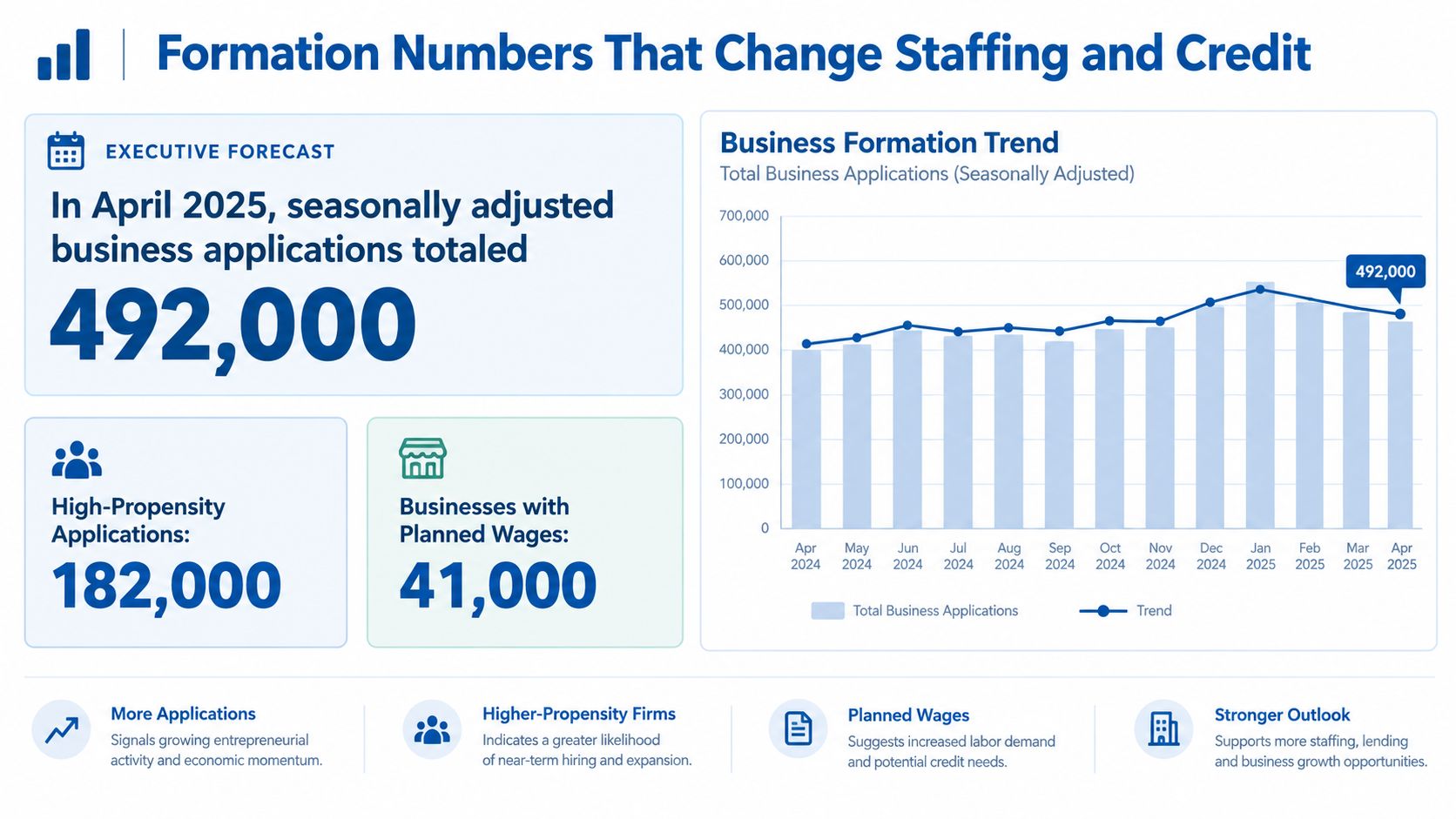
In April 2025, seasonally adjusted U.S. business applications totaled 449,508, down 0.9% from March, according to the Census Business Formation Statistics historical release. That's a measure of applications, not completed customer formation.
The accompanying graphic is contextual rather than a forecasting input. Use the cited Census release for the application total and validate any dashboard figures against their underlying series before putting them into a board forecast.
Separate market volume from bank conversion
Consider a hypothetical market with 10,000 monthly applications. A 1.5% application-to-operating-account conversion implies 150 accounts; increasing conversion to 2.0% adds 50 accounts, using the scenario associated with the Census application framework cited above. These are planning assumptions, not observed bank results.
The staffing implication is important. Management could pursue better qualification and conversion before hiring against an assumed expansion in market size. But the bank should first establish whether conversion is constrained by prospect quality, outreach capacity, onboarding friction, or product fit.
Census publishes 12 monthly series, comprising four application series and eight formation series; a hypothetical comparison of 8% annual application growth against 3% growth in expected formations illustrates why the measures shouldn't drive identical forecasts, using the Census formation-series framework.
Translate the difference into operating decisions
| Decision | What management should test |
|---|---|
| Branch staffing | Whether verified onboarding and service workloads support additional capacity |
| Small-business underwriting | Whether qualified applications, rather than filings alone, justify more review resources |
| Treasury-sales targets | Whether operating businesses show relevant payment and cash-management needs |
| Deposit forecasts | Whether expected account openings translate into funded, active relationships |
Use strategic workforce planning to connect those workload assumptions to staffing choices. Don't allocate personnel from a market-growth percentage without testing the bank's own funnel.
A sustained decline in formations should prompt a downside scenario for merchant services, payroll accounts, equipment finance, and working-capital demand. It shouldn't automatically trigger a credit retreat: management must distinguish fewer prospective borrowers from deteriorating existing borrowers.
The actionable benchmark is conversion across stages, from market signal to qualified prospect, operating account, and funded relationship. That tells directors whether the problem lies in market opportunity or the bank's execution.
From Raw Filings to a Usable Entity Record
A bank can buy a static directory, reconcile filings inside its CRM, or operate a governed entity-resolution pipeline. Those choices differ less in presentation than in the bank's ability to explain identity, change, and uncertainty.
The Eurostat–OECD manual on business-demography statistics treats statistical business registers as a primary source and explains that enterprise births and deaths often require matching and profiling. Economic activity means employment and/or turnover during the reporting period, not merely a surviving legal record.
Compare the operating models
| Approach | Useful role | Main limitation |
|---|---|---|
| Static directory | Initial market exploration | Limited visibility into subsequent changes and match decisions |
| Ad hoc CRM matching | Resolving individual sales situations | Inconsistent rules and difficult reconstruction |
| Entity-resolution pipeline | Repeatable qualification, monitoring, and routing | Requires explicit governance and exception handling |
The pipeline should retain stable identifiers, registration and activity dates, legal status, industry, operating evidence, and corporate relationships. It should distinguish genuine business births from restructurings, mergers, or legal-unit changes before deduplicated records reach relationship managers.
Identifier literacy matters here. A reference on what a DUNS number is can support the team's understanding of entity identification, but analysts still need to preserve each identifier's source and scope.
Make matching date-aware and auditable
A 2023 entity and a 2024 entity with identical names shouldn't automatically share an ownership template: under the original FinCEN framework, newer reporting companies included company-applicant information while older companies didn't, as explained in FinCEN's beneficial-ownership FAQs. Preserve the historical reporting context rather than forcing all entities into a uniform set of required fields.
Audit test: A reviewer should be able to reconstruct which records were matched, which evidence supported the match, and which contradictions remained unresolved.
A joined intelligence environment should connect entity records with financial, regulatory, market, and people data while preserving their different meanings. Bank-performance information can support market benchmarking; borrower-level evidence supports prospect qualification. Don't present one as proof of the other.
The production objective is a record that supports a specific action with a visible rationale. An unresolved match belongs in an exception queue, not behind a confident-looking prospect score.
Privacy Limits and the Next Move for Your Team
A beneficial-ownership requirement doesn't guarantee usable ownership intelligence. Directors must distinguish whether information exists from whether the bank may access it, retrieve it reliably, verify it, and connect it to the correct entity.
A 2025 Global Financial Integrity assessment covered 38 Latin American and Caribbean jurisdictions; among 22 Caribbean jurisdictions, 15 had private registers, four had none, and three offered partial access based on legitimate interest, according to Global Financial Integrity's ownership-register assessment. Register existence is therefore an inadequate measure of practical transparency.
Permission the evidence before activating it
Management should establish role-based access, permitted purposes, retention controls, and retrieval procedures before circulating ownership data. A sales user shouldn't automatically receive every detail available to a compliance investigator.
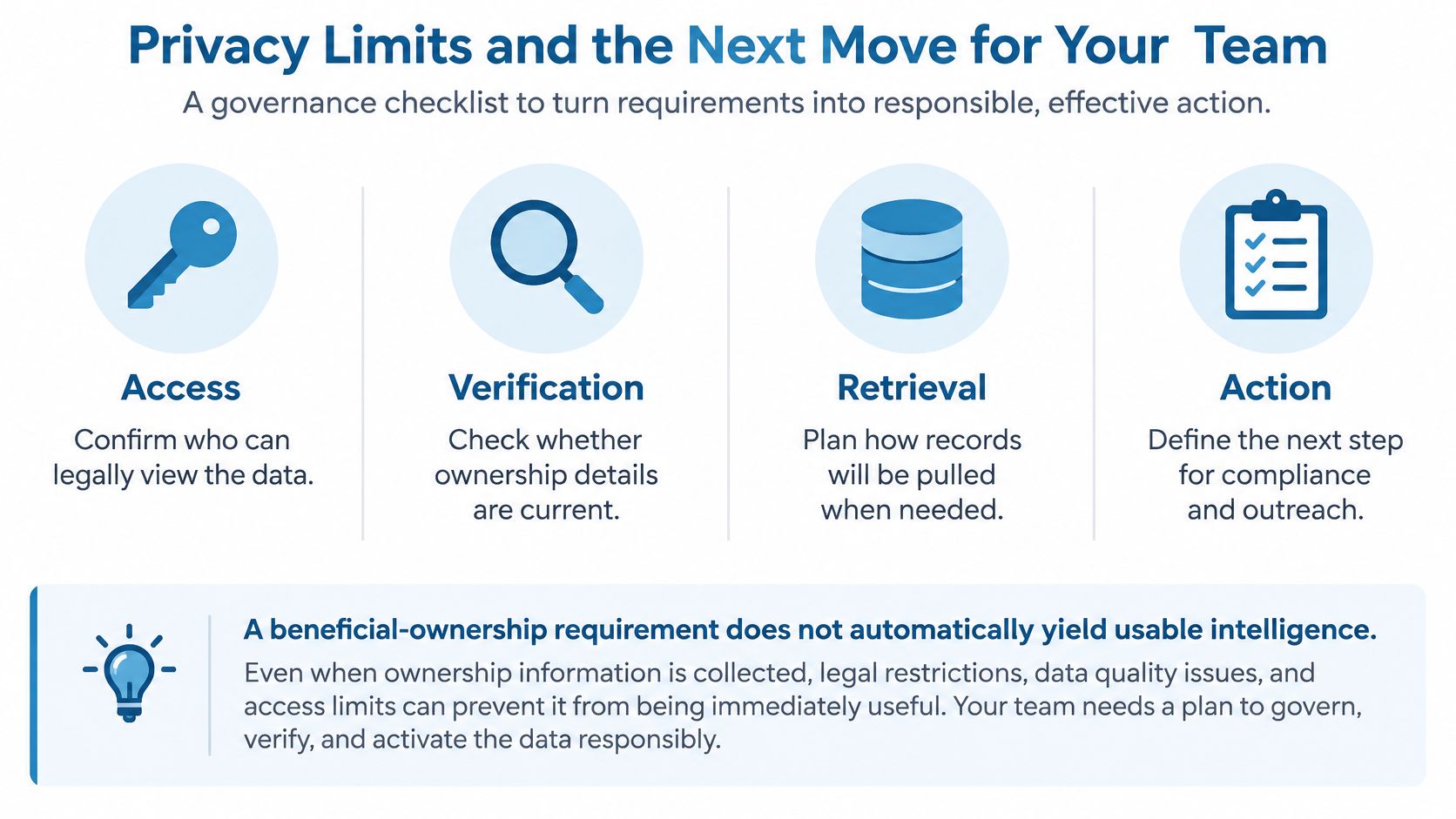
Corroborate ownership before relying on it for a commercial decision or a suspicious-activity review. An inaccessible field isn't evidence of concealment, and a registry entry isn't independently verified ground truth. Preserve the distinction between missing information, conflicting information, and confirmed adverse evidence.
Give the team a concrete review mandate
Directors can commission a focused review of the existing prospect universe rather than another indiscriminate data purchase.
- Name the source: Record who maintains each field and what it measures.
- Test freshness: Compare the retrieval date with the underlying reporting date.
- Separate applications from formations: Keep entrepreneurial intent distinct from operating evidence.
- Date-stamp ownership rules: Preserve the applicable jurisdiction and reporting context.
- Measure conversion: Track movement into qualified outreach, active accounts, and lending review.
- Benchmark the footprint: Compare formation signals with deposit and lending performance across relevant peers.
Ask commercial, risk, compliance, and data leaders to agree on the evidence required at each handoff. The deliverable should be a smaller, defensible opportunity set with explicit exceptions, not just a larger registry.
Visbanking's Bank Intelligence and Action System brings together financial, regulatory, market, and people data to support explainable benchmarking and relationship analysis. Visit Visbanking to explore your footprint's formation, deposit, and lending signals against peers, then identify where verified opportunity warrants a change in staffing, outreach, or credit review.
Latest Articles
Brian's Banking Blog
How to Secure REST API with JWT for Banking
Brian's Banking Blog
Commercial Loan Analysis: A Bank Executive's Guide
Brian's Banking Blog
Understanding Statistical Significance in Banking
Brian's Banking Blog
Option Adjusted Spread: A Banker's Practical Framework
Brian's Banking Blog
How to Improve Margins: A Bank Leader's Playbook
Brian's Banking Blog