
A Guide to the Report on Internal Control Over Financial Reporting
Brian's Banking Blog
A report on internal control over financial reporting (ICFR) is management's formal assessment of the effectiveness of the company's internal processes in safeguarding its financial statements. For bank executives and directors, this is not merely a compliance document. It is the bedrock of the institution's integrity and the trust placed in it by investors and regulators.
Why ICFR Is a Strategic Asset, Not Just a Compliance Hurdle
Viewing the annual ICFR report solely through the lens of regulatory obligation is a significant missed opportunity. A robust ICFR framework is the foundation of trustworthy financial data—the same data that informs every critical decision, from capital allocation to strategic acquisitions. When treated as a strategic tool, ICFR transforms from a cost center into a tangible competitive advantage. It elevates the institution from simply passing an audit to building an operational fortress that protects shareholder value.
From Compliance Box-Ticking to Data-Driven Decisions
The market's confidence in your bank is directly linked to the integrity of its financial statements. A material weakness in internal controls can have swift and severe consequences, eroding investor confidence and attracting intense regulatory scrutiny.
Consider a scenario where a bank's allowance for credit losses (ACL) calculation relies on outdated economic models. This oversight leads to the allowance being understated by $5,200,000. This is not a rounding error; it is a strategic blind spot that fundamentally misrepresents the bank's true risk exposure. An effective ICFR framework, powered by modern data intelligence, would have flagged such a deviation long before it escalated into a crisis.
By using data to benchmark key metrics against peers, leadership can shift from reactive compliance to proactive governance. This ensures the numbers driving strategy are not just compliant, but correct.
The Role of Data Intelligence in Fortifying Controls
Strengthening ICFR today requires more than manual checklists. It demands an objective view of your bank's performance relative to the market. This is where data intelligence platforms become indispensable. For a deeper dive into the broader landscape, our guide to bank regulatory reporting offers crucial context.
By integrating financial, regulatory, and market data, these systems provide the tools for:
- Proactive Risk Assessment: Continuously monitor key performance indicators (KPIs) against a curated peer group to identify anomalies before they become material weaknesses.
- Enhanced Board Oversight: Equip the audit committee with clear, contextual dashboards that demonstrate control effectiveness and highlight potential vulnerabilities.
- Informed Strategic Planning: Validate the foundational data used for budgeting and forecasting against real-world performance benchmarks, instilling confidence in strategic initiatives.
Mastering the ICFR report is about more than satisfying regulators. It is essential for maintaining investor confidence, protecting the bank’s reputation, and ensuring the integrity of the data that fuels sustainable growth. Visbanking provides the peer and market intelligence needed to contextualize your performance and validate your controls.
The SOX 404 Mandate: More Than a Rulebook
The Sarbanes-Oxley Act was not conceived in a quiet boardroom; it was forged in the aftermath of corporate scandals that destroyed billions in shareholder value and shattered public trust. For bank leadership, understanding its core tenets—particularly Section 404—is fundamental to institutional stability.
SOX 404 elevated internal controls from the back office to the boardroom. The law mandates that management establish, maintain, and formally report on the effectiveness of their internal controls over financial reporting (ICFR) annually. This responsibility cannot be delegated; accountability rests with the executive team. To ensure objectivity, an independent external auditor must also audit and provide a separate opinion on management's assessment. This dual-key system is designed to prevent the oversight failures that precipitated SOX.
A Clear Line: Management vs. Auditors
The roles defined by SOX 404 are unambiguous, creating a critical system of checks and balances. Misunderstanding these distinctions exposes the bank to significant governance risk.
Management's Responsibility: Leadership owns the ICFR framework. They are responsible for its design, implementation, and the rigorous annual assessment of its effectiveness. The final report on internal control over financial reporting is their official attestation.
Auditor's Responsibility: The external auditor acts as the independent verifier. Their role is not to build or remediate controls, but to test them. They evaluate the evidence and issue a professional opinion on the fairness of management’s assessment.
This structure provides the board with two distinct perspectives: management's internal assessment and the auditor's external validation.
Why Banks Feel the Weight of SOX 404 More Acutely
For most corporations, a control failure is a significant problem. For a bank, it can be an existential threat. Trust is the primary currency in banking, and a "material weakness" in an ICFR report can trigger immediate and severe repercussions from both regulators and the market.
Consider a $10,000,000,000 community bank. Management identifies a procedural gap in loan modification approvals but deems it insignificant. The external auditor, however, views the potential for misstatement as high and flags it as a material weakness. The result: an adverse opinion on the bank’s controls, a declining stock price, heightened FDIC scrutiny, and a potential credit rating downgrade.
A clean audit opinion on internal controls is more than a compliance milestone. It is a clear signal to the market that the bank is well-managed and its financial data is reliable. An adverse opinion can vaporize confidence overnight.
The focus on ICFR became a global standard following the Sarbanes-Oxley Act of 2002. By 2024, over 11,000 U.S. public companies were subject to SOX ICFR requirements, making it a cornerstone of investor confidence. You can dig deeper into the history of ICFR on auditboard.com.
Effective governance requires bank directors and executives to not only know the rules but to have the data to challenge their own assumptions. How do our control tests compare to peer institutions? Are our risk assessments keeping pace with emerging threats?
This is where data intelligence becomes non-negotiable. Platforms like Visbanking provide the external benchmarks necessary to put your control environment in context. It transforms SOX 404 compliance from an annual exercise into a continuous, data-driven governance process. Explore our data and see how you can benchmark your bank’s control framework.
Building a Resilient ICFR Framework with COSO
To construct a durable ICFR framework, bank leadership requires a blueprint, not just a theory. The COSO framework provides that blueprint. Its five components are not an abstract compliance exercise; they are the foundational pillars of the bank’s financial fortress, protecting the integrity of the data that drives every major decision.
These components should be viewed as an integrated system with a singular purpose: reliable financial reporting. This system begins with the culture set at the top and extends to the continuous oversight maintained in daily operations.
The Five Pillars of a Strong Control Environment
The COSO framework is a powerful management tool for building a resilient institution. For bank directors, a practical understanding of these pillars is key to effective oversight.
Control Environment: This is the "tone at the top." It is the ethical foundation established by the board and senior leadership, demonstrating a non-negotiable commitment to integrity. Without this, the most well-designed policies will ultimately fail.
Risk Assessment: This pillar focuses on proactively identifying vulnerabilities. In banking, this includes analyzing potential misstatements in complex areas like loan portfolio valuation, assessing the risks of integrating a new financial technology platform, or stress-testing the models for the Allowance for Credit Losses (ACL). It is a systematic process to find risks before they materialize.
Control Activities: These are the specific policies and procedures implemented to mitigate identified risks. Examples in a bank include mandatory dual authorization for wire transfers exceeding $100,000, daily reconciliation of correspondent accounts, or formal validation of interest rate risk models.
Information & Communication: This pillar ensures the right data reaches the right people, accurately and on time. It encompasses everything from the IT systems generating financial reports to the clarity of the CFO’s board materials. The objective is to ensure critical insights are not lost in transmission.
Monitoring Activities: This is the mechanism for verifying that controls are operating as intended. It includes regular internal audits, management reviews of key metrics, and automated system alerts for anomalous transactions. It transforms control oversight from an annual event into a continuous function.
A strong report on internal control over financial reporting is the direct result of a well-executed COSO framework. It signals to regulators and investors that leadership has not only established controls but is actively ensuring their effectiveness.
From Framework to Action with Data Intelligence
Implementing these pillars effectively is impossible in the modern banking environment without robust data intelligence. A meaningful risk assessment, for example, requires more than internal analysis. You must understand how your bank’s risk profile compares to its peers.
Suppose your bank's ACL ratio is 25% lower than the peer average for institutions with a similar loan composition. Is this a sign of superior underwriting or a dangerous blind spot? Data intelligence platforms provide this crucial external perspective, transforming risk assessment from conjecture into data-backed validation. Our overview of risk and control self-assessment methods offers a deeper look at this process.
Monitoring also becomes exponentially more powerful when informed by external data. Instead of merely confirming a control was performed, you can analyze its effectiveness by benchmarking the outcomes. This data-first approach converts governance principles into concrete actions that protect the bank.
Translating the five COSO components into practical oversight can be challenging. The table below clarifies what each component means for bank directors and executives.
COSO Components in a Banking Context
| COSO Component | Executive-Level Responsibility | Example Control Activity in a Bank |
|---|---|---|
| Control Environment | Championing a culture of ethical conduct and accountability from the top down. | Enforcing a strict code of conduct policy with zero tolerance for breaches. |
| Risk Assessment | Proactively identifying and analyzing risks to financial reporting accuracy. | Conducting quarterly assessments of cybersecurity threats to financial systems. |
| Control Activities | Designing and implementing specific policies to mitigate identified risks. | Requiring dual-signature authority for all major vendor payments. |
| Information & Communication | Ensuring relevant and reliable information is shared internally and externally. | Implementing a clear process for escalating control deficiencies to the audit committee. |
| Monitoring Activities | Continuously evaluating the effectiveness of internal controls over time. | Performing surprise cash counts at branch locations and reviewing internal audit findings. |
By structuring it this way, the framework becomes a tangible guide for leadership, ensuring every pillar is actively managed.
The infographic below illustrates the governance hierarchy that supports an effective ICFR process, from the regulatory mandate down to the specific duties of management and auditors.
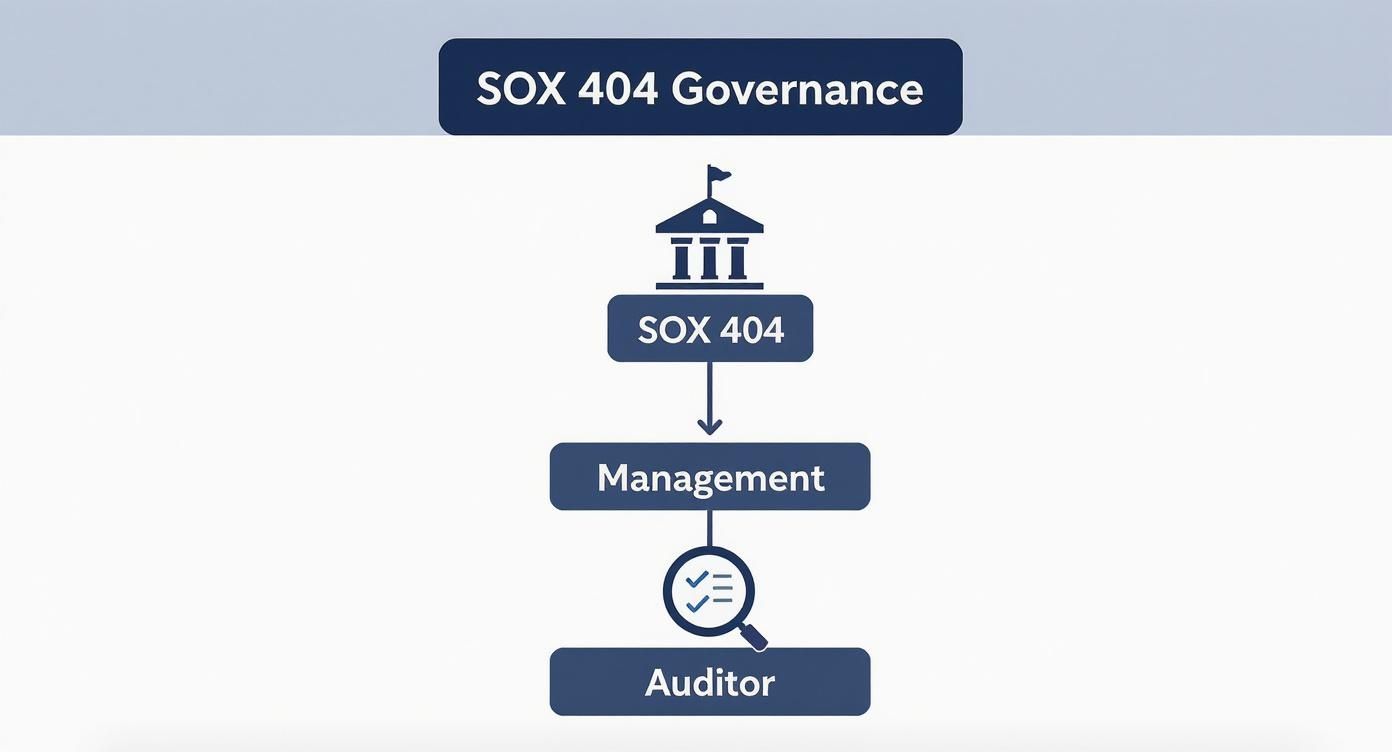
This structure delineates the distinct but interconnected roles required by SOX 404, creating the checks and balances necessary for trustworthy financial reporting.
Using Data to Identify and Remediate Control Weaknesses

An ICFR framework’s true value is tested not in its design but in its daily operational effectiveness. The ultimate measure is whether controls function within a dynamic, fast-moving environment. To gain a competitive edge, banks must shift from a reactive, audit-driven mindset to a continuous, data-informed strategy.
This transition elevates the report on internal control over financial reporting from a historical record into a forward-looking management tool. The critical question changes from, "Did we pass the audit?" to "Where are our hidden vulnerabilities, and how do we remediate them before they become material?"
From Red Flags to Real-Time Intelligence
Consider a common scenario for a regional bank. During the annual ICFR review, a potential weakness is noted in the allowance for credit losses (ACL) calculation. The bank is still using macroeconomic models that have not been updated to reflect sharp, recent shifts in regional economic data. Consequently, its allowance ratio has slowly diverged from its peer group. An analysis reveals a significant deviation, suggesting the allowance may be understated by as much as $1,500,000. This is not a minor discrepancy—it is a potential material misstatement that directly threatens the bank's financial health and capital adequacy.
A modern data intelligence tool would have raised alarms much earlier. By continuously benchmarking the bank’s ACL ratios against a curated peer group of similar-sized institutions with comparable loan portfolios, a platform like Visbanking identifies these dangerous trends in real-time. The board's audit committee would see the internal metric in its proper market context.
A strong control environment does not eliminate risk. It ensures that when a key metric like the ACL ratio deviates, leadership has the external context to ask the right questions immediately, not six months later during an audit.
This proactive monitoring is essential. Research shows a direct correlation between effective internal controls and the quality of financial disclosures. Firms with weak internal controls face error or restatement probabilities that are 20-30% higher than their well-controlled counterparts. The stakes are high.
The Remediation Process: A Disciplined Response
Once data has identified a potential weakness, a disciplined, structured remediation process is critical. This is where leadership demonstrates its commitment to the integrity of financial reporting. The objective is not just to patch the immediate problem but to strengthen the underlying process.
Key steps include:
- Root Cause Analysis: Investigate beyond the symptom. Was the ACL model outdated due to resource constraints, an oversight in the model risk management policy, or a communication failure between the risk and finance departments?
- Design and Implement New Controls: Based on the root cause, develop a more robust control. This could involve requiring quarterly model validation against updated economic forecasts or mandating a formal review if the ACL ratio deviates more than 10% from the peer median.
- Document Everything: Every step—from identification to design, implementation, and testing of the new control—must be meticulously documented. This audit trail is vital for auditors and regulators.
To better identify patterns and anomalies in control data, it is worth exploring various financial data visualization techniques. These can transform complex datasets into clear, actionable insights for the board.
Embedding Continuous Improvement
Remediating a single control weakness is a tactical win; building a system of continuous improvement is a strategic victory. This requires strong bank data governance to ensure the information fueling your controls is both reliable and timely. Leadership must foster a culture where identifying a potential issue is viewed as a strength, not a failure.
By integrating peer benchmarking and data intelligence into the ICFR program, the audit committee and executive team can:
- Validate Control Effectiveness: Move beyond simple pass/fail tests by analyzing outcomes. If a control is intended to maintain an efficiency ratio in line with peers, continuous monitoring is the only way to prove its real-world effectiveness.
- Anticipate Emerging Risks: Identify industry-wide trends or risks that could impact your bank before they manifest as internal problems.
- Provide Objective Oversight: Arm the board with unbiased, data-backed evidence of the control environment's health, strengthening its oversight capacity.
This data-driven approach transforms ICFR from a compliance exercise into a dynamic defense system, giving leadership confidence that their financial reporting is fundamentally sound.
The Future of ICFR: AI Automation and ESG Reporting
The annual report on internal control over financial reporting is not a static document. For any bank leader focused on the future, it is clear this report is on the cusp of significant evolution. Two powerful forces are driving this change: the rise of artificial intelligence (AI) and the increasing demand for verifiable Environmental, Social, and Governance (ESG) data.
The traditional approach to ICFR—relying on manual spot-checks and periodic testing—is becoming obsolete. It is a reactive methodology that often identifies problems long after damage has occurred. The future is not about historical review; it is about continuous, real-time monitoring powered by AI.
From Periodic Sampling to Continuous Monitoring
AI-driven systems can analyze 100% of a bank's transactions in real-time—an impossible task for a human team. Instead of discovering a control failure at quarter-end, these platforms can identify anomalous activity signaling potential fraud or error the moment it happens. This represents a fundamental shift from hindsight to foresight.
Consider a sophisticated payment fraud scheme. A manual review might eventually uncover a pattern of unusual transactions, but likely after a significant financial loss. An AI monitoring tool, in contrast, could flag a payment that deviates from established behavior in milliseconds, enabling intervention before funds leave the bank. This transforms internal controls from a detective function into an active security system.
The strategic advantage of AI in ICFR is its ability to operate at the speed of risk. For bank executives, this means strategic decisions can be based on financial data that is continuously validated, not just periodically reviewed.
This is not a futuristic concept; it is a present reality. By 2025, an estimated 70% of internal control teams at major global companies will use AI platforms for real-time monitoring and risk assessment. This shift is driven by stricter regulations and the need for reliable ESG reporting. More insights on these internal control trends over at empoweredsystems.com are available.
The Expanding Scope: ESG Reporting
Perhaps the most significant change to ICFR is its expanding scope beyond financials. Investors, regulators, and customers are demanding trustworthy, auditable ESG data. This pressure requires banks to manage ESG reporting with the same rigor as their balance sheets.
The challenge is that ESG data is often unstructured, sourced from disparate systems, and lacks the standardized accounting principles of financial data. This creates a high risk of errors, inconsistencies, and "greenwashing."
To manage this risk, banks must apply core ICFR principles to their ESG reporting:
- Control Environment: The board and senior leadership must establish a tone that prioritizes accurate ESG metrics.
- Risk Assessment: Identify where material risks exist in ESG data, such as miscalculating financed emissions or reporting inaccurate diversity statistics.
- Control Activities: Implement specific controls to ensure ESG data is complete and accurate, from automated data validation to independent review of carbon accounting methodologies.
The framework that has protected your bank's financial integrity for decades is the ideal blueprint for building trust in these new, critical disclosures. As the definition of "materiality" expands, so too must the scope of your internal controls.
Tools like Visbanking are becoming indispensable in this new landscape, providing the intelligence to benchmark both financial and non-financial performance against peers. To prepare for the future, bank leadership must not only adopt new technology but also expand their vision of what a strong control environment is designed to protect. A crucial first step is to benchmark your performance to understand your current standing.
Strengthening Your Bank's Financial Governance
The report on internal control over financial reporting is often viewed as an annual compliance exercise. This perspective is a profound strategic miscalculation. The report is a direct reflection of your bank's operational discipline and its commitment to transparent governance. A robust ICFR program is not a cost center—it is a strategic asset that sharpens decision-making, reduces the risk of costly financial restatements, and builds market confidence.
There is a vast difference between passive compliance and active governance. Compliance achieves the minimum standard. Active governance builds an institution resilient enough to withstand market volatility. This requires moving beyond internal checklists and leveraging external data for a complete operational picture.
From Reporting to Active Governance
Active governance is defined by asking tough, data-backed questions.
Suppose your bank's efficiency ratio is 58%. In isolation, this number lacks context. However, if a data intelligence platform reveals that your direct peers are averaging 52%, that seemingly acceptable metric becomes a red flag demanding immediate board-level attention.
This is what transforms the ICFR process from a static report into a dynamic cycle of continuous improvement. To execute this effectively, leadership should explore various best practices in financial governance to enhance their own frameworks.
An effective report on internal control over financial reporting is not the finish line. It is the starting point for a strategic conversation, providing the board with validated data to challenge assumptions and drive superior performance.
Ultimately, elevating your bank's financial integrity requires a commitment to objective, data-driven oversight. The first step is to benchmark your controls and key metrics against the market. Only then can you see where you truly stand.
Visbanking provides the critical peer insights to transform your ICFR from a regulatory burden into a cornerstone of strategic leadership. Let us demonstrate how our data intelligence platform can equip your board with the confidence to act decisively.
Answering Your Top Questions About ICFR
As a bank executive or director, accountability for the integrity of financial reporting rests with you. Here are direct answers to common questions about your role in the ICFR process.
Management’s Job vs. The Auditor's Job
These roles are separate by design.
Management's role is to own the ICFR process. Your team is responsible for designing, implementing, and assessing the effectiveness of the controls. The final report is management’s assertion that the system is functioning properly.
The external auditor’s role is to provide an independent opinion on management's work. They test the controls you have implemented; they do not create or remediate them. This two-part system is a cornerstone of SOX, ensuring objective verification.
How Is a "Material Weakness" Determined?
A control deficiency becomes a material weakness when there is a reasonable possibility that a material misstatement of the financial statements will not be prevented or detected on a timely basis. The determination is based not only on the size of an error that has occurred but on the potential magnitude of an error that could occur.
For example, in a $1,000,000,000 bank, a flaw is found in the loan loss reserve model. Even if the current discrepancy is minor, if that flaw could potentially lead to a $2,500,000 understatement of reserves, it would likely be deemed material. This is where data platforms are invaluable, allowing you to benchmark key ratios against peers to identify control gaps before they become critical failures.
The Audit Committee’s Role in All This
The audit committee's function is not day-to-day management but rigorous oversight.
The committee's responsibility is to challenge management's assertions, scrutinize the findings from both internal and external audits, and ensure any identified deficiencies are remediated promptly. Effective oversight requires asking incisive questions backed by objective data.
Accepting an internal report at face value is passive. Asking, "How do our fraud detection controls compare to the peer median?" is active governance. This is how a compliance exercise is transformed into a powerful governance tool.
Visbanking provides the external benchmarks and peer intelligence to elevate these conversations. Stop guessing and start knowing. Explore how our data can arm your audit committee with the insights to govern with total confidence. Benchmark your bank’s performance today.
Related Articles

Visbanking Blog
Bank Failure: Understanding the Risks and Protections for Consumers

Visbanking Blog
Capital Banking in the USA: An Overview of Investment Services, Financial Instruments, and Regulations

Visbanking Blog
The FFIEC: Regulating and Supervising Financial Institutions to Maintain a Safe and Sound Financial System

Visbanking Blog
Visbanking Unveils Interactive Quarterly Banking Profile, Available One Month Ahead of FDIC Release

Visbanking Blog
Exploring Cutting-Edge Technologies Empowering US Banks: A Deep Dive into Visbanking Banking Report Portal

Visbanking Blog