
Prospect Review: How Banks Judge Which Prospects to Pursue
Brian's Banking Blog
U.S. banks capture only about 70% of their clients' potential banking wallet, according to Boston Consulting Group. That reframes prospect review: the task isn't finding more companies to call. It's determining which relationships deserve scarce coverage capacity, which requests fit credit policy, and which opportunities can improve the bank's economics.
A large prospect list answers none of those questions by itself. Directors should expect a disciplined filter that connects the company's needs with the bank's own funding position, risk appetite, and return requirements before a relationship manager starts pursuing the business.
Why Relationship Managers Need a Sharper Filter
A majority of relationship managers acquire fewer than five new clients per year, based on McKinsey's interviews with executives at more than 15 banks. The same analysis reports that every respondent in a September 2022 survey of 70 corporate and commercial banks said their institution had accelerated adoption of analytics-enabled digital frontline solutions during the preceding two years.
Consider the coverage arithmetic in a hypothetical team. If each banker on a 40-person team adds no more than four relationships annually, that team produces no more than 160 new relationships. This isn't an estimate for every bank, because the interview finding concerns a majority of bankers, not all bankers. It illustrates why management should examine what reaches the calendar, not just how full that calendar looks.
Define the decision before building the list
Prospect review is a structured test of whether a company deserves the next increment of business-development effort. It evaluates commercial potential, likely product needs, addressable wallet, and conversion probability alongside the bank's ability to serve the relationship profitably.
That definition separates review from list building. A company can be large, familiar, and well connected without presenting an actionable opportunity. A smaller operating business with a documented financing event and accessible decision-maker may deserve attention first.
Coverage rule: A prospect should earn a place on a banker's calendar through evidence of fit and timing, not familiarity alone.
Replace familiarity with an investment case
Personal networks and manually assembled company research can provide useful context. They shouldn't determine priority without a consistent comparison against other opportunities.
Require the banker to explain what the company needs, why the bank can meet that need, and what makes engagement timely. Then distinguish the evidence from the assumptions:
- Verified facts: Ownership, operating footprint, existing relationships, and current financial information.
- Commercial hypotheses: Potential treasury needs, likely borrowing requirements, or possible dissatisfaction.
- Unresolved questions: Decision authority, relationship portability, and the event that could prompt action.
This quarter's operating objective should be a defensible coverage queue, not a longer contact file. Management needs to know why each opportunity deserves attention and what evidence would change that decision.
The Prospect Review Scorecard at a Glance
Use this proposed management scorecard to make coverage decisions explicit rather than treating every qualified company as an immediate sales opportunity.
Prospect review scorecard: criteria, evidence and red flags
| Criterion | Question It Answers | Evidence to Collect | Red Flag |
|---|---|---|---|
| Organizational fit | Does the company match our size, location and sector appetite? | Revenue band, employee count, headquarters and operating footprint, sector code | Outside the target footprint or below minimum revenue |
| Decision access | Who signs off, and can we reach them? | Verified names and roles for owner, CFO and treasurer | Only a junior contact on record |
| Existing bank position | Who holds the operating accounts and products? | Banks of record, products in use, deposit concentration | Fully banked with no review date in sight |
| Wallet and product need | How much business is addressable? | Estimated loan, treasury and deposit wallet; named product need | Need unknown or price-only |
| Switching trigger | Why would they move now? | Facility maturity, acquisition, expansion, documented dissatisfaction | No event in the past 12 months |
| Credit capacity | Can we lend within current policy? | Leverage, debt-service coverage, liquidity, collateral | Requested exposure exceeds policy limits |
| Data confidence | How current and verified is the record? | Date stamp and source for each data point | Stale statements or inferred relationships |
Score evidence, not banker enthusiasm
For this proposed framework, score each criterion 0 for absent, 1 for partial, or 2 for confirmed, using the evidence specified in its row. “Confirmed” should mean that the information supports pursuit, not merely that someone completed the field.
The proposed routing thresholds are straightforward: 10 or more out of 14 moves to coverage, 6 to 9 enters nurture, and anything lower leaves the active pipeline. These are operating rules to test and calibrate against your bank's results, not externally validated predictors of conversion.
For a useful comparison outside banking, review how Lead Printer qualifies outbound leads. The relevant management distinction is between identifying a company and establishing that it deserves sales attention. Banks must add credit capacity, balance-sheet fit, and decision-quality controls to that distinction.
Treat red flags as gates
A red flag is a stop sign, not a point deduction. A prospect with requested exposure beyond policy limits doesn't advance because its referral path is strong or its CFO is accessible.
Commercial and information gaps require different remedies. A missing senior contact calls for validation; a stale statement calls for refreshed documentation; a policy breach calls for restructuring or removal from active pursuit. Record the remedy and a named owner before reopening the opportunity.
Start with organizational fit and data confidence. These checks can eliminate unsuitable records before bankers and credit staff invest in detailed analysis.
For a practical pilot, select ten current prospects and apply this proposed scorecard. Count how many would have earned a call, identify which stop signs the existing process missed, and discuss the exceptions with coverage and credit leaders together.
Testing Organizational Fit and Decision-Makers
Consider a hypothetical regional bank targeting businesses with $20 million to $150 million in revenue within 50 miles of its branches. A 90-employee manufacturer 35 miles away, with revenue inside that band, would rank ahead of a $400 million company headquartered in another state. The larger company isn't necessarily a worse borrower. It fails this bank's stated coverage mandate.
Apply that screen before considering the prestige of the account. Revenue, employee count, headquarters, and operating locations should tell a coherent story about the company's scale and service requirements.
Separate headquarters from operating relevance
A headquarters address alone can mislead. An out-of-market company may operate a substantial local facility, while a locally registered business may conduct most of its activity elsewhere.
Check where the company produces, employs, collects payments, and makes financial decisions. Then ask whether the bank can support those activities within its approved geographic and sector appetite.
Our Prospect app identifies prospects by size, location, and bank relationships. Use those dimensions to construct the initial population, then validate exceptions rather than expanding the target market to accommodate attractive names.
Existing product relationships should shape the opening conversation. Prospect shows where prospects bank and which products they use, helping bankers distinguish a narrow entry point from a credible full-relationship opportunity.
If a competitor holds treasury and payroll, don't assume that a lending discussion will automatically move those services. Establish whether the company wants another credit provider, a specific service improvement, or a broader banking review before assigning a cross-sell expectation.
Verify authority rather than collecting titles
The contact record should distinguish influence, evaluation, and authorization. The owner may approve strategic borrowing, the CFO may select the bank, and the treasurer may evaluate cash-management execution.
Use relationship-mapping software to organize those connections, but verify each role before treating it as decision authority. Our Prospect app gives direct access to key contacts at target businesses; the banker still needs to establish who can authorize the proposed transaction.
- Owner: Confirm control and involvement in financing decisions.
- CFO: Establish responsibility for bank selection and financial negotiations.
- Treasurer: Identify responsibility for liquidity, payments, and implementation.
Close the initial screen with a concrete test: Can the banker name the person who signs the facility and show when that contact's role was last confirmed? If not, the next assignment is contact validation, not a product pitch.
Weighing Hard Financials Against Relationship Evidence
Hard financial information and relationship evidence answer different questions. Financial statements help assess repayment capacity; conversations and site visits help establish whether the banker understands the operating business behind those statements.
The FDIC's Small Business Lending Survey finds that relationship-oriented, staff-intensive practices remain central to small-business lending, with in-person contact and site visits supporting relationship development. It also finds that small banks rely more on difficult-to-quantify relationship information, while large banks more often emphasize credit-bureau and other quantitative information, particularly for smaller loans.

Keep capacity and evidence quality separate
Maintain a capacity and risk assessment covering statements, bureau information, debt levels, liquidity, repayment history, and proposed exposure. Alongside it, maintain an evidence-quality assessment covering verified operating history, management reliability, local-market knowledge, site-visit findings, and prior banking relationships.
The purpose isn't to let favorable relationship impressions offset weak repayment capacity. It's to show which questions remain unanswered even when the financial ratios appear acceptable.
Commercial information resources, including Dun & Bradstreet data, can support the company profile. They don't replace borrower-specific verification or a current assessment of the requested transaction.
Route contrasting prospects differently
In a hypothetical case, Prospect A has debt-service coverage of 1.6x, a clean bureau file, and no completed site visit. Assume its financial measures meet the bank's applicable policy. Its capacity assessment is favorable, but its relationship evidence is incomplete, so the banker schedules targeted due diligence before issuing a proposal.
Prospect B's owner has banked with the institution for eight years, and a site visit supports management's account of operations. Its financial statements, however, are fourteen months old. The appropriate action is a document refresh before a term sheet, not an exception based on familiarity.
Missing soft information is an uncertainty flag. It isn't evidence of low risk.
Record what the visit or refresh must establish. For the first prospect, that might mean validating production activity, customer concentration, and management's explanation of working-capital needs. For the second, it means reconciling recent trading performance with existing obligations and the proposed borrowing.
The resulting queue is more useful than a single blended score. Strong financial measures with shallow relationship evidence go to targeted due diligence; positive relationships with stale financials go to documentation refresh. Neither category should receive an automatic approval or rejection.
Sizing the Wallet and Spotting Switching Triggers
Consider two hypothetical companies requesting the same $20 million credit facility. One would also bring $15 million in operating deposits; the other would keep its deposits elsewhere. The first could offer greater strategic value, provided the balances are durable, their cost is acceptable, and the bank can deliver the associated services profitably.
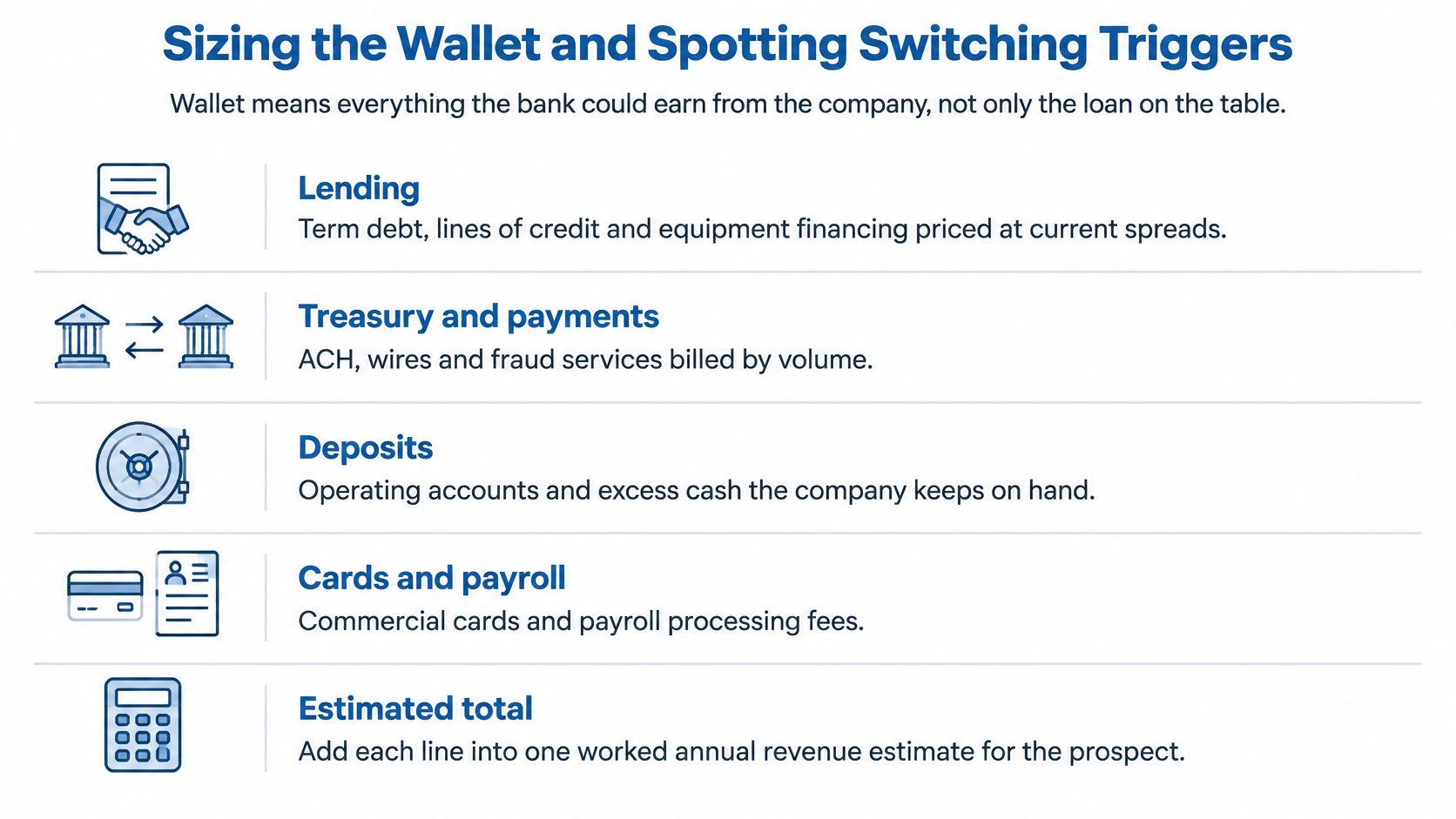
Wallet means the banking business the institution could realistically earn, not just the loan under discussion. Separate addressable business from the company's total activity, because an incumbent relationship or implementation constraint may prevent some products from moving.
Wallet components for a worked prospect
| Wallet Component | Basis |
|---|---|
| Credit facility | Requested loan, priced for utilization, term, risk, and capital usage |
| Operating deposits | Balances held at a competitor, assessed for portability and stability |
| Treasury and payments | Cash management fees estimated from service needs and transaction activity |
| Payroll and cards | Payroll and card activity assessed for eligible products and net contribution |
Estimate lending income using expected utilization rather than the commitment alone. For treasury, cards, and payroll, distinguish gross fees from the cost of providing the service; for deposits, evaluate funding value rather than treating balances as revenue.
Determine whether the wallet can move
Recent corporate-banking research found that 46% of companies planned to switch or were considering switching an existing banking partner within the next 12 months, while new business requirements drove exploration of new products and services in about two-thirds of cases. That supports a timing test, not an assumption that every attractive company is available.
Log specific triggers and verify their relevance:
- Facility maturity: A maturity within the next 12 months is a proposed monitoring window, not proof of intent to switch.
- Ownership or acquisition: Establish who will control banking decisions after the transaction.
- Expansion: Identify the financing, payment, or liquidity requirement associated with the new operation.
- Product gap: Name the capability the company needs and the incumbent doesn't adequately provide.
- Dissatisfaction: Document the actual complaint, such as fees, service delays, or technology limitations.
A prospect can be attractive on paper and still have no reason to move. Before outreach, require the banker to name the trigger, the unmet need, the addressable wallet, and the referral path. If those elements remain speculative, keep the opportunity under observation rather than treating it as immediately convertible.
Testing the Deal Against Bank Economics
Peer margin benchmarks for prospect pricing
| Measure | Net Interest Margin | Quarterly Change | Context |
|---|---|---|---|
| Community banks, Q4 2025 | 3.77% | Up 4 basis points | Highest since 2018 |
| All FDIC-insured institutions, Q4 2025 | 3.39% | Up 5 basis points | Highest since 2019 |
| Community-bank gap to industry | 38 basis points | Narrowed by 1 basis point | Compare prospects with peers of similar size, not national averages |
The FDIC's fourth-quarter 2025 banking profile reports community-bank NIM of 3.77%, up 4 basis points and the highest since 2018, compared with an industry margin of 3.39%, a 38-basis-point gap. Its industry results announcement reports that the industry margin increased 5 basis points to its highest level since 2019; the difference in quarterly changes means the community-bank advantage narrowed by 1 basis point.
Use NIM as context, not a loan-rate hurdle
These are institution-level margin benchmarks, not minimum loan coupons or universal deal-approval thresholds. Compare a prospect's expected contribution with similarly positioned peers, then apply the bank's own funding, expense, credit-loss, and capital assumptions.
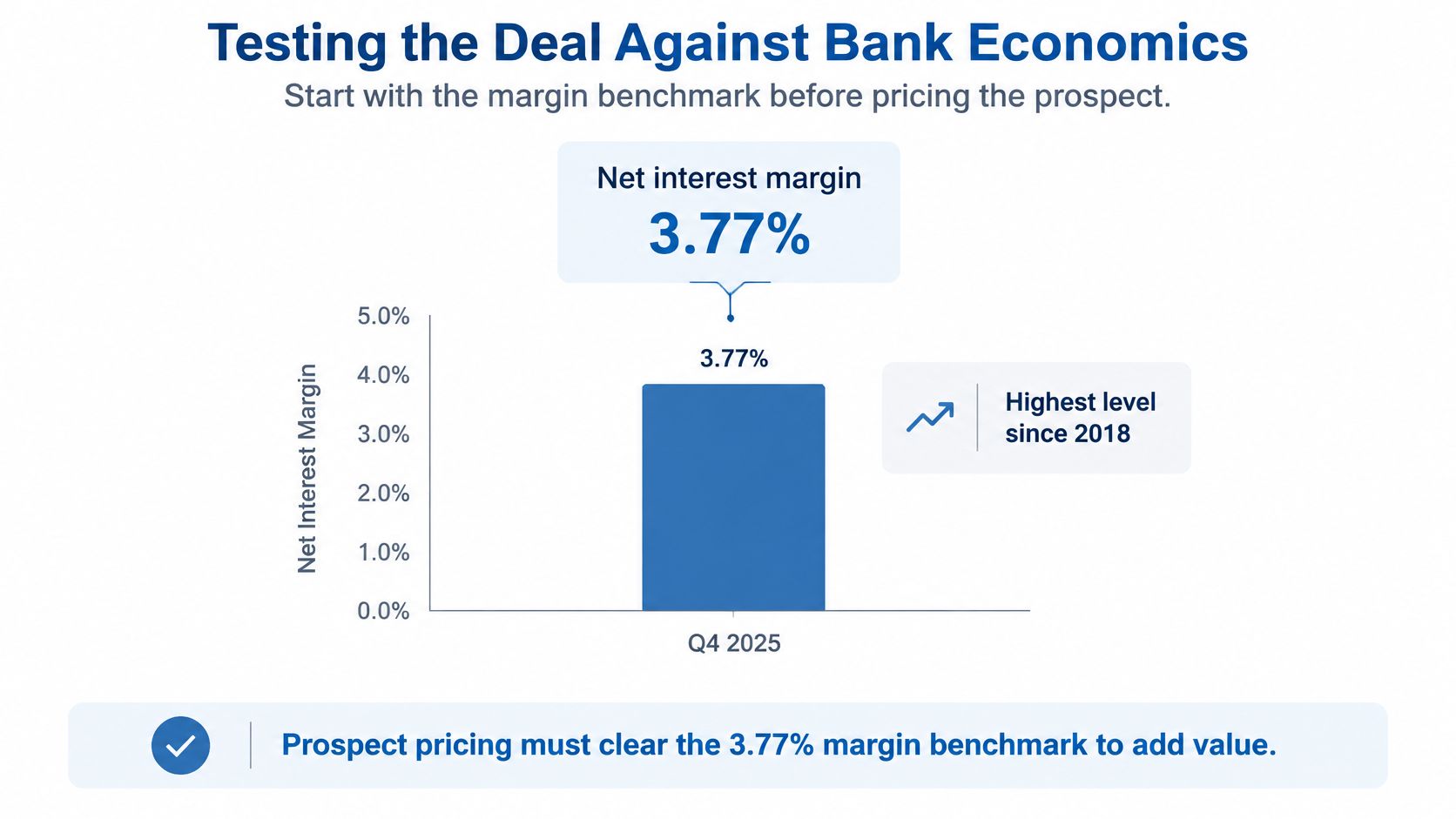
The chart's benchmark is a starting reference, not a sufficient pricing rule. A relationship adds value only after management evaluates its full risk-adjusted economics, including bank customer acquisition cost.
Our Performance app provides insights into bank and credit union financials, including profitability, risk, and efficiency. Our bank call report pages show quarterly trends for assets versus liabilities, loans and leases versus deposits, interest income versus expense, net interest income, noninterest expense versus income, and net income. Use those comparisons to identify the balance-sheet constraint the next relationship should help address.
Apply policy and funding tests
The Federal Reserve's April 2025 Senior Loan Officer Opinion Survey reported tighter standards for commercial and industrial loans to firms of all sizes, alongside tighter commercial real estate policies for loan-to-value and debt-service-coverage ratios. In a hypothetical $10 million CRE request, a revised LTV limit could require more borrower equity or a smaller facility. Resolve that structure before investing in a competitive proposal.
The FDIC's first-quarter 2025 profile reported quarterly industry loan growth of 0.5% and domestic deposit growth of 1.0%. That divergence is a reason to examine funding and deployment together, not to presume that more deposits always improve a deal.
For example, a hypothetical $10 million loan paired with $8 million in operating deposits may meet a return hurdle that the loan alone fails. Test deposit stability, pricing, and servicing costs before assigning that benefit.
Before advancing, answer three questions:
- Pricing: Does expected contribution meet internal return requirements in a relevant peer context?
- Structure: Does the transaction survive current policy limits?
- Funding: Does it add balances the bank can use economically?
Deciding Which Prospects Get Coverage This Quarter
The following hypothetical decisions show why the total score and the advancement gates must remain separate.
Prospect decisions under the scorecard
| Prospect | Score | Key Evidence | Decision |
|---|---|---|---|
| Prospect 1: 90-employee manufacturer | 12 of 14 | Confirmed CFO contact; facility maturing in nine months | Move to coverage |
| Prospect 2: Strong revenue, single relationship | 7 of 14 | Stale statements | Enter nurture list |
| Prospect 3: Proposed exposure with debt-service red flag | 11 of 14 | Debt-service red flag on proposed exposure | Leave active pipeline |
The manufacturer has a clear next action: assign coverage and prepare a financing discussion around the maturity. The second company needs a document-refresh owner and a reopening condition. The third requires a restructured request before it can return to active pursuit, regardless of relationship strength.

Measure what happens after the win
Adopt a monthly re-scoring cadence as a management practice. Track exposure uplift, early delinquency, risk-grade migration, and defaults by officer, segment, and source, rather than stopping measurement at funded volume.
A controlled experiment at a large U.S. commercial bank found that loan officers assigned to prospecting increased loan size and volume but also increased defaults; they didn't generate new applications and instead persuaded existing applicants to borrow more. Separate net-new prospects, dormant relationships, existing applicants, and current customers so management doesn't mistake increased exposure for market expansion.
Apply the same discipline to profitability. AmbitionCFO's discussion of ranking accounts by profit after delivery provides a useful commercial lens: judge the relationship after the cost of serving it, not by its headline revenue.
A coverage decision is an allocation of banker time, credit capacity, and funding. Approve it with the same clarity you expect from other resource decisions.
Bring the resulting decisions to the quarterly business-development review. Ask which prospects fit the bank's strategic needs, which require better evidence, and which should stop consuming active coverage.
Visbanking offers Prospect for identifying commercial relationships and key contacts, and Performance for benchmarking the financial context behind coverage decisions. Visit Visbanking, choose the product that fits your needs, and request a guided demo or pilot to test your pipeline against peer-bank economics. Account signup is free, so you can begin exploring the data before committing coverage time.
Latest Articles
Brian's Banking Blog
8 Sources of Lead for Banks: Prioritize with Data
Brian's Banking Blog
Data Integration vs ETL for Bank Decisions
Brian's Banking Blog
8 Trend Analysis Examples Every Bank Executive Needs
Brian's Banking Blog
Annual Contract Value Explained: Formula and Examples

Brian's Banking Blog
8 Case Study Examples Banking Executives Can Reuse

Brian's Banking Blog