
Mapping Relationships Software: Driving Growth and Managing Risk with Network Intelligence
Brian's Banking Blog
Relationship mapping software transforms static contact lists into a dynamic network, revealing the connections that drive both opportunity and risk. This is not another CRM feature; it is a strategic intelligence tool that illuminates who knows whom, how they are connected, and what those relationships mean for your bank’s bottom line. For bank executives, this technology provides the clarity needed to make faster, more informed decisions that protect the balance sheet and accelerate growth.
Your Bank’s Relationship Network: Its Most Valuable, Untapped Asset
In banking, you manage relationships, not just accounts. Yet traditional CRMs offer a dangerously narrow view, showing a client in isolation while ignoring the intricate web of connections surrounding them. This blind spot is precisely what mapping relationships software is engineered to eliminate.
By integrating disparate data sources—FDIC call reports, UCC filings, and professional network data—the software converts raw information into actionable intelligence. This is not an IT upgrade; it is a fundamental shift in how you view your market.
From Data Points to Strategic Decisions
At its core, relationship mapping software converts a jumble of information into a clear, contextual map. It is the difference between navigating a city with a phone book versus a real-time GPS. Your CRM is the phone book; relationship mapping is the GPS for your business ecosystem.
The strategic shift is clear:
| Area of Focus | Traditional Banking Approach | Relationship Mapping Advantage |
|---|---|---|
| Prospecting | Cold calls and linear outreach based on firmographics. | Identifying the "warmest path" to a prospect through existing connections. |
| Risk Assessment | Evaluating entities in isolation, missing collusive threats. | Visualizing hidden networks to spot potential fraud rings or concentrated risk. |
| Client Growth | Focusing only on the direct needs of a single client. | Uncovering cross-sell opportunities by mapping a client's entire business network. |
| Data Usage | Data is stored in siloed systems (CRM, core, etc.) and rarely connected. | Data is unified into a single, interactive map that provides a holistic view. |
This shift empowers your team to move from data entry to data-driven strategy. The market has taken notice. The Partner Relationship Management (PRM) software space, which relies heavily on network mapping, was valued at $1.73 billion in 2023 and is projected to reach $4.10 billion by 2031. Banks leveraging this technology are reporting 30% faster deal cycles. This is about turning data silos into a revenue engine. You can read more about this market growth and its implications.
By making complex networks visible, banks gain a decisive competitive edge. You can pinpoint the optimal introduction to a high-value target, neutralize sophisticated fraud schemes before they materialize, and navigate regulations with a clear, auditable trail.
The Visbanking Perspective
At Visbanking, we view this technology as the essential bridge between your data and decisive action. A bank’s network is its most underutilized asset. Our platform was built to unlock that value by weaving public and proprietary data into a single, explorable map.
Consider a practical example: a relationship manager maps the board members of a key commercial client and discovers direct connections to three high-growth tech firms on your prospect list. Those are instant warm introductions. This is how you create a repeatable process for systematic growth.
Ultimately, relationship mapping provides the foresight necessary to not just compete, but lead. A critical first step is to benchmark your performance against your peers to identify where your next strategic opportunity lies.
How Relationship Mapping Technology Works
For a bank executive, "software" often implies another dashboard or a glorified spreadsheet. Mapping relationships software is a different class of tool entirely. Built on network analysis, it transforms static data points into a dynamic ecosystem of connections. It provides a real-time GPS view of your market, showing how capital, influence, and risk flow between entities.
The technology does not just list data; it reveals the relationships between the data. Every person, company, and asset is a 'node,' and every connection is a 'link.' This system rests on three core technologies that work in concert to deliver actionable intelligence.
The Three Pillars of Network Intelligence
This is not a single feature; it is an integrated system designed to convert disconnected data into a clear map of your business landscape.
Graph Databases Unlike traditional relational databases, graph databases are purpose-built to store and query relationships at exceptional speed. They answer complex, multi-layered questions that would cripple a conventional system. A loan committee can ask, "Show me every board member of our commercial clients with indirect ties to this high-risk entity, extending three degrees of separation." The output is a visual map, not a spreadsheet, making the risk impossible to ignore.
Professional Graphs This component provides the human context. A professional graph is a massive, curated dataset of career histories, board seats, and corporate affiliations. The Visbanking platform, for instance, integrates a proprietary graph of over 2.6 million professionals. This engine identifies the warmest introduction paths based on verified career data. It instantly answers, "Who in our bank has the strongest link to the new CEO at our top prospect?"
Link Analysis Algorithms This is the intelligence layer that identifies patterns a human analyst would miss. Link analysis algorithms constantly sift through the network, flagging anomalies, hidden clusters, and non-obvious connections. For a bank, this is a fraud detection superpower. The software can instantly spot a web of seemingly unrelated small business loans that all trace back to a single, hidden beneficial owner—a pattern nearly impossible to find manually when data is scattered across departments.
This concept map illustrates how a bank’s core functions—client service, data management, and risk mitigation—are unified through a network approach.
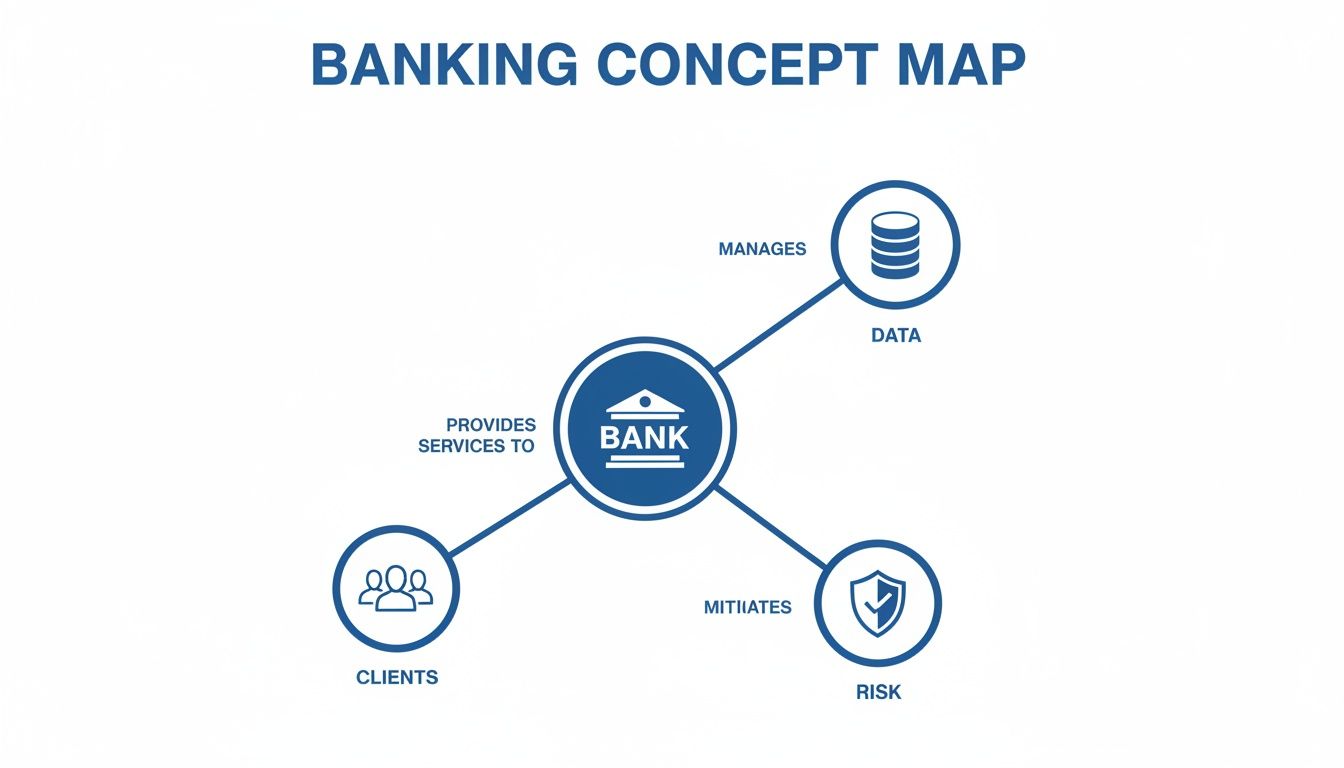
The key takeaway for leadership is that your data is not a collection of siloed assets. It is the connective tissue that directly links your client relationships to your risk management framework.
The power lies in integrating these three pillars. The system connects the what (the relationships) with the who (the professional context) and the why (the hidden patterns), providing the complete picture required for superior decision-making.
Executing this requires sophisticated data integration. You can explore the technical requirements in our guide on data integration best practices. By mastering these elements, you can transform your data from a passive asset into a strategic advantage.
Unlocking Growth Through Network Intelligence
Executives require measurable impact, not theoretical benefits. Relationship-mapping software is designed to deliver tangible business development outcomes by turning network data into a systematic engine for growth. It enables teams to move from reactive prospecting to proactive, intelligence-driven market penetration.
The objective is to consistently identify the most efficient path to high-value opportunities. This is a direct catalyst for accelerating the sales cycle and capturing market share with precision.

Accelerating Prospecting with Trusted Introductions
The primary hurdle in commercial banking is securing the initial meeting with a key decision-maker. Cold outreach is inefficient. Mapping relationships software removes this barrier by revealing trusted connections your team already possesses but may not be aware of.
Imagine your relationship manager is targeting a fast-growing private equity firm. A standard CRM provides a company name and a list of partners. Relationship mapping software connects the dots.
- The Scenario: A relationship manager maps the board of an existing client, a large healthcare system.
- The Insight: The software instantly reveals that one of the hospital’s board members also serves as an outside director for the target private equity firm. This is a high-value, trusted link that was previously invisible.
- The Action: Instead of a cold email, the manager can request a direct introduction from a trusted peer of their target. This single insight can shorten the sales cycle by weeks and dramatically increases the probability of securing a meeting.
This marks a fundamental shift from a volume-based "spray and pray" approach to precision targeting. It enables your team to leverage the bank’s entire social capital, turning every client relationship into a potential gateway for new business.
Platforms like Visbanking automate the discovery of these hidden connections, converting static data into a prioritized list of qualified leads defined by relationship strength. It provides a systematic method for ensuring your team always follows the path of least resistance.
Executing Targeted Market Expansion
Expanding into a new territory or industry is a capital-intensive decision. Relationship mapping software reduces uncertainty by providing a detailed, data-driven analysis of the landscape before you commit significant resources.
By analyzing public data sources—such as SBA loans, UCC filings, and corporate registrations—a bank can identify underserved markets and key local influencers. This facilitates a surgical market-entry strategy.
- The Scenario: A bank is considering expanding its commercial lending operations into an adjacent metropolitan area.
- The Insight: By mapping recent UCC filings and SBA 7(a) loan data, the software reveals that 40% of new logistics companies in that market secured financing from a single, out-of-state credit union known for slow underwriting.
- The Action: This is a clear indicator of an underserved niche. The bank can now focus its business development efforts on these logistics firms, armed with a competitive lending product tailored to their needs. The software didn't just find an opportunity; it identified a specific competitor's weakness to exploit.
This data-first approach replaces intuition with evidence, giving leadership the confidence to allocate capital effectively. The broader CRM ecosystem is projected to reach $96.39 billion by 2027. For banks, CRM tools with these mapping capabilities have been shown to boost customer retention by 25-40% by making these complex networks visible. You can dig deeper into the growth of the CRM software market.
Network intelligence provides the context needed for decisive action. By understanding who is connected to whom, banks can uncover opportunities that competitors, reliant on traditional methods, will miss. Discover your next opportunity with a purpose-built relationship manager prospecting tool.
Fortifying Defenses with Risk and Compliance Mapping
While driving growth is critical, a bank’s primary duty is to protect its capital. Relationship mapping software represents a fundamental shift in risk management, moving from reactive, checklist-based compliance to a dynamic, intelligence-led defense. It provides the clarity to identify and neutralize threats before they impact the balance sheet.
This technology transforms risk oversight from a siloed, manual process into a unified, visual discipline. By connecting transaction logs, corporate filings, and beneficial ownership records, the software illuminates patterns of collusion and concentration risk that are otherwise invisible.

Uncovering Sophisticated Fraud Rings
Modern fraud is perpetrated by coordinated networks, not lone actors. Link analysis, a core function of this software, is designed specifically to dismantle these schemes by investigating the web of connections between accounts.
Consider this scenario:
- The Threat: Your bank approves five separate small business loans, each for $250,000, to five different LLCs. On the surface, each application appears legitimate, with different guarantors in unrelated industries.
- The Discovery: Relationship mapping software aggregates the data and immediately flags an anomaly. While the LLCs have different registered agents, three share the same mailing address. Further analysis reveals two of the guarantors are co-owners of an inactive shell corporation discovered in public records.
- The Action: What appeared to be a diversified $1.25 million credit exposure is revealed as a concentrated risk controlled by a single, undisclosed party attempting to circumvent lending limits. The platform flags the entire network for immediate review, preventing a likely coordinated default.
Identifying Hidden Counterparty Risk
Systemic risk often arises not from a single, obvious failure, but from an unforeseen dependency that quietly permeates a portfolio. Mapping software provides risk officers with a visual representation of these hidden concentrations in the supply chain and third-party ecosystem.
For example, a bank might discover that five of its largest commercial borrowers—spanning manufacturing to logistics—all rely on a single, specialized raw material supplier. The failure of that one supplier, a risk that would never appear on an individual credit file, could trigger a cascade of defaults. This foresight allows the bank to proactively manage that concentration risk with its borrowers.
For bank leadership, this capability is transformative. It shifts risk management from a historical review of what went wrong to a forward-looking analysis of what could go wrong. It is the difference between remediation and prevention.
This move toward unified, visual intelligence is gaining traction. The Business Mapping Software market is projected to see a 15% CAGR from 2025-2033, driven largely by its application in risk management. In banking, these tools have been shown to improve decision-making effectiveness by 35%, while smart mapping can reduce certain risks for relationship managers by 20-30%. You can review data on this growing market and its impact on risk analysis.
Streamlining BSA/AML Compliance
Adhering to the Bank Secrecy Act (BSA) and Anti-Money Laundering (AML) regulations is a resource-intensive challenge. The traditional method of manually reviewing transaction spreadsheets is slow and prone to error.
Relationship mapping offers a superior approach. It provides auditors and regulators with a clear, intuitive visual map of fund flows and entity relationships. Instead of a spreadsheet, they see an interactive diagram showing how funds moved between entities, through shell companies, and into high-risk jurisdictions. This visual evidence provides transparent, auditable proof of due diligence and dramatically accelerates audit cycles. Visbanking delivers targeted anti-money laundering solutions using this exact methodology.
This is precisely the intelligence Visbanking is designed to surface. By connecting your internal data with external public records, our platform delivers the predictive signals required for decisive action. Begin by benchmarking your institution’s performance to see where these hidden risks may be concentrated.
How to Select the Right Relationship Mapping Solution
Choosing the right relationship mapping software is a strategic business decision, not an IT procurement exercise. The market is filled with tools ranging from simple diagramming applications to enterprise-grade intelligence platforms. Bank leadership must be surgical in their selection, focusing on solutions that deliver demonstrable strategic value.
A superficial evaluation can lead to adopting a tool that cannot handle the complexity of your network or fails to meet regulatory scrutiny. The goal is to select an intelligence partner, not just another dashboard that creates more noise than signal.
The Executive’s Evaluation Checklist
A disciplined evaluation rests on five non-negotiable criteria. These pillars separate basic tools from the enterprise-grade platforms that drive superior banking decisions. If a provider cannot definitively satisfy each of these requirements, they should not be considered.
Data Integration and Unification Can the platform natively connect and synthesize the complex datasets your bank utilizes? This includes FDIC call reports, SEC filings, UCC records, and HMDA data. A powerful solution must seamlessly blend these external sources with your internal CRM data to create a single, coherent view of your network.
Scalability and Performance Your bank’s ecosystem comprises hundreds of thousands, if not millions, of connections. Can the system manage this complexity without performance degradation? The software must be built on a high-performance engine, such as a graph database, that can execute complex, multi-level queries in real time.
Auditability and Explainability When the software flags a high-risk connection, can it show its work? To satisfy internal risk committees and external regulators, the system’s findings must be fully transparent. A clear, defensible audit trail showing precisely how the platform connected the dots is essential. "Black box" algorithms are unacceptable.
Ecosystem Connectivity How well does the solution integrate with your existing technology stack, particularly your CRM and core banking systems? A siloed tool creates friction and inhibits adoption. Look for robust APIs that allow data and insights to flow directly into the workflows your team already uses daily.
Security and Compliance This is non-negotiable. Does the software meet the stringent security and data governance standards of the financial industry? The platform must have enterprise-grade security protocols, SOC 2 compliance, and a deep understanding of the regulatory environment in which you operate.
A Phased Implementation Strategy
A "big bang" rollout across the entire institution is a common mistake. A more prudent approach is to start with a focused, high-impact use case to prove ROI and build executive support.
Begin with a well-defined problem where network intelligence offers a clear advantage, such as commercial prospecting in a specific market. When you can demonstrate a measurable lift—for example, a 15% increase in qualified leads from network analysis in the first quarter—you build momentum and create internal champions for a broader implementation.
This phased approach minimizes disruption and allows teams to adapt their workflows organically. Once value is proven in one area, you can expand to more complex challenges like counterparty risk or BSA/AML compliance, using the initial success to fuel wider adoption.
The ultimate objective is to embed network intelligence into the operational DNA of your bank. Selecting the right software is the first critical step. The next is to demonstrate its value quickly. A great place to start is to benchmark your performance against your peers to pinpoint your greatest opportunities.
Measuring Success and Driving Adoption
Technology deployment is only the first step. The critical question for executives is whether the investment delivers a return. Any expenditure on relationship-mapping software must be justified by measurable results tied directly to the bottom line.
Value must be clearly quantified, whether for the board or for relationship managers. For growth initiatives, success is measured by increased efficiency and opportunity conversion. For risk and compliance, the return is measured in cost avoidance and operational streamlining.
Quantifying the Return on Investment
To build a compelling business case, you must set specific, quantifiable targets. Vague goals like "improved prospecting" are insufficient.
Consider these practical KPIs:
Sales and Business Development:
- Reduced Sales Cycle Length: Measure the time from initial contact to a signed deal. A reasonable target is to reduce this by 20% within six months by leveraging warm introductions identified through network analysis.
- Increased Qualified Lead Generation: Track the number of high-quality leads sourced directly from mapping existing client networks. A team of ten relationship managers could aim to generate 50 new qualified opportunities per quarter.
Risk and Compliance:
- Reduced False Positives in Fraud Detection: Investigating legitimate transactions flagged as suspicious is a significant resource drain. A target to reduce false positives by 30% frees up analysts to focus on genuine threats identified by link analysis.
- Reduced Audit Preparation Time: The hours dedicated to preparing for regulatory audits are substantial. Relationship mapping provides a clear, visual trail of due diligence, which can significantly reduce preparation and response times.
Driving Adoption from the Top Down
The most sophisticated software is useless if it is not adopted. Driving adoption is a cultural challenge, not a technological one. It requires shifting your team's mindset from viewing accounts in silos to seeing the entire connected network.
True adoption occurs when your relationship managers no longer see this as "another tool" but as the most efficient path to achieving their targets. The goal is to transition from a culture of static reporting to one of decisive, data-driven action.
This requires consistent reinforcement from leadership and integration into daily routines. The technology must feel like a natural extension of a relationship manager's workflow, not an interruption. A platform like Visbanking is designed for this purpose, delivering actionable analytics directly where your teams operate. When the path of least resistance is also the most effective, adoption follows.
The objective is to create a flywheel effect, where early successes build momentum and encourage broader engagement. A logical starting point is to benchmark your bank’s performance against peers to identify low-hanging fruit. Nothing motivates action faster than a clear path to growth or a means to mitigate significant risk.
To understand your current position and identify these opportunities, explore how our benchmarking tools can provide a clear starting point.
Still Have Questions? Let's Clear Them Up.
Strategic investments naturally prompt important questions. Here are answers to some of the most common inquiries we receive from bank executives evaluating relationship mapping.
Isn't This Just a Fancy CRM?
No. A CRM is a system of record—a digital rolodex that stores contact information. Relationship mapping software is a system of intelligence. It takes the data from your CRM, integrates it with thousands of external data sources, and builds a dynamic map of your network.
A CRM tells you who your client is. This technology shows you who they know. It is the difference between a static list and a strategic asset for sourcing new business and identifying non-obvious risk.
How Can We Be Sure Our Bank's Data is Safe?
Security is the foundation of any enterprise-grade platform designed for the banking industry. This includes SOC 2 compliance, end-to-end data encryption, and access controls as stringent as your own.
At Visbanking, data governance is paramount. Your bank’s proprietary data is segregated and protected. Our system then layers public data on top to generate insights without ever compromising your sensitive information.
How Do I Sell This Investment to My Board?
Focus on ROI. The business case rests on two pillars every board member understands: accelerating profitable growth and mitigating risk.
Frame the investment in terms of outcomes, not software features. Present it as a plan to reduce the commercial sales cycle by 20% by identifying warm introductions, or a method to decrease fraud-related false positives by 30%.
The most effective approach is to start with a pilot program in a single high-impact area, such as commercial prospecting. Within one quarter, you can present the board with tangible, financial results. A successful pilot makes the case for a broader rollout on its own.
The real expense is not the software; it is the opportunity cost of missed revenue and unidentified risks. When you convert your bank’s network into an intelligent asset, you are not just purchasing a tool—you are securing a competitive advantage.
Ready to move from dashboards to decisions? Visbanking is the intelligence platform that unifies your data and directs you to your next strategic win. Benchmark your bank’s performance against peers and discover how relationship intelligence can accelerate your growth today.
Related Articles

Visbanking Blog
Don't let data scare you!

Visbanking Blog
Banking Data Analytics: Turning Information Into Profit

Visbanking Blog
In the world of banking, digital transformation is no longer a 'nice-to-have'. It's a necessity

Visbanking Blog
Revolutionize Your Bank's Performance with BIAS: Unlocking the Future of Visual Banking Data

Visbanking Blog
From Data Overload to Actionable Insights: How BIAS Simplifies Banking Intelligence

Visbanking Blog