
Using Dun & Bradstreet Data to Drive Strategic Banking Decisions
Brian's Banking Blog
In commercial banking, intuition is valuable, but it is not a basis for sound capital allocation. For decisions that stand up to board and regulatory scrutiny, executives require precise, objective, third-party data. This is the role of Dun & Bradstreet data. It provides a standardized, comprehensive view of commercial entities, making it a cornerstone for rigorous risk assessment, targeted prospecting, and disciplined portfolio management. It is the difference between assumption and analysis.
Why Dun & Bradstreet Data Is a Strategic Banking Asset
In an environment where commercial loan performance dictates quarterly results, relying solely on internal data is a significant liability. Dun & Bradstreet (D&B) data is not merely a contact list; it is a strategic asset providing the external, verified intelligence necessary to operate with precision. For bank executives, this translates directly into more predictable revenue streams and a fortified balance sheet.
Its primary function is to deliver a consistent, objective picture of a business's operational health and history. Consider a scenario: one of your relationship managers is evaluating a $500,000 credit line for a new logistics company. The applicant's self-reported financials appear adequate, but what is the complete picture? D&B data provides immediate context, revealing their actual payment history with suppliers, uncovering undisclosed corporate affiliations, and flagging counterparty risks that internal data would never capture.
From Historical Roots to Modern Strategy
The demand for objective commercial data is not new. Dun & Bradstreet's origins trace back to July 20, 1841, when the Mercantile Agency was founded to create a central repository for assessing merchant credit risk. Its role was cemented during the Great Depression, proving essential for navigating economic uncertainty—a function it continues to serve today.
This history underscores a fundamental principle for today’s banking leaders: sound data has always been the foundation of sound financial decisions. To fully appreciate D&B's modern role, it must be viewed within the broader banking and finance landscape.
A bank’s success is measured by the quality of its decisions. Integrating Dun & Bradstreet data ensures those decisions are informed by one of the most trusted sources of commercial intelligence, turning risk into calculated opportunity.
The Foundation for Actionable Intelligence
Ultimately, the value of Dun & Bradstreet data is realized only through its effective application. A raw data file on a server generates no return. It becomes valuable only when integrated into a team's daily workflows, which is where a dedicated bank intelligence platform becomes essential.
Platforms like Visbanking's BIAS are the engine that transforms raw data into actionable insights. It connects D&B's rich commercial profiles with FDIC call reports, SBA loan data, and UCC filings to create a unified view of every client and prospect. The system is designed not just to display data, but to deliver answers. You can learn more about how we make information useful with our Data as a Service solutions.
By making Dun & Bradstreet data accessible and interpretable, you empower your lenders to reduce charge-offs, drive profitable loan growth, and build a commercial portfolio resilient to market cycles.
Decoding the Data That Drives Decisions
To maximize the utility of Dun & Bradstreet data, banking leaders must understand its core components. These are not disparate data points; they are powerful signals that, when interpreted correctly, provide a distinct competitive advantage in commercial banking.
Each data element offers a unique perspective for evaluating risk or identifying opportunity, contributing to a comprehensive assessment of a business's health.
The foundational element is the D-U-N-S Number. It functions as a Social Security Number for businesses—a unique nine-digit code that establishes a single, verifiable identity for every commercial entity. This simple number resolves the data integrity issues common in CRMs, where a single company may have multiple entries due to minor inconsistencies. By definitively identifying who you are dealing with—and all their related entities—you bring a new level of clarity to risk management and prospecting. We explore this further in our article on what a D-U-N-S Number is and its critical importance for your bank.
Core Data Pillars for Banking Strategy
Beyond basic identification, several other data pillars are crucial for informed decision-making. These components move beyond who a business is to explain how they operate and to whom they are connected. This is the context required for high-stakes credit and relationship management.
Firmographics: This is the fundamental business profile—industry (using SIC/NAICS codes), annual revenue, employee count, and years in operation. For a relationship manager, this is a strategic tool. For instance, a qualified prospect list can be generated instantly by filtering for manufacturing firms within a specific geography with over $20,000,000 in revenue and at least 50 employees.
Corporate Family Trees: A business rarely operates in isolation. D&B's corporate linkage data maps the entire structure of parent companies, subsidiaries, and branches. This is critical for managing concentration risk; it prevents the bank from overextending credit to a single corporate family through its various entities. It also illuminates cross-selling opportunities within a client's broader organization that might otherwise be missed.
This flowchart illustrates how these data elements combine to support the core banking functions of risk mitigation, prospecting, and portfolio health.
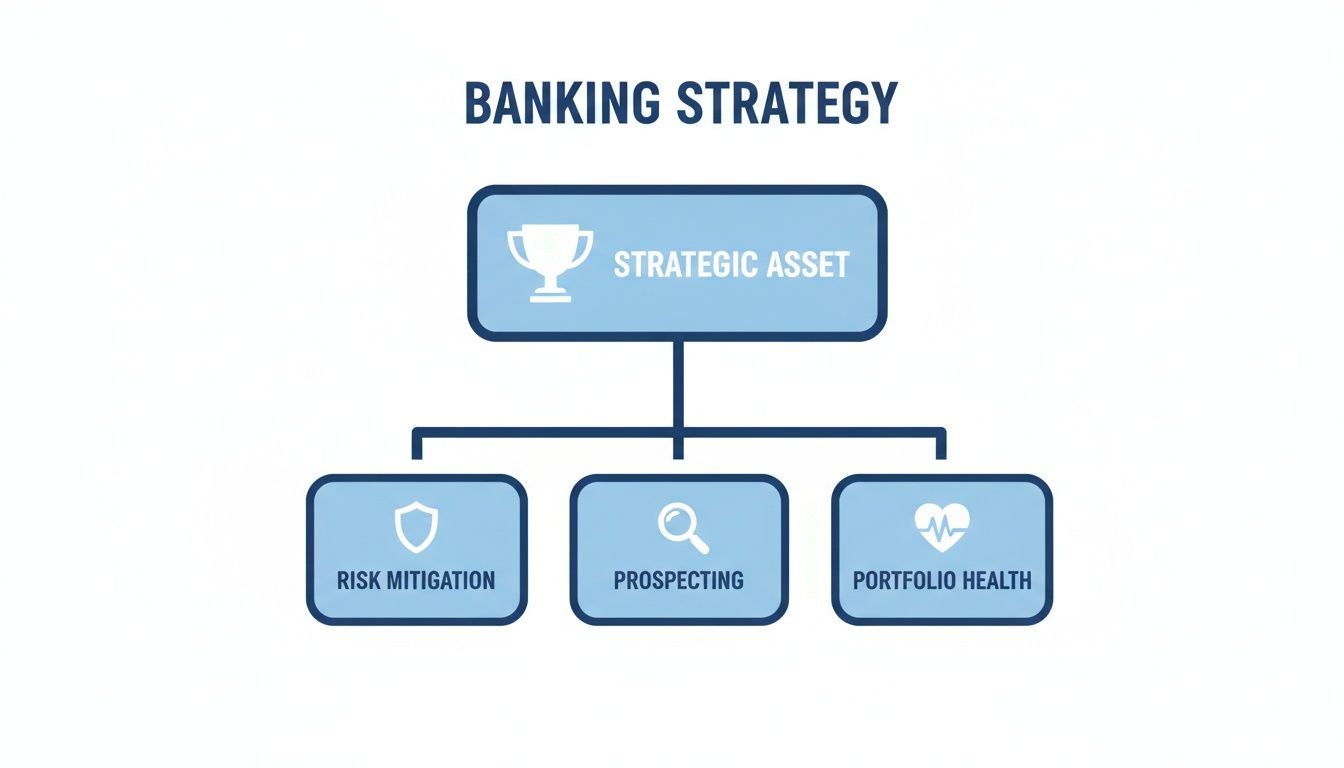
The visual representation is clear: high-quality data is not an expense. It is the foundation upon which a sound banking strategy is built.
The following table connects these key data signals directly to their practical banking applications.
Key Dun & Bradstreet Data Signals and Their Banking Applications
This table outlines the most critical D&B data elements and demonstrates their direct application in commercial banking decisions.
| Data Component | What It Measures | Strategic Banking Application |
|---|---|---|
| D-U-N-S® Number | A unique nine-digit identifier for a business entity. | Entity resolution, preventing duplicate records, and creating a single source of truth for each client. |
| Firmographics | Basic business attributes like revenue, industry, and employee count. | Prospecting, market segmentation, and identifying clients that fit the bank's ideal risk-return profile. |
| Corporate Family Tree | The hierarchical relationship between parent companies and subsidiaries. | Assessing total credit exposure to a single corporate entity and identifying cross-sell opportunities. |
| PAYDEX® Score | A 1-100 score indicating a company's past payment performance to its suppliers. | A leading indicator of financial stress; used in underwriting and ongoing portfolio monitoring. |
| Trade Payments | Detailed records of a company's payment habits with its vendors. | Granular insight into a borrower's cash flow discipline and operational stability. |
These signals transition the bank from conjecture to conviction, providing the evidence needed to support strategic decisions.
Turning Scores and Payments into Action
Raw data becomes truly valuable when translated into predictive scores and behavioral indicators. Two of the most potent signals in the Dun & Bradstreet dataset are the PAYDEX Score and the underlying trade payment data, which provide a direct window into a company’s financial discipline.
The PAYDEX Score is a numerical rating from 1 to 100 indicating whether a business pays its bills on time. A score of 80 signifies prompt payment. A score of 50, however, indicates payments are typically 30 days delinquent. This is a powerful leading indicator of financial distress that often surfaces long before a company's credit formally deteriorates. For an underwriting team, a declining PAYDEX is a material red flag demanding further investigation.
Finally, the trade payment data provides the narrative behind the score. It shows the specific payment history a company has with its suppliers. This allows your team to determine if a potential borrower is consistently late in paying key vendors, even if their submitted financials appear sound.
When integrated into a system like Visbanking’s BIAS, these data points cease to be abstract numbers. They become actionable signals that direct your team's attention precisely where it is needed most. Mastering these core components enables your bank to shift from a reactive to a proactive posture, building a stronger, more profitable portfolio.
Putting Dun & Bradstreet Data to Work
Understanding the components of Dun & Bradstreet’s data is foundational. Applying it to achieve measurable results is where strategic advantage is created. For bank executives, this means converting abstract data points into smarter underwriting, targeted prospecting, and a more resilient loan portfolio.
The following three scenarios illustrate how D&B data becomes a critical tool in daily banking operations. These are not theoretical exercises; they are the types of actions that separate market leaders from the competition.

Use Case 1: Commercial Credit Risk Assessment
A mid-sized manufacturing firm applies for a $1,500,000 loan. The company has been a client for years, and its submitted financials appear solid. However, a standard credit check provides only a partial, and often curated, view.
The underwriting team integrates D&B data into its analysis. It immediately identifies a red flag: the firm’s PAYDEX score has deteriorated from 82 to 65 in the last six months. This is a material change, indicating a pattern of delayed payments to suppliers—a classic early warning sign of cash-flow problems not yet visible in quarterly financial statements.
The bank's action is decisive and strategic. Instead of declining the loan, it adjusts the pricing to reflect the heightened risk profile and adds a covenant requiring the client to maintain a minimum PAYDEX score. The outcome is a win-win: the bank protects its capital, and the client secures necessary funding under appropriate terms. This decision was driven entirely by a single, critical data point.
A PAYDEX score isn't just a number; it’s a direct indicator of a company's financial discipline. A falling score is one of the earliest, most reliable warnings of impending distress, allowing you to manage risk before it manages you.
Use Case 2: Proactive and Targeted Prospecting
A senior relationship manager is tasked with expanding the bank's commercial portfolio in the logistics sector. Traditional methods like indiscriminate cold-calling are inefficient and yield poor results. The objective is to identify high-quality prospects who align with the bank's ideal client profile.
Instead of speculative outreach, the manager uses D&B firmographics to build a highly targeted list. The criteria are specific:
- Industry: Logistics and Warehousing (NAICS Code 4931).
- Location: Within a 100-mile radius of the bank's main commercial hub.
- Revenue: Between $20,000,000 and $100,000,000 annually.
- Size: More than 50 employees.
In moments, a broad market of hundreds of businesses is refined to ten ideal targets. The manager then layers on D&B’s corporate family tree data to identify potential cross-sell opportunities with parent or sister companies. This transforms prospecting from a volume game into a strategic exercise, dramatically increasing the probability of success. For a deeper dive, review our guide on business banking prospecting software.
Use Case 3: Dynamic Portfolio Monitoring
Managing portfolio risk is a continuous process, not a quarterly review. Consider a $500,000 line of credit extended to a regional construction company with a flawless payment history.
Rather than waiting for a delinquency—at which point options are limited—the bank employs an automated monitoring system integrated with D&B's data feed, similar to the functionality within Visbanking’s BIAS platform. The system is configured to trigger an alert if any client's D&B Delinquency Predictor Score drops by more than 15%. One morning, an alert for the construction firm is sent to the relationship manager's dashboard.
The manager immediately accesses the firm's D&B profile and discovers three new public liens have been filed against the company. This information would not have surfaced through conventional channels for weeks. Armed with this intelligence, the manager contacts the client to discuss the situation and temporarily freezes the credit line. This single proactive measure prevents a potential $500,000 loss.
By integrating D&B's commercial signals with proprietary data, the bank shifts from a reactive to a predictive stance. It is no longer just managing loans; it is making strategic decisions based on a complete, forward-looking view of its entire portfolio. This is the competitive edge that data intelligence provides.
Plugging D&B Data Into Your Tech Stack
Acquiring high-quality Dun & Bradstreet data is the first step. Effectively integrating it to drive decisions is what creates value. For bank leadership, this is not a back-office IT project; it is a critical operational imperative that dictates the speed at which insight is converted into action. Without a robust integration strategy, even the best data remains an expensive, underutilized asset.
The initial challenge is universal: entity resolution. Most bank CRMs contain duplicate or conflicting records for the same commercial client. Layering D&B data onto this foundation only compounds the problem. The first step must be data cleansing. A proper integration uses the D-U-N-S Number as the definitive key to de-duplicate existing records and establish a single, reliable profile for each client.
Data Delivery: Files vs. APIs
Once client data is standardized, the method of D&B data delivery must be determined. There are two primary approaches, each serving distinct strategic needs.
Bulk Data Files: This is analogous to receiving a comprehensive encyclopedia on a quarterly basis. These large datasets are ideal for macro-level analysis, such as market segmentation, building prospecting universes, or conducting a portfolio-wide health assessment.
Real-Time APIs: An API functions as a direct, on-demand query to D&B's database. This method is suited for transactional tasks, such as pulling the latest PAYDEX score during loan application processing or instantly verifying a new business's details during onboarding.
A mature data strategy employs both. Bulk files support strategic planning, while APIs enable real-time execution. The key is ensuring your technology stack can manage both methods efficiently.
Licensing and Data Hygiene
Dun & Bradstreet’s data is a proprietary asset governed by specific licensing agreements. Executives must understand the terms of use, storage, and data retention. For example, attempting to use licensed data to create a new, marketable product would likely violate a standard internal-use agreement and create significant legal and financial risk.
Data is not a one-time purchase. It's a living asset that requires constant maintenance. Neglecting data hygiene is like allowing sludge to accumulate in a high-performance engine—it will eventually fail when you need it most.
Beyond legal compliance, maintaining data freshness is an ongoing operational requirement. Businesses evolve: they merge, revenues change, and risk profiles shift. Your integration must include a systematic process for refreshing D&B data to avoid making decisions based on outdated information. A client's revenue could grow from $5,000,000 to $15,000,000 in a single year, fundamentally changing the relationship opportunity. Without a data refresh, your team operates with a blind spot.
This is precisely the type of operational heavy lifting that platforms like Visbanking are designed to manage. We handle the complexities of entity resolution, API integration, and scheduled data refreshes through production-grade data pipelines. This liberates your internal resources and accelerates your bank's return on its data investment. To assess your current position, a valuable first step is to explore how our data can help you benchmark performance.
Understanding Data Limitations and Compliance
Effective leadership requires a complete understanding of one's tools—their strengths as well as their weaknesses. While Dun & Bradstreet data provides an unparalleled map of the commercial landscape, assuming it is infallible is a critical error. A robust banking strategy must acknowledge its limitations and navigate the complex compliance environment in which it operates.
The most significant limitation is potential data lag. Information on smaller, private companies may be updated less frequently than for large, public corporations. A firm’s reported PAYDEX score or annual revenue might not reflect a recent, material downturn. Relying exclusively on this data is like driving while looking only in the rearview mirror—it shows where you have been, not the obstacles immediately ahead.
The Necessity of Data Triangulation
This is why best-in-class risk management is built on data triangulation. A multi-million-dollar credit decision should never hinge on a single source. The D&B profile should serve as the foundation, but not the entire structure.
Dun & Bradstreet data tells you the "what"—a snapshot of a company's health. You need other sources to understand the "why" and anticipate the "what's next." This is how you build a complete, defensible picture of risk.
For example, a prospective borrower may have a flawless D&B report. However, a concurrent check of UCC filings could reveal that all its primary assets have recently been pledged as collateral to another lender. Suddenly, the clean report is put into a very different context. Platforms like Visbanking’s BIAS are designed for this purpose—they automatically integrate D&B profiles with UCC filings and regulatory reports to expose these critical, often hidden, connections.
Navigating KYC and AML Compliance
Beyond accuracy, compliance is paramount. D&B data is a powerful asset for Know Your Customer (KYC) and Anti-Money Laundering (AML) programs, but it is not a panacea. It is highly effective for enriching Customer Due Diligence (CDD) by untangling complex corporate structures and identifying ultimate beneficial owners. It helps answer the fundamental question: "Who are we really doing business with?"
However, it does not replace the primary source verification mandated by regulators. Your compliance framework must still include the rigorous validation of identities against official documentation. D&B data provides a richer context, but it does not absolve the bank of its core regulatory obligations. Ensuring the proper handling of this sensitive information requires a strong data governance strategy.
By acknowledging these limitations and integrating Dun & Bradstreet data into a broader, multi-source intelligence strategy, your bank can transition from being merely data-rich to being truly data-driven. It is a pragmatic approach that reduces surprises, strengthens compliance, and leads to more profitable decisions.
To see how your current data strategy compares to the market, you can explore our data tools to get started.
Transforming Raw Data Into Actionable Intelligence
Raw data is a commodity. The strategic asset that separates market leaders from the rest of the pack is intelligence. While Dun & Bradstreet data provides a critical layer of commercial information, its true power is unlocked only when it is integrated into the fabric of your bank's decision-making ecosystem.
A single data point is an anecdote. A synthesis of thousands of data points is the foundation for a decisive, strategic move.
This is the core philosophy behind Visbanking's Bank Intelligence and Action System (BIAS). We fuse high-quality D&B profiles with other critical datasets that banks rely on, including FDIC call reports, SBA loan data, and UCC filings. The result is a multi-dimensional view of every client and prospect that no single source can provide alone.
From Data Points to Strategic Insight
An integrated system is what transforms scattered information into a powerful decision-making engine. It connects the dots that are otherwise invisible, drawing a straight line from observation to action.
Consider the strategic insights generated by combining these sources:
- D&B + FDIC Call Reports: You don't just see a prospect's D&B risk score. You see it alongside their current bank's performance metrics, potentially identifying a weakened competitor and creating a strategic opening.
- D&B + SBA Loan Data: Your team identifies a growing company that recently secured an SBA loan. A review of its D&B firmographics indicates they are poised to outgrow their current banking services. This is the optimal moment to proactively offer the treasury management solutions they will soon require.
- D&B + UCC Filings: Cross-referencing a D&B corporate family tree with UCC records reveals that a subsidiary's assets are already pledged to a competitor—a crucial detail that prevents a high-risk lending decision.
A D&B profile tells you a business's story. Fusing it with regulatory and public data gives you the complete narrative—context, subtext, and the crucial final chapter that dictates your next move.
Putting Intelligence Into Your Team's Hands
This is where the Visbanking platform delivers a competitive advantage. Our Prospect application does not just display a static D&B profile; it brings it to life by revealing key decision-makers and their professional networks.
Similarly, our Bank Performance module allows you to take a prospect identified via Dun & Bradstreet data and instantly benchmark its financial health against a highly specific peer group. Imagine identifying a $30,000,000 manufacturing firm and, in the same interface, seeing that it outperforms 85% of its industry peers. That insight transforms a cold call into a strategic conversation about how your bank can help them capitalize on their success.
Ultimately, the goal is to equip your team with a system that drives faster, smarter, and more profitable banking decisions. It starts with a clear understanding of your own performance and the market opportunities before you.
See how our platform can turn data into the intelligence you need to win. We invite you to explore our tools and benchmark your bank's performance against your competitors.
Your Questions, Answered
When evaluating new data sources, banking executives have direct, pointed questions. Let's address them.
Isn't Dun & Bradstreet Data Just Like Other Credit Bureau Data?
No. A consumer credit bureau like Experian is focused on individuals. Dun & Bradstreet data is built exclusively for the commercial world.
It provides a distinct set of metrics essential for business analysis. These include the D-U-N-S Number for definitive entity resolution, the PAYDEX score measuring actual payment behavior to suppliers, and detailed corporate family trees. For underwriting a commercial loan or evaluating a B2B partner, D&B provides intelligence that consumer data cannot.
What Is the First Step My Bank Should Take to Get Started with D&B?
Before licensing data, the first step is an internal assessment of your data infrastructure and strategic objectives. Conduct a candid review of the quality of your current commercial client data. Identify the gaps.
Next, define your primary goal. Is it to reduce credit losses, improve prospecting efficiency, or enhance compliance? Your objective will determine which D&B datasets will deliver the greatest immediate impact. This is where a platform like Visbanking can accelerate progress. Instead of initiating a complex internal IT project, you can leverage an environment where Dun & Bradstreet data is already integrated with other core banking datasets, enabling you to achieve your goals more quickly.
Can We Rely Solely on D&B Data for Commercial Lending Decisions?
No. That would be a significant strategic error. D&B data is a powerful tool, but it is only one component of a comprehensive risk assessment.
Prudent banking requires synthesizing D&B insights with other essential sources, including the borrower's financial statements, public records such as UCC filings, and other regulatory data.
A holistic approach, which is the foundation of platforms like Visbanking's BIAS, triangulates multiple data points to create a comprehensive risk profile. This leads to more resilient and defensible credit decisions.
By blending these sources, you move beyond simple report-pulling and begin building a multi-dimensional view of both risk and opportunity. This is the hallmark of a modern, data-driven financial institution.
Your bank’s success is a direct result of the quality of its intelligence. Visbanking turns complex data into the clear, actionable insights your team needs to make smarter, faster decisions.
Related Articles

Visbanking Blog
Banking Data Analytics: Turning Information Into Profit

Visbanking Blog
BIAS: Your Competitive Edge in Banking Data Driven Strategy

Visbanking Blog
Capital Banking in the USA: An Overview of Investment Services, Financial Instruments, and Regulations

Visbanking Blog
From Data Overload to Actionable Insights: How BIAS Simplifies Banking Intelligence

Visbanking Blog
The Future of Financial Analytics: Solutions by VISBANKING

Visbanking Blog