
A Modern Enterprise Data Strategy for Bank Leaders
Brian's Banking Blog
An enterprise data strategy is not an abstract IT project; it is the blueprint that converts raw information into a decisive competitive advantage. For bank executives, this is a fundamental business decision—transforming scattered data points from a costly liability into profitable, strategic action. The objective is to drive tangible results for the bottom line.
Moving From Data Overload to Decisive Insight
Financial institutions are inundated with data from FDIC call reports, market feeds, and internal core systems. Yet, for all this volume, the clear insights required to act with confidence are often elusive. This data overload leads to reactive, backward-looking reporting instead of the proactive, forward-looking decisions necessary to outperform the market. Without a coherent strategy, data becomes noise, bogging down teams and obscuring mission-critical opportunities.

A modern data strategy provides the operational playbook to resolve this. It aligns governance, architecture, and talent to deliver clarity. The goal is to move from siloed spreadsheets and legacy systems toward a unified intelligence hub where data is clean, accessible, and actionable.
The True Cost of a Disconnected Strategy
Operating without a unified data view is not merely inefficient; it has tangible costs. Consider a commercial lending team prospecting for new clients. Lacking a unified view, they may expend dozens of hours manually assembling call report data and cross-referencing internal records. By the time a target list is compiled, the opportunity may have passed.
This is a significant opportunity cost. While your team validates data, a competitor with a clear, real-time market view closes a $10,000,000 C&I loan you were not even positioned to pursue.
From Reporting to Actionable Intelligence
A winning strategy shifts the focus from historical reporting to forward-looking intelligence. It empowers leadership to ask—and instantly answer—the questions that drive performance.
- Which specific loan segments present the highest risk for the upcoming quarter?
- Where are the most profitable, untapped customer relationships located?
- How does our institution truly measure against its top three peers on critical performance metrics?
Answering these questions requires more than raw data. It demands a system engineered to integrate disparate sources into a single, reliable picture of the market and your bank's position within it. This is the core purpose of a well-executed enterprise data strategy.
Platforms like Visbanking's Bank Intelligence and Action System (BIAS) are designed for this purpose. We unify complex datasets to provide the clarity needed for sustainable growth and intelligent risk management. To understand how modern platforms convert information into a competitive edge, explore the fundamentals of business intelligence and analytics for banking. This guide will provide a clear roadmap for building a strategy that delivers measurable returns.
The Three Pillars of a Winning Data Strategy
A robust enterprise data strategy is built on three essential pillars. If one is weak, the entire structure is compromised. Executing these correctly provides the framework to convert data from a liability into your most powerful asset.
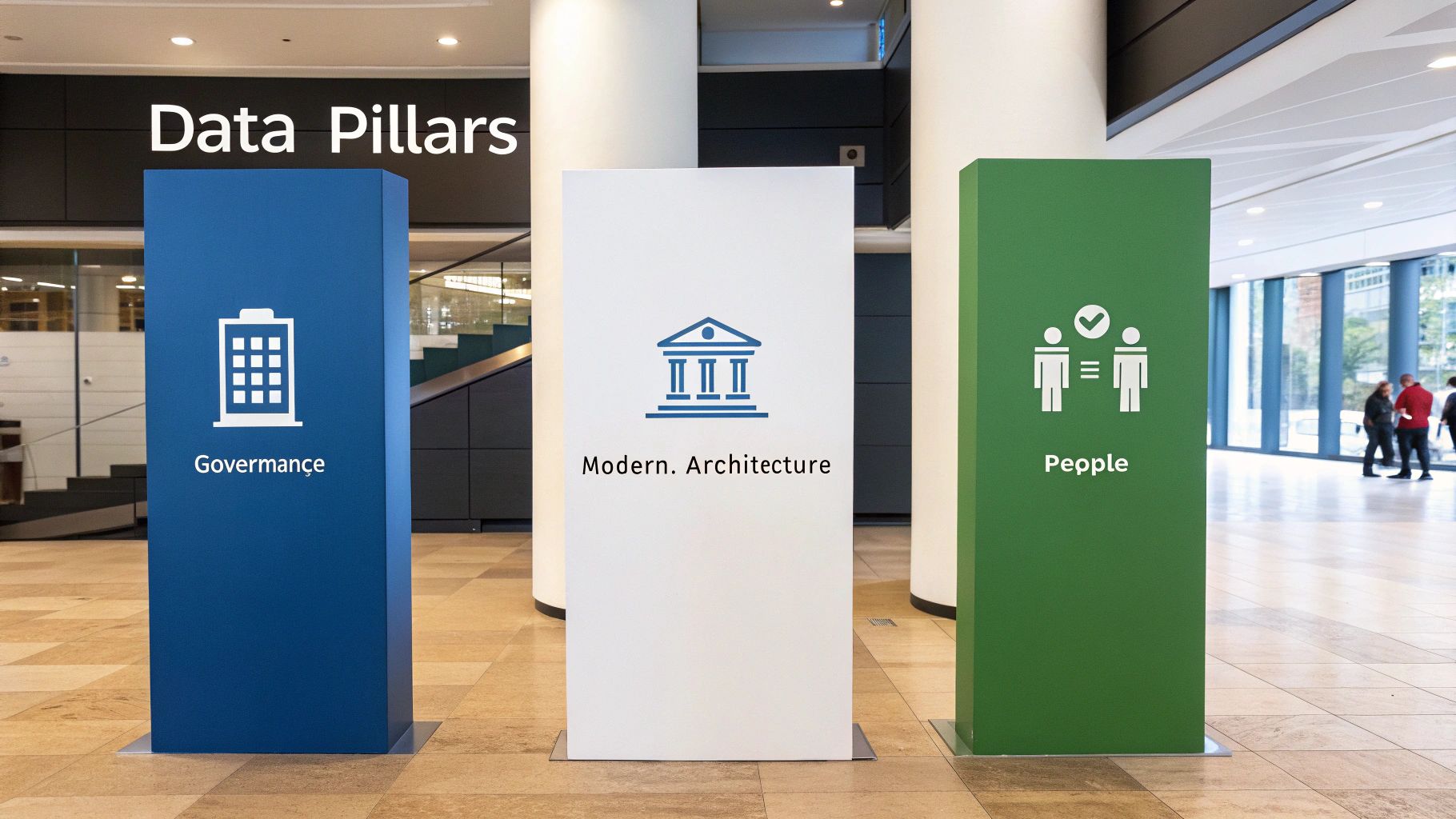
The scale of data is expanding rapidly. The enterprise data management market was valued at USD 97.5 billion in 2023 and is projected to reach USD 281.9 billion by 2033. Internal data center storage needs nearly doubled from 297 to 570 terabytes between 2020 and 2022. Consequently, 92% of companies now identify data governance as their top priority. To manage this, financial institutions are shifting from a cost-center mindset to one focused on driving measurable value.
This table outlines that fundamental shift:
Pillars of a Modern Enterprise Data Strategy
| Pillar | Traditional View (Cost Center) | Modern View (Profit Driver) |
|---|---|---|
| Data Governance | A restrictive set of rules to avoid fines. | A framework that enables confident, compliant use of data to find opportunities. |
| Modern Architecture | A complex IT project to maintain legacy systems. | An integrated platform that unlocks real-time insights for frontline teams. |
| People & Process | Hiring IT staff to manage data infrastructure. | Building a data-literate culture that empowers everyone to make smarter decisions. |
The modern approach is not just about managing data; it is about deploying it to grow the bottom line.
Pillar 1: Data Governance
Data Governance is the charter defining data ownership, quality standards, and access controls. It functions as the internal control system for your information, ensuring every data point is accurate, secure, and auditable. Without it, even sophisticated analytics tools produce unreliable outputs. If loan origination data is inconsistent across systems, for example, any credit risk model built upon it will be flawed. Strong governance prevents this by assigning clear ownership and enforcing quality, ensuring the numbers presented to the board and regulators are trustworthy.
Governance is not about restricting data access. It is about making data safe and reliable for confident, widespread use. It transforms data from a potential regulatory liability into a trusted asset for strategic decision-making.
A strong governance program establishes clear data lineage, which is essential during regulatory examinations. It answers the critical questions: Where did this number originate? Who is responsible for it? How do we verify its accuracy? We have authored a comprehensive guide on what data governance in banking entails in practice.
Pillar 2: Modern Data Architecture
If governance is the rulebook, Data Architecture is the operational blueprint. The objective is to dismantle siloed legacy systems and build an integrated platform that consolidates all relevant datasets. This is the engine that powers a data strategy. A modern architecture removes the barriers between the core banking system, FDIC call reports, UCC filings, and macroeconomic data. Analysts often spend 80% of their time locating and preparing data and only 20% analyzing it. An effective architecture inverts this ratio.
Imagine a commercial lender viewing a prospect’s complete profile—internal relationship data combined with external market signals—in a single interface. They could act on opportunities in minutes, not weeks. This is the power of a well-designed architecture.
Pillar 3: People and Process
This pillar is where strategy becomes execution. Superior governance and technology are useless if the team is not equipped or empowered to use them. The final pillar focuses on cultivating a culture where decisions are driven by data, not intuition. It requires investing in people and providing them with tools that enhance their workflow. Instead of wasting hours in spreadsheets for peer benchmarking, your team should utilize a platform like Visbanking to instantly compare your performance against 4,600+ other institutions.
This liberates your most valuable talent to focus on analyzing the "why" behind the numbers, not just compiling the "what." This is how a data strategy becomes an integral part of daily business operations.
How Data Intelligence Drives Real Banking Outcomes
An enterprise data strategy is judged by its direct impact on the P&L. Success is measured in tangible results: accelerated growth, superior risk management, and improved operational efficiency. When data is unified and accessible, it transitions from an IT budget line item to a driver of revenue and profit. These are the concrete, measurable returns that a well-executed strategy delivers, turning concepts like "governance" into a competitive advantage.
Precision Prospecting for Commercial Growth
Consider a universal banking goal: expanding the commercial and industrial (C&I) loan portfolio. With fragmented data, relationship managers are trapped in a cycle of manual research and cold calls, missing prime opportunities. A unified data strategy changes this dynamic entirely.
By integrating real-time market data with internal relationship history, your team can identify high-value commercial clients with surgical precision. Imagine instantly identifying every privately held company in your footprint with revenues between $10,000,000 and $50,000,000 that recently filed a UCC lien for new equipment—a clear indicator of financing needs. This allows your team to engage at the precise moment of opportunity.
This approach is not just about better targeting; it makes your most valuable asset—your people—vastly more efficient. The result is a more productive sales team and faster growth. A mid-sized bank leveraging this intelligence could realistically target and achieve a 15% increase in its C&I portfolio in a single year.
Proactive Risk Mitigation in Your Loan Portfolio
Risk management is another area transformed by a modern data strategy. Traditional methods often rely on lagging indicators, identifying credit problems only after they have materialized. This reactive posture is costly, leading to unexpected charge-offs and higher loan loss provisions. Data intelligence enables a shift from monitoring to active risk mitigation. By layering predictive signals over your existing portfolio data, you can detect early warning signs of distress long before a loan becomes delinquent.
Consider the practical applications:
- Early Warning Signals: Receive automated alerts when a commercial borrower's public filings indicate a significant drop in cash flow or an abrupt departure of a key executive.
- Concentration Risk Analysis: Instantly model the impact of a downturn in a specific industry or geographic area, allowing you to rebalance the portfolio before a market shift.
- Predictive Modeling: An intelligence platform like Visbanking can surface leading indicators of credit risk, enabling proactive conversations with at-risk borrowers weeks or months earlier.
This foresight directly impacts the bottom line. For a bank with a $1,000,000,000 loan portfolio, identifying and mitigating just a handful of at-risk commercial loans could prevent $5,000,000 in potential losses.
Strategic Benchmarking for Competitive Edge
Finally, a robust data strategy provides the clarity needed to outperform competitors. Without a systematic way to benchmark performance, strategic planning becomes guesswork. True competitive analysis requires a deep, data-driven understanding of how you compare to relevant peers.
Imagine a quarterly leadership review where, instead of viewing high-level metrics, your team can instantly compare the bank's performance against over 4,600 institutions across dozens of key indicators. This clarity reveals threats and opportunities with precision. For example, a mid-sized bank might discover its non-interest income lags its peer group by 30 basis points. By analyzing the data, they could identify an underperforming product or an overlooked fee opportunity. Addressing this single gap could increase profitability by 8% for the year.
These outcomes—precision growth, proactive risk management, and strategic outperformance—constitute the business case for your enterprise data strategy. The first step is often to benchmark your institution against your peers.
A Pragmatic Roadmap for Implementation
An enterprise data strategy's value lies in its execution. A grand vision without a practical, phased plan leads to analysis paralysis and wasted resources. For bank executives, the objective is to build momentum, demonstrate value early, and mitigate major risks. This roadmap is designed for decisive action, breaking the initiative into manageable phases where each step builds on the last. The key is securing an early, high-impact win to prove the strategy's value and gain executive support for a full rollout.
The timeline below illustrates how a sound strategy progresses from identifying opportunities to achieving full market intelligence, turning raw data into confident action.
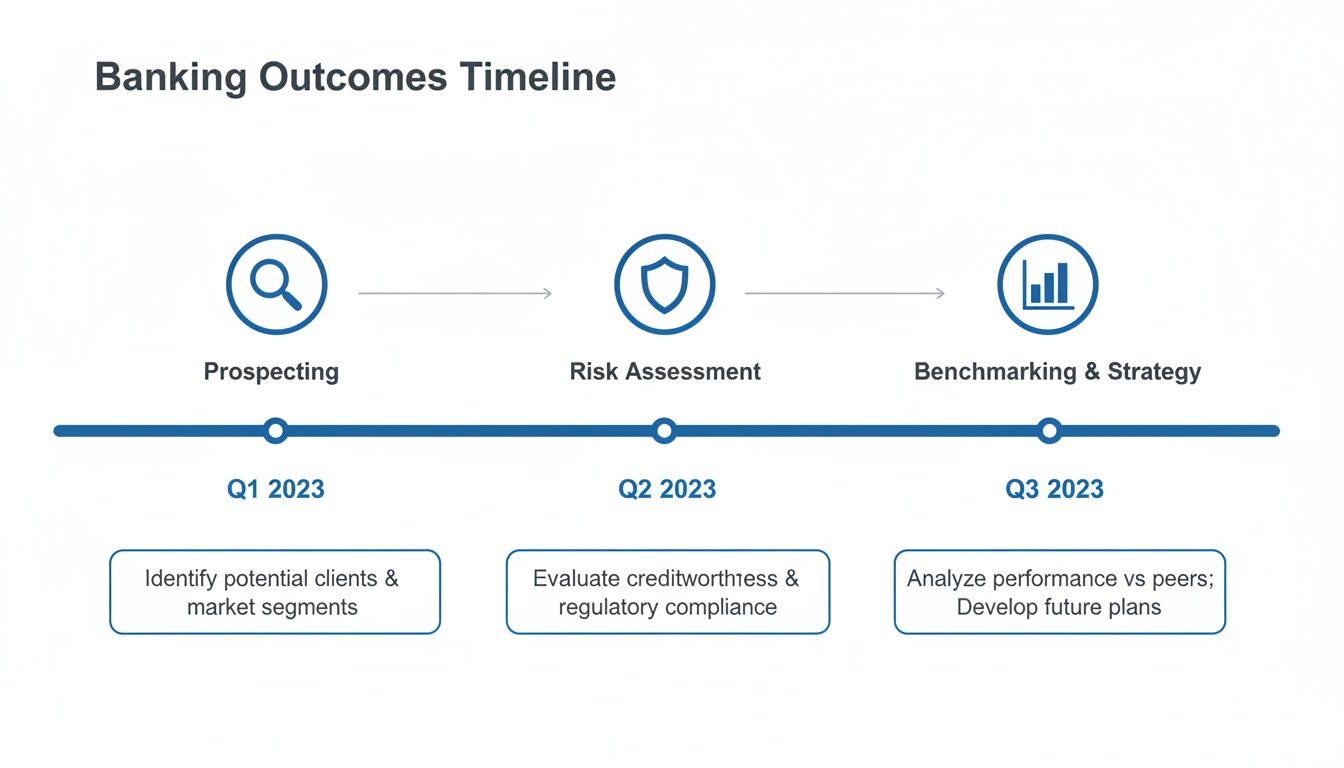
The flow is logical: identify growth targets, assess associated risks, and measure performance against competitors to refine the next strategic move.
Phase 1: Assessment and Foundation (Months 1–3)
The first 90 days are critical for laying the groundwork. This is not about boiling the ocean; it is about focused, strategic preparation. The mission is to establish a clear baseline and select a pilot project with a high probability of success.
Key actions:
- Conduct a Data Asset Audit: Map all existing data sources, from the core system to third-party feeds. Identify where your most valuable information resides and, critically, where the largest quality gaps exist.
- Define Core Governance Policies: Establish initial rules for data ownership (e.g., commercial lending vs. retail deposits) and outline basic quality standards.
- Select a High-Impact Pilot Project: This is the most crucial step. Choose a project that solves a real business problem and can deliver a measurable result quickly. For many banks, peer performance benchmarking is an ideal starting point. It primarily uses external, structured data, allowing you to bypass a lengthy internal data cleanup process and gain immediate, actionable insights for the board.
Phase 2: Pilot and Scale (Months 4–9)
With a solid foundation, the focus shifts to execution. The pilot project serves as the proof of concept, demonstrating the value of a centralized data approach and building the business case for broader investment. During this phase, the team launches the benchmarking pilot. Using a platform like Visbanking, which integrates thousands of data sources out of the box, bypasses a protracted internal data integration project and accelerates time-to-value.
The goal is a quick win. Identifying a $20,000,000 growth opportunity by analyzing peer loan concentrations provides a clear ROI and generates leadership enthusiasm for subsequent phases. Concurrently, the technical team can begin building a scalable architecture for future initiatives, applying lessons learned from the pilot. Implementing strong data engineering best practices is non-negotiable for creating scalable and secure data platforms.
Phase 3: Enterprise Integration (Months 10–18+)
A successful pilot provides the mandate for enterprise-wide expansion. This phase involves integrating more complex internal datasets, rolling out advanced analytics, and embedding a data-first mindset into the corporate DNA. Initial governance policies are expanded into an institution-wide framework, and predictive tools for risk management and AI-powered prospecting are introduced.
However, a significant challenge exists: a reported 77% of organizations describe their data quality as average or poor. This underscores the necessity of establishing robust governance from the outset.
Common Pitfall to Avoid: Analysis Paralysis. The greatest risk is becoming stalled while debating a "perfect" strategy. Avoid this by focusing on a tangible pilot. Real-world results replace theoretical arguments and create unstoppable momentum.
This phased approach systematically de-risks the data strategy implementation and ensures it delivers compounding value. Start by benchmarking your institution to secure that critical first win.
Looking Ahead: Weaving Predictive Intelligence into Your Strategy
A forward-thinking enterprise data strategy does not merely reflect the past; it serves as a GPS for the future. For financial institutions committed to maintaining a competitive edge, integrating predictive intelligence and AI is no longer optional—it is imperative. The focus must shift from reactive reporting ("what happened?") to proactive intelligence ("what is about to happen?").
The impact is direct and significant. Imagine receiving advance warnings on predictive risk signals in your commercial loan portfolio, identifying potential credit issues months before they surface. Consider automating talent acquisition by searching a professional network of over 2,600,000 contacts to pinpoint the exact expertise required. This is the practical result of a forward-looking data strategy.

This shift is underway. Projections indicate that by 2026, over 80% of enterprises will use Generative AI or AI-powered applications, with global AI spending expected to surpass $300 billion. Yet, a significant execution gap remains. A startling 75% of companies still rely heavily on Excel for analytics, and 69% admit to being over-reliant on it—a major competitive vulnerability that modern, AI-driven platforms are designed to address. More on these trends can be found in this insightful article from Techment.
From "Black Box" to Actionable Insight
For any bank executive, the critical question regarding AI is not "what can it do?" but "how does it work, and can I trust it?" The term "AI" can evoke images of an opaque "black box" that produces answers without explanation. In a highly regulated industry, this is a non-starter. The solution is ensuring any predictive intelligence is both explainable and auditable. Your team, board, and regulators must be able to understand why a model flagged a loan for review or recommended a new market. Selecting the right technology partner is therefore critical.
An effective AI integration is not about deploying confusing algorithms. It is about providing production-ready infrastructure, secure APIs, and automated alerts that integrate into daily workflows to deliver clear, defensible insights.
In practice, this means loan officers receive email alerts with specific, data-backed reasons for a change in a borrower's risk profile. It means the business development team is notified of a high-value prospect with context on why they are an ideal fit. This clarity transforms predictive analytics from a buzzword into a trusted operational tool.
Putting AI to Work—Responsibly and Efficiently
Deploying a machine learning model requires more than hiring a data scientist. It demands a robust infrastructure to manage the entire lifecycle—from development and testing to deployment and ongoing monitoring. This is the domain of MLOps (Machine Learning Operations) and "feature stores," which form the backbone of an advanced data strategy.
A platform like Visbanking provides this foundation out of the box, enabling your institution to:
- Deploy Models Without the Headache: Transition a model from a data scientist's laptop to a full-scale production application, avoiding the significant cost and complexity of building the infrastructure internally.
- Keep Governance Front and Center: Maintain complete audit trails on model performance and data usage to satisfy regulatory requirements.
- Integrate Seamlessly: Connect predictive insights directly to core systems, CRM, or other platforms, ensuring the right information reaches the right people at the right time.
By building on a platform designed for responsible AI, your bank can proactively manage risk and capitalize on opportunities with confidence. To see how this operates in practice, you can learn more about predictive analytics for banks. The next step is to assess your current position and identify where this intelligence can deliver the greatest impact.
Turning Your Data into a Competitive Advantage
The ultimate test of an enterprise data strategy is not the sophistication of its dashboards or the volume of data collected. It is the quality and speed of the decisions it enables. The goal is to move beyond siloed data and reactive reports to a state of integrated intelligence that empowers leadership to act with conviction. In today's market, the institution that can interpret signals and act fastest wins. The time for deliberation is over; it is time to execute.
Bridging the Gap Between Data and Action
An effective data strategy closes the critical gap between identifying a problem and implementing a solution. A legacy system might flag a negative trend in portfolio risk but provide no context as to the "why" or "how," leaving leadership to react after damage has occurred. A modern approach connects the dots in real-time.
It does not just report what happened—such as a 12% increase in delinquencies in a specific loan category. It reveals why, pointing to the market factors or borrower behaviors driving the trend. This allows for a surgical response rather than a costly, broad-based guess.
This is precisely where a purpose-built platform is transformative. A tool like Visbanking is designed to be that bridge, engineered to deliver answers—not just more data points—directly to decision-makers, from the C-suite to the front lines.
Your First Step Toward Decisive Intelligence
Implementing a full-scale enterprise data strategy can seem daunting. However, the most effective approach is to start with a single, high-impact initiative that delivers a quick win and builds momentum. Your first step can be simple yet powerful. Benchmark your institution against a curated peer group to instantly identify strengths and weaknesses. Or, analyze customer data to uncover low-hanging cross-selling opportunities that have been hidden in plain sight.
This initial success demonstrates the tangible power of connected intelligence and builds the case for further investment. The journey from data overload to decisive advantage begins with a single informed move.
Start by benchmarking your bank's performance and discover what is possible.
A Few Questions We Hear All The Time
When we discuss building an enterprise data strategy, bank leadership teams consistently raise a few key questions. Here are direct answers.
How Do We Justify The ROI On This Thing?
The ROI for a data strategy is measured by its contribution to the P&L. The business case rests on three pillars:
- Slash Inefficiency: Consider the hours your team spends on manual reporting. An initial project can reduce the time spent on quarterly peer analysis by 80%, freeing your best people for value-added work.
- Pinpoint Growth: A well-designed strategy can surface specific commercial loan prospects, providing a clear roadmap to grow a portfolio by 10% in a single year.
- Dodge Risk: The objective is to anticipate problems. By receiving early warnings on at-risk loans, you can act proactively and prevent millions in potential charge-offs.
These are tangible outcomes that fund the strategy and build momentum.
We're a Smaller Bank. Do We Really Need All This?
Yes, but you need a smart, scalable strategy, not a "big bank" one. Avoid monolithic, multi-year projects that drain resources.
The key is a modular approach. Start with one specific, high-value problem that can be solved quickly.
For a community or regional bank, this is a significant competitive advantage. You can adopt a powerful tool for peer benchmarking or market analysis, achieve an immediate win, and build from there. Platforms like Visbanking are designed to deliver this day-one value.
Where Do We Even Start If Our Data Is a Mess?
Disorganized internal data does not prevent you from starting; it dictates where you start. Do not attempt to clean everything at once—that is a recipe for failure. Instead, select a project where you can either control the data or bypass the internal issues.
A prime example is unifying external market data for competitive analysis. By working with clean, structured public data (like FDIC call reports), you can gain immediate strategic insights. Securing a quick, visible win demonstrates the power of good data and builds the case for tackling more complex internal cleanup projects later.
The most effective Visbanking strategies begin with a single, clear objective. Whether it's benchmarking performance, identifying new prospects, or managing risk, the right platform provides the clarity to act with confidence.
Related Articles

Visbanking Blog
Banking Data Analytics: Turning Information Into Profit

Visbanking Blog
BIAS: Your Competitive Edge in Banking Data Driven Strategy

Visbanking Blog
The Future of Financial Analytics: Solutions by VISBANKING

Visbanking Blog
Revolutionize Your Banking Operations with Data-Driven Insights from BIAS

Visbanking Blog
In the world of banking, digital transformation is no longer a 'nice-to-have'. It's a necessity

Visbanking Blog