
A Strategic Analysis of Share Draft Accounts for Bank Executives
Brian's Banking Blog
Share draft accounts are not a niche product for credit unions; they are a direct and growing threat to your bank's core deposit base. For bank leadership, understanding the mechanics and market appeal of these accounts is a competitive necessity. Ignoring their low-fee structure and dividend-earning potential is a strategic vulnerability that allows credit union rivals to steadily erode your market share.
Why Share Draft Accounts Demand Executive Attention
As the primary transactional vehicle for millions of consumers, share draft accounts represent a critical battleground for retail deposits. They directly challenge the stability and profitability of a bank's foundational demand deposit accounts (DDAs). A granular analysis of their competitive advantages is not an academic exercise—it is essential for strategic planning.
The low-cost nature of share draft accounts is a primary driver of member loyalty at credit unions. This loyalty translates into a stable, low-cost funding source that is difficult for commercial banks to compete against without a precise, data-informed strategy. These accounts are a key component of core deposits, which are the lifeblood of institutional liquidity and lending capacity.
For any bank seeking to defend its deposit base and strategically outmaneuver credit union competitors, a deep, data-driven understanding of share draft account performance is non-negotiable.
This is precisely where data intelligence platforms provide a decisive advantage. Visbanking offers the analytical lens required to dissect these competitive dynamics, transforming raw market data into the actionable intelligence needed to protect and grow your institution's core funding.
Decoding The Competitive Threat
Effective strategy requires a clear-eyed assessment of the competition. For bank executives, this means understanding the fundamental structural differences between a standard checking account and a credit union’s share draft account. The distinction goes beyond nomenclature. As member-owned cooperatives, credit unions can eliminate monthly maintenance fees and offer dividends in lieu of interest—a value proposition with significant consumer appeal.
To compete effectively, you must dissect this value proposition and identify where your own products may be underperforming.
This graphic illustrates the core pillars of the credit union advantage derived from these accounts.
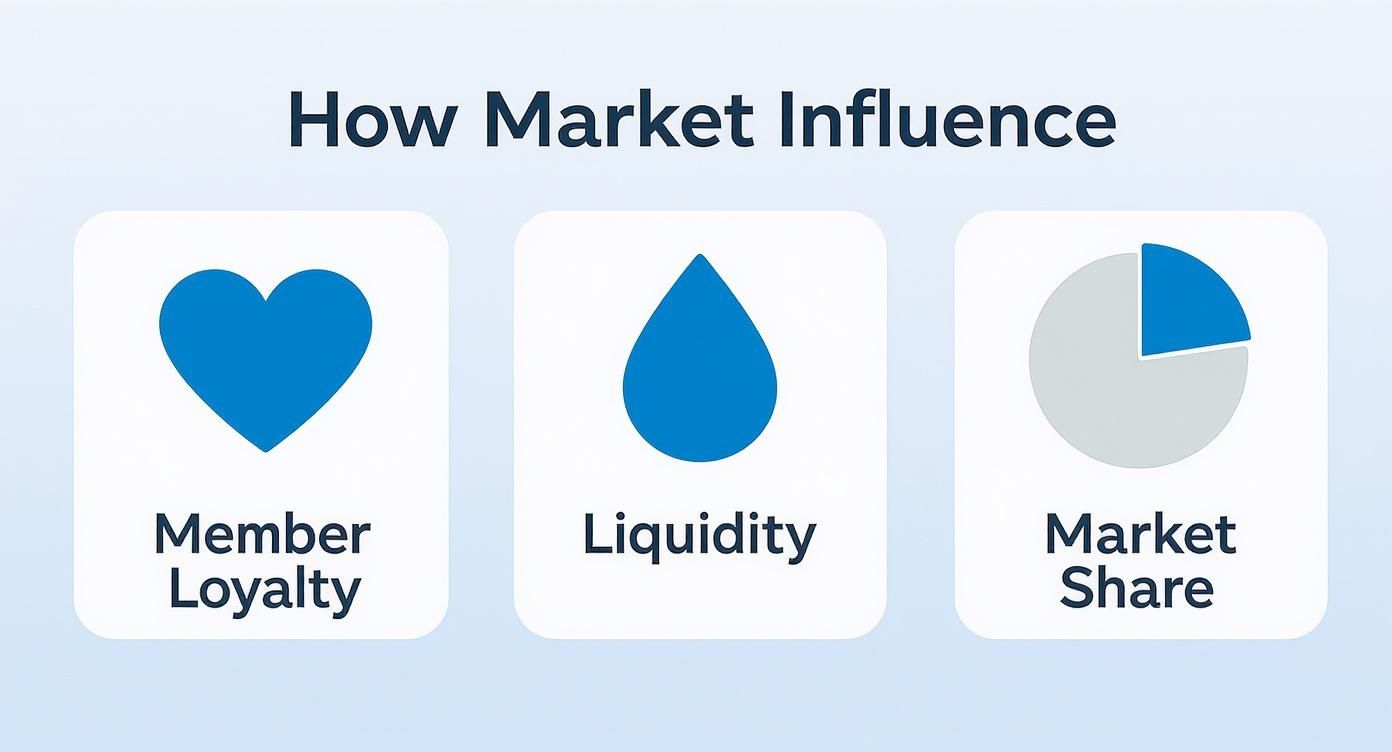
A simple transactional account becomes a powerful tool for fostering member loyalty and stabilizing the institution's funding base. This model has proven effective; a review of trends in credit union asset size confirms their growing market power.
The first step is not to react, but to analyze. Benchmarking your institution’s offerings against local credit unions using a data intelligence platform like Visbanking is the foundation for building a winning counter-strategy.
Share Draft Vs. Checking Account: A 5-Year Financial Impact Analysis
Let's move beyond theory to quantitative impact. The financial differences between these account types compound significantly over time, creating a compelling narrative for consumers.
This table illustrates a hypothetical 5-year scenario for a customer maintaining a $2,500.00 average balance.
| Feature | Credit Union Share Draft Account | Commercial Bank Checking Account |
|---|---|---|
| Average Monthly Fee | $0.00 | $12.00 (waivable with conditions) |
| Annual Fees (Assuming Not Waived) | $0.00 | $144.00 |
| Dividend/Interest Rate (APY) | 0.10% (as dividends) | 0.01% (as interest) |
| Annual Earnings (Approx.) | $2.50 | $0.25 |
| Net Annual Cost/Gain | +$2.50 (Gain) | -$143.75 (Cost) |
| 5-Year Net Impact | +$12.50 (Gain) | -$718.75 (Cost) |
Over a five-year period, the net financial difference for the consumer approaches $731.25. For the bank, this represents not only a lost customer but also the loss of a low-cost deposit relationship that could have been cross-sold. This is the financial reality of the competitive landscape, highlighting the market power of the "no-fee" and "higher-yield" model.
Share Draft Accounts Have Gone Digital
The term 'draft' may evoke an antiquated image of paper checks, but today’s share draft accounts are thoroughly modern. Credit unions have invested heavily in digitizing these products, equipping them with the features customers now expect as standard.

They have successfully transitioned these accounts into the digital age, dispelling any notion that credit unions lag in technological adoption. Features like mobile check deposit, P2P payments, and seamless digital wallet integration are now commonplace. Credit unions are competing directly with commercial banks for the digitally-native customer.
This evolution is part of the broader secular decline in paper-based transactions, a trend well-documented in data such as cheque usage statistics on Wikipedia.
The key takeaway for bank leadership is clear: never underestimate a competitor's technological capabilities. A robust bank digital strategy is no longer just a growth initiative; it is a critical defensive measure. Utilizing a platform like Visbanking to monitor competitors' feature rollouts is the only way to accurately benchmark your position and inform your next strategic investment.
Tracking Market Impact and Growth Trends
Share draft accounts are more than a product line; they are a key component of the M1 money supply and a reliable indicator of consumer financial behavior. As of Q3 2023, transactional deposits like these formed a substantial portion of the $18.1 trillion M1 money stock. You can explore further on the Federal Reserve Economic Data site for a deeper analysis of this data.
Monitoring trends in these account balances provides direct insight into your local market's financial pulse. This is mission-critical competitive intelligence.
Consider this scenario: data reveals a sustained 5% quarter-over-quarter increase in share draft deposits at three key credit union competitors in your primary market. This is a leading indicator of potential deposit outflows from your own institution. For a bank leader, connecting these data points to calculate return on investment for defensive product strategies separates proactive management from reactive damage control.
This is where real-time data intelligence becomes indispensable. Platforms like Visbanking empower executives to identify these subtle yet significant market shifts as they occur.
The objective is to benchmark performance continuously, enabling your team to adjust deposit strategies and product offerings before market share is lost.
Turning Insight Into Action for Bank Leaders

Acknowledging a competitive threat is insufficient; decisive action is required. To counter the encroachment of credit union share draft accounts, intelligence must be converted into a clear, executable strategy. The goal is not imitation but strategic neutralization of their advantages while amplifying your own.
This requires a rigorous examination of your bank's fee structures, particularly for entry-level checking products, and a commitment to a superior digital user experience. For example, if market intelligence shows a local credit union acquired 1,500 new share draft accounts in the six months following the elimination of overdraft fees, that is a direct signal. It identifies a specific consumer pain point and a competitor's successful tactic.
Your next move must be grounded in data. Benchmark your institution’s performance against these key credit union players. A data intelligence tool allows you to move beyond speculation and identify their specific vulnerabilities—and your greatest opportunities to protect and grow your core deposit base.
Ready to act with confidence? See how Visbanking delivers the market intelligence you need to make the right call.
A Few Key Questions for the C-Suite
What's the Real Bottom-Line Advantage of a Share Draft Account Over a Bank's Checking Account?
The primary advantage is cost, driven by the credit union's non-profit, cooperative structure. This model enables them to offer share draft accounts with no monthly maintenance fees and significantly lower ancillary charges, such as for overdrafts. Furthermore, many pay dividends on balances—a feature absent in most standard bank checking accounts.
Are My Members' Funds as Safe in a Share Draft Account as They Are in a Bank?
Yes, the deposit insurance is functionally identical. Share draft accounts are insured by the National Credit Union Administration (NCUA) through its National Credit Union Share Insurance Fund (NCUSIF). This provides the same level of protection—up to $250,000.00 per individual depositor—as the FDIC provides for bank deposits.
How Does the Global Rise in Account Ownership Impact Our Market Strategy?
The global trend validates the fundamental demand for the core product. Between 2011 and 2021, the share of adults worldwide with a formal financial account increased from 51% to 76%. This confirms that demand for basic transactional accounts is robust and growing. The strategic question is not if consumers need an account, but which institution they will choose. You can dive deeper into this trend over at the World Bank.
To win the battle for core deposits, you must first understand your opponent's strategy.
With Visbanking, you can benchmark your institution’s performance against key credit union competitors, turning raw market data into your next strategic advantage. Explore the Visbanking platform and start protecting and growing your core deposit base today.
Related Articles

Visbanking Blog
Capital Banking in the USA: An Overview of Investment Services, Financial Instruments, and Regulations

Visbanking Blog
In the world of banking, digital transformation is no longer a 'nice-to-have'. It's a necessity

Visbanking Blog
BIAS: Your Competitive Edge in Banking Data Driven Strategy

Visbanking Blog
Visbanking Unveils Interactive Quarterly Banking Profile, Available One Month Ahead of FDIC Release

Visbanking Blog
Banking Data Analytics: Turning Information Into Profit

Visbanking Blog