
Decoding Credit Union Asset Size for Banks
Brian's Banking Blog
When evaluating a credit union, asset size is more than a line item on a balance sheet—it is a direct measure of competitive strength.
A credit union’s asset size dictates its ability to invest in technology, price loans aggressively, absorb regulatory costs, and expand into new markets. For any bank executive, this metric is the foundation of actionable competitive intelligence.
Why a Credit Union’s Asset Size Should Matter to Your Bank
A credit union’s balance sheet is a blueprint for its competitive strategy. It is the foundational metric that signals both strategic ambition and operational capacity.
When bank executives track the asset size of their credit union rivals, it is not merely an exercise in observation. It is an analysis of their next strategic move.
A substantial asset base provides the financial firepower to challenge established banks on multiple fronts. It funds new digital banking platforms, enables the recruitment of top-tier commercial lenders, and provides the capital cushion required for acquisitions. For a deeper analysis of their structure, see our guide on understanding credit unions in the United States.
From the Balance Sheet to the Battlefield
To illustrate, consider two different credit union competitors:
- A $500 million credit union: This institution is likely focused on its core business—retail products such as auto loans and mortgages. Its marketing is local, its technology budget is constrained, and its digital experience is unlikely to be a market differentiator.
- A $5 billion credit union: This is a different class of competitor entirely. It possesses the scale to launch sophisticated regional marketing campaigns, roll out competitive commercial lending products, and deploy a mobile banking application that can compete with any regional bank.
The tenfold increase in asset size represents an exponential leap in competitive threat. The larger player can absorb new compliance costs while simultaneously undercutting bank loan rates. Its scale creates operational efficiencies that are reinvested directly into its growth engine.
As a bank executive, a competitor's growing asset base must be recognized for what it is: a direct investment in the tools and talent required to capture your market share. Their financial statement is a statement of intent.
Translating Data Into Actionable Intelligence
Monitoring the credit union asset size of local competitors provides a powerful leading indicator of their strategic direction.
For example, if a nearby credit union increases its assets by 15% in a single year, that is a critical data point. Such growth may signal an impending branch expansion, the acquisition of a smaller institution, or the launch of a wealth management division.
By using a financial intelligence platform like Visbanking to track these shifts, executives can move from a reactive posture to a proactive one. Pinpointing which credit unions are expanding most rapidly enables the effective deployment of resources, adjustment of product pricing, and preparation of your team for the competitive challenges ahead.
The first step is to benchmark your bank against key credit union players. That is how raw data is transformed into a tangible strategic advantage.
Understanding the NCUA Asset Thresholds
For bank strategists, the National Credit Union Administration (NCUA) asset thresholds are not arbitrary regulatory lines; they are a competitive roadmap. Each tier reveals critical information about a credit union's operational reality, from compliance burdens to its capacity for market disruption.
Understanding these key inflection points provides insight into a competitor's strategic mindset. An institution's position within these tiers directly signals its regulatory pressure, which in turn shapes its cost structure, product strategy, and overall agility.
As a credit union grows, it does not simply scale; it must fundamentally alter its business model.
The Small Credit Union Tier: Under $100 Million
Credit unions with assets under $100 million are hyperlocal institutions. Their strategic focus is on deep relationships within a specific community or employee group. For banks, they do not represent a significant direct threat in terms of sophisticated products or digital services.
However, their strategic value should not be dismissed. They are prime acquisition targets. A larger, more aggressive credit union can acquire several of these smaller players to rapidly expand its footprint in your market. Monitoring the financial health of these smaller credit unions can provide early warning of consolidation activity.
The Mid-Size Tiers: $100 Million to $10 Billion
This is the arena where competition intensifies. Once a credit union surpasses the $500 million and then the $1 billion asset marks, its capabilities expand significantly. They begin to invest substantial capital in technology, recruit specialized lending talent, and build dedicated marketing teams.
This infographic details how a credit union's asset size fuels its ability to compete directly on technology, rates, and market reach.
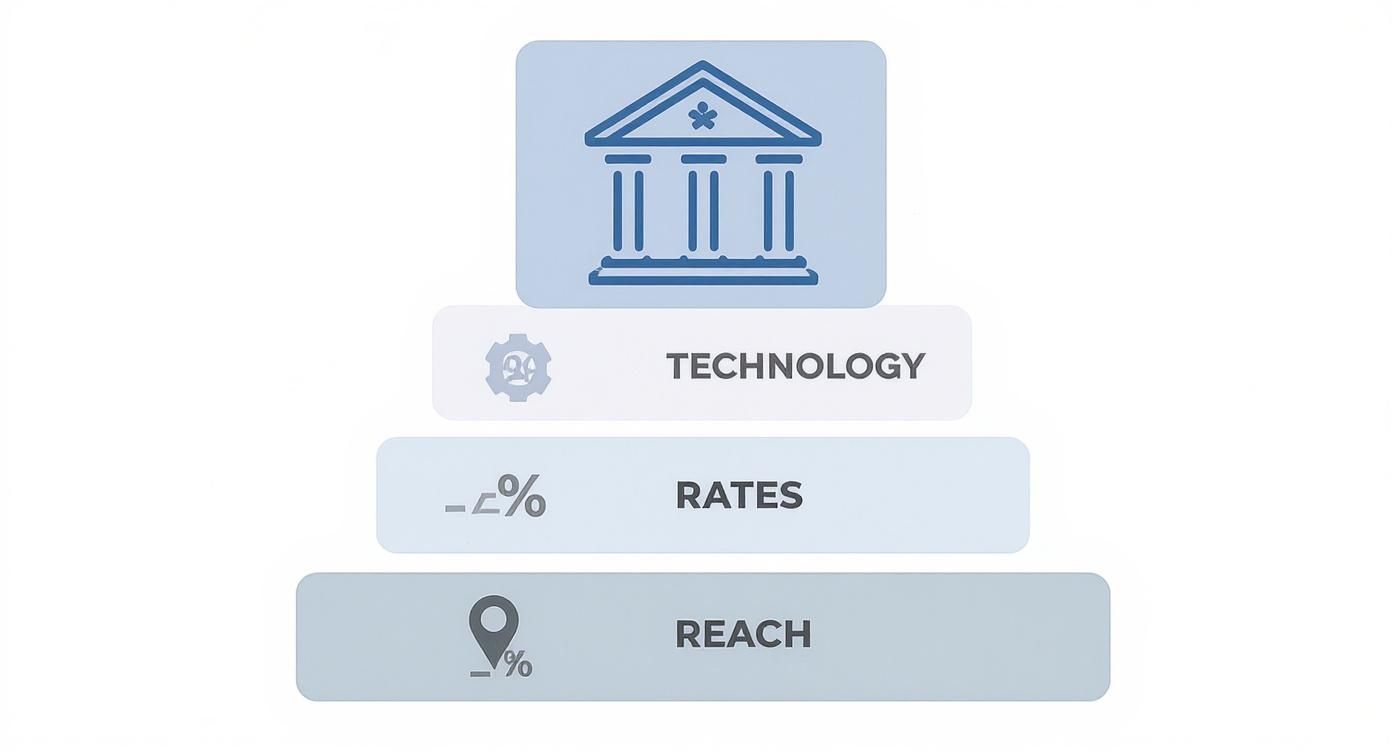
A larger asset base is the launchpad for every competitive weapon a credit union can deploy against a bank.
A credit union that crosses $1 billion in assets begins to operate like a regional bank, but with the significant advantage of a tax-exempt status. It can implement aggressive pricing on both loans and deposits, directly impacting a bank's core profitability.
The most critical asset threshold for any bank to monitor is the $10 billion mark. Crossing this line subjects a credit union to the authority of the Consumer Financial Protection Bureau (CFPB), a monumental operational and financial event.
The Major League: Over $10 Billion
Once a credit union exceeds $10 billion in assets, it enters a new regulatory environment. The transition requires massive investments in compliance systems, risk management frameworks, and legal counsel. This preparatory phase can temporarily slow a credit union's growth as it diverts capital to build the required infrastructure.
For a competing bank, this period presents a window of opportunity. A credit union preparing for CFPB oversight may become more risk-averse or pull back from its most aggressive pricing. However, once it absorbs these costs and adapts, it emerges as a far more formidable competitor.
Consider a $9.5 billion credit union that has been growing at 15% year-over-year. Its leadership is no longer solely focused on loan growth; it is now consumed with stress testing, fair lending analysis, and preparation for intense regulatory examinations.
Using a data platform like Visbanking to track its product filings and asset allocation during this phase can reveal strategic shifts long before any public announcement. That intelligence can be used to adjust your own product roadmap and marketing, capitalizing on their internal focus.
By understanding what each credit union asset size means for a competitor's operations, you can convert dry regulatory data into predictive competitive intelligence. Explore how Visbanking’s platform can help you benchmark these key competitors and turn market data into decisive action.
Connecting Asset Size to Performance and Profitability
A credit union's asset size is a direct predictor of its performance. This metric dictates everything from back-office efficiency to its ability to price loans competitively. For any bank executive, understanding this connection is fundamental to assessing a competitor's strengths and weaknesses.
The core principle is scale. A larger asset base creates tangible economic advantages that translate directly into market power.
Larger institutions can spread fixed costs—such as compliance, IT infrastructure, and executive salaries—over a much wider revenue base. This is a classic example of economies of scale, clearly visible in their key performance indicators. The result is a more resilient institution capable of weathering economic downturns and investing in growth initiatives beyond the reach of smaller competitors.
This scale advantage extends to funding. Credit unions with significant assets command better terms in wholesale funding markets. This lowers their cost of funds, which in turn allows them to offer more attractive rates on both loans and deposits—a direct challenge to a bank's net interest margin.
The Math Behind Scale and Efficiency
This is not merely theoretical. Let's analyze two credit unions in the same market to see how the numbers play out.
- Credit Union A: A community-focused institution with $500 million in assets. Its fixed operating costs (technology, compliance, administration) are $15 million annually.
- Credit Union B: A regional institution with $5 billion in assets. Its fixed costs are higher, at $75 million, due to a larger footprint and more complex operations.
While Credit Union B's absolute costs are five times higher, this is not the full picture. For Credit Union A, fixed costs represent 3% of its assets. For Credit Union B, that figure is only 1.5%.

That 50% efficiency advantage is significant. It provides the larger institution with the financial capacity to invest more in member-facing technology, marketing, and top-tier talent, further widening the competitive gap. This operational leverage directly impacts the efficiency ratio, a crucial measure of profitability. A lower ratio means less revenue is consumed by expenses, freeing up capital to fuel growth or absorb pricing pressure.
From Assets to Profitability Metrics
The effects of scale are evident across every major performance metric, creating a formidable competitor.
A larger credit union asset size does more than lower costs; it fundamentally changes an institution's capacity for risk management and income generation. Greater diversification in lending portfolios and access to sophisticated hedging instruments provide a stability that smaller organizations cannot replicate.
This stability is reflected in two key profitability metrics:
- Return on Assets (ROA): Larger credit unions often post stronger, more consistent ROA. They can generate more fee income from diverse services like wealth management and insurance. Combined with lower operating costs as a percentage of assets, this results in superior returns.
- Net Interest Margin (NIM): Scale provides the flexibility to optimize both sides of the balance sheet. With access to cheaper funding and the ability to originate a wider variety of higher-yielding loans, larger credit unions can protect their margins, even in a compressed interest rate environment.
Industry trends reflect this reality. As of March 2025, there were 4,411 credit unions in the U.S., down from 4,759 just two years prior—a clear sign of consolidation. Meanwhile, giants like Navy Federal Credit Union (approximately $190.2 billion in assets) and State Employees' Credit Union ($55.4 billion) continue to grow, demonstrating how scale creates a self-reinforcing cycle. You can explore more data on the industry's largest players to see their financial strength.
For bank strategists, the message is clear. A competitor's asset size is a reliable proxy for its pricing power, operational resilience, and profitability. By using a financial intelligence platform to benchmark these metrics against your own, you can move from observation to action—pinpointing specific threats and opportunities created by the scale of your credit union competition.
How Mergers Are Creating Formidable Competitors
The credit union industry is in a state of continuous consolidation, a trend that is redrawing the competitive landscape for community and regional banks. This is not a random occurrence; it is a calculated response to significant market pressures. Ignoring this wave of M&A activity is a strategic error, as it is actively creating larger, more aggressive, and better-funded competitors in your market.
The rationale behind this merger frenzy is straightforward. Credit unions are pursuing the economies of scale that a larger credit union asset size provides. Concurrently, mounting regulatory burdens and the high cost of essential technology are compelling smaller institutions to seek larger partners to remain viable.
The Strategic Calculus of Consolidation
Every merger is a deliberate strategic move designed to build a more powerful financial institution. When two credit unions combine, the new entity gains an immediate and significant competitive advantage, enabling it to challenge banks in ways that were previously impossible.
Consider a practical example:
- Credit Union A holds $750 million in assets, with a legal lending limit capped at $10 million for a single borrower.
- Credit Union B has a similar profile, also with $750 million in assets and an equivalent lending cap.
Independently, neither can compete for larger commercial real estate deals or significant business loans in their market. That lucrative business defaults to regional banks. Following a merger, however, they form a $1.5 billion institution with a much higher lending limit—perhaps $20 million. With a single transaction, they have become a serious competitor for the commercial deals from which they were previously excluded.
A merger is more than the combination of two balance sheets. It is an aggregation of competitive power. The new institution gains a larger geographic footprint, an expanded member base for cross-selling, and a unified marketing budget that delivers greater impact.
From Merger Announcement to Market Disruption
The advantages do not end with lending. The new, larger credit union can pool its resources to invest in capabilities that were once unattainable, such as sophisticated digital banking platforms, specialized lending teams, and powerful data analytics—all essential tools for attracting and retaining high-value customers.
This trend is not limited to credit union-to-credit union mergers. A growing number are now acquiring community banks to accelerate growth and gain immediate expertise in commercial lending. This strategy provides instant access to talent, technology, and an established business loan portfolio. To understand the prevalence of this tactic, learn more about how credit unions continue to acquire banks as a primary growth strategy.
Turning M&A Data Into a Competitive Weapon
For banking leaders, this is a clear and present threat. You can no longer view your local credit union competitors as static entities. Their asset size, market reach, and capabilities can change overnight.
This is why tracking M&A activity has become a critical component of modern competitive intelligence. By monitoring announcements and analyzing NCUA call report data, you can identify which competitors are poised for a significant increase in strength.
For example, a sudden jump in a competitor’s asset base that cannot be explained by organic growth is a clear indicator that a merger has occurred. This is your signal to investigate. What new markets did they enter? What new product lines did they inherit? How will their combined marketing budget affect your customer acquisition costs?
A data intelligence platform is essential for this analysis. It allows you to set alerts for significant shifts in a competitor’s credit union asset size, enabling a swift response. By benchmarking your own bank against these newly enlarged players, you can identify strategic gaps and adjust your game plan before losing market share. Do not simply observe consolidation—use the data to get ahead of it.
Putting Your Data to Work with Strategic Benchmarking
Effective strategy is not built on static, quarterly reports that are outdated upon arrival. It is forged with dynamic, real-time data.
Knowing a competitor’s asset size is the first step. The true differentiator, however, is leveraging that knowledge with powerful data intelligence, transforming competitor analysis from a reactive exercise into a proactive weapon. Relying on last quarter's numbers means you are already on defense.
In today's market, success requires granular data to precisely benchmark your position. This is where theory becomes practice.
From Numbers on a Page to Smart Decisions
Instead of relying on broad national trends, a savvy executive can build a custom, actionable competitive set. Forget comparing your institution to every credit union in the country.
Imagine creating a peer group of only those institutions within a 50-mile radius that fall into the $1 billion to $5 billion asset tier. Suddenly, you are analyzing your actual competitors.
This laser-focused approach provides immediate and relevant comparisons. By tracking this curated group, you can benchmark the metrics that truly matter in near real-time:
- Loan Growth: Is a competitor rapidly gaining auto loan market share?
- Deposit Costs: Which institutions are aggressively pricing CDs to attract liquidity?
- Return on Assets (ROA): How does your profitability truly compare to the credit unions vying for the same customers?
A Real-World Scenario
Imagine you receive an alert: a local $2.4 billion credit union's commercial loan portfolio has grown by 18% in the last two quarters, while yours grew by only 6%. That is not just a data point; it is a strategic warning.
Armed with that insight, you can begin an immediate investigation. What are their latest commercial real estate filings? Have they recently hired a new team of business development officers?
Without this targeted benchmarking, you might not recognize the threat until your own commercial pipeline begins to diminish. Real-time data intelligence reverses this dynamic, transforming you from a passive observer into an active strategist who can make decisive moves with confidence.
This approach also reveals opportunities. The data might show that the same peer group has consistently low loan-to-share ratios in small business lending. That signals an underserved market segment, ready for a targeted lending campaign from your institution.
The era of making strategic decisions based on year-old data is over. While macro-level reports like the largest U.S. credit unions by asset size in 2025 provide valuable context, the true advantage is found in granular, localized analysis. It is time to see how building custom peer groups can turn raw financial data into your most powerful strategic tool.
A Few Burning Questions
Executives frequently ask about the competitive landscape. Here are direct answers to common questions regarding credit union size and its strategic implications for your bank.
When Should I Really Start to Worry About a Credit Union Competitor?
While there is no single number applicable to every market, the moment a credit union surpasses $1 billion in assets, the competitive dynamic changes. This is a critical inflection point.
Once they cross this threshold, they gain the financial capacity for significant investments: modern digital platforms, top-tier lending talent, and the marketing power to compete directly with community and regional banks. They are no longer a niche player; they are targeting your core business.
If a local credit union is approaching the $1 billion mark, it is time to pay close attention. Its ability to price loans aggressively and attract deposits is about to be significantly enhanced, making it a direct threat to both your retail and commercial client base.
What Can Asset Growth Tell Me About Their Game Plan?
Rapid, sustained asset growth is a strategic indicator.
When a credit union consistently reports annual asset growth exceeding 10%, it is not accidental. It signifies a deliberate strategy to capture market share, either through acquisitions or an aggressive marketing and lending campaign. It is a clear statement of intent.
By tracking this growth velocity—a function simplified by a tool like Visbanking—you can begin to see their playbook unfold. For instance, a sudden surge in deposits often precedes a major push into new lending areas, such as small business or commercial real estate, as they seek to deploy that liquidity for higher returns.
Do not stop at total assets. To gain a complete picture, you must analyze key metrics. Assets Per Member indicates wallet share, the Net Worth Ratio reveals their capital reserves for future growth, and the Loan-to-Share Ratio shows how aggressively they are lending.
Analyzing these KPIs provides a much sharper, more useful assessment of a credit union's competitive strength than asset size alone. This is how you transform raw data into a clear understanding of their strategy and financial health, enabling you to formulate a more intelligent competitive response.
Your competitors are not standing still. With Visbanking, you can replace static reports with dynamic, real-time competitive intelligence. Benchmark your performance, anticipate market shifts, and make bold moves backed by the industry's best data. See how to turn insight into action at https://www.visbanking.com.
Related Articles

Visbanking Blog
List of Banks by Asset Size

Visbanking Blog
Transforming Credit Unions: Visbanking's Data Revolution

Visbanking Blog
BIAS: Your Competitive Edge in Banking Data Driven Strategy

Visbanking Blog
Revolutionize Your Banking Operations with Data-Driven Insights from BIAS

Visbanking Blog
Credit Unions Banks Pursuing Growth & Opportunity

Visbanking Blog