
Mastering the Metro 2 Format: A Strategic Guide for Bank Executives
Brian's Banking Blog
At its core, the Metro 2 format for credit reporting is the standardized language financial institutions must use to communicate with the major credit bureaus. It is a rigid, 426-character file format ensuring that all consumer credit data—from mortgages to auto loans—is reported with absolute consistency. Think of it as the universal translator for the entire U.S. credit ecosystem.
For bank executives, mastering this format is not a back-office compliance task. It is a strategic imperative that directly impacts risk management, portfolio health, and competitive positioning.
A Strategic Asset, Not a Compliance Hurdle
Many bank leaders view Metro 2 reporting through the narrow lens of regulatory compliance—a cost center fraught with the risk of Fair Credit Reporting Act (FCRA) penalties.
This perspective is dangerously limited. The data you furnish to the bureaus is a direct reflection of your bank's operational discipline and data governance. Inaccurate reporting signals internal weaknesses. Accurate reporting, however, is a strategic asset.
When viewed as a driver of business intelligence, the objective shifts from merely avoiding fines to leveraging this critical data stream for a competitive advantage.
The Power of Precise Data
Every data point transmitted in the Metro 2 format shapes critical decisions, both inside and outside your institution. This standardized language, created by the Consumer Data Industry Association (CDIA), ensures that a loan originated by your bank is understood in the exact same way as one from a national competitor. This uniformity allows credit bureaus to process millions of accounts with the precision that underpins the entire credit market.
That precision translates directly into tangible business outcomes:
- Superior Risk Assessment: High-quality, accurate data feeds more reliable credit scores, which in turn drive smarter, more profitable underwriting decisions. For example, consistently accurate reporting of payment histories prevents the misclassification of low-risk borrowers, allowing you to price loans more competitively.
- Accurate Portfolio Analysis: Clean, consistent data provides an unvarnished view of your portfolio's health. It reveals emerging credit weaknesses or performance trends that ambiguous data would obscure.
- Strengthened Customer Relationships: Correctly reporting account statuses, especially during sensitive periods like loan modifications, prevents damaging disputes that erode customer trust and consume operational resources.
The takeaway: Metro 2 reporting is the engine that converts your bank's raw account data into the universal language of credit risk. Fluency in this language is a direct measure of your institution's operational competence and data governance.
This shift from a compliance task to a strategic tool is a powerful one. We can break down the change in mindset like this:
From Compliance Task to Strategic Advantage
| Operational Focus | Conventional View (Compliance) | Strategic View (Data Intelligence) |
|---|---|---|
| Objective | Avoid FCRA penalties and regulatory scrutiny. | Gain a competitive edge through superior data quality. |
| Data Quality | "Good enough" to pass audits. | A critical asset that drives underwriting and portfolio analysis. |
| Reporting Team | A siloed, back-office cost center. | An integrated source of business intelligence. |
| ROI | Measured in fines avoided. | Measured in better loan performance and market insights. |
| Executive View | A tactical necessity delegated down the chain. | A strategic function with direct C-suite oversight. |
As more businesses start seeing Metro 2 reporting as a strategic asset, it’s also important to understand the bigger picture of how financial technology companies communicate their value. You can find some great insights on this in guides covering fintech marketing.
Ultimately, the goal is to move from a reactive, compliance-first mindset to a proactive, data-centric one. By treating your reporting process as a source of business intelligence, you unlock its true power. The data you furnish isn't just an obligation—it's one of your most valuable assets. Platforms like Visbanking enable banks to benchmark their reporting accuracy against peers, turning compliance data into a powerful tool for strategic action.
Decoding the Metro 2 Data Structure
To make sound executive decisions, you must understand the data you are working with. The Metro 2 format for credit reporting organizes every consumer account into a highly structured digital record, distilled into a rigid 426-character string.
This uniformity is its greatest strength. It guarantees that a loan made in Des Moines is interpreted by credit models in the exact same way as one from Miami.
Each Metro 2 record functions like a standardized file, with specific, interconnected segments that eliminate ambiguity and enforce a universal language across the credit industry.
The Anatomy of a Metro 2 Record
The format is layered, with the Base Segment acting as the foundation for every account you report.
- Header and Trailer Records: These are the bookends for your entire data submission. The Header identifies your institution as the furnisher, and the Trailer confirms the file's integrity by providing control totals for accounts and records.
- Base Segment: This is the core data for each account. It contains the essential information: consumer identifiers, account numbers, dates, credit limits, and current balance.
- Associated Segments (J1/J2, K1-K4, etc.): These are supplemental records that attach to the Base Segment to provide additional context. For instance, a J2 Segment is used to report the account history for a co-borrower on a mortgage, ensuring their credit file is also updated correctly.
This is not administrative minutia; it is the raw material for critical business intelligence. How your bank manages risk, analyzes its portfolio, and understands its customers all begins with the integrity of this structure.
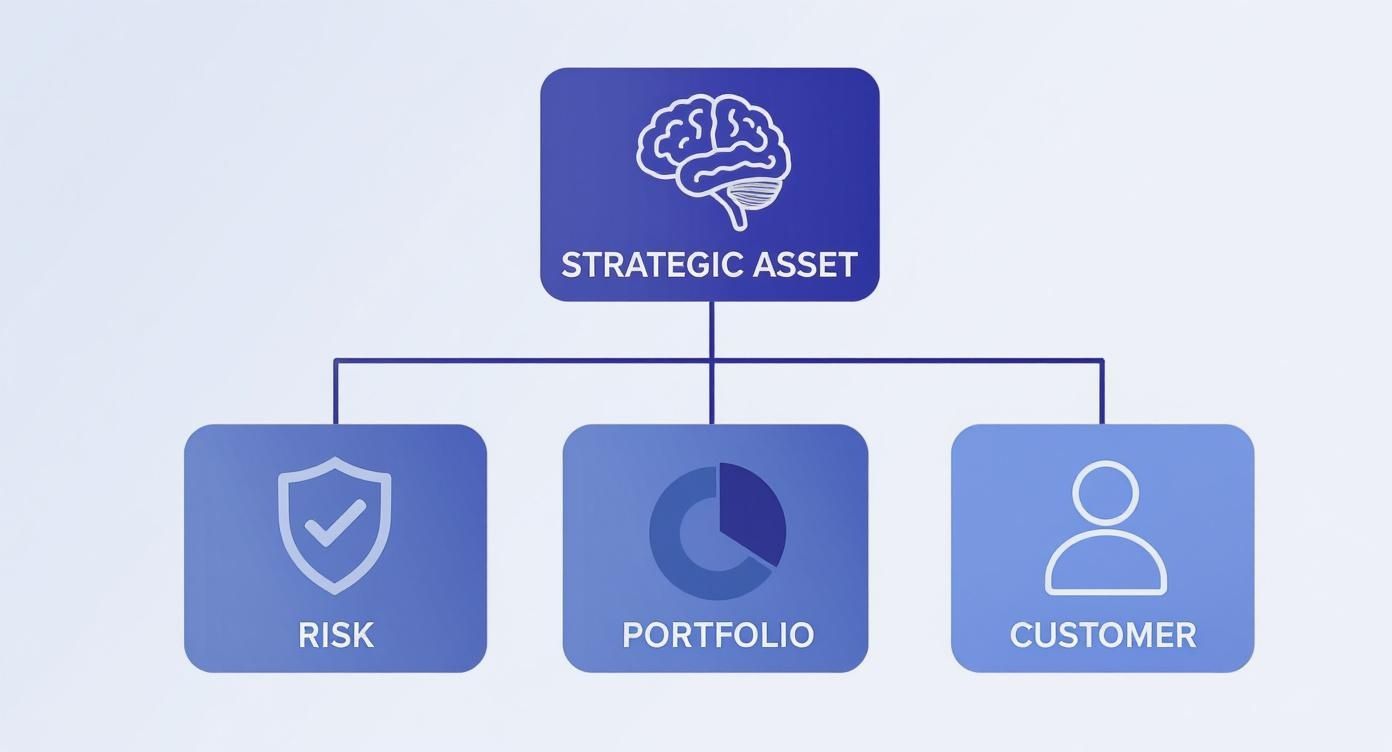
The key insight for leadership is that this structured data is a strategic asset, not just a regulatory chore.
A Practical Example of the Base Segment
Consider a $350,000, 30-year fixed-rate mortgage. The Base Segment for this loan would contain specific fields that define its core attributes:
- Account Number: The loan's unique identifier within your core system.
- Portfolio Type: Coded as 'M' for Mortgage.
- Account Status Code: A two-digit code, such as '11' for "Current" or '78' for "30-59 Days Delinquent."
- Date Opened: The date the loan was originated.
- Highest Credit or Original Loan Amount: $350,000.
- Current Balance: The outstanding principal, updated monthly.
- Scheduled Monthly Payment Amount: The principal and interest payment.
- Payment History Profile: A 24-month string of codes showing the payment status for the preceding two years.
The takeaway: This rigid structure forces absolute clarity. A payment is either on time, 30 days late, or 60 days late—there is no room for interpretation. This eliminates the data ambiguity that leads to flawed analysis and poor business decisions.
Understanding this blueprint is the first step for any executive seeking to improve data quality. Without a firm grasp of how this information is structured, identifying and rectifying reporting errors at their source is impossible.
Data intelligence platforms like Visbanking are designed to process these structured outputs at scale, identifying systemic issues and portfolio risks that are often invisible from within a bank's own systems. By benchmarking your reported data against peers, you can quickly determine if a spike in delinquencies reflects a genuine credit problem in your portfolio or a correctable flaw in your reporting process. Explore our data to see this principle in practice.
The Staggering Cost of Bad Credit Reporting
In banking, compliance is not just a goal; it is the bedrock of the business. With the Metro 2 format for credit reporting, the line between precision and disaster is measured in millions of dollars—lost to operational waste, regulatory fines, and reputational damage.
A seemingly minor error, when scaled across an entire loan portfolio, creates significant financial and legal exposure.
Perfect credit reporting is the minimum expectation. Regulators and credit bureaus maintain a strict scorecard. Failure to meet their standards is a clear signal of weak internal controls—the kind of attention no executive wants. Understanding the key performance metrics is the first step to mitigating this risk.
The Six Pillars of Reporting Compliance
Regulators evaluate six key areas that provide a comprehensive assessment of a bank's reporting process. These pillars are a direct reflection of your operational control and data governance.
- Timeliness: Reporting deadlines are non-negotiable. Missed deadlines can trigger immediate penalties and damage your institution's standing with the bureaus.
- Accuracy: Your reported data must perfectly mirror your system of record. The slightest discrepancy can harm consumers and lead to FCRA violations.
- Completeness: All required fields for an account must be populated. Blank fields indicate systemic flaws in data collection or mapping logic.
- Error Rate: The percentage of accounts reported with errors is a critical KPI for operational risk management.
- Dispute Resolution Time: The speed and accuracy with which you handle consumer disputes is a direct measure of your compliance program's effectiveness.
- Audit Readiness: You must be able to produce clear, documented evidence of your reporting controls at a moment's notice.
Getting Metro 2 reporting right is a make-or-break issue. Regulators and the credit bureaus enforce these standards rigorously. Incomplete or inaccurate data leads to disputes, and disputes shatter the trust between your institution and the bureaus.
Putting a Price Tag on "Small" Errors
The cost of poor data quality is not abstract. Consider this practical example:
A mid-sized bank holds a 200,000-account mortgage portfolio. A subtle data mapping flaw results in a 0.5% error rate. While this figure may seem negligible, it means 1,000 incorrect records are being transmitted to the bureaus every month.
If just 20% of those errors lead to a consumer dispute, your team must now process 200 new disputes monthly. With an industry average cost of $50 to $100 to investigate and resolve each dispute, this single "small" error is costing the bank $120,000 to $240,000 annually in direct operational expenses.
The takeaway: This calculation does not include potential FCRA fines, which can reach thousands of dollars per violation, or the corrosive damage these errors inflict on your relationships with the bureaus and your customers.
This is where data intelligence provides a decisive advantage. Benchmarking your performance is not a vanity exercise; it is a critical risk management function. Comparing your dispute and error rates against peers instantly reveals whether you are aligned with industry norms or exposed to a costly problem hidden within your operations. Solid financial data quality management is the foundation of a sound reporting system.
Inaccurate reporting is an avoidable tax on your institution. It drains resources, invites regulatory scrutiny, and erodes the trust that is the very foundation of banking.
Mapping Data From Your Core to the Credit Bureaus
The integrity of your credit reporting hinges on a single, critical process: the translation of nuanced data from your internal systems into the rigid, standardized language of the Metro 2 format.
This translation, or data mapping, is where most reporting failures originate. These failures are rarely born from bad intentions; they stem from flawed logic. For any bank leader serious about risk management, mastering this translation is non-negotiable.
The challenge lies in distinguishing between two fundamentally different types of data fields. The first is straightforward. The second is where significant operational risk emerges.
Direct vs. Derived Fields
Not all data fields are mapped equally. Success requires separating simple data transfers from complex, logic-driven calculations.
- Direct Fields: These involve a one-to-one transfer of information. A customer's first name, Social Security Number, or loan origination date is taken directly from your core system and placed into the corresponding Metro 2 field. This is the simplest part of the mapping process.
- Derived Fields: This is where complexity—and risk—intensifies. These fields require the application of business logic to interpret raw data and assign a specific code. The Account Status Code, for instance, does not exist as a single field in your core. It must be derived by analyzing a customer's payment history against their contractual due dates.
This process of mapping and transforming data is a significant technical and operational challenge. Your team must differentiate between direct fields that are fed straight into the file and derived fields that require carefully constructed business logic to produce the correct values.
Validating this entire mapping process is absolutely critical for success.
A HELOC Reporting Example
Consider a Home Equity Line of Credit (HELOC). Its status is fluid, requiring your system to make a judgment every month based on a precise set of rules.
Imagine a HELOC with a payment due on June 1st. When your system generates the Metro 2 file on June 30th, it must apply logic to determine the correct Account Status Code:
- If the payment was made on time, the code is 11 (Current).
- If the payment has not been received, the code becomes 71 (30-59 Days Delinquent).
- If the customer is in a pre-arranged forbearance plan, the code may remain 11, but now requires a Special Comment Code of CP (Account in Forbearance) to be appended.
If this logic is flawed—even by a single day—you have misreported the account. Now, multiply that error across a portfolio of 10,000 HELOCs. The result could be hundreds of customer disputes and significant, unwanted regulatory attention.
The takeaway: The Metro 2 format is a language with no room for synonyms or nuance. Your systems must translate the complex story of an account into a precise, standardized code. Any ambiguity in your internal logic is magnified as a glaring error in your final report.
This is precisely why robust validation is non-negotiable.
A comprehensive data dictionary documenting every mapping rule is a necessary starting point. However, internal checks alone are insufficient. They can confirm that your system followed its own rules, but they cannot tell you if those rules were correct. This is where advanced Metro 2 software becomes an essential governance tool.
An external validation layer, like that provided by Visbanking, is indispensable. By analyzing the final data output that the bureaus receive, our platform identifies anomalies and patterns that indicate underlying mapping failures. We can tell you if a sudden spike in 30-day delinquencies reflects a real portfolio risk or is merely a symptom of a broken business rule in your reporting engine.
Reporting Complex Scenarios with Accuracy
Any institution can report a simple, current auto loan. The true test of a bank’s data integrity and operational control comes when customer circumstances become complex.
It is in these real-world scenarios—bankruptcies, loan modifications, and forbearances—where reporting errors multiply, costs escalate, and regulators focus their attention.
For bank executives, ensuring the Metro 2 format for credit reporting is accurate in these situations is a fundamental risk management function. A single misreported loan modification can destroy a customer relationship and trigger a costly dispute. A mishandled bankruptcy can result in serious legal and financial penalties for violating federal law.
The stakes are high. Accuracy is mandatory. This requires a clear understanding of specific Metro 2 codes and their business implications.
Navigating Loan Modifications and Forbearances
When a borrower experiences financial hardship, your reporting must adapt. It is no longer a simple payment history but a more nuanced narrative. The key is to accurately reflect the agreement you have made with the customer without unfairly damaging their credit profile.
Consider a $45,000 auto loan for which you have granted the borrower a three-month forbearance. Under this agreement, the account is contractually current. However, simply reporting it as "Current" (Account Status Code 11) is incomplete and misleading.
To provide a complete and accurate picture, a combination of codes is required:
- Account Status Code: 11 (Current)
- Special Comment Code: CP (Account in Forbearance)
This combination informs the credit bureaus that the account is current because a formal forbearance agreement is in place. Omitting the Special Comment Code misrepresents the situation and can create significant problems for the consumer when they seek new credit in the future.
The Critical Case of Bankruptcy Reporting
Reporting on an account associated with a bankruptcy is one of the highest-risk activities in credit furnishing. The moment a customer files, an "automatic stay" is imposed by federal law. All collection activities—including reporting the account as delinquent—must cease immediately.
Imagine a customer with a $15,000 personal loan files for Chapter 7 bankruptcy. Your system must be configured to immediately stop reporting the previous payment status and switch to the correct bankruptcy code.
The proper procedure is to use one of these specific Account Status Codes:
- 07: Chapter 7 Bankruptcy
- 13: Chapter 13 Bankruptcy
If your institution continues to report a delinquent status (e.g., Code 93 for 90 days late) after receiving notification of the bankruptcy, you are in violation of federal law. This is not a minor data error; it is a major compliance failure that can lead directly to litigation and substantial fines.
The takeaway: In complex scenarios, Metro 2 reporting requires judgment. Your reporting logic must correctly translate complex legal and financial arrangements into a few precise codes. An error creates a direct pipeline from a data field to a courtroom.
This is where a high-level, data-driven overview becomes a powerful tool. A platform like Visbanking can analyze your final reporting data to identify anomalies. For example, is your institution suddenly reporting a high volume of the "CP" forbearance code? This could indicate emerging stress in your portfolio. Conversely, are you reporting zero bankruptcies when national filings are rising? This could signal a critical failure in your reporting process.
The table below outlines these critical scenarios, linking code choices to business outcomes and the type of intelligence that requires executive monitoring.
Reporting Framework for Special Account Conditions
| Scenario | Key Metro 2 Field/Code | Business Impact of Misreporting | Data Intelligence Insight |
|---|---|---|---|
| Loan Forbearance | Account Status 11 with Special Comment CP | Reporting as just "Current" misleads future lenders and can trigger customer disputes. | A spike in "CP" codes can be an early warning of portfolio-wide stress. |
| Loan Modification | Account Status 11 with Special Comment CO | Failure to report the modification can result in inaccurate credit profiles and compliance issues under the CARES Act. | Tracking modification trends helps forecast future loan performance and loss mitigation needs. |
| Chapter 7 Bankruptcy | Account Status 07 | Continuing to report delinquency violates the automatic stay, leading to legal penalties and reputational damage. | Comparing your bankruptcy reporting rates to peer banks can reveal gaps in your internal processes. |
| Chapter 13 Bankruptcy | Account Status 13 | Incorrect coding can interfere with the court-approved repayment plan and trigger legal action from the trustee. | Consistent use of this code, benchmarked against industry data, validates your compliance procedures. |
Benchmarking how you report these special conditions against peer institutions provides a crucial reality check. It helps you distinguish between a genuine trend in your loan portfolio and a critical error in your reporting system. This enables leadership to address systemic problems before they escalate into a full-blown compliance crisis. Explore Visbanking's data to see how this insight can protect your bank.
Turning Reporting Data into Business Intelligence
Mastering the Metro 2 format for credit reporting is essential for compliance. But stopping there leaves a significant opportunity unrealized. For astute bank executives, the true value lies not in the act of reporting, but in the intelligence embedded within the data itself.
This is where you transform a regulatory obligation into a competitive advantage.
The stream of data you send to the credit bureaus is a real-time electrocardiogram of your portfolio’s health and a leading indicator of market shifts. When analyzed correctly, this mandatory process becomes a powerful strategic asset, providing clear answers to critical business questions.

From "What Happened" to "Why It Happened"
Your internal reports may show a 2.3% increase in auto loan delinquencies last quarter. This is a lagging indicator; it only tells you what has already occurred. True business intelligence places that number in context and explains why it happened.
By benchmarking your reporting data against peers, you can answer strategic questions:
- Is it an internal problem or a market trend? Is that 2.3% delinquency spike unique to your portfolio, or is it a regional issue affecting all lenders? If your peers are only seeing a 0.8% increase, the problem is likely internal, warranting a review of your underwriting standards or collections practices.
- Where is risk concentrated? Are loan modifications distributed evenly, or are they clustered in specific geographic areas? A high concentration could be an early warning of local economic distress, allowing you to adjust your risk models proactively.
- Is our data accurate? A sudden surge in a specific Special Comment Code across your mortgage portfolio might not reflect borrower behavior at all. It could be a red flag for a systemic error in your data mapping that requires immediate correction.
The takeaway: The strategic advantage is realized when you begin treating compliance output as strategic input. It is no longer just about generating a correct file; it is about understanding the story that file tells about your bank and your market when compared to thousands of your peers.
This approach enables a shift from reactive to proactive decision-making. By analyzing aggregated, anonymized reporting data, you gain an objective assessment of your true performance.
The insights derived from this analysis should inform everything from underwriting policies and product development to collections strategies and capital allocation. This is the foundation of modern business intelligence for banks—transforming mandatory data into a decisive competitive edge.
It is time to stop viewing Metro 2 reporting as the finish line. It is the starting point for making smarter, data-driven decisions.
A Few Common Metro 2 Questions
From the executive suite, the technical details of the Metro 2 format for credit reporting may seem distant. The strategic consequences, however, land directly on your desk. Here are direct answers to questions that leaders frequently ask.
Why Can’t We Just Report What Our Core System Says?
Your core banking system was not designed for this purpose. It is built to manage your internal accounting, not to speak the highly specific, rigid language of credit reporting.
For example, your core system might log that a payment arrived five days late. Metro 2, however, requires a specific code—such as '71' for an account that is 30-59 days delinquent. Converting raw payment data into the correct code requires a translation layer that applies complex business rules. This translation is the source of most reporting errors. It is far more than a simple data transfer.
What’s the Difference Between a Direct and an Indirect Dispute?
Understanding this distinction is critical for managing operational risk and team workload. The two dispute types arrive through different channels and require distinct responses.
- Indirect Dispute: This occurs when a customer contacts a credit bureau like Equifax or Experian. The bureau then sends you a formal notice—an Automated Consumer Dispute Verification (ACDV)—through the e-OSCAR system, triggering a mandated investigation on your part.
- Direct Dispute: In this case, the customer contacts your institution directly. Your team is still obligated to investigate. If an error is found, you are responsible for proactively sending an Automated Universal Dataform (AUD) to all credit bureaus to correct the record.
How Does This Data Impact Underwriting Decisions?
The data you furnish to the bureaus is the same information that fuels credit scores and risk models across the industry—including those used by your own underwriters. The principle of "garbage in, garbage out" applies directly.
The takeaway: When you have systemic reporting errors, you are polluting the data ecosystem. That flawed data feeds back into the very models your bank relies on to make profitable lending decisions. By ensuring your reporting is accurate, you are not just fulfilling a compliance requirement; you are safeguarding the integrity of the tools your bank uses to manage risk.
Ultimately, mastering Metro 2 is not solely about avoiding regulatory penalties. It is about taking control of a critical data asset that shapes your bank's risk profile, its reputation, and its future success.
At Visbanking, we help you turn this compliance obligation into a competitive advantage. Our platform enables you to benchmark your reporting accuracy and portfolio trends against your peers, transforming a regulatory burden into actionable business intelligence. Explore our data to see how you can shift from basic reporting to strategic foresight.
Related Articles

Visbanking Blog
Unveiling the US Banks Credit Quality Chart on VisBanking Report Portal

Visbanking Blog
Transforming Credit Unions: Visbanking's Data Revolution

Visbanking Blog
Banking Data Analytics: Turning Information Into Profit

Visbanking Blog
Revolutionize Your Bank's Performance with BIAS: Unlocking the Future of Visual Banking Data

Visbanking Blog
The Future of Financial Analytics: Solutions by VISBANKING

Visbanking Blog