
A Bank Executive's Guide to Metro 2 Software
Brian's Banking Blog
Credit reporting is not a back-office compliance task. It is a core strategic function that directly impacts risk management, regulatory standing, and institutional reputation. For bank leadership, mastery of this process is non-negotiable, and at its center is Metro 2 software—the standardized language for reporting loan data to national credit bureaus.
This guide provides a board-level perspective on how robust Metro 2 software moves beyond compliance to become a driver of intelligent banking decisions.
Metro 2: The Cornerstone of Your Bank’s Data Integrity

In banking, data integrity is paramount. Every lending decision, risk model, and compliance audit hinges on the quality of underlying information. Metro 2 software ensures the data transmitted to Experian, Equifax, and TransUnion is structured, consistent, and fully compliant. Without this mandated format, the national credit reporting system would be unreliable, making sound underwriting impossible.
Think of Metro 2 as the SWIFT network for consumer credit data. It is a non-negotiable standard that compels every data furnisher to speak the same language, eliminating ambiguity and reducing systemic risk.
The Strategic Value of Standardized Reporting
For executives, the impact of Metro 2 extends far beyond the IT department. Proper implementation directly mitigates major liabilities and advances core business objectives.
- Regulatory Compliance: The format is purpose-built to meet the stringent requirements of the Fair Credit Reporting Act (FCRA). It serves as the first line of defense against violations and the significant penalties issued by regulators like the CFPB.
- Risk Management: Accurate, timely reporting provides a clear, reliable view of portfolio health. This enables sharper risk modeling and proactive adjustments to lending strategy.
- Operational Efficiency: Compliant software automates reporting, slashing manual errors, reducing the cost of dispute resolution, and redirecting human capital toward strategic, revenue-generating activities.
Let's quantify the impact.
Consider a bank with a $1.0 billion consumer loan portfolio. Reducing its reporting error rate from 1.0% to 0.1% eliminates 9,000 potential inaccuracies. This preempts thousands of annual customer disputes, preserving brand trust and avoiding significant legal and operational costs.
The Metro 2® format is governed by the Consumer Data Industry Association (CDIA). Access is tightly controlled, and for good reason. Only qualified data furnishers, processors, and software vendors may use it, ensuring system-wide reliability. Ultimately, the quality of your bank’s regulatory reporting shapes its ability to compete and thrive.
The following table translates these core functions directly into strategic value.
Core Functions and Strategic Impact of Metro 2
| Core Function | Strategic Impact for Your Bank |
|---|---|
| Data Standardization | Ensures reporting is accepted by all major credit bureaus without errors, protecting your institution's reputation. |
| FCRA Compliance | Acts as a built-in safeguard against costly regulatory fines and legal challenges from the CFPB and consumers. |
| Error Reduction | Minimizes customer disputes and the operational drain of investigating and resolving them, directly lowering costs. |
| Automated Reporting | Frees valuable employee time from manual data entry, enabling a focus on strategic analysis and growth initiatives. |
| Data Integrity | Provides a clean, reliable data source for internal risk modeling, portfolio analysis, and strategic planning. |
Mastering these functions is not merely about compliance—it is about building a more resilient and competitive financial institution. High-quality data is the fuel for advanced analytics. By ensuring flawless reporting with robust Metro 2 software, you create a powerful data asset. This clean data can then feed into intelligence platforms like Visbanking, unlocking precise peer benchmarking and revealing competitive opportunities that would otherwise be lost in noise.
Navigating the Data Furnishing Regulatory Landscape
In credit reporting, compliance is the absolute baseline. The Fair Credit Reporting Act (FCRA) imposes non-negotiable duties on data furnishers. Your bank has a legal mandate to report information that is both accurate and complete and to promptly investigate consumer disputes.
Failure to comply carries severe consequences. The Consumer Financial Protection Bureau (CFPB) actively pursues institutions with deficient reporting practices, resulting in consent orders, restitution, and civil penalties that can easily reach seven figures.
Metro 2 as a Procedural Safeguard
This is where superior Metro 2 software ceases to be an operational choice and becomes a core component of your defense strategy. The Metro 2 format was designed to align with FCRA requirements, providing a standardized structure that enforces accuracy and consistency.
Consider a mid-sized bank with a $2.0 billion consumer loan portfolio. A systemic reporting error affecting just 0.5% of accounts—10,000 customers—would place the institution squarely in the CFPB's crosshairs. A resulting consent order could impose a multi-million-dollar fine, not to mention the reputational damage and the operational burden of remediation. Robust Metro 2 software is the first line of defense against this scenario.
This regulatory pressure is a key driver of the U.S. software market. This sector, including vital compliance tools, was estimated at USD 243.65 billion and is projected to reach USD 676.46 billion by 2034, as institutions seek precise tools to manage regulatory risk. More detail on the software market's expansion at Precedence Research is available.
Adopting best-in-class Metro 2 software is a direct investment in the bank's risk posture. It provides the structured process and auditable trail necessary to demonstrate due diligence to regulators, fundamentally lowering compliance risk.
However, software alone is insufficient. True oversight requires continuous monitoring to ensure data integrity and procedural adherence. This is where you must understand what regulatory intelligence means for your bank. Tools like Visbanking transform compliance data into a clear view of performance and risk. By benchmarking your reporting metrics against peers, you can identify anomalies and fortify your compliance framework before they attract regulatory scrutiny.
The Features That Define a Strategic Reporting System
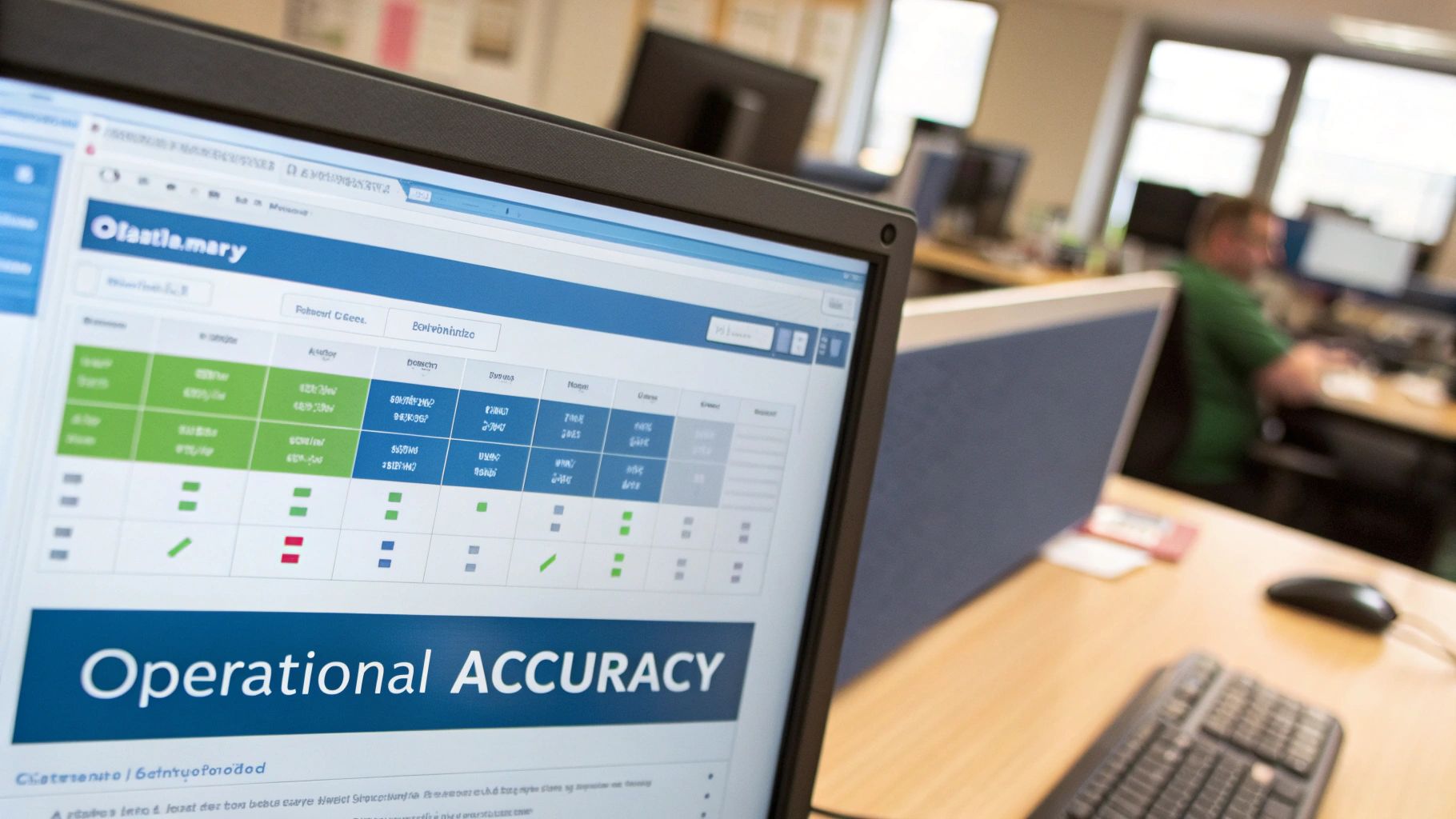
Effective Metro 2 software is more than a data pipeline; it is an active governance system designed to enforce accuracy and drive operational efficiency. For bank executives, selecting software with the right features distinguishes a compliance burden from a strategic asset. The primary function is to identify and correct errors before they are transmitted to credit bureaus. This proactive validation is the single most effective defense against costly disputes and regulatory examinations.
Building a Foundation of Data Integrity
At a minimum, your software must perform intelligent, automated validation against the official Metro 2 format. This extends beyond syntax to logical consistency. For example, the system must instantly flag an account where the "Date of First Delinquency" precedes the "Account Open Date"—a common error nearly impossible to detect through manual spot-checks.
These non-negotiable features are the bedrock of data integrity:
- Automated Validation Rules: The software must maintain an up-to-date library of rules reflecting the latest CDIA guidelines to prevent common errors from leaving the institution.
- Airtight Audit Trails: Every change, submission, and user action must be logged, creating an immutable record for regulatory examinations and internal audits.
- Flexible Field Management: The system must accommodate the full spectrum of your products, from standard mortgages to complex commercial lines of credit with unique reporting requirements.
Consider the nuance of Special Comment Codes. Following a natural disaster, correctly flagging affected accounts with forbearance (Code AW) can prevent thousands of customers from being inaccurately reported as delinquent. This single software capability protects both the consumer's credit and the bank's reputation.
From Compliance to Competitive Insight
Mastering these features does more than ensure compliance—it creates a foundation of clean, reliable data. High-quality data is the prerequisite for effective analytics; without it, strategic tools operate on flawed inputs. Optimizing your bank's processes with the right tools is a critical component of financial data quality management.
Imagine a bank with 250,000 consumer accounts. A system that automates validation for 99.9% of those records reduces the manual review workload to just 250 accounts. This represents a massive efficiency gain, freeing expert staff to focus on strategy rather than data remediation.
Ultimately, the goal is for this pristine Metro 2 data to feed directly into the bank’s business intelligence ecosystem. With clean, structured reporting data, a platform like Visbanking can deliver precise peer benchmarks on portfolio health, delinquency rates, and risk concentrations. A compliance function is thus transformed into a source of powerful competitive insight.
The Financial Impact of Reporting Accuracy
For any bank executive, the essential question is return on investment. The case for superior Metro 2 reporting is not about satisfying a compliance mandate; it is about delivering a direct, measurable impact on the bottom line. Inaccurate data creates operational friction—spurring customer disputes, requiring manual intervention, and attracting regulatory scrutiny. Each outcome carries a real cost that erodes profitability.
Quantifying the Cost of Errors
Let's ground this in financial reality. For a community bank with a $500 million consumer loan portfolio, a 1.5% reporting error rate is a significant financial drag. This seemingly small percentage translates to thousands of flawed accounts requiring investigation and remediation.
Now, consider the impact of implementing top-tier metro 2 software and tightening internal processes to drive that error rate down to 0.1%. The financial picture changes dramatically. The following table provides a direct cost comparison for a bank with a $500 million portfolio.
Cost Analysis of Reporting Error Rates ($500 Million Portfolio)
| Metric | High Error Rate (1.5%) | Low Error Rate (0.1%) | Annual Financial Impact |
|---|---|---|---|
| Incorrect Accounts | 7,500 | 500 | 7,000 fewer problem accounts |
| Est. Dispute Resolution Cost | $150,000 | $10,000 | $140,000 saved annually |
| Est. Manual Correction Hours | 2,500 hours | 167 hours | 2,333 fewer staff hours |
| Regulatory Fine Risk | Moderate to High | Low | Reduced exposure to fines |
The difference is not trivial; the cost of inaction is a continuous, unnecessary drain on resources.
For a bank of this size, reducing reporting errors from 1.5% to 0.1% can yield annual cost savings of $250,000 or more. This calculation includes reduced dispute resolution costs, fewer labor hours for manual corrections, and a lower probability of incurring substantial regulatory fines.
The ROI for investing in a best-in-class data reporting solution becomes unequivocally clear.
The Strategic Returns of Data Fidelity
The benefits extend beyond direct cost savings. The strategic advantages of pristine credit data are even more significant. High-quality, reliable data is the foundation for sound decision-making across the institution. Clean reporting data enables more accurate loan pricing models, ensuring risk is appropriately compensated. It also builds customer trust, a priceless asset that solidifies loyalty.
This high-fidelity data becomes a powerful strategic tool when fed into an intelligence platform like Visbanking. It allows you to benchmark your portfolio’s performance against peers with absolute confidence, knowing your own data is unimpeachable. We invite you to explore our platform and see how accurate data unlocks the sharp, actionable insights your bank needs to compete.
How to Select the Right Metro 2 Solution
Choosing a Metro 2 software provider is a significant capital and strategic decision. This is not another line item in the IT budget; it is a foundational component of the bank's data governance framework that will impact operations and regulatory standing for years. You are not just buying a tool—you are entering a long-term partnership. The vendor’s expertise, support responsiveness, and technology roadmap will directly influence your ability to navigate an evolving compliance landscape.
Core Evaluation Criteria for Bank Leadership
Vetting potential Metro 2 software providers comes down to three pillars that distinguish adequate solutions from those that deliver a true strategic advantage.
Scalability for Growth: Your reporting requirements will only increase. Can the solution handle a 50% growth in your loan portfolio over the next five years without performance degradation? Demand clear answers from vendors on their architecture's capacity to manage increased data volume and transactional complexity as your bank expands.
Seamless Core Integration: The software must integrate flawlessly with your core banking system. A disjointed system creates manual workarounds, data entry errors, and significant operational drag. Insist on a live demonstration of API capabilities and a detailed integration plan before entering into any agreement.
Expert Vendor Support: When a reporting issue arises, you need an expert, not a generic helpdesk. Investigate the vendor’s support structure, service-level agreements, and the specific compliance expertise of their team. This is your operational safety net.
Vetting Implementation and Long-Term Viability
Beyond software features, scrutinize the vendor's implementation methodology. A structured plan that includes detailed data mapping, rigorous testing in a sandboxed environment, and comprehensive staff training is a strong indicator of competence. This minimizes the risk of errors from day one. As part of your due diligence, it is prudent to gain a wider perspective on selecting financial reporting software.
A key consideration is the vendor's position in the broader market. The global market for vertical software—which includes specialized tools like Metro 2®—is projected to grow from USD 169 billion to nearly USD 549 billion by 2035. This massive expansion reflects a clear trend toward quality and specialization. You can learn more about this expanding market and its implications.
Partnering with a provider who has a proven track record in this niche ensures they have the resources to keep their software current with evolving regulations.
Ultimately, the objective is a system that produces data you can trust implicitly. That clean, reliable data is the fuel for advanced analytics platforms like Visbanking. When your foundational reporting is flawless, you enhance your ability to benchmark performance and identify competitive opportunities.
Explore our platform to see how accurate data drives decisive action.
Turning Compliance Data into Competitive Intelligence
For too long, bank leadership has viewed regulatory reporting as a cost center—a defensive necessity. This perspective overlooks a significant opportunity. The high-quality, standardized data produced for Metro 2 compliance is one of your bank's most valuable and underutilized assets. This clean, structured data is the ideal fuel for genuine business intelligence. A deeper understanding of competitive intelligence can reframe this function, transforming a reactive requirement into a proactive source of strategic insight.
From Regulatory Burden to Strategic Advantage
By feeding this reliable compliance data into an intelligence platform like Visbanking, you unlock a new dimension of analysis. The standardized nature of Metro 2 reporting allows for incredibly precise benchmarking of key performance indicators against your peers.
For example, your bank’s delinquency rate on its $300 million auto loan portfolio is 0.85%. In isolation, this metric is meaningless. Is it strong or weak performance? When benchmarked against a curated peer group, however, you discover their average is 0.60%. Suddenly, that 25-basis-point gap is no longer just a number. It is an actionable signal to investigate underwriting standards, collections strategies, or geographic risk concentration. You have just converted compliance data into strategy.
This concept map illustrates the three pillars—scalability, integration, and support—that are critical for selecting the right software solution.
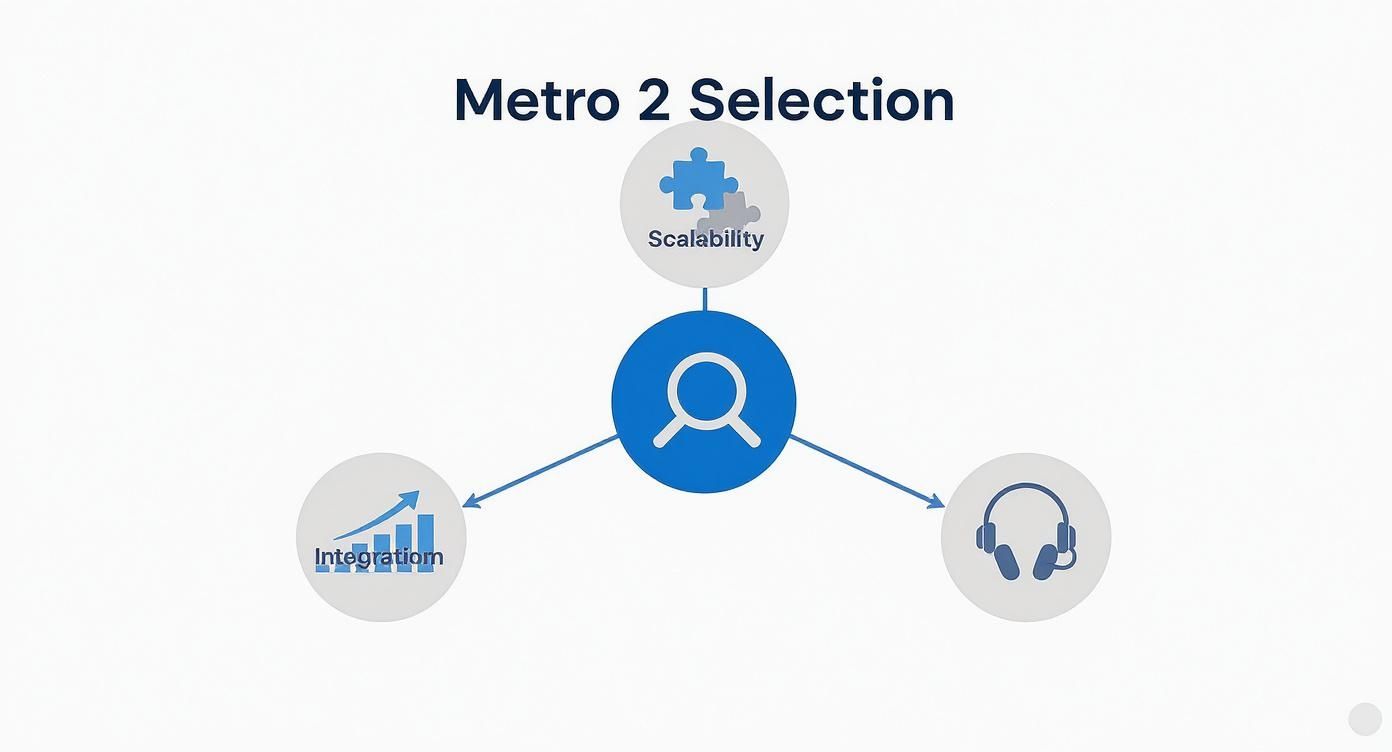
Selecting a solution that excels in these three areas ensures your data asset remains robust and reliable as your bank grows.
The core principle is simple: your bank is already producing this data to meet regulatory demands. The strategic imperative is to leverage it, transforming a sunk cost into a competitive advantage that drives superior risk management and intelligent growth.
This is the essence of modern, data-driven banking. It is about moving beyond dashboards to make decisive, informed moves. Your Metro 2 software is not the finish line; it is the launchpad.
Ready to see how your portfolio truly performs against the competition? Explore Visbanking's platform and start turning your compliance data into your next competitive advantage.
Metro 2 Software: Your Questions Answered
As a bank executive, your focus is on strategy, not the minutiae of data entry. However, a firm grasp of the principles behind your data reporting is essential. Here are direct answers to common board-level questions.
How Often Should We Review Our Metro 2 Software Vendor?
A formal review of your Metro 2 software and vendor relationship should be conducted at least every two years, or whenever a significant regulatory change occurs. This is a strategic assessment, not a technical one. Is the software keeping pace with the bank's growth? Can it handle the increasing complexity of your portfolio? For instance, post-acquisition, your system must seamlessly integrate a new portfolio. A biennial review ensures your technology is an enabler, not a constraint.
What Is the Board's Role in Metro 2 Oversight?
The board's role is governance, not operations. Directors are responsible for ensuring a robust governance framework for all data furnishing activities is in place and effective. This means verifying that management has implemented appropriate Metro 2 software, established clear policies, and demonstrated a consistent record of FCRA compliance. The board should expect and receive regular reporting on key metrics such as dispute rates and data accuracy trends.
A director's most powerful tool is the right question. For example: "What is our current credit reporting error rate, how does it compare to our defined peer group, and what is the estimated financial impact of those errors on our bottom line?"
How Does Metro 2 Data Impact Lending Strategy?
The accuracy of your Metro 2 data is the bedrock of strategic lending decisions. Flawed reporting data leads to unreliable risk models and skewed portfolio analysis. You cannot effectively manage risk that you cannot accurately measure.
Conversely, high-fidelity data is a competitive weapon. It enables confident benchmarking of your performance. Imagine discovering that your auto loan delinquency rate is 30 basis points higher than your peer group average. That is not just a data point; it is a powerful signal. This single insight, derived from trustworthy data, can trigger a strategic review of underwriting criteria or collections processes, directly shaping a more profitable lending strategy.
At Visbanking, we empower institutions to convert high-quality compliance data into a competitive advantage. Our intelligence platform provides the tools to benchmark performance with precision, transforming data reporting from a regulatory necessity into a driver of smarter, faster decisions. See how you can move from dashboards to decisive action.
Related Articles

Visbanking Blog
Unveiling the US Banks Credit Quality Chart on VisBanking Report Portal

Visbanking Blog
Transforming Credit Unions: Visbanking's Data Revolution

Visbanking Blog
Credit Union vs Bank: The $2 Trillion Member Advantage

Visbanking Blog
FDIC Call Reports: The Banking Data Goldmine Explained

Visbanking Blog
Bank Comparison Tools: Find Your Perfect Financial Match

Visbanking Blog