
A Strategic Guide to Corporate Banking Lead Generation Software
Brian's Banking Blog
For decades, corporate banking operated on a reliable playbook: personal networks, industry events, and a solid reputation. That was sufficient. In today's environment of compressed margins and relentless competition, that playbook is now dangerously obsolete.
Enter corporate banking lead generation software. This is not just another tool; it is the new foundation for identifying, qualifying, and winning high-value clients at scale. This is not about incremental technological adoption; it is a strategic imperative for market leadership.
Why Data-Driven Growth Is The New Mandate
Relying solely on relationships means you are consistently the last to know about an opportunity. While your team awaits a referral, your competitors are already analyzing market intelligence to pinpoint companies exhibiting clear signals of needing new banking services—long before any public announcement.
The mandate for today's banking leaders is unequivocal: data intelligence must be woven into the fabric of your client acquisition strategy. The objective is a fundamental shift from reactive engagement to proactive, targeted acquisition, replacing intuition with empirical data that signals a company's next strategic move.

From Relationship Management to Intelligence-Led Acquisition
The most effective lead generation platforms function as a digital intelligence unit for your business development teams. They deliver the specific, actionable intelligence required to preempt the competition by flagging critical growth triggers. The core purpose is to focus your most valuable asset—your relationship managers' time—on opportunities with the highest probability of closing.
Consider this practical comparison:
- The Old Way: A relationship manager learns from a contact that a mid-market manufacturer, Company X, is seeking a new line of credit. By the time this information is received, half a dozen other banks are already preparing proposals.
- The Data-Driven Way: An advanced intelligence platform flags that Company X recently filed UCC liens for $2.5 million in new heavy machinery. It also correlates this with their recent hiring of a CFO known for executing capital expansion strategies. This insight allows your bank to proactively engage with a tailored equipment financing and treasury management package three months before the company formalizes its capital search.
This is the competitive differentiator. While others react to news, your team acts on predictive insights.
The real power is not in the software itself, but in the quality of the intelligence it provides. The banks that win are those that master the art of interpreting market signals and acting decisively, converting raw data into tangible market share.
Adopting this data-first methodology transforms your growth strategy from an art into a science. You gain the ability to map your total addressable market, identify underserved industries, and allocate resources with precision for maximum impact.
To move forward, a comprehensive understanding of analytics for banking is the logical next step. Begin by benchmarking your institution's performance against your peers and discover how market data can become the engine that drives your bank's growth.
What Constitutes a Modern Lead Generation Engine for Corporate Banking?
Let us be precise: a "lead generation engine" in the context of corporate finance is not a glorified sales CRM. A CRM is an essential tool for managing the relationships you already have. A true lead generation engine, conversely, is a purpose-built client acquisition platform, engineered for the long, complex process that defines corporate banking.
This is not passive contact management. It is a proactive intelligence system designed to identify and interpret critical buying signals. It synthesizes disparate, high-value data streams—regulatory filings, market shifts, executive changes, and digital intent—into a single, actionable source of truth.
The analogy is simple: you can cast a wide, inefficient net, or you can deploy a high-tech sonar system. The net catches everything, leaving your team to sort through a sea of unqualified prospects. The sonar, however, pinpoints the most valuable opportunities moving beneath the surface, allowing you to focus your efforts with absolute precision.
From Static Lists to Dynamic Triggers
Traditional prospecting relied on static lists and high-volume, low-probability outreach. A modern engine inverts this model. It operates on dynamic, real-time triggers that signal an imminent need for capital. The objective is not merely to find companies within a target industry; it is to know precisely when they need you.
Examine these two scenarios:
The Old Way: A relationship manager is given a list of all manufacturing firms in their territory with revenues over $100 million. They begin a cycle of cold calls, hoping to connect with a company that might need financing within the next year. The process is inefficient, with a predictably low success rate.
The Smart Way: The lead generation engine flags a target manufacturing firm that just filed new UCC-1s for equipment valued at $5 million. Simultaneously, it notes the hiring of a new CFO with a documented history of executing M&A transactions. The combination of these signals provides a strong, data-backed indicator of an upcoming need for either capex financing or M&A advisory services.
This transforms the engagement. Your team is no longer making a low-probability cold call; they are initiating a timely, well-informed, and strategic conversation. Guesswork is replaced by intelligence-driven action.
Synthesizing Intelligence Into Action
At its core, corporate banking lead generation software is about converting raw, unstructured information into qualified, actionable opportunities. It achieves this by connecting data points that were previously isolated in disparate silos, making correlation impossible.
A modern lead generation engine is less a software tool and more a strategic capability. It provides the foresight to engage a potential client not when they are actively seeking a bank, but at the precise moment they begin to recognize a problem a bank can solve.
For instance, a platform like Visbanking can identify a privately-held company that is rapidly winning government contracts and expanding its operational footprint. This company may not be actively shopping for a new credit facility, but the data indicates they will outgrow their current banking relationship within the next 6 to 12 months. That is your window of opportunity to initiate a strategic dialogue.
This data-first approach provides a significant competitive advantage. For banking leaders committed to building a more predictable and scalable growth engine, investing in advanced bank prospecting software is no longer discretionary—it is a strategic necessity. When you understand the data's story, you empower your relationship managers to act with conviction, armed with insights your competitors lack. The objective is to benchmark your current position and discover how a data-driven engine can redefine your market standing.
The Core Capabilities That Drive Measurable ROI
When evaluating corporate banking lead generation software, it is easy to become overwhelmed by feature lists. For bank executives, however, the only relevant question is how those features translate into measurable business outcomes: higher-quality leads, compressed sales cycles, and a clear, positive impact on the bottom line. The focus must shift from "What does it do?" to "What does it do for us?"
This perspective is paramount. The market for B2B lead generation software—the engine room for corporate banking client acquisition—is projected to grow from $6.78 billion in 2025 to $15 billion by 2035. This is not a fleeting trend; it is a fundamental transformation in how banks will compete for and win new business. You can review the B2B lead generation software market's growth projections to grasp the scale of this shift.
Let's cut through the noise and concentrate on the core capabilities that directly impact performance.
Predictive Lead Scoring
Effective lead generation is an exercise in focus. Predictive lead scoring is the technology that enables this. It employs AI to analyze vast datasets—from UCC filings and loan activity to recent executive hires—to score and rank prospects based on their probability of conversion.
Consider this: your team has a list of 500 potential corporate clients. Instead of initiating 500 cold outreach attempts, the system identifies the top 10% and indicates they have a 75% or higher probability of requiring new financing in the next six months. This transforms your relationship managers' efforts from a volume-based numbers game into a series of strategic strikes, allowing them to concentrate their expertise where it will have the greatest impact.
Intent Data Monitoring
The decisive advantage is gained when you understand a company's needs before they issue an RFP. This is the power of intent data monitoring. It functions as a listening post for the entire market, detecting the digital "breadcrumbs" that signal active interest.
A practical example:
- The Signal: Your platform issues an alert. Three senior finance executives at a target manufacturing firm have been researching international cash management solutions online.
- The Action: Your relationship manager does not wait. They initiate contact with a tailored conversation about optimizing global treasury operations.
- The Result: You are engaged weeks, often months, before your competitors are even aware an opportunity exists. You are not merely responding to a need; you are shaping the solution around your bank's specific strengths.
This is the essence of building true market intelligence.
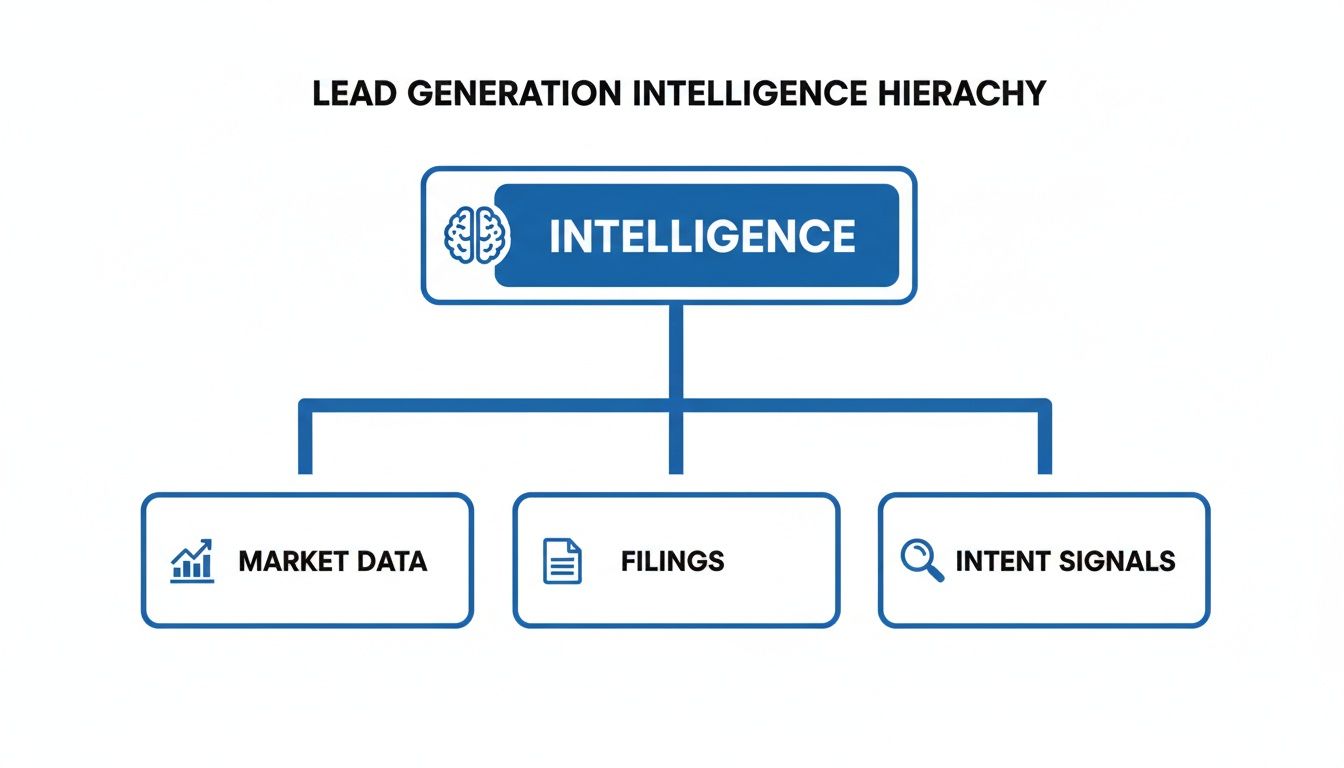
It is not about a single data source. It is about synthesizing market data, public filings, and subtle intent signals to create a complete, actionable view of an opportunity.
To connect these capabilities to performance, here is a breakdown of how essential software features directly impact your bank's bottom line.
Essential Software Capabilities and Their Business Impact
| Core Capability | Description | Direct Business Impact (Example) |
|---|---|---|
| Predictive Lead Scoring | Uses AI to rank prospects by their likelihood to need banking services, based on financial data, filings, and company activity. | A relationship manager focuses on the top 10% of scored leads, increasing their meeting-to-close ratio by 50% in one quarter. |
| Intent Data Monitoring | Tracks online research and content consumption from target companies to identify early signs of a purchasing need. | Your team engages a prospect researching M&A financing 60 days before they formally seek a lender, becoming the incumbent advisor. |
| CRM Integration | Automatically pushes qualified leads, scores, and all relevant data directly into your bank's existing CRM (e.g., Salesforce). | Eliminates manual data entry, saving each banker an average of 5 hours per week and ensuring lead follow-up is never missed. |
| Automated Nurturing | Delivers pre-scheduled, relevant content (reports, case studies) to warm leads who are not yet ready for a direct conversation. | A prospect receives a timely article on supply chain finance and re-engages, leading to a new $5M credit facility six months later. |
| Analytics & Reporting | Provides dashboards that visualize the entire lead funnel, from initial contact to conversion, including key metrics like CAC. | Leadership identifies that leads from the logistics sector have the lowest CAC and highest LTV, prompting a strategic shift in marketing spend. |
This table is not a list of features; it is a roadmap illustrating how technology translates directly into a more profitable corporate banking division.
Seamless CRM Integration and Nurturing
A powerful lead generation tool must be a natural extension of your team's existing workflow, not another cumbersome application. Deep, seamless CRM integration is therefore non-negotiable. When a high-potential lead is identified, all associated intelligence—the score, intent signals, and contact data—must flow directly into the systems your bankers use daily.
For prospects who are a good fit but not yet ready to engage, the best platforms provide automated nurturing sequences. These systems can deliver a series of relevant industry reports or case studies over time, maintaining top-of-mind awareness without manual intervention.
The ultimate litmus test for any lead generation platform is straightforward: does it lower your Customer Acquisition Cost (CAC) while increasing the lifetime value of the clients you acquire? Every feature must be evaluated against this standard.
Robust Analytics and Reporting
If it cannot be measured, it cannot be improved. Any top-tier platform must deliver clear, transparent analytics that provide a complete view of your client acquisition funnel. Bank directors require dashboards that track vital signs: lead velocity, conversion rates by industry, and the all-important customer acquisition cost for each new relationship.
This is where intelligence platforms like Visbanking become invaluable. By providing granular data on loan activity and market trends, they establish the foundation for accurate, real-world benchmarking. You can assess not only your internal performance but also your position relative to the competition. Defining your true bank customer acquisition cost is the first step toward strategically reducing it. Together, these capabilities create a growth engine that is predictable, scalable, and highly profitable.
How to Select The Right Software Partner For Your Institution
Selecting a software partner for corporate banking lead generation is a strategic decision, not a simple procurement exercise. The right partner becomes an engine for profitable growth; the wrong one results in wasted resources, frustrated relationship managers, and a portfolio of unqualified leads.
The focus must be on the quality of the intelligence underpinning the technology, not on superficial features.
Consider two banks. Bank A adopts a generic lead platform and sees its lead volume increase by 5%. However, their relationship managers soon find that 90% of these leads are unqualified, resulting in wasted time and effort.
Bank B, in contrast, partners with a specialist provider whose platform is built on deep financial data. Their lead volume increases by only 2%, but the quality is exponentially higher. As a result, their deal closure rate for these leads increases by 30%. The lesson is clear: intelligence drives profit, not just activity.
This choice is more critical than ever. The market for this software is projected to grow from $7.4 billion in 2025 to $16.2 billion by 2034. As you can discover more insights about lead generation software market growth, it is evident that banks making informed technology decisions today will secure a dominant market position tomorrow.
Evaluating Data Quality and Financial Acumen
The single most critical evaluation criterion is the data itself. A generic provider may offer basic firmographic data, but for corporate banking, this is merely table stakes. You require a partner with genuine financial sector expertise.
Their platform must be powered by data that is directly relevant to your business: UCC filings, SBA loan histories, commercial real estate transactions, and signals indicating shifts in a company's treasury management needs. This is the data that uncovers real, actionable opportunities.
A partner’s value is not measured by the volume of their data, but by their ability to synthesize that data into forward-looking intelligence that provides your bankers with a competitive edge.
When vetting potential partners, move beyond the standard demonstration. Ask pointed questions. What are your data sources? What is your data refresh frequency? Most importantly, how do you connect disparate data points to identify a qualified opportunity? This is where a platform like Visbanking excels, by integrating financial, regulatory, and market data into a cohesive, actionable picture.
Assessing Security, Compliance, and Integration
For any financial institution, security and compliance are non-negotiable. Your partner must meet and exceed industry standards for data protection. Conduct thorough due diligence in this area.
- Security Protocols: How is data encrypted, both in transit and at rest?
- Compliance Certifications: Can they provide documentation of adherence to all relevant financial regulations and data privacy laws?
- Integration Capability: Will this software integrate seamlessly with your existing CRM and core banking systems, or will it create another data silo?
A cumbersome integration can derail user adoption from the start. The software should function as an intelligent enhancement to the tools your relationship managers already use daily, not an additional administrative burden. The objective is to make their jobs more effective, not more complicated.
By prioritizing data quality, financial expertise, and robust security, you will identify a partner that delivers a true competitive advantage, not just a list of names.
Implementing Your Strategy: From Pilot to Enterprise Rollout

The successful deployment of new lead generation software is a matter of disciplined, strategic execution, not a large-scale, simultaneous launch. The primary cause of new technology failure is poor user adoption, often because the rollout is disconnected from the daily realities of a relationship manager.
Initiating with a focused pilot program is the most prudent approach. It validates the software’s value on a manageable scale, cultivates internal champions, and builds an undeniable business case for an enterprise-wide deployment. The key is to avoid an overly ambitious scope. Instead, select one high-performing team or a specific industry vertical with significant growth potential. This creates a controlled environment for measurement and rapid feedback, ensuring the software delivers tangible results quickly.
Designing a Pilot Program That Delivers Results
A successful pilot program is founded on clear, measurable objectives. Vague targets like "improve lead generation" are insufficient. Success must be defined by metrics that will withstand scrutiny at the executive level.
For example, if your pilot focuses on the logistics sector, a well-defined goal would be to increase qualified, actionable leads for asset-based lending by 25% within six months. This level of specificity transforms a technology trial into a strategic business initiative. Before committing to a full pilot, many institutions conduct a smaller-scale evaluation; understanding the principles of a proof of concept in fintech can significantly de-risk the entire process.
The essential components of an effective pilot include:
- Targeted Scope: Select a single team or vertical where you possess an existing advantage or see a significant opportunity. This ensures clean data and clear attribution of results.
- Success Metrics: Define your Key Performance Indicators (KPIs) upfront. Examples include lead-to-meeting conversion rates, time saved on manual prospecting, or the dollar value of the new pipeline generated.
- Executive Sponsorship: Secure a senior leader to champion the pilot. Their endorsement signals that this is a strategic priority and helps overcome internal resistance.
Ensuring Seamless Integration and Training
For your relationship managers, any tool that disrupts their workflow is a liability, not an asset. The software must integrate directly into your existing CRM. True value is realized when actionable intelligence—such as a prospect’s recent UCC filing or a surge in strategic hiring—is surfaced directly within the systems they already use daily.
Training must be equally pragmatic. Avoid generic feature overviews. Focus exclusively on how the software makes their job more effective and helps them close more business. Demonstrate precisely how it delivers a pre-qualified opportunity, complete with the specific talking points needed to initiate a compelling conversation. When bankers see the platform directly contributing to their pipeline and compensation, adoption becomes a non-issue.
The true measure of a pilot's success is not just the number of new leads generated, but the number of internal advocates it creates. When your top performers begin evangelizing how the software helps them win, the case for a full rollout becomes self-evident.
Benchmarking and Building the Business Case
Throughout the pilot, your performance data is your most valuable asset. This is where market intelligence platforms become a strategic weapon. Use the data from your pilot to benchmark your team's performance against direct competitors.
Imagine discovering that your pilot team’s customer acquisition cost (CAC) decreased by 15%. Using a platform like Visbanking, you then see that your primary rival's CAC remains 20% higher than your own. This is the type of empirical evidence that justifies a broader investment.
It is no surprise that the global lead generation outsourcing market, which underpins many of these strategies, was valued at $9,093.9 million in 2024 and is projected to reach $15,949.3 million by 2030.
By demonstrating a clear, data-backed ROI in a controlled setting, you eliminate speculation. You can present a business case to the board that not only shows how the software functions, but proves how it will drive measurable market share gains across the entire institution.
The Future of Client Acquisition Is Data Intelligence
Discussions about lead generation software in corporate banking often get mired in feature comparisons. This misses the central point: the decisive factor is not the platform itself, but the quality of the intelligence that fuels it. The software is the vehicle; the data is the high-octane fuel that wins the race.
The banks that will outperform their peers are those that become adept at interpreting—and acting upon—the signals this technology uncovers. This represents a fundamental shift from a reactive to a predictive posture. This is not a new gadget for your relationship managers; it is a complete re-architecting of your competitive strategy.
Turning Data Points into Deals
Let us translate this into a concrete example. A mid-market manufacturing company has quietly increased its UCC filings for new equipment by 40% over the past six months. Concurrently, they hire a new supply chain director with a documented track record of global expansion. A basic platform registers two disconnected facts. An intelligence engine identifies a clear and compelling opportunity.
This is an unmistakable signal that the company is preparing for a significant operational expansion—one that will likely require trade finance, treasury management services, or an expanded credit facility.
The critical capability is connecting these seemingly disparate data points into a coherent narrative of opportunity. That is the point at which data transitions from a static report into a set of revenue-generating instructions for your team.
This completely alters the operational dynamic. Instead of your team asking, "Who should we cold call today?" they can ask with confidence, "Which three companies in our territory are most likely to require a $20 million credit line in the next six months, and what is our strategic entry point?"
This is the future of corporate banking—a discipline won with empirical evidence, not just intuition. The time for theoretical discussion is over. The first step is to move from the hypothetical to the practical. Benchmark your current client acquisition performance against the competition and discover how powerful market data, like that provided by Visbanking, can become the engine for your future growth.
Common Questions from Banking Leaders
When evaluating new technology, practical questions take precedence. Here are some of the most common inquiries we receive from banking executives, with direct and substantive answers.
How is this different from our CRM?
An excellent question. Your CRM is designed to manage the relationships you already have. It is an essential tool for that purpose. This software, however, is engineered exclusively for client acquisition.
It is the engine that identifies new, high-value prospects by analyzing external data—market signals, financial filings, and digital intent. It pinpoints the ideal client before they enter your pipeline.
Your CRM manages the conversation. This software finds you the right entities to converse with in the first place.
What is the typical ROI?
While results vary, the data is compelling. Banks leveraging this level of intelligence typically report a 20-40% reduction in customer acquisition costs by eliminating wasted effort on unqualified leads. They also experience a 15-30% increase in the volume of genuinely qualified opportunities.
The primary value, however, is strategic. Imagine your team identifies a privately-held company requiring a $50 million credit facility three months before any competitor is aware of the need. That single transaction can deliver an immediate and substantial return. The ultimate ROI lies not just in efficiency metrics, but in the market share you capture and the high-value, long-term relationships you build.
How do we ensure our bankers will actually use it?
Adoption is contingent on one factor: making their jobs more effective and their compensation higher. Simply providing another tool is insufficient. It must be positioned as the competitive weapon it is.
The banks that succeed in this follow a consistent strategy:
- Start with a focused pilot program. Onboard your top performers first and allow them to become internal champions for the technology.
- Focus training on their bottom line. Demonstrate exactly how the platform leads to better opportunities, larger deals, and less time wasted on unproductive prospecting.
- Ensure seamless integration. The software must connect directly to the CRM they already use daily. The intelligence should feel like a native part of their existing workflow, not an additional login to manage.
When your relationship managers see the platform delivering actionable, pre-vetted opportunities that directly impact their success, adoption ceases to be a challenge. It becomes the competitive edge they cannot operate without.
At Visbanking, we understand that growth in today's banking landscape is driven by intelligent, actionable data. To see how your institution's performance truly compares to the competition, explore the data-driven insights our platform provides. Begin making better-informed strategic decisions by visiting https://www.visbanking.com.
Related Articles

Visbanking Blog
Banking Data Analytics: Turning Information Into Profit

Visbanking Blog
Fastest Growing Banks: Who's Winning the Asset Race?

Visbanking Blog
Revolutionize Your Banking Operations with Data-Driven Insights from BIAS

Visbanking Blog
Unlocking Growth: A Comprehensive Guide to US Banks Contacts

Visbanking Blog
Exploring Cutting-Edge Technologies Empowering US Banks: A Deep Dive into Visbanking Banking Report Portal

Visbanking Blog